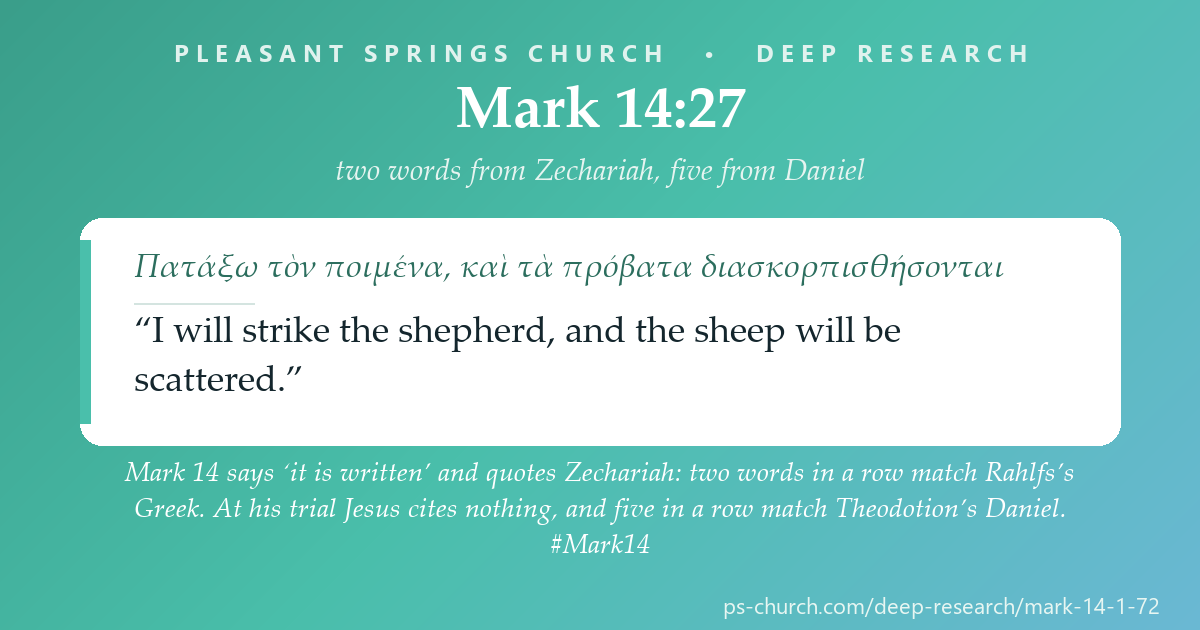
Seventy-two verses, one night. Mark 14 appeals to Scripture three times in so many words and quotes words once — “I will strike the shepherd, and the sheep will be scattered” (14:27). Screened against 30,348 units of the Greek Old Testament, that quotation shares two consecutive words with Zechariah 13:7 in Rahlfs’s Greek, and Zechariah is not even among the units tied at the verse’s own ceiling of three. At the trial, Jesus answers the high priest with no it is written at all — and that sentence shares five with Theodotion’s Daniel 7:13, tie band one, while Matthew’s version of the same answer shares five with the Old Greek instead. The chapter’s deepest run of all is six words about Ammonites running into a city. Where Mark’s Zechariah differs from Rahlfs in number and in syntax, it stands with the Hebrew; in person it stands with neither. See the method →
Mark 14:1–72 — selected verses
Greek NT · ESVVersification. Mark 14 has 72 verses in the SBLGNT and 72 in the English tradition (counted in the KJV on our disk; the ESV verses printed here carry the same numbers), so the chapter itself has no offset. The offsets on this page belong to the Old Testament texts set beside it, and there are four sets: Psalm 40:10 in the Septuagint is Hebrew 41:10 and ESV 41:9; the refrain Psalm 41:6, 41:12 and 42:5 in the Septuagint is Hebrew 42:6, 42:12 and 43:5, ESV 42:5, 42:11 and 43:5; Psalm 109:1 in the Septuagint is Hebrew and ESV 110:1; Jeremiah 38:31 in the Septuagint is Hebrew and ESV 31:31. No offset at Zechariah 9:11 or 13:7, Exodus 24:8, Daniel 7:13, Amos 2:16, Isaiah 50:6, 51:17–23 and 53:12, 1 Chronicles 19:15, 2 Chronicles 29:1, Jeremiah 15:1, Jonah 4:9 or Song of Songs 4:3: the same numbers stand in Hebrew, Greek and English.
The Shape of the Passage
Sequence, with two brackets you can countWho wrote this, to whom, and why does the longest chapter in the shortest Gospel spend seventy-two verses on what is mostly a single night?
Author
The tradition from Papias, preserved in Eusebius (Church History 3.39.15), says: “Mark, having become the interpreter of Peter, wrote down accurately, though not in order, whatsoever he remembered of the things said or done by Christ. For he neither heard the Lord nor followed him, but afterward, as I said, he followed Peter …” We print that last clause because this chapter makes it matter: the young man who runs away naked (14:51–52) has often been read as Mark’s own signature, and Papias, in the sentence after the one that names Mark, says Mark did not follow the Lord. Both readings are reported in Stage 5; neither can be settled from the text.
Mark 14 is the longest chapter in Mark — 72 verses of the Gospel’s 673 — and most of it is one night. A Gospel that usually moves at a run slows here almost to the hour: two days before (14:1), the first day of Unleavened Bread (14:12), evening (14:17), the three comings in the garden (14:41), the two cockcrows (14:72).
Audience
A Gentile-facing church, traditionally Rome, which needed Aramaic glossed (Αββα ὁ πατήρ at 14:36) and a Jewish festival dated for it (14:12). The chapter also speaks to a church that knew what it was to be handed over: παραδίδωμι occurs seven times in Mark 14, and Mark 13:9–12 had already used the same verb of the disciples.
Inside the story, the audience shrinks. The Twelve at the table (14:17); three taken further into the garden (14:33); then ἔφυγον πάντες (14:50), and one more runs away naked. By 14:66 the only follower left in the story is Peter, in a courtyard, and he is saying he does not know the man.
Orient on the festival, the supper, the garden, the council and the denial.
Search by reference and by topic: Passover, Unleavened Bread, Bethany, nard, Judas Iscariot, Last Supper, covenant, Gethsemane, Abba, Sanhedrin, blasphemy, Son of Man, Peter.
Which articles are relevant?
- Dictionary of Jesus and the Gospels (IVP, 2nd ed.) — “Last Supper,” “Passion Narrative,” “Trial of Jesus,” “Gethsemane,” “Judas Iscariot,” “Peter,” “Son of Man,” “Abba.”
- Anchor Bible Dictionary — “Passover and Feast of Unleavened Bread,” “Lord’s Supper,” “Sanhedrin,” “Nard,” “Young Man, Naked.”
- NIDNTTE — διαθήκη, αἷμα, παραδίδωμι, γρηγορέω, σκανδαλίζω, βλασφημία.
- Dictionary of New Testament Background — “Passover,” “Sanhedrin,” “Temple, Jewish,” “Mishnah” (for the trial-procedure question in Stage 5).
Bibliography surfaced:
- Raymond E. Brown, The Death of the Messiah, 2 vols. — Gethsemane to the grave, scene by scene; the standard reference for 14:26–72.
- R. T. France, The Gospel of Mark (NIGTC); Joel Marcus, Mark 8–16 (Anchor Yale); Adela Yarbro Collins, Mark (Hermeneia); Craig Evans, Mark 8:27–16:20 (WBC); William Lane (NICNT).
- Joachim Jeremias, The Eucharistic Words of Jesus; Darrell Bock, Blasphemy and Exaltation in Judaism and the Final Examination of Jesus; Rikki Watts, Isaiah’s New Exodus in Mark.
A festival, a jar of perfume worth a year's wages, a garden called oil-press, and a court that met at night.
Set each element beside its neighbours in Israel’s scriptures and the Second-Temple world, and say which neighbours are read here and which are only reported.
Which parallels shed light on religion and worldview?
The festival. Exodus 12 (see the Exodus 12 page) sets the lamb on the fourteenth day at evening and the unleavened bread for seven days after; Mark joins the two names in one breath (14:1) and dates the meal by the slaughter of the lamb (14:12). Reported, not checked here: Josephus counts the Passover victims of one year in the hundreds of thousands (Jewish War 6.422–427), which is what a city crowded for the feast meant to the authorities who wanted to avoid θόρυβος τοῦ λαοῦ (14:2).
The perfume. μύρου νάρδου πιστικῆς stands in two New Testament verses, this and John 12:3. Mark prices it at more than three hundred denarii (14:5); Matthew 20:2 makes one denarius a day’s wage, so the jar is about a labourer’s year. Reported: Pliny, Natural History 12.42–43, on nard as an imported luxury. In the screened Greek Old Testament the nard is in the Song of Songs (1:12; 4:13, 14) and nowhere else.
The garden. Gethsemane is usually explained from Aramaic as “oil-press” (reported; no Aramaic corpus was searched for this page). The night of watching has an Old Testament background the Gospel does not cite: Exodus 12:42 calls Passover a night of watching for the LORD.
The court. Reported, and later than Mark: the Mishnah (tractate Sanhedrin 4:1) requires capital cases to be tried by day and not on the eve of a festival, and (7:5) describes the judges tearing their garments at blasphemy. The Mishnah was compiled around AD 200, and whether its rules bound a first-century council is disputed; Stage 5 lists it as a crux rather than using it as a stick.
A Passover night is a night of remembering a rescue. Mark tells this one as a night of forgetting: the disciples sleep through the watching, all of them run, and Peter swears he does not know the man — until ἀνεμνήσθη ὁ Πέτρος τὸ ῥῆμα, and the chapter ends on the one man who remembers.
A covenant Mark names once, a verb he uses seven times in one chapter, and a 'twice' that only he sets beside the cock.
Counts are lemma counts from the MorphGNT columns of the SBLGNT held here (7,927 verses), one entry per occurrence. Greek Old Testament counts are over the 30,348 CATSS units screened here; where the Odes appendix (289 more units, 30,637 held in all) would change a zero, the held figure is given too. A negative is a negative on that corpus.
Once in Mark. Mark’s only covenant is in the cup word (τὸ αἷμά μου τῆς διαθήκης). And Mark’s only other uses of αἷμα are 5:25 and 5:29, the woman with the flow of blood (Mark 5–7 page).
Three occurrences in Mark, all in 14:3–5. The jar is broken, not uncapped: συντρίβω.
Five occurrences in Mark, every one of them in this chapter (14:1, 12 twice, 14, 16).
Seven times in Mark 14 (vv.10, 11, 18, 21, 41, 42, 44) of Mark’s 20. The ESV renders it betray at 14:18; it is the same verb used of John (1:14) and of the disciples (13:9).
Six times in Mark, in two clusters of three: 13:34, 35, 37 and 14:34, 37, 38. The command that closes chapter 13 fails in the garden.
Eight times in Mark; four of them in 14:37–41. The other four are the sower’s night (4:27), the boat in the storm (4:38), Jairus’s daughter (5:39) and the doorkeeper warning (13:36).
Three New Testament verses, Mark 14:36; Romans 8:15; Galatians 4:6, and in all three it is followed by ὁ πατήρ. Searched unanchored in the Greek Old Testament, the letters stand in 159 word occurrences, and 158 of them are other words (sabbath, Rabbah and the like). See Stage 4.
Mark uses it twice: here, and at 6:26 of Herod, περίλυπος γενόμενος ὁ βασιλεὺς, before the Baptist’s execution. The Greek Old Testament has the word in eight units, always in this one form.
Six New Testament verses; Mark has two, 14:30 and 14:72, and they are the only two with a cock. Mark’s ἀλέκτωρ occurs four times, all in this chapter.
Four times in Mark: 14:30, 31, 72 — and 8:34, ἀπαρνησάσθω ἑαυτὸν. The only other use of this verb in Mark is a denial of oneself. Peter’s actual denials in the courtyard (14:68, 70) use the simple verb ἀρνέομαι, which Mark uses nowhere else.
Four times in Mark: twice of the young man (14:51, 52) and twice of the burial cloth (15:46). νεανίσκος and περιβάλλω are each used twice by Mark, here and 16:5, the young man at the tomb περιβεβλημένον στολὴν λευκήν.
What the word counts show
Mark keeps his covenant word for one sentence. τὸ αἷμά μου τῆς διαθήκης is the only covenant in the Gospel and one of three uses of blood; the other two are the woman whose bleeding stopped when she touched his clothes. A reader of Mark meets blood twice as something that is healed before meeting it once as something poured out.
The vocabulary of failure is concentrated, and it has a reverse image. The three stay awake commands of Gethsemane answer the three of 13:34–37; the four sleep verbs of 14:37–41 answer the doorkeeper’s warning of 13:36. And Peter’s future-tense disown (14:30, 31, 72) is the verb of 8:34: the denial Jesus asked for was of oneself.
Mark uses νεανίσκος twice and περιβάλλω twice, and both pairs are 14:51 and 16:5: a young man wrapped in a linen cloth who runs from the arrest, and a young man wrapped in a white robe who sits in the tomb. The linen word itself comes back once more, for the cloth Jesus is buried in (15:46). That is a measured pattern of shared words. It is not a measured identification, and Stage 5 reports the readings without choosing one.
One quotation, four allusions everyone prints, and a trial answer with no formula that out-measures them all.
Method: each verse of Mark 14 was screened for its longest run of consecutive shared word forms against the CATSS Greek Old Testament — 30,348 verse units screened, 30,637 held (the 289 units of the Odes appendix are held but not screened, by house convention) — with the shelf’s frozen normaliser and the cross-edition spelling fold. Every Greek Old Testament text is Rahlfs as digitised by CATSS: one text per book, except Daniel (with Susanna and Bel), where both the Old Greek and Theodotion are held, and Joshua, Judges and Tobit, each held in two text forms. The tie band is the number of units reaching the same depth, printed every time. A run of one means the verse shares single word forms but no two in a row; it does not mean the verse shares no word.
What the screen returned
The distribution first. Of the 72 verses: 71 reach two, 55 reach three, 13 reach four, three reach five, one reaches six, and nothing reaches seven. One verse, 14:51, shares no two consecutive word forms with any unit at all. The Mark 13 page reported this chapter’s ceiling as six; we reproduce it.
| Mark 14 | Old Testament text named | pair run | the verse’s ceiling (band) | what stops the run |
|---|---|---|---|---|
| 14:27 strike the shepherd it is written | Zechariah 13:7 (Rahlfs) | 2 | 3 (15) | verb, number and object all differ; only τὰ πρόβατα runs |
| 14:62 the Son of Man no formula | Daniel 7:13, Theodotion | 5 | 5 (1) | this is the ceiling: no other unit reaches five |
| Daniel 7:13, Old Greek | 4 | one preposition | ||
| Psalm 109:1 (ESV 110:1) | 2 | word order and the form of the verb | ||
| 14:18 one who eats with me | Psalm 40:10 (ESV 41:9) | 2 | 2 (1,277) | with me where the psalm has my bread |
| 14:24 blood of the covenant | Exodus 24:8 | 2 | 3 (120) | μου inside the phrase |
| Zechariah 9:11 | 1 | different case of blood | ||
| Jeremiah 38:31 (ESV 31:31) | 1 | Mark has no new | ||
| 14:34 my soul is very sorrowful | Psalm 41:6, 12; 42:5 (ESV 42:5, 11; 43:5) | 1 | 4 (1) | the psalm addresses the soul; Mark speaks about it |
| 14:52 fled naked | Amos 2:16 (Rahlfs) | 1 | 2 (326) | Rahlfs has will pursue, not will flee |
| 14:65 spitting and slaps | Isaiah 50:6 | 1 | 3 (5) | same word families, different forms |
Read the first two rows together; they are the finding. Mark 14 appeals to Scripture three times in so many words — καθὼς γέγραπται περὶ αὐτοῦ (14:21), γέγραπται (14:27), ἵνα πληρωθῶσιν αἱ γραφαί (14:49) — and only once does it go on to quote words. Those words share two with Zechariah 13:7 as the Septuagint on our disk has it, and the verse’s own ceiling of three is reached by fifteen units, 12 of them through and the sheep and three through and he says to them. Zechariah is not in the band. Meanwhile the one sentence in the chapter that names no text at all, the answer to the high priest, reaches five, band one. Only two other verses of the chapter reach five or more, and both partners are accidents: 14:16 (1 Chronicles 19:15, six) and 14:53 (2 Kings 10:5, which the Greek calls 4 Kingdoms: five, and the elders and the).
Which is the limit of the method, in its sharpest form. Nobody doubts that 14:27 is Zechariah; Mark says so. The measurement says two. The screen finds verbatim contact with the Greek on our disk; it does not find quotation, and it does not find allusion.
Zechariah 13:7 — where Mark is closer to the Hebrew, scoped to Rahlfs
Zechariah 13:7 (no offset) · Mark 14:27
MT · LXX · ESVSet the three side by side, clause for clause — the Hebrew הַךְ אֶת־הָרֹעֶה וּתְפוּצֶיןָ הַצֹּאן, Rahlfs πατάξατε τοὺς ποιμένας καὶ ἐκσπάσατε τὰ πρόβατα, Mark Πατάξω τὸν ποιμένα, καὶ τὰ πρόβατα διασκορπισθήσονται:
- The verb. The Hebrew is a singular imperative, strike. Rahlfs has a plural imperative. Mark has a first-person future, I will strike. In number Mark stands with the Hebrew (singular); in person Rahlfs stands with the Hebrew (both are imperatives) and Mark stands with neither. The verb itself is the same in Rahlfs and Mark, πατάσσω.
- The shepherd. The Hebrew has one shepherd. Rahlfs has the shepherds — the plural stands three times in this verse — and Mark has τὸν ποιμένα, singular, with the Hebrew. With the article, that singular accusative stands in one screened Greek Old Testament unit, Isaiah 63:11 (without the article, ποιμένα stands in four: Ezekiel 34:23, Isaiah 63:11, Jeremiah 28:23 (Hebrew and ESV 51:23) and Zechariah 11:16, but not 13:7), where God is remembered as the one who brought up τὸν ποιμένα τῶν προβάτων, the shepherd of the sheep.
- The sheep. In the Hebrew the flock is the subject of a verb of scattering (וּתְפוּצֶיןָ הַצֹּאן); in Mark the sheep are the subject of a passive, will be scattered. Rahlfs has a second plural imperative with the sheep as its object, ἐκσπάσατε τὰ πρόβατα, draw out the sheep. On syntax, Mark is with the Hebrew. Mark’s form διασκορπισθήσονται stands in four Greek Old Testament units (Jeremiah 27:37 (Hebrew and ESV 50:37), Psalm 58:16 (Hebrew 59:16, ESV 59:15), Psalm 91:10 (Hebrew 92:10, ESV 92:9), Tobit 14:4 (Sinaiticus text)), none of them Zechariah; the ἐκσπάσατε family occurs 21 times in the Greek Old Testament and never in the New.
- Other Greek witnesses are not held. We have one Greek Zechariah, the CATSS text of Rahlfs. Commentators report Greek manuscripts of Zechariah 13:7 whose wording stands closer to the Gospels’ (Codex Alexandrinus is the one usually named); none is on this disk, so this page neither prints that wording nor measures it. Every statement above is about Rahlfs, and none says which Greek, if any, Mark read.
Where Rahlfs has two plural imperatives, πατάξατε τοὺς ποιμένας καὶ ἐκσπάσατε τὰ πρόβατα, Mark has a singular shepherd and sheep that are scattered rather than drawn out, as the Hebrew does, and a speaker — I — whom neither the Hebrew nor Rahlfs has in that clause. Matthew 26:31 agrees with Mark in all three respects and has, besides, τῆς ποίμνης at the end; it too measures 2 against Rahlfs. That is a description of three texts, not a history of how one became another. The Zechariah 9–14 page measured the same two words.
Daniel 7:13 in two Greek forms — and the Gospels splitting between them
Daniel 7:13 (no offset)
Aramaic · Greek · ESVThe Aramaic has עִם־עֲנָנֵי שְׁמַיָּא, with the clouds of heaven. Theodotion has μετὰ τῶν νεφελῶν τοῦ οὐρανοῦ; the Old Greek has ἐπὶ τῶν νεφελῶν τοῦ οὐρανοῦ. Mark has μετὰ τῶν νεφελῶν τοῦ οὐρανοῦ — Theodotion’s preposition, which is also the Aramaic’s sense — and Matthew’s parallel has ἐπὶ τῶν νεφελῶν τοῦ οὐρανοῦ, the Old Greek’s. Each five-word phrase stands in one screened unit of the Greek Old Testament.
| New Testament verse | Theodotion | Old Greek | its own ceiling (band, partner) |
|---|---|---|---|
| Mark 14:62 — μετὰ τῶν νεφελῶν τοῦ οὐρανοῦ | 5 | 4 | 5 (1, Theodotion 7:13) |
| Matthew 26:64 — ἐπὶ τῶν νεφελῶν τοῦ οὐρανοῦ | 4 | 5 | 5 (1, Old Greek 7:13) |
| Matthew 24:30 | 4 | 5 | deeper elsewhere: 6 against Genesis 28:14, a formula |
| Revelation 1:7 | 3 | 2 | deeper elsewhere: 5, band 3, a formula |
| Mark 13:26 | 1 | 1 | a battle formula, 4 words, band 3 (see the Mark 13 page) |
So the same trial answer, in two Gospels, measures five against one Greek Daniel and four against the other, and the two Gospels pick opposite partners. This reproduces the Mark 13 page’s figures for 14:62 (Theodotion 5, band 1; Old Greek 4) and adds Matthew’s mirror image. The Daniel 7 page has the vision itself. Two cautions: the Old Greek of Daniel survives in very few witnesses, and nothing here says either evangelist had a scroll of either version; and the ESV of Mark says coming with the clouds of heaven while the ESV of Matthew says coming on the clouds of heaven, so the difference is visible in English too.
Psalm 109:1 (ESV 110:1) is the other half of the sentence, and it measures two. Mark has ἐκ δεξιῶν καθήμενον τῆς δυνάμεως; the Psalm has κάθου ἐκ δεξιῶν μου. The shared ἐκ δεξιῶν stands in 44 screened units. The ESV of the Psalm, from the Hebrew: “Sit at my right hand”. Two chapters earlier the same Gospel quotes Psalm 109:1 at 14 consecutive words (12:36). Mark can quote the Psalm verbatim; at the trial he does not. The Psalm 110 page has the Psalm.
The table, the cup and the garden
- 14:18 and Psalm 40:10 (Hebrew 41:10, ESV 41:9). who ate my bread: the Hebrew אוֹכֵל לַחְמִי, the Septuagint ὁ ἐσθίων ἄρτους μου, Mark ὁ ἐσθίων μετ’ ἐμοῦ. ὁ ἐσθίων stands in two screened units, Leviticus 11:40 and the Psalm, and the pair run is 2. John 13:18, which names the Scripture and quotes the line (“He who ate my bread has lifted his heel against me”), has Ὁ τρώγων μου τὸν ἄρτον and measures 2 too, through against me. Mark names no psalm. See the Psalms 38–41 page.
- 14:24 and Exodus 24:8. “Behold the blood of the covenant”. Where the Septuagint has ἰδοὺ τὸ αἷμα τῆς διαθήκης, Mark has τὸ αἷμά μου τῆς διαθήκης: three runs of two tie as the pair’s maximum (and he said, the blood, of the covenant), because μου stands between the last two. Hebrews 9:20 has Τοῦτο τὸ αἷμα τῆς διαθήκης and measures 5, band 1; the Hebrews 8–10 page made the same point, and the Matthew 26:26–29 page has Matthew’s cup word, which runs 7 words against Mark’s. The articled phrase the blood of the covenant stands in one screened Greek Old Testament unit, Exodus 24:8; blood and covenant stand together in three (Exod 24:8, Ezek 44:7, Zech 9:11).
- 14:24 and Zechariah 9:11. “because of the blood of my covenant with you”. The Hebrew has בְּדַם־בְּרִיתֵךְ, the blood of your covenant; Rahlfs has ἐν αἵματι διαθήκης, with no pronoun and blood in another case. Pair run 1.
- 14:24 and Jeremiah 38:31 (ESV 31:31). “I will make a new covenant”. Rahlfs has διαθήκην καινήν. Mark’s cup word, in the SBLGNT, has no new, and the pair run is 1. The apparatus shows the Byzantine edition supplying it: τῆς WH NA28 ] τὸ τῆς Treg; τὸ τῆς καινῆς RP. In the New Testament, blood, covenant and new (καινός) stand together in two verses, Luke 22:20; 1 Corinthians 11:25; with the other word for new, νέος, Hebrews 12:24 makes a third. See the Jeremiah 31 page.
- 14:24, ‘for many’. ὑπὲρ πολλῶν stands in no screened Greek Old Testament unit and in one New Testament verse; Matthew 26:28 has περὶ πολλῶν, and so does the Byzantine edition of Mark (ἐκχυννόμενον ὑπὲρ πολλῶν WH Treg NA28 ] περὶ πολλῶν ἐκχυνόμενον RP). Isaiah 53:12 has he bore the sin of many — Hebrew חֵטְא־רַבִּים, Septuagint ἁμαρτίας πολλῶν — and the pair run with Mark is 1. The Isaiah 53 page has the Servant.
- 14:34 and the Psalm refrain. “Why are you cast down, O my soul” (Septuagint 41:6, 41:12, 42:5; Hebrew 42:6, 42:12, 43:5; at 42:11 and 43:5 the ESV line, which includes Hope in God, ends “my salvation and my God”). The Hebrew has מַה־תִּשְׁתּוֹחֲחִי נַפְשִׁי; the Septuagint περίλυπος εἶ ψυχή; Mark Περίλυπός ἐστιν ἡ ψυχή μου. The Psalm speaks to the soul in the second person and Mark speaks about it in the third, so the run is 1. Very sorrowful and soul stand together in four Greek Old Testament units, the three refrain verses and Tobit 3:1 (Sinaiticus text). ἕως θανάτου also stands in Jonah 4:9: Rahlfs has σφόδρα λελύπημαι ἐγὼ ἕως θανάτου, I am grieved, where the Hebrew has I am angry and the ESV, from the Hebrew, angry enough to die (pair run 2). See the Psalms 42–43 page; the same night in Matthew has its own Matthew 26:36–46 page.
Abba, the young man, and the slaps
- Abba. The form Αββα stands in one unit of the Greek Old Testament, screened or held: 2 Chronicles 29:1, ὄνομα τῇ μητρὶ αὐτοῦ Αββα. It is the name of Hezekiah’s mother — the Hebrew has אֲבִיָּה, and the ESV His mother’s name was Abijah. Searched unanchored, the four letters occur in 159 Greek Old Testament word occurrences, and every one of the others is a different word (most of them sabbath). So no Greek Old Testament unit on this disk addresses God as Abba, and in the New Testament the word always comes with its gloss, Αββα ὁ πατήρ. No Aramaic text was searched.
- The young man and Amos 2:16. “shall flee away naked in that day” translates the Hebrew עָרוֹם יָנוּס. Rahlfs’s Greek of the same verse reads ὁ γυμνὸς διώξεται, the naked one will pursue, so the link usually drawn from Mark’s γυμνὸς ἔφυγεν to Amos is a link to the Hebrew, not to the Septuagint on our disk. Naked and flee stand together in one screened Greek Old Testament unit, 2 Maccabees 11:12 (Lysias’s routed army), and the exact phrase will flee naked in none, held or screened. Genesis 39:12, Joseph leaving his garment and fleeing, measures 1 against 14:52 — but its last three words tie with Peter at 14:68 (below).
- 14:65 and Isaiah 50:6. I hid not my face from disgrace and spitting. The spitting family and the slapping family stand together in one Greek Old Testament unit, Isaiah 50:6 (ἐμπτυσμάτων; τὰς δὲ σιαγόνας μου εἰς ῥαπίσματα), and in two New Testament verses, Matthew 26:67; Mark 14:65. But the forms differ, so the pair run is 1. And here the Hebrew and Greek part company: where the Hebrew has וּלְחָיַי לְמֹרְטִים, my cheeks to those who pluck (the ESV’s those who pull out the beard), the Septuagint has my cheeks to slaps, and Mark’s ῥαπίσμασιν is that Greek noun. A stem search written too loosely for spit also catches ἐμπεπτωκότας at 2 Kings 25:11 (4 Kingdoms in the Greek), a form of a different verb, fall into; the counts above exclude it.
Counter-examples, printed against our own case
The runs of five and four above would look like evidence if nothing else in the chapter reached them. These do:
| row | run | band | partner | shared words | what it is |
|---|---|---|---|---|---|
| 14:16 | 6 | 1 | 1 Chronicles 19:15 | καὶ ἦλθον εἰς τὴν πόλιν καὶ | the Ammonites running into a city |
| 14:34 | 4 | 1 | Jeremiah 15:1 | ἐστιν ἡ ψυχή μου | God’s soul not toward the people (the ESV: my heart would not turn toward this people) — and it beats the Psalm, which measures 1 |
| 14:72 | 4 | 1 | Tobit 6:5 (Vaticanus-Alexandrinus text) | ὡς εἶπεν αὐτῷ ὁ | a boy cooking a fish, as the angel told him |
| 14:70 | 4 | 2 | Song of Songs 4:3; 6:7 | καὶ ἡ λαλιά σου | the lover’s mouth (your mouth is lovely); and a clause most editions omit |
| 14:53 | 5 | 1 | 2 Kings 10:5 (4 Kingdoms) | καὶ οἱ πρεσβύτεροι καὶ οἱ | Jehu’s letter to the elders of Samaria |
| 14:68 | 3 | 4 | Genesis 39:12, 13, 15, 18 | καὶ ἐξῆλθεν ἔξω | Joseph fleeing Potiphar’s wife — matched by Peter, not by the young man |
And one this page cannot classify. 14:41, εἰς τὰς χεῖρας τῶν, runs four, band one, against Isaiah 51:23, εἰς τὰς χεῖρας τῶν ἀδικησάντων σε — and Isaiah 51:17–23 is the passage about τὸ ποτήριον τοῦ θυμοῦ, the cup taken from Jerusalem’s hand, five verses after Mark’s τὸ ποτήριον τοῦτο. Into the hands is ordinary Greek (55 screened units have εἰς τὰς χεῖρας); the band of one is about the following article. We print it and do not lean on it.
The chapter against the rest of the New Testament, and the rest of Mark
- Against the 7,254 Greek New Testament verses outside Mark, the deepest is 14:21 against Matthew 26:24 at 23 words, band 1 — the woe on the betrayer. Then 14:34 against Matthew 26:38 at 13, 14:25 against Matthew 26:29 at 11, and 14:18, 14:38 and 14:48 at 10 each against Matthew. The quotation at 14:27 runs only 4 against Matthew 26:31, in two tied runs: he says to them, Jesus, and the quotation’s opening, Πατάξω τὸν ποιμένα, καὶ; after that Matthew orders the second clause differently and adds of the flock.
- Against the other 601 rows of Mark, four verses reach six, each with band 1: 14:13 against 11:2 (the two errands into the town), 14:33 against 5:37 (Peter, James and John), 14:43 against 8:31 (the chief priests, scribes and elders) — and 14:61 against 8:29, λέγει αὐτῷ· Σὺ εἶ ὁ χριστὸς. The question that condemns Jesus is worded, six words running, like the confession Peter made.
- 14:62 against 13:26, the other Son of Man in clouds: 4 words, the Son of Man. 14:58 against Matthew 26:61: 4, διὰ τριῶν ἡμερῶν with its and. Mark’s three-day phrases vary: the three passion predictions share μετὰ τρεῖς ἡμέρας, and 14:58 and 15:29 word it differently — six verses pair a three with a day (Mark 8:2, 8:31, 9:31, 10:34, 14:58, 15:29) and none pairs third with day, in the SBLGNT.
The literature, the readings this chapter divides people over, and the page's weak points, first.
Brown, France, Marcus and Yarbro Collins for the spade-work. Holders of each reading are marked reported: we did not re-read them for this page. The church’s own frame is labelled as the church’s.
Commentaries & studies:
- Raymond E. Brown, The Death of the Messiah (1994); R. T. France (NIGTC, 2002); Joel Marcus, Mark 8–16 (2009); Adela Yarbro Collins, Mark (2007); Morna Hooker (BNTC, 1991).
- Joachim Jeremias, The Eucharistic Words of Jesus (ET 1966); James Barr, “Abba Isn’t ‘Daddy’,” Journal of Theological Studies 39 (1988).
- Robin Scroggs and Kent Groff, “Baptism in Mark: Dying and Rising with Christ,” JBL 92 (1973), on the young man; Darrell Bock, Blasphemy and Exaltation (1998), on 14:61–64.
- Augustine, Harmony of the Gospels 3.2.6–8 (NPNF 1.6), on the crowings; Eusebius, Church History 3.39.15 (NPNF 2.1), Papias on Mark.
Augustine on the one evangelist who counts the cock
Mark alone has the twice, and the tension it creates with Matthew, Luke and John was noticed early. Augustine (Harmony of the Gospels 3.2.7): “Thus it appears that all of them tell us how the Lord foretold that Peter would deny Him before the cock crew, but that they do not all mention how often the cock was to crow, and that Mark is the only one who has presented a more explicit notice of this incident in the narrative.” He goes on to argue that the threefold denial began before the first crowing and was finished before the second, so all four accounts stand. The SBLGNT apparatus compares five printed editions, and every one of them has δίς at 14:72, in different places: φωνῆσαι δὶς τρίς με ἀπαρνήσῃ NA28 ] δὶς φωνῆσαι τρίς με ἀπαρνήσῃ WH Treg; φωνῆσαι δὶς ἀπαρνήσῃ με τρίς RP. At 14:68 two of them drop the first crowing altogether (καὶ ἀλέκτωρ ἐφώνησεν Treg RP NA28 ] – WH NIV). Reported, not checked: some manuscripts omit twice at 14:30 and 14:72; no manuscript is on this disk.
Readings that divide, reported fairly:
- ‘As it is written’ and ‘woe to that man’ (14:21). “For the Son of Man goes as it is written of him, but woe to that man by whom the Son of Man is betrayed!” The verse puts what is written and a man’s own guilt in one sentence and explains neither. Readings: that God ordained the betrayal and Judas is still culpable because he did what he wanted (the Reformed compatibilist reading; Calvin on the Harmony, reported); that God foreknew what Judas would freely do and the Scriptures announced it, without causing it (the Arminian reading, reported); that God knew, by what Molinists call middle knowledge, what Judas would freely do in the circumstances God chose to actualise, and brought his purpose about through those choices, so that the betrayal was foretold and freely done (Luis de Molina; William Lane Craig; Kenneth Keathley, reported); and that God determined the event of Jesus’ being handed over without settling in advance that Judas would be the one (open theists such as Gregory Boyd, reported). The church reads the verse in the Molinist frame: God’s plan is foreknown and certain, Judas’ choice is his own and genuinely free, and the woe is real. That is the church’s framework, not Mark’s; the verse states both halves and does not explain how they fit, and this page claims no necessity for God that the text does not state.
- ‘For many’ (14:24). Readings: that many is a Semitic inclusive meaning all, the multitude set against the one (Joachim Jeremias, reported); that it names those for whom the death was intended and to whom it is applied, the elect (John Owen, The Death of Death, reported); and that it echoes Isaiah 53:11–12’s the many without settling the scope question by itself (many commentators, reported). The church holds unlimited provision: the death is sufficient for all and offered to all, and applied to those who receive it. Its own words, in /beliefs Article 10, on the offer of grace, include: “By this we mean that no one is beyond the offer of grace …” The verse says many, and this page does not make it say more.
- ‘Until that day’ (14:25). ὅταν αὐτὸ πίνω καινὸν ἐν τῇ βασιλείᾳ τοῦ θεοῦ looks past the cross to a drinking that has not yet happened. Readings: that the kingdom came at the resurrection or Pentecost (realised readings, C. H. Dodd, reported); that it is inaugurated now and consummated at the return (George Ladd, reported); amillennial readings of the heavenly banquet (reported); and dispensational readings that separate Israel’s kingdom from the church (reported). The church is historic premillennial: a real future kingdom on earth after Christ’s return, and not the Darby–Scofield scheme. That frame is ours; the verse supplies that day and new, and no calendar.
- Peter’s denial (14:66–72). “And he broke down and wept”. Mark ends the chapter there; the next time he names Peter is 16:7. This page does not set Peter beside Judas to sort true believers from false ones; Mark gives no verdict on either man’s heart beyond the woe of 14:21 and the weeping of 14:72. The church’s frame is /beliefs Article 10, in its own words: “all who genuinely receive Christ are held secure. Our assurance rests not on the strength of our own grip on God, but on the finished work of Christ and the faithfulness of the One who keeps His own (Romans 8:39; Philippians 1:6) — and Scripture’s warnings are themselves a real means by which He holds us fast.” Read that way, the warning of 14:30 and the cockcrow of 14:72 are part of how Peter was held, not proof that he had never been.
- ‘The spirit is eager; the flesh is feeble’ (14:38). τὸ μὲν πνεῦμα πρόθυμον ἡ δὲ σὰρξ ἀσθενής. The church reads the weakness of the flesh in the frame of ancestral sin: what comes down from Adam is mortality, not inherited guilt. The saying describes the disciples’ condition; it does not accuse them of Adam’s sin.
- Who was the young man (14:51–52)? Mark himself, signing the work (an old suggestion, reported; Papias, quoted above, says Mark did not follow the Lord); a baptismal figure, stripped here and robed in white at 16:5 (Scroggs and Groff, reported); the fulfilment of Amos 2:16 (reported; but see Stage 4: the Septuagint on our disk does not say flee); or simply a witness to how complete the flight was. Stage 3’s word pairs are real; they do not choose among these.
- ‘Abba’ (14:36). Jeremias argued that it was a child’s intimate word and that Jesus’ use of it in prayer was unparalleled (reported); Barr argued that it was the ordinary adult word for father and that ‘Daddy’ overstates it (reported). Stage 4 can add only that no Greek Old Testament unit here uses it of God.
- ‘I am’ (14:62). Ἐγώ εἰμι stands in three verses of Mark (6:50; 13:6; 14:62). Whether it is a plain yes or an echo of the divine self-naming of Exodus 3:14 and Isaiah 43:10 is argued both ways (reported); Matthew 26:64 and Luke 22:70 word the answer differently. The SBLGNT apparatus has no entry at 14:62; manuscript readings there are reported by commentators and not checked here.
- Was the trial legal? The Mishnah’s rules (Stage 2) would make a night session on a feast irregular; whether those rules were in force under the high priests of Jesus’ day is disputed (Brown, reported). The page does not use a a code compiled around AD 200 to convict a first-century court.
What this page could not check — and where it is weakest
- The headline rests on one Greek text of Zechariah. The two-word figure at 14:27 is a figure against Rahlfs as digitised by CATSS. No Göttingen apparatus and no manuscript of Greek Zechariah was searched. If a Greek witness reads a singular shepherd with will be scattered, as commentators report of some, the run against that text would be deeper, and this page’s contrast between 14:27 and 14:62 would shrink. That is the page’s weakest point and it is named first.
- The Daniel result rests on the thinnest witness on the page. The Old Greek of Daniel survives in very few manuscripts; the five-against-four split between Mark and Matthew is a fact about the two files on this disk.
- The apparatus compares five printed editions, not manuscripts. Every textual sentence here — 14:24, 27, 51, 68, 70, 72 — is about what those editions print.
- Hebrew and Aramaic were read, not screened. We quote the Masoretic text at Zechariah 13:7, 9:11, Psalm 41:10 and 42:6, Amos 2:16, Isaiah 50:6 and 53:12, 2 Chronicles 29:1 and Daniel 7:13, but Mark 14 was not screened against the Hebrew, and no run on this page rests on Hebrew wording. No Aramaic corpus (Targum, Qumran) was searched for Abba or Gethsemane.
- Josephus, Pliny and the Mishnah are reported, not read. Their references in Stage 2 come from standard discussion and were not checked against texts on this disk.
- The screen cannot see allusion, and this chapter proves it twice: the explicit quotation measures two, and the Isaiah 50 scene, which uses the same two rare word families, measures one.
- The tie band belongs to the corpus searched. A band of one over 30,348 units is not a claim about every Greek text that existed.
- Only eight verses of Mark are printed in the ESV. The other renderings on this page are ours and should be checked against a published translation.
- What we deliberately did not do: settle the date of the supper (Mark’s Passover meal against John’s chronology), identify the young man, or decide the legality of the trial. The measurement does not reach any of them.
From the numbers to Monday.
Name what you learned, why it matters, and one concrete response.
What should we carry away — and do?
- The one quotation measures two, and that is not a problem with the quotation. Mark says it is written and gives Zechariah in a form that, in number and syntax, stands closer to the Hebrew than to the Greek on our disk. However Mark knew the line, it is not a copy of that Greek.
- The trial answer cites nothing and carries the most. Asked if he is the Christ, Jesus answers in words shared with Daniel 7:13 and Psalm 110:1, with no it is written at all. Five consecutive words of Theodotion’s Daniel, band one, at the moment that decided his death.
- The covenant word is said once. τὸ αἷμά μου τῆς διαθήκης is Mark’s only covenant. Everything else about the cup is left for the reader to hear.
- Stay awake, three times, and asleep, four. The garden scene carries the command of chapter 13 and the failure of it in the same eleven verses — and the denial Jesus asked for in 8:34 was of oneself.
- The chapter ends on a man who remembers. Peter recalls τὸ ῥῆμα and weeps. The next time Mark names him is 16:7.
Step in response: read Mark 14:66–72 and Mark 8:34 together, aloud. Then ask which denial you have been practising.
Mark 14:27 · to share
Greek NT + ESVEvery Deep Research page traces its passage across the whole sweep — the Old Testament, the Second-Temple world between the testaments (historical witnesses, not Scripture), and the New Testament. Follow the thread:
Pleasant Springs Church — Deep Research
Research method after Michael S. Heiser’s Bible Research Method (examine dictionaries → ancient literature → important words → textual connections → academic publications → share), with the Pleasant Springs “Author & Audience” foundation. Scripture set in the Hebrew, the Greek editions named on each page and the ESV (Old Testament), and the Greek New Testament and the ESV (New Testament), per the practice of Pleasant Springs Church. Mark 14:1–72 research grounded in Brown, The Death of the Messiah, France (NIGTC), Marcus (Anchor Yale) and Yarbro Collins (Hermeneia); Augustine and Papias quoted from the Schaff translations. All run lengths, tie bands and word counts on this page were produced by the shelf’s measurement substrate against the SBLGNT (MorphGNT) and the CATSS Greek Old Testament files held locally — both Greek forms of Daniel included — and are re-derived by the page’s self-check.
Scripture quotations marked ESV are from the ESV® Bible (The Holy Bible, English Standard Version®), © 2001 by Crossway, a publishing ministry of Good News Publishers. ESV Text Edition: 2016. Used by permission. All rights reserved. The ESV text may not be quoted in any publication made available to the public by a Creative Commons license, and the ESV may not be translated in whole or in part into any other language. www.esv.org
|
Did this study bless you today? 💚 Give to Support PS Church100% of gifts go to the General Fund — thank you. |