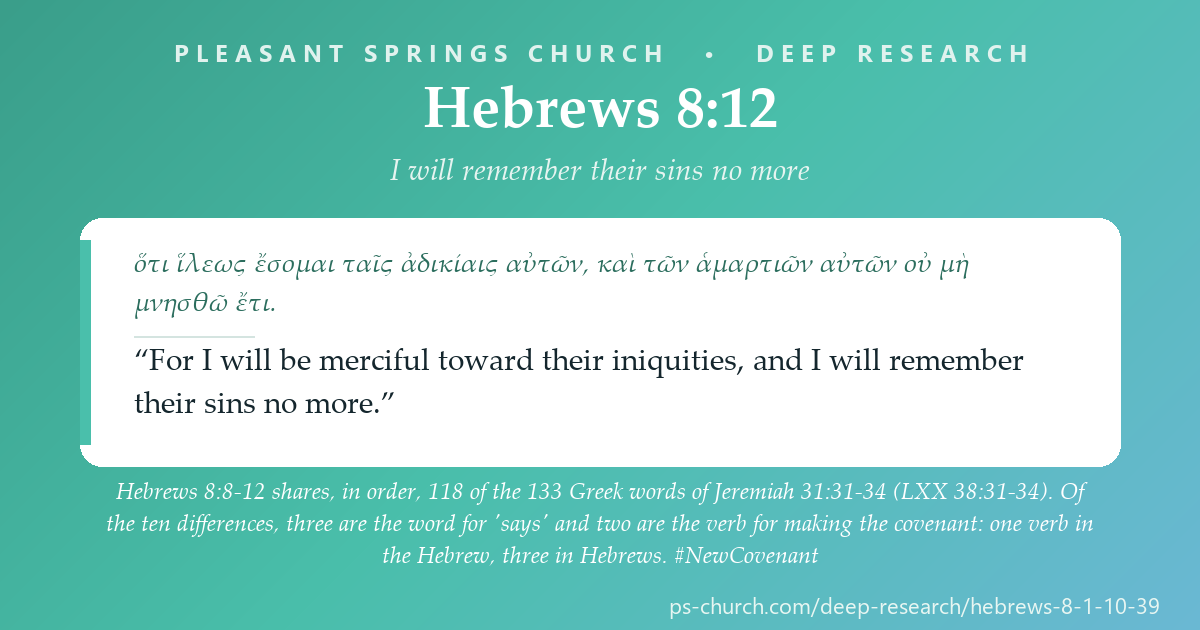
Jeremiah’s promise of a new covenant has 133 words in the Greek Old Testament. Hebrews 8 quotes it and shares 118 of them in the same order — more than any other long quotation measured here. The ten places where it differs are small, and two kinds of word account for half of them: wherever Greek Jeremiah writes φησὶν κύριος, declares the Lord, Hebrews writes λέγει κύριος — three times out of three — and where the Hebrew uses one verb for making a covenant three times, and Greek Jeremiah one verb three times, Hebrews uses three. Because of the first difference, the opening verse of the quotation measures deeper against ten verses it is not quoting than against the one it is. This study measures every quotation in Hebrews 8–10 — Jeremiah twice, Exodus, Psalm 40 and its body, Deuteronomy, Isaiah, Habakkuk — prints the accidents beside the citations and the Hebrew beside the Greek, parses the warning of 10:26–31, and sets out how it has been read, with the church’s own reading labelled as the church’s. See the method →
Hebrews 8:1–10:39
Greek NT · ESVVersification — none in Hebrews; Jeremiah, the Psalter and three psalm headings carry offsets. Hebrews 8, 9 and 10 are numbered identically in the SBLGNT and the ESV (13, 28 and 39 verses), and Hebrews is a New Testament book, so there is no Septuagint column in the codex. The offsets live in the Old Testament verses beside it. Jeremiah 31:31–37 = Masoretic 31:31–37 = Septuagint 38:31–37: Greek Jeremiah is a different arrangement of the book, and its chapters 26–51 do not carry the Hebrew numbers. Inside the oracle the verses align one to one, checked line by line against the CATSS and Masoretic files; the three verses after it do not: ESV/Masoretic 31:35, 31:36 and 31:37 are Septuagint 38:36, 38:37 and 38:35. Jeremiah 34:8 and 34:15 = Septuagint 41:8 and 41:15. Psalm 40:6–8 = Masoretic 40:7–9 = Septuagint 39:7–9 (the heading is verse 1 in the Hebrew and the Greek, unnumbered in the ESV). Psalm 42:2 = Masoretic 42:3 = Septuagint 41:3; Psalm 51:11 = Masoretic 51:13 = Septuagint 50:13; Psalm 54:6 = Masoretic 54:8 = Septuagint 53:8; Psalm 135:14 = Septuagint 134:14 and Psalm 110:1 = Septuagint 109:1 (chapter only). Greek Exodus 39:14 = Masoretic/ESV 39:35 (Greek Exodus 35–40 is arranged differently). Exodus 24:8, 25:40, 26:30, 30:6; Leviticus 17:11; Numbers 15:27–30; Deuteronomy 17:6 and 32:35–36; Isaiah 1:11, 26:11, 26:20 and 53:12; Habakkuk 2:3–4; Ezekiel 11:21; Amos 9:13: no offset — each checked against the Masoretic and CATSS files (Greek Exodus 25 has no verse 6 — the oil and spices — but does not renumber, so 25:40 is 25:40 in all three). Witnesses that are not Scripture on this shelf (1 Esdras, Baruch, Wisdom, 2 and 4 Maccabees) are cited by their CATSS numbers.
The Shape of the Passage
Three interlocking brackets around a central exposition, then exhortation — a sequence with counted links; NOT a chiasmHebrews 5–7 said what kind of priest Jesus is. Chapters 8–10 say where he serves, under what covenant, and with what offering — and then what that means for people who are tempted to go back.
Author
The writer of Hebrews is unnamed, and this page will not name him. What chapters 8–10 show is a writer who lets Scripture carry the argument at length. He quotes Jeremiah’s oracle whole — five verses, more than a hundred words — and then spends a chapter and a half on what it means before quoting it again. He introduces it with μεμφόμενος γὰρ αὐτοὺς λέγει, he finds fault with them when he says, and the second time with μαρτυρεῖ δὲ ἡμῖν καὶ τὸ πνεῦμα τὸ ἅγιον, the Holy Spirit too bears witness to us: for this writer the prophet’s words are the Spirit’s, spoken now.
He quotes exactly and he quotes freely, and both on the same page. At 8:12 he reproduces Jeremiah’s last clause word for word; at 10:17 he gives the same clause with an added phrase and a different verb form. At 8:9 he agrees with the Greek of Jeremiah against the Hebrew; at 10:30 his first quotation of Deuteronomy agrees with neither the Greek Deuteronomy held here nor, word for word, the Hebrew. At 10:38 he has Habakkuk’s two halves in the other order. This page records each of those and explains none of them. Explanations — a different Greek text in front of him, quotation from memory, deliberate adaptation — are all in the literature, and Stage 5 says which could not be checked.
Audience
People who knew the tabernacle by heart. The writer names the lampstand, the table, the bread of the Presence, the second curtain, the ark, the urn of manna, Aaron’s rod and the tablets, and then says of these it is not now the time to speak in detail (9:5) — as though his readers could supply the detail themselves.
Believers who had once suffered well and were now tired. The writer asks them to call to mind their early days, when, newly enlightened, they stood their ground through a great contest of suffering (10:32). They had shared in public shame, visited prisoners and lost property (10:33–34). The writer’s fear is not that they will forget the doctrine but that they will stop meeting (10:25), let go of their confidence (10:35) and shrink back.
And people for whom the old offerings were still a live alternative. The argument that there is οὐκέτι προσφορὰ περὶ ἁμαρτίας (no longer an offering for sin) is aimed at readers who could still imagine one. Whether that means the Temple was still standing when Hebrews was written is argued both ways (the present tenses of 9:6–9 and 10:1–3 are the usual evidence); the page does not decide it.
Orient on covenant, tabernacle, sacrifice, atonement and apostasy.
Search by topic: new covenant, covenant/testament, tabernacle, Holy of Holies, altar of incense, Day of Atonement, blood, sacrifice, sin offering, once for all, apostasy, perseverance, Hebrews and the Old Testament. None of these reference works is held on this disk, and none was opened for any sentence on this page. They are listed as orientation, as on every page of the shelf.
Which articles are relevant?
- Anchor Bible Dictionary — “Covenant,” “New Covenant,” “Tabernacle,” “Day of Atonement,” “Sacrifice and Sacrificial Offerings,” “Hebrews, Epistle to the.”
- Dictionary of the Later New Testament & Its Developments — “Hebrews,” “New Covenant,” “Sacrifice, Offerings, Gifts,” “Apostasy,” “Old Testament in Hebrews.”
- Dictionary of New Testament Background — “Temple, Jewish,” “Day of Atonement,” “Damascus Document,” “Septuagint/Greek Old Testament.”
- NIDNTTE / TDNT — the word families of διαθήκη, ἐφάπαξ, σκιά, ἱλαστήριον and τελειόω.
Bibliography surfaced:
- Harold W. Attridge (Hermeneia, 1989); William L. Lane, Hebrews 9–13 (WBC 47B, 1991); Paul Ellingworth (NIGTC, 1993); F. F. Bruce (NICNT, rev. 1990); Craig R. Koester (Anchor Bible, 2001); Peter T. O’Brien (Pillar, 2010; withdrawn by the publisher, 2016); Gareth Lee Cockerill (NICNT, 2012) on Hebrews.
- On the quotations: Susan E. Docherty, The Use of the Old Testament in Hebrews (2009); Gert J. Steyn, A Quest for the Assumed LXX Vorlage of the Explicit Quotations in Hebrews (2011); George H. Guthrie on Hebrews in Beale and Carson, eds., Commentary on the New Testament Use of the Old Testament (2007).
- On the warning: Herbert W. Bateman IV, ed., Four Views on the Warning Passages in Hebrews (2007).
The heavenly pattern, the hidden ark, the blood of the martyrs — what is on this disk and what is not — and how the early church read 10:26.
Heiser’s method asks what a first reader brought to the text. For Hebrews 8–10 three Greek witnesses on this disk can be measured, and two famous ones cannot. Each is labelled with what was actually read, and none is Scripture.
Three Greek witnesses, measured against Hebrews:
Wisdom of Solomon 9:8 has the idea of 8:5 — the earthly sanctuary as a copy of a heavenly one — in its own words: εἶπας οἰκοδομῆσαι ναὸν ἐν ὄρει ἁγίῳ σου καὶ ἐν πόλει κατασκηνώσεώς σου θυσιαστήριον μίμημα σκηνῆς ἁγίας ἣν προητοίμασας ἀπ' ἀρχῆς (the page’s rendering: you told me to build a temple on your holy mountain, and an altar in the city of your dwelling, a copy of the holy tent that you prepared from the beginning). Measured: against 8:5 the pair run is 1 and against 9:24 it is 0. Same thought, no shared phrase.
2 Maccabees 2:4–8 tells how Jeremiah hid the tent, the ark and the altar of incense in a cave on the mountain Moses climbed: καὶ τὴν σκηνὴν καὶ τὴν κιβωτὸν καὶ τὸ θυσιαστήριον τοῦ θυμιάματος. It names the altar of incense in the same breath as the ark, which bears on 9:4 — and it calls it τὸ θυσιαστήριον τοῦ θυμιάματος, not θυμιατήριον. Against 9:4 the pair run is 3 (καὶ τὴν κιβωτὸν).
4 Maccabees 17:22 says the martyrs’ deaths were διὰ τοῦ αἵματος τῶν εὐσεβῶν ἐκείνων καὶ τοῦ ἱλαστηρίου τοῦ θανάτου αὐτῶν — through the blood of those devout ones and the propitiation of their death — by which providence preserved Israel. It is the nearest thing on this disk to Hebrews’ language of a death that atones; against 9:12 the pair run is 1. None of the three is said to be Hebrews’ source, and none is Scripture.
The Damascus Document, Qumran and Philo — reported, not read:
⚠️ The Damascus Document is not held on this disk. It is often cited because it speaks of a new covenant in the land of Damascus (CD 6:19; 8:21; 19:33–34; 20:12), a community’s own name for itself. That is reported from the editions and was not checked; the page quotes no line of it. The Habakkuk Pesher (1QpHab), which reads Habakkuk 2:3–4 of the Teacher of Righteousness and the community, is not held either. Philo discusses the pattern of Exodus 25:40 in works that are not on this disk (only On the Giants is held). Whether the writer of Hebrews knew any of these is a historical question this page cannot reach, and it rests nothing on them.
How the early church read 10:26 — Chrysostom, quoted from the file on this disk:
What shall we say then to them both? That he does not take away repentance, nor the propitiation through repentance, nor does he thrust away and cast down with despair the fallen. He is not thus an enemy of our salvation; but what? He takes away the second Washing. For he did not say, no more is there repentance, or no more is there remission, but "no more" is there a "sacrifice," that is, there is no more a second Cross. … "For," saith he, "if we sin willfully." See how he is disposed to pardon. He says, "if we sin willfully," so that there is pardon for those [who sin] not willfully.John Chrysostom, Homilies on Hebrews 20 (NPNF1 14), on 10:26
Chrysostom’s question is not the modern one. He is answering two groups at once — those who deny repentance to the lapsed, and those who put off baptism for fear of sinning after it — and he reads no longer remains a sacrifice as no second cross, no second washing: repentance is not shut off. He also hears in willfully that there is pardon for those who sin otherwise — the distinction Leviticus 4 and Numbers 15 draw (Stage 4). The page reports his reading and does not adopt it. One thing it shows about English: where the ESV has go on sinning, the Schaff translation of Chrysostom has a plain if we sin; the Greek has a present participle and no if (Stage 3).
Every priest in the old tent stood. There was no chair in the sanctuary; the work was never finished, so no one sat. Hebrews makes that the whole contrast: every priest stands daily at his service, offering the same sacrifices again and again; but this priest, having offered one sacrifice for sins, sat down. The writer opens chapter 8 on that picture and closes the argument of chapter 10 on it, and between the two he quotes Jeremiah’s promise that God will remember sins no more. The sitting is the proof of the promise. You do not sit down in the middle of a job. You sit down when it is done.
The warning of 10:26–29 parsed from the file — and the vocabulary of covenant, copy, blood and once.
Every headword below is the MorphGNT lemma read off the verse; every count is that lemma counted across all 7,927 verses of the SBLGNT, or a regular expression run over the 30,348 screened Greek Old Testament units. A count is a count of word forms in these two corpora, nothing more.
Hebrews 10:26–29, word by word:
The grammar, as the MorphGNT parsing column has it. The sentence of 10:26 is a genitive absolute: Ἑκουσίως γὰρ ἁμαρτανόντων ἡμῶν, literally for, we sinning willingly. The participle is present, and the pronoun is first person plural — the writer includes himself. 10:29 describes the one it warns with three aorist participles and one aorist indicative.
| verse | form (SBLGNT) | lemma (MorphGNT) | parsing (MorphGNT) | gloss | NT |
|---|---|---|---|---|---|
| 10:26 | Ἑκουσίως | ἑκουσίως | adverb | willingly, deliberately | 2 |
| 10:26 | ἁμαρτανόντων | ἁμαρτάνω | present active participle gen. pl. masc. | sinning | 42 |
| 10:26 | λαβεῖν | λαμβάνω | aorist active infinitive | to receive | 258 |
| 10:26 | ἐπίγνωσιν | ἐπίγνωσις | noun acc. sg. fem. | knowledge | 20 |
| 10:26 | ἀπολείπεται | ἀπολείπω | present passive indicative | remains | 7 |
| 10:29 | ἀξιωθήσεται | ἀξιόω | future passive indicative | will be thought worthy | 7 |
| 10:29 | καταπατήσας | καταπατέω | aorist active participle nom. sg. masc. | having trampled | 5 |
| 10:29 | ἡγησάμενος | ἡγέομαι | aorist middle participle nom. sg. masc. | having counted | 28 |
| 10:29 | ἡγιάσθη | ἁγιάζω | aorist passive indicative | was sanctified | 28 |
| 10:29 | ἐνυβρίσας | ἐνυβρίζω | aorist active participle nom. sg. masc. | having insulted | 1 |
What the grammar settles, and what it does not. It settles that there is no if in 10:26 (the ESV’s For if we go on sinning deliberately is a fair rendering of a circumstantial participle, and a choice); that the sinning is described as ongoing, not a single act; and that the person of 10:29 is said to have been sanctified, with ἡγιάσθη in the aorist. It does not settle who the subject of ἡγιάσθη is, what kind of sanctification is meant, or whether the writer expects anyone he is addressing to do this. Those are questions of reading, and Stage 5 sets the readings side by side.
33 times in the New Testament, seventeen of them in Hebrews, and fourteen of those in chapters 8–10. In 9:16–17 the ESV renders it will — a testament, which takes effect at the death of the one who made it. Others read covenant throughout and take the death to be that of the sacrificial victim by which a covenant was ratified (the next verses are Exodus 24). Both readings are reported, not settled here.
Seven in the New Testament (Luke 22:29 (×2); Acts 3:25; Hebrews 8:10, 9:16, 9:17, 10:16). Greek Jeremiah uses it three times in the oracle; Hebrews has it once, at 8:10 (and again at 10:16), and uses its participle at 9:16–17 for the one who made the will. The Hebrew of Jeremiah has one verb throughout, וְכָרַתִּי, cut (a covenant).
six times in the New Testament, and only here with a covenant. In the Greek Old Testament held here the form συντελέσω stands in six units and in none of them is a covenant its object (in five it is God bringing judgment to an end). With a covenant as its object the verb stands twice, both in Greek Jeremiah 41 (Masoretic 34:8 and 34:15): the covenant of release Zedekiah’s Jerusalem made and then broke. The page notices the coincidence and builds nothing on it.
Five in the New Testament, three in Hebrews (Romans 6:10; 1 Corinthians 15:6; Hebrews 7:27, 9:12, 10:10); absent from the Greek Old Testament held here. With ἅπαξ (14 times in the New Testament, eight in Hebrews) the theme of once is Hebrews’ own: eleven of the New Testament’s nineteen uses of the two words stand in this one letter.
Seven in the New Testament, two in Hebrews (8:5; 10:1). Paired at 8:5 with ὑπόδειγμα (copy) and at 9:24 answered by ἀντίτυπος (copies) and ἀληθινός (the true things). Colossians 2:17 is the only other New Testament verse that calls the law’s observances a shadow.
A New Testament hapax, and absent from the Greek Old Testament held here. Whether it means the shedding of the victim’s blood or its pouring out at the altar is debated; the ESV reads the shedding of blood.
A New Testament hapax. In the Greek Old Testament held here a censer three times out of three. Exodus calls the altar of incense by another name. See 9:4 in the codex and Stage 5.
Twice in the New Testament (10:26; 1 Peter 5:2, of elders who serve willingly). In the Greek Old Testament held here five units, among them Psalm 53:8 (ESV 54:6), the freewill offering. The sins the old sacrifices covered were the ἀκουσίως kind (sixteen units) — and Numbers 15:30 gives the other kind its own name, ἐν χειρὶ ὑπερηφανίας, with a high hand.
A New Testament hapax, absent from the Greek Old Testament held here — the noun of Habakkuk’s verb in 10:38, coined or chosen for the answer: we are not of those who shrink back.
Six in the New Testament, three in Hebrews (8:6; 9:15; 12:24), each time with covenant. In the Greek Old Testament held here once, Job 9:33 — Job’s wish for an arbiter between himself and God.
Every citation measured, the tie bands beside the runs, the longest quotation aligned word by word, the Hebrew and Greek differences set side by side, and the accidents printed with the citations.
Greek against Greek: the 80 MorphGNT rows of Hebrews 8–10 against the 30,348 screened CATSS units (the 64 files held, less the Odes, by house convention), with the shelf’s edition-equivalence table, and against the other 7,847 verses of the Greek New Testament. Contiguous runs of whole word forms, never lemmas; the tie band is the number of target units reaching the same depth. This finds verbatim contact. It does not find allusion. Across the 80 rows against the Greek Old Testament: 79 reach two, 56 reach three, 28 reach four, 17 reach five, 7 reach six, 6 reach nine, 5 reach ten, 4 reach 13, 3 reach 14, 2 reach 23, and nothing reaches 24. Against the rest of the New Testament: 79 reach two, 53 reach three, 12 reach four, 1 reaches five, and nothing reaches six. The word-for-word alignments are an exact longest common subsequence of the same normalised forms.
★ The finding: 118 of 133 words, and ten differences.
Greek Jeremiah 38:31–34 (Jeremiah 31:31–34 in the ESV and the Hebrew) has 133 word forms in CATSS. Hebrews 8:8–12, from Ἰδοὺ on, has 131, and 118 of them stand in Jeremiah’s order. The differences fall in ten places:
| # | Jeremiah | Greek Jeremiah (CATSS) | Hebrews 8 (SBLGNT) | Masoretic | kind |
|---|---|---|---|---|---|
| 1 | 31:31 · LXX 38:31 | φησὶν κύριος | λέγει κύριος | נְאֻם־יְהֹוָה | says the Lord |
| 2 | 31:31 · LXX 38:31 | διαθήσομαι τῷ οἴκῳ | συντελέσω ἐπὶ τὸν οἶκον | וְכָרַתִּי | covenant verb and its case |
| 3 | 31:31 · LXX 38:31 | τῷ οἴκῳ | ἐπὶ τὸν οἶκον | וְאֶת־בֵּית | the same construction, for Judah |
| 4 | 31:32 · LXX 38:32 | διεθέμην | ἐποίησα | כָּרַתִּי | covenant verb |
| 5 | 31:32 · LXX 38:32 | καὶ ἐγὼ | κἀγὼ | וְאָנֹכִי | spelling (crasis) |
| 6 | 31:32 · LXX 38:32 | φησὶν κύριος | λέγει κύριος | נְאֻם־יְהֹוָה | says the Lord |
| 7 | 31:33 · LXX 38:33 | φησὶν κύριος | λέγει κύριος | נְאֻם־יְהֹוָה | says the Lord |
| 8 | 31:33 · LXX 38:33 | διδοὺς δώσω | διδοὺς | נָתַתִּי | a doubled verb, single |
| 9 | 31:33 · LXX 38:33 | γράψω | ἐπιγράψω | אֶכְתְּבֶנָּה | a compound for a simple verb |
| 10 | 31:34 · LXX 38:34 | ἀπὸ μικροῦ αὐτῶν καὶ ἕως | ἀπὸ μικροῦ ἕως | לְמִקְּטַנָּם וְעַד־גְּדוֹלָם | two words fewer (the Byzantine text keeps one) |
Two kinds of word account for half of the ten. Every one of Greek Jeremiah’s three φησὶν κύριος stands where Hebrews has λέγει κύριος (rows 1, 6, 7). And of the three verbs for making the covenant — one verb, וְכָרַתִּי, cut, in all three places of the Hebrew; one verb, διατίθεμαι, in all three places of the Greek — Hebrews has that verb in one place and other verbs in two (rows 2 and 4), so that the new covenant is συντελέσω, accomplished, the old one ἐποίησα, made, and only the covenant of 8:10 has Jeremiah’s διαθήσομαι. The same verb differs once more at 9:20, where Greek Exodus 24:8 has διέθετο and Hebrews ἐνετείλατο. The other five places are a spelling, a single verb where Jeremiah doubles it, a compound verb, two words Hebrews lacks and a preposition repeated for Judah.
Measured: φησὶν κύριος stands 30 times in 28 Greek Old Testament units, 26 of the 30 in Jeremiah, and in no New Testament verse; λέγει κύριος stands 649 times in 624 units (147 of them in Jeremiah) and in 12 New Testament verses, four of them Hebrews 8:8, 8:9, 8:10 and 10:16. And 13 of Jeremiah’s 26 φησὶν κύριος stand in its Greek chapters 37–38 (Masoretic 30–31) — the chapters that hold this oracle. That is a description of two texts, measured. It does not say why the writer wrote what he wrote: a Greek text of Jeremiah that already read λέγει κύριος, his own habit, or something else — Stage 5 says what could not be checked. The English cannot show any of it: the ESV renders both formulas declares the Lord.
Behold, the days are coming, declares the Lord, when I will make a new covenant with the house of Israel and the house of Judah, not like the covenant that I made with their fathers on the day when I took them by the hand to bring them out of the land of Egypt, my covenant that they broke, though I was their husband, declares the Lord.Jeremiah 31:31–32 (ESV) · Septuagint 38:31–32: ἰδοὺ ἡμέραι ἔρχονται φησὶν κύριος καὶ διαθήσομαι τῷ οἴκῳ Ισραηλ καὶ τῷ οἴκῳ Ιουδα διαθήκην καινήν οὐ κατὰ τὴν διαθήκην ἣν διεθέμην τοῖς πατράσιν αὐτῶν ἐν ἡμέρᾳ ἐπιλαβομένου μου τῆς χειρὸς αὐτῶν ἐξαγαγεῖν αὐτοὺς ἐκ γῆς Αἰγύπτου ὅτι αὐτοὶ οὐκ ἐνέμειναν ἐν τῇ διαθήκῃ μου καὶ ἐγὼ ἠμέλησα αὐτῶν φησὶν κύριος · Masoretic: הִנֵּה יָמִים בָּאִים נְאֻם־יְהֹוָה וְכָרַתִּי אֶת־בֵּית יִשְׂרָאֵל וְאֶת־בֵּית יְהוּדָה בְּרִית חֲדָשָׁה לֹא כַבְּרִית אֲשֶׁר כָּרַתִּי אֶת־אֲבוֹתָם בְּיוֹם הֶחֱזִיקִי בְיָדָם לְהוֹצִיאָם מֵאֶרֶץ מִצְרָיִם אֲשֶׁר־הֵמָּה הֵפֵרוּ אֶת־בְּרִיתִי וְאָנֹכִי בָּעַלְתִּי בָם נְאֻם־יְהֹוָה
How long is the longest quotation? Measured against seven others:
| quotation | Greek OT words | NT words | shared in order |
|---|---|---|---|
| Jer 38:31-34 / Heb 8:8b-12 | 133 | 131 | 118 |
| Joel 3:1-5 / Acts 2:17-21 | 113 | 108 | 85 |
| Ps 15:8-11 / Acts 2:25-28 | 68 | 66 | 60 |
| Ps 94:7-11 / Heb 3:7-11 | 80 | 74 | 59 |
| Isa 6:9-10 / Acts 28:26-27 | 56 | 55 | 50 |
| Isa 6:9-10 / Matt 13:14-15 | 56 | 55 | 48 |
| Isa 53:7-8 / Acts 8:32-33 | 57 | 48 | 38 |
| Isa 54:1 / Gal 4:27 | 26 | 25 | 23 |
The shelf’s Jeremiah 31:31–34 page calls Hebrews 8:8–12 the longest Old Testament citation in the New Testament, as the literature usually does. The measurement can check a narrower claim: of the eight long quotations measured here, it shares the most words with its source in order — 118, against 85 for Joel in Acts 2. By the deepest single run it is not first. Across all 7,927 verses of the Greek New Testament the deepest runs into the Greek Old Testament are Matthew 13:15 and Acts 28:27 (24 each, both Isaiah 6:10), and three verses tie at 23: Galatians 4:27, Hebrews 8:9 and Hebrews 8:11. Hebrews 8:9 and 8:11 are tied for third, not first.
The second quotation is not the first one again:
At 10:16–17 Hebrews returns to Jeremiah 38:33–34 (31:33–34), and keeps 26 of those two verses’ 82 words in order — it quotes the first line and the last and leaves out the middle. Set against its own 8:10–12 it differs in these places, among others: πρὸς αὐτοὺς for τῷ οἴκῳ Ἰσραὴλ; heart and mind exchanged; and their lawless deeds added; μνησθήσομαι for μνησθῶ. The apparatus shows the copying tradition pulling the two together: the Byzantine text adds 10:17’s phrase at 8:12 (αὐτῶν WH Treg NA28 ] + καὶ τῶν ἀνομιῶν αὐτῶν RP) and restores 8:12’s verb at 10:17 (μνησθήσομαι WH Treg NA28 ] μνησθῶ RP).
All the citations, measured:
| Hebrews | Greek Old Testament | pair run | row’s deepest run · band | where it parts |
|---|---|---|---|---|
| 8:5 | Exodus 25:40 | 4 | 4 · 3 | adds φησίν and πάντα; δειχθέντα for δεδειγμένον |
| 8:8 | Jeremiah 38:31 (31:31) | 3 | 6 · 10 | the deepest partners are ten other units, not this one |
| 8:9 | Jeremiah 38:32 (31:32) | 23 | 23 · 1 | verb; crasis; formula |
| 8:10 | Jeremiah 38:33 (31:33) | 13 | 13 · 1 | formula; one verb for two |
| 8:11 | Jeremiah 38:34 (31:34) | 23 | 23 · 1 | two words fewer |
| 8:12 | Jeremiah 38:34 (31:34) | 14 | 14 · 1 | nowhere: the whole verse |
| 9:20 | Exodus 24:8 | 5 | 5 · 1 | Τοῦτο for ἰδοὺ; ἐνετείλατο for διέθετο |
| 9:28 | Isaiah 53:12 | 1 | 3 · 3 | no two consecutive forms: same words, other order |
| 10:5 | Psalm 39:7 (40:6) | 5 | 5 · 1 | σῶμα for ὠτία |
| 10:6 | Psalm 39:7 (40:6) | 4 | 4 · 2 | tied with Baruch 1:10; plural for singular; εὐδόκησας for ᾔτησας |
| 10:7 | Psalm 39:8–9 (40:7–8) | 10 | 10 · 1 | ὁ θεός earlier; stops before your law is within my heart |
| 10:9 | Psalm 39:9 (40:8) | 5 | 5 · 1 | the clause alone |
| 10:13 | Psalm 109:1 (110:1) | 3 | 3 · 16 | a paraphrase: ἕως τεθῶσιν οἱ ἐχθροὶ αὐτοῦ for ἕως ἂν θῶ τοὺς ἐχθρούς σου |
| 10:16 | Jeremiah 38:33 (31:33) | 5 | 5 · 1 | πρὸς αὐτοὺς for τῷ οἴκῳ Ισραηλ; heart and mind exchanged |
| 10:17 | Jeremiah 38:34 (31:34) | 4 | 5 · 1 | the deepest partner is Ezekiel 11:21 |
| 10:28 | Deuteronomy 17:6 | 2 | 3 · 1 | the deepest partner is 1 Esdras 9:4 |
| 10:30a | Deuteronomy 32:35 | 1 | — | one word; four with Romans 12:19 (band 1) |
| 10:30b | Deuteronomy 32:36 | 5 | 5 · 2 | tied with Psalm 134:14 (135:14) |
| 10:37 | Isaiah 26:20; Habakkuk 2:3 | 3; 4 | 4 · 1 | the article ὁ; future for subjunctive |
| 10:38 | Habakkuk 2:4 | 9 | 9 · 1 | the two halves in the other order; μου elsewhere |
The quotations are short except one. Outside 8:8–12 the deepest citation runs are ten (10:7, Psalm 40) and nine (10:38, Habakkuk); every other quotation in these chapters reaches five or fewer, and two of them — Isaiah 53:12 at 9:28 and Deuteronomy 32:35 at 10:30 — share no two consecutive word forms with the Greek Old Testament verse they are read against.
The Hebrew and the Greek, side by side — reported, never explained:
| where | Masoretic | Greek OT (CATSS) | Hebrews (SBLGNT) | what differs |
|---|---|---|---|---|
| Jeremiah 31:31–33 (LXX 38) · Heb 8:8–10 | וְכָרַתִּי · כָּרַתִּי · אֶכְרֹת | διαθήσομαι · διεθέμην · διαθήσομαι | συντελέσω · ἐποίησα · διαθήσομαι | one verb three times in the Hebrew; one verb three times in the Greek; three verbs in Hebrews |
| Jeremiah 31:32 (LXX 38:32) · Heb 8:9 | אֲשֶׁר־הֵמָּה הֵפֵרוּ אֶת־בְּרִיתִי וְאָנֹכִי בָּעַלְתִּי בָם | ὅτι αὐτοὶ οὐκ ἐνέμειναν ἐν τῇ διαθήκῃ μου καὶ ἐγὼ ἠμέλησα αὐτῶν | ὅτι αὐτοὶ οὐκ ἐνέμειναν ἐν τῇ διαθήκῃ μου, κἀγὼ ἠμέλησα αὐτῶν | Hebrew: they broke my covenant, though I was their husband; Greek and Hebrews: they did not continue in my covenant, and I disregarded them |
| Jeremiah 31:33 (LXX 38:33) · Heb 8:10 | נָתַתִּי אֶת־תּוֹרָתִי בְּקִרְבָּם | διδοὺς δώσω νόμους μου εἰς τὴν διάνοιαν αὐτῶν | διδοὺς νόμους μου εἰς τὴν διάνοιαν αὐτῶν | Hebrew: my law, within them; Greek and Hebrews: my laws, into their mind |
| Jeremiah 31:31–34 (LXX 38:31–34) · Heb 8:8–12 | נְאֻם־יְהֹוָה × 4 | φησὶν κύριος × 3 | λέγει κύριος × 3 | the Hebrew has the formula four times; the Greek and Hebrews three; the Greek’s word is not Hebrews’ |
| Exodus 24:8 · Heb 9:20 | הִנֵּה דַם־הַבְּרִית אֲשֶׁר כָּרַת יְהֹוָה | ἰδοὺ τὸ αἷμα τῆς διαθήκης ἧς διέθετο κύριος | Τοῦτο τὸ αἷμα τῆς διαθήκης ἧς ἐνετείλατο | Hebrew and Greek agree (behold; made); Hebrews has this, commanded |
| Psalm 40:6 (MT 40:7; LXX 39:7) · Heb 10:5 | אׇזְנַיִם כָּרִיתָ לִּי | ὠτία δὲ κατηρτίσω μοι | σῶμα δὲ κατηρτίσω μοι | Hebrew and Rahlfs agree (ears); Hebrews has a body |
| Habakkuk 2:3 · Heb 10:37 | כִּי־בֹא יָבֹא | ἐρχόμενος ἥξει | ὁ ἐρχόμενος ἥξει | Hebrew: it will surely come (the vision); Greek: coming, he will come; Hebrews: the coming one will come |
| Habakkuk 2:4 · Heb 10:38 | עֻפְּלָה … וְצַדִּיק בֶּאֱמוּנָתוֹ יִחְיֶה | ἐὰν ὑποστείληται … ὁ δὲ δίκαιος ἐκ πίστεώς μου ζήσεται | ὁ δὲ δίκαιός μου ἐκ πίστεως ζήσεται … ἐὰν ὑποστείληται | Hebrew: puffed up … by his faith; Greek: if he shrinks back … by my faithfulness; Hebrews: my righteous one first, the shrinking back second |
| Deuteronomy 32:35 · Heb 10:30 | לִי נָקָם וְשִׁלֵּם | ἐν ἡμέρᾳ ἐκδικήσεως ἀνταποδώσω | Ἐμοὶ ἐκδίκησις, ἐγὼ ἀνταποδώσω | Hebrew: to me vengeance and recompense; Greek: in a day of vengeance I will repay; Hebrews and Romans 12:19: to me vengeance, I will repay |
| Isaiah 53:12 · Heb 9:28 | חֵטְא־רַבִּים נָשָׂא | ἁμαρτίας πολλῶν ἀνήνεγκεν | πολλῶν ἀνενεγκεῖν ἁμαρτίας | the same sense in all three; Hebrews’ word order is its own |
Read the rows together. At Jeremiah 31:32 and 31:33 Hebrews has the Greek where the Greek and the Hebrew part. At Psalm 40:6 it has neither: the Hebrew and Rahlfs’ Greek agree on ears, and Hebrews has a body. At Deuteronomy 32:35 it agrees with Romans 12:19 against the Greek held here, and its first word is closer to the Hebrew. At Habakkuk 2:4 it has the Greek’s words in its own order. No one theory — Hebrews follows the Septuagint, Hebrews corrects to the Hebrew, Hebrews quotes from memory — covers every row, and the page offers none. No apparatus of the Greek Old Testament is held here, so whether a Greek manuscript of Jeremiah, the Psalter, Deuteronomy or Habakkuk reads as Hebrews does cannot be checked.
Exact phrases, checked:
| exact form | Greek OT units (of 30,348) | NT verses (of 7,927) |
|---|---|---|
| φησὶν κύριος — Greek Jeremiah’s formula | 28 | 0 |
| λέγει κύριος — Hebrews’ | 624 | 12 |
| ἰδοὺ ἡμέραι ἔρχονται φησὶν κύριος — Jeremiah 38:31 | 6 | 0 |
| Ἰδοὺ ἡμέραι ἔρχονται, λέγει κύριος — Hebrews 8:8 | 10 | 1 |
| διαθήκην καινήν | 1 | 1 |
| ἡ καινὴ διαθήκη — the Supper | 0 | 2 |
| συντελέσω ἐπὶ | 0 | 1 |
| διδοὺς δώσω | 1 | 0 |
| ἐπιγράψω | 0 | 2 |
| οὐ μὴ μνησθῶ ἔτι — 8:12 | 1 | 1 |
| μνησθήσομαι ἔτι — 10:17 | 0 | 1 |
| καὶ τῶν ἀνομιῶν αὐτῶν | 1 | 1 |
| ὠτία δὲ κατηρτίσω — the Psalter | 1 | 0 |
| σῶμα δὲ κατηρτίσω — Hebrews | 0 | 1 |
| ὁλοκαυτώματα καὶ περὶ ἁμαρτίας | 1 | 2 |
| τὸ αἷμα τῆς διαθήκης | 1 | 2 |
| Τοῦτο τὸ αἷμα | 0 | 1 |
| αἷμα ταύρων καὶ τράγων | 1 | 1 |
| τῷ προσώπῳ τοῦ θεοῦ | 1 | 1 |
| ἅπαξ τοῦ ἐνιαυτοῦ | 2 | 1 |
| ἁμαρτίας πολλῶν — Isaiah | 1 | 0 |
| πολλῶν ἀνενεγκεῖν — Hebrews | 0 | 1 |
| Ἐμοὶ ἐκδίκησις | 0 | 2 |
| Κρινεῖ κύριος τὸν λαὸν αὐτοῦ | 2 | 1 |
| μικρὸν ὅσον ὅσον | 1 | 1 |
| ὁ ἐρχόμενος ἥξει | 0 | 1 |
| ἐκ πίστεώς μου — Habakkuk | 1 | 0 |
| ὁ δὲ δίκαιός μου — Hebrews | 0 | 1 |
| ἐκ πίστεως ζήσεται — Romans 1:17, Galatians 3:11, Hebrews 10:38 | 0 | 3 |
| ἐπὶ δυσὶν ἢ τρισὶν | 0 | 1 |
| τὸν υἱὸν τοῦ θεοῦ | 0 | 5 |
| καὶ τὸ πνεῦμα τὸ ἅγιον | 1 | 2 |
Each count is the exact normalised form, in that order. A zero says the form does not stand there; it does not say the words or the idea are absent. Inflected and reordered relatives of these phrases exist — διαθήκης καινῆς at 9:15, for example, is not διαθήκην καινήν.
⚠️ The counter-examples — the runs that mean less than they look:
| Hebrews | the measured partner | run · band | what it is |
|---|---|---|---|
| 8:8 | Amos 8:11, 9:13; Isaiah 39:6; Jeremiah 7:32, 9:24, 16:14, 19:6, 23:5, 23:7, 28:52 | 6 · 10 | ten verses Hebrews is not quoting, beating the one it is (3) |
| 8:5 | Exodus 25:40 = 26:30 = 27:8 | 4 · 3 | the citation, tied with two neighbours it does not cite |
| 9:2 | Numbers 3:31 | 5 · 1 | καὶ ἡ τράπεζα καὶ ἡ: an inventory of furniture |
| 9:24 | Psalm 41:3 (42:2) | 4 · 1 | appear before God: an exact phrase, no citation signal |
| 10:4 | Isaiah 1:11 | 4 · 1 | blood of bulls and goats: an exact phrase, no citation signal |
| 10:6, 10:8 | Psalm 39:7 = Baruch 1:10 | 4 · 2 | the citation tied with a penitential prayer in Baruch |
| 10:15 | Psalm 50:13 (51:11) | 5 · 1 | καὶ τὸ πνεῦμα τὸ ἅγιον: and the Holy Spirit; the same five words are Acts 5:32 (band 1) |
| 10:17 | Ezekiel 11:21 | 5 · 1 | deeper than the Jeremiah it quotes (4) |
| 10:28 | 1 Esdras 9:4 | 3 · 1 | two or three days; the law of witnesses reaches 2 |
| 10:30 | Deuteronomy 32:36 = Psalm 134:14 | 5 · 2 | the citation, tied with a psalm that repeats it |
| 10:39 | Exodus 10:26 | 3 · 1 | ἡμεῖς δὲ οὐκ: an accident |
Read 8:8 first. The opening of the most famous quotation in Hebrews measures deeper against ten verses it is not quoting than against the one it is, because a single word of a formula has differs. Then 10:17, where the same oracle’s last line measures deeper against Ezekiel. Then 10:28, where a verse about two or three days outranks the law of witnesses. The screen cannot tell a citation from an accident, and the depth of a run is not the strength of a connection. Psalm 41:3 at 9:24 and Isaiah 1:11 at 10:4 are exact phrases found in one unit each, and that is all that is claimed for them.
What the screen cannot see:
- Leviticus 16 — the Day of Atonement behind 9:7, 9:12 and 9:25 is everywhere in sense and measures three words at most (ἅπαξ τοῦ ἐνιαυτοῦ); see the Day of Atonement.
- Numbers 19 — the ashes of the heifer at 9:13 (pair run one; ὕδωρ ῥαντισμοῦ is not Hebrews’ wording).
- Numbers 15:27–31 — the unwitting sin and the sin with a high hand, the distinction most readers hear in 10:26; in Greek it shares no two consecutive word forms with 10:26 (pair run 0). “But the person who does anything with a high hand, whether he is native or a sojourner, reviles the Lord, and that person shall be cut off from among his people.”
- Jeremiah 31:35–37 (LXX 38:35–37, in another order) — the verses straight after the oracle, which Hebrews does not quote: “‘If this fixed order departs from before me, declares the Lord, then shall the offspring of Israel cease from being a nation before me forever.’” Greek ἐὰν παύσωνται οἱ νόμοι οὗτοι ἀπὸ προσώπου μου φησὶν κύριος καὶ τὸ γένος Ισραηλ παύσεται γενέσθαι ἔθνος κατὰ πρόσωπόν μου πάσας τὰς ἡμέρας (Stage 5).
- Exodus 30:6 — the incense altar in front of the veil (Greek ἀπέναντι τοῦ καταπετάσματος), against 9:4.
Which cross-references matter?
- Jeremiah 31:31–37 (LXX 38:31–37) — the oracle and its sequel (see Jeremiah 31:31–34).
- Exodus 24:1–8; 25:40 — the blood of the covenant and the pattern on the mountain (see Exodus 24, Exodus 25).
- Psalm 40:6–8 (LXX 39:7–9) — see Psalms 38–41 and Psalms in the New Testament.
- Habakkuk 2:3–4; Romans 1:17; Galatians 3:11 — see Habakkuk 2:4.
- Deuteronomy 32:35–36; Romans 12:19 — see Deuteronomy 32 and Romans 12–13.
- Isaiah 53:12 — see Isaiah 52:13–53:12.
- Luke 22:20; 1 Corinthians 11:25; Mark 14:24 — the new covenant and the blood of the covenant at the Supper: “And likewise the cup after they had eaten, saying, ‘This cup that is poured out for you is the new covenant in my blood.”
- Hebrews 6:4–8; 12:15–29 — the other warnings (see Hebrews 5–7); and 12:24, where Jesus is the mediator of a new covenant and his sprinkled blood speaks better than Abel’s.
The readings of 10:26–31 and of the scope of the offering, with their proponents; the church’s frame labelled as the church’s; Israel and 8:13; and everything this page could not check.
None of the modern works named on this page was re-read for it. The positions are reported as the literature commonly summarises them, and a reader who wants to rely on an attribution should check it in the book. Chrysostom in Stage 2 is the exception: he is quoted from a file on this disk.
Commentaries & studies:
- Harold W. Attridge, The Epistle to the Hebrews (Hermeneia, 1989); William L. Lane, Hebrews 1–8 and 9–13 (WBC 47A–B, 1991); Paul Ellingworth (NIGTC, 1993); F. F. Bruce (NICNT, rev. 1990); Craig R. Koester (AB 36, 2001); Peter T. O’Brien (Pillar, 2010; withdrawn by the publisher, 2016); Gareth Lee Cockerill (NICNT, 2012).
- On the quotations: Susan E. Docherty (2009); Gert J. Steyn (2011); George H. Guthrie in Beale and Carson (2007); Karen H. Jobes, “The Function of Paronomasia in Hebrews 10:5–7,” TrinJ 13 (1992), on body for ears.
- On the warning: Herbert W. Bateman IV, ed., Four Views on the Warning Passages in Hebrews (2007); Scot McKnight, TrinJ 13 (1992); Thomas R. Schreiner and Ardel B. Caneday (2001).
- On the scope of the offering: John Owen, The Death of Death in the Death of Christ (1647); on the many, Joachim Jeremias in TDNT 6, s.v. polloi. On the church’s frame: Timothy George, Amazing Grace (2000; 2nd ed. 2011), the ROSES acronym; Kenneth Keathley, Salvation and Sovereignty: A Molinist Approach (2010).
Hebrews 10:26–31: the readings, fairly stated.
Each reading below is stated as its own holders would state it, with the anchor they lean on hardest and the text that gives them the most trouble. The table is deliberately the same shape as the one on the shelf’s Hebrews 5–7 page, because most readers read the two warnings together.
| reading | the people of 10:26–29 are | no sacrifice remains means | its strongest anchor in the passage | what it has to explain | held by (reported) |
|---|---|---|---|---|---|
| 1. Loss of salvation | genuine believers — we, after receiving the knowledge of the truth, sanctified by the blood (10:29) | one who deliberately and persistently repudiates Christ forfeits salvation; there is no other sacrifice to return to | ἐν ᾧ ἡγιάσθη read of the apostate; the first person plural of 10:26; 10:38 in Hebrews’ order, where my righteous one is the one who may shrink back | 10:14 (he has perfected for all time those who are being sanctified) and 10:39 (we are not of those who shrink back) | I. Howard Marshall (1969); Scot McKnight, TrinJ 13 (1992); Grant R. Osborne and Gareth Lee Cockerill in Four Views (2007); David A. deSilva (2000) |
| 2. Hypothetical | genuine believers | real as a consequence, stated of a case the writer does not expect: if a believer could repudiate the one sacrifice, none would be left | 10:39, read as the writer’s verdict on his hearers | the vivid present tenses and the concrete description of 10:29; what a warning about the impossible is for | reported for Thomas Hewitt (1960) and Homer A. Kent Jr. (1972) |
| 3. False professors (phenomenological) | members of the covenant community who received the truth and were outwardly set apart by the covenant blood, without being regenerate | real: those who turn from the one sacrifice after such knowledge have nowhere else to go | 10:39 separates we from those who shrink back; 1 John 2:19; ἁγιάζω in the covenantal sense of 9:13 (the flesh purified), or with Christ as its subject | the same vocabulary is used of the real church (10:10, 10:14, 10:32) | John Owen, Exposition of Hebrews (1668–84); Wayne Grudem (1995); Buist M. Fanning in Four Views (2007) |
| 4. Temporal judgment / loss of reward | genuine believers | no further sacrifice can avert discipline; the fire and vengeance are God’s judgment on his own people in this life, or a loss of reward, not eternal destruction | Κρινεῖ κύριος τὸν λαὸν αὐτοῦ — his people; 10:35 (μεγάλην μισθαποδοσίαν, great reward) | εἰς ἀπώλειαν at 10:39 and ἐσθίειν μέλλοντος τοὺς ὑπεναντίους at 10:27 | Zane C. Hodges (1983); Thomas K. Oberholtzer, BSac 145 (1988); Randall C. Gleason in Four Views (2007); Joseph C. Dillow (1992) |
| 5. Means of perseverance | those the writer addresses as believers | real and prospective: the warning states what would follow, and is itself the means God uses so that it does not | the warning sits between faithful is he who promised (10:23) and we are not of those who shrink back | it explains what the warning is for more than who the people of 10:29 are | Thomas R. Schreiner and Ardel B. Caneday, The Race Set Before Us (2001) |
| Chrysostom (on this disk) | the baptized | no second sacrifice, no second washing; repentance remains | willfully, which implies pardon for other sin | none of the modern questions | quoted in Stage 2 from NPNF 14 |
⚠️ The church’s frame — labelled as the church’s, not as a result:
Pleasant Springs teaches eternal security in the ROSES framing (the acronym is Timothy George’s; Kenneth Keathley develops it in a Molinist key): a true believer cannot finally lose salvation; in the words of the church’s statement of faith, all who genuinely receive Christ are held secure, and Scripture’s warnings are themselves a real means by which God holds his people fast (see TULIP, DAISY and ROSES and what we believe). That is the church’s position. Nothing measured on this page establishes it, and nothing measured on this page refutes it. On that frame, reading 5 is closest to the statement of faith’s own words about the warnings; readings 2 and 3 and some forms of reading 4 are compatible with it; reading 1 is the one it excludes.
What stays hard for the church’s frame in this text, and the page will not hide it: (a) the writer says we (ἡμῶν); (b) the person of 10:29 is said to have been sanctified (ἡγιάσθη), and the same verb at 10:10 and 10:14 describes the real church; (c) Hebrews’ own ordering of Habakkuk makes my righteous one the subject of ἐὰν ὑποστείληται.
What the frame can point to in the passage itself: 10:14, “For by a single offering he has perfected for all time those who are being sanctified.” — a perfect tense, τετελείωκεν, and εἰς τὸ διηνεκὲς; 10:39, “But we are not of those who shrink back and are destroyed, but of those who have faith and preserve their souls.”; the faithful promiser of 10:23; and the priest who sat down because the work was finished. Outside Hebrews, 1 John 2:19, “They went out from us, but they were not of us; for if they had been of us, they would have continued with us. But they went out, that it might become plain that they all are not of us.” and John 10:28, “I give them eternal life, and they will never perish, and no one will snatch them out of my hand.”
9:28 and 10:10–14 and the scope of the offering — two readings, and the church’s labelled:
The scope words in the text, and only those: 9:26 εἰς ἀθέτησιν ἁμαρτίας (for the setting aside of sin, singular); 9:28 πολλῶν (to bear the sins of many, the sense of Isaiah 53:12); 10:10 ἡγιασμένοι ἐσμὲν (we); 10:14 τοὺς ἁγιαζομένους; and, earlier in the letter, 2:9 ὑπὲρ παντὸς (for every one, or for everything).
A limited (particular) reading — John Owen’s, among others — takes the many of 9:28 as those for whom the offering was made and who are actually perfected by it (10:14): an offering that perfects cannot have been made for those who are not perfected; and the priest who offered is the priest who intercedes (7:25; 9:24), so the offering and the intercession have one extent — if he offered for all, he intercedes for all, and all would be saved (reported; Owen is not on this disk). An unlimited reading takes many in Isaiah 53 and in the Gospels’ ransom saying as an inclusive Semitic idiom (the many over against the one; Jeremias is the usual citation), sets 9:28 beside 2:9 and 1 John 2:2 (“He is the propitiation for our sins, and not for ours only but also for the sins of the whole world.”), and reads 10:14 of the application of the offering, not its extent. Each reading has to explain the other’s best verse.
Pleasant Springs holds unlimited provision: the once-for-all offering is sufficient for all and offered to all, while its application belongs to those who come to God through Christ (7:25; 10:22). That is the church’s position; the scope words above are what the text gives.
8:13 and Israel — what the verse says and does not say:
What is called obsolete is a covenant, and the grammar says so: τὴν πρώτην is feminine and refers to the first covenant of 8:7. The verse does not speak of a people. Hebrews quotes the promise as Jeremiah gave it — with the house of Israel and with the house of Judah — and keeps both houses to the word. The verses that follow the oracle in Jeremiah, which Hebrews does not quote, promise that the offspring of Israel will not cease: “‘If this fixed order departs from before me, declares the Lord, then shall the offspring of Israel cease from being a nation before me forever.’” (Hebrew גַּם זֶרַע יִשְׂרָאֵל יִשְׁבְּתוּ מִהְיוֹת גּוֹי; Greek καὶ τὸ γένος Ισραηλ παύσεται γενέσθαι ἔθνος, in another verse order). Paul, writing of Israel, says “For the gifts and the calling of God are irrevocable.”
The difference at 10:16 — πρὸς αὐτοὺς, with them, for with the house of Israel — is read by some as widening the address to the church of Jews and Gentiles, and by others as shorthand for the same people named at 8:8 and 8:10. The text does not say which. This page’s reading, not a ratified church position: the new covenant is God’s promise to Israel, fulfilled in Christ and opened to the nations; Hebrews 8:13 is not a verdict on the Jewish people, and this page will not be used as one.
Interpretation notes worth keeping:
- The altar of incense (9:4). Two main readings are reported: θυμιατήριον means a censer (the King James Version’s choice; the word’s sense in all three Greek Old Testament units held here); or it means the altar, and ἔχουσα says the inner room had it as its own, the altar whose incense went in on the Day of Atonement, though it stood outside (the ESV’s choice). The page does not resolve it.
- Once to die (9:27). The church teaches ancestral sin as inherited mortality, not inherited guilt. The verse fits that frame — death is appointed to human beings as such — and says nothing either way about guilt inherited from Adam. Nothing more is claimed.
- A second time (9:28). ἐκ δευτέρου is the plainest statement in Hebrews of Christ’s return. The church’s historic premillennialism neither needs this verse for its scheme nor is threatened by it; the page draws no timetable from it.
- A body you prepared (10:5). The incarnation the church confesses does not rest on one word of one Greek manuscript tradition: Hebrews 10:10 says the offering was the body of Jesus Christ, and the creedal confession rests on the whole New Testament witness. The page reports the textual question and stops there.
⚠️ What this page could not check — and where it is weakest:
- The modern literature was not re-read. Every attribution of a reading to a scholar in this stage is reported, not verified against the book — including the placement of Hewitt and Kent under the hypothetical reading, Owen’s view of the subject of ἡγιάσθη, and Jeremias on the many.
- No apparatus of the Greek Old Testament. CATSS is Rahlfs’ hand edition, not Göttingen. Whether any Greek manuscript of Jeremiah 38 reads λέγει κύριος, συντελέσω or ἐποίησα; whether any Greek Psalter reads σῶμα; whether any Greek Deuteronomy reads Ἐμοὶ ἐκδίκησις; and whether Codex Alexandrinus of Habakkuk reads my righteous one (as the shelf’s Habakkuk 2:4 page reports) — none of it can be checked here. The page’s findings about Hebrews’ differences are findings about these two editions, CATSS and the SBLGNT, and nothing wider. If a Greek Jeremiah with λέγει κύριος existed, row 1, 6 and 7 of the table would describe the writer’s text, not his choices.
- The New Testament apparatus is the SBLGNT’s (Holmes; CC BY 4.0), which compares five printed editions — Westcott–Hort, Tregelles, the Greek text behind the NIV, Robinson–Pierpont and NA28 — and reports no manuscripts. It records no edition that reads φησὶν κύριος in Hebrews 8.
- The Damascus Document, the Habakkuk Pesher, Philo’s treatments of Exodus 25:40 and the Mishnah on the Day of Atonement are not on this disk. Nothing on the page rests on them.
- The ESV’s footnotes were not fetched. Where the page says what the ESV reads, it means the text the Crossway API returns with footnotes switched off.
- The comparison of long quotations is a sample. Eight quotations were aligned; the claim is that Hebrews 8:8–12 shares the most words in order among those eight, not among every quotation in the New Testament. The whole-New-Testament claim the page does make is the narrower one about single runs (24, 24, 23, 23, 23).
- The screen finds verbatim contact only. Leviticus 16, Numbers 15 and 19 and the whole tabernacle account stand behind these chapters in sense and barely register in number.
- The weakest point of the page is its emphasis. Ten differences in 133 words is a fact; that five of them fall on two kinds of word is a fact; that this means anything about the writer’s intention is not shown, and the page does not claim it. Says for declares is the most ordinary difference a Greek writer could make. What the page builds on it is a habit of reading: a citation is not a photocopy, and the differences are worth seeing before anyone explains them.
- Doctrine. The church’s positions on security, on the scope of the atonement, on ancestral sin, on the last things and on Israel are labelled wherever they appear. The measurement does not adjudicate 10:26–31 or 9:28, and the page does not pretend that it does.
A priest who sat down, a promise quoted twice, and a warning that ends in confidence.
Name what you learned, why it matters, and one concrete response.
What should we carry away — and do?
- The work is finished. The priests of the old tent stood; this priest sat down. One offering, once for all, and the one who made it is seated.
- God has promised to forget. Hebrews quotes Jeremiah twice and keeps the last line both times: I will remember their sins no more. Where sins are forgiven, the writer says, no other offering is needed.
- The warning is the other side of the same truth. If there is one sacrifice, there is no second one to turn to. The writer does not soften that — and then he reminds his readers who they have been, and says, we are not of those who shrink back.
- Read the quotation before you explain it. Hebrews shares, in order, 118 of Jeremiah’s 133 Greek words, and the ten places it differs are worth seeing.
Step in response: 10:24–25 is the practical end of all this theology — consider how to stir one another up, and do not stop meeting together. This week, name one believer who has gone quiet, and go and encourage them.
Hebrews 8:12 · to share
Greek NT + ESVEvery Deep Research page traces its passage across the whole sweep — the Old Testament, the Second-Temple world between the testaments (historical witnesses, not Scripture), and the New Testament. Follow the thread:
Pleasant Springs Church — Deep Research
Research method after Michael S. Heiser’s Bible Research Method (examine dictionaries → ancient literature → important words → textual connections → academic publications → share), with the Pleasant Springs “Author & Audience” foundation. Scripture set in the Hebrew, the Greek editions named on each page and the ESV (Old Testament), and the Greek New Testament and the ESV (New Testament), per the practice of Pleasant Springs Church. Hebrews research grounded in Attridge, Lane, Ellingworth, Bruce, Koester, O’Brien (withdrawn by the publisher, 2016) and Cockerill, with Docherty, Steyn and Guthrie on the quotations and Bateman’s Four Views on the warning — none of which were consulted for any number on this page. Text: Greek New Testament from the SBL edition as digitized by MorphGNT (text, lemma and parsing columns); SBLGNT apparatus, Michael W. Holmes (ed.), Society of Biblical Literature and Logos Bible Software, CC BY 4.0; Greek Old Testament from Rahlfs’ Septuaginta as digitized by CATSS; Hebrew from the Masoretic text as printed in Sefaria’s Miqra according to the Masorah; Chrysostom from the public-domain Schaff Nicene and Post-Nicene Fathers. ⚠️ VERSE NUMBERING. Hebrews has no offset. Jeremiah 31:31–34 = Septuagint 38:31–34; Jeremiah 31:35, 36, 37 = Septuagint 38:36, 37, 35; Jeremiah 34:8, 15 = Septuagint 41:8, 15; Psalm 40:6–8 = Masoretic 40:7–9 = Septuagint 39:7–9; Psalm 42:2 = Masoretic 42:3 = Septuagint 41:3; Psalm 51:11 = Masoretic 51:13 = Septuagint 50:13; Psalm 54:6 = Masoretic 54:8 = Septuagint 53:8; Psalm 110:1 and 135:14 = Septuagint 109:1 and 134:14; Exodus (but Greek 39:14 = 39:35), Leviticus, Numbers, Deuteronomy, Isaiah, Ezekiel, Amos and Habakkuk numbered alike in all three. ⚠️ The measurement, in full. Greek against Greek; MorphGNT normalised word; CATSS FORM column, beta-code transliterated first; both sides lowercased, accents and breathings dropped, final sigma folded, filtered to Greek letters, with the shelf’s edition-equivalence table on cross-corpus screens. Contiguous runs of whole word forms, never lemmas. 80 rows against 30,348 verse units — the 64 CATSS files less the Odes, which are held but not screened by house convention — and against the other 7,847 verses of the Greek New Testament; the whole New Testament against the same units for the single-run comparison; exact longest common subsequence for the alignments. Exhaustive and deterministic. It finds verbatim contact, not allusion.
Scripture quotations marked ESV are from the ESV® Bible (The Holy Bible, English Standard Version®), © 2001 by Crossway, a publishing ministry of Good News Publishers. ESV Text Edition: 2016. Used by permission. All rights reserved. The ESV text may not be quoted in any publication made available to the public by a Creative Commons license, and the ESV may not be translated in whole or in part into any other language. www.esv.org
|
Did this study bless you today? 💚 Give to Support PS Church100% of gifts go to the General Fund — thank you. |