Psalm 110:4 — 109:4 in the Greek Psalter — has fifteen words there. In these three chapters Hebrews quotes fourteen of them — and the one it never writes is the little verb are, in You are a priest forever. It quotes the end of the verse first, twice at length and three times in part, and only at 7:21, the sixth time, does it quote the beginning: “The Lord has sworn and will not change his mind”. In between it does something no reader expects: it stops, rebukes its hearers, warns them in the hardest sentence of the letter, tells them it is sure of better things for them — and then explains what an oath of God is, from the oath God swore to Abraham. This study measures every citation in Hebrews 5–7, prints its accidents beside its citations, parses the warning of 6:4–6 word by word, and sets out how it has been read — with the church’s own reading labelled as the church’s. See the method →
Hebrews 5:1–7:28
Greek NT · ESVVersification — none in Hebrews, one chapter number in the Psalter, and three psalm headings. Hebrews 5, 6 and 7 are numbered identically in the SBLGNT and the ESV (14, 20 and 28 verses), and Hebrews is a New Testament book, so there is no Septuagint column in the codex. The offsets live in the Old Testament verses beside it. Psalm 110:4 = Masoretic 110:4 = Septuagint 109:4: the Greek Psalter runs one psalm behind from 9/10 to 147, but the verse does not move, because the Hebrew heading Of David, a psalm stands inside verse 1 (checked against the Masoretic file). Psalm 2:7 has no heading and no offset in any system. Genesis 3:17–18, 14:17–20, 17:2, 22:16–17 and 33:18, Leviticus 16:2 and Numbers 23:19: no offset — each checked line for line against the Masoretic and CATSS files before the claim was made. Three psalm verses carry a heading offset: ESV Psalm 76:2 = Masoretic 76:3 = Septuagint 75:3; ESV Psalm 34:5 and 34:8 = Masoretic 34:6 and 34:9 = Septuagint 33:6 and 33:9; and the heading of Psalm 42, which the ESV prints unnumbered, is Masoretic 42:1 and Septuagint 41:1. 1 Kings 12:31 is CATSS 3 Kingdoms 12:31: the book is renamed, the verse is not. Witnesses that are not Scripture on this shelf (Sirach, 2 and 3 Maccabees, Tobit, the Letter of Jeremiah) are cited by their CATSS numbers.
The Shape of the Passage
Interlocking brackets, then exposition — a sequence with four counted links; NOT a chiasmHebrews 4:14–16 announced a great high priest and bade the readers draw near. Chapters 5–7 say what kind of priest he is — and break off in the middle to tell the readers what kind of hearers they have become.
Author
The writer of Hebrews is unnamed, and this page will not name him. Tertullian, early in the third century, quotes 6:4–8 as the work of Barnabas (Stage 2 prints the sentence); that is a witness to one reader’s attribution, not a settled fact. What the text shows is an argument that is not afraid to stop. At 5:10 the writer has just said the decisive thing — Jesus was designated by God a high priest after the order of Melchizedek — and at 5:11 he breaks off: “About this we have much to say, and it is hard to explain, since you have become dull of hearing.” He does not resume the sentence until 6:20, and when he does he resumes it in the same five Greek words.
Between the two he does four things, and the order matters. He rebukes (5:11–6:3): they ought to be teachers and need milk. He warns (6:4–8), in the hardest sentence of the letter. He reassures (6:9–12): “in your case, beloved, we feel sure of better things”. And he swears — or rather, he tells them that God has sworn (6:13–18), to Abraham, by himself, because there was no one greater to swear by. The warning is not the last word of the digression; the oath is.
Then the exposition. From three verses of Genesis 14 the writer draws a name, a city, a blessing and a tithe — and a silence: no father, no mother, no genealogy. From one verse of Psalm 110 he draws another priest, not of Aaron’s order; a priest forever; and, last of all, a priest made by an oath. The Son who learned obedience through what he suffered (5:8) is the Son whom the word of the oath appoints, made perfect forever (7:28).
Audience
Believers who had gone slack. The writer’s word for them is νωθρός — dull, sluggish — and he uses it twice, at the edges of his rebuke (5:11; 6:12). These are not strangers to the faith. They have served the saints and still do (6:10); a few chapters later he will remind them of the former days when, after you were enlightened, you endured a hard struggle with sufferings (10:32). The danger he sees is not ignorance but arrested growth: people who once ran well settling for the first principles and going no further.
People who needed both a warning and an anchor. The writer will not choose between them. He tells them plainly what it would mean to fall away after such light; and he tells them, just as plainly, that he is persuaded of better things for them, things that belong to salvation, and that God has given we who have fled for refuge two unchangeable things to hold. How those two halves fit together is the question this page has to answer honestly, and Stage 5 does not pretend there is only one answer.
And people who knew the Day of Atonement. The hope that enters into the inner place behind the curtain (6:19) uses the words of Leviticus 16; the readers are expected to hear the high priest’s one day of the year in them, and to hear that Jesus has gone in ahead of them, as a forerunner, and stays.
Orient on priesthood, Melchizedek, oaths, apostasy and perseverance.
Search by topic: high priest, Melchizedek, Psalm 110, Salem, tithe, oath, covenant, apostasy, perseverance, assurance, repentance, Day of Atonement, veil. None of these reference works is held on this disk, and none was opened for any sentence on this page. They are listed as orientation, as on every page of the shelf.
Which articles are relevant?
- Anchor Bible Dictionary — “Melchizedek,” “High Priest,” “Hebrews, Epistle to the,” “Oath,” “Apostasy.”
- Dictionary of the Later New Testament & Its Developments — “Hebrews,” “Priest, High Priest,” “Perseverance,” “Apostasy,” “Old Testament in Hebrews.”
- Dictionary of New Testament Background — “Melchizedek, Traditions of,” “Qumran: Melchizedek (11QMelch),” “Philo,” “Josephus.”
- NIDNTTE / TDNT — the word families of ἀδύνατος, μετάνοια, ὅρκος, διαθήκη and τελείωσις.
Bibliography surfaced:
- Harold W. Attridge (Hermeneia, 1989); William L. Lane (WBC 47A, 1991); Paul Ellingworth (NIGTC, 1993); F. F. Bruce (NICNT, rev. 1990); Craig R. Koester (Anchor Bible, 2001); Peter T. O’Brien (Pillar, 2010; withdrawn by the publisher, 2016); Gareth Lee Cockerill (NICNT, 2012) on Hebrews.
- Fred L. Horton, The Melchizedek Tradition (1976); Paul J. Kobelski, Melchizedek and Melchireša‘ (1981); Eric F. Mason, ‘You Are a Priest Forever’ (2008).
- Herbert W. Bateman IV, ed., Four Views on the Warning Passages in Hebrews (2007).
Melchizedek between the Testaments — what is on this disk and what is not — and how the early church read the warning.
Heiser’s method asks what a first reader brought to a name before he read the text. For Melchizedek that question has a famous answer at Qumran which this disk does not hold, a plain answer in Josephus which it does, and a Greek Psalter that had already translated part of the name. Each is labelled with what was actually read.
Josephus, measured against Hebrews and Genesis:
Josephus retells Genesis 14 at Jewish Antiquities 1.179–182. The Greek of Niese’s edition is held on this disk (Perseus Digital Library). Here is 1.180 whole:
ἔνθα ὁ τῆς Σολυμᾶ ὑποδέχεται βασιλεὺς αὐτὸν Μελχισεδέκ· σημαίνει δὲ τοῦτο βασιλεὺς δίκαιος· καὶ ἦν δὲ τοιοῦτος ὁμολογουμένως, ὡς διὰ ταύτην αὐτὸν τὴν αἰτίαν καὶ ἱερέα γενέσθαι τοῦ θεοῦ· τὴν μέντοι Σολυμᾶ ὕστερον ἐκάλεσεν Ἱεροσόλυμα.Josephus, Antiquities 1.180 (Niese) — the page’s rendering: “There the king of Solyma receives him — Melchizedek; this means righteous king; and such he was by common consent, so that for this reason he was also made priest of God. Solyma they afterwards called Hierosolyma.”
and the tithe, at 1.181: Ἁβράμου δὲ διδόντος καὶ τὴν δεκάτην τῆς λείας αὐτῷ — when Abram gave him the tenth of the spoil, he accepted the gift.
Measured: Hebrews 7:1–6 against Josephus 1.180–181 shares at most two consecutive word forms — ὁ Μελχισέδεκ at 7:1 and τοῦ θεοῦ at 7:3. Josephus against the CATSS Genesis 14:17–20 shares at most two as well. Three tellings of one scene, and Josephus shares no phrase beyond a name with either of the other two. What two of them share is a reading: Josephus and Hebrews both name Abram as the one who gave the tenth, which Genesis does not do (Stage 4), and both translate the name — Josephus βασιλεὺς δίκαιος, righteous king; Hebrews βασιλεὺς δικαιοσύνης, king of righteousness. Josephus does not render Salem as peace, and says nothing of a priesthood that lasts, or of genealogy, and he says Salem was later Jerusalem, which Hebrews does not. Neither text is said here to depend on the other.
11QMelchizedek, Philo and 2 Enoch — reported, not read:
⚠️ 11QMelchizedek (11Q13) is not held on this disk. It is the Second Temple text most often set beside Hebrews 7: a fragmentary scroll from Qumran Cave 11 in which, as its editors describe it, Melchizedek is an exalted heavenly figure who proclaims the release of the Jubilee (Leviticus 25; Isaiah 61:1), carries out God’s judgment, and is read as the ’elōhîm of Psalm 82:1. That description is reported from the published editions and studies (van der Woude 1965; de Jonge and van der Woude 1966; Kobelski 1981; Mason 2008) and was not checked here. The page quotes no line of 11Q13, measures nothing against it, and rests nothing on it. What can be said from Hebrews itself is narrow: Hebrews never calls Melchizedek an angel, a heavenly being or a deliverer; it says he was made like the Son of God (7:3), which makes him the likeness and the Son the original. Whether the writer knew traditions like 11Q13, or wrote against them, is a historical question this page cannot reach.
Philo is held only in part. The one Philo treatise on this disk is On the Giants. His reading of Melchizedek — Salem as peace, Melchizedek as the righteous king and as the Logos who is priest (Allegorical Interpretation 3.79–82) — is reported from the literature and was not checked.
2 Enoch’s Melchizedek appendix is on this shelf, studied in Morfill’s English: a story of Melchizedek’s miraculous birth that supplies, against six of Hebrews 7:3’s seven phrases, exactly what Hebrews says is absent — a mother among them. The appendix study measures that, and calls it what it is: not Scripture, and not even part of 2 Enoch on its own editors’ account.
How the early church read 6:4–6 — five Fathers, quoted from the files on this disk:
None of the five frames the passage the way the modern readings in Stage 5 do. Their argument was about baptism and about whether the lapsed could be restored.
For there is extant withal an Epistle to the Hebrews under the name of Barnabas--a man sufficiently accredited by God … He who learnt this from apostles, and taught it with apostles, never knew of any "second repentance" promised by apostles to the adulterer and fornicator.Tertullian, On Modesty 20 (ANF 4) — written in his Montanist period, against restoring adulterers to communion
What then, is repentance excluded? Not repentance, far from it! But the renewing again by the laver. … There is not then any second laver: there is not [indeed].John Chrysostom, Homilies on Hebrews 9 (NPNF1 14)
And that the writer was speaking of baptism is evident from the very words in which it is stated that it is impossible to renew unto repentance those who were fallen, inasmuch as we are renewed by means of the laver of baptism, whereby we are born againAmbrose, Concerning Repentance 2.2.8 (NPNF2 10) — the “heretics” are the Novatians
Surely we cannot deny that they have been baptized who have been illuminated, and have tasted the heavenly gift, and have been made partakers of the Holy Spirit, and have tasted the good word of God. But if the baptized cannot sin, how is it now that the Apostle says, "And have fallen away"? Montanus and Novatus would smile at this, for they contend that it is impossible to renew again through repentance those who have crucified to themselves the Son of God, and put Him to an open shame.Jerome, Against Jovinianus 2.3 (NPNF2 6)
Those, then, who, after having been baptized into Father, Son, and Holy Spirit, and having been taught that there is one divine nature in three subsistences, are rebaptized, these, as the divine Apostle says, crucify the Christ afresh.John of Damascus, Exact Exposition of the Orthodox Faith 4.9 (NPNF2 9)
What the five share, and what they do not. Chrysostom, Ambrose and John of Damascus take to renew again to repentance to mean to baptize again, and say repentance itself is not shut off. Tertullian, and the Novatians as Ambrose and Jerome report them, take it to deny restoration to the lapsed. Jerome takes the people of 6:4–5 to be the baptized, and says they can fall. The page reports these and does not adopt any of them. One small thing they show about English: the Schaff translators render Chrysostom’s text of 6:6 as the powers of the world to come, if they shall fall away, to renew them again unto repentance — an if that the Greek participle does not carry (Stage 3).
Melchizedek’s silence, read as a type — Chrysostom on 7:3:
Thou sayest well: he both died and had parents. How then [was he] "without father, without mother"? How "having neither beginning of days nor end of life"? How? [Why] from its not being expressed. … As in case of this man, we know not either "beginning of days," or "end of life," because they have not been written; so we know [them] not in the case of Jesus, not because they have not been written, but because they do not exist.John Chrysostom, Homilies on Hebrews 12 (NPNF1 14)
This is the reading the shelf already holds on its Genesis 14 and Psalm 110 pages: a real man whom the text leaves without recorded parents so that he can stand as a picture; a type, not a Christophany. Hebrews draws the type itself, which is why the house can teach it plainly: the seeing is the New Testament’s own move, not ours laid on Genesis.
It is easy to read Hebrews 6 as though the warning were the point and the reassurance a softening afterthought. The order of the chapter says otherwise. The writer could have stopped at verse 8, with the field burned. He goes on, and where he goes is not to the readers’ record but to God’s character: God wanted to show the heirs of the promise how unchangeable his purpose was, so he did what people do when they want to end an argument — he swore. And since there was no one greater, he swore by himself. Two unchangeable things, the promise and the oath, in which it is impossible for God to lie. The same word that made the warning so final — impossible — is now turned the other way, and on the church’s reading it is the stronger use, because the first is about what we cannot undo and the second is about what God will not. Hope, the writer says, is an anchor; and an anchor is not something a sailor holds in his hands. It goes down out of sight and holds the ship from a place the ship cannot see. This one has gone behind the curtain, where Jesus went first.
The participle chain of 6:4–6, parsed from the file — and the vocabulary of oath, anchor and priest.
Every headword below is the MorphGNT lemma read off the verse; every count is that lemma counted across all 7,927 verses of the SBLGNT, or a regular expression run over the 30,348 screened Greek Old Testament units. A count is a count of word forms in these two corpora, nothing more.
Hebrews 6:4–6, word by word:
The grammar, as the MorphGNT parsing column has it. One article, τοὺς, governs the five aorist participles from 6:4 to 6:6; the two present participles agree with it in case, and the ESV reads them adverbially. The five aorist participles are in bold; the two present participles at the end are not. The sentence’s main clause is impossible … to renew again to repentance; everything else describes the people.
| verse | form (SBLGNT) | lemma (MorphGNT) | parsing (MorphGNT) | gloss | NT |
|---|---|---|---|---|---|
| 6:4 | Ἀδύνατον | ἀδύνατος | adjective nom. sg. neut. | impossible | 10 |
| 6:4 | τοὺς | ὁ | article acc. pl. masc. | the (ones) | — |
| 6:4 | ἅπαξ | ἅπαξ | adverb | once | 14 |
| 6:4 | φωτισθέντας | φωτίζω | aorist passive participle acc. pl. masc. | having been enlightened | 11 |
| 6:4 | γευσαμένους | γεύομαι | aorist middle participle acc. pl. masc. | having tasted | 15 |
| 6:4 | μετόχους | μέτοχος | adjective acc. pl. masc. | sharers | 6 |
| 6:4 | γενηθέντας | γίνομαι | aorist passive participle acc. pl. masc. | having become | 667 |
| 6:5 | γευσαμένους | γεύομαι | aorist middle participle acc. pl. masc. | having tasted | 15 |
| 6:6 | παραπεσόντας | παραπίπτω | aorist active participle acc. pl. masc. | having fallen away / aside | 1 |
| 6:6 | ἀνακαινίζειν | ἀνακαινίζω | present active infinitive | to renew | 1 |
| 6:6 | ἀνασταυροῦντας | ἀνασταυρόω | present active participle acc. pl. masc. | crucifying again | 1 |
| 6:6 | παραδειγματίζοντας | παραδειγματίζω | present active participle acc. pl. masc. | holding up to contempt | 1 |
What the grammar settles, and what it does not. It settles that having fallen away is a fifth participle in the same series as enlightened, tasted, become sharers and tasted, under one article — the people who fall away are the people described, not a second group. It settles that there is no if in the Greek. It does not settle whether what is described is saving faith, what impossible is impossible for, or whether the writer thinks it will happen to anyone. Those are questions of reading, and Stage 5 sets the readings side by side.
Neuter singular impossible four times in Hebrews (6:4, 6:18, 10:4, 11:6) of seven in the New Testament (the others: Matthew 19:26, Mark 10:27, Romans 8:3). In Hebrews’ other three uses the impossibility is absolute — God cannot lie; bulls’ blood cannot take away sins; without faith it is impossible to please him. Every reading of 6:4 must say whether the first use is of the same kind, and Stage 5 says what each does.
Twice in Hebrews: 6:4 and 10:32 (11 in the New Testament). At 10:32 the participle describes the readers’ own conversion — after you were enlightened, you endured. In the Greek Old Testament held here the passive form stands in two psalm verses, one of them Septuagint Psalm 33:6 (ESV 34:5), literally come to him and be enlightened (Stage 4). By the middle of the second century it was a name for baptism: And this washing is called illumination, because they who learn these things are illuminated in their understandings. (Justin Martyr, First Apology 61, ANF 1).
Fifteen times in the New Testament, three in Hebrews: 2:9, 6:4, 6:5. At 2:9 Jesus is to taste death for everyone — the full experience of dying, not a sip. That use is the strongest single objection to reading tasted in 6:4–5 as sampled without swallowing; it does not by itself say what the tasting produced.
Six times in the New Testament and five of them in Hebrews (Luke 5:7; Hebrews 1:9, 3:1, 3:14, 6:4, 12:8). At 3:1 the readers are, in the page’s literal rendering, holy brothers, sharers of a heavenly calling; at 3:14, we have come to share in Christ, if indeed we hold our original confidence firm to the end — a perfect tense with a condition that looks forward. Both sides of the debate cite 3:14.
A New Testament hapax, and an aorist, the fifth in its chain. In the Greek Old Testament held here: 8 units, 5 of them Ezekiel (14:13; 15:8; 18:24; 20:27; 22:4), where it is covenant faithlessness, and two in Wisdom (6:9; 12:2). Nothing in the form marks it as conditional; the conditional English of older translations is an interpretation of an attributive participle.
Once in the Greek Bible — absent from all 30,348 Greek Old Testament units and from the rest of the New Testament. Whether ana- means again or simply up (in later Greek the compound can mean crucify) is a lexical question this disk cannot settle; most English versions, the ESV among them, read once again.
Four times in the New Testament, all in Hebrews 7:20–28 (Hebrews 7:20 (×2), 7:21, 7:28). In the Greek Old Testament held here three times: 1 Esdras 8:90, and Ezekiel 17:18–19, where Zedekiah despises the oath he swore and God calls it my oath. Hebrews uses it only of God’s oath that he will not change his mind.
Twice in the New Testament, 6:17 and 6:18; twice in the Greek Old Testament held here, both of King Ptolemy’s fixed resolve in 3 Maccabees (5:1; 5:12; a witness, not Scripture). The two unchangeable things are most often taken to be the promise and the oath of 6:13–17.
A New Testament hapax. Greek Old Testament: Numbers 13:20 (first-ripe grapes), Isaiah 28:4 (the early fig), Wisdom 12:8 (wasps sent ahead). One who goes first so that others can follow — and at 6:20 the place he has gone is behind the curtain.
Eight times in the New Testament, all in Hebrews 5–7 (Hebrews 5:6, 5:10, 6:20, 7:1, 7:10, 7:11, 7:15, 7:17). In the Greek Old Testament held here twice, Genesis 14:18 and Psalm 109:4; in the Masoretic text twice, Genesis 14:18 and Psalm 110:4. Hebrews names him four times as often in three chapters as the whole Old Testament does.
With ἀμήτωρ and ἀγενεαλόγητος: three New Testament hapaxes in a row, none in the Greek Old Testament held here. Genesis 14 gives Melchizedek no parents and no genealogy; Hebrews turns that silence into a portrait.
A New Testament hapax. Greek Old Testament: Sirach 29:15–16 (the friend who stands surety) and 2 Maccabees 10:28. A guarantor puts himself under the obligation; Hebrews says Jesus has become one, of a better covenant.
Every citation measured, the tie bands beside the runs, the divergences set side by side, and the accidents printed with the citations.
Greek against Greek: the 62 MorphGNT rows of Hebrews 5–7 against the 30,348 screened CATSS units (the 64 files held, less the Odes, by house convention), with the shelf’s edition-equivalence table, and against the other 7,865 verses of the Greek New Testament. Contiguous runs of whole word forms, never lemmas; the tie band is the number of target units reaching the same depth. This finds verbatim contact. It does not find allusion. Across the 62 rows against the Greek Old Testament: 61 reach two, 34 reach three, 15 reach four, 6 reach five, 5 reach six, 4 reach seven, 3 reach eight, and nothing reaches nine. Against the rest of the New Testament: 61 reach two, 34 reach three, 7 reach four, 1 reaches eight, and nothing reaches nine.
The citations, measured:
| Hebrews | Greek Old Testament | run | band | the shared words | where it stops |
|---|---|---|---|---|---|
| 5:5 | Psalm 2:7 | 8 | 1 | Υἱός μου εἶ σύ, ἐγὼ σήμερον γεγέννηκά σε | at the end of the oracle; Hebrews keeps the Psalter’s verb |
| 5:6 | Psalm 110:4 · LXX 109:4 | 8 | 1 | ἱερεὺς εἰς τὸν αἰῶνα κατὰ τὴν τάξιν Μελχισέδεκ | before: Σὺ ἱερεὺς against σὺ εἶ ἱερεὺς |
| 5:10 | Psalm 110:4 · LXX 109:4 | 4 | 1 | κατὰ τὴν τάξιν Μελχισέδεκ | the phrase alone |
| 6:14 | Genesis 22:17 | 7 | 1 | μὴν εὐλογῶν εὐλογήσω σε καὶ πληθύνων πληθυνῶ | before: Εἰ against ἦ; after: σε against τὸ σπέρμα σου |
| 6:19 | Leviticus 16:2, 16:12, 16:15; Exodus 26:33 | 3 | 4 | ἐσώτερον τοῦ καταπετάσματος | Hebrews adds εἰς τὸ; none of the four has it |
| 6:20 | Psalm 110:4 · LXX 109:4 | 4 | 1 | κατὰ τὴν τάξιν Μελχισέδεκ | the phrase alone |
| 7:1 | Genesis 14:18 | 5 | 1 | ἱερεὺς τοῦ θεοῦ τοῦ ὑψίστου | Genesis has bread and wine between king and priest; Hebrews omits them |
| 7:2 | Genesis 14:20 | 3 | 1 | δεκάτην ἀπὸ πάντων | Genesis: ἔδωκεν αὐτῷ; Hebrews: ἐμέρισεν Ἀβραάμ |
| 7:11 | Psalm 110:4 · LXX 109:4 | 4 | 2 | κατὰ τὴν τάξιν Μελχισέδεκ | band 2: the other partner is 2 Chronicles 30:19, καὶ οὐ κατὰ τὴν |
| 7:17 | Psalm 110:4 · LXX 109:4 | 8 | 1 | ἱερεὺς εἰς τὸν αἰῶνα κατὰ τὴν τάξιν Μελχισέδεκ | as at 5:6: the Psalter’s verb is not there |
| 7:21 | Psalm 110:4 · LXX 109:4 | 6 | 1 | Ὤμοσεν κύριος, καὶ οὐ μεταμεληθήσεται Σὺ | the verb again; then ἱερεὺς εἰς τὸν αἰῶνα (4) |
| 6:8 | Genesis 3:18 | 3 | 2 | ἀκάνθας καὶ τριβόλους | band 2: the other partner is the heading of Psalm 42 (LXX 41:1) |
The six deepest rows are all citations and all at tie band one — unlike Zechariah 1–8 on this shelf, where the deepest runs were accidents. Hebrews 5–7 is nevertheless not where Hebrews quotes most deeply: its three eights rank well below Hebrews 8:9 and 8:11 (23 each, Jeremiah 38 in the Greek numbering = Masoretic and ESV 31) and Hebrews 1:9 (20; Septuagint Psalm 44:8 = ESV 45:7). The psalm verse is short, and Hebrews never quotes it whole. The Greek Psalter’s Psalm 109:4 has 15 words; the citations at 5:6, 7:17 and 7:21 together cover 14 of them. The one word of the verse Hebrews never quotes is εἶ.
★ The finding: the oath kept for last.
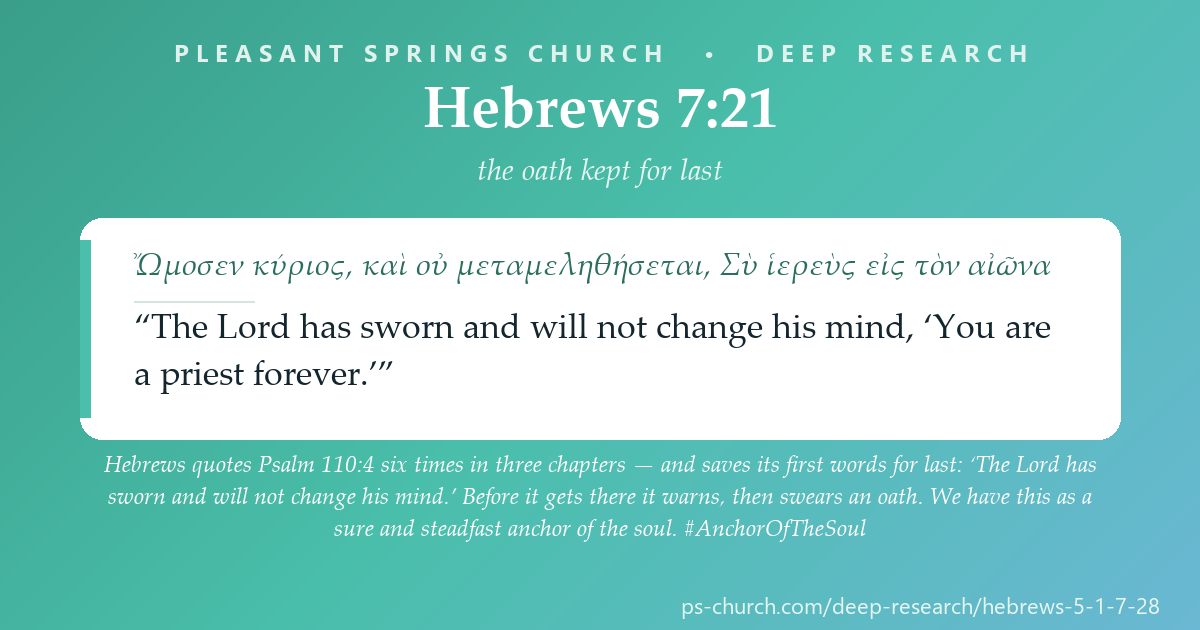
Six verses share four or more consecutive words with Septuagint Psalm 109:4 (Psalm 110:4), and in all six it is the deepest (at 7:11 jointly with 2 Chronicles 30:19) partner: 5:6 (8), 5:10 (4), 6:20 (4), 7:11 (4, band 2), 7:17 (8), 7:21 (6). The first five are all the second half of the verse — You are a priest forever after the order of Melchizedek. The first half — ὤμοσεν κύριος καὶ οὐ μεταμεληθήσεται, The Lord has sworn and will not change his mind — is quoted once, in the sixth of the six, at 7:21. Its exact words stand in one unit of the Greek Old Testament and one verse of the New. Between the first citation and the last the writer spends 6:13–18 explaining what it means when God swears, from the oath to Abraham, and opens 7:20 with it was not without an oath. That is a description of the order of a text, measured; it is not a proof of what the writer intended, and the page does not offer it as one.
The Lord has sworn and will not change his mind, “You are a priest forever after the order of Melchizedek.”Psalm 110:4 (ESV) · Septuagint 109:4: ὤμοσεν κύριος καὶ οὐ μεταμεληθήσεται σὺ εἶ ἱερεὺς εἰς τὸν αἰῶνα κατὰ τὴν τάξιν Μελχισεδεκ · Masoretic: נִשְׁבַּע יְהֹוָה וְלֹא יִנָּחֵם אַתָּה־כֹהֵן לְעוֹלָם עַל־דִּבְרָתִי מַלְכִּי־צֶדֶק
The divergences, side by side — reported, never explained:
| where | Masoretic | Greek OT (CATSS) | Hebrews (SBLGNT) | what differs | the Old Testament verse in the ESV |
|---|---|---|---|---|---|
| Psalm 2:7 · Heb 5:5 | בְּנִי אַתָּה | υἱός μου εἶ σύ | Υἱός μου εἶ σύ | the Greek supplies a verb; Hebrews keeps it | I will tell of the decree: The Lord said to me, “You are my Son; today I have begotten you. |
| Psalm 110:4 (LXX 109:4) · Heb 5:6, 7:17, 7:21 | אַתָּה־כֹהֵן | σὺ εἶ ἱερεὺς | Σὺ ἱερεὺς | the Greek supplies a verb; Hebrews does not have it, three times out of three | The Lord has sworn and will not change his mind, “You are a priest forever after the order of Melchizedek.” |
| Psalm 110:4a (LXX 109:4a) · Heb 7:21 | נִשְׁבַּע יְהֹוָה וְלֹא יִנָּחֵם | ὤμοσεν κύριος καὶ οὐ μεταμεληθήσεται | Ὤμοσεν κύριος, καὶ οὐ μεταμεληθήσεται | none — the oath is quoted to the word | (as above) |
| Genesis 22:17 · Heb 6:14 | אַרְבֶּה אֶת־זַרְעֲךָ | πληθυνῶ τὸ σπέρμα σου | πληθυνῶ σε | Hebrew and Greek agree (your offspring); Hebrews differs from both (you). The two words of Hebrews stand at Genesis 17:2, “that I may make my covenant between me and you, and may multiply you greatly.” | and said, “By myself I have sworn, declares the Lord, because you have done this and have not withheld your son, your only son, I will surely bless you, and I will surely multiply your offspring as the stars of heaven and as the sand that is on the seashore. And your offspring shall possess the gate of his enemies, |
| Genesis 14:20 · Heb 7:2 | וַיִּתֶּן־לוֹ מַעֲשֵׂר מִכֹּל | καὶ ἔδωκεν αὐτῷ δεκάτην ἀπὸ πάντων | δεκάτην ἀπὸ πάντων ἐμέρισεν Ἀβραάμ | neither Genesis names the giver; Hebrews does, and so does the ESV of Genesis | And he blessed him and said, “Blessed be Abram by God Most High, Possessor of heaven and earth; and blessed be God Most High, who has delivered your enemies into your hand!” And Abram gave him a tenth of everything. |
| Numbers 23:19 · Heb 6:18, 7:21 | וִיכַזֵּב · וְיִתְנֶחָם | διαρτηθῆναι · ἀπειληθῆναι | ψεύσασθαι · μεταμεληθήσεται | the Hebrew verse has both of Hebrews’ senses, lie and change his mind (the second from the same root as Psalm 110:4’s יִנָּחֵם); the Greek verse has neither word | God is not man, that he should lie, or a son of man, that he should change his mind. Has he said, and will he not do it? Or has he spoken, and will he not fulfill it? |
Read the first two rows together. Both oracles are verbless in Hebrew; the Greek Psalter gives both a verb; Hebrews keeps the verb in one and not in the other, in consecutive verses (5:5–6), and keeps the same pattern at 7:17 and 7:21. A reader who wanted to say Hebrews was following the Hebrew at Psalm 110:4 would have to explain the Genesis row, where Hebrews follows neither; a reader who wanted to say Hebrews was paraphrasing freely would have to explain the oath row, quoted to the word. The page does neither. No apparatus of the Greek Psalter is held here, so whether any Greek witness of Psalm 109:4 lacks the verb cannot be checked; the SBLGNT apparatus records no edition of Hebrews that has it.
Salem and peace. βασιλεὺς Σαλήμ, ὅ ἐστιν βασιλεὺς εἰρήνης — king of Salem, that is, king of peace. The name Σαλημ stands in four CATSS units: Genesis 14:18, Genesis 33:18, Judith 4:4, and Jeremiah 48:5 in the Greek numbering, where the Masoretic 41:5 has Shiloh, מִשִּׁלוֹ. Where the Masoretic Psalm 76:3 has the city — בְשָׁלֵם — and the ESV prints, at 76:2, “His abode has been established in Salem, his dwelling place in Zion.”, the Greek Psalter, at 75:3, has ἐν εἰρήνῃ, in peace. And the traffic runs the other way at Genesis 33:18, where the Masoretic שָׁלֵם is the ESV’s safely — “And Jacob came safely to the city of Shechem, which is in the land of Canaan, on his way from Paddan-aram, and he camped before the city.” — and the Greek makes it a town, εἰς Σαλημ. The equation Hebrews makes is already in the Greek Old Testament once. The page does not say Hebrews took it from there.
⚠️ The counter-examples — six rows at four with a tie band of one, and two are the psalm:
| Hebrews | partner (run 4, band 1) | the shared words | what the partner is |
|---|---|---|---|
| 5:3 | Sirach 10:2 | τοῦ λαοῦ, οὕτως καὶ | as the judge of the people, so are his officials — a proverb about rulers (a witness, not Scripture) |
| 5:10 | Septuagint Psalm 109:4 (ESV 110:4) | κατὰ τὴν τάξιν Μελχισέδεκ | the psalm |
| 6:10 | 2 Maccabees 8:4 | εἰς τὸ ὄνομα αὐτοῦ | the blasphemies committed against his name (a witness, not Scripture) |
| 6:20 | Septuagint Psalm 109:4 (ESV 110:4) | κατὰ τὴν τάξιν Μελχισέδεκ | the psalm |
| 7:5 | 3 Kingdoms 12:31 (1 Kings) | ἐκ τῶν υἱῶν Λευὶ | Jeroboam’s priests: “He also made temples on high places and appointed priests from among all the people, who were not of the Levites.” |
| 7:24 | Tobit 12:18 (BA) | αὐτὸν εἰς τὸν αἰῶνα | bless him forever (a witness, not Scripture) |
Same depth, same band, and four of the six are not the psalm. The psalm’s after the order of Melchizedek at 5:10 and 6:20 is indistinguishable, by number, from a proverb about magistrates, a Maccabean complaint, a doxology in Tobit and a line from Kings. The 7:5 row is the one to sit with: its only partner is a verse about a priesthood that was, literally, not of the sons of Levi — Jeroboam’s, which the narrator condemns — while Hebrews 7 is arguing for a priest who is not of Levi either. The screen cannot tell an echo from an accident, and on this row neither can the page. Add 5:1 (four, band four: a formula), 6:8 (three, band two: Genesis and a psalm heading) and 7:11 (four, band two: the psalm and 2 Chronicles), and the rule of the shelf is plain on one page: a run means nothing until someone reads the partner.
What the screen cannot see:
- Psalm 34:5, 34:8 (Masoretic 34:6, 34:9 · Septuagint 33:6, 33:9) — the Greek psalm has both of 6:4’s verbs: φωτίσθητε (Those who look to him are radiant, and their faces shall never be ashamed.) and γεύσασθε (Oh, taste and see that the Lord is good! Blessed is the man who takes refuge in him!). Measured against 6:4 and 6:5 the pair runs are one word each: the forms differ (imperatives there, participles here). The page notices the pair and builds nothing on it; no commentary was checked for it.
- Genesis 3:17–18 — “thorns and thistles it shall bring forth for you; and you shall eat the plants of the field.” The curse on the ground stands behind thorns and thistles … near to being cursed (6:8): three words of form, and the curse itself only in sense.
- Numbers 14 — Kadesh-barnea, the background the loss-of-reward reading gives 6:4–8 (Stage 5). Its oath (ἦ μὴν, the same particle as Genesis 22:17) belongs to the wilderness chapters of Hebrews 3–4.
- Leviticus 16 — “and the Lord said to Moses, ‘Tell Aaron your brother not to come at any time into the Holy Place inside the veil, before the mercy seat that is on the ark, so that he may not die. For I will appear in the cloud over the mercy seat.” The Day of Atonement behind 6:19–20: three words of form at band four, and a whole ritual in sense (see the Day of Atonement).
- Numbers 23:19 — the verse most often cited for impossible for God to lie: in Greek it shares no word form with 6:18 (pair run 0; the one word in common, God, is nominative in Numbers and accusative in Hebrews). “God is not man, that he should lie, or a son of man, that he should change his mind. Has he said, and will he not do it? Or has he spoken, and will he not fulfill it?”
Which cross-references matter?
- Psalm 2:7; Psalm 110:1, 4 (LXX 109:1, 4) — the two oracles of 5:5–6; Psalm 110:1 is echoed at 1:3 and quoted at 1:13 — see Psalm 2, Psalm 110, Hebrews 1:1–4.
- Genesis 14:17–20; Genesis 22:16–17 — Melchizedek, and the oath after the Aqedah (see Genesis 14, Genesis 22).
- Hebrews 2:17–18; 4:14–16 — the merciful and faithful high priest, announced and then offered (see Hebrews 2, Hebrews 4:14–16); the warning chapters that precede this page are Hebrews 3:1–4:13.
- Hebrews 10:26–39; 12:15–17 — the other two warnings in the same register; 10:32 (after you were enlightened) and 10:39 (we are not of those who shrink back) bear directly on 6:4–9.
- Romans 8:34; 1 John 2:1 — Christ the intercessor and advocate, beside 7:25.
The readings of 6:4–8 with their proponents, the church’s frame labelled as the church’s, and everything this page could not check.
None of the modern works named on this page was re-read for it. The positions are reported as the literature commonly summarises them, and a reader who wants to rely on an attribution should check it in the book. The Fathers in Stage 2 are the exception: they are quoted from files on this disk.
Commentaries & studies:
- Harold W. Attridge, The Epistle to the Hebrews (Hermeneia, 1989); William L. Lane, Hebrews 1–8 (WBC 47A, 1991); Paul Ellingworth (NIGTC, 1993); F. F. Bruce (NICNT, rev. 1990); Craig R. Koester (AB 36, 2001); Peter T. O’Brien (Pillar, 2010; withdrawn by the publisher, 2016); Gareth Lee Cockerill (NICNT, 2012).
- On Melchizedek: A. S. van der Woude, OTS 14 (1965); M. de Jonge and A. S. van der Woude, “11Q Melchizedek and the New Testament,” NTS 12 (1966); Fred L. Horton (1976); Paul J. Kobelski (1981); Eric F. Mason (2008).
- On the warning: Herbert W. Bateman IV, ed., Four Views on the Warning Passages in Hebrews (2007); Scot McKnight, “The Warning Passages of Hebrews,” TrinJ 13 (1992); Wayne Grudem, “Perseverance of the Saints: A Case Study from Hebrews 6:4–6 and the Other Warning Passages in Hebrews,” in Schreiner and Ware, eds., The Grace of God, the Bondage of the Will (1995); Thomas R. Schreiner and Ardel B. Caneday, The Race Set Before Us (2001); Randall C. Gleason, “The Old Testament Background of the Warning in Hebrews 6:4–8,” BSac 155 (1998).
- On the church’s frame: Timothy George, Amazing Grace (2000; 2nd ed. 2011), the ROSES acronym; Kenneth Keathley, Salvation and Sovereignty: A Molinist Approach (2010). On oblation and intercession: John Owen, The Death of Death in the Death of Christ (1647).
Hebrews 6:4–8: the readings, fairly stated.
Each reading below is stated as its own holders would state it, with the anchor they lean on hardest and the text that gives them the most trouble. No reading is free of trouble; the passage would not have been argued over for eighteen centuries if one were.
| reading | the five participles describe | impossible means | its strongest anchor in Hebrews | what it has to explain | held by (reported) |
|---|---|---|---|---|---|
| 1. Loss of salvation | genuine believers — the words are Hebrews’ own for the church (10:32; 3:1, 3:14) | real: a believer who deliberately repudiates Christ cannot be brought back (some in this view limit it to the repudiation of 6:6, persisted in) | one article, five aorists, one people; 10:29, where the one who has spurned the Son is the one who ἡγιάσθη, was sanctified, by the blood of the covenant | 6:9 (things that belong to salvation) and the oath and anchor of 6:13–20, which ground assurance in God rather than in the hearer | I. Howard Marshall, Kept by the Power of God (1969); Scot McKnight, TrinJ 13 (1992); Grant R. Osborne and Gareth Lee Cockerill in Four Views (2007); David A. deSilva, Perseverance in Gratitude (2000) |
| 2. Hypothetical | genuine believers | real as a consequence, but stated of a case the writer does not expect to happen: if a believer could fall away, there would be no road back | 6:9, read as the writer’s own verdict on his hearers; the warning serves the call to go on to maturity (6:1) | the Greek has no condition, only a participle in the chain; critics ask what a warning about the impossible is for | Thomas Hewitt (Tyndale, 1960); Homer A. Kent Jr. (1972) |
| 3. False professors (phenomenological) | real experiences inside the covenant community — light, a taste of the gift, a share in the Spirit’s work — that stop short of regeneration | real: those who repudiate Christ after such light will not be brought back | the land of 6:7–8 (the same rain, two crops, and the crop shows the ground); 6:9 separates ‘better things’ from what was described; 3:14 (we have come to share in Christ, if…) makes holding fast the evidence of having shared | the vocabulary: enlightened at 10:32 and sharers at 3:1 and 3:14 are used of the real church, and taste at 2:9 is Jesus’ real death | John Owen, Exposition of Hebrews (1668–84); Roger Nicole (1975); Wayne Grudem (1995); Buist M. Fanning in Four Views (2007) |
| 4. Loss of reward / covenant discipline | genuine believers | real, but what is lost is reward, usefulness or the inheritance in this life, not eternal life; the burning of 6:8 is a field’s, a judgment of works (compare 1 Corinthians 3:15) | 6:8 says near to being cursed, and it is the land that is burned; the redeemed generation that lost the land at Kadesh (Numbers 14) is the model | eternal judgment is already named in 6:2; 10:27 and 10:39 speak of fire and of ἀπώλειαν, ruin | Zane C. Hodges (Bible Knowledge Commentary, 1983); Thomas K. Oberholtzer, BSac 145 (1988); Randall C. Gleason, BSac 155 (1998) and in Four Views (2007); Joseph C. Dillow (1992) |
| 5. Means of perseverance (a fifth, often added) | those the writer addresses as believers | real and prospective: the warning states what would follow, and is itself the means God uses so that it does not | 6:11–12 (earnestness until the end); the oath of 6:17–20; 3:14 | it explains what the warning is for more than who the people of 6:4–6 are | Thomas R. Schreiner and Ardel B. Caneday, The Race Set Before Us (2001) |
| The Fathers held on this disk | the baptized (Jerome; Chrysostom) | for Chrysostom, Ambrose and John of Damascus: no second baptism; for Tertullian and the Novatians: no restoration of the lapsed | renew again, read as the laver | none of the modern questions; theirs was a dispute about baptism and penance | quoted in Stage 2 from ANF 4 and NPNF 6, 9, 10, 14 |
⚠️ The church’s frame — labelled as the church’s, not as a result:
Pleasant Springs teaches eternal security in the ROSES framing (the acronym is Timothy George’s; Kenneth Keathley develops it in a Molinist key): a true believer cannot finally lose salvation; in the words of the church’s statement of faith, all who genuinely receive Christ are held secure; and the warnings are a real means by which God holds his people fast (see TULIP, DAISY and ROSES and what we believe). That is the church’s position. Nothing measured on this page establishes it, and nothing measured on this page refutes it. On that frame, readings 3 and 5 are its natural homes; readings 2 and 4 are compatible with it; reading 1 is the one it excludes.
What stays hard for the church’s frame in this text, and the page will not hide it: (a) the five participles use Hebrews’ own vocabulary for the real church — φωτισθέντες at 10:32, μέτοχοι at 3:14; (b) γεύσηται θανάτου at 2:9 makes tasted a word for real experience; (c) παραπεσόντας is the fifth aorist of one series, not a condition; (d) Ἀδύνατον is absolute in Hebrews’ other three uses.
What the frame can point to in the passage itself: 6:9, “Though we speak in this way, yet in your case, beloved, we feel sure of better things—things that belong to salvation.”; the oath and the anchor of 6:13–20; 7:25, where the ground of able to save to the uttermost is that he always lives to intercede; and, beyond the chapter, 10:39, “But we are not of those who shrink back and are destroyed, but of those who have faith and preserve their souls.” and 3:14, “For we have come to share in Christ, if indeed we hold our original confidence firm to the end.” Outside Hebrews, 1 John 2:19, “They went out from us, but they were not of us; for if they had been of us, they would have continued with us. But they went out, that it might become plain that they all are not of us.” and John 10:28, “I give them eternal life, and they will never perish, and no one will snatch them out of my hand.”
7:25–27 and the scope of the offering — the church’s position labelled:
7:25: “Consequently, he is able to save to the uttermost those who draw near to God through him, since he always lives to make intercession for them.” And, two verses on, the offering made ἐφάπαξ, once for all. John Owen argued (The Death of Death, 1647) that Christ’s offering and his intercession have the same scope — he offered for exactly those for whom he intercedes, so that an offering wider than the intercession would divide the one work of the one high priest; and 7:25 names them: those who draw near (reported; Owen is not on this disk and was not re-read). That division is exactly what the church’s position makes, and it is the point Owen contests. Pleasant Springs holds unlimited provision: the once-for-all offering is sufficient for all and offered to all — Hebrews 2:9 has him taste death ὑπὲρ παντὸς (“But we see him who for a little while was made lower than the angels, namely Jesus, crowned with glory and honor because of the suffering of death, so that by the grace of God he might taste death for everyone.” — the ESV’s by the grace of God follows the reading of Westcott–Hort, Tregelles, NA28 and Robinson–Pierpont; the SBLGNT held here reads χωρὶς θεοῦ, apparatus χωρὶς Holmes ] χάριτι WH Treg NA28 RP, as the Hebrews 2 study sets out) — while its application, and the intercession of 7:25, belong to those who come. What the text itself gives is its scope words, and only those: 7:25 τοὺς προσερχομένους; 7:27 τῶν τοῦ λαοῦ and ἐφάπαξ; 2:9 ὑπὲρ παντὸς, which the shelf’s Hebrews 2 study left open between everyone and everything. The church’s position is the church’s.
Interpretation notes worth keeping:
- Weakness, sin and death. Hebrews names three limits on Aaron’s line: weakness (5:2; 7:28), their own sins (5:3; 7:27) and death (7:23). Each priest offers for his own sins; the line fails because its priests die. The church teaches ancestral sin as inherited mortality, not inherited guilt; the passage fits that frame and says nothing either way about guilt inherited from Adam. Nothing more is claimed.
- The days of his flesh (5:7–8). He learned obedience through what he suffered is not a move from disobedience to obedience but the Son’s obedience tested to the full; the page reads it within the creedal boundary — one person, truly God and truly man — and claims no more.
- A type, not a Christophany. Melchizedek was made like the Son (7:3). The shelf’s Genesis 14, Psalm 110 and Hebrews 4:14–16 pages say the same; so does Chrysostom (Stage 2).
- The age to come (6:5). Its powers are tasted now. The page draws no millennial scheme from the phrase; the church’s historic premillennialism neither needs it nor is threatened by it.
⚠️ What this page could not check — and where it is weakest:
- The modern literature was not re-read. Every attribution of a reading to a scholar in this stage is reported, not verified against the book. That includes the four contributors to Four Views and the placement of Hewitt and Kent under the hypothetical reading.
- 11QMelchizedek (11Q13) is not on this disk. Nor is Philo’s Allegorical Interpretation (only On the Giants is held), nor Josephus’ Jewish War (6.438 also names Melchizedek; only the Antiquities is held). Heiser’s own writing on Melchizedek is not on disk either, so the Stage 2 framing is the shelf’s use of his method, not a summary of his conclusions.
- No apparatus of the Greek Old Testament. CATSS is Rahlfs’ hand edition, not Göttingen. Whether any Greek witness of Psalm 109:4 lacks εἶ, or any witness of Genesis 22:17 reads σε, cannot be checked here. The page’s finding about the verb is a finding about these two editions, CATSS and the SBLGNT, and nothing wider.
- The New Testament apparatus is the SBLGNT’s (Holmes; CC BY 4.0), which compares four printed editions — Westcott–Hort, Tregelles, NA28 and Robinson–Pierpont — and reports no manuscripts. It records no edition that reads the verb at 5:6, 7:17 or 7:21.
- The ESV’s footnotes were not fetched. Where the page says what the ESV reads, it means the text the Crossway API returns with footnotes switched off.
- The screen finds verbatim contact only. The fact that 6:4–6 shares no more than a formula with any verse of either Testament does not mean the passage has no background; Psalm 34 (Septuagint 33), Genesis 3 and Numbers 14 are all candidates the screen cannot see.
- The weakest point of the page is its title. Kept for last describes the order in which a text cites a verse; it does not prove a design, and the missing verb is one word — the copula, which Greek drops freely. The page builds no doctrine on either. What it does build on them is a habit of reading: a citation is not a photocopy, and the differences are worth seeing before anyone explains them.
- The thirty-three. The count of New Testament verses that share no two consecutive word forms with anything comes from the shelf’s Romans 12–13 study; this page re-derived only Hebrews’ two members of it (7:22 and 13:1).
- Doctrine. The church’s positions on security, on the atonement and on ancestral sin are labelled wherever they appear. The measurement does not adjudicate Hebrews 6:4–8, and the page does not pretend that it does.
A warning you cannot soften, and an oath you cannot break.
Name what you learned, why it matters, and one concrete response.
What should we carry away — and do?
- The warning is real, and it is not the last word. Hebrews 6 does not end at the burned field. It ends behind the curtain, with an anchor that holds from a place we cannot see.
- God swore, so that we would not have to wonder. People swear by something greater to end an argument; God had nothing greater, so he swore by himself. The hope set before us rests on two things in which it is impossible for God to lie.
- The priest who lives forever does not stop interceding. The reason he can save to the uttermost is not our grip but his life: he always lives to make intercession for those who draw near through him.
- Read the Greek before you explain it. The writer quotes the psalm fourteen words out of fifteen and the oath last of all. The differences are small and real, and seeing them comes before any theory of why.
Step in response: if you have been drifting — going slack, as the writer says, content with the first things — do not answer that with fear alone, and do not answer it with presumption. Do what he did: read the warning through to the oath. Then draw near to God through the priest who lives to intercede for you, and go on.
Hebrews 6:19 · to share
Greek NT + ESVEvery Deep Research page traces its passage across the whole sweep — the Old Testament, the Second-Temple world between the testaments (historical witnesses, not Scripture), and the New Testament. Follow the thread:
Pleasant Springs Church — Deep Research
Research method after Michael S. Heiser’s Bible Research Method (examine dictionaries → ancient literature → important words → textual connections → academic publications → share), with the Pleasant Springs “Author & Audience” foundation. Scripture set in the Hebrew, the Greek editions named on each page and the ESV (Old Testament), and the Greek New Testament and the ESV (New Testament), per the practice of Pleasant Springs Church. Hebrews research grounded in Attridge, Lane, Ellingworth, Bruce, Koester, O’Brien and Cockerill, with Horton, Kobelski and Mason on Melchizedek and Bateman’s Four Views on the warning — none of which were consulted for any number on this page. Text: Greek New Testament from the SBL edition as digitized by MorphGNT (text, lemma and parsing columns); SBLGNT apparatus, Michael W. Holmes (ed.), Society of Biblical Literature and Logos Bible Software, CC BY 4.0; Greek Old Testament from Rahlfs’ Septuaginta as digitized by CATSS; Hebrew from the Masoretic text as printed in Sefaria’s Miqra according to the Masorah; Josephus from Niese’s edition, Perseus Digital Library, CC BY-SA 4.0; Tertullian, Chrysostom, Ambrose, Jerome and John of Damascus from the public-domain Schaff Ante-Nicene and Nicene and Post-Nicene Fathers. ⚠️ VERSE NUMBERING. Hebrews has no offset. Psalm 110:4 = Septuagint 109:4 (chapter only); ESV Psalm 76:2, 34:5 and 34:8 = Masoretic 76:3, 34:6, 34:9 = Septuagint 75:3, 33:6, 33:9; the heading of Psalm 42 = Masoretic 42:1 = Septuagint 41:1; 1 Kings = CATSS 3 Kingdoms; Genesis, Leviticus and Numbers numbered alike in all three. ⚠️ The measurement, in full. Greek against Greek; MorphGNT normalised word; CATSS FORM column, beta-code transliterated first; both sides lowercased, accents and breathings dropped, final sigma folded, filtered to Greek letters, with the shelf’s edition-equivalence table on cross-corpus screens. Contiguous runs of whole word forms, never lemmas. 62 rows against 30,348 verse units — the 64 CATSS files less the Odes, which are held but not screened by house convention — and against the other 7,865 verses of the Greek New Testament. Exhaustive and deterministic. It finds verbatim contact, not allusion.
Scripture quotations marked ESV are from the ESV® Bible (The Holy Bible, English Standard Version®), © 2001 by Crossway, a publishing ministry of Good News Publishers. ESV Text Edition: 2016. Used by permission. All rights reserved. The ESV text may not be quoted in any publication made available to the public by a Creative Commons license, and the ESV may not be translated in whole or in part into any other language. www.esv.org
|
Did this study bless you today? 💚 Give to Support PS Church100% of gifts go to the General Fund — thank you. |