Hebrews reads out five verses of Psalm 95, quotes lines of it four times more, and once sets Genesis 2 beside it — and the whole argument rests on a word. In the Greek, the psalm’s my rest (τὴν κατάπαυσίν μου) and Genesis’ God rested (κατέπαυσεν) are one word family, and the writer uses it eleven times in thirty-two verses. In the Hebrew they are not. Psalm 95:11 has אֶל־מְנוּחָתִי, from the root nûaḥ; Genesis 2:2 has וַיִּשְׁבֹּת, from shābat, the root of Sabbath. Measured on this disk, the Greek noun stands in ten verses of the Greek Old Testament that have a Hebrew original, and in nine of the ten the Hebrew verse carries nûaḥ. The one Hebrew verse that gives God’s seventh day the psalm’s root is Exodus 20:11 (וַיָּנַח בַּיּוֹם הַשְּׁבִיעִי) — and Hebrews 4:4 matches Genesis 2:2 for nine consecutive Greek words, tie band 1, and Exodus 20:11 for four. Then, at 4:9, the writer names the rest that remains with σαββατισμὸς — a word that stands in none of the 30,637 verse units of Greek Old Testament held here, built on sabbaton: the other root. The measurement says where the words stand. It does not say the writer knew Hebrew, coined the word, or chose it for its root, and this page does not say so either. Stage 4 prints the runs of four that mean nothing at all, and the citation of Numbers that measures no more than they do. See the method →
Hebrews 3:1–4:13 (twenty-six of thirty-two verses)
Greek New Testament (SBLGNT, via MorphGNT) · ESVThe Old Testament texts set beside it do carry offsets, and every one is stated where it is used and gathered here. Psalm 95 is Greek Psalm 94, with the same verse numbers: Psalm 95:7–11 = Greek 94:7–11. The Hebrew psalm has no heading; the Greek psalm’s first verse opens with one (Stage 2). Psalm 132:14 is Greek Psalm 131:14. Numbers 10:36 in the Hebrew and the ESV is Greek Numbers 10:35 (the Greek reorders 10:34–36). 1 Chronicles 6:31 in the ESV is 6:16 in both the Hebrew and the Greek. 1 Kings 8:56 is filed by the Greek as 3 Kingdoms 8:56 and 2 Samuel 9:9 as 2 Kingdoms 9:9, with the same numbers. Genesis 2:2–3 and 31:35, Exodus 16:30, 17:7, 20:11, 31:17 and 35:2, Numbers 12:7, 14:29–34, 20:13 and 26:4, Deuteronomy 12:9–10, Joshua 1:13, 10:20, 21:44, 22:4 and 23:1, Judges 19:16 and 20:43, 2 Chronicles 6:41, Proverbs 5:4 and Isaiah 66:1 are numbered alike in all three. Judges is held in two Greek texts, A and B; where one is quoted the page names it.
Reading the Greek column. Bold marks the words each note is about — the measured run, where the row has one worth printing; underline marks a second set. The Greek is the SBLGNT text column with its apparatus sigla removed, read off the MorphGNT files at build time. Where the SBLGNT and the ESV part company — 3:2, 3:10, 4:8, 4:10 — the note says so and both are printed as they stand.
The Shape of the Passage
A sequence of five panels inside a frame that closes one verse after this study ends — two measured brackets, NOT a chiasmThe letter’s own words first, and the inference kept apart from them. Every count in this section is read off the MorphGNT parsing of Hebrews 3:1–4:13 held on this disk: 522 words in 32 verses, of which 125 — 23.9 per cent — are quotation: 111 from Psalm 95 and 14 from Genesis 2:2.
Author
The writer of Hebrews is unnamed, and this page will not guess. What the passage shows is a preacher who treats an old psalm as present speech. He introduces it with λέγει τὸ πνεῦμα τὸ ἅγιον — the Holy Spirit says, present tense — and later as spoken ἐν Δαυὶδ λέγων, in David, saying. The two texts of the psalm differ on that second point. The Hebrew Psalm 95 has no heading at all; it opens לְכוּ נְרַנְּנָה לַיהֹוָה, Oh come, let us sing. The Greek psalm opens with one: αἶνος ᾠδῆς τῷ Δαυιδ, a praise of a song, of David. In David can mean the man or the book of Psalms called by his name; the page does not choose, and the argument of 4:7–8 needs only that the psalm’s Today was spoken long after Joshua.
He argues in the order of the text he is reading. The three questions of 3:16–18 are built on the psalm’s three verbs, in the psalm’s sequence: the embittering (παρεπίκραναν), the loathing (προσώχθισεν), the oath (ὤμοσεν). Then εἰσελθεῖν (3:19), the verb of the oath itself. It is exposition the way a lawyer reads a statute: clause by clause, and nothing skipped.
And he does not belittle Moses. The comparison of 3:1–6 opens with the words of God’s own commendation — faithful in God’s house (Numbers 12:7) — and keeps the word πιστός for both. The difference is not between faithful and unfaithful but between ὡς θεράπων and ὡς υἱὸς: a servant in the house, and a son over it.
Audience
Holy brothers. The passage addresses its hearers twice, ἀδελφοὶ ἅγιοι (3:1) and ἀδελφοί (3:12), and describes them as κλήσεως ἐπουρανίου μέτοχοι — partakers of a heavenly calling. The warning of 3:12 is spoken to people the writer calls brothers in the same breath. Stage 5 sets out what has been made of that.
People who need to keep hearing. ἀκούω stands five times in the passage; σκληρύνω four times — and four of its six New Testament occurrences are here (Acts 19:9 and Romans 9:18 are the other two). The danger named is not ignorance but a heart that has heard and gone hard.
A church that is told to talk to itself. The remedy of 3:13 is communal and daily: παρακαλεῖτε ἑαυτοὺς καθ’ ἑκάστην ἡμέραν — exhort one another every day. Not the preacher to the congregation, but the congregation to itself, ἄχρις οὗ τὸ Σήμερον καλεῖται, for as long as the word Today is still being said.
Orient on Moses the servant, Massah and Meribah, Kadesh and the forty years, rest and Sabbath, and the warning passages — before touching a single number.
Search by topic: Hebrews, Letter to the; Moses; servant; house of God; Psalm 95 (the Venite); Massah and Meribah; Kadesh-barnea; wilderness wanderings; forty; oath; rest; Sabbath; seventh day; Joshua; apostasy; perseverance; warning passages; word of God; sword.
Which articles are relevant?
- Anchor Bible Dictionary — “Hebrews, Epistle to the,” “Rest,” “Sabbath,” “Massah and Meribah,” “Kadesh,” “Wilderness Wanderings.”
- Dictionary of the Later New Testament & Its Developments (IVP) — “Hebrews,” “Apostasy,” “Perseverance,” “Old Testament in Hebrews,” “Sabbath, Sunday, and the Lord’s Day.”
- NIDNTTE / TDNT — the articles on katapausis and katapauō, sabbaton and sabbatismos, sēmeron, apistia and apeitheia, metochos, logos.
- HALOT / BDB — the Hebrew roots nûaḥ (with mənûḥāh) and shābat (with shabbāt): the two words for rest this page is about.
Bibliography surfaced:
- William L. Lane (WBC 47A), Harold W. Attridge (Hermeneia), Paul Ellingworth (NIGTC), F. F. Bruce (NICNT), Gareth Lee Cockerill (NICNT), Peter T. O’Brien (Pillar), Craig R. Koester (Anchor Yale), David A. deSilva (Perseverance in Gratitude) on Hebrews.
- Otfried Hofius, Katapausis (WUNT 11, 1970); Jon Laansma, ‘I Will Give You Rest’ (WUNT 2/98, 1997) — the two monographs on the rest motif.
- Herbert W. Bateman IV, ed., Four Views on the Warning Passages in Hebrews (2007); Thomas R. Schreiner and Ardel B. Caneday, The Race Set Before Us (2001).
Two place-names in a desert, an oath at Kadesh, and what the first Christian centuries did with the seventh day.
Witnesses, not Scripture, and each one marked as either read on this disk or reported. The Greek and Hebrew Old Testament are read from the corpora; the Church Fathers from the public-domain Ante-Nicene and Nicene and Post-Nicene Fathers English held in this library; rabbinic and other sources are reported from the standard literature and were not checked against any text here.
Massah and Meribah: two names in one text, two events in the other
The Hebrew of Psalm 95:8 names two places — כִּמְרִיבָה כְּיוֹם מַסָּה, as at Meribah, as on the day at Massah — the place of Exodus 17:7 where Israel “tested the Lord.” The Greek psalm names none. It has ἐν τῷ παραπικρασμῷ and κατὰ τὴν ἡμέραν τοῦ πειρασμοῦ: the embittering and the testing. For Massah the psalm and Greek Exodus agree — Exodus 17:7 names the place πειρασμὸς καὶ λοιδόρησις — but for Meribah they part: Exodus has the second of those words, Greek Numbers 20:13 has ὕδωρ ἀντιλογίας, and the Greek psalm uses neither. Its noun for Meribah stands in no other verse of the screened Greek Old Testament. (That finding was first measured on this shelf’s Psalms 93–96 study, and it reproduces here.) Hebrews 3:8 has the wording of the Greek, and then, in its own sentence at 3:16, uses the verb of the same family, παρεπίκραναν.
The ESV shows the difference without meaning to. At Psalm 95:8 it prints “do not harden your hearts, as at Meribah, as on the day at Massah in the wilderness,”; at Hebrews 3:8 it prints “do not harden your hearts as in the rebellion, on the day of testing in the wilderness,”. One English Bible, following each text faithfully, and an English reader sees two places in the psalm and two events in the letter.
Kadesh: an oath about a land, read as an oath about a rest
Numbers 14 is the story Hebrews 3:16–19 retells — the spies, the refusal, the oath, the forty years, the bodies in the wilderness. The oath of Numbers 14:30 has the same shape in both languages as the oath of the psalm: the Hebrew אִם־אַתֶּם תָּבֹאוּ אֶל־הָאָרֶץ against אִם־יְבֹאוּן אֶל־מְנוּחָתִי; the Greek εἰ ὑμεῖς εἰσελεύσεσθε εἰς τὴν γῆν against εἰ εἰσελεύσονται … τὴν κατάπαυσίν μου. In Numbers the object is the land. In the psalm it is my rest. Deuteronomy 12:9 had already set the two side by side: “for you have not as yet come to the rest and to the inheritance that the Lord your God is giving you.” — אֶל־הַמְּנוּחָה וְאֶל־הַנַּחֲלָה; εἰς τὴν κατάπαυσιν καὶ εἰς τὴν κληρονομίαν. Hebrews 3:18 shares three words with that verse, in a tie band of five.
The children, and what they bore. Numbers 14 does not only exclude a generation; it brings another in. “But your little ones, who you said would become a prey, I will bring in, and they shall know the land that you have rejected.” And of the same children: “And your children shall be shepherds in the wilderness forty years and shall suffer for your faithlessness, until the last of your dead bodies lies in the wilderness.” — the Hebrew וְנָשְׂאוּ אֶת־זְנוּתֵיכֶם, the Greek ἀνοίσουσιν τὴν πορνείαν ὑμῶν, they shall bear your whoredom. The children carry the consequence for forty years, and they enter; the ones whose bodies fall are, in Hebrews’ own words, τοῖς ἁμαρτήσασιν, those who sinned (3:17). The church that keeps this shelf holds that what Adam’s children inherit is mortality and its consequences, not his guilt. Numbers 14 is not a text about Adam and is not offered as proof of that; it is a narrative in which bearing a consequence and bearing guilt are visibly not the same thing, and the reader can weigh it.
The seventh day after the New Testament — read on this disk
The Epistle of Barnabas (early second century) reads Genesis 2:2 as a calendar of history. From the English held here (ANF vol. 1, Barnabas 15): “This implieth that the Lord will finish all things in six thousand years, for a day is with Him a thousand years… ‘And He rested on the seventh day.’ This meaneth: when His Son, coming [again], shall destroy the time of the wicked man, and judge the ungodly… then shall He truly rest on the seventh day.” Barnabas does not quote Hebrews.
Irenaeus of Lyons (c. 180) reads it the same way, and his Genesis has the Greek reading. From ANF vol. 1 (Against Heresies 5.28.3): “God brought to a conclusion upon the sixth day the works that He had made; and God rested upon the seventh day from all His works… in six days created things were completed: it is evident, therefore, that they will come to an end at the sixth thousand year.” And at 5.33.2 the kingdom is “the seventh day, which has been sanctified, in which God rested from all the works which He created, which is the true Sabbath of the righteous.” Note the sixth day: that is the Greek Genesis, τῇ ἕκτῃ, not the Hebrew. Irenaeus is the classic early witness to the premillennial hope.
Augustine held that reading and then let it go. From NPNF1 vol. 2 (City of God 20.7), of the view that a thousand-year Sabbath follows six thousand years: “this opinion would not be objectionable, if it were believed that the joys of the saints in that Sabbath shall be spiritual… for I myself, too, once held this opinion.” And at 22.30: “the seventh shall be our Sabbath, which shall be brought to a close, not by an evening, but by the Lord’s day, as an eighth and eternal day.”
Three witnesses, two readings of the seventh day, and none of them is Hebrews. The English is nineteenth-century translation read from a local text and not checked against the Greek or the Latin; Irenaeus’ fifth book survives mainly in Latin.
Reported, not checked on this disk
- The Mishnah, Sanhedrin 10:3, and the Babylonian Talmud’s discussion of it (Sanhedrin 110b) — whether the wilderness generation has a share in the world to come. Rabbi Akiva is reported as saying it has none, with Psalm 95:11 among his texts; Rabbi Eliezer as saying it has. An ancient Jewish debate over exactly the line Hebrews reads eschatologically. No rabbinic text is held here; the attribution and the proof-texts are reported, not verified.
- Babylonian Talmud, Sanhedrin 99a — Rabbi Eliezer is reported as reckoning the days of the Messiah at forty years from Psalm 95:10. Commentators set this beside the forty years of Hebrews 3:9–10. Not verified here.
- Joseph and Aseneth 8:9 — Joseph prays that Aseneth may “enter your rest, which you have prepared for your chosen ones,” with the same Greek noun. Date and provenance are disputed; the text is not held here.
- Plutarch, On Superstition 3 (Moralia 166A) — the other early occurrence of the noun Hebrews uses at 4:9, in the plural, of Jewish Sabbath-keeping. Reported in the lexicons; not checked. If it is right, the word existed outside Hebrews, and nothing on this page says the writer coined it.
- Psalms of Solomon 9:1 — this one is on the disk and was measured: Israel exiled ἐν τῷ ἀποστῆναι αὐτοὺς ἀπὸ κυρίου, three words shared with Hebrews 3:12, tie band 1 (Stage 4). See the shelf’s Psalms of Solomon 1–9 study.
One Greek word for rest, two Hebrew roots beneath it, and a third word that names one of them.
Each count below was run against the corpora on this disk, not quoted from a lexicon: the 7,927 verses of the Greek New Testament (MorphGNT lemma column for New Testament counts) and 30,348 verse units of Greek Old Testament screened out of the 64 CATSS files held here. ⚠️ Held and screened are different numbers on this shelf. The 64 files hold 30,637 verse units; 289 of them are the Odes, the canticles appended to the Greek Psalter, which stay on the disk and out of anything called “the Greek Old Testament” here. Where a zero is printed, the Odes were searched too. Hebrew word chips are read off the Masoretic text by word index.
| word | this passage | Hebrews | Greek NT | Greek OT screened |
|---|---|---|---|---|
| κατάπαυσις rest (noun) | 8 | 8 | 9 | 12 verses (by eye; see the chip) |
| καταπαύω rest (verb) | 3 | 3 | 4 | — |
| σαββατισμός Sabbath rest | 1 | 1 | 1 | 0 (and 0 in the Odes) |
| σήμερον today | 5 | 8 | 41 | 271 verses |
| παραπικρασμός embittering | 2 | 2 | 2 | 1 |
| ἀπιστία unbelief | 2 | 2 | 11 | 1 |
| ἀπείθεια disobedience | 2 | 2 | 7 | — |
| μέτοχος partaker, companion | 2 | 5 | 6 | — |
| θεράπων servant | 1 | 1 | 1 | 61 verses |
| κῶλον corpses | 1 | 1 | 1 | 6 verses |
New Testament columns: lemma counts off the MorphGNT lemma column. Greek Old Testament column: form counts over the 30,348 screened CATSS units (there is no lemma column in CATSS), so a dash means the form-search was not run or would not be clean.
“Rest” — the psalm’s word, used eight times. Nine times in the Greek New Testament: these eight, and Acts 7:49, where Stephen quotes Isaiah 66:1, τίς τόπος τῆς καταπαύσεώς μου. In the Hebrew Bible God says my rest in exactly three verses — Psalm 95:11 (אֶל־מְנוּחָתִי), Psalm 132:14 (זֹאת־מְנוּחָתִי) and Isaiah 66:1 (מְנוּחָתִי) — and the Greek renders all three with this noun and my: τὴν κατάπαυσίν μου, αὕτη ἡ κατάπαυσίς μου, τῆς καταπαύσεώς μου. The New Testament quotes two of the three; and the third, Psalm 132:14, makes God’s rest a place, Zion. In the screened Greek Old Testament the noun stands in twelve verses (the form also serves the verb, so the twelve were sorted by eye); ten have a Hebrew original, and in nine of those ten the Hebrew verse carries the root nûaḥ. The tenth is Exodus 35:2, whose Hebrew has שַׁבַּת שַׁבָּתוֹן.
“Rested” — Genesis’ verb. At God’s seventh day the Greek Old Testament uses it for both Hebrew roots: καὶ κατέπαυσεν τῇ ἡμέρᾳ τῇ ἑβδόμῃ ἀπὸ πάντων τῶν ἔργων αὐτοῦ for וַיִּשְׁבֹּת at Genesis 2:2 (and again at 2:3 for שָׁבַת); καὶ κατέπαυσεν τῇ ἡμέρᾳ τῇ ἑβδόμῃ for וַיָּנַח בַּיּוֹם הַשְּׁבִיעִי at Exodus 20:11; and at Exodus 31:17 τῇ ἡμέρᾳ τῇ ἑβδόμῃ ἐπαύσατο καὶ κατέπαυσεν for שָׁבַת וַיִּנָּפַשׁ. So in Greek one stem carries both; in Hebrew they are two. When the subject is the people, the Greek can choose differently: at Exodus 16:30, καὶ ἐσαββάτισεν ὁ λαὸς τῇ ἡμέρᾳ τῇ ἑβδόμῃ — for וַיִּשְׁבְּתוּ — the people do not ‘rest’ but ‘sabbath’.
“Sabbath rest” — the one rest word in the passage that comes from neither text it quotes. Once in the Greek New Testament; no occurrence in the 30,637 Greek Old Testament verse units held here, Odes included. The verb it is built from does occur: the form ἐσαββάτισεν at Exodus 16:30, and in six more verses (Leviticus 23:32, 26:34 and 26:35, 2 Chronicles 36:21, 1 Esdras 1:55, 2 Maccabees 6:6). It names the root that Genesis 2:2 has in Hebrew and does not show in Greek. Whether the writer meant that, knew it, or simply used a word his hearers already had for Sabbath-keeping is beyond what a word count can reach.
“Into my rest” — the root nûaḥ. A place of settled rest: the ark’s resting place, the land at peace, Zion. Deuteronomy 12:9 pairs it with the inheritance; Joshua 21:44 says the Lord gave it (וַיָּנַח יְהֹוָה).
“And he ceased” — the root shābat. The verb of stopping, from which shabbāt, Sabbath, is formed. Psalm 95:11 and Genesis 2:2, the two verses Hebrews sets side by side at 4:3–5, share no word in Hebrew at all beyond the relative particle — measured, a run of one. Exodus 20:11 is the bridge the Hebrew Bible builds itself: וַיָּנַח בַּיּוֹם הַשְּׁבִיעִי, and he rested on the seventh day, with the psalm’s root, followed at once by אֶת־יוֹם הַשַּׁבָּת, the Sabbath day. The root meets the seventh day twice more, at Exodus 23:12 and Deuteronomy 5:14, but there it is the ox and the servant who rest; for God’s own rest, Exodus 20:11 is the only one.
“Today” — five times in four verses. At 3:13 it takes the article and becomes a noun, τὸ Σήμερον; at 4:7 the writer says God πάλιν τινὰ ὁρίζει ἡμέραν, Σήμερον, again appoints a certain day, ‘Today’, μετὰ τοσοῦτον χρόνον, so long afterward. The argument of 4:7–8 is that a Today spoken after Joshua means the rest was not given by Joshua.
“Servant” — once in the New Testament. The word of Greek Numbers 12:7 (ὁ θεράπων μου Μωυσῆς), where the Hebrew has עַבְדִּי. In the screened Greek Old Testament it stands in 61 verses, 27 of them in Exodus, where most are Pharaoh’s; Hebrews sets ὡς θεράπων against ὡς υἱὸς — not a rebuke of Moses but a rank.
“Sharers” or “companions”. Six times in the New Testament, five of them in Hebrews (1:9, 3:1, 3:14, 6:4, 12:8). At 1:9 it is Greek Psalm 44:8, the king’s companions, and the ESV renders it companions; at 3:14 the ESV renders it share in. The Greek is the same word.
“Unbelief” — the bracket of 3:12–19. Eleven times in the New Testament, twice in Hebrews, both here. In the screened Greek Old Testament: once, Wisdom 14:25. Its partner in the next paragraph, ἀπείθεια, disobedience, also stands twice in Hebrews, at 4:6 and 4:11, and the verb τοῖς ἀπειθήσασιν joins them at 3:18. The writer uses the two words as one charge.
“Bodies” — literally limbs. Once in the New Testament; in six verses of the screened Greek Old Testament, three of them Numbers 14:29, 14:32 and 14:33 (a seventh hit, Judith 15:4, is the place-name Kola). The word is how the allusion to Kadesh can be seen, since the run against Numbers 14:29 is only three, in a band of 132.
“Sharper”. Once in the New Testament, never in the Greek Old Testament held here — like κριτικὸς beside it and τετραχηλισμένα in 4:13. Of the seven words in this passage whose lemma stands in no Greek Old Testament verse here (cognates such as energeia and enthymēma do occur), five are in the two verses about the word of God (these three, with energēs and enthymēsis), one is apostolos at 3:1, and the seventh is σαββατισμὸς.
Five citations of one psalm, one of Genesis — and the word that joins them, measured in two languages.
The method: every verse of Hebrews 3:1–4:13 was screened against the 30,348 screened verse units of Greek Old Testament (30,637 held, less the 289 of the Odes) for the longest contiguous run of identical normalised word forms, with the tie band — how many target verses reach the same depth — printed beside each run. Word forms, never lemmas; a gap or a reordering breaks the run; the shelf’s edition-equivalence table folds ou/ouk/ouch, ek/ex and the movable nu. On this Greek convention a single shared word scores 1, so 0 means no shared word at all. The same 32 rows were screened against the other 7,895 verses of the Greek New Testament. Exhaustive and deterministic; nothing sampled. This finds verbatim contact. It does not find allusion.
The Old Testament texts, in all three columns
Hebrew (MAM) · Greek (CATSS / Rahlfs) · ESVWhat the screen returned
Against the Greek Old Testament: all 32 rows reach two, 25 reach three, 16 reach four, 10 reach five, 8 reach six, 5 reach nine, 3 reach twelve, 1 reaches seventeen, and nothing reaches eighteen. Every row of five or more is a citation with a tie band of 1, and every row of four is an accident, a formula, or — once — a citation the run cannot tell from them.
| Hebrews | Greek OT partner | run | band | what it is |
|---|---|---|---|---|
| 3:8 | Psalm 94:8 (Hebrew & ESV 95:8) | 17 | 1 | the whole verse of the psalm |
| 3:11 | Psalm 94:11 (95:11) | 12 | 1 | the whole verse |
| 4:3 | Psalm 94:11 (95:11) | 12 | 1 | the same twelve again |
| 3:15 | Psalm 94:8 (95:8) | 9 | 1 | the psalm, shortened |
| 4:4 | Genesis 2:2 | 9 | 1 | the seventh day — against Exodus 20:11 it is 4 |
| 3:7 / 4:7 | Psalm 94:7 (95:7) | 6 / 6 | 1 / 1 | ‘Today, if you hear his voice’ |
| 4:5 | Psalm 94:11 (95:11) | 6 | 1 | the oath, halved |
| 3:9 / 3:10 | Psalm 94:9 / 94:10 | 5 / 5 | 1 / 1 | where the two Greek texts part |
| 3:16 | Numbers 26:4 | 4 | 1 | counter-example |
| 4:9 | Esther 10:3g | 4 | 1 | counter-example |
| 4:10 | Job 4:17; Judges (A) 19:16 | 4 | 2 | counter-example |
| 3:5 | Numbers 12:7; Genesis 31:35; 2 Samuel 9:9 | 4 | 3 | the citation, tied with two accidents |
| 3:6 | four verses | 4 | 4 | ‘over his house’ |
| 3:2 | sixteen verses | 4 | 16 | ‘in his house’, a formula |
| 3:12 | Psalms of Solomon 9:1 | 3 | 1 | a witness, not Scripture |
| 3:17 | 132 verses | 3 | 132 | the Kadesh allusion, invisible |
Against the rest of the Greek New Testament: nothing passes five. All 32 reach two, 23 reach three, 7 reach four, and 1 reaches five — 3:7, λέγει τὸ πνεῦμα τὸ ἅγιον, against Acts 21:11, tie band 1. The psalm’s oath at 3:11 shares nothing longer than two words with any verse outside this passage (tie band 616). The deepest New Testament contacts are formulas and furniture: 3:2 and 3:5 reach four with Acts 11:13 and 18:8 (in his house, all his house); 3:18 reaches four with Matthew 12:4; 4:9 four with Hebrews 11:25; 4:12 four with ten verses that say the word of God.
The five citations of the psalm, measured two ways
| Hebrews | the psalm | per verse | verses joined |
|---|---|---|---|
| 3:7–11 | 94:7c–11 | 6 · 17 · 5 · 5 · 12 | 28, then 17; 59 of 65 tokens identical |
| 3:15 | 94:7c–8a | 9 | 15 |
| 4:3 | 94:11 | 12 | 12 |
| 4:5 | 94:11b | 6 | 6 |
| 4:7 | 94:7c–8a | 6 | 11 |
The screen measures verse against verse, so a quotation that crosses a verse boundary is understated by it; the right-hand column joins the psalm’s verses and measures again. Every row has a tie band of 1.
The long citation is two unbroken stretches with a seam between them. Aligned word by word, Hebrews 3:7b–11 has 67 words and the Greek psalm 94:7c–11 has 65; 59 are identical. The first 28 run without a break, from Σήμερον to οἱ πατέρες ὑμῶν; the last 17 run without a break, from οὐκ ἔγνωσαν to the end of the oath. Every one of the nine differences falls in the 22 words between — 3:9b–10, the lines about the forty years.
| Hebrews 3:9–10 | Greek Psalm 94:9–10 | what kind of difference | |
|---|---|---|---|
| 1–2 | ἐν δοκιμασίᾳ | ἐδοκίμασαν | a noun phrase for a verb — the run of 28 ends here |
| 3 | εἶδον | εἴδοσαν | two forms of the same aorist |
| 4 | τεσσεράκοντα | τεσσαράκοντα | spelling of the two editions, not of the texts |
| 5 | διὸ | — | added; it moves the forty years |
| 6 | ταύτῃ | ἐκείνῃ | this for that generation |
| 7 | εἶπον | εἶπα | two forms of the same aorist |
| 8–9 | αὐτοὶ δὲ | καὶ αὐτοὶ | and dropped, but added |
One of the nine is spelling and two are alternative forms of the same verb. What is left is a noun for a verb, this for that, but for and, and διὸ. The Hebrew psalm agrees with the Greek psalm where it matters here: אַרְבָּעִים שָׁנָה אָקוּט בְּדוֹר — forty years I loathed a generation. Hebrews 3:9–10 attaches the forty years to seeing God’s works; Hebrews 3:17, in the writer’s own sentence, attaches them to the loathing. The page does not say why; Stage 2 reports one ancient reading of the forty years, and a reader can see that the writer uses both attachments within eight verses.
The Psalms 93–96 study on this shelf first published the 59 of 65 and the run of 28, and counts nine points of difference; the table above lists the same nine in seven rows, two of which hold two differences each.
The finding: one Greek word, two Hebrew roots
Hebrews 4:3–5 does something a reader of the Greek finds natural and a reader of the Hebrew might not. It sets side by side two verses that share a word. ‘As I swore in my wrath, They shall not enter my rest’ — τὴν κατάπαυσίν μου. ‘And God rested on the seventh day from all his works’ — κατέπαυσεν. Rest and rested. The argument is that God’s own rest has existed since creation, and so the rest the psalm denies the wilderness generation is not Canaan but God’s; and since the psalm says Today long after Joshua, it is still open.
In Hebrew the two verses do not share that word. Psalm 95:11 has אֶל־מְנוּחָתִי — mənûḥāh, from nûaḥ, settled rest. Genesis 2:2 has וַיִּשְׁבֹּת — from shābat, to cease. Measured, the two Hebrew verses share a run of one, and the one word is the relative particle. The Greek Old Testament puts both roots into one stem. Its noun κατάπαυσις stands in ten verses that have a Hebrew original, and in nine of the ten the Hebrew verse carries nûaḥ; its verb καταπαύω renders shābat at Genesis 2:2 and 2:3 and nûaḥ at Exodus 20:11. The Hebrew Bible does make the bridge itself, once, for God’s own rest: Exodus 20:11 says God וַיָּנַח בַּיּוֹם הַשְּׁבִיעִי, rested on the seventh day, with the psalm’s root. And the measurement shows which wording Hebrews 4:4 has: Genesis 2:2, nine consecutive words, tie band 1; Exodus 20:11, four. The verse Hebrews quotes is the one whose Hebrew does not share the psalm’s root.
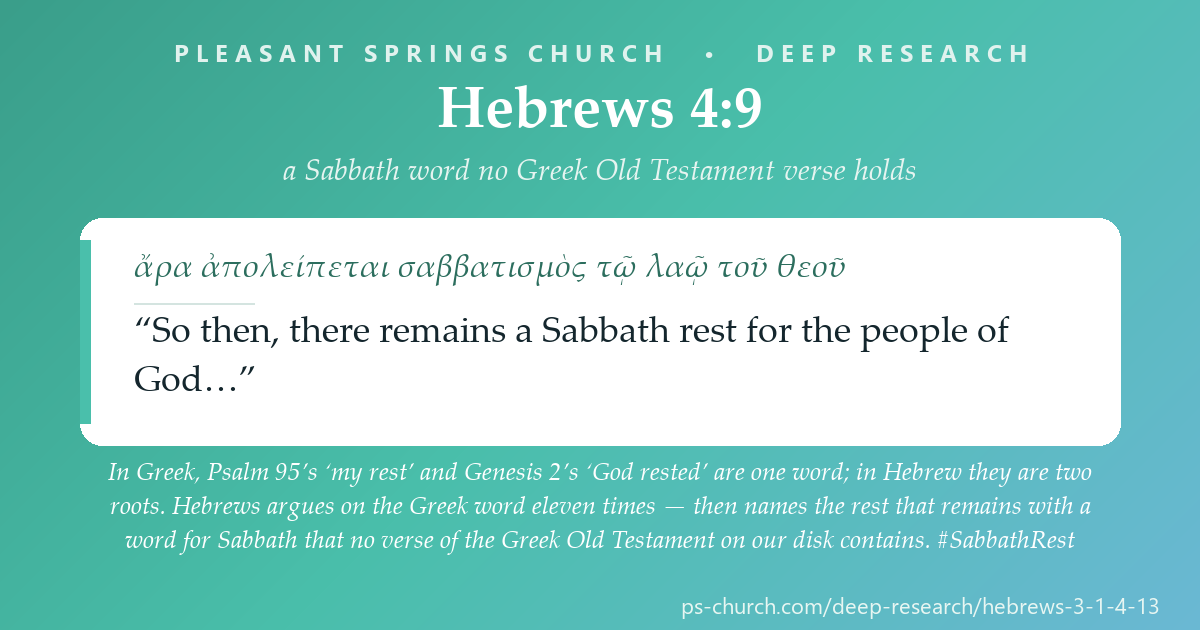
Then the writer draws his conclusion, and changes the word. ἄρα ἀπολείπεται σαββατισμὸς τῷ λαῷ τοῦ θεοῦ — so then, there remains a Sabbath rest for the people of God. σαββατισμὸς is not the psalm’s word or Genesis’. It stands in none of the 30,637 verse units of Greek Old Testament on this disk. It is built on sabbaton — the Greek form of shabbāt, the root Genesis 2:2 has in Hebrew and hides in Greek. Here the measurement stops, and so does this page. It cannot say whether the writer read Hebrew, whether he knew the Greek of Genesis was covering a different root, whether the word was his or already current (Plutarch is reported to have it), or whether the choice was meant to be heard. What it can say is where the words stand: eleven times the stem that joins the two texts in Greek, once the root that separates them in Hebrew, and the once is the conclusion.
Joshua, who never gave rest
Hebrews 4:8 argues from a counterfactual: αὐτοὺς Ἰησοῦς κατέπαυσεν … περὶ ἄλλης ἐλάλει μετὰ ταῦτα ἡμέρας — if Joshua had given them rest, he would not have spoken of another day afterward. Measured: in the Greek Old Testament held here the giver of rest to the people is the Lord, in nine verses of Deuteronomy and Joshua — eight name him (Deuteronomy 3:20, 12:10, 25:19; Joshua 1:13, 1:15, 21:44, 22:4, 23:1) and Deuteronomy 5:33 implies him — καὶ κατέπαυσεν αὐτοὺς κύριος, “And the Lord gave them rest on every side just as he had sworn to their fathers. Not one of all their enemies had withstood them, for the Lord had given all their enemies into their hands.” Joshua is the subject of the verb once, at Joshua 10:20, ὡς κατέπαυσεν Ἰησοῦς, and there it means he stopped. Only three verses in the whole screened corpus carry both the name and the verb, and in none of them does Joshua give anyone rest. The sentence Hebrews denies is one the Greek Old Testament held here never says. The argument lands on the psalm’s Today, spoken μετὰ τοσοῦτον χρόνον.
The counter-examples this page prints against itself
- 3:5 against Numbers 12:7 — run 4, tie band 3. ἐν ὅλῳ τῷ οἴκῳ is also Genesis 31:35 (ἐν ὅλῳ τῷ οἴκῳ — Laban searching; the words are a Greek plus, absent from the Hebrew and so from the ESV printed below) and, shifted one word, 2 Samuel 9:9 (ὅλῳ τῷ οἴκῳ αὐτοῦ). “Not so with my servant Moses. He is faithful in all my house.” “And she said to her father, ‘Let not my lord be angry that I cannot rise before you, for the way of women is upon me.’ So he searched but did not find the household gods.” The citation everyone names scores exactly what two accidents score. It is recognisable by θεράπων and Moses and faithful, not by the run.
- 3:17 against Numbers 14:29 — run 3, tie band 132. “your dead bodies shall fall in this wilderness, and of all your number, listed in the census from twenty years old and upward, who have grumbled against me,” An allusion a child can see measures as a formula, because the verb changed tense and the order turned round.
- 3:16 against Numbers 26:4 — run 4, tie band 1. “‘Take a census of the people, from twenty years old and upward,’ as the Lord commanded Moses. The people of Israel who came out of the land of Egypt were:” The census of the generation that replaced the one that fell. Apt; ordinary words; the screen cannot say which, and the page will not.
- 4:9 against Esther 10:3g — run 4, tie band 1. τῷ λαῷ τοῦ θεοῦ — Mordecai explaining two lots, ‘one for the people of God.’ A run of four with a band of one, beside the most important word on the page, and it means nothing.
- 4:10 against Job 4:17 and Judges (A) 19:16 — run 4, tie band 2, against Genesis 2:2 at three. “And behold, an old man was coming from his work in the field at evening. The man was from the hill country of Ephraim, and he was sojourning in Gibeah. The men of the place were Benjaminites.” The real echo is outranked by two accidents because Hebrews’ line has no word for all.
- 3:12 against Psalms of Solomon 9:1 — run 3, tie band 1. Close in sense (falling away, and losing the inheritance); three words; a witness, not Scripture.
- New Testament side: 3:7 against Acts 21:11 — run 5, tie band 1; 3:18 against Matthew 12:4 — run 4, tie band 1. “And coming to us, he took Paul’s belt and bound his own feet and hands and said, ‘Thus says the Holy Spirit, ‘This is how the Jews at Jerusalem will bind the man who owns this belt and deliver him into the hands of the Gentiles.’’” The deepest contact the passage has with any other New Testament verse is a way of saying the Holy Spirit says.
- 3:16 against Romans 10:16 — run 3, tie band 1. ἀλλ’ οὐ πάντες / ἀλλ’ οὐ πάντες — “But they have not all obeyed the gospel. For Isaiah says, ‘Lord, who has believed what he has heard from us?’” The same three words about hearing and not believing, in another letter. Shared idea or shared idiom: not measurable.
Where the passage’s threads run in the rest of Scripture
- Psalm 95 (Greek 94) — the psalm Hebrews reads (see Psalms 93–96).
- Genesis 2:1–3; Exodus 20:11; 31:17 — God’s seventh day in three texts and two roots (see Genesis 2:1–3, Exodus 20).
- Exodus 17:1–7; Numbers 20:1–13 — Massah and Meribah (see Exodus 17).
- Numbers 12:1–16; 13:1–14:45; 26:1–65 — Moses the faithful servant; Kadesh and the oath; the second census (see Numbers 12, Numbers 13–14, Numbers 26).
- Deuteronomy 12:9–10; Joshua 21:43–45 — the rest and the inheritance, and the rest the Lord gave (see Deuteronomy 12, Joshua 20–22).
- Matthew 11:28–30 — “I will give you rest,” in a different Greek word (anapauō), and so invisible to every count on this page.
- Hebrews 4:14–16; 6:4–12; 10:19–39 — the confession held fast, and the letter’s other warnings (see Hebrews 4:14–16).
- Revelation 1:16; 2:12; 19:15 — the two-edged sword from the mouth; the other New Testament uses of the adjective at 4:12 are Revelation 1:16 and 2:12 (ῥομφαία δίστομος).
The scholarship, the readings of the warning and the rest — and what this page could not check.
This section exists to say where the page is weak. A finding without its limits is not a finding.
Commentaries & studies
- William L. Lane, Hebrews 1–8 (WBC 47A, 1991); Harold W. Attridge, The Epistle to the Hebrews (Hermeneia, 1989); Paul Ellingworth (NIGTC, 1993); F. F. Bruce (NICNT, rev. 1990); Gareth Lee Cockerill (NICNT, 2012); Peter T. O’Brien (Pillar, 2010); Craig R. Koester (Anchor Yale 36, 2001).
- Otfried Hofius, Katapausis: Die Vorstellung vom endzeitlichen Ruheort im Hebräerbrief (WUNT 11, 1970); Jon Laansma, ‘I Will Give You Rest’: The Rest Motif in the New Testament with Special Reference to Mt 11 and Heb 3–4 (WUNT 2/98, 1997); Harold W. Attridge, “‘Let Us Strive to Enter That Rest’: The Logic of Hebrews 4:1–11,” HTR 73 (1980).
- Peter Enns, “Creation and Re-Creation: Psalm 95 and Its Interpretation in Hebrews 3:1–4:13,” WTJ 55 (1993); Susan E. Docherty, The Use of the Old Testament in Hebrews (2009); Radu Gheorghita, The Role of the Septuagint in Hebrews (2003).
- Andrew T. Lincoln, “Sabbath, Rest, and Eschatology in the New Testament,” in D. A. Carson, ed., From Sabbath to Lord’s Day (1982).
- None of these were consulted for any number on this page, which were run on the text files named in the footer.
The warning of 3:12–14 and 4:1, 4:11 — the readings, and who holds them
The text first, without leaning on it. The warning is spoken to people called ἀδελφοὶ ἅγιοι and ἀδελφοί; the danger is ἐν τῷ ἀποστῆναι ἀπὸ θεοῦ ζῶντος, falling away from the living God; and the promise is conditional: μέτοχοι γὰρ τοῦ Χριστοῦ γεγόναμεν, ἐάνπερ τὴν ἀρχὴν τῆς ὑποστάσεως μέχρι τέλους βεβαίαν κατάσχωμεν — we have become sharers of Christ, if indeed we hold our original confidence firm to the end. γεγόναμεν is a perfect; the condition is ἐάνπερ with an aorist subjunctive. The grammar is compatible with more than one reading, and it does not decide between them.
- A real possibility of loss. The condition is genuine: a true believer can fall away and be lost. The address to ‘brothers’ and the verb of 3:12 are taken at face value. Classical and Wesleyan Arminian readings — I. Howard Marshall, Kept by the Power of God (1969); Scot McKnight, “The Warning Passages of Hebrews,” Trinity Journal 13 (1992); Grant R. Osborne and Gareth Lee Cockerill in Bateman, ed., Four Views (2007).
- Evidence of genuineness. Holding fast shows that one has become a sharer — the weight falls on the perfect γεγόναμεν — and falling away shows that one never had (compare 1 John 2:19). Classical Reformed readings — John Owen; Wayne Grudem, “Perseverance of the Saints: A Case Study from Hebrews 6:4–6 and the Other Warning Passages” (1995); Buist M. Fanning in Four Views.
- The means of perseverance. The warnings are addressed to real believers and are the means by which God keeps them; they describe a consequence that will not overtake those who heed them. Thomas R. Schreiner and Ardel B. Caneday, The Race Set Before Us (2001).
- Loss of reward or of covenant blessing, not of salvation. The rest is an inheritance or a blessing that a believer can forfeit, as the Kadesh generation forfeited the land. Joseph C. Dillow, The Reign of the Servant Kings (1992); Randall C. Gleason, “The Old Testament Background of Rest in Hebrews 3:7–4:11,” Bibliotheca Sacra 157 (2000), and his ‘moderate Reformed’ essay in Four Views.
The church’s frame, labelled as the church’s. Pleasant Springs holds a Molinist account of grace and election, summarised in the ROSES scheme (Timothy George’s acronym, set on a Molinist footing by Kenneth Keathley, Salvation and Sovereignty, 2010), and it holds eternal security: a true believer will not finally fall away, and falling away reveals that one was never regenerate. That is closest to the second reading above, and it can be joined to the third: on William Lane Craig’s middle-knowledge account (“‘Lest Anyone Should Fall’,” International Journal for Philosophy of Religion 29, 1991), God knows how each believer would freely respond to the warnings and has given them as the means by which those who are his persevere. The page does not claim the Greek proves that frame. It claims only that the frame does not have to bend the Greek: the perfect stays a perfect, the condition stays a condition, and the brothers stay brothers. Readers who hold the first or fourth reading read the same words, and the page has printed them in full.
The rest that remains — present, future, or a thousand years?
The passage says the rest is entered now (εἰσερχόμεθα γὰρ εἰς κατάπαυσιν οἱ πιστεύσαντες, present tense, 4:3), that it remains (4:9), and that it is to be striven for (4:11). Readings divide over how those fit: a present rest of salvation entered by faith; a future rest, the consummation, entered in part now — the reading most of the commentaries named above are reported to take; a millennial rest, the seventh day of history, as Barnabas and Irenaeus read Genesis 2 (Stage 2); and an inheritance-reward in the coming kingdom, as Dillow reads it. The church that keeps this shelf is historic premillennial and does not follow the Darby–Scofield system; Irenaeus is that position’s classic early witness, and Augustine, who once held the Sabbath-millennium reading and gave it up, is printed beside him. Hebrews 4 itself names no thousand years, and this page does not say it teaches one.
And one more frame, the church’s again. Pleasant Springs holds that the provision of the atonement is unlimited. The passage’s own words are that the good news came “to us just as to them” (καὶ γάρ ἐσμεν εὐηγγελισμένοι καθάπερ κἀκεῖνοι) and that they failed to enter δι’ ἀπείθειαν, because of disobedience — not for want of a promise. The page notes that the frame fits the sentence; it does not argue the doctrine from it.
What this page did NOT check, and where it is weakest
- The finding crosses languages, and no screen on this shelf does. Every run on this page is Greek against Greek or Hebrew against Hebrew. “Nine of the ten verses carry nûaḥ” is a count of which Hebrew verses contain a word of that root, made by eye on the ten verses the Greek noun stands in. It is verse co-occurrence, not word alignment: no aligned Greek–Hebrew corpus is held here, so the page cannot prove that the Greek noun translates that Hebrew word in each verse. At Exodus 35:2 the Greek has more words for rest than the Hebrew, and which renders which is not something this shelf can decide.
- A zero is a zero on this disk. “σαββατισμὸς stands in no verse of the Greek Old Testament” means the 30,637 CATSS units held here. CATSS is a digitisation of Rahlfs, not a critical edition; no Göttingen volume, no Aquila, Symmachus or Theodotion outside Daniel, no Philo, no Josephus, no papyri. The word’s other early occurrence, in Plutarch, is reported, not seen. Absent here is not the same as coined by the writer, and the page never says the second.
- The run engine cannot see through the two editions’ spelling of forty. The SBLGNT spells it with epsilon in all 24 New Testament occurrences (compounds included) and Rahlfs with alpha in all 151 of his, and the shelf’s equivalence table does not fold them, so every run is cut at that word. It moves no number on this page — folded, the seam of 3:9b–10 is still a seam — but it is counted among the nine differences because the alignment compares forms, and it is a difference of editions, not of texts.
- The Greek New Testament is the SBLGNT, not NA28, and there is no apparatus. At 3:2 (all), 3:6 (firm to the end), 3:9 (in testing), 3:10 (this) and 4:2 (the participle) the manuscripts differ, and the page reports what the SBLGNT reads, where the ESV differs, and stops. It does not say which reading is original.
- The English column was fetched, not typed. Every ESV verse on this page was read from Crossway’s API on 7 November 2026, passed through the shelf’s typesetting step, and cached; the selfcheck compares each printed verse against that cache. It was not re-fetched for the dry run.
- Nothing rabbinic, and no Philo. The Mishnah and Talmud passages, Joseph and Aseneth and Plutarch in Stage 2 are reported from the standard literature and could not be checked against any text held here. The three Church Fathers are nineteenth-century English, read locally and not checked against the Greek or Latin.
- The readings of the warning are summarised, not re-read. The positions in the list above are attributed from the standard literature; none of those books was re-read for this page. The church’s frame is stated as the church’s.
- The structure diagram is ours. It is built from counts made on the MorphGNT lemma column and labelled a sequence; Vanhoye and Attridge were not re-read for it. The weakest joint is the frame, whose second half lies outside this study.
- Direction of influence is never asserted. That Hebrews 4:4 matches Greek Genesis 2:2 for nine words is a measurement. That the writer “used the Septuagint,” that anyone “changed” the psalm at 3:9–10, or that Psalms of Solomon 9:1 or Numbers 26:4 lie behind anything, is a historical claim this method cannot make and this page does not make.
- The author of Hebrews is unknown. The page says “the writer” throughout and offers no candidate. And whether in David (4:7) means the man or the Psalter, it does not settle.
Reading list
- Herbert W. Bateman IV, ed., Four Views on the Warning Passages in Hebrews (Kregel, 2007).
- Thomas R. Schreiner and Ardel B. Caneday, The Race Set Before Us: A Biblical Theology of Perseverance and Assurance (IVP, 2001).
- Kenneth Keathley, Salvation and Sovereignty: A Molinist Approach (B&H, 2010).
- William Lane Craig, “‘Lest Anyone Should Fall’: A Middle Knowledge Perspective on Perseverance and Apostolic Warnings,” IJPR 29 (1991).
- Jon Laansma, ‘I Will Give You Rest’ (1997); Otfried Hofius, Katapausis (1970).
- None of these were consulted for the measurements on this page.
Today, and a rest that has been waiting since the seventh day.
What the passage asks
It asks to be heard today. The psalm was old when Hebrews read it, and the writer still calls it what the Holy Spirit says. Five times in four verses he repeats one word — Today — and at 3:13 he makes it a noun, a stretch of time with edges: as long as it is called ‘Today’. The danger is not that the voice will stop speaking. It is that a heart will go hard while it is still speaking.
It gives the remedy to the church, not only to the preacher. Exhort one another every day (3:13). The hardening the passage fears is ‘by the deceitfulness of sin’ — slow, and hard to see from inside. The cure is other people who will say so, daily.
It says the rest is older than the wilderness. God’s rest is not a reward invented for Israel and withdrawn; it has stood open since the seventh day, when the works were finished. The generation at Kadesh did not fail to earn it. They failed to believe the one who offered it. And the conclusion is spoken in a word that sounds like the Sabbath itself: there remains a Sabbath rest for the people of God.
And it ends with a word that cuts. The same word that was heard and not believed in the desert is living and active, sharper than any two-edged sword, and before it nothing is hidden. That is not a threat to the believing; it is the reason they can be honest. The next study on this shelf is the throne of grace.
What should we carry away — and do?
- Hear it as present speech. The writer says the Spirit says, not said. Read the psalm this week as if it were addressed to you by name, because the letter says it is.
- Take 3:13 literally. Name one person you will encourage, and be encouraged by, every day this week — not with advice, but with the reminder that it is still Today.
- Rest is entered by believing. ‘We who have believed enter that rest’ (4:3), and whoever enters rests from his works as God did from his (4:10). Stop working to make yourself acceptable; on the church’s reading, the work that saves is finished.
- Let the word find you. Hebrews 4:12–13 is the doorway to 4:14–16. Being laid bare before God is how the passage leads you to the high priest who sympathises.
Hebrews 4:9–10 · to share
Greek NT + ESVEvery Deep Research page traces its passage across the whole sweep — the Old Testament, the Second-Temple world between the testaments (historical witnesses, not Scripture), and the New Testament. Follow the thread:
Pleasant Springs Church — Deep Research
Research method after Michael S. Heiser’s Bible Research Method (examine dictionaries → ancient literature → important words → textual connections → academic publications → share), with the Pleasant Springs “Author & Audience” foundation. Scripture set in the Hebrew, the Greek editions named on each page and the ESV (Old Testament), and the Greek New Testament and the ESV (New Testament), per the practice of Pleasant Springs Church. Hebrews 3:1–4:13 research grounded in Lane (WBC), Attridge (Hermeneia), Ellingworth (NIGTC), Bruce and Cockerill (NICNT), O’Brien (Pillar) and Koester (Anchor Yale), with Hofius and Laansma on the rest motif and Bateman’s Four Views on the warnings — none of which were consulted for any number on this page. Text: Greek New Testament from the SBL edition as digitized by MorphGNT; Greek Old Testament from Rahlfs’ Septuaginta as digitized by CATSS; Hebrew from the Masoretic text as printed in Sefaria’s Miqra according to the Masorah; Barnabas, Irenaeus and Augustine from the public-domain Ante-Nicene and Nicene and Post-Nicene Fathers. No critical apparatus was consulted on any side. ⚠️ VERSE NUMBERING. Hebrews is a New Testament book: MorphGNT Hebrews 3 has 19 verses and Hebrews 4 has 16, the ESV the same, and there is no offset in the passage. The Old Testament texts beside it: Psalm 95 = Greek Psalm 94, verse numbers unchanged (95:7–11 = 94:7–11); Psalm 132:14 = Greek 131:14; Numbers 10:36 Hebrew and ESV = Greek 10:35; 1 Chronicles 6:31 ESV = 6:16 Hebrew and Greek; 1 Kings and 2 Samuel filed by the Greek as 3 and 2 Kingdoms with the same numbers; Genesis, Exodus, the rest of Numbers, Deuteronomy, Joshua, Judges, 2 Chronicles, Proverbs and Isaiah as cited here numbered alike in all three. ⚠️ The measurement, in full. Greek against Greek. MorphGNT normalised word; CATSS FORM column, beta-code transliterated first. Both sides lowercased, accents and breathings dropped, final sigma folded, filtered to Greek letters, and passed through the shelf’s edition-equivalence table (ou/ouk/ouch, ek/ex, movable nu) on cross-corpus screens. Contiguous runs of whole word FORMS, never lemmas. Corpus: the 32 MorphGNT rows of Hebrews 3:1–4:13 against the other 7,895 verses of the Greek New Testament, and against 30,348 verse units — the 64 CATSS files less the Odes, which are held (30,637 units) but not screened. Hebrew against Hebrew for the Masoretic pairs, consonantal forms. Word counts by the MorphGNT lemma column. Exhaustive and deterministic; nothing sampled, so no seed applies. On the Greek convention a single shared word scores 1, so 0 means no shared word at all. The tie band — how many target verses reach the same maximum — is printed beside every run. ⚠️ What was NOT measurable. No screen crosses languages: the Hebrew-root counts are verse co-occurrence, by eye. No Targums, Qumran, rabbinic texts, Philo, Plutarch, Joseph and Aseneth, later Greek versions, apparatus or papyri. Every sentence on this page about them is reported, not measured. ⚠️ Direction of influence is never asserted. Nothing here says the writer of Hebrews read Hebrew, coined a word, used one Greek text rather than another, or that any translator changed anything. The page reports where the words agree, prints the tie bands and its own counter-examples, and stops.
Scripture quotations marked ESV are from the ESV® Bible (The Holy Bible, English Standard Version®), © 2001 by Crossway, a publishing ministry of Good News Publishers. ESV Text Edition: 2016. Used by permission. All rights reserved. The ESV text may not be quoted in any publication made available to the public by a Creative Commons license, and the ESV may not be translated in whole or in part into any other language. www.esv.org
|
Did this study bless you today? 💚 Give to Support PS Church100% of gifts go to the General Fund — thank you. |