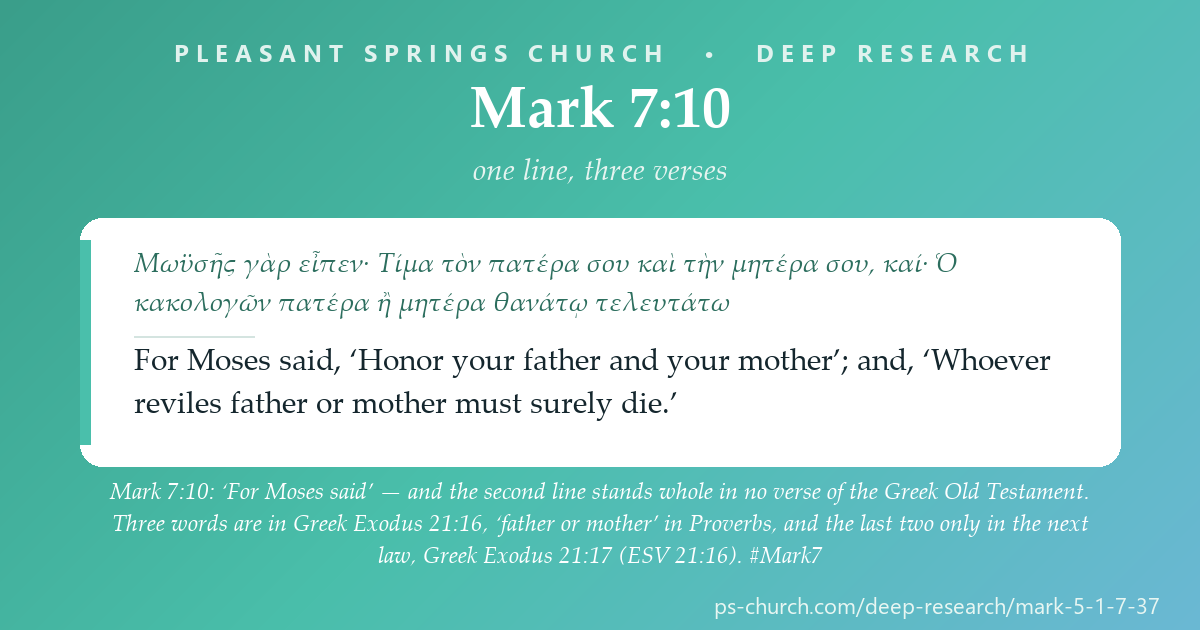
At Mark 7:10 Jesus says “For Moses said” and gives two lines. The first is the fifth commandment, and against all 30,348 screened verse units of the Greek Old Testament it ties at eight words between Deuteronomy 5:16 and Ruth 2:11 — the commandment and Boaz praising a woman for leaving her father and mother. The second line, “Whoever reviles father or mother must surely die”, stands whole in no Greek Old Testament verse. Its first three Greek words stand in one, the reviler law (Greek Exodus 21:16); father or mother without his stands after the same verb in one, Proverbs; and its last two words stand in one — the next law in Greek Exodus, the law against kidnapping, while the reviler law itself ends otherwise. One line, three verses. The page then follows the passage from the tombs of the Gerasenes — where it measures the one Old Testament verse that has tombs and swine together — through Jairus, the woman, John, the loaves and the sea to Isaiah 29:13 and the deaf man; prints its counter-examples beside its findings; and never says who borrowed from whom. See the method →
Mark 5:1–7:37
Greek NT · ESV or our renderingVersification. Mark 5–7 carries one difference of its own: there is no Mark 7:16 in the SBLGNT, so the passage has 135 verses, not 136; the apparatus records the verse in Tregelles and Robinson–Pierpont (ἄνθρωπον WH NA28 ] + 16 Εἴ τις ἔχει ὦτα ἀκούειν ἀκουέτω Treg RP), and the ESV, like the SBLGNT, goes from 7:15 to 7:17. There is no Septuagint column because Mark is a New Testament book. The offsets are in the Old Testament texts measured, each checked against the Masoretic and CATSS files: Exodus 21:16 and 21:17 stand in the opposite order in the Greek — ESV and Masoretic 21:16 (kidnapping) = Greek 21:17; ESV and Masoretic 21:17 (reviling father or mother) = Greek 21:16. Exodus 20:20 (ESV and Greek) = Masoretic 20:17 in the edition held, which numbers the four short commandments as one verse (20:13). Proverbs 20:20 (ESV and Masoretic) = Greek Proverbs 20:9a. 1 Kings = Greek 3 Kingdoms and 1 Samuel = 1 Kingdoms, same verse numbers here. Psalm 23:2 = Greek 22:2; Psalm 18:6 = Masoretic 18:7 = Greek 17:7; Psalm 38:13 = Masoretic 38:14 = Greek 37:14. Malachi 4:3 (ESV) = Masoretic and Greek 3:21. Jeremiah 40:11 (ESV) = Greek Jeremiah 47:11; ESV Jeremiah 46:28 and 42:11 = Greek 26:28 and 49:11. Isaiah 29:13, 29:18, 35:5–6, 41–43 and 65:3–4, Numbers 27:17, 2 Chronicles 18:16, Ezekiel 34:5, Job 9:8–11, Exodus 20:12 and 33:19–22, Deuteronomy 4:19, 5:16 and 32:8, Genesis 1:31 and 38:8, Leviticus 11:7, 15:25 and 18:16, Esther 5:3 and 8:3, Ruth 2:11 and Amos 7:8 are numbered alike in all three. Judith and the Maccabees are Greek only, and Judges is measured in both CATSS texts, A and B.
The Shape of the Passage
A sequence with two intercalations, bracketed by measured words — NOT a chiasmThree chapters, 135 verses of Greek, crossing and recrossing the lake. The stories run from a graveyard in the Decapolis to a deaf man in the Decapolis, and between them the dead are raised, a prophet is beheaded, crowds are fed, and the law of clean and unclean is argued.
Author
Tradition from Papias onward names Mark, interpreter of Peter, identified with the John Mark of Acts 12:12. This page cannot test that from the text and does not try; the shelf’s Mark 1 study states the same position.
What the text does show is a writer who translates. Three Aramaic words in these chapters are given and glossed — Ταλιθα κουμ (5:41), Κορβᾶν (7:11), Εφφαθα (7:34) — each followed by which is. The gloss ὅ ἐστιν stands in 9 verses of Mark, three of them here. And Mark stops the story to explain a custom: 7:3–4, which the ESV prints in brackets.
Audience
Most locate Mark’s first readers in Rome in the 60s. The glosses fit readers who had Greek and not Aramaic, and who needed the washing of hands explained. This page reports that location and does not argue it.
Readers who would be called unclean. These chapters gather nearly every kind of impurity the law knows — tombs, swine, a flow of blood, a corpse, Gentile territory, unwashed hands — and Jesus goes into each. A congregation of Jews and Gentiles eating together would hear 7:1–23 as their own question. Whatever their exact situation — and the page does not reconstruct it — the passage keeps asking who may come near.
Orient on the Decapolis, demons and Legion, the laws of impurity, Herod Antipas, the feedings, the tradition of the elders and Corban.
Search by topic: Gerasa / Gadara; Decapolis; Demon, unclean spirit; Legion; Clean and unclean; Jairus; Herod Antipas; Herodias; John the Baptist; Feeding of the five thousand; Walking on the water; Tradition; Corban; Tyre and Sidon; Syrophoenician.
Which articles are relevant?
- Anchor Bible Dictionary — “Decapolis,” “Gerasenes,” “Demon,” “Herod Antipas,” “Corban,” “Clean and Unclean.”
- Dictionary of Jesus and the Gospels (IVP) — “Demon, Devil, Satan,” “Clean and Unclean,” “Herodian Dynasty,” “Tradition,” “Sea, Lake.”
- New International Dictionary of NT Theology and Exegesis — ἀκάθαρτος, κοινός, καθαρίζω, παράδοσις, σπλαγχνίζομαι.
- Commentary on the New Testament Use of the Old Testament (Beale & Carson, 2007) — the Mark chapter, on 6:34, 6:48–50, 7:6–7 and 7:10.
Settle the numbering first
Mark 5–7 has one gap of its own — no 7:16 in the SBLGNT or the ESV. The texts it is measured against have more, and Exodus 21 is the one that matters most here, because the page’s finding is in it.
| ESV | Masoretic | Septuagint (CATSS) | |
|---|---|---|---|
| kidnapping | Exodus 21:16 | 21:16 | 21:17 |
| reviling father or mother | Exodus 21:17 | 21:17 | 21:16 |
| the lamp put out | Proverbs 20:20 | 20:20 | 20:9a |
| Do not fear at Sinai | Exodus 20:20 | 20:17 | 20:20 |
| ashes under your feet | Malachi 4:3 | 3:21 | 3:21 |
| deaf and mute | Psalm 38:13 | 38:14 | 37:14 |
The Greek order of Exodus 21 was read off the file, not a table: CATSS Exodus 21:16 is ὁ κακολογῶν πατέρα αὐτοῦ ἢ μητέρα αὐτοῦ τελευτήσει θανάτῳ; 21:17 is ὃς ἐὰν κλέψῃ τίς τινα τῶν υἱῶν Ισραηλ καὶ καταδυναστεύσας αὐτὸν ἀποδῶται καὶ εὑρεθῇ ἐν αὐτῷ θανάτῳ τελευτάτω. The Hebrew of the reviler law: וּמְקַלֵּל אָבִיו וְאִמּוֹ מוֹת יוּמָת.
Isaiah 65 on tombs and swine; the laws of impurity; Josephus on John; Jerome on Talitha; Chrysostom on Corban; and the woman with the flow of blood.
★ Tombs and swine: Isaiah 65:3–4
“a people who provoke me to my face continually, sacrificing in gardens and making offerings on bricks;” “who sit in tombs, and spend the night in secret places; who eat pig’s flesh, and broth of tainted meat is in their vessels;”
| Greek (CATSS) | Hebrew (Masoretic) | |
|---|---|---|
| tombs | ἐν τοῖς μνήμασιν καὶ ἐν τοῖς | הַיֹּשְׁבִים בַּקְּבָרִים |
| swine | κρέα ὕεια | הָאֹכְלִים בְּשַׂר הַחֲזִיר |
| demons (65:3) | τοῖς δαιμονίοις ἃ οὐκ ἔστιν — to the demons, which do not exist | וּמְקַטְּרִים עַל־הַלְּבֵנִים — and offering on the bricks; no word for demons |
What was measured. A tomb noun (any form of mnēma, mnēmeion or taphos) stands in 95 units of the screened Greek Old Testament; a swine word (any form of hys, sys or hyeios, with the rock badger’s choir- counted in) stands in 20; and the two together in one: Isaiah 65:4. In the Masoretic text a form of qbr (grave) and of ḥzyr (pig) stand together in one verse, the same one. And only in Greek does the verse before it add demons: Isaiah 65:3–4 is the one pair of consecutive units in the screened Greek Old Testament with all three. The demon word, daimonion, stands in 24 units in all.
What it does not show. Mark’s words are not Isaiah’s except for the tombs. His pig is χοῖρος, a word with no form in the Greek Old Testament; his demon words are δαιμονίζομαι and the unclean spirit. The six-word run at 5:5 is mostly function words, and on Robinson–Pierpont’s word order the same verse finds its deepest partner elsewhere — six words, tie band 1, with ἐν τοῖς ὄρεσιν καὶ ἐν τοῖς σπηλαίοις, the Maccabees keeping the feast of booths in the mountains and caves (2 Maccabees 10:6). Commentators often set Isaiah 65 beside Mark 5 (reported; Joel Marcus, Mark 1–8, 2000, is one). The page reports the co-occurrence and draws nothing further from it.
⚠️ Tombs, swine, blood, a corpse, unwashed hands: impurity is not sin
The church’s frame, labelled as the church’s. Pleasant Springs teaches that ritual impurity is not sin. These chapters touch almost every source of it the law names, and the verses measured here keep the two apart:
| in Mark | the law | what the law says | what Mark says |
|---|---|---|---|
| tombs (5:2–5) | Numbers 19:16 | shall be unclean seven days | an unclean spirit; the man is not called a sinner |
| swine (5:11–16) | Leviticus 11:7 | is unclean to you | the herd is drowned; no one eats |
| the flow of blood (5:25–34) | Leviticus 15:25 | she shall continue in uncleanness | Daughter, your faith has saved you |
| the dead girl (5:35–43) | Numbers 19:11 | ὁ ἁπτόμενος τοῦ τεθνηκότος … unclean seven days | κρατήσας τῆς χειρὸς: he takes her hand |
| hands (7:2–5) | — | see below | defiled, κοινός, common |
Hands: the Greek Pentateuch puts a washing verb beside hands in five units, searched unanchored — the priests at the laver (Exodus 30:19, 30:21, and Greek 38:27 = ESV 40:31–32), the man with a discharge (Leviticus 15:11), and the elders over the heifer (Deuteronomy 21:6). None of them is about eating. The ESV of the laver: with which Aaron and his sons shall wash their hands. Mark calls the washing at meals τὴν παράδοσιν τῶν πρεσβυτέρων, the tradition of the elders, and does not call it a law of Moses. The woman of 5:25 is the subject of the shelf’s Twelve Years Unclean study, which makes this correction at length.
What the same laws also say, in both texts. The discharge law closes with a sin offering and atonement, τὴν μίαν περὶ ἁμαρτίας (Hebrew ḥaṭṭā’t, Leviticus 15:30); and in Numbers 19 the Hebrew names the cleansing from a corpse with the same root (19:9, 19:12–13, 19:17, 19:20) where the Greek has hagnizō, purify. Many render the Hebrew purification offering (reported); the page records the wording and does not settle it. Greek Leviticus 14:19, of the leper, likewise has from his sin where the Hebrew has from his uncleanness.
The woman with the flow of blood — what the other study found
Summarised, not repeated. The shelf’s study measured six things about 5:25–34; two are re-derived here. ῥύσει αἵματος stands in one Greek Old Testament unit, Leviticus 15:25, and in two New Testament verses, Mark 5:25 and Luke 8:43; and μάστιξ, the ESV’s disease, is the word for a whip or a scourge. That study also finds that she is the one person Jesus addresses as Daughter in the Gospels, and reads her touch through Haggai 2:12–13. One thing it does not say, and this page adds: in Mark she touches τοῦ ἱματίου αὐτοῦ, the cloak; the tassel is Matthew’s and Luke’s word at that point, and Mark’s at 6:56.
Josephus on the death of John — held here only in English, through Eusebius
The page holds no Greek of Josephus. It holds Eusebius’ Church History 1.11, in McGiffert’s English (NPNF second series, vol. 1), which quotes Antiquities 18:
Herod feared that his great influence might lead to some sedition, for they appeared ready to do whatever he might advise. He therefore considered it much better, before any new thing should be done under John's influence, to anticipate it by slaying him, than to repent after revolution had come, and when he found himself in the midst of difficulties. On account of Herod's suspicion John was sent in bonds to the above-mentioned citadel of Machæra, and there slain.Josephus, Antiquities 18, as quoted by Eusebius, Church History 1.11.6 (McGiffert)
Mark gives the motive as Herodias (6:17–19), a feast, a dance and an oath; Josephus, in this translation, gives it as fear of sedition and names a fortress. Eusebius, a few sentences earlier, writes: It was on her account also that he slew John. The page prints the two accounts side by side and does not harmonise them.
Jerome on Talitha koum, and Chrysostom on Corban
We read in Mark of the Lord saying Talitha cumi and it is immediately added “which is interpreted, Damsel, I say unto thee, arise.” The evangelist may be charged with falsehood for having added the words “I say unto thee” for the Hebrew is only “Damsel arise.”Jerome, Letter 57.7, to Pammachius (NPNF second series, vol. 6)
Jerome’s point is that Mark translates for sense. The Greek bears him out: the gloss Τὸ κοράσιον, σοὶ λέγω, ἔγειρε has four words for the two of Ταλιθα κουμ. Robinson–Pierpont spells the second koumi (apparatus above).
And Mark again makes this plainer, by saying, “It is Corban, by whatsoever thou mightest be profited by me;” which means, not a gift and present, but properly an offering.John Chrysostom, Homily 51 on Matthew (NPNF first series, vol. 10)
Chrysostom reads Mark’s gloss dōron as an offering to God. The Greek Old Testament reads the Hebrew word the same way: where Leviticus and Numbers have qorban, the Greek of the same verse has a dōr- word in 72 of 74 units — for example προσαγάγῃ δῶρα τῷ κυρίῳ (brings an offering to the Lord).
The word-chains, the foreign words, and two that the Greek Bible uses once on each side.
Which words carry the passage?
Ten times in 5:1–7:37 (6:8, 6:37, 6:38, 6:41, 6:41, 6:44, 6:52, 7:2, 7:5, 7:27) of 21 in all Mark: the five loaves, the hardened hearts about the loaves, bread eaten with defiled hands, the children’s bread.
Twice in the Greek New Testament (5:23, 7:25), and no form in the Greek Old Testament: Jairus and the Greek woman.
In 5:1–7:37 at 5:10, 6:7, 6:17, 6:27: Legion begs not to be sent; Jesus sends the Twelve; Herod sends to seize John and to behead him.
At 5:23, 5:28, 5:34, 6:56: the daughter, the woman twice, the sick of Gennesaret. The ESV renders it made well.
The Pharisees’ word (7:2, 7:5), and the verb κοινόω five times in 7:15–23. Acts 10:15 sets the same pair against each other: What God has made clean, do not call common.
Once in Mark 5–7, at 7:19; the clause it governs is the subject of Stage 5.
Once in 5:1–7:37, of the shepherdless crowd; 3 times in Mark.
Once in the Greek New Testament and once in the Greek Old Testament (Isaiah 35:6).
Foreign words, and what the Greek Old Testament has of them
| Mark | the word | gloss | Greek Old Testament |
|---|---|---|---|
| 5:41 | Ταλιθα κουμ | Τὸ κοράσιον, σοὶ λέγω, ἔγειρε | no form of either word |
| 7:11 | Κορβᾶν | Δῶρον | no form; the Hebrew qorban is rendered by dōr- (Stage 2) |
| 7:34 | Εφφαθα | Διανοίχθητι | no form |
| 5:9 | Λεγιὼν | (a Latin word, not glossed) | no form |
| 6:27 | σπεκουλάτορα | (Latin, not glossed) | no form |
None of the five has a form anywhere in the screened Greek Old Testament. Mark’s Gospel is the only Gospel with Κορβᾶν; Matthew 27:6 has the related κορβανᾶν, the temple treasury.
Moses at 7:10, Isaiah at 7:6–7, the shepherd at 6:34, the sea at 6:48–50, the deaf at 7:37; the deepest runs both ways; the sandwiches.
★★ Moses said (7:10) — one line, three verses
“For Moses said, ‘Honor your father and your mother’; and, ‘Whoever reviles father or mother must surely die.’”
| Greek | words shared with Mark 7:10 | Hebrew | ESV | |
|---|---|---|---|---|
| Mark 7:10, line 1 | Τίμα τὸν πατέρα σου καὶ τὴν μητέρα σου | — | — | Honor your father and your mother |
| Deuteronomy 5:16 | τίμα τὸν πατέρα σου καὶ τὴν μητέρα σου | 8 | כַּבֵּד אֶת־אָבִיךָ וְאֶת־אִמֶּךָ | Honor your father and your mother |
| Exodus 20:12 | τίμα τὸν πατέρα σου καὶ τὴν μητέρα — no your after mother | 7 | כַּבֵּד אֶת־אָבִיךָ וְאֶת־אִמֶּךָ | Honor your father and your mother |
| Ruth 2:11 (accident) | τὸν πατέρα σου καὶ τὴν μητέρα σου | 8, tied | — | how you left your father and mother |
| Mark 7:10, line 2 | Ὁ κακολογῶν πατέρα ἢ μητέρα θανάτῳ τελευτάτω | — | — | Whoever reviles father or mother must surely die |
| Exodus 21:16 Greek (ESV 21:17) | ὁ κακολογῶν πατέρα αὐτοῦ ἢ μητέρα αὐτοῦ τελευτήσει θανάτῳ | 3 — Ὁ κακολογῶν πατέρα | וּמְקַלֵּל אָבִיו וְאִמּוֹ מוֹת יוּמָת | Whoever curses his father or his mother shall be put to death |
| Proverbs 20:9a Greek (ESV 20:20) | κακολογοῦντος πατέρα ἢ μητέρα σβεσθήσεται λαμπτήρ αἱ δὲ κόραι τῶν ὀφθαλμῶν αὐτοῦ ὄψονται σκότος | 3 — πατέρα ἢ μητέρα | מְקַלֵּל אָבִיו וְאִמּוֹ | If one curses his father or his mother |
| Exodus 21:17 Greek (ESV 21:16) | ὃς ἐὰν κλέψῃ τίς τινα τῶν υἱῶν Ισραηλ καὶ καταδυναστεύσας αὐτὸν ἀποδῶται καὶ εὑρεθῇ ἐν αὐτῷ θανάτῳ τελευτάτω | 2 — θανάτῳ τελευτάτω | וְגֹנֵב אִישׁ וּמְכָרוֹ … מוֹת יוּמָת | Whoever steals a man and sells him |
What the table shows. The first line matches Greek Deuteronomy 5:16 for eight words and Greek Exodus 20:12 for seven: Exodus has no your after mother, Deuteronomy and Mark do. The Hebrew of both commandments has it. And the eight ties, tie band 2, with Ruth 2:11, which has the same words in a sentence about leaving one’s parents — a citation and an accident at the same depth, and the reason no run on this page is read by its length alone.
The second line has no partner deeper than three. Taken in pieces: Ὁ κακολογῶν πατέρα stands in one Greek Old Testament unit, Exodus 21:16, the reviler law, which goes on πατέρα αὐτοῦ ἢ μητέρα αὐτοῦ — with his twice; πατέρα ἢ μητέρα, without his, after a form of kakolog-, stands in one, Proverbs 20:9a (κακολογοῦντος πατέρα ἢ μητέρα); and θανάτῳ τελευτάτω stands in one, Exodus 21:17, the kidnapping law, while the reviler law ends τελευτήσει θανάτῳ. The form τελευτάτω stands in three Greek Old Testament units (Exodus 21:17, 35:2; Leviticus 24:16).
The Hebrew makes the Greek difference disappear. In the Masoretic text the two laws end alike, מוֹת יוּמָת, and the reviler law joins the parents with וְאִמּוֹ, and his mother, where the Greek, Mark and the ESV have or. The reviler law and the proverb open with the same Hebrew words (וּמְקַלֵּל אָבִיו וְאִמּוֹ / מְקַלֵּל אָבִיו וְאִמּוֹ; contiguous pair run 2, the prefixed and breaking it). So in Hebrew there is nothing to choose between; in Greek, Mark’s wording stands in three verses and in none of them whole. Matthew 15:4 has the same second line, word for word (pair run 8).
The page reports where the words stand. It does not say that anyone combined verses, quoted from memory, or used a Greek text other than the one held here; a Greek Exodus with teleutatō at 21:16 would remove the finding, and no other Greek text of Exodus was searched (Stage 5).
★ Isaiah 29:13 (7:6–7), in Greek and in Hebrew
And he said to them, “Well did Isaiah prophesy of you hypocrites, as it is written, “‘This people honors me with their lips, but their heart is far from me; in vain do they worship me, teaching as doctrines the commandments of men.
“And the Lord said: ‘Because this people draw near with their mouth and honor me with their lips, while their hearts are far from me, and their fear of me is a commandment taught by men,”
| Greek of Isaiah (CATSS) | Hebrew of Isaiah (Masoretic) | Mark 7:6–7 | |
|---|---|---|---|
| draws near | ἐγγίζει μοι | נִגַּשׁ | — |
| with its mouth | — | בְּפִיו | — |
| lips honour | τοῖς χείλεσιν αὐτῶν τιμῶσίν με | וּבִשְׂפָתָיו כִּבְּדוּנִי | τοῖς χείλεσίν με τιμᾷ |
| heart far | ἡ δὲ καρδία αὐτῶν πόρρω ἀπέχει ἀπ' ἐμοῦ | וְלִבּוֹ רִחַק מִמֶּנִּי | ἡ δὲ καρδία αὐτῶν πόρρω ἀπέχει ἀπ’ ἐμοῦ — 8 |
| in vain | μάτην | — | μάτην |
| they revere / their fear of me | σέβονταί με | וַתְּהִי יִרְאָתָם אֹתִי | σέβονταί με |
| commandment(s) of men | διδάσκοντες ἐντάλματα ἀνθρώπων καὶ διδασκαλίας | מִצְוַת אֲנָשִׁים מְלֻמָּדָה | διδάσκοντες διδασκαλίας ἐντάλματα ἀνθρώπων |
What the table shows. Mark 7:6 shares eight consecutive words with the Greek of Isaiah (tie band 1) and 7:7 shares five (tie band 1). The words the Gospel is remembered for are in the Greek column and not the Hebrew one: μάτην, in vain, has no counterpart in the Masoretic verse, and where the Hebrew has their fear of me is a commandment of men, taught (the ESV: their fear of me is a commandment taught by men), the Greek has they revere me, teaching commandments of men and teachings. The alignment of they revere me with their fear of me is ours. The form σέβονταί stands in two Greek Old Testament units (Isaiah 29:13, Wisdom 15:18), and matēn with any form of seb- in one. The Hebrew has with its mouth, which this Greek text does not; Greek Isaiah has draws near, as the Hebrew does, and Mark does not. And at the end the two Greek texts turn the order: ἐντάλματα ἀνθρώπων καὶ διδασκαλίας in Isaiah, διδασκαλίας ἐντάλματα ἀνθρώπων in Mark.
Mark and Matthew 15:8–9 share twelve and eight words — deeper than either shares with Isaiah. Entalmata, commandments, stands in one other New Testament verse, Colossians 2:22, κατὰ τὰ ἐντάλματα καὶ διδασκαλίας τῶν ἀνθρώπων, in a passage about rules of food and drink. The shelf’s Isaiah 27–29 study measures the same verse from Isaiah’s side and reports the same eight.
★ Like sheep without a shepherd (6:34)
“When he went ashore he saw a great crowd, and he had compassion on them, because they were like sheep without a shepherd. And he began to teach them many things.”
| text | Greek | pair run with Mark 6:34 | with Matthew 9:36 | Hebrew |
|---|---|---|---|---|
| Mark 6:34 | ὡς πρόβατα μὴ ἔχοντα ποιμένα | — | 4 | — |
| Matthew 9:36 | ὡσεὶ πρόβατα μὴ ἔχοντα ποιμένα | 4 | — | — |
| Numbers 27:17 | ὡσεὶ πρόβατα οἷς οὐκ ἔστιν ποιμήν | 1 | 2 | כַּצֹּאן אֲשֶׁר אֵין־לָהֶם רֹעֶה |
| 1 Kings 22:17 (3 Kingdoms) | ὡς ποίμνιον ᾧ οὐκ ἔστιν ποιμήν | 1 | 1 | כַּצֹּאן אֲשֶׁר אֵין־לָהֶם רֹעֶה |
| 2 Chronicles 18:16 | ὡς πρόβατα οἷς οὐκ ἔστιν ποιμήν | 2 | 1 | כַּצֹּאן אֲשֶׁר אֵין־לָהֶן רֹעֶה |
| Ezekiel 34:5 | διὰ τὸ μὴ εἶναι ποιμένας | 1 | 1 | מִבְּלִי רֹעֶה |
| Judith 11:19 (a witness) | ὡς πρόβατα οἷς οὐκ ἔστιν ποιμήν | 2 | 1 | (no Hebrew) |
None of the shepherd texts reaches beyond two words with Mark 6:34. μὴ ἔχοντα ποιμένα stands in no Greek Old Testament unit; the Greek Old Testament’s wording, to whom there is no shepherd, stands in 4 units (Numbers 27:17, 3 Kingdoms 22:17, 2 Chronicles 18:16, Judith 11:19). Mark’s two words with 2 Chronicles and Judith are hōs probata, which stands in 15 units of the screened Greek Old Testament. Matthew 9:36 has ὡσεὶ where Mark has ὡς, and so reaches two with Numbers, where hōsei probata stands (and in one other unit, Greek Psalm 79:2 = ESV 80:1); its deepest Greek Old Testament run is 3 (tie band 2), and it is not a shepherd text. The shelf’s Matthew 8–10 study measures Matthew 9:36 the same way.
One coincidence across chapters. The only two Greek Old Testament units with ὁρκίζω σε are ποσάκις ἐγὼ ὁρκίζω σε (3 Kingdoms 22:16) and 2 Chronicles 18:15 — Ahab adjuring Micaiah, in the verse before Micaiah sees Israel as sheep that have no shepherd. Legion’s oath at 5:7 and the shepherdless crowd at 6:34 find their Greek Old Testament partners one verse apart. Two words at most in each; the page prints it as an accident.
★ Walking on the sea, passing by, and I am (6:48–50)
“And he saw that they were making headway painfully, for the wind was against them. And about the fourth watch of the night he came to them, walking on the sea. He meant to pass by them,” but when they saw him walking on the sea they thought it was a ghost, and cried out, for they all saw him and were terrified. But immediately he spoke to them and said, “Take heart; it is I. Do not be afraid.”
| text | Greek | pair run with Mark 6:48 | Hebrew | ESV |
|---|---|---|---|---|
| Job 9:8 | περιπατῶν ὡς ἐπ' ἐδάφους ἐπὶ θαλάσσης | 1 | וְדוֹרֵךְ עַל־בָּמֳתֵי יָם | trampled the waves of the sea |
| Job 9:11 | ἐὰν παρέλθῃ με | 1 | וְיַחֲלֹף (ḥlp) | he moves on |
| Exodus 33:19 | ἐγὼ παρελεύσομαι πρότερός σου | 1 | אֲנִי אַעֲבִיר כׇּל־טוּבִי | I will make all my goodness pass before you |
| Exodus 33:22 | ἡνίκα δ' ἂν παρέλθῃ μου ἡ δόξα | 1 | — | while my glory passes by |
| 1 Kings 19:11 (3 Kingdoms) | ἰδοὺ παρελεύσεται κύριος | 2 | וְהִנֵּה יְהֹוָה עֹבֵר | And behold, the Lord passed by |
| Amos 7:8 | οὐκέτι μὴ προσθῶ τοῦ παρελθεῖν αὐτόν | 1 | לֹא־אוֹסִיף עוֹד עֲבוֹר לוֹ | I will never again pass by them |
What was measured. A form of peripat- (walk) with a form of thalass- (sea), searched unanchored with the augment, stands in two units of the screened Greek Old Testament: Job 38:16, God asking Job whether he has walked in the tracks of the abyss (periepatēsas), and Job 9:8 — and three verses later Job says of the same God ἐὰν παρέλθῃ με. The Greek of Job has ἐπὶ θαλάσσης without the article, which stands in 3 units; Mark has ἐπὶ τῆς θαλάσσης, which stands in 4 and none of them Job, so the pair run is one. Where the Greek of Job has walking as on dry ground upon the sea, the Hebrew has וְדוֹרֵךְ עַל־בָּמֳתֵי יָם, treading on the heights of the sea, and the ESV trampled the waves of the sea.
The pass-by verb: ἤθελεν παρελθεῖν stands nowhere in the Greek Old Testament. The form παρελθεῖν stands in 12 units, and two of them are God speaking of passing by Israel — Amos 7:8 and 8:2, I will never again pass by them. In Exodus 33:19 and 1 Kings 19:11 the Greek has other forms of the same verb for the Hebrew ‘br, as Amos does; at Job 9:11 it stands for another Hebrew verb, ḥlp, move on. None of these reaches beyond two words with Mark.
I am, do not fear.
| Isaiah 41–43 (82 units) | whole screened Greek Old Testament | |
|---|---|---|
| adjacent egō eimi | 41:4, 43:10, 43:25 | 182 units |
| mē + a form of phob- | 41:10, 41:13, 43:1, 43:5 | 99 units |
| both in one unit | none adjacent (41:10 has egō gar eimi and mē phobou) | 7: 2Sam/K 13:28, Gen 26:24, Gen 46:3, Jer 1:8, Jer 1:17, Jer 26:28, Jer 49:11 |
| a form of thars- and of phob- | none | Exod 20:20, Jdt 11:1 |
The combination is usually traced to Isaiah 41–43 (reported). In the Greek of those chapters adjacent egō eimi never shares a verse with do not fear, but Isaiah 41:10 has both mē phobou and egō gar eimi, with one word between, as close as Genesis 26:24; in all of Greek Isaiah adjacent egō eimi stands in 16 units and never beside do not fear. Where the Greek Old Testament does put them together, six of the seven units are God speaking — to Isaac, to Jacob, to Jeremiah, and through Jeremiah to Israel (Greek Jeremiah 26:28 and 49:11 = ESV 46:28 and 42:11) — and the seventh is Absalom ordering a murder, μὴ φοβηθῆτε ὅτι οὐχὶ ἐγώ εἰμι (2 Samuel 13:28). The first of them: ἐγώ εἰμι ὁ θεὸς Αβρααμ … μὴ φοβοῦ (Genesis 26:24; ESV I am the God of Abraham your father. Fear not), where the Hebrew has אָנֹכִי, I, and no verb. And Θαρσεῖτε with a phob- form stands together in two units, one of them Sinai: θαρσεῖτε at Exodus 20:20, where the Hebrew and the ESV have אַל־תִּירָאוּ, Do not fear. The measurement finds verbatim contact; the readings of egō eimi are in Stage 5.
★ He has done all things well (7:31–37)
“And they were astonished beyond measure, saying, ‘He has done all things well. He even makes the deaf hear and the mute speak.’” “Then the eyes of the blind shall be opened, and the ears of the deaf unstopped;” “then shall the lame man leap like a deer, and the tongue of the mute sing for joy. For waters break forth in the wilderness, and streams in the desert;”
| test (screened Greek Old Testament, unanchored) | units | what they are |
|---|---|---|
| kal- (good) + panta + a form of poie- (make) | Esth 8:12r, Gen 1:25, Gen 1:31, Job 13:9, Lev 5:4, Qoh 3:11 | the creation days (Genesis 1:25, 1:31), τὰ πάντα ἐποίησεν καλὰ (Ecclesiastes 3:11), and three others |
| kal- + lian (very) | Gen 1:31, TobS 6:12 | καλὰ λίαν; and Sarah in Tobit, καλὸν λίαν |
| kōphos (deaf) + a form of akou- (hear) | Isa 29:18, Isa 35:5, Isa 42:18, Ps 37:14 | three in Isaiah, where the deaf hear (29:18 is in the chapter Mark quotes at 7:6); and Psalm 37:14 (ESV 38:13), where the psalmist is as a deaf man who does not hear |
| kōphos + mogilal- or alal- (mute) | Ps 37:14 | ὡσεὶ κωφὸς … ὡσεὶ ἄλαλος (Psalm 38:13 ESV) |
The verse shares one word with Genesis 1:31 and one with Isaiah 35:5; its deepest Greek Old Testament run is two, with a tie band of 523. The run screen hears nothing. The co-occurrence tests hear more: good with all and made stands at the creation; the deaf hear in three units, all Isaiah; and μογιλάλος in the Greek Old Testament only at Isaiah 35:6.
Opened ears. In the Greek of Isaiah 35:5 the eyes are opened and the ears hear: ὦτα κωφῶν ἀκούσονται. In the Hebrew both are opened: וְאׇזְנֵי חֵרְשִׁים תִּפָּתַחְנָה, the ears of the deaf shall be opened (ESV the ears of the deaf unstopped). Mark says the man’s ears were opened (7:35). Here Mark’s wording is nearer the Hebrew’s than the Greek’s; the page reports it and draws nothing from it.
The deepest runs out of Mark 5–7 into the Greek Old Testament
135 rows against the 30,348 screened units (the 64 CATSS files less the Odes; 30,637 are held with the Odes): all 135 reach two, 106 reach three, 45 reach four, 8 reach five, 3 reach six, 2 reach eight, and nothing reaches nine. Of the rows at exactly four, 16 have a tie band of one and 21 a band above one.
| Mark | deepest run | tie band | partner | what it is |
|---|---|---|---|---|
| 7:6 | 8 | 1 | Isaiah 29:13 | the citation |
| 7:10 | 8 | 2 | Deuteronomy 5:16, Ruth 2:11 | the commandment — tied with an accident |
| 5:5 | 6 | 1 | Isaiah 65:4 | tombs (Stage 2); edition-dependent |
| 7:7 | 5 | 1 | Isaiah 29:13 | the citation |
| 6:18 | 5 | 1 | Genesis 38:8 | the opposite law (codex note) |
| 7:25 | 5 | 1 | Esther 8:3 | fell at his feet |
| 5:1 | 5 | 2 | Deuteronomy 30:13, Jeremiah 22:20 | formula: across the sea |
| 5:40 | 5 | 2 | 1 Maccabees 9:60, 12:52 | accident: καὶ τοὺς μετ' αὐτοῦ καὶ |
| 5:8 | 4 | 1 | Zechariah 13:2 | τὸ πνεῦμα τὸ ἀκάθαρτον |
| 5:22 | 4 | 1 | Esther 8:3 | at his feet |
| 6:23 | 4 | 2 | Esther 5:3, 7:2 | half of my kingdom |
| 6:41, 7:34 | 4 | 2 | Deuteronomy 4:19, Job 22:26 | looking up to heaven |
| 5:29 | 4 | 1 | Numbers 19:4 | accident: τοῦ αἵματος αὐτῆς, the red heifer’s blood |
| 6:11 | 4 | 1 | Malachi 3:21 | accident (codex note) |
| 6:32 | 4 | 1 | Jonah 1:5 | accident: ἐν τῷ πλοίῳ, Jonah asleep below |
| 6:48 | 4 | 1 | 1 Maccabees 14:34 | accident: ἐπὶ τῆς θαλάσσης, a town on the coast |
| 7:33 | 4 | 1 | Psalm 17:7 (ESV 18:6) | accident (codex note) |
| 5:7 | 4 | 9 | six + three units | formula: Τί ἐμοὶ καὶ σοί |
The two deepest rows are both eight, both named citations — and one of them ties with Ruth. Below them the band-1 rows are a mixture of findings (5:3, 5:5, 5:8, 5:22, 7:25) and accidents (5:29, 6:11, 6:32, 6:48, 7:33, and others not tabled: 5:20, 6:21, 6:29, 6:30, 6:37, 6:49, 7:3, 7:31). The accidents are on the page so that no other four or five on it is read as a finding by itself.
The deepest runs out of Mark 5–7 into the rest of the Greek New Testament
Against the 7,254 verses outside Mark: all 135 reach one, 134 two, 116 three, 70 four, 31 five, 19 six, 14 seven, 12 eight, 7 nine, 6 ten, 3 twelve, 2 thirteen, 1 fourteen, and nothing reaches fifteen.
| Mark | deepest run | tie band | partner |
|---|---|---|---|
| 6:41 | 14 | 1 | Matthew 14:19 — the blessing of the loaves |
| 5:13 | 13 | 1 | Luke 8:33 — the swine |
| 7:6 | 12 | 1 | Matthew 15:8 — Isaiah 29:13 in both |
| 5:7 | 10 | 1 | Luke 8:28 |
| 5:14 | 10 | 1 | Luke 8:34 |
| 5:34 | 10 | 1 | Luke 8:48 |
| 6:4 | 9 | 1 | Matthew 13:57 |
| 7:7, 7:10, 6:17, 6:34, 5:37 | 8 | 1 | Matthew 15:9, 15:4, 14:3, 14:14; 17:1 |
At the other end, the vice list of 7:22 reaches only one word, tie band 26 — no two of its consecutive words stand together in any New Testament verse outside Mark. The tables say nothing about who read whom.
The two intercalations, measured
| frame | inset | the word | |
|---|---|---|---|
| 5:21–43 | 5:42 ἐτῶν δώδεκα | 5:25 δώδεκα ἔτη | twelve years; δώδεκα nowhere else in Mark 5 |
| 5:23 ἵνα σωθῇ | 5:28 σωθήσομαι; 5:34 σέσωκέν σε | save | |
| 5:35 Ἡ θυγάτηρ σου | 5:34 Θυγάτηρ | daughter | |
| 5:36 Μὴ φοβοῦ, μόνον πίστευε | 5:33 φοβηθεῖσα; 5:34 ἡ πίστις σου | fear, faith | |
| 5:24 συνέθλιβον αὐτόν | 5:31 συνθλίβοντά σε | συνθλίβω, in the New Testament only here | |
| 6:6b–31 | 6:7 ἀποστέλλειν; 6:30 οἱ ἀπόστολοι | 6:17 ἀποστείλας; 6:27 ἀποστείλας | send; apostles once in the SBLGNT of Mark |
The words that bracket the frames are counted, not inferred; the reading that the inset interprets the frame — the woman’s faith answering the father’s fear, the cost of preaching set inside the mission — is the commentators’ (reported; it is the standard reading of Mark’s intercalations) and not a measurement.
The readings with their holders, the church’s frame labelled as the church’s, and everything this page could not check.
None of the modern works named on this page was re-read for it. Positions are reported as the literature commonly summarises them; a reader who wants to rely on an attribution should check it in the book. Three ancient texts are quoted from files on this disk, in English: Eusebius quoting Josephus, Jerome’s Letter 57 and Chrysostom’s 51st homily on Matthew (NPNF). Every number on the page was measured on files on this disk and can be re-derived.
Commentaries & studies:
- R. T. France, The Gospel of Mark (NIGTC, 2002); Joel Marcus, Mark 1–8 (AB 27, 2000); Robert A. Guelich, Mark 1–8:26 (WBC 34A, 1989); William L. Lane, The Gospel according to Mark (NICNT, 1974); Adela Yarbro Collins, Mark (Hermeneia, 2007).
- Rikki E. Watts, “Mark,” in Beale and Carson, Commentary on the New Testament Use of the Old Testament (2007); Richard B. Hays, Echoes of Scripture in the Gospels (2016).
- On the demonic: Michael S. Heiser, The Unseen Realm (2015); Ched Myers, Binding the Strong Man (1988); Paul W. Hollenbach, JAAR 49 (1981).
- On 7:19: James G. Crossley, The Date of Mark’s Gospel (2004).
- Michael W. Holmes, ed., The Greek New Testament: SBL Edition (2010) and its apparatus.
⚠️ Thus he declared all foods clean (7:19) — what the Greek has, and the readings
The Greek. καθαρίζων πάντα τὰ βρώματα, cleansing all the foods. No word in it means thus or declared, and the Greek has no brackets; the ESV’s (Thus he declared all foods clean.) is a reading of the clause, a fair one but a reading. The participle is nominative masculine singular (MorphGNT parse -PAPNSM-); the noun before it, ἀφεδρῶνα, is masculine accusative, so the participle cannot agree with it. The apparatus: καθαρίζων WH Treg NA28 ] καθαρίζον RP — Westcott–Hort, Tregelles and NA28 with the SBLGNT, Robinson–Pierpont with a neuter. Matthew 15:17, at the same point, has no such clause: passes into the stomach and is expelled.
| reading of καθαρίζων πάντα τὰ βρώματα (7:19) | in brief | held by (reported, except where marked) |
|---|---|---|
| 1. The narrator’s comment: Jesus declared all foods clean | the masculine nominative participle goes back to the speaker of 7:18; Mark draws the consequence for the food laws | the ESV and most modern translations; R. T. France, The Gospel of Mark (NIGTC, 2002); Joel Marcus, Mark 1–8 (2000) |
| 2. The digestive process purges the food | the clause describes what the body does; on the neuter reading it agrees with the process, not with Jesus | Robinson–Pierpont, which prints the neuter (checked: the apparatus); the King James Version, “purging all meats” |
| 3. A comment about defilement by hands, not about the food laws | the question raised in 7:2–5 is unwashed hands and the tradition; read in that frame the clause does not set aside Leviticus 11 | James G. Crossley, The Date of Mark’s Gospel (2004) |
What the passage does say plainly is 7:15: “There is nothing outside a person that by going into him can defile him, but the things that come out of a person are what defile him.” The church’s frame applies here only as far as it goes: ritual impurity is not sin (Stage 2). The church has no ratified statement on Mark 7:19 and the food laws, and this page does not supply one.
⚠️ Legion and the demonic — four readings
“And Jesus asked him, ‘What is your name?’ He replied, ‘My name is Legion, for we are many.’” “And he begged him earnestly not to send them out of the country.”
| reading of Legion and the demonic in 5:1–20 | in brief | held by (reported) |
|---|---|---|
| 1. Personal evil spirits, as the text presents them | the spirits speak, plead, are named and are commanded; the narrative means what it says | the traditional reading of the church, ancient and modern |
| 2. The divine council and the nations | the nations were allotted to lesser spiritual powers (Deuteronomy 32:8–9, read with the Greek and a Qumran text); Jesus’ work in Gentile territory begins to reclaim them; 5:10’s out of the region is read territorially | Michael S. Heiser, The Unseen Realm (2015) |
| 3. Legion as Rome | a legion drowned in the sea: the story read as a political allegory of occupation | Ched Myers, Binding the Strong Man (1988) |
| 4. Possession as a social and psychological condition | the demoniac read in terms of colonial and social pressure, without denying the narrative | Paul W. Hollenbach, “Jesus, Demoniacs, and Public Authorities” (JAAR, 1981) |
On reading 2, what the texts held here show: Greek Deuteronomy 32:8 reads κατὰ ἀριθμὸν ἀγγέλων θεοῦ, according to the number of angels of God; the Masoretic text reads לְמִסְפַּר בְּנֵי יִשְׂרָאֵל, according to the number of the sons of Israel; and the ESV prints according to the number of the sons of God, a reading this page cannot check because no Qumran text is on this disk. The page reports the four readings and adopts none; it treats the spirits as the narrative does, as beings who speak and are commanded.
Egō eimi at 6:50 — two readings
| reading of ἐγώ εἰμι (6:50) | in brief | held by (reported) |
|---|---|---|
| 1. The divine self-name | with the walking on the sea and the passing by, an echo of Exodus 3:14 and Isaiah’s I am he | Richard B. Hays, Echoes of Scripture in the Gospels (2016) |
| 2. Self-identification | it is I, as the ESV renders it: the frightened disciples are told who the figure is | the plain sense; the ESV’s rendering (checked: it is I) |
Stage 4 shows what the measurement can contribute: adjacent egō eimi stands beside do not fear in God’s speech in Genesis and Jeremiah, and in Isaiah 41–43 only with gar between (41:10); walking on the sea stands in Job 9:8 (with walking in the abyss at Job 38:16); and Exodus 33, 1 Kings 19 and Amos 7–8 have God passing by. None of it reaches beyond two words. The case for reading 1 is made from the cluster, not from any one run, and the page leaves it there.
Hardened hearts (6:52), and what the church teaches
The narrator says the disciples’ ἡ καρδία πεπωρωμένη. One narrative does not make a doctrine, and the page does not build one on it. The church’s frame, in the church’s own words (what we believe, Article 10): all who genuinely receive Christ are held secure … Scripture’s warnings are themselves a real means by which He holds us fast.
What this page did NOT check, and where it is weakest:
- The finding at 7:10 rests on one Greek text of Exodus and Proverbs. The Greek Old Testament here is Rahlfs as digitised by CATSS. No Göttingen apparatus and no manuscript of Greek Exodus was searched. If any Greek witness reads thanatō teleutatō at the reviler law, or patera ē mētera without his there, the line would stand in one verse, and the page’s title would be wrong. That is the page’s weakest point and it is named first.
- The apparatus compares five printed editions, not manuscripts. Every textual statement on the page — 5:1, 5:5, 5:9, 5:34, 5:41, 6:3, 6:11, 6:14, 6:22, 6:23, 7:4, 7:8, 7:16, 7:19, 7:28, 7:32 — is a statement about what those editions print. No manuscript was consulted, and none is named.
- The Isaiah 65 finding is edition-dependent. The six-word run at 5:5 is SBLGNT word order; on Robinson–Pierpont’s order it is four. The co-occurrence of tombs and swine does not depend on the edition, but it is a co-occurrence of nouns, not a shared phrase, and Mark’s pig and demon words are not Isaiah’s.
- The co-occurrence tests depend on the word lists. Tomb nouns were searched as mnēma, mnēmeion and taphos; swine as hys, sys, hyeios and choir-; the deaf as the adjective kōphos (the verb kōpheuō, be silent, was excluded). A different list could give a different count.
- The run screen hears verbatim contact only. The shepherd line scores two, the walking on the sea one, I am, do not fear two, all things well two with a band of hundreds. The page names these uses from the text and the commentaries and reports the scores as the limit of the method, not as evidence against the use.
- Qumran is not held. Deuteronomy 32:8 is given in the Greek and the Hebrew held; the reading the ESV prints cannot be checked here. No Aramaic text is held either: the glosses at 5:41, 7:11 and 7:34 are Mark’s, and the page does not reconstruct the Aramaic.
- Josephus, Jerome and Chrysostom are quoted in nineteenth-century English. Their Greek and Latin are not on this disk.
- Our own renderings of the Mark verses whose ESV is not printed were checked by machine against the ESV and the King James Version for shared runs of five words or more; the NRSV is not on this disk and was not checked.
- The structure diagram is ours. It is built from counted words, not from a commentary’s outline, and is labelled a sequence, expressly not a chiasm.
- Judith, Tobit, Sirach, Wisdom, 1, 2 and 4 Maccabees and the Psalms of Solomon are witnesses, not Scripture. They are screened because CATSS holds them, and labelled where named.
- Direction of influence is never asserted. Where Mark’s wording stands nearer Deuteronomy than Exodus, nearer the Hebrew of Isaiah 35:5 than the Greek, or in three verses of Exodus and Proverbs at once, the page reports where the words stand and nothing more.
He goes where the unclean are, and Mark never calls him unclean.
Name what you learned, why it matters, and one concrete response.
What should we carry away — and do?
- Scripture is quoted to honour parents, and the quotation is used to expose a way around it. Jesus sets “Honor your father and your mother” against a vow that let a son keep from them what they needed (7:11–13). The commandment of God is not kept by a religious reason for neglect.
- Nothing outside a person defiles him. The tombs, the swine, the blood, the corpse, the unwashed hand — Jesus goes into each, and Mark never says it made him unclean. Impurity is not sin; what comes out of the heart is what the passage calls defiling (7:20–23).
- Two parents fall at his feet, a synagogue ruler and a Greek woman, each for a little daughter. Both are answered.
- He sees the crowd as sheep without a shepherd, and first he teaches them And he began to teach them many things — then he feeds them.
Step in response: read Exodus 21:15–17 and Mark 7:9–13 side by side, then ask where your own faithfulness has become a reason not to care for someone God has put in front of you. Then read 7:37 aloud: “He has done all things well”.
Mark 7:10 · to share
Greek NT + ESVEvery Deep Research page traces its passage across the whole sweep — the Old Testament, the Second-Temple world between the testaments (historical witnesses, not Scripture), and the New Testament. Follow the thread:
Related on the shelf. Mark 4:35–41, the storm the night before 5:1; Twelve Years Unclean, the woman of 5:25–34; Isaiah 27–29, the verse quoted at 7:6–7; Matthew 14–17, the same feeding, sea and tradition in Matthew; Job 8–10, the God who walks on the sea; Isaiah 62–66, the tombs and the swine.
Pleasant Springs Church — Deep Research
Research method after Michael S. Heiser’s Bible Research Method (examine dictionaries → ancient literature → important words → textual connections → academic publications → share), with the Pleasant Springs “Author & Audience” foundation. Scripture set in the Hebrew, the Greek editions named on each page and the ESV (Old Testament), and the Greek New Testament and the ESV (New Testament), per the practice of Pleasant Springs Church. Mark works named on this page (none re-read for it): France, Marcus, Guelich, Lane, Yarbro Collins, Watts, Hays, Heiser, Myers, Hollenbach and Crossley — none of which were consulted for any number on this page. Text: Greek New Testament from the SBL edition as digitized by MorphGNT (text, parsing and lemma columns); SBLGNT apparatus, Michael W. Holmes (ed.), Society of Biblical Literature and Logos Bible Software, CC BY 4.0; Greek Old Testament from Rahlfs’ Septuaginta as digitized by CATSS; Hebrew from the Masoretic text as printed in Sefaria’s Miqra according to the Masorah; Eusebius, Jerome and Chrysostom from the Nicene and Post-Nicene Fathers. ⚠️ VERSE NUMBERING. Mark 5–7 has no 7:16 in the SBLGNT or the ESV. ESV and MT Exodus 21:16 = LXX 21:17 and ESV and MT 21:17 = LXX 21:16. ESV and LXX Exodus 20:20 = MT 20:17. ESV and MT Proverbs 20:20 = LXX 20:9a. 1 Kings = 3 Kingdoms, 1 Samuel = 1 Kingdoms. Psalm 23:2 = LXX 22:2; Psalm 18:6 = MT 18:7 = LXX 17:7; Psalm 38:13 = MT 38:14 = LXX 37:14. ESV Malachi 4:3 = MT and LXX 3:21. ESV Jeremiah 40:11 = LXX 47:11; ESV 46:28 and 42:11 = LXX 26:28 and 49:11. The other texts are numbered alike in all three. ⚠️ The measurement, in full. Greek against Greek; MorphGNT normalised word; CATSS form column, beta-code transliterated first; both sides lowercased, accents and breathings dropped, final sigma folded, with the shelf’s edition-equivalence table on cross-corpus screens. Contiguous runs of whole word forms, never lemmas. 135 rows against 30,348 verse units — the 64 CATSS files less the Odes — and against the 7,254 verses of the Greek New Testament outside Mark. Co-occurrence tests are unanchored regular expressions over the same normalised forms. Hebrew phrase counts consonantal, over 23,204 Masoretic verse units. Exhaustive and deterministic. It finds verbatim contact, not allusion.
Scripture quotations marked ESV are from the ESV® Bible (The Holy Bible, English Standard Version®), © 2001 by Crossway, a publishing ministry of Good News Publishers. ESV Text Edition: 2016. Used by permission. All rights reserved. The ESV text may not be quoted in any publication made available to the public by a Creative Commons license, and the ESV may not be translated in whole or in part into any other language. www.esv.org
|
Did this study bless you today? 💚 Give to Support PS Church100% of gifts go to the General Fund — thank you. |