Ten stories of power — a leper, a centurion’s servant, a fever, a storm, two demoniacs, a paralytic, a dead girl and a bleeding woman, two blind men, a mute man — then a tax collector called, a crowd like sheep with no shepherd, and twelve men sent out. Matthew quotes Scripture twice in the stories, and the two citations measure at opposite ends. Go and learn what this means introduces Hosea 6:6, and the five Greek words that follow are the Septuagint’s, word for word, at a tie band of one. This was to fulfill introduces Isaiah 53:4, and the Greek that follows shares one word with the Septuagint, the article — while its two nouns stand where the Hebrew has words for sickness and pain, and the Greek Isaiah has sins and for us. See the method →
Matthew 8:1–10:42 — selected verses
Greek NT · ESVVersification. Matthew 8–10 carries no offset: the Greek New Testament on this disk and the ESV both number the chapters 34, 38 and 42 verses, and there is no Septuagint column because Matthew is a New Testament book. The offsets are in the Old Testament texts the page measures, each checked verse by verse against the Masoretic and CATSS files by content before being stated: Jeremiah 50:6 (Hebrew and ESV) = Septuagint Jeremiah 27:6, because the Greek Jeremiah places the oracles against the nations elsewhere; Psalm 107:3 = Septuagint 106:3, Psalm 103:3 = Septuagint 102:3, and Psalm 80:1 (ESV) = Masoretic 80:2 = Septuagint 79:2; Deuteronomy 29:22 (ESV) = 29:21 in the Hebrew and the Greek (the ESV’s 29:1 is their 28:69); 1 Kings 22:17 = 3 Kingdoms 22:17 and 2 Kings 13:23 = 4 Kingdoms 13:23 and 2 Samuel = 2 Kingdoms (book name only); the Letter of Jeremiah 14 is printed in the KJV as Baruch 6:16 and in the Vulgate as Baruch 6:14–15. Micah 7:6, Hosea 6:6, Isaiah 43:5, 49:12, 53:3–5 and 59:19, Numbers 15:38, 19:11 and 27:17, 2 Chronicles 18:16, Ezekiel 34:4–5 and 34:16, Leviticus 13:45–46, 13:49, 14:2–10, 15:25 and 15:33, Deuteronomy 7:15 and 28:61, Malachi 1:11 and Zechariah 8:23, 10:2 and 11:11 are numbered alike in all three. Judith has no Hebrew or ESV text; it is cited by the CATSS numbering.
The Shape of the Passage
A sequence: three miracle blocks, two interludes, a bracket, a discourse — NOT a chiasmMatthew 5–7 gave the words; chapters 8–9 give the deeds, and chapter 10 hands both to the twelve. The man whose name the Gospel carries is called in the middle of it.
Author
The Gospel does not name its writer, but it names a tax collector at his post. At the call in 9:9 this Gospel has Μαθθαῖον λεγόμενον, a man called Matthew; Mark 2:14 and Luke 5:27 tell the same call of a man named Λευὶν. Every list of the twelve includes Matthew, and only this one adds ὁ τελώνης, the tax collector (Mark 3:18, Luke 6:15 and Acts 1:13 have the name alone). Measured off the Greek; what it means is argued. The oldest witness to Matthew as author is Papias, as Eusebius quotes him:
So then Matthew wrote the oracles in the Hebrew language, and every one interpreted them as he was able.Papias, as quoted by Eusebius, Church History 3.39.16 (NPNF2 1, held in the shelf’s library)
What Papias meant by the Hebrew language is disputed, and the page does not settle it. It notes, and draws nothing from it, that at 8:17 the quotation of Isaiah has the Hebrew’s sense where Rahlfs’ Greek differs (Stage 4).
Audience
Readers who knew the purity laws. A leper, a woman with a flow of blood, a dead girl: Leviticus 13–15 and Numbers 19 made each of them a source of uncleanness (Leviticus 13 by isolation; 15 and Numbers 19 by touch explicitly), and in each story Jesus touches or is touched. The chapters never explain the law; they assume it.
A church being sent. Chapter 10 is addressed to the twelve and runs on past them — to synagogues, governors and kings (10:17–18), to households divided, to whoever gives even a cup of cold water. Who first read it, and where, the page does not reconstruct.
Orient on leprosy and purity, centurions, tax collectors, Gadara, the fringe, mourners, and the mission.
Search by topic: leprosy (skin disease), clean and unclean, centurion, Capernaum, Peter’s house, Gadara / Gerasa, demon possession, tax collector, table fellowship, fasting, tassels (tzitzit), flute players and mourning, Son of David, apostle, Samaritans, Beelzebul, Son of Man.
Which articles are relevant?
- Anchor Bible Dictionary — “Leprosy,” “Clean and Unclean,” “Centurion,” “Capernaum,” “Gadarenes,” “Tax Collector,” “Fringes,” “Twelve, The.”
- Dictionary of Jesus and the Gospels (2nd ed.) — “Healing,” “Miracles and Miracle Stories,” “Clean and Unclean,” “Discipleship,” “Mission,” “Son of Man,” “Servant of Yahweh.”
- NIDNTTE / TDNT — ἀσθένεια (weakness), νόσος (disease), βαστάζω (carry), ἔλεος (mercy), σπλαγχνίζομαι (have compassion), κράσπεδον (fringe).
Bibliography surfaced:
- W. D. Davies and Dale C. Allison, Matthew 8–18 (ICC, 1991); Donald A. Hagner, Matthew 1–13 (WBC 33A, 1993); R. T. France, The Gospel of Matthew (NICNT, 2007); Ulrich Luz, Matthew 8–20 (Hermeneia, 2001); Craig S. Keener, The Gospel of Matthew (2009).
- Craig L. Blomberg, “Matthew,” in G. K. Beale and D. A. Carson, eds., Commentary on the New Testament Use of the Old Testament (2007); Maarten J. J. Menken, Matthew’s Bible (2004).
- D. A. Carson, “Matthew,” in The Expositor’s Bible Commentary 8 (1984).
- On healing and the atonement: A. B. Simpson, The Gospel of Healing (1885); F. F. Bosworth, Christ the Healer (1924); B. B. Warfield, Counterfeit Miracles (1918).
- On 10:23: Albert Schweitzer, The Quest of the Historical Jesus (1906; ET 1910); N. T. Wright, Jesus and the Victory of God (1996).
The purity laws the stories assume, the fringe, the shepherd image, and the earliest Christian readers.
Read the laws of Leviticus 13–15 and Numbers 15 and 19 in the Septuagint and the ESV, the shepherd texts the commentaries name, and the second-to-fourth-century readers held on this disk. The Mishnah, the rabbinic midrashim and Josephus are not on this disk; everything this stage says from them is reported, not checked.
Which parallels shed light on religion and worldview?
Three kinds of uncleanness, and a touch in each. The leper was to live alone; His dwelling shall be outside the camp. A woman whose discharge of blood went on for many days was, all those days, unclean. And “Whoever touches the dead body of any person shall be unclean seven days.” In Matthew 8–9 Jesus touches the leper (ἥψατο αὐτοῦ), is touched by the woman (ἥψατο), and takes the dead girl by the hand (9:25). In none of the three is anything said to become unclean, and in none is the sufferer called a sinner. Measured: Matthew’s word for the woman, αἱμορροοῦσα, stands in one Greek Old Testament unit, Leviticus 15:33 — the summary of that very law (for her who is unwell with her menstrual impurity).
The fringe. “Speak to the people of Israel, and tell them to make tassels on the corners of their garments throughout their generations, and to put a cord of blue on the tassel of each corner.” The Greek of that verse has the plural κράσπεδα; the word stands in 4 Greek Old Testament units (Numbers 15:38, 15:39, Deuteronomy 22:12, Zechariah 8:23), and Zechariah 8:23 is the one with Matthew’s phrase τοῦ κρασπέδου: ten men from the nations of every tongue shall take hold of the robe of a Jew. The woman takes hold of the fringe of a Jew’s garment and is healed; the text makes no comment, and the page makes none for it.
Sheep without a shepherd. The Hebrew has one phrase for it, כַּצֹּאן אֲשֶׁר אֵין־לָהֶם רֹעֶה, in three verses (in 2 Chronicles with a feminine suffix): Moses asking for a successor (Numbers 27:17), and Micaiah’s vision of Israel scattered on the mountains (1 Kings 22:17; 2 Chronicles 18:16). The same picture stands in Ezekiel 34:5 and in Judith 11:19, where Judith promises Holofernes he will drive Jerusalem ὡς πρόβατα οἷς οὐκ ἔστιν ποιμήν — like sheep that have no shepherd (our rendering; the ESV has no Judith). In Matthew the image moves Jesus to compassion; in Judith it is a conqueror’s boast.
Mercy and not sacrifice (reported). The rabbinic tractate Avot de-Rabbi Natan (4) is commonly reported to tell of Yohanan ben Zakkai consoling a disciple over the ruined temple with Hosea 6:6; the text is not on this disk and the report is not checked, and the page draws no line between it and Matthew.
Early Christian readers. The letter of Ignatius to Polycarp survives in a shorter form and a longer, expanded one, and ANF prints both, with a shorter Syriac version besides. In the shorter, the sentence Bear the infirmities of all has no quotation; the longer adds Matthew 8:17 and applies it to a bishop’s patience with his people:
Bear the infirmities of all, as being a perfect athlete [in the Christian life], even as does the Lord of all. For says [the Scripture], "He Himself took our infirmities, and bare our sicknesses."Ignatius, To Polycarp 1, longer recension (ANF 1, held)
The longer recension is commonly dated to the fourth century (reported), so this is not a second-century witness, and the page does not use it as one.
Chrysostom, preaching on 8:17 in the late fourth century, felt the gap Stage 4 measures from the other side: the prophet’s words, as he read them, concerned sins, and he asked why Matthew applied them to diseases:
He said not, "He did them away," but "He took and bare them;" which seems to me to be spoken rather of sins, by the prophet, in harmony with John, where he saith, "Behold the Lamb of God, that beareth the sin of the world."John Chrysostom, Homilies on Matthew 27.2, on 8:17 (NPNF1 10, held)
How then doth the evangelist here apply it to diseases? Either as rehearsing the passage in the historical sense, or to show that most of our diseases arise from sins of the soul.John Chrysostom, Homilies on Matthew 27.2 (NPNF1 10, held)
The second reason is Chrysostom’s, and the page does not adopt it; Stage 5 sets it beside the church’s own position on ancestral sin.
- Leviticus 13–14 — skin disease and its cleansing; see Leviticus 13–14.
- Leviticus 15 — discharges; see Leviticus 15, and the church’s lesson Twelve Years Unclean.
- Numbers 27:12–23 — a shepherd for the congregation; see Numbers 27. 1 Kings 22 — Micaiah; see 1 Kings 20–22.
- Hosea 6:6 — see Hosea 4–8. Isaiah 53 — see Isaiah 52:13–53:12. Micah 7 — see Micah.
- Judith 11 — witness, not Scripture; see Judith 8–16.
- Ignatius, To Polycarp 1 (both recensions); Chrysostom, Homilies on Matthew 27 and 34 — held in the shelf’s library (ANF 1; NPNF1 10).
By the law, what an unclean person touched became unclean. In these chapters the direction is reversed and the text says only what happened: the leper was cleansed; the woman was made well; the girl ἠγέρθη, was raised. Nothing in Matthew says the law was set aside; what the stories show is a holiness that is not undone by contact.
Weakness and disease, mercy, compassion, a flow of blood, and the words for a divided house.
Each count was run against the corpora on this disk, not quoted from a lexicon: 7,927 verses of Greek New Testament (MorphGNT lemma column) and 30,348 verse units of Greek Old Testament screened out of the 64 CATSS files held (30,637 held; the 289 units of the Odes are held but not screened, by house convention, and every absence claimed below was searched in the Odes too). Every no form on this page was run on normalised word forms without anchoring the start of the word, so that augments, prefixes and sigla cannot hide a form. A count of zero for a form is not a claim that the Greek Old Testament lacks the idea.
Weakness, sickness. Measured: this is the lemma’s one use in Matthew (24 in the New Testament, 12 of them in Paul). The phrase τὰς ἀσθενείας ἡμῶν stands in no Greek Old Testament unit, and the noun’s forms in only 7 — none of them Isaiah 53.
Disease. 3 of Matthew’s 5 uses are in these chapters. τὰς νόσους stands in two Greek Old Testament units: Deuteronomy 29:21 and Psalm 102:3 (ESV 103:3), who heals all your diseases.
To carry, to bear. 27 New Testament occurrences, 3 in Matthew. Isaiah’s Greek does not have it; the Hebrew verb at the same place, סְבָלָם, is the verb of carrying a load.
Mercy. 3 uses in Matthew: the two quotations of Hosea (I desire mercy) and the woe of 23:23. At Hosea 6:6 it stands where the Hebrew has חֶסֶד, which the ESV renders there steadfast love. The English differs; the Greek of Hosea and of Matthew does not.
To be moved with compassion. 11 New Testament occurrences, all in the Gospels and 5 in Matthew. The form ἐσπλαγχνίσθη stands in no Greek Old Testament unit.
To suffer a flow of blood. 1 New Testament occurrence. In the Greek Old Testament no form beginning haimor- stands in any unit but Leviticus 15:33, screened or held.
To divide, set at odds. 1 New Testament occurrence, and no form containing dichaz- or dichas- stands in any Greek Old Testament unit. It is Jesus’ verb, not Micah’s.
Member of the household. 2 New Testament occurrences, both in Matthew 10 (those of his own household). No form containing oikiak- stands in the Greek Old Testament held here.
The ten miracles, counted by a stated rule:
The rule. A unit counts when the text gives a sufferer or a danger, a word or touch of Jesus, and an outcome it states. Summaries (8:16, 9:35) are not units. The ruler’s daughter and the woman inside her story count as two, because each has its own sufferer and its own outcome verse.
| unit | who | the outcome, in Matthew’s word | |
|---|---|---|---|
| 1 | 8:1–4 | a leper | ἐκαθαρίσθη (8:3) |
| 2 | 8:5–13 | a centurion’s servant | ἰάθη (8:13) |
| 3 | 8:14–15 | Peter’s mother-in-law | ἀφῆκεν (8:15) |
| 4 | 8:23–27 | the storm on the sea | γαλήνη (8:26) |
| 5 | 8:28–34 | two demon-possessed men | ἐξελθόντες (8:32) |
| 6 | 9:1–8 | a paralytic | ἐγερθεὶς (9:7) |
| 7 | 9:18–19, 23–26 | a ruler’s daughter | ἠγέρθη (9:25) |
| 8 | 9:20–22 | a woman with a discharge of blood | ἐσώθη (9:22) |
| 9 | 9:27–31 | two blind men | ἠνεῴχθησαν (9:30) |
| 10 | 9:32–34 | a mute demoniac | ἐλάλησεν (9:33) |
Ten units in 3 blocks (3, 3, 4). Count 9:18–26 as one and there are nine, in three threes — the arrangement most commentators report. The page uses ten because the rule above gives ten, and says so.
Word chains, counted rather than asserted:
- Follow ×10 — ἀκολουθέω: Matthew 8:1, 8:10, 8:19, 8:22, 8:23, 9:9 (×2), 9:19, 9:27, 10:38. Crowds follow (8:1), a scribe offers to (8:19), a disciple is told to (8:22), the disciples do (8:23), Matthew does (9:9), Jesus follows the ruler (9:19), the blind men follow (9:27), and in 10:38 the cross is the condition.
- Touch ×5 — ἅπτω: Matthew 8:3, 8:15, 9:20, 9:21, 9:29. He touches the leper, the woman with the fever and the blind men’s eyes; the woman with the flow of blood touches him (9:20), having said to herself that she would (9:21). At 9:25 the verb is another, ἐκράτησεν, took hold.
- Faith ×4 — πίστις: Matthew 8:10, 9:2, 9:22, 9:29: a Gentile’s, theirs who brought the paralytic, the woman’s, the blind men’s. 8:26 has the opposite, ὀλιγόπιστοι.
- Authority ×4 — ἐξουσία: Matthew 8:9, 9:6, 9:8, 10:1. The centurion is under it; the Son of Man has it to forgive; the crowds glorify God for giving it to men; and the twelve are given it.
- Fear in chapter 10 — φοβέομαι: Matthew 10:26, 10:28 (×2), 10:31. Three are do not fear (10:26, 28, 31) and one, at 10:28, is φοβεῖσθε δὲ μᾶλλον, Rather fear him.
- Sheep ×3 — πρόβατον: Matthew 9:36, 10:6, 10:16. Without a shepherd; lost; among wolves.
Five Old Testament texts measured against the Greek and set beside the Hebrew; then the Gospels against each other.
The method: every one of the 114 verses of Matthew 8–10 was screened against the 30,348 screened Greek Old Testament units for the longest contiguous run of identical normalised word forms, with the tie band — how many units reach that depth — beside each run; then against the other 7,813 verses of the Greek New Testament. Word forms, never lemmas; a change of case, of order, or one article between two words breaks the run. It finds verbatim contact, not allusion. Each Old Testament text the passage is said to use was then set against its verse one to one. Greek cannot be screened against Hebrew, so the Hebrew columns below are an alignment read off the texts word by word, and labelled as that.
What the screen returned:
Against the Greek Old Testament, the 114 rows: 113 reach two, 92 reach three, 28 reach four, 5 reach five, 1 reaches six, and nothing reaches seven. The one row that does not reach two is 10:8, whose deepest contact is a single word (tie band 93). Against the rest of the Greek New Testament: 113 reach two, 105 reach three, 82 reach four, 50 reach five, 37 reach six, 29 reach seven, 20 reach eight, 10 reach nine, 9 reach ten, 8 reach twelve, 7 reach fourteen, 6 reach fifteen, 4 reach sixteen, 3 reach eighteen, 2 reach twenty-three, 1 reaches twenty-four, and nothing reaches twenty-five.
| Matthew | the text | against its source (pair) | row’s deepest against the Greek OT | signal |
|---|---|---|---|---|
| 9:13 | Hosea 6:6 | 5 | 5, band 1 (Hosea 6:6) | Go and learn what this means |
| 8:17 | Isaiah 53:4 | 1 (the article) | 3, band 1 (Deuteronomy 29:21) | This was to fulfill what was spoken |
| 9:36 | Numbers 27:17 and others | 2 at most | 3, band 2 (accidents) | none |
| 10:6 | Jeremiah 50:6 (LXX 27:6) | 1 | 3, band 1 (Zechariah 11:11) | none |
| 10:35–36 | Micah 7:6 | 1 and 1 | 4, band 40; 2, band 48 | none |
| 8:4 | Leviticus 14 | 1 (14:2); 2 at most in the chapter | 3, band 7 | the gift that Moses commanded |
| 8:11 | Psalm 107:3, Isaiah 59:19, 49:12 | 4, 2, 1 | 6, band 1 (2 Kings 13:23) | none |
Read it slowly. No row in Matthew 8–10 reaches seven words against the Greek Old Testament. The one row that reaches six is the patriarchs’ names with a preposition. Of the texts these chapters cite, one is given word for word — Hosea 6:6, five words, the band one, the whole clause — and it is the one introduced as a lesson to be learned. The one introduced as fulfilled shares an article with the Greek Isaiah. Of the unsignalled texts, Psalm 107:3 reaches four against 8:11 (its phrase stands in two Greek Old Testament units); the rest measure one or two.
Hosea 6:6 at 9:13 and 12:7. Ἔλεος θέλω καὶ οὐ θυσίαν is διότι ἔλεος θέλω καὶ οὐ θυσίαν without its first word. Five words against the Septuagint, tie band 1; the same five in 12:7; the two Matthew verses run 8 with each other. In Hebrew the clause is חֶסֶד חָפַצְתִּי וְלֹא־זָבַח, and the Greek renders it item for item. Matthew quotes the half of the verse where the Greek and the Hebrew go together item for item, and stops before the comparison (rather than burnt offerings), where the Greek has ἢ and the Hebrew the prefix min: both say than.
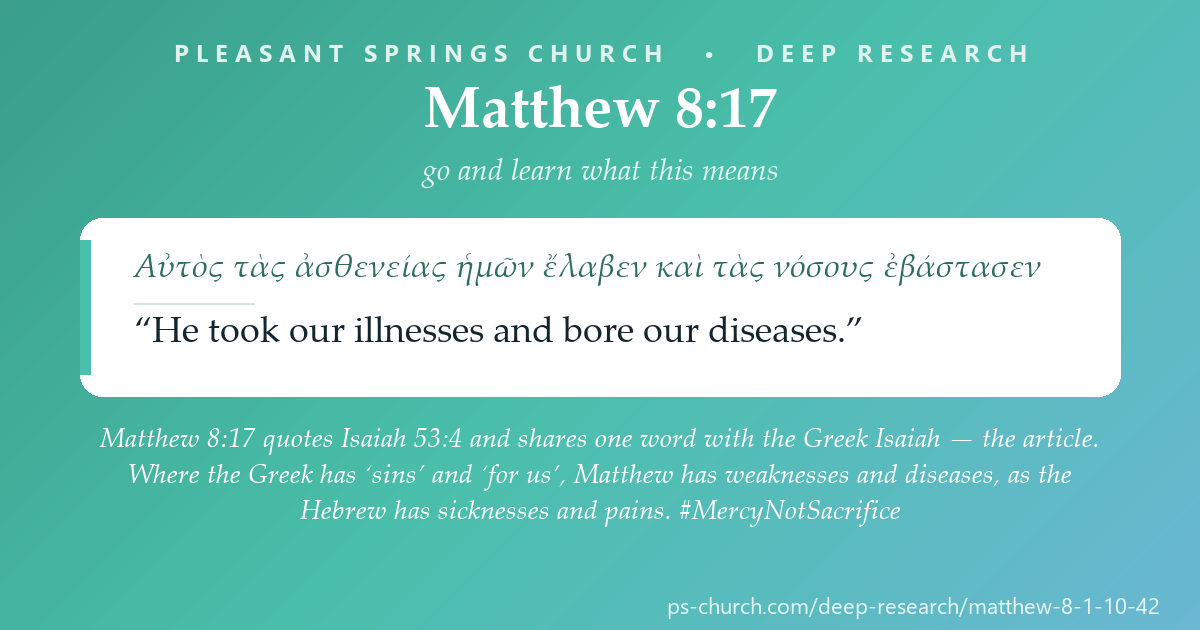
Isaiah 53:4 at 8:17. Αὐτὸς τὰς ἀσθενείας ἡμῶν ἔλαβεν καὶ τὰς νόσους ἐβάστασεν against οὗτος τὰς ἁμαρτίας ἡμῶν φέρει καὶ περὶ ἡμῶν ὀδυνᾶται: one word, the article. Where Rahlfs has τὰς ἁμαρτίας ἡμῶν, our sins, the Hebrew has חֳלָיֵנוּ — the noun the ESV renders at Deuteronomy 28:61 Every sickness — and Matthew has τὰς ἀσθενείας ἡμῶν, our weaknesses. Where Rahlfs has περὶ ἡμῶν ὀδυνᾶται, suffers pain for us, the Hebrew has וּמַכְאֹבֵינוּ סְבָלָם, and our pains, he carried them, and Matthew has καὶ τὰς νόσους ἐβάστασεν, and carried the diseases. In both nouns, and in the second verb, Matthew’s word stands closer to the Hebrew than to Rahlfs. In one detail it stands with neither: the Hebrew says our twice, Matthew once.
One verse earlier, the Greek itself has a sickness word. Isaiah 53:3 has the same Hebrew noun, חֹלִי, and there Rahlfs has μαλακίαν, sickness. And the deepest contact Matthew’s sentence has anywhere in the Greek Old Testament is three words of Deuteronomy 29:21, καὶ τὰς νόσους αὐτῆς — the sicknesses with which the Lord has made it sick. An accident of wording, and the page prints it as one.
The New Testament’s other use of Isaiah 53:4–5 measures the other way. 1 Peter 2:24, He himself bore our sins in his body on the tree, shares 3 words with Rahlfs’ Isaiah 53:4 and 3 with 53:5 — τὰς ἁμαρτίας ἡμῶν, the very words Matthew does not have (though the phrase stands in 15 Greek Old Testament units, so it is no fingerprint). Against each other Matthew 8:17 and 1 Peter 2:24 share 1 word.
What this does not show. It does not show that Matthew translated the Hebrew, or used a Greek text revised toward it, or a collection of texts already in Greek. All are proposed in the literature (Stage 5), and the disk holds no Greek Isaiah but Rahlfs’ as digitized by CATSS. Every closer to the Hebrew on this page means: closer than Rahlfs. Where Matthew and the Greek differ, the page reports which text has Matthew’s word; it does not say who had it first.
Isaiah 53:4, word by word:
| Matthew 8:17 | Septuagint Isaiah 53:4 (Rahlfs) | Masoretic Isaiah 53:4 | |
|---|---|---|---|
| he | Αὐτὸς | οὗτος this one | הוּא |
| our … | τὰς ἀσθενείας ἡμῶν our weaknesses | τὰς ἁμαρτίας ἡμῶν our sins | חֳלָיֵנוּ the noun of Deuteronomy 28:61, ESV Every sickness |
| took / bears / bore | ἔλαβεν took | φέρει bears | נָשָׂא |
| and the … | τὰς νόσους the diseases (no our) | καὶ περὶ ἡμῶν and for us | וּמַכְאֹבֵינוּ the noun of 53:3, ESV a man of sorrows |
| carried | ἐβάστασεν carried | ὀδυνᾶται suffers pain | סְבָלָם he carried them |
| the ESV’s English | He took our illnesses and bore our diseases | — | Surely he has borne our griefs and carried our sorrows |
Pair runs with Matthew 8:17: Isaiah 53:4 = 1, 53:3 = 1, 53:5 = 1. τὰς ἀσθενείας ἡμῶν stands in no Greek Old Testament unit; τὰς νόσους in two (Deuteronomy 29:21; Psalm 102:3, ESV 103:3). The ESV renders the Hebrew nouns of Isaiah 53:4 griefs and sorrows, and Matthew’s Greek illnesses and diseases: one translation, two choices, and the reader should know both. Mark 1:32–34 and Luke 4:40–41 tell the same evening of healings and have no quotation.
Hosea 6:6, word by word:
| Matthew 9:13 (and 12:7) | Septuagint Hosea 6:6 | Masoretic Hosea 6:6 | |
|---|---|---|---|
| for | — | διότι | כִּי |
| mercy / steadfast love | Ἔλεος | ἔλεος | חֶסֶד |
| I desire | θέλω | θέλω | חָפַצְתִּי |
| and not sacrifice | καὶ οὐ θυσίαν | καὶ οὐ θυσίαν | וְלֹא־זָבַח |
| and the knowledge of God | not quoted | καὶ ἐπίγνωσιν θεοῦ | וְדַעַת אֱלֹהִים |
| rather than burnt offerings | not quoted | ἢ ὁλοκαυτώματα than + noun | מֵעֹלוֹת prefix min, from / than |
| the ESV’s English | I desire mercy, and not sacrifice | — | “For I desire steadfast love and not sacrifice, the knowledge of God rather than burnt offerings.” |
And again at 12:7, to the Pharisees over the grain plucked on the Sabbath: “And if you had known what this means, ‘I desire mercy, and not sacrifice,’ you would not have condemned the guiltless.”
The five-word sequence stands in one Greek Old Testament unit (Hosea 6:6) and in two New Testament verses (Matthew 9:13, 12:7); the Hebrew pair חֶסֶד חָפַצְתִּי in one Masoretic verse. Against Mark 2:17 Matthew 9:13 runs 5 and against Luke 5:32 4 — ἦλθον καλέσαι δικαίους ἀλλὰ ἁμαρτωλούς, the saying that follows; neither of them has Hosea. See Hosea 4–8 and Mark 2–3.
Sheep without a shepherd: the texts the commentaries name, and one they do not
| text | the Greek Old Testament | the ESV | pair run with Matthew 9:36 | with Mark 6:34 |
|---|---|---|---|---|
| Numbers 27:17 — Moses asks for a successor | ὡσεὶ πρόβατα οἷς οὐκ ἔστιν ποιμήν | as sheep that have no shepherd | 2 | 1 |
| 1 Kings 22:17 (3 Kingdoms) — Micaiah | ὡς ποίμνιον ᾧ οὐκ ἔστιν ποιμήν | as sheep that have no shepherd | 1 | 1 |
| 2 Chronicles 18:16 — Micaiah | ὡς πρόβατα οἷς οὐκ ἔστιν ποιμήν | as sheep that have no shepherd | 1 | 2 |
| Ezekiel 34:5 — the shepherds of Israel | διὰ τὸ μὴ εἶναι ποιμένας | because there was no shepherd | 1 | 1 |
| Zechariah 10:2 | ὡς πρόβατα … διότι οὐκ ἦν ἴασις | they are afflicted for lack of a shepherd | 1 | 2 |
| Judith 11:19 (witness, not Scripture) | ὡς πρόβατα οἷς οὐκ ἔστιν ποιμήν | like sheep that have no shepherd (ours; no ESV) | 1 | 2 |
| Psalm 79:2 (ESV 80:1) — not usually named | ὡσεὶ πρόβατα | you who lead Joseph like a flock | 2 | — |
| Mark 6:34 | ὡς πρόβατα μὴ ἔχοντα ποιμένα | like sheep without a shepherd | 4 | — |
The deepest of the named texts against Matthew 9:36 is Numbers 27:17 at 2 — ὡσεὶ πρόβατα — and it is tied: Psalm 79:2 (ESV 80:1) has the same two words. ὡσεὶ πρόβατα stands in 2 Greek Old Testament units and one New Testament verse; Mark 6:34 has ὡς πρόβατα, the form of 2 Chronicles 18:16, Zechariah 10:2 and Judith 11:19. οὐκ ἔστιν ποιμήν stands in 4 units (Numbers 27:17, 1 Kings 22:17, 2 Chronicles 18:16, Judith 11:19); Matthew and Mark both have μὴ ἔχοντα ποιμένα, which no Greek Old Testament unit has. Matthew’s sentence stands at Jesus’ first sending of the twelve; Mark’s, at the feeding of the five thousand (like sheep without a shepherd), and Matthew’s own feeding (14:14) runs 1 with 9:36. One curiosity, reported and not explained: at Zechariah 10:2, where the Hebrew has כִּי־אֵין רֹעֶה, no shepherd, Rahlfs has οὐκ ἦν ἴασις, there was no healing.
Micah 7:6 (unsignalled), word by word:
| Matthew 10:35–36 | Septuagint Micah 7:6 | Masoretic Micah 7:6 | Luke 12:53 | |
|---|---|---|---|---|
| the son / a man and his father | ἄνθρωπον κατὰ τοῦ πατρὸς αὐτοῦ | υἱὸς ἀτιμάζει πατέρα | כִּי־בֵן מְנַבֵּל אָב | υἱὸς ἐπὶ πατρί |
| a daughter against her mother | θυγατέρα κατὰ τῆς μητρὸς αὐτῆς | θυγάτηρ ἐπαναστήσεται ἐπὶ τὴν μητέρα αὐτῆς | בַּת קָמָה בְאִמָּהּ | θυγάτηρ ἐπὶ τὴν μητέρα |
| a daughter-in-law against her mother-in-law | νύμφην κατὰ τῆς πενθερᾶς αὐτῆς | νύμφη ἐπὶ τὴν πενθερὰν αὐτῆς | כַּלָּה בַּחֲמֹתָהּ | νύμφη ἐπὶ τὴν πενθεράν |
| the enemies of a man | ἐχθροὶ τοῦ ἀνθρώπου | ἐχθροὶ ἀνδρὸς | אֹיְבֵי אִישׁ | — |
| are those of his house | οἱ οἰκιακοὶ αὐτοῦ | πάντες οἱ ἄνδρες οἱ ἐν τῷ οἴκῳ αὐτοῦ all + five words | אַנְשֵׁי בֵיתוֹ no all | — |
| the ESV | a daughter against her mother | — | “for the son treats the father with contempt, the daughter rises up against her mother, the daughter-in-law against her mother-in-law; a man’s enemies are the men of his own house.” | “They will be divided, father against son and son against father, mother against daughter and daughter against mother, mother-in-law against her daughter-in-law and daughter-in-law against mother-in-law.” |
| pair run with Micah 7:6 (Greek) | 1 and 1 | — | — | 4 |
Matthew 10:35–36 against Septuagint Micah 7:6: 1 and 1. Luke 12:53 against it: 4. Matthew against Luke: 2 and 1. Where Micah’s Greek has ἐπὶ twice, Matthew has κατὰ three times (κατὰ τῆς μητρὸς stands in no Greek Old Testament unit) and Luke has Micah’s ἐπὶ. Where Micah’s Greek has πάντες, all, the Hebrew and Matthew have no such word. And Micah’s verb, ἐπαναστήσεται, is not in 10:35 at all; it stands, in another form, in 10:21 and Mark 13:12, the only two New Testament verses with it. See Micah.
East and west, and the patriarchs (8:11):
| text | the Greek | the ESV | pair run with Matthew 8:11 | with Luke 13:28–29 |
|---|---|---|---|---|
| 2 Kings 13:23 (4 Kingdoms) — the covenant | μετὰ Αβρααμ καὶ Ισαακ καὶ Ιακωβ | his covenant with Abraham, Isaac, and Jacob | 6 | 6 (13:28) |
| Psalm 107:3 (LXX 106:3) | ἀπὸ ἀνατολῶν καὶ δυσμῶν καὶ βορρᾶ καὶ θαλάσσης | from the east and from the west, from the north and from the south | 4 | 5 (13:29) |
| Isaiah 59:19 | οἱ ἀπ' ἀνατολῶν ἡλίου | from the rising of the sun | 2 | — |
| Isaiah 43:5 | ἀπὸ ἀνατολῶν ἄξω τὸ σπέρμα σου καὶ ἀπὸ δυσμῶν συνάξω σε | I will bring your offspring from the east, and from the west I will gather you | 2 | — |
| Malachi 1:11 | ἀπ' ἀνατολῶν ἡλίου ἕως δυσμῶν | from the rising of the sun to its setting | 2 | — |
| Isaiah 49:12 | ἰδοὺ οὗτοι πόρρωθεν ἔρχονται | these shall come from afar | 1 | — |
ἀπὸ ἀνατολῶν καὶ δυσμῶν stands in 2 Greek Old Testament units (Psalm 106:3 and Psalms of Solomon 11:2) and two New Testament verses (Matthew 8:11, Luke 13:29); the five words of the names Ἀβραὰμ καὶ Ἰσαὰκ καὶ Ἰακὼβ in 18 screened units (20 held) and four New Testament verses. Luke has the two sayings in the other order — the weeping and the patriarchs (13:28) before the east and west (13:29) — and Matthew 8:12 against Luke 13:28 runs 9. See Psalm 107.
The lost sheep of the house of Israel (10:6; 15:24):
τὰ πρόβατα τὰ ἀπολωλότα οἴκου Ἰσραήλ — the lost sheep of the house of Israel. The Greek of Jeremiah 27:6 (MT and ESV 50:6) begins πρόβατα ἀπολωλότα ἐγενήθη ὁ λαός μου, and the Hebrew צֹאן אֹבְדוֹת הָיוּ עַמִּי: My people have been lost sheep. Pair run: 1. The two content words are the same forms in both, but Matthew sets an article between them, and a contiguous-run screen counts that as a break. πρόβατα ἀπολωλότα stands in 1 Greek Old Testament unit; Matthew’s τὰ πρόβατα τὰ ἀπολωλότα in none, and in two New Testament verses, 10:6 and “I was sent only to the lost sheep of the house of Israel” (15:24; the two run 6 with each other). οἴκου Ἰσραήλ stands in 27 Greek Old Testament units, most of them Ezekiel. This is the screen’s limit, printed as one: the strongest verbal echo in the chapter scores one. See Jeremiah 49–52.
The leper and Leviticus 14 (8:4):
| text | pair run with Matthew 8:4 |
|---|---|
| Leviticus 14:2 — οὗτος ὁ νόμος τοῦ λεπροῦ | 1 |
| Leviticus 14:13 and 14:35 | 2 each (τῷ ἱερεῖ) |
| Leviticus 14:3, 14:4, 14:10 | 1, 1, 1 |
| Leviticus 13:49 — καὶ δείξει τῷ ἱερεῖ | 2 (τῷ ἱερεῖ; the verb is another form) |
| Mark 1:44 — offer for your cleansing what Moses commanded | 8 |
| Luke 5:14 | 5 |
Of the 57 verses of Leviticus 14, the deepest against Matthew 8:4 reach 2, and the two words are τῷ ἱερεῖ (Leviticus 14:13 and Leviticus 14:35), a phrase found in 34 Greek Old Testament units. προσέταξεν Μωϋσῆς, Moses commanded, stands in 2 Greek Old Testament units, neither of them about leprosy (Exodus 36:6, Deuteronomy 27:1), and in the three Gospel verses. σεαυτὸν δεῖξον stands in Matthew 8:4 and Mark 1:44 only; Luke 5:14 has the two words the other way round. The law is named, not quoted.
The Gospels against each other — measured, not adjudicated:
| Matthew | deepest run against the rest of the Greek NT | partner | what it is |
|---|---|---|---|
| 8:20 | 24, band 1 | Luke 9:58 | a saying; against Mark alone, 5 (the narrative frame) |
| 8:9 | 23, band 1 | Luke 7:8 | the centurion’s speech; against Mark alone, 3 |
| 9:35 | 18, band 1 | Matthew 4:23 | Matthew with Matthew: the bracket |
| 10:22 | 16, band 1 | Mark 13:13 | the deepest with Mark: Mark’s chapter on the end |
| 9:6 | 15, band 1 | Mark 2:10 | the paralytic |
| 10:21 | 15, band 1 | Mark 13:12 | Mark’s chapter on the end again |
| 8:12 | 14, band 2 | Matthew 22:13, 25:30 | Matthew’s refrain |
| 9:13 | 8, band 1 | Matthew 12:7 | the Hosea quotation, twice |
| 8:17 | 8, band 2 | Matthew 4:14, 12:17 | the Isaiah formula line |
Against Mark alone the deepest row is 10:22 at 16 (band 1, Mark 13:13); against Luke alone, 8:20 at 24 (Luke 9:58); against John alone, nothing beyond 5. The two deepest New Testament runs in the passage are with Luke, in two passages Mark does not have. Matthew 10 against Mark’s own mission charge (6:7–13) reaches only 4 (10:14 with 6:11), while against Mark 13 it reaches 16 and 15. The page reports where the shared wording is; it does not say which Gospel had it first, or whether a lost source stands behind any of it. Those are the questions of the synoptic problem, and the measurement does not decide them. See Luke 7–8, Luke 9–10, Luke 5 and Mark 4:35–41.
Counter-examples this page prints against itself:
- 10:26 — run 4, tie band 1 — the Letter of Jeremiah 14. Μὴ οὖν φοβηθῆτε αὐτούς, so do not fear them, and μὴ οὖν φοβηθῆτε αὐτούς — the same four words, the same order, a band of one: as clean a signal as Hosea’s. In the Letter of Jeremiah them are idols. It is an accident, and it is printed so that the five words of Hosea 6:6 are not read as more than they are.
- 8:28, 9:23, 10:34 — run 4, tie band 1 each. Tobit 1:3 (Sinaiticus), Septuagint Jeremiah 45:11 (Hebrew and ESV 38:11), Amos 8:11: into the country of the, into the house of the, on the earth not. Isaiah 53:4, which Matthew names, scores 1.
- 8:11 — the deepest run of all, 6, band 1 — is a formula. The names Ἀβραὰμ καὶ Ἰσαὰκ καὶ Ἰακὼβ stand in 18 screened units; one preposition makes the sixth word.
- 8:17 — the quotation’s deepest contact is not its source. Deuteronomy 29:21, three words, band 1.
- 10:6 — run 3, band 1, Zechariah 11:11. τὰ πρόβατα τὰ φυλασσόμενα (ESV the sheep traders, who were watching me, where the Hebrew is read differently): the same three Greek words as Matthew’s τὰ πρόβατα τὰ, and another flock. It outscores Jeremiah.
- 9:36 — run 3, band 2. Jeremiah 7:16 and 2 Samuel 10:5, περὶ αὐτῶν ὅτι and αὐτῶν ὅτι ἦσαν: both deeper than any shepherd text.
The readings of 8:17 and of 10:23 with their holders, the church’s frame labelled as the church’s, and everything this page could not check.
None of the modern works named on this page was re-read for it. Their positions are reported as the literature commonly summarises them, and are marked reported. The ancient writers quoted — Papias in Eusebius, Ignatius, Chrysostom — are cut word for word at build time from the public-domain ANF and NPNF translations held in the shelf’s library, and are marked held. Every number on the page was measured on files on this disk.
Commentaries & studies:
- W. D. Davies and Dale C. Allison (ICC, 1991); Donald A. Hagner (WBC 33A, 1993); R. T. France (NICNT, 2007); Ulrich Luz (Hermeneia, 2001); Craig S. Keener (2009); D. A. Carson (EBC 8, 1984) — all reported, none re-read.
- On the quotations: Maarten J. J. Menken, Matthew’s Bible (2004); Craig L. Blomberg in Beale and Carson (2007) — reported.
- On the church’s frame: Kenneth Keathley, Salvation and Sovereignty: A Molinist Approach (2010); William Lane Craig, The Only Wise God (1987); George Eldon Ladd, The Blessed Hope (1956) — reported.
Where does Matthew’s wording at 8:17 come from? The proposals:
- From the Hebrew, rendered afresh at the point where the Greek differs (a common view of Matthew’s formula quotations; reported).
- From a Greek text revised toward the Hebrew, of the kind later associated with Aquila, Symmachus and Theodotion (reported; no such text is on this disk).
- From a collection of texts already in Greek, used by teachers before the Gospel was written (reported).
- The measurements bear on all three and decide none. They show which text has Matthew’s words; they cannot show how the words got there.
⚠️ He took our illnesses: healing and the atonement, four readings
The text first. “That evening they brought to him many who were oppressed by demons, and he cast out the spirits with a word and healed all who were sick.” “This was to fulfill what was spoken by the prophet Isaiah: ‘He took our illnesses and bore our diseases.’” Matthew sets the quotation after an evening of healings, in Galilee, before the cross; he does not mention the cross here. Isaiah’s next verse says he was pierced for our transgressions and with his wounds we are healed, and 1 Peter 2:24 reads that line of sins (By his wounds you have been healed). All four readings below have to account for both uses.
| reading of 8:17 | in brief | held by |
|---|---|---|
| 1. Healing provided in the atonement, a present privilege | Isaiah 53:4 promises bodily healing as part of what the cross secures, and Matthew 8:17 shows it; believers may ask for it now on that ground | A. B. Simpson (1885); classical Pentecostal statements, e.g. the Assemblies of God’s Statement of Fundamental Truths on divine healing (reported) |
| 2. Healing guaranteed now to faith | as reading 1, with the added claim that healing is assured to believers who believe and confess it, so that continuing sickness is a failure of faith | F. F. Bosworth (1924); Word of Faith teachers such as Kenneth E. Hagin (reported) |
| 3. Fulfilled in the earthly ministry; the full healing is resurrection | Matthew applies Isaiah to the healings of that evening; the cross deals with sin and its fruit, and the body’s full healing waits for the resurrection, so healing now is a gift God may give, not a guarantee | D. A. Carson (1984); R. T. France (2007) (reported) |
| 4. The prophet spoke of sins; Matthew applies it to diseases | Isaiah’s words concern sins, and Matthew uses them of diseases either in a historical sense or because diseases arise from sin | John Chrysostom (held, quoted in Stage 2) |
What the measurement adds, and what it does not. Stage 4 shows that Matthew’s nouns, weaknesses and diseases, stand where the Hebrew has sickness and pain and Rahlfs has sins. That bears on reading 4’s premise that the prophet’s words concern sins rather than diseases; it does not decide between readings 1–3, which differ on when and how the healing is given, not on whether Matthew applies the verse to sickness. This is not one of the church’s ratified positions, and the page does not choose. The church does hold that Christ’s atonement is an unlimited provision, offered to all; that is about its scope, and it settles none of the four.
And Chrysostom’s second reason, labelled. He says most diseases arise from sins of the soul. The church’s position on ancestral sin is that Adam’s children inherit mortality, not his guilt; on that frame sickness belongs to the mortality all inherit, and no sufferer in these chapters is told his sickness was his sin. At 9:2 Jesus forgives the paralytic’s sins first and heals him second, and the text says the healing was given that you may know that the Son of Man has authority on earth to forgive sins — it does not say the paralysis came from them.
⚠️ Clean and unclean: the church’s position, labelled
Pleasant Springs holds that ritual impurity is not sin. Under the law the leper, the woman with the flow of blood and the dead girl were sources of uncleanness (Leviticus 13:45–46; 15:25; Numbers 19:11), and none of the three is called a sinner for it in Matthew. Leviticus is not silent on sin, and the page reports it: the cleansed leper and the woman whose discharge has ended each bring a sin offering (Leviticus 14:19, 14:31; 15:30), and at 14:19 the Greek has the priest atone for the one being cleansed ἀπὸ τῆς ἁμαρτίας αὐτοῦ, from his sin, where the Hebrew has מִטֻּמְאָתוֹ, from his uncleanness. Scripture also narrates skin disease as judgment on Miriam (Numbers 12:10), Gehazi (2 Kings 5:27) and Uzziah (2 Chronicles 26:19–21); the church’s position is read beside those texts, not in place of them. The leper asks to be made clean, not forgiven; the woman is called θύγατερ and told your faith has made you well. That is the church’s position, and nothing measured on this page establishes or refutes it; the texts are consistent with it, and the page shows where.
⚠️ Before the Son of Man comes (10:23): five readings
The text first. “When they persecute you in one town, flee to the next, for truly, I say to you, you will not have gone through all the towns of Israel before the Son of Man comes.” The phrase ἔλθῃ ὁ υἱὸς τοῦ ἀνθρώπου stands in two New Testament verses, this and 25:31, where the Son of Man comes in glory to judge the nations; τὰς πόλεις τοῦ Ἰσραὴλ in this verse only. Matthew 16:28, the saying most often set beside it, shares 2 words with it. The ancient readers already took it more than one way:
to destroy this fear, He saith, "Ye shall not have gone round Palestine first, but I will straightway come upon you."John Chrysostom, Homilies on Matthew 34.1, on 10:23 (NPNF1 10, held)
| reading of 10:23 | in brief | held by |
|---|---|---|
| 1. Within the mission | the Son of Man rejoins the twelve before they have been round the towns of Israel; the coming is his return to them | John Chrysostom (held, quoted above) |
| 2. Preterist: the judgment of AD 70 | the Son of Man’s coming is his vindication in the judgment on Jerusalem within that generation | R. T. France (2007); N. T. Wright (1996) (reported) |
| 3. Futurist: the mission to Israel lasts until the Parousia | the disciples’ mission to Israel will not be finished before the Son of Man comes at the end; 10:17–22 already looks beyond the first mission | D. A. Carson (1984) and others (reported) |
| 4. Resurrection and enthronement | the coming is the risen Son of Man given all authority (28:18) | proposed by several commentators; no holder named here |
| 5. A mistaken expectation | Jesus expected the end before the twelve came back, and it did not come | Albert Schweitzer (1906) (reported) |
The church’s frame — labelled as the church’s, not as a result. Pleasant Springs holds historic premillennialism — the view set out by Ladd (reported) — and not the dispensational scheme of John Nelson Darby and the Scofield Reference Bible. The frame expects a future, bodily coming of the Son of Man, and reading 3 sits most easily with it; but the frame does not by itself exclude readings 1, 2 or 4 for this verse, and premillennial readers are found holding each of them (reported). Scofield’s notes are commonly reported to assign 10:16–23 to a Jewish remnant preaching in a future tribulation (reported); that division of the passage is the one the frame does not follow. Nothing measured here settles 10:23, and the page leaves it hard.
⚠️ The one who endures to the end (10:22), and the warnings of 10:32–33
The text first. “and you will be hated by all for my name’s sake. But the one who endures to the end will be saved.” “So everyone who acknowledges me before men, I also will acknowledge before my Father who is in heaven,” Matthew 10:22 runs 7 words with Matthew 24:13 and 16 with Mark 13:13.
- Perseverance as the evidence of genuine faith, with the warnings addressed to all hearers (the Reformed tradition, reported).
- Loss of salvation possible for one who does not endure (Arminian and Wesleyan traditions, reported).
- Endurance as the means God uses to keep those who are his, the warnings among those means (reported, and the church’s frame below).
The church’s frame, in its own words. Pleasant Springs teaches eternal security in the ROSES framing (TULIP, DAISY and ROSES). Its statement of faith (what we believe, Article 10) says that “all who genuinely receive Christ are held secure” and that “Scripture’s warnings are themselves a real means by which He holds us fast.” On that frame 10:22 and 10:33 are real warnings, spoken to be heeded, and among the means by which those who are his are kept. That is the church’s position; nothing measured on this page establishes or refutes it.
⚠️ Not one of them will fall to the ground apart from your Father (10:29)
“Are not two sparrows sold for a penny? And not one of them will fall to the ground apart from your Father.” The sentence is offered as comfort to men about to be persecuted, not as a theory of providence. The traditions read it within their own: meticulous providence, in which God ordains each sparrow’s fall (John Calvin and the Reformed tradition, reported); Molinist providence, in which God, knowing what every creature would freely do in any circumstance, orders a world in which nothing falls outside his knowing and permitting (Keathley; Craig, reported); and open theism, in which God does not foreknow free choices with certainty (Gregory A. Boyd, God of the Possible, 2000, reported). Pleasant Springs reads providence on the Molinist frame, summarised by ROSES rather than the Canons of Dort. That is the church’s frame, and the verse does not prove it.
What this page did NOT check, and where it is weakest:
- No Greek Old Testament but Rahlfs’ (as digitized by CATSS) was searched. No Göttingen apparatus, no codex readings, and no text of Aquila, Symmachus or Theodotion for Isaiah, Hosea, Micah or Jeremiah is on this disk; whether any Greek version read a sickness word at Isaiah 53:4 could not be checked. Every closer to the Hebrew on this page means: closer than Rahlfs.
- The Hebrew is the Masoretic text only, as printed by Sefaria. The Isaiah scrolls from Qumran were not consulted.
- Greek cannot be screened against Hebrew. The alignment tables in Stage 4 are read off the texts word by word; they are a judgement, laid out so a reader can check it, not a measurement.
- The contiguous-run screen misses what it cannot see. At 10:6 the two words Matthew shares with Jeremiah are split by an article and score 1. Allusions in other words — Isaiah 35:5–6 behind the blind and the mute, Jonah behind the storm, Ezekiel 34 behind the shepherd — score 1 or 2 and are named, not measured.
- The Gospels are compared, not explained. The runs with Mark and Luke are shared wording. No source theory was assumed or tested, and no reconstruction of a sayings source was consulted.
- The SBLGNT apparatus was not consulted. Variants commonly reported at 8:28 (Gadarenes, Gerasenes, Gergesenes) and at 9:34 (omitted in some Western witnesses) were not checked; the page prints the SBL text.
- The Mishnah, the midrashim and Josephus are not on this disk. Everything said about purity practice, tax collectors, mourners and the Avot de-Rabbi Natan story is reported.
- The ten-miracle count is a counting rule, stated in Stage 3; a different rule gives nine.
- The structure diagram is ours, built from repeated words counted in the text, not from a commentary’s outline; it is labelled a sequence with one measured bracket, expressly not a chiasm.
- Our own renderings of the Matthew verses whose ESV is not printed were checked by machine against the ESV and the KJV for shared runs of five or more words. The NRSV is not on this disk and could not be checked. Judith 11:19 is our rendering because the ESV has no Judith.
- Direction of influence is never asserted. Where Matthew’s wording matches the Hebrew against Rahlfs (8:17), or Luke matches Rahlfs more closely than Matthew (Micah 7:6), the page reports the match and nothing more.
- Tobit, Judith, the Letter of Jeremiah and the Psalms of Solomon are witnesses, not Scripture. They were screened because CATSS holds them, and are named only as counter-examples or counts.
Ten acts of power, a call, a lesson to go and learn, and twelve men sent.
Name what you learned, why it matters, and one concrete response.
What should we carry away — and do?
- He touched what the law kept at a distance. A leper, a woman twelve years unclean, a dead girl. In each story the touch goes from him to them, and what passes is cleansing, not uncleanness.
- Go and learn. The one text in these chapters Matthew gives word for word is a lesson, not a proof: I desire mercy, and not sacrifice. He gives it twice, and both times to Pharisees (9:11, 12:2).
- Isaiah is read for the sick. Matthew’s words for Isaiah 53:4 are words for weakness and disease, where the Hebrew has sickness and pain. Whatever else the verse means, it means that the servant’s burden includes the bodies of the people brought to him that evening (8:16).
- Compassion becomes a sending. He sees the crowds harassed and helpless, tells his disciples to pray for workers, and in the next verse sends them.
- Do not fear, three times. The discourse that promises courts, floggings and divided houses says do not fear three times, and gives sparrows as the reason.
Step in response: read Matthew 8–9 aloud in one sitting and count the ten stories with the rule in Stage 3; then read Leviticus 13:45–46 and 15:25 and notice who, in Matthew, is no longer kept outside. Then do what 10:42 names: give someone even a cup of cold water.
Matthew 8:17 · to share
Greek NT + ESVEvery Deep Research page traces its passage across the whole sweep — the Old Testament, the Second-Temple world between the testaments (historical witnesses, not Scripture), and the New Testament. Follow the thread:
Pleasant Springs Church — Deep Research
Research method after Michael S. Heiser’s Bible Research Method (examine dictionaries → ancient literature → important words → textual connections → academic publications → share), with the Pleasant Springs “Author & Audience” foundation. Scripture set in the Hebrew, the Greek editions named on each page and the ESV (Old Testament), and the Greek New Testament and the ESV (New Testament), per the practice of Pleasant Springs Church. Matthew works named on this page (none re-read for it, all reported): Davies and Allison, Hagner, France, Luz, Keener and Carson, with Menken and Blomberg on the quotations; Simpson, Bosworth and Warfield on healing; Schweitzer, Wright and Ladd on 10:23; Keathley, Craig and Boyd on providence — none of which were consulted for any number on this page. Ancient writers cut from the ANF and NPNF translations held in the shelf’s library: Papias (in Eusebius), Ignatius, Chrysostom. Text: Greek New Testament from the SBL edition as digitized by MorphGNT (text and lemma columns); Greek Old Testament from Rahlfs’ Septuaginta as digitized by CATSS; Hebrew from the Masoretic text as printed in Sefaria’s Miqra according to the Masorah. ⚠️ VERSE NUMBERING. Matthew 8–10 has no offset. Hebrew and ESV Jeremiah 50:6 = Septuagint 27:6; Psalm 107:3 = Septuagint 106:3; Psalm 103:3 = Septuagint 102:3; ESV Psalm 80:1 = Masoretic 80:2 = Septuagint 79:2; ESV Deuteronomy 29:22 = Hebrew and Greek 29:21; 1 Kings = 3 Kingdoms and 2 Kings = 4 Kingdoms; the Letter of Jeremiah 14 = KJV Baruch 6:16; Septuagint Jeremiah 45:11 = Hebrew and ESV 38:11; the other texts are numbered alike in all three. ⚠️ The measurement, in full. Greek against Greek; MorphGNT normalised word; CATSS form column, beta-code transliterated first; both sides lowercased, accents and breathings dropped, final sigma folded, with the shelf’s edition-equivalence table on cross-corpus screens. Contiguous runs of whole word forms, never lemmas. 114 rows against 30,348 verse units — the 64 CATSS files less the Odes — and against the other 7,813 verses of the Greek New Testament; absence claims also searched the 30,637 units held. Hebrew counts consonantal, over 23,204 Masoretic verse units. Exhaustive and deterministic. It finds verbatim contact, not allusion.
Scripture quotations marked ESV are from the ESV® Bible (The Holy Bible, English Standard Version®), © 2001 by Crossway, a publishing ministry of Good News Publishers. ESV Text Edition: 2016. Used by permission. All rights reserved. The ESV text may not be quoted in any publication made available to the public by a Creative Commons license, and the ESV may not be translated in whole or in part into any other language. www.esv.org
|
Did this study bless you today? 💚 Give to Support PS Church100% of gifts go to the General Fund — thank you. |