Two quarrels about the Sabbath, a servant who will not shout, a charge that the healer works by Beelzebul, a sign refused and a sign promised, and a family redrawn. In the middle of it Matthew sets the longest fulfilment quotation in his Gospel — Isaiah 42:1–4, 61 Greek words — and against Rahlfs’ Greek Isaiah it measures 5, 1, 2 and 5 words, verse by verse. It touches the Greek at its two ends and hardly between them. Where it begins, it agrees with the Hebrew against the Greek: no Jacob, no Israel. Where it ends, it agrees with the Greek against the Hebrew: in his name the Gentiles will hope, where the Hebrew has the coastlands waiting for his law. The deepest Greek Old Testament run in the chapter is not in the quotation at all: twelve words of Jonah 2:1 (ESV 1:17), tie band one, in a sentence that opens For just as. See the method →
Matthew 12:1–50 — selected verses
Greek NT · ESVVersification. Matthew 12 carries no offset: the SBL Greek on this disk and the ESV both number the chapter to 50 — though the ESV’s running text, as Crossway’s API returns it, has no verse 47 (see the codex). There is no Septuagint column because Matthew is a New Testament book. The offsets are in the Old Testament texts, each checked by content against the Masoretic and CATSS files before being stated: Jonah 2:1 in the Hebrew and the Greek = ESV Jonah 1:17, and so Jonah 2:2 = ESV 2:1 and 2:11 = ESV 2:10; 1 Kingdoms (1 Samuel) 21:2–10 in the Hebrew and the Greek = ESV 21:1–9, so the bread is given at 21:7, ESV 21:6; Psalm 11:8 (Septuagint) = 12:8 (Hebrew) = 12:7 (ESV), and the four Psalms holding the ends of the earth, Septuagint 45:10, 58:14, 60:3 and 64:6, are Hebrew 46:10, 59:14, 61:3 and 65:6 and ESV 46:9, 59:13, 61:2 and 65:5; 2 Esdras 23:17–18 = Nehemiah 13:17–18. 1 Samuel 20:15 and 30:12, 2 Samuel 12:20, 1 Kings 10:1 and 2 Kings 1:2 differ only in the book name (1–4 Kingdoms); the saying the ESV prints at 1 Kings 8:13 has no 8:13 in Rahlfs, whose Greek gives a different form of it after 8:53. Isaiah 42:1–4, Numbers 28:9–10, Genesis 8:9, 18:9 and 37:10, Esther 4:16 and Leviticus 24:9 are numbered alike in all three.
The Shape of the Passage
A sequence of six units with measured threads — NOT a chiasmMatthew 11 closed with an invitation to rest; chapter 12 opens on the day of rest and spends its first fourteen verses on it. The questions of who wrote the Gospel and of Papias’ testimony are taken up on the Matthew 8–10 page and not repeated here.
Author
The evangelist who quotes — at his longest here. Of the ten formula quotations, where this Gospel says a prophet’s word was fulfilled, the quotation at 12:17–21 is the longest: 61 Greek words, against 33 for 4:14–16, the next of the ten (13:14–15, Isaiah 6:9–10, which Jesus introduces with is fulfilled, has 47 and is not one of the ten; with it, 12:18–21 is still the longest). The count runs from the first word after the formula to the end of the quoted words (Stage 4 gives all ten). And it is the one in which the measurement finds Matthew’s Greek touching Rahlfs’ Isaiah at the two ends and hardly between them.
Material only this Gospel has. The priests who profane the Sabbath, the temple and the something greater, Hosea 6:6, and the whole Isaiah quotation (12:5–7, 17–21) have no counterpart in Mark or Luke: against each of those Gospels alone, none of these verses runs deeper than 4. The τρεῖς ἡμέρας καὶ τρεῖς νύκτας of 12:40 is also this Gospel’s alone; Luke’s sign of Jonah (11:29–32) has no form of κῆτος.
Audience
Readers who knew the stories without being told them. David at Nob, the Sabbath offerings, Jonah, the queen who came to test Solomon: the chapter names each in a clause and explains none. It also assumes its readers know who the Pharisees are, what a Sabbath walk through a field permits, and why a healing on the Sabbath could be an accusation (ἵνα κατηγορήσωσιν αὐτοῦ).
A question about who belongs. The chapter opens with a quarrel about the law and ends with a family redefined: “For whoever does the will of my Father in heaven is my brother and sister and mother.” Between those, the quotation of Isaiah names the nations twice (ἔθνος) — he will proclaim justice to the Gentiles and in his name the Gentiles will hope. Who first read the Gospel, and where, the page does not reconstruct.
Orient on the Sabbath, the bread of the Presence, the Servant of the Lord, Beelzebul, the unforgivable sin, Jonah, Sheba and the family of Jesus.
Search by topic: Sabbath, Sabbath controversies, bread of the Presence (showbread), Nob, Ahimelech, Abiathar, priests and the temple service, Servant of the Lord (Servant Songs), Beelzebul, Satan, exorcism, strong man, blasphemy, unpardonable sin, Jonah, Nineveh, Sheba, sign, unclean spirits, brothers of Jesus.
Which articles are relevant?
- Anchor Bible Dictionary — “Sabbath,” “Bread of the Presence,” “Servant of the Lord,” “Beelzebul,” “Blasphemy,” “Jonah,” “Sheba, Queen of,” “Brothers and Sisters of Jesus.”
- Dictionary of Jesus and the Gospels (2nd ed.) — “Sabbath,” “Servant of Yahweh,” “Demon, Devil, Satan,” “Exorcism,” “Blasphemy,” “Sign,” “Family.”
- NIDNTTE / TDNT — σάββατον (Sabbath), παῖς (servant, child), βλασφημία (blasphemy), σημεῖον (sign), κρίσις (judgment, justice).
Bibliography surfaced:
- W. D. Davies and Dale C. Allison, Matthew 8–18 (ICC, 1991); Donald A. Hagner, Matthew 1–13 (WBC 33A, 1993); R. T. France, The Gospel of Matthew (NICNT, 2007); Ulrich Luz, Matthew 8–20 (Hermeneia, 2001); Craig S. Keener, The Gospel of Matthew (2009).
- Craig L. Blomberg, “Matthew,” in G. K. Beale and D. A. Carson, eds., Commentary on the New Testament Use of the Old Testament (2007); Maarten J. J. Menken, Matthew’s Bible (2004); Richard Beaton, Isaiah’s Christ in Matthew’s Gospel (2002).
- Michael S. Heiser, The Unseen Realm (2015), on the spiritual powers and the kingdom of God.
- Augustine, Sermon 71 (NPNF1 6, Sermon 21); John Chrysostom, Homilies on Matthew 41 (NPNF1 10); Origen, De Principiis 1.3.7 (ANF 4) — on the blasphemy against the Spirit.
The texts the chapter names and does not quote, the Sabbath in the Maccabean crisis, and the name Beelzebul.
Read 1 Samuel 21, Numbers 28, Jonah 1–3, 1 Kings 10 and 2 Kings 1 in the Septuagint and the ESV, with the Hebrew where the two differ, and 1 Maccabees 2 in Rahlfs. The Mishnah, the Dead Sea Scrolls and Josephus are not on this disk; anything said from them is reported, not checked.
Which parallels shed light on religion and worldview?
David at Nob. “So the priest gave him the holy bread, for there was no bread there but the bread of the Presence, which is removed from before the Lord, to be replaced by hot bread on the day it is taken away.” In Rahlfs the verse is 1 Kingdoms 21:7 and it names the priest Αβιμελεχ ὁ ἱερεὺς; the Hebrew names him אֲחִימֶלֶךְ, Ahimelech (21:2, ESV 21:1); Mark 2:26 has in the time of Abiathar the high priest; Matthew and Luke name nobody. Three names in three texts and a silence in two: the Mark 2–3 page sets out the explanations and resolves none, and this page reports the wording and adjudicates nothing. The story of Nob itself is on the 1 Samuel 18–24 page.
The Sabbath offering. “On the Sabbath day, two male lambs a year old without blemish, and two tenths of an ephah of fine flour for a grain offering, mixed with oil, and its drink offering:” “this is the burnt offering of every Sabbath, besides the regular burnt offering and its drink offering.” Matthew does not quote it; Stage 4 measures one word. Matthew 12:5 points to the priests’ Sabbath work in the temple, which this law requires (see Numbers 28–29).
The Sabbath under the Maccabees. When the king’s men came out against the faithful in the wilderness, the faithful answered: καὶ εἶπον οὐκ ἐξελευσόμεθα οὐδὲ ποιήσομεν τὸν λόγον τοῦ βασιλέως βεβηλῶσαι τὴν ἡμέραν τῶν σαββάτων — We will not come out, nor do the king’s bidding and profane the Sabbath day. (our rendering) They were attacked τοῖς σάββασιν and died without resisting, and Mattathias’ men resolved to fight if attacked on the Sabbath (2:41). Measured: 1 Maccabees 2:38 is the only screened Greek Old Testament unit with Matthew’s dative τοῖς σάββασιν (13 New Testament verses have it), and 2:34 is one of 15 units in which a form of profane and a form of Sabbath stand together. See 1 Maccabees 1–4; a witness, not Scripture.
Jonah. “And the Lord appointed a great fish to swallow up Jonah. And Jonah was in the belly of the fish three days and three nights.” In the Hebrew and the Greek this is Jonah 2:1; the Greek calls the creature κήτει μεγάλῳ, a great sea creature, where the Hebrew has דָּג גָּדוֹל, a great fish. Matthew’s τοῦ κήτους is the Greek’s word. See Jonah 1:17–2:10 and Jonah.
The queen of Sheba. “Now when the queen of Sheba heard of the fame of Solomon concerning the name of the Lord, she came to test him with hard questions.” Rahlfs calls her βασίλισσα Σαβα; Matthew and Luke call her βασίλισσα νότου, queen of the South, a phrase the Greek Old Testament does not have. See 1 Kings 9–11.
Beelzebul (reported, and measured where it can be). The name stands in no Greek Old Testament unit, screened or held. The nearest name in the Old Testament is the god of Ekron: “Now Ahaziah fell through the lattice in his upper chamber in Samaria, and lay sick; so he sent messengers, telling them, ‘Go, inquire of Baal-zebub, the god of Ekron, whether I shall recover from this sickness.’” There the Hebrew has בְּבַעַל זְבוּב and Rahlfs τῇ Βααλ μυῖαν θεὸν Ακκαρων, Baal-fly, god of Ekron (our rendering). The letters ζεβοὺλ stand in the Greek Old Testament only as the name of Zebul, Abimelech’s officer in Judges 9 (10 units across the two Greek texts of Judges). An explanation commonly given (reported) reads zebul as exalted dwelling: outside the names Zebulun, Zebul and Jezebel, the consonants זְבֻל stand in 6 Masoretic verses, among them 1 Kings 8:13, “I have indeed built you an exalted house”. If that is right, Beelzebul would be lord of the house, and the chapter’s houses — the strong man’s (12:29), the spirit’s (12:44), and the τὸν οἰκοδεσπότην Βεελζεβοὺλ of 10:25 — would be a play on it. The page records the proposal and does not adopt it. Michael Heiser reads the strong man and the kingdom of 12:28–29 within the Bible’s account of rebel spiritual powers whose domain the kingdom of God invades (The Unseen Realm, reported); that frame is his, not a result of this page.
- 1 Samuel 21 — 1 Samuel 18–24. Numbers 28 — Numbers 28–29.
- Isaiah 42 — Isaiah 40–42. Jonah — the fish and the prayer.
- 1 Kings 10 — 1 Kings 9–11. 1 Maccabees 2 — 1 Maccabees 1–4 (witness, not Scripture).
- The Mark parallel — Mark 2:1–3:35. The baptism voice — Mark 1 and Matthew 3:13–17.
- Origen, Chrysostom, Augustine on 12:31–32 — held in the shelf’s library (ANF 4; NPNF1 6 and 10), quoted in Stage 5.
Here, Spirit, chosen, beloved, sea creature, Beelzebul, blasphemy, waterless.
Counts are by MorphGNT lemma across the SBL Greek New Testament, and by unanchored searches of the normalised Greek Old Testament forms, so that augments, endings and elision do not hide a hit. A count of word forms is never offered as a count of words.
Which words matter most?
Here. 18 uses in Matthew, three of them in this chapter, each after a comparative: μεῖζόν at 12:6 (the temple), πλεῖον at 12:41 and 12:42 (Jonah, Solomon). The phrases πλεῖον Ἰωνᾶ ὧδε and πλεῖον Σολομῶνος ὧδε stand in Luke 11:31–32 as well; τοῦ ἱεροῦ μεῖζόν ἐστιν ὧδε stands in this verse alone.
Spirit. 6 occurrences in the chapter: my Spirit on the servant (12:18), the Spirit of God (12:28), the Spirit blasphemed (12:31–32), and then the unclean spirit and its seven (12:43, 45). The word that names the power in the healing names the power in the possession.
To choose. One New Testament occurrence, this verse. Forms beginning hairet- or hēret- (the verb, and once the noun at Wisdom 8:4) stand in 29 screened Greek Old Testament units and in none of Isaiah’s; Rahlfs’ Isaiah 42:1 has ὁ ἐκλεκτός μου instead, and the Hebrew בְּחִירִי, my chosen.
Beloved. 3 uses in Matthew: the two voices from heaven (3:17, 17:5) and this quotation. In the New Testament the lemma and εὐδοκέω, be well pleased, share a verse seven times, three of them in Matthew and those same three. ὁ ἀγαπητός μου stands in no Greek Old Testament unit (Stage 4).
Sea creature. One New Testament occurrence. Forms of the noun stand in 11 screened Greek Old Testament units, three of them in Jonah (2:1, 2:2, 2:11), and in Genesis 1:21 for the great sea creatures of the fifth day.
Beelzebul. 7 New Testament verses (Matthew 10:25, 12:24, 12:27; Mark 3:22; Luke 11:15, 18, 19); no Greek Old Testament unit. See Stage 2.
Blasphemy. 18 New Testament occurrences, 4 in Matthew (12:31 twice, 15:19, 26:65). At 26:65 the charge of blasphemy is laid against Jesus himself.
Waterless. 4 New Testament occurrences (here, Luke 11:24, 2 Peter 2:17, Jude 12). In the Greek Old Testament the adjective stands in 23 screened units, but never beside a form of place; ἀνύδρων τόπων is the Gospels’ phrase.
Isaiah 42 verse by verse against Rahlfs and the Hebrew; Jonah; Nob; the Sabbath law; the synoptic sayings; the doublets inside Matthew; and the counter-examples.
Greek against Greek: all fifty verses of Matthew 12 were screened against the 30,348 screened Greek Old Testament units (the 64 CATSS files less the Odes; absence claims also searched the 30,637 units held) and against the other 7,877 verses of the Greek New Testament. Contiguous runs of whole word forms; every run is given with its tie band, the number of units that reach the same depth. Greek cannot be screened against Hebrew; the alignments with the Masoretic text below are read off the texts, laid out so that a reader can check them.
★★ Isaiah 42:1–4: the quotation touches Rahlfs at its two ends
“Behold my servant, whom I uphold, my chosen, in whom my soul delights; I have put my Spirit upon him; he will bring forth justice to the nations.” “He will not grow faint or be discouraged till he has established justice in the earth; and the coastlands wait for his law.” The runs, verse against verse. Each cell is the longest run of consecutive words a verse of Matthew shares with a verse of Rahlfs’ Isaiah:
| Matthew ↓ / Rahlfs → | Isaiah 42:1 | 42:2 | 42:3 | 42:4 |
|---|---|---|---|---|
| 12:18 | 5 | 1 | 1 | 1 |
| 12:19 | 1 | 1 | 1 | 1 |
| 12:20 | 1 | 1 | 2 | 2 |
| 12:21 | 1 | 1 | 1 | 5 |
The diagonal reads 5, 1, 2, 5. The first and last verses run five words each, both at a tie band of one — nothing else in the Greek Old Testament reaches five with either. The two verses between run one and two, and their deepest contacts anywhere in the Greek Old Testament are 3 words at a band of 23 and 2 at a band of 135: noise. Of the quotation’s 61 Greek words, the measurement finds Rahlfs’ wording at its edges.
Clause by clause, with the Hebrew. The last column is a judgement, scoped to Rahlfs: closer to the Hebrew means closer than Rahlfs, not closer than every Greek text that ever existed.
| clause | Matthew (SBL) | Rahlfs | Hebrew (MT) | Matthew’s wording stands closer to |
|---|---|---|---|---|
| 42:1a / 12:18a | Ἰδοὺ ὁ παῖς μου | Ιακωβ ὁ παῖς μου | הֵן עַבְדִּי | the Hebrew: behold, and no name |
| 42:1b / 12:18b | ὃν ᾑρέτισα, ὁ ἀγαπητός μου | ἀντιλήμψομαι αὐτοῦ Ισραηλ ὁ ἐκλεκτός μου | אֶתְמׇךְ־בּוֹ בְּחִירִי | the Hebrew in having no name; in its words, neither (beloved is in neither) |
| 42:1c / 12:18c | εἰς ὃν εὐδόκησεν ἡ ψυχή μου | προσεδέξατο αὐτὸν ἡ ψυχή μου | רָצְתָה נַפְשִׁי | both have my soul; the verbs differ in all three |
| 42:1d / 12:18d | θήσω τὸ πνεῦμά μου ἐπ’ αὐτόν | ἔδωκα τὸ πνεῦμά μου ἐπ' αὐτόν | נָתַתִּי רוּחִי עָלָיו | Rahlfs, word for word after the verb; Matthew’s verb is future, the other two past |
| 42:1e / 12:18e | κρίσιν τοῖς ἔθνεσιν ἀπαγγελεῖ | κρίσιν τοῖς ἔθνεσιν ἐξοίσει | מִשְׁפָּט לַגּוֹיִם יוֹצִיא | both for justice to the nations; for the verb, neither: Rahlfs and the Hebrew say bring out, Matthew proclaim |
| 42:2 / 12:19 | οὐκ ἐρίσει οὐδὲ κραυγάσει, οὐδὲ ἀκούσει τις ἐν ταῖς πλατείαις τὴν φωνὴν αὐτοῦ | οὐ κεκράξεται οὐδὲ ἀνήσει οὐδὲ ἀκουσθήσεται ἔξω ἡ φωνὴ αὐτοῦ | לֹא יִצְעַק וְלֹא יִשָּׂא וְלֹא־יַשְׁמִיעַ בַּחוּץ קוֹלוֹ | neither word for word (one word shared with Rahlfs); in the streets is nearer the Hebrew בַּחוּץ (ESV in the street) than Rahlfs’ ἔξω, outside |
| 42:3a–b / 12:20a | κάλαμον συντετριμμένον οὐ κατεάξει καὶ λίνον τυφόμενον οὐ σβέσει | κάλαμον τεθλασμένον οὐ συντρίψει καὶ λίνον καπνιζόμενον οὐ σβέσει | קָנֶה רָצוּץ לֹא יִשְׁבּוֹר וּפִשְׁתָּה כֵהָה לֹא יְכַבֶּנָּה | Rahlfs in two-word pieces and the same order; the verb συντρίβω is in both Greek texts, in different places |
| 42:3c, 4b / 12:20b | ἕως ἂν ἐκβάλῃ εἰς νῖκος τὴν κρίσιν | ἀλλὰ εἰς ἀλήθειαν ἐξοίσει κρίσιν … ἕως ἂν θῇ ἐπὶ τῆς γῆς κρίσιν | לֶאֱמֶת יוֹצִיא מִשְׁפָּט … עַד־יָשִׂים בָּאָרֶץ מִשְׁפָּט | neither: to victory is in neither; Rahlfs’ to truth is the Hebrew’s faithfully |
| 42:4a | — | ἀναλάμψει καὶ οὐ θραυσθήσεται | לֹא יִכְהֶה וְלֹא יָרוּץ | Matthew has no counterpart for he will not grow faint or be discouraged |
| 42:4c / 12:21 | τῷ ὀνόματι αὐτοῦ ἔθνη ἐλπιοῦσιν | καὶ ἐπὶ τῷ ὀνόματι αὐτοῦ ἔθνη ἐλπιοῦσιν | וּלְתוֹרָתוֹ אִיִּים יְיַחֵלוּ | Rahlfs, against the Hebrew: name for law, nations for coastlands |
What the table shows. Where the quotation begins, Matthew’s wording agrees with the Hebrew against Rahlfs: Rahlfs has Ιακωβ ὁ παῖς μου and Ισραηλ ὁ ἐκλεκτός μου; the Hebrew has neither name, and neither has Matthew. Where it ends, Matthew’s wording agrees with Rahlfs against the Hebrew: τῷ ὀνόματι αὐτοῦ ἔθνη ἐλπιοῦσιν is Rahlfs’ wording less one preposition, where the Hebrew has וּלְתוֹרָתוֹ אִיִּים יְיַחֵלוּ — the coastlands wait for his law. Between them, in 12:19–20, Matthew’s Greek matches neither text word for word. The page does not say where Matthew’s wording came from; Stage 5 lists the proposals. Two facts bear on them: the phrase τῷ ὀνόματι αὐτοῦ ἔθνη ἐλπιοῦσιν stands in one Greek Old Testament unit, Isaiah 42:4, and ἔθνη ἐλπιοῦσιν in three (Isaiah 11:10, 42:4, 51:5); Romans 15:12, quoting Isaiah 11:10, is the only other New Testament verse with it.
My beloved: the quotation and the voice from heaven
“and behold, a voice from heaven said, ‘This is my beloved Son, with whom I am well pleased.’” Against 12:18 the voice runs 2 words (ὁ ἀγαπητός), and so does the voice at the transfiguration (17:5). The verbs are one lemma in different forms, εὐδόκησα and εὐδόκησεν, which a form screen cannot join; by lemma, ἀγαπητός and εὐδοκέω share a verse in Matthew three times — 3:17, 12:18 and 17:5. Neither word is in Rahlfs’ Isaiah 42:1, which has προσεδέξατο (Mt 12:18 against Isaiah 42:1: 5; Mark 1:11 against Isaiah 42:1: 1, measured on the Mark 1 page). ὁ ἀγαπητός μου stands in no Greek Old Testament unit and in two New Testament verses, this and 2 Peter 1:17, the transfiguration remembered. One more fact, reported without an inference: Rahlfs’ Isaiah 44:2 calls the servant ὁ ἠγαπημένος Ισραηλ ὃν ἐξελεξάμην, the beloved Israel whom I chose (our rendering) — a participle of a different verb, which shares 2 words with 12:18 (παῖς μου). The Matthew 3:13–17 page reads the baptism voice; the measurement here says only which words are shared and which are not.
★★★ Jonah 2:1: twelve words, tie band one
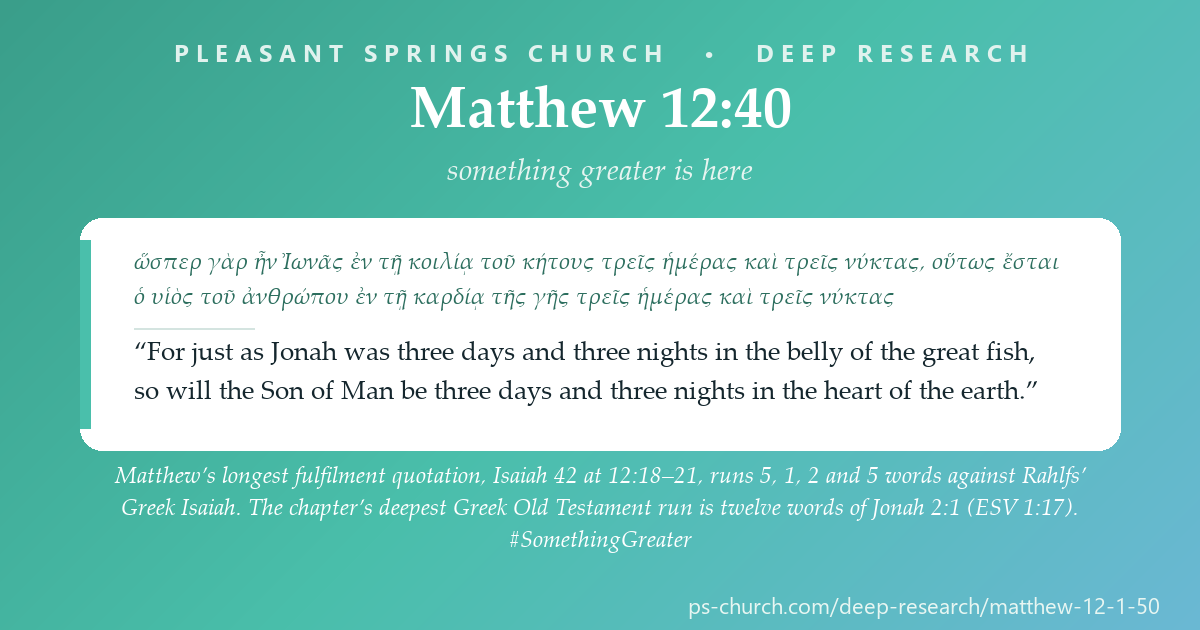
“And the Lord appointed a great fish to swallow up Jonah. And Jonah was in the belly of the fish three days and three nights.” (Hebrew and Greek 2:1.) “For just as Jonah was three days and three nights in the belly of the great fish, so will the Son of Man be three days and three nights in the heart of the earth.”
| the clause | |
|---|---|
| Matthew 12:40 | ἦν Ἰωνᾶς ἐν τῇ κοιλίᾳ τοῦ κήτους τρεῖς ἡμέρας καὶ τρεῖς νύκτας |
| Jonah 2:1 (Rahlfs) | ἦν Ιωνας ἐν τῇ κοιλίᾳ τοῦ κήτους τρεῖς ἡμέρας καὶ τρεῖς νύκτας |
| Jonah 2:1 (Hebrew) | וַיְהִי יוֹנָה בִּמְעֵי הַדָּג שְׁלֹשָׁה יָמִים וּשְׁלֹשָׁה לֵילוֹת |
Twelve consecutive words with Rahlfs, and no other Greek Old Testament unit reaches twelve. The next-deepest rows in the chapter reach seven (12:4, 12:47), and both are counter-examples. On this clause the Hebrew and the Greek agree in sense: שְׁלֹשָׁה יָמִים וּשְׁלֹשָׁה לֵילוֹת is three days and three nights, and בִּמְעֵי הַדָּג is in the belly of the fish, where the Greek has τοῦ κήτους, the sea creature.
The phrase, searched unanchored. τρεῖς ἡμέρας καὶ τρεῖς νύκτας stands in 2 Greek Old Testament units, screened or held: Jonah 2:1 and 1 Kingdoms 30:12, where an Egyptian servant left behind by the Amalekites had not eaten bread or drunk water for three days and three nights. The Hebrew phrase שְׁלֹשָׁה יָמִים וּשְׁלֹשָׁה לֵילוֹת stands in the same two verses and no others. To catch every inflection, the screen also took every unit in which a form beginning tre- or tri- stands with a form beginning nykt-: 6 units, and of the four besides those two, Esther 4:16 is the only one that counts days and nights together — ἐπὶ ἡμέρας τρεῖς νύκτα καὶ ἡμέραν (for three days, night or day). The others are a thirty and a thirteen beside a by night, and Judith’s three days with her nightly walk. Against 1 Kingdoms 30:12 the verse runs 5: the phrase alone.
Matthew’s other ways of counting the days. Five more phrases in this Gospel count the days to the rising, or to the temple raised again; τρεῖς ἡμέρας καὶ τρεῖς νύκτας is the only one that counts nights, and the only one tied to a text:
| phrase | Matthew | elsewhere in the New Testament |
|---|---|---|
| τρεῖς ἡμέρας καὶ τρεῖς νύκτας | 12:40 | none |
| τῇ τρίτῃ ἡμέρᾳ | 16:21; 17:23; 20:19 | Luke 9:22; 24:7, 46; Acts 10:40 |
| Μετὰ τρεῖς ἡμέρας | 27:63 | Mark 8:31; 9:31; 10:34; Acts 25:1 |
| ἕως τῆς τρίτης ἡμέρας | 27:64 | none in that form |
| διὰ τριῶν ἡμερῶν | 26:61 | Mark 14:58 |
| ἐν τρισὶν ἡμέραις | 27:40 | Mark 15:29; John 2:19, 20 |
How 12:40 squares with a burial on the Friday and a rising on the first day of the week is a question of reading, not of measurement; Stage 5 gives the readings.
Luke’s sign of Jonah. “For as Jonah became a sign to the people of Nineveh, so will the Son of Man be to this generation.” Against 12:40 it runs 4 (ὁ υἱὸς τοῦ ἀνθρώπου); it has no fish, no belly and no count of days. The verse 12:40 is screened against Luke as a whole at 8 (Luke 17:24, οὕτως ἔσται ὁ υἱὸς τοῦ ἀνθρώπου ἐν τῇ, the days of the Son of Man).
David at Nob, and the priests on the Sabbath
| text | the priest | entered the house of God | the bread of the Presence |
|---|---|---|---|
| Matthew 12:4 | no name | εἰσῆλθεν εἰς τὸν οἶκον τοῦ θεοῦ | τοὺς ἄρτους τῆς προθέσεως |
| Mark 2:26 | ἐπὶ Ἀβιαθὰρ ἀρχιερέως | εἰσῆλθεν εἰς τὸν οἶκον τοῦ θεοῦ | τοὺς ἄρτους τῆς προθέσεως |
| Luke 6:4 | no name | εἰσῆλθεν εἰς τὸν οἶκον τοῦ θεοῦ | τοὺς ἄρτους τῆς προθέσεως |
| 1 Kingdoms 21:2–7 (Rahlfs) | Αβιμελεχ | no form of house in 21:2–10 | τοὺς ἄρτους τῆς προθέσεως |
| 1 Samuel 21:2–7 (Hebrew) | אֲחִימֶלֶךְ | no form of house in 21:2–10 | הַפָּנִים (21:7) |
Measured. τοὺς ἄρτους τῆς προθέσεως stands in 2 screened Greek Old Testament units (1 Kingdoms 21:7 and 1 Chronicles 23:29) and in Matthew, Mark and Luke; the Hebrew הַפָּנִים of 21:7 stands with כִּי־אִם־לֶחֶם — the phrase bread of the Presence in 5 Masoretic verses with the article, and a sixth, Exodus 25:30, without it. εἰσῆλθεν εἰς τὸν οἶκον τοῦ θεοῦ stands in one Greek Old Testament unit, 2 Kingdoms 12:20, which is the verse’s deepest run (7, band 1); there Rahlfs has τὸν οἶκον τοῦ θεοῦ where the Hebrew has בֵית־יְהֹוָה (ESV the house of the Lord) — a difference between the two texts, disclosed because the run depends on it. Abiathar is absent from Matthew: the name Ἀβιαθὰρ stands in one New Testament verse, Mark 2:26. The page reports Mark’s wording and does not adjudicate it.
The priests who profane the Sabbath. Against Numbers 28:9–10, one word. But the verb is the Greek Old Testament’s own for Sabbath-breaking: a form of profane (bebel-) and a form of Sabbath stand together in 15 screened units — Exodus 31:14, Isaiah 56:2 and 56:6, Ezekiel 20:13, 16, 21 and 24, 22:8, 22:26 and 23:38, Nehemiah 13:17–18 (2 Esdras 23:17–18), and 1 Maccabees 1:43, 1:45 and 2:34 (augmented forms, ebebel-, counted). In the New Testament a form beginning bebel- stands in 7 verses, and 12:5 is the only one in the Gospels. And in Rahlfs’ Nob story the same root stands twice, as an adjective — ἄρτοι βέβηλοι, common bread (21:5, ESV 21:4). A contiguous-run screen cannot see a shared root, and the page draws no line between the two; it reports that both halves of Jesus’ argument, David and the priests, sit beside this word in the Greek.
⚠️ The blasphemy saying in three Gospels
| Matthew | Mark | Luke |
|---|---|---|
| διὰ τοῦτο λέγω ὑμῖν, πᾶσα ἁμαρτία καὶ βλασφημία ἀφεθήσεται τοῖς ἀνθρώποις, ἡ δὲ τοῦ πνεύματος βλασφημία οὐκ ἀφεθήσεται. καὶ ὃς ἐὰν εἴπῃ λόγον κατὰ τοῦ υἱοῦ τοῦ ἀνθρώπου, ἀφεθήσεται αὐτῷ· ὃς δ’ ἂν εἴπῃ κατὰ τοῦ πνεύματος τοῦ ἁγίου, οὐκ ἀφεθήσεται αὐτῷ οὔτε ἐν τούτῳ τῷ αἰῶνι οὔτε ἐν τῷ μέλλοντι. | Ἀμὴν λέγω ὑμῖν ὅτι πάντα ἀφεθήσεται τοῖς υἱοῖς τῶν ἀνθρώπων, τὰ ἁμαρτήματα καὶ αἱ βλασφημίαι ὅσα ἐὰν βλασφημήσωσιν· ὃς δ’ ἂν βλασφημήσῃ εἰς τὸ πνεῦμα τὸ ἅγιον, οὐκ ἔχει ἄφεσιν εἰς τὸν αἰῶνα, ἀλλὰ ἔνοχός ἐστιν αἰωνίου ἁμαρτήματος. | καὶ πᾶς ὃς ἐρεῖ λόγον εἰς τὸν υἱὸν τοῦ ἀνθρώπου, ἀφεθήσεται αὐτῷ τῷ δὲ εἰς τὸ ἅγιον πνεῦμα βλασφημήσαντι οὐκ ἀφεθήσεται. |
| — | “for they were saying, ‘He has an unclean spirit.’” | — |
Measured, and the answer is small. The three forms of the saying share little consecutive wording: Matthew 12:31 against Mark 3:28, 2; 12:32 against Mark 3:29, 3; 12:32 against Luke 12:10, 4 (τοῦ ἀνθρώπου, ἀφεθήσεται αὐτῷ). By lemma, all three have forgive, Spirit and holy; Matthew and Mark have βλασφημία and αἰών; Matthew and Luke have a word spoken κατὰ τοῦ υἱοῦ τοῦ ἀνθρώπου, where Mark has τοῖς υἱοῖς τῶν ἀνθρώπων. Only Mark has the explanation of 3:30; against all fifty verses of Matthew 12, Mark 3:30 shares no two consecutive words (0 with single words not counted; it shares single words such as spirit and unclean), and neither do Mark 3:20–21, the family coming to seize him. Luke sets the saying in another chapter, after the Beelzebul controversy (11:14–23) and away from it. The page reports the shared wording and does not adjudicate how the Gospels are related.
Doublets inside Matthew, and the brood of vipers
- 12:39 and 16:4 — 16 consecutive words, band 1: Γενεὰ πονηρὰ καὶ μοιχαλὶς σημεῖον ἐπιζητεῖ … Matthew gives the refusal of a sign twice in nearly the same words.
- 12:7 and 9:13 — Hosea 6:6, 8 words with each other.
- 12:17 and 4:14 — the formula, 9 words; with 8:17, 8.
- 12:33–35 and 7:16–20 — the tree and its fruit. Shared lemmas: δένδρον, καρπός, σαπρός, καλός; shared consecutive words, 2 at most. The same image, said again in other sentences.
- The brood of vipers — γεννήματα ἐχιδνῶν in 4 New Testament verses: Matthew 3:7 and Luke 3:7 (John the Baptist), Matthew 12:34 and 23:33 (Jesus). Searched unanchored: no form beginning echidn- stands in any Greek Old Testament unit, screened or held. 12:34 runs 3 with 23:33 (γεννήματα ἐχιδνῶν, πῶς) and 2 with 3:7.
The fulfilment quotations, by length
Counted from the first word after each formula to the end of the quoted words (at 1:23, up to Emmanuel; at 27:9–10, the whole of the two verses after the formula):
| fulfilment quotation | Greek words quoted |
|---|---|
| 1:22–23 | 15 |
| 2:15 | 6 |
| 2:17–18 | 20 |
| 2:23 | 2 |
| 4:14–16 | 33 |
| 8:17 | 9 |
| 12:17–21 | 61 |
| 13:35 | 10 |
| 21:4–5 | 20 |
| 27:9–10 | 26 |
The page’s own counter-examples
Printed so that the runs of five at 12:18 and 12:21 are not read as more than they are. Each of these rows reaches four or more against the Greek Old Testament, most at a tie band of one, and none is a source:
| row | run | band | partner | shared words | what it is |
|---|---|---|---|---|---|
| 12:47 | 7 | 1 | Genesis 37:10 | ἡ μήτηρ σου καὶ οἱ ἀδελφοί σου | a family formula; Joseph’s dream |
| 12:4 | 7 | 1 | 2 Kingdoms 12:20 | εἰσῆλθεν εἰς τὸν οἶκον τοῦ θεοῦ | David, but not at Nob |
| 12:49 | 5 | 3 | Genesis 8:9 and two more | καὶ ἐκτείνας τὴν χεῖρα αὐτοῦ | a gesture; Noah and the dove |
| 12:41 | 4 | 1 | Psalm 11:8 (ESV 12:7) | τῆς γενεᾶς ταύτης καὶ | an accident |
| 12:24 | 4 | 1 | 1 Kingdoms 20:15 | εἰ μὴ ἐν τῷ | an accident |
| 12:39 | 4 | 1 | Genesis 18:9 | ὁ δὲ ἀποκριθεὶς εἶπεν | a narrative formula |
| 12:28 | 4 | 1 | Psalms of Solomon 17:3 | ἡ βασιλεία τοῦ θεοῦ | a phrase; a witness, not Scripture |
The distribution against the Greek Old Testament: of the fifty rows, all 50 reach two, 40 reach three, 20 reach four, 7 reach five, 3 reach seven, 1 reaches twelve, and nothing reaches thirteen. Against the rest of the New Testament: all 50 reach two, 48 reach three, 40 reach four, 23 reach five, 20 reach six, 17 reach seven, 13 reach eight, 11 reach nine, 10 reach ten, 9 reach eleven, 7 reach fourteen, 5 reach fifteen, 3 reach sixteen, 1 reaches twenty-four, and nothing reaches twenty-five. Against Mark alone the deepest run is 10 (12:47, Mark 3:32), then 7 at 12:4 and 12:49; against Luke alone, 24 (12:41, Luke 11:32); against John alone, 5.
The readings of the blasphemy saying, of the three days and nights, and of Isaiah’s wording, with their holders; the church’s frame labelled as the church’s; and everything this page could not check.
None of the modern works named on this page was re-read for it. Their positions are reported as the literature commonly summarises them, and are marked reported. The ancient writers quoted — Origen, Chrysostom and Augustine — are cut word for word at build time from the public-domain ANF and NPNF translations held in the shelf’s library, and are marked held. Every number on the page was measured on files on this disk.
Commentaries & studies:
- W. D. Davies and Dale C. Allison (ICC, 1991); Donald A. Hagner (WBC 33A, 1993); R. T. France (NICNT, 2007); Ulrich Luz (Hermeneia, 2001); Craig S. Keener (2009) — all reported, none re-read.
- On the quotation of Isaiah 42: Maarten J. J. Menken, Matthew’s Bible (2004); Richard Beaton, Isaiah’s Christ in Matthew’s Gospel (2002); Craig L. Blomberg in Beale and Carson (2007) — reported.
- On the powers: Michael S. Heiser, The Unseen Realm (2015) — reported.
- On the church’s frame: Kenneth Keathley, Salvation and Sovereignty: A Molinist Approach (2010) — reported.
Where does the wording of 12:18–21 come from? The proposals:
- From the Hebrew, rendered afresh, with Greek phrases already familiar from the Septuagint where they fitted (a common view of Matthew’s formula quotations; reported).
- From a Greek text already revised toward the Hebrew, of the kind later associated with Aquila, Symmachus and Theodotion — the view commonly attributed to Menken (reported; no such text is on this disk).
- From a Greek tradition of the passage shaped by its use — at the baptism (beloved, well pleased) and in the mission to the nations (reported).
- The measurements bear on all three and decide none. They show that the quotation agrees with the Hebrew against Rahlfs at its start and with Rahlfs against the Hebrew at its end; they cannot show how its words were chosen.
⚠️ The blasphemy against the Spirit will not be forgiven: the readings
The text first. “Therefore I tell you, every sin and blasphemy will be forgiven people, but the blasphemy against the Spirit will not be forgiven.” “And whoever speaks a word against the Son of Man will be forgiven, but whoever speaks against the Holy Spirit will not be forgiven, either in this age or in the age to come.” The saying follows a healing and a charge: the crowd asks whether this is the Son of David, and the Pharisees answer “It is only by Beelzebul, the prince of demons, that this man casts out demons”. Jesus answers that the power is the Spirit of God. Every reading has to account for that setting, and for the fact that the saying distinguishes a word against the Son of Man, which is forgiven.
| reading of 12:31–32 | in brief | held by |
|---|---|---|
| 1. Final impenitence | the sin that is not forgiven is the hardened refusal of repentance persisted in to the end of life; it cannot be pronounced on anyone while he lives | Augustine (held, quoted below) |
| 2. Calling the Spirit’s work Satan’s, knowingly | the Pharisees saw demons driven out by the Spirit of God (12:28) and named the power Beelzebul (12:24); the saying answers that charge | John Chrysostom (held, quoted below); R. T. France and D. A. Carson among many moderns (reported) |
| 3. Relapse after sharing the Spirit | one who has received a share in the Holy Spirit and falls back is guilty of it | Origen (held, quoted below) |
| 4. Possible only in Jesus’ earthly ministry | the sin consisted in rejecting the Spirit’s works done in his presence, and cannot be committed now | proposed by several writers (reported; no holder named here) |
This impenitence then is "the blasphemy of the Spirit, which shall not be forgiven, neither in this world, neither in the world to come."Augustine, Sermon 71.20 (Sermon 21 in NPNF1 6, held)
But this impenitence or impenitent heart may not be pronounced upon, as long as a man lives in the flesh. For we are not to despair of any so long as "the patience of God leadeth the ungodly to repentance," and doth not hurry him out of this life;Augustine, Sermon 71.21 (NPNF1 6, held)
For though ye say that ye know not me; yet of this surely ye are not ignorant, that to cast out devils, and to do cures, is a work of the Holy Ghost. It is not then I only whom ye are insulting, but the Holy Ghost also.John Chrysostom, Homilies on Matthew 41.5, on 12:31–32 (NPNF1 10, held)
whereas he who has been deemed worthy to have a portion of the Holy Spirit, and who has relapsed, is, by this very act and work, said to be guilty of blasphemy against the Holy Spirit.Origen, De Principiis 1.3.7 (ANF 4, held; the work survives chiefly in Rufinus’ Latin, reported)
What the measurement adds, and what it does not. It adds the setting: πνεῦμα runs through the chapter from the quotation (12:18) to the exorcism (12:28) to the saying (12:31–32), and the saying in Matthew, unlike Mark’s, has no explanatory verse after it (Stage 4). It does not decide between the readings.
The church’s frame, in its own words — and no further. Pleasant Springs has no ratified statement on what the blasphemy against the Spirit is, and this page does not supply one. What the church does hold bears on reading 3. Its statement of faith (what we believe, Article 10) says that “all who genuinely receive Christ are held secure” and that “Scripture’s warnings are themselves a real means by which He holds us fast.” On that frame the saying is read as a real warning, spoken to be heeded, and not as teaching that one who has genuinely received Christ can be lost. Readings 1, 2 and 4 are compatible with the article and the page does not choose among them. That is the church’s position on security; nothing measured on this page establishes or refutes it.
A pastoral note, labelled as one. Augustine’s second paragraph above — that the sin may not be pronounced on anyone while he lives — is the one ancient reading quoted here that speaks directly to the person afraid he has committed it. It is offered as Augustine’s, not as a ruling.
⚠️ Three days and three nights (12:40): the readings
- Inclusive reckoning — part of a day counts as the day, and a day and a night is an idiom for one day, so Friday afternoon to Sunday morning is three (a common view; reported).
- A literal seventy-two hours, with the crucifixion moved to Wednesday or Thursday (reported; held by some modern writers, no holder named here).
- The phrase is Jonah’s, taken over with the text and not meant as a timetable; the point is the comparison (reported).
- Measured: the phrase is the only one of Matthew’s six ways of counting the days that counts nights, and it is the one that runs twelve words with Jonah 2:1 (Stage 4). The measurement does not decide the reading.
His mother and his brothers (12:46–50)
The text says ἡ μήτηρ καὶ οἱ ἀδελφοὶ αὐτοῦ, his mother and his brothers, and does not say who the brothers were. The traditions read ἀδελφός three ways: sons of Mary and Joseph born after Jesus (Helvidius, reported); sons of Joseph by an earlier marriage (Epiphanius, reported); and cousins (Jerome, reported). The page takes no position on it.
What this page did NOT check, and where it is weakest:
- No Greek Old Testament but Rahlfs’ (as digitized by CATSS) was searched. No Göttingen apparatus, no codex readings, and no text of Aquila, Symmachus or Theodotion for Isaiah 42 is on this disk. Every closer to the Hebrew on this page means: closer than Rahlfs. Whether some Greek text read behold without the names, or to victory, could not be checked.
- The Hebrew is the Masoretic text only, as printed by Sefaria. The Isaiah scrolls from Qumran and the Targum were not consulted.
- Greek cannot be screened against Hebrew. The Isaiah and Jonah alignment tables are read off the texts word by word; they are a judgement, laid out so a reader can check it, not a measurement. The last column of the Isaiah table is the page’s weakest ground.
- The contiguous-run screen misses what it cannot see: two datives of one noun at 12:5, a shared root (bebel-) across 1 Kingdoms 21 and 12:5, the verb συντρίβω in different slots at 12:20, and word order at 12:13. Each is named, not measured.
- The SBLGNT apparatus was not consulted. 12:47 is printed by the SBL edition but is absent from the ESV’s running text; the SBL text on disk marks the whole verse with its variant brackets, and the verse is commonly reported to be missing from some early manuscripts; the spelling Beelzebul is commonly reported to vary in the manuscripts. Neither was checked.
- The Gospels are compared, not explained. The runs with Mark and Luke are shared wording; no source theory was assumed or tested.
- The Mishnah, the Dead Sea Scrolls and Josephus are not on this disk. Anything said about Sabbath practice in the first century, about Beelzebul’s etymology, or about the queen of Sheba outside the Bible is reported.
- The fulfilment-quotation lengths depend on where each quotation is said to end; the rule is stated with the table. On any reasonable rule 12:18–21 is the longest; the margin depends on the rule.
- The structure diagram is ours, built from repeated words counted in the Greek, not from a commentary’s outline; it is labelled a sequence, expressly not a chiasm.
- Our own renderings of the Matthew verses whose ESV is not printed were checked by machine against the ESV and the KJV for shared runs of five or more words; the NRSV is not on this disk and could not be checked. 1 Maccabees is our rendering because the ESV used here has no Apocrypha.
- Direction of influence is never asserted. Where Matthew’s wording matches the Hebrew against Rahlfs (12:18) or Rahlfs against the Hebrew (12:21), the page reports the match and nothing more.
- 1 Maccabees and the Psalms of Solomon are witnesses, not Scripture. They were screened because CATSS holds them, and are named only as context, counts or counter-examples.
Two Sabbaths, a servant, a charge, a sign, and a family.
Name what you learned, why it matters, and one concrete response.
What should we carry away — and do?
- Something greater is here, three times. Greater than the temple, more than Jonah, more than Solomon: the priest’s house, the prophet’s word and the king’s wisdom are each named and each surpassed, in the same short word, ὧδε.
- The servant does not shout. In the middle of two controversies Matthew sets the longest quotation in his Gospel, and it describes a servant who will not quarrel or cry aloud: “a bruised reed he will not break”.
- The nations are in it. Twice in four verses: justice to the Gentiles, and in his name the Gentiles will hope.
- The Spirit is the issue. The same word names the Spirit put on the servant, the Spirit by whom the demons go out, and the Spirit whom the charge blasphemes. The warning is real, and the church’s statement of faith holds that Scripture’s warnings are themselves a real means by which He holds us fast (Stage 5).
- The family is redrawn. “For whoever does the will of my Father in heaven is my brother and sister and mother.”
Step in response: read Matthew 12 aloud in one sitting, and each time you hear here (12:6, 41, 42) stop and name what is surpassed. Then read Isaiah 42:1–4 in your Bible, and notice the line Matthew does not give: He will not grow faint or be discouraged.
Matthew 12:40 · to share
Greek NT + ESVEvery Deep Research page traces its passage across the whole sweep — the Old Testament, the Second-Temple world between the testaments (historical witnesses, not Scripture), and the New Testament. Follow the thread:
Pleasant Springs Church — Deep Research
Research method after Michael S. Heiser’s Bible Research Method (examine dictionaries → ancient literature → important words → textual connections → academic publications → share), with the Pleasant Springs “Author & Audience” foundation. Scripture set in the Hebrew, the Greek editions named on each page and the ESV (Old Testament), and the Greek New Testament and the ESV (New Testament), per the practice of Pleasant Springs Church. Matthew works named on this page (none re-read for it, all reported): Davies and Allison, Hagner, France, Luz, Keener and Carson; Menken, Beaton and Blomberg on the quotation; Heiser on the powers; Keathley on the church’s frame — none of which were consulted for any number on this page. Ancient writers cut from the ANF and NPNF translations held in the shelf’s library: Origen, Chrysostom, Augustine. Text: Greek New Testament from the SBL edition as digitized by MorphGNT (text and lemma columns); Greek Old Testament from Rahlfs’ Septuaginta as digitized by CATSS; Hebrew from the Masoretic text as printed in Sefaria’s Miqra according to the Masorah. ⚠️ VERSE NUMBERING. Matthew 12 has no offset (the ESV’s running text has no 12:47). Hebrew and Greek Jonah 2:1 = ESV 1:17; 1 Kingdoms 21:2–10 = ESV 1 Samuel 21:1–9; Psalm 11:8 (Septuagint) = 12:8 (Hebrew) = 12:7 (ESV); Septuagint Psalms 45:10, 58:14, 60:3, 64:6 = ESV 46:9, 59:13, 61:2, 65:5; 2 Esdras 23:17–18 = Nehemiah 13:17–18; 1–4 Kingdoms = 1–2 Samuel and 1–2 Kings; the other texts are numbered alike in all three. ⚠️ The measurement, in full. Greek against Greek; MorphGNT normalised word; CATSS form column, beta-code transliterated first; both sides lowercased, accents and breathings dropped, final sigma folded, with the shelf’s edition-equivalence table on cross-corpus screens. Contiguous runs of whole word forms, never lemmas. 50 rows against 30,348 verse units — the 64 CATSS files less the Odes — and against the other 7,877 verses of the Greek New Testament; absence claims also searched the 30,637 units held. Hebrew counts consonantal, over 23,204 Masoretic verse units. Exhaustive and deterministic. It finds verbatim contact, not allusion.
Scripture quotations marked ESV are from the ESV® Bible (The Holy Bible, English Standard Version®), © 2001 by Crossway, a publishing ministry of Good News Publishers. ESV Text Edition: 2016. Used by permission. All rights reserved. The ESV text may not be quoted in any publication made available to the public by a Creative Commons license, and the ESV may not be translated in whole or in part into any other language. www.esv.org
|
Did this study bless you today? 💚 Give to Support PS Church100% of gifts go to the General Fund — thank you. |