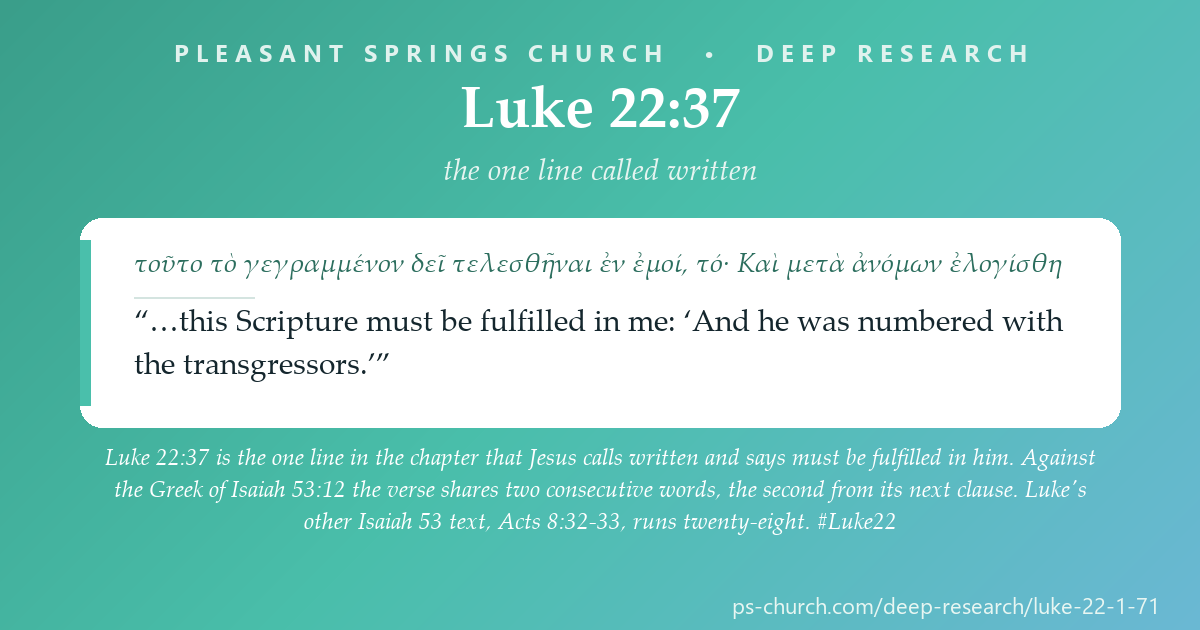
Luke 22 is the night before the cross, told at a table, on a hillside and in a courtyard — and it holds the one sentence in which Jesus names a line as written and says it must be fulfilled in him (22:37). Measured against the Greek Isaiah 53:12 it names, that sentence shares two consecutive word forms, and the second belongs to the next clause. Luke’s other Isaiah 53 text, Acts 8:32–33, runs twenty-eight. Screened against the Greek Old Testament held here (the Odes set aside), all 71 verses of the chapter reach a ceiling of four. The deepest contact anywhere is ten words with 1 Corinthians 11:25 — the cup, inside the words one printed edition sets in double brackets. See the method →
Luke 22:3, 15–22, 29–32, 37, 42–44, 53, 61–62, 69
Greek NT · ESVThe Shape of the Passage
A sequence, with four sayings at table answered in the night — NOT a chiasmVersification of the texts measured. Greek Jeremiah 38:31–34 = Hebrew and ESV Jeremiah 31:31–34 (the Greek Jeremiah runs its chapters in another order). Psalm 109:1 in the Greek = Psalm 110:1 in the Hebrew and the ESV; Psalm 117:22 Greek = 118:22; Psalm 115:1 Greek = Hebrew 116:10 = ESV 116:10; and Psalm 29:10 Greek = Hebrew 30:10 = ESV 30:9 (three numberings for one verse: the Greek numbering is one psalm lower, and the Hebrew counts the title as verse 1). Isaiah 53 has no offset: 53:7, 53:8 and 53:12 are the same verse in the Greek, the Hebrew and the ESV. 1 and 2 Samuel = Greek 1 and 2 Kingdoms; 1 and 2 Kings = 3 and 4 Kingdoms, with the same chapter and verse at 1 Kingdoms 28:22, 3 Kingdoms 19:5–8 and 3 Kingdoms 1:38. Daniel is held in two Greek texts, the Old Greek and Theodotion, named on every line; both number 7:9, 7:13 and 10:16–19 as the Hebrew and the ESV do. Hosea 12:5 in the Greek and the Hebrew = ESV 12:4. Deuteronomy 29:13 in the Greek and the Hebrew = ESV 29:14. Exodus 3:2 and 24:8, Zechariah 9:11 and 14:4, Amos 9:9, 2 Chronicles 7:18, Leviticus 24:7, Genesis 3:19 and Numbers 31:36 carry no offset. The Psalms of Solomon, 2 and 4 Maccabees and Wisdom are Greek only, have no Hebrew numbering to differ from, and are witnesses, not Scripture.
Luke tells the night before the cross as a meal, a prayer and a hearing — and he tells it with details Mark and Matthew do not carry.
Author
Luke, by the tradition the church received. Irenaeus, writing about 180, says: “Luke also, the companion of Paul, recorded in a book the Gospel preached by him.” (Against Heresies 3.1.1). That is a witness to who Luke was believed to be, not a measurement, and this page does not use it as one.
What only this account has, measured against Mark 14 and Matthew 26 on our disk. A cup before the bread as well as after it (δεξάμενος ποτήριον, 22:17; and 22:20). The betrayer’s hand named at the table after the cup, not before the bread (22:21; Mark 14:18–21 and Matthew 26:21–25 stand before the bread). An angel on the Mount of Olives (22:43): Mark 14:32–42 and Matthew 26:36–46 carry no form of ἄγγελος at all. The ear healed (ἰάσατο αὐτόν, 22:51): Mark 14:47, Matthew 26:51 and John 18:10 cut the ear and none of them has a word for healing it. And the Lord turning to look at Peter (22:61), which Stage 4 measures.
And the closest Greek he shares, at the one place it matters most, is with a letter, not a Gospel. The cup word, 22:20, runs ten consecutive words with 1 Corinthians 11:25 and one with Mark 14:24. Irenaeus’s sentence and that measurement sit side by side on this page; neither proves anything about the other, and the page claims no dependence in any direction.
Audience
Theophilus, and readers who will meet these men again in Acts. The table talk is spoken to the people who will lead: “let the greatest among you become as the youngest, and the leader as one who serves” (22:26). The one told to “strengthen your brothers” (22:32) is the one who stands up to speak in Acts 1 and 2. A reader of both books watches the prayer for Simon answered in public.
And readers who live under benefactors. And he said to them, “The kings of the Gentiles exercise lordship over them, and those in authority over them are called benefactors. (22:25). εὐεργέται was a title Hellenistic kings and Roman patrons bore on coins and inscriptions (reported; no inscription was read for this page). Luke’s reader knew what the word cost and who paid it. The sentence that answers it is “But I am among you as the one who serves” (22:27).
Orient on the Passover and Unleavened Bread, the Lord’s Supper, covenant, the Mount of Olives, the Sanhedrin and the Son of Man.
Search by topic: Passover, Feast of Unleavened Bread, Lord’s Supper, covenant (new covenant), Judas Iscariot, Satan, Gethsemane / Mount of Olives, Sanhedrin, Son of Man, right hand of God, farewell discourse.
Which articles are relevant?
- Anchor Bible Dictionary — “Passover and Feast of Unleavened Bread,” “Lord’s Supper,” “Covenant,” “Judas Iscariot,” “Gethsemane,” “Sanhedrin,” “Son of Man.”
- Dictionary of Jesus and the Gospels — “Last Supper,” “Gethsemane,” “Trial of Jesus,” “Farewell Discourse,” “Kingdom of God.”
- NIDNTTE / TDNT — διαθήκη (covenant), διατίθεμαι (to covenant, to assign), ἀνάμνησις (remembrance), ἀγωνία (anguish), σινιάζω (to sift).
Bibliography surfaced:
- Darrell L. Bock (BECNT), I. Howard Marshall (NIGTC), Joseph A. Fitzmyer (Anchor Yale), Joel B. Green (NICNT), John Nolland (WBC) on Luke.
- Raymond E. Brown, The Death of the Messiah — on the Mount of Olives, the arrest and the hearing.
- Joachim Jeremias, The Eucharistic Words of Jesus; I. Howard Marshall, Last Supper and Lord’s Supper.
- Bruce M. Metzger, A Textual Commentary on the Greek New Testament — on 22:19b–20 and 22:43–44.
- Beale & Carson, Commentary on the New Testament Use of the Old Testament (Luke).
A Passover meal, a farewell at table, a hillside at night and a council at dawn.
Read the chapter as four settings in sequence and ask what each would have meant to a first-century reader — and say plainly which of the background is reported rather than read.
What frames the meal?
Passover and Unleavened Bread. Luke opens with the two names joined, ἡ ἑορτὴ τῶν ἀζύμων ἡ λεγομένη Πάσχα — the festival of the unleavened loaves, the one people call the Passover, was drawing near (our rendering; the ESV of this verse is not printed here) (22:1). The Septuagint uses the three words ἑορτὴ τῶν ἀζύμων in Leviticus 23:6, Deuteronomy 16:16 and 2 Chronicles 8:13 in this form (nine more units, among them Exodus 23:15, have the noun in another case) — the three units that tie this row’s ceiling of three — and the meal itself is told from Exodus 12. The later order of the Passover meal, with four cups of wine, is in the Mishnah (tractate Pesachim 10). That text is not held here, and its date relative to Luke’s night is argued; it is reported, and nothing on this page is measured against it.
Two cups. Luke has a cup at 22:17, before the bread, and the cup “after they had eaten” at 22:20. The Didache, an early church manual reported as first- or early second-century, gives its thanksgiving in the order cup then bread: “First, concerning the cup” … “And concerning the broken bread” (Didache 9.2–3, ANF 7). That is a witness to an order, not evidence about which form of Luke’s text is original, and the page does not use it as either.
What is a farewell at table?
A speech by a leader who knows he is about to die, delivered to his successors, with warnings, a settlement of what passes to them, and a word about what is coming. Genesis 49 (Jacob), Deuteronomy 31–33 (Moses) and the Second-Temple Testaments of the Twelve Patriarchs are the examples usually given, with Plato’s account of Socrates’ last day on the Greek side (all reported; the Testaments are not held here). Read that way, 22:14–38 has each part: a death announced (22:15, “before I suffer”), a betrayal foretold (22:21–22), a dispute settled (A dispute also arose among them, as to which of them was to be regarded as the greatest., 22:24), a bequest (22:29), a warning to the chief successor (22:31–34), and a word about the hard days ahead (22:35–38). The genre label is the commentators’; the five links in the structure diagram are what we measured.
The dispute. φιλονεικία (22:24) is a New Testament hapax as a noun; the adjective of the same family stands once more, at 1 Corinthians 11:16. Its answer is a reversal of rank that any Greek reader would have felt: But not so with you. Rather, let the greatest among you become as the youngest, and the leader as one who serves. (22:26), and then For who is the greater, one who reclines at table or one who serves? Is it not the one who reclines at table? But I am among you as the one who serves. (22:27).
The swords. He said to them, “But now let the one who has a moneybag take it, and likewise a knapsack. And let the one who has no sword sell his cloak and buy one. (22:36). And they said, “Look, Lord, here are two swords.” And he said to them, “It is enough.” (22:38). Readers have taken the instruction literally, figuratively and ironically (all reported); the chapter itself has the sword used once, at 22:49–50, and answered at once: But Jesus said, “No more of this!” And he touched his ear and healed him. (22:51). And the arrest is made with a kiss: but Jesus said to him, “Judas, would you betray the Son of Man with a kiss?” (22:48).
The night, and two early witnesses to 22:44
The Mount of Olives is τὸ Ὄρος τῶν Ἐλαιῶν — he went out and made his way, as his habit was, up the Mount of Olives; his disciples came after him too (our rendering; the ESV of this verse is not printed here) (22:39). In the Greek Old Testament the four words stand in one unit, Zechariah 14:4, the day the Lord’s feet stand on that mountain: ἐπὶ τὸ ὄρος τῶν ἐλαιῶν. That is a place name meeting a place name; the measurement does not make it more.
Two second-century writers know the sweat. Justin Martyr, about 160: “For in the memoirs which I say were drawn up by His apostles and those who followed them, [it is recorded] that His sweat fell down like drops of blood while He was praying” (Dialogue with Trypho 103, ANF 1; the bracket is the ANF editors’, and so is the footnote there that refers the passage to Luke 22:44 and 42). Irenaeus, about 180, arguing from the signs of real flesh that had Christ taken nothing from Mary, then “nor would He have wept over Lazarus, nor have sweated great drops of blood” (Against Heresies 3.22.2). Neither names a Gospel for the sweat; Justin speaks of the memoirs of the apostles. They are witnesses that the detail was being read in the second century. They are not a count of manuscripts, and this page does not turn them into one.
- Exodus 12; Leviticus 23:5–8; Deuteronomy 16:1–8 — Passover and Unleavened Bread.
- Exodus 24:8; Jeremiah 31:31–34; Zechariah 9:11 — blood and covenant (see Exodus 24, the New Covenant, Zechariah 9–14).
- Isaiah 52:13–53:12 — the Servant; the one line Luke 22 names as written (see the Suffering Servant).
- Psalm 110:1; Daniel 7:9–14 — the right hand and the Son of Man (see Psalm 110, Daniel 7).
- Psalms of Solomon 17 — a Second-Temple psalm of the kingdom and the son of David; a witness, not Scripture (see Psalms of Solomon 10–18).
- Justin, Dialogue 103; Irenaeus, Against Heresies 3.22.2 and 5.33.1; Didache 9 — early witnesses, quoted from the ANF volumes on our disk.
The vocabulary of the covenant, the sieve, the prayer and the look.
Every count below is from the MorphGNT lemma column over all 7,927 verses of the Greek New Testament, and from the 30,348 screened units of the Greek Old Testament (the Odes, 289 units, are held and searched where the text says so). Where a stem is searched rather than a lemma, it says so, and every near-homograph set aside is named in the selfcheck.
Twice in one verse: κἀγὼ διατίθεμαι ὑμῖν, καθὼς διέθετό μοι ὁ πατήρ μου βασιλείαν. The ESV gives “I assign to you, as my Father assigned to me, a kingdom”. It is the Septuagint’s covenant-making verb. The exact form διέθετό stands in 30 Greek Old Testament units, among them Exodus 24:8, τὸ αἷμα τῆς διαθήκης ἧς διέθετο κύριος, and in the New Testament only here and at Acts 3:25. The lemma stands seven times in the New Testament, two of them in this verse and four in Hebrews 8–10. Stage 4 measures it against Jeremiah.
Four times in the New Testament: Luke 22:19, 1 Corinthians 11:24 and 11:25, and Hebrews 10:3, of the yearly sacrifices. In the Greek Old Testament the phrase εἰς τὴν ἐμὴν ἀνάμνησιν has its nearest form in εἰς ἀνάμνησιν, which stands in four units; one of them, Leviticus 24:7, is the frankincense (and, in the Greek only, salt) laid on the loaves set before the Lord, and it is the only Greek Old Testament unit in which a form of the word for bread and a form of this noun stand together. A co-occurrence, reported; Stage 6 gives the readings of the Supper without deciding them.
A New Testament hapax, and no form of it stands in the Greek Old Testament — the stem searched as a substring across all 30,637 units held, the Odes included. Amos 9:9, the verse usually set beside it, has a winnowing word in the Greek and a sieve in the Hebrew (Stage 4). The verb before it, ἐξῃτήσατο, is a hapax too, and the stem stands in no Greek Old Testament unit either (two units with exetaz-, a different verb, are set aside by name in the selfcheck).
Four times in the New Testament, three of them in Luke: 16:9 (when the money gives out), here, and 23:45, τοῦ ἡλίου ἐκλιπόντος, the sun failing at the cross. The fourth is Hebrews 1:12. A distribution, not a design; but Luke uses one verb for the faith that is prayed for and the light that goes out.
Eight times in the New Testament, six of them in Luke–Acts. One of the six is Acts 2:23, τῇ ὡρισμένῃ βουλῇ καὶ προγνώσει τοῦ θεοῦ … διὰ χειρὸς ἀνόμων — and that is the only New Testament verse in which this verb and the adjective of 22:37, ἀνόμων, stand together. Luke’s chapter has the two words fifteen verses apart; Peter’s sermon has them in one sentence, with foreknowledge between them.
Twice in the New Testament, both in Luke–Acts: here, and Acts 9:19, where Saul eats and is strengthened. In the Greek Old Testament a form of it and a form of ἄγγελος stand together in two screened units only: Deuteronomy 32:43, in a line the Hebrew does not have, and Hosea 12:5, where it is Jacob who prevails with the angel (Stage 4). The Odes, which repeat Deuteronomy 32 as their second song, hold a copy of the first.
A New Testament hapax. As a noun in the Greek Old Testament it stands in three units, all in 2 Maccabees — 3:14 and 3:16, the city and the high priest in anguish as the temple treasury is threatened, and 15:19. The related verb stands in a few more. θρόμβοι, clots, drops, is a hapax with no form in the Greek Old Testament; ἱδρὼς, sweat, is a hapax whose noun stands in three Greek Old Testament units (the verb to sweat in two more): Genesis 3:19, ἐν ἱδρῶτι τοῦ προσώπου σου, 2 Maccabees 2:26 and 4 Maccabees 7:8. The last is the only Greek Old Testament unit in which the sweat noun and a blood word stand together, of the martyr Eleazar and his kind: ἰδίῳ αἵματι καὶ γενναίῳ ἱδρῶτι — by their own blood and noble sweat (our rendering). A witness, not Scripture. Words shared, in other forms; the run measure sees nothing, and we claim nothing.
Eleven times in the New Testament. In the denial scenes of Mark 14 and Matthew 26 it stands once, Mark 14:67, and the one looking is the servant girl: ἐμβλέψασα αὐτῷ. In Luke the one who looks is the Lord (Stage 4).
Two phrases, counted
“New covenant.” In the Greek Old Testament a form of καινός and a form of διαθήκη stand together in one unit, Jeremiah 38:31 (ESV 31:31). A substring search also returns 1 Kingdoms 23:18, but there the letters belong to a place, ἐν Καινῇ (Horesh, in the Hebrew), and it is set aside by name. “Blood” and “covenant” stand together in three units: Exodus 24:8, Ezekiel 44:7 and Zechariah 9:11. All three words together stand in no Greek Old Testament unit, and in two New Testament verses: Luke 22:20 and 1 Corinthians 11:25 — three, if the other Greek adjective for new is counted: Hebrews 12:24, διαθήκης νέας.
“The power of darkness.” ἡ ἐξουσία τοῦ σκότους (22:53): the noun and its genitive, in any case, stand in two New Testament verses, here and Colossians 1:13, ἐκ τῆς ἐξουσίας τοῦ σκότους. The ESV renders the same two Greek words “the power of darkness” in Luke and “the domain of darkness” in Colossians, so the English does not show that they are one phrase. In the Greek Old Testament a form of each word stands together in no unit at all.
One word the night repeats
πειρασμός, testing, trial, temptation, stands six times in Luke, and three of them are tonight: You are those who have stayed with me in my trials, (22:28), and the two sayings that frame the Mount of Olives (22:40, 46). The first of Luke’s six is 4:13, where the devil, having finished every testing, ἀπέστη ἀπ’ αὐτοῦ ἄχρι καιροῦ — stood off from him until a fitting time (our rendering; the ESV of this verse is not printed here). Luke’s narrator next names Satan or the devil at 22:3; in between, the two names stand only inside sayings of Jesus (8:12, 10:18, 11:18, 13:16). That is a distribution, measured; what it means is a reading.
What the measurement found, what it under-reports, and what it cannot say.
Method: every one of Luke 22’s 71 Greek verses was screened for its longest run of consecutive shared word forms against (a) the Greek Old Testament held locally, 30,348 screened units in 63 CATSS files (the Odes, the 64th file, held and not screened: letting them back in deepens no row), and (b) the 6,778 verses of the Greek New Testament outside Luke. Normalisation is accent- and case-blind, with MorphGNT’s own spelling equivalences on the Old Testament side. The tie band beside each run is the number of target units that reach the same depth. Greek-side screens count single words, so a 1 means shares one word and no two in a row and a 0 in a named pair means shares no word form at all. This finds verbatim contact. It does not find allusion.
How deep does Luke 22 run into the Greek Old Testament?
Four, and no further. Of the 71 rows: all but one reach two, 59 reach three, 19 reach four, and nothing reaches five. The one row below two is 22:12, the large furnished upper room, which shares no two consecutive word forms with any of the 30,348 units. Of the nineteen rows at four, thirteen have a tie band of 1, and here is what they are: the Mount of Olives in Zechariah 14:4 (22:39); an angel appearing in Exodus 3:2 (22:43); “the kingdom of God” in the Psalms of Solomon 17:3 (22:18); “in my blood” in Psalm 29:10 (22:20); the kings of the nations in Isaiah 14:18 (22:25); and eight stock phrases, among them ἐκ τοῦ ἀριθμοῦ τῶν — Judas “of the number of the” twelve — which is, form for form, the number of the sheep taken as spoil in Numbers 31:36. Not one of the nineteen is Isaiah 53, Jeremiah 38, Exodus 24, Zechariah 9, Psalm 109 or Daniel 7.
★ The one line Luke 22 calls written
At 22:37 Jesus says “this Scripture must be fulfilled in me” and names the line: Καὶ μετὰ ἀνόμων ἐλογίσθη. It is the chapter’s only citation formula; screened for the nine words the Luke 23 page uses, the chapter carries three tokens, πληρωθῇ at 22:16 and γεγραμμένον and τελεσθῆναι here. Measured against the Greek Isaiah 53:12, the verse shares two consecutive word forms — and the second of the two belongs to Luke’s next clause. Inside the four quoted words, two stand in Isaiah, in the same order (Καὶ … ἐλογίσθη), and no two of them in a row. The verse’s own ceiling against the Greek Old Testament is three, tie band 6, and Isaiah 53:12 is not in that band: all six share καὶ γὰρ τὸ or the like. 593 screened units reach the two that Isaiah reaches.
Isaiah 53:12, Greek (CATSS) — καὶ ἐν τοῖς ἀνόμοις ἐλογίσθη
Luke 22:37 — Καὶ μετὰ ἀνόμων ἐλογίσθη
Isaiah 53:12, Hebrew — וְאֶת־פֹּשְׁעִים נִמְנָהWhere the Greek Isaiah has in among the lawless, Luke has with lawless men, a different preposition and a different case. The Hebrew reads וְאֶת־פֹּשְׁעִים נִמְנָה, and with transgressors he was counted; its first word carries the preposition with. The ESV renders the Hebrew of Isaiah “was numbered with the transgressors” and the Greek of Luke “And he was numbered with the transgressors”, so the English is identical where the two Greek texts share two word forms in four, and no two in a row.
We print the comparison and we stop. That Luke’s preposition agrees with the Hebrew’s against the Greek Isaiah’s is a fact about three texts on our disk. It does not show which text anyone read, and this page does not say.
If a low number meant the tool could not find a quotation, the number would be worthless. So here are the other New Testament verses that introduce a line as written with τὸ γεγραμμένον, and Luke’s own other Isaiah 53 text:
| Verse | how it is introduced | text named | longest run |
|---|---|---|---|
| Luke 20:17 | Τί οὖν ἐστιν τὸ γεγραμμένον τοῦτο | Psalm 117:22 (ESV 118:22) | 10 — the whole line |
| Acts 8:32–33 | ἡ δὲ περιοχὴ τῆς γραφῆς | Isaiah 53:7–8 | 10 and 20; joined, 28 |
| 2 Corinthians 4:13 | κατὰ τὸ γεγραμμένον | Psalm 115:1 (ESV 116:10) | 3 — all three words of the line |
| Luke 22:37 | τοῦτο τὸ γεγραμμένον δεῖ τελεσθῆναι ἐν ἐμοί | Isaiah 53:12 | 2 — and one inside the four quoted words |
The same author, the same chapter of Isaiah, twenty-eight words against two. Counted the other way, as forms in order with gaps allowed, Acts 8:32–33 carries 38 of its 48 forms in Isaiah’s order (the Hebrews 8–10 page’s figure again), and the quoted clause of 22:37 carries 2 of its 4. In Acts 8:32–33 Luke sets out Isaiah 53:7–8 so close to the Greek that the run crosses the verse break; in Luke 20:17 he sets out the psalm line entire. Paul’s three in 2 Corinthians 4:13 is small only because the line is three words long, and all three are there. Luke 22:37 is the one of the four in which the quoted words share no two in a row with the text named. What that means — a different Greek text, a rendering of his own, a line given from memory — is argued (reported), and the measurement cannot decide it.
The cup, measured
“This cup that is poured out for you is the new covenant in my blood” (22:20). Against the three Old Testament texts usually set beside it, the cup word shares one word form in a row with each — the run is καὶ each time; out of order it also shares τῷ with Jeremiah, τὸ with Exodus, and ἐν and αἵματί with Zechariah:
| Text | Luke 22:20 (the cup) | Mark 14:24 | Matthew 26:28 | 1 Corinthians 11:25 |
|---|---|---|---|---|
| Jeremiah 38:31 (ESV 31:31) | 1 | 1 | 0 | 1 |
| Exodus 24:8 | 1 | 2 | 2 | 1 |
| Zechariah 9:11 | 1 | 1 | 1 | 1 |
| Psalm 29:10 (ESV 30:9) | 4 | — | — | — |
Its deepest Greek Old Testament contact is ἐν τῷ αἵματί μου, tie band 1 — Psalm 29:10 in the Greek, “What profit is there in my death” in the ESV. Note the English: the Hebrew word there is בְּדָמִי, in my blood, which the ESV renders “in my death”; the Greek agrees with the Hebrew. A man going down to the pit asks what his blood is worth. It is an accident of four common words, and it is printed because it is the number. Sixteen screened units reach three with 22:20, none of them Jeremiah 38, Exodus 24 or Zechariah 9.
What does stand in those texts is the vocabulary. Jeremiah 38:31: διαθήσομαι … διαθήκην καινήν, the adjective after the noun and in the accusative, where Luke has ἡ καινὴ διαθήκη; the Hebrew has בְּרִית חֲדָשָׁה (“when I will make a new covenant with the house of Israel and the house of Judah”). Exodus 24:8: ἰδοὺ τὸ αἷμα τῆς διαθήκης (“Behold the blood of the covenant that the Lord has made with you”). Zechariah 9:11: ἐν αἵματι διαθήκης, by blood of covenant, with no possessive in the Greek; the Hebrew בְּדַם־בְּרִיתֵךְ has one (your covenant), and the ESV gives “because of the blood of my covenant with you”. Three texts, three different forms of the phrase, and Luke’s matches none of them form for form. For scale: where Hebrews 8:8–12 sets out Jeremiah 38:31–34, 118 of its 131 word forms stand in Greek Jeremiah’s order (the Hebrews 8–10 page’s figure, measured again here). Luke’s cup word is not that kind of contact with Jeremiah, and the page does not call it one.
★ The cup against the other three accounts
The cup word is the chapter’s deepest contact anywhere: ten consecutive words with 1 Corinthians 11:25, tie band 1 — μετὰ τὸ δειπνῆσαι, λέγων· Τοῦτο τὸ ποτήριον ἡ καινὴ διαθήκη (“This cup is the new covenant in my blood”). No other New Testament verse outside Luke reaches five with it. The bread word, 22:19, runs six with 1 Corinthians 11:24 (τοῦτο ποιεῖτε εἰς τὴν ἐμὴν ἀνάμνησιν; “This is my body, which is for you”) and five with each of Mark 14:22 and Matthew 26:26 (Τοῦτό ἐστιν τὸ σῶμά μου). Measured pairwise, the four cup words fall into two pairs:
| Luke 22:20 | Mark 14:24 | Matthew 26:28 | |
|---|---|---|---|
| 1 Corinthians 11:25 | 10 | 1 | 1 |
| Mark 14:24 | 1 | — | 7 |
| Matthew 26:28 | 1 | 7 | — |
Mark’s “This is my blood of the covenant, which is poured out for many” and Matthew’s “poured out for many for the forgiveness of sins” run seven with each other; Luke and Paul run ten; across the pairs, nothing deeper than one. These figures reproduce the Mark 14 page’s (Mark 14:24 against Matthew 26:28, seven; against Luke 22:20, one), measured again here. The two-family grouping of the Supper words is reported widely in the commentaries listed in Stage 1; how it came about is not something this measurement can say, and the page says nothing about it.
The edition matters here, and the page says so. The ten words sit inside the passage Westcott and Hort double-bracket. Remove 22:19b–20 and screen again: the chapter’s ceiling against the rest of the New Testament falls from ten to eight (22:11 with Mark 14:14, and 22:52 with Mark 14:48 and Matthew 26:55), and 22:19a reaches five, tie band 2, with Mark and Matthew.
22:29 and the covenant verb, against Jeremiah
The verb of 22:29 is the noun of 22:20 made into an action, and in Greek the two are one family. Against Jeremiah 38:31 the verse shares no word form at all (pair run 0): Jeremiah has the future διαθήσομαι, Luke the present and the aorist. Against Jeremiah 38:33, a run of one (μοι, with μου shared out of order). Against Exodus 24:8 it shares exactly one form, and it is the verb: διέθετό. The present διατίθεμαι stands in one Greek Old Testament unit, Deuteronomy 29:13 (ESV 29:14), καὶ οὐχ ὑμῖν μόνοις ἐγὼ διατίθεμαι τὴν διαθήκην ταύτην — and not for you only do I set this covenant in place (our rendering).
The one Greek Old Testament unit in which this verb, a form of βασιλεία and a form of θρόνος all stand together is 2 Chronicles 7:18, the promise to Solomon on David’s throne: καὶ ἀναστήσω τὸν θρόνον τῆς βασιλείας σου ὡς διεθέμην Δαυιδ (“as I covenanted with David your father”). Its run with 22:29 is 0; the contact is in the vocabulary, not the wording. And the English hides the family. The ESV renders the one Greek verb “assign” in Luke, “covenanted” in Chronicles, “make” in Jeremiah. The Hebrew of all three Old Testament verses has the root of וְכָרַתִּי (Jeremiah’s form), to cut a covenant, which is not related to the Hebrew noun for covenant, so the verb–noun pairing is a fact about the Greek only.
Thrones and the twelve tribes
“sit on thrones judging the twelve tribes of Israel” (22:30). A form of throne, of tribe, of judging and the name Israel stand together in two New Testament verses: here and Matthew 19:28, “you who have followed me will also sit on twelve thrones, judging the twelve tribes of Israel”. On the SBLGNT the two verses run three, τὰς δώδεκα φυλὰς, and 22:30’s ceiling outside Luke is three, tie band 12.
Change the edition and the number doubles. The SBLGNT apparatus at 22:30 has τὰς … φυλὰς κρίνοντες WH NA28 ] κρίνοντες τὰς … φυλὰς Treg RP: Westcott–Hort and NA28 with the SBLGNT, Tregelles and Robinson–Pierpont with the participle first. Rebuilt from that line — the four words moved exactly where the lemma stands — Tregelles’ 22:30 runs six with Matthew 19:28, tie band 1, the whole of κρίνοντες τὰς δώδεκα φυλὰς τοῦ Ἰσραήλ. Three or six is an editors’ decision, not a fact about Luke that we can settle. Daniel 7:9, where thrones are set, measures 1 in both Greek texts, and no Greek Old Testament unit has a form of throne, of tribe and of the verb to judge together.
“Sift you like wheat” — 22:31 and Amos 9:9
“Satan demanded to have you, that he might sift you like wheat” (22:31). The verb σινιάσαι has no form in any of the 30,637 Greek Old Testament units held, searched as a substring with no anchor. Amos 9:9, the usual comparison, measures 1 in a row (ἰδοὺ), and the two columns of Amos differ on the very tool: the Greek has ὃν τρόπον λικμᾶται ἐν τῷ λικμῷ, as one winnows with a winnowing fan; the Hebrew has בַּכְּבָרָה, with a sieve, which is the ESV’s “as one shakes with a sieve”. Neither has a word for wheat. Two grammatical facts in Luke’s own verses are measurable: the ‘you’ Satan asks for is plural, ὑμᾶς, and the ‘you’ Jesus prays for is singular, περὶ σοῦ. Stage 6 gives the readings.
The angel and the agony — 22:43–44
And there appeared to him an angel from heaven, strengthening him. (22:43). The verse’s opening ὤφθη δὲ αὐτῷ ἄγγελος is, form for form, in one Greek Old Testament unit, Exodus 3:2 — ὤφθη δὲ αὐτῷ ἄγγελος κυρίου, “the angel of the Lord appeared to him”, the bush — tie band 1, and in the New Testament in one other verse, which is also Luke’s (and Acts 7:30, retelling the bush, has ὤφθη αὐτῷ … ἄγγελος with words between; Judges 6:12 has the same words with καὶ ὤφθη αὐτῷ ἄγγελος): 1:11, ὤφθη δὲ αὐτῷ ἄγγελος κυρίου — to him there appeared the Lord’s angel, standing at the right of the incense altar (our rendering; the ESV of this verse is not printed here). Below it, Genesis 18:1 and 26:2 reach three (ὤφθη δὲ αὐτῷ).
This fact can be read both ways in the textual question, and both ways are argued (reported). A verse that opens like Luke 1:11 sounds like Luke; a copyist who knew Luke 1:11 could write a verse that sounds like Luke. The measurement shows the likeness. It cannot show who produced it.
The texts usually set beside the scene measure low. Daniel 10:18, where a figure touches Daniel and strengthens him (“touched me and strengthened me”): 0 in both Greek texts — no word form shared; Theodotion has ἐνίσχυσέν με and the Old Greek κατίσχυσέ με. 1 Kingdoms 28:22, food to give Saul strength: 0. 3 Kingdoms 19:5–8, the angel who wakes and feeds Elijah: 1, 1 and 0 (see Elijah; and for the same night in Matthew, Matthew 26:36–46). The two Greek Old Testament units where a strengthening verb and an angel stand together are Hosea 12:5 (ESV 12:4), καὶ ἐνίσχυσεν μετὰ ἀγγέλου — “He strove with the angel and prevailed” — where it is Jacob, not the angel, who prevails; and Deuteronomy 32:43, καὶ ἐνισχυσάτωσαν αὐτῷ πάντες ἄγγελοι θεοῦ, a line the Hebrew of 32:43 does not have: הַרְנִינוּ גוֹיִם עַמּוֹ כִּי דַם־עֲבָדָיו יִקּוֹם וְנָקָם יָשִׁיב לְצָרָיו וְכִפֶּר אַדְמָתוֹ עַמּוֹ. Each measures 1 against 22:43.
And being in agony he prayed more earnestly; and his sweat became like great drops of blood falling down to the ground. (22:44). Its words are the rarest in the chapter (Stage 3): ἀγωνίᾳ a New Testament hapax found as a noun in three Greek Old Testament units, all in 2 Maccabees; θρόμβοι found in none; ἐκτενέστερον found in no form, though the plain adverb, ektenōs, stands in four Greek Old Testament units of crying to God (Joel 1:14, Jonah 3:8, Judith 4:12, 3 Maccabees 5:9) and in Luke’s own Acts 12:5. Its deepest Old Testament run is three, tie band 170 — ἐπὶ τὴν γῆν in 151 units and καὶ ἐγένετο ὁ in 19. Removing 22:43–44 from the screen leaves the chapter’s ceiling at four with eighteen rows.
“Seated at the right hand of the power of God” — 22:69
But from now on the Son of Man shall be seated at the right hand of the power of God. (22:69). Measured against the two texts it is usually read from, and beside the same answer in Mark and Matthew:
| Psalm 109:1 (ESV 110:1) | Daniel 7:13, Theodotion | Daniel 7:13, Old Greek | |
|---|---|---|---|
| Luke 22:69 | 2 | 1 | 1 |
| Mark 14:62 | 2 | 5 | 4 |
| Matthew 26:64 | 2 | 4 | 5 |
Luke’s answer has no clouds. In 22:66–71 there is no form of the word for cloud, no coming participle and no you will see; Mark’s “coming with the clouds of heaven” is the five-word run with Theodotion’s Daniel, μετὰ τῶν νεφελῶν τοῦ οὐρανοῦ, and Matthew’s is the five-word run with the Old Greek, ἐπὶ τῶν νεφελῶν τοῦ οὐρανοῦ — one preposition apart (“with the clouds of heaven there came one like a son of man”). The Mark and Matthew figures reproduce the Mark 14 page’s, measured again. Luke’s verse shares 1 with either Daniel in a row, yet it shares four forms with each, υἱὸς and ἀνθρώπου among them: Daniel has υἱὸς ἀνθρώπου with no article, so the words never line up. Against Psalm 109:1, all three Gospels share the same two words, ἐκ δεξιῶν (“Sit at my right hand”). Luke has his own Son of Man coming in a cloud at 21:27, ἐρχόμενον ἐν νεφέλῃ; the absence here is in this verse, not in the book.
“From now” is the other measurable difference. Luke’s ἀπὸ τοῦ νῦν stands in seven New Testament verses, five of them in Luke’s Gospel and a sixth in Acts, and two of the five in this chapter: the cup (22:18) and here. Matthew, at the same two moments, has ἀπ’ ἄρτι (26:29 and 26:64); Mark has neither. At the council the ESV renders both Greek phrases “from now on” (at Matthew 26:29 it gives again), so English readers see one expression where the Greek has two. ἐκ δεξιῶν τῆς δυνάμεως stands in Matthew 26:64 and here (Mark 14:62 has the same words with καθήμενον between); Luke alone continues it τῆς δυνάμεως τοῦ θεοῦ. And the verse’s deepest contact in the rest of the New Testament is not a trial at all: five words, tie band 1, with Matthew 12:40, ἔσται ὁ υἱὸς τοῦ ἀνθρώπου — the sign of Jonah. A formula, and the page’s second counter-example.
And the next question gets an answer in the plural: So they all said, “Are you the Son of God, then?” And he said to them, “You say that I am.” (22:70).
“The Lord turned and looked at Peter” — 22:61, measured against Mark and Matthew
Said at table: Jesus said, “I tell you, Peter, the rooster will not crow this day, until you deny three times that you know me.” (22:34). Answered in the courtyard: And the Lord turned and looked at Peter. And Peter remembered the saying of the Lord, how he had said to him, “Before the rooster crows today, you will deny me three times.” And he went out and wept bitterly. (22:61–62).
What the other two accounts have, and do not have. In Mark 14:66–72 and Matthew 26:69–75 there is no form of the verb for turning, no form of ὁ κύριος, and the only form of the verb Luke uses here is the servant girl’s in Mark 14:67 (Stage 3). In the New Testament a form of turning and a form of ἐνέβλεψεν stand together in one verse, this one. The participle στραφεὶς stands ten times in the New Testament, seven of them in Luke. Peter’s remembering is a different verb in each Gospel: ὑπεμνήσθη here (the only time that form stands in the New Testament), ἀνεμνήσθη in Mark, ἐμνήσθη in Matthew. The shared words are the rooster saying, ὅτι Πρὶν ἀλέκτορα φωνῆσαι, four in a row, tie band 2 (Mark 14:72 and Matthew 26:75).
And here the edition moves a finding. The SBLGNT, Tregelles and RP read τοῦ λόγου τοῦ κυρίου; the apparatus has λόγου Treg RP ] ῥήματος WH NA28, Westcott–Hort and NA28 reading rhēmatos. With the SBLGNT word, the four-word phrase stands in no other New Testament verse in this case (in other cases, eleven verses of Acts and the Thessalonian letters). With the NA28 word, 22:61 runs five with Acts 11:16, tie band 1, its deepest contact outside Luke — ἐμνήσθην δὲ τοῦ ῥήματος τοῦ κυρίου ὡς, “And I remembered the word of the Lord”, Peter again, remembering again. On the SBLGNT the same pair runs three. We report both and choose neither.
Two places where Luke and Matthew share words Mark does not have. 22:62, καὶ ἐξελθὼν ἔξω ἔκλαυσεν πικρῶς, runs five with Matthew 26:75, tie band 1, and one with Mark 14:72; 22:64, τίς ἐστιν ὁ παίσας σε, runs five with Matthew 26:68 and one with Mark 14:65. These are among the “minor agreements” the synoptic discussion turns on (reported). This page states no theory of Gospel relationships, in any direction.
The rest of the New Testament: where Luke 22 runs deepest
Against the 6,778 verses outside Luke the rows go much deeper than against the Old Testament: all 71 reach two, 21 reach five, 5 reach seven, and one reaches ten.
- 22:20 ↔ 1 Corinthians 11:25 — 10, tie band 1. The cup.
- 22:11 ↔ Mark 14:14 — 8, tie band 1. ὅπου τὸ πάσχα μετὰ τῶν μαθητῶν μου φάγω — the message to the householder.
- 22:52 — 8, tie band 2 (Mark 14:48 and Matthew 26:55): Ὡς ἐπὶ λῃστὴν ἐξήλθατε μετὰ μαχαιρῶν καὶ ξύλων — have you come out as if after a bandit, carrying swords and cudgels (our rendering; the ESV of this verse is not printed here).
- 22:2 ↔ Mark 14:1 and 22:10 ↔ Mark 14:13 — 7 each, tie band 1.
- 22:19 ↔ 1 Corinthians 11:24 and 22:46 ↔ Matthew 26:41 — 6 each, tie band 1. The second is προσεύχεσθε, ἵνα μὴ εἰσέλθητε εἰς πειρασμόν; with Mark 14:38 it runs three, Mark’s shorter verb breaking it before εἰς πειρασμόν.
Read the two ceilings against each other. The whole Greek Old Testament, 30,348 units, tops out at four, and its fours are a place name, an angel formula and stock phrases. The New Testament outside Luke, a corpus less than a quarter the size, tops out at ten. A bigger corpus gives more chances to match by accident, so the Old Testament’s four is weaker evidence of contact than the numbers alone suggest, not stronger.
What was consulted, what was not, and where this page is weakest.
This is the section that makes the shelf trustworthy. It is written for someone trying to catch us out.
Commentaries & studies:
- Darrell L. Bock (BECNT), I. Howard Marshall (NIGTC), Joseph A. Fitzmyer (Anchor Yale), Joel B. Green (NICNT), John Nolland (WBC) on Luke.
- Raymond E. Brown, The Death of the Messiah, on 22:39–71 and on 22:43–44.
- Bruce M. Metzger, A Textual Commentary on the Greek New Testament, on 22:19b–20 and 22:43–44.
- Bart D. Ehrman and Mark A. Plunkett, “The Angel and the Agony” (CBQ 45, 1983), and the replies to it (reported), on whether 22:43–44 belong to the text.
- Joachim Jeremias, The Eucharistic Words of Jesus, on the shorter and longer texts of the Supper.
What the manuscripts are reported to show, and why it is only reported
22:19b–20. The shorter text, ending at Τοῦτό ἐστιν τὸ σῶμά μου, is reported from Codex Bezae (D) and some Old Latin manuscripts, with a few Syriac manuscripts rearranging the verses; the longer text is reported from P75, Sinaiticus, Vaticanus and nearly all other witnesses. 22:43–44. The verses are reported absent from P75, Vaticanus, Alexandrinus and Washingtonianus among others, and from Sinaiticus as a corrector left it; present in its first hand, in Bezae and in most later manuscripts; marked with critical signs in some, and in one family of manuscripts placed in Matthew 26 instead. We have not seen any of these manuscripts. Every word of this paragraph is reported from the standard textual commentaries, and none of it is a measurement.
What we did check is the apparatus. The SBLGNT apparatus lines printed on this page were read from the file and are reproduced as they stand, with every edition they name: at both places Tregelles, NA28 and Robinson–Pierpont with the SBLGNT text, and Westcott–Hort in double brackets. The apparatus records readings and Westcott–Hort’s double brackets; it is not a record of every edition’s typography, and we did not open NA28 or the UBS edition to see how they mark these verses.
What this page could NOT check
- No manuscripts were consulted. P75, Vaticanus, Sinaiticus and Bezae appear on this page only as reported witnesses. The Mark apparatus is not held here, so the page cannot report which editions print Mark 15:28, the verse in some manuscripts that sets Isaiah 53:12 in Mark’s crucifixion; the SBLGNT on our disk has no Mark 15:28 at all.
- The Greek Old Testament is one text per book (CATSS / Rahlfs), with Daniel in two. Where the Greek Isaiah tradition differs from Rahlfs at 53:12, a different base text could move the run of 22:37; the Lucianic and Hexaplaric texts were not consulted.
- The Mishnah, the Targums and the Testaments of the Twelve Patriarchs are not held. Everything on this page about the order of the Passover meal or the farewell-testament form is reported, not read.
- Hebrew was not screened. The Masoretic words printed here are read from the file to show where the columns differ; no number on this page is a Hebrew measurement.
- No inscription or coin was read for the ‘benefactor’ title of 22:25.
- The structure diagram was built from the Greek, not from a commentary, and it is a sequence. If it is wrong, it is wrong on the evidence shown.
Where this page is weakest
- The 22:37 finding is a fact about word forms, and it is easy to over-read. Two consecutive words do not mean Luke did not have Isaiah in mind; he says he did. The page prints Acts 8:32–33 and Luke 20:17 so that the low number can be weighed, not so that it can be turned into an argument.
- The Exodus 3:2 four is four common words. Appeared to him, an angel is how Greek says an angel appeared. The page prints it because it is the number and because it bears on the textual question both ways; it is not an allusion this page claims.
- Four findings depend on the edition. 22:30 against Matthew 19:28 is three or six, and 22:61 against Acts 11:16 is three or five. With Robinson–Pierpont’s word order at 22:20, the cup against the SBLGNT’s 1 Corinthians 11:25 runs fourteen, not ten; with its reading Peter at 22:62, the minor agreement with Matthew 26:75 falls from five to three. The structure diagram’s links are SBLGNT links too (see the diagram note).
- The run measure under-reports the Mount of Olives frame (22:40/46 measure two, though four words are shared) and the cup against Jeremiah (one, though both Greek texts carry the same two words in other forms). A number is not a judgement.
- Justin does not name Luke, and Irenaeus names no Gospel for the sweat at 3.22.2; the saying Irenaeus gives at 5.33.1 is in Matthew’s wording. They are cited for what they are.
- Direction of influence is never asserted on this page — not between Luke and Paul, Luke and Mark or Matthew, Luke and Isaiah, or Luke and the Psalms of Solomon.
A covenant cup, a prayer for one man, a look across a courtyard, and a seat at the right hand.
Name what you learned, why it matters, and one concrete response.
Readings, given fairly — and what the church holds
1. Judas: “Satan entered” and “as it has been determined.” Then Satan entered into Judas called Iscariot, who was of the number of the twelve. (22:3). For the Son of Man goes as it has been determined, but woe to that man by whom he is betrayed! (22:22). Luke also has Judas act: he goes and confers (22:4), and καὶ ἐξωμολόγησεν — he agreed, and began watching for a good moment to hand him over to them away from the crowd (our rendering; the ESV of this verse is not printed here) (22:6). Readers hold the clauses together in different ways (all reported): a Reformed reading in which God’s decree ordains the betrayal and Judas, acting willingly, is guilty; an Arminian reading in which God foreknows a free act and ‘determined’ governs the Son of Man’s path, not Judas’s choice; and a Molinist reading. The Molinist frame is the church’s — its own teaching page says so in its title, “… and why Pleasant Springs Church teaches Molinism” (TULIP, DAISY & ROSES) — in which God, knowing what Judas would freely do in every circumstance, wills the world in which the Son of Man goes his determined way and a free man bears the woe. The verse does not name a theory; the frame is how the church holds both of its clauses, and Acts 2:23, with determined and foreknowledge in one sentence (Stage 3), is where Luke comes nearest to saying both at once.
2. Peter: “that your faith may not fail.” Simon, Simon, behold, Satan demanded to have you, that he might sift you like wheat, but I have prayed for you that your faith may not fail. And when you have turned again, strengthen your brothers. (22:31–32). Readings (reported): that the prayer infallibly secures Peter’s faith, as it secures every believer’s (Reformed perseverance); that the prayer is real intercession whose answer is Peter’s turning, while warnings stay real (many Arminian and Wesleyan readers); that Peter’s confession failed for a night while his faith did not fail at root (commonly reported in the commentaries). The church’s position is in its own words in /beliefs, Article 10, Hope: “all who genuinely receive Christ are held secure”, and “Scripture’s warnings are themselves a real means by which He holds us fast.” The article is not written about this verse and the page does not make it a proof-text. It notes one thing the chapter does: it places intercession (22:32) and warning (“Pray that you may not enter into temptation”, 22:40; and again, and he said to them, “Why are you sleeping? Rise and pray that you may not enter into temptation.”, 22:46) in the same night, which is the pairing the article names. This page does not set Peter beside Judas to argue which of them really believed.
3. “Given for you … poured out for you.” Luke has τὸ ὑπὲρ ὑμῶν at both the bread and the cup; Mark has ὑπὲρ πολλῶν and Matthew περὶ πολλῶν; Paul has it at the bread only. Readings (reported): that ‘many’ and ‘you’ name the elect for whom the death was intended (limited atonement, Dort); that they name those present as representatives of all for whom the provision is made (unlimited atonement, held by Arminian, Amyraldian and many Lutheran readers). The church holds an unlimited-provision atonement — Christ died for all, without universalism; its TULIP, DAISY & ROSES page names it Singular Redemption (Unlimited Atonement, Limited Application), while /beliefs, Article 2, says only that Jesus “bore our sin”. One textual fact belongs here: the next sentence after the cup is But behold, the hand of him who betrays me is with me on the table. (22:21), and Judas is named at 22:3, 47 and 48 and nowhere between. Some readers take that to mean Judas was among those addressed at the cup (reported); Luke narrates no departure, and the page draws no conclusion from silence.
4. The Supper. /beliefs has no article on the Lord’s Supper, so this page states no church position and gives the readings (all reported): the Catholic teaching of a change of substance (Lateran IV, Trent); the Orthodox teaching of a real change held as mystery; the Lutheran sacramental union; Calvin’s real spiritual presence; and the memorial reading (Zwingli and many Baptists), which leans on ἀνάμνησιν. Readers on each side have pointed to Leviticus 24:7, where frankincense on the loaves is for a remembrance before the Lord (reported). The Matthew 26:26–29 page gives the same readings at more length.
5. The kingdom, the table and the thrones. For I tell you I will not eat it until it is fulfilled in the kingdom of God. (22:16). that you may eat and drink at my table in my kingdom and sit on thrones judging the twelve tribes of Israel. (22:30). Readings (reported): historic premillennial, an earthly kingdom after the resurrection in which the apostles share Christ’s rule — Irenaeus reads the cup saying that way: “He promised to drink of the fruit of the vine with His disciples, thus indicating both these points: the inheritance of the earth in which the new fruit of the vine is drunk, and the resurrection of His disciples in the flesh.” (Against Heresies 5.33.1; the saying he gives is in Matthew’s wording); amillennial, the kingdom now in Christ’s reign and the church (Augustine, City of God XX); and dispensational, a restored national Israel ruled by the apostles in a millennium kept distinct from the church (Darby, Scofield). The church’s frame is historic premillennialism — its end-times teaching calls the fourth framework it teaches “Historic Premillennial Covenantal (Pleasant Springs’ position)” — and it does not hold the Darby–Scofield scheme. What ‘the twelve tribes’ denotes at 22:30 is argued within that frame too, and this page does not settle it. The meal in the kingdom is already on Luke’s table at 14:15, where a guest blesses whoever will eat bread in the kingdom of God (see Luke 14–15); the run between 22:30 and 14:15 is three, ἐν τῇ βασιλείᾳ.
What should we carry away — and do?
- He told them what was written and then let it happen. The one line he names (22:37) is short and does not even stand word for word in the Greek Isaiah held here. Luke does not stop to say when it was finished; at 23:32–33 he is led out with two others, and the reader can set the two side by side.
- The cup comes with a name for what it is. “the new covenant in my blood”. Whatever a church believes about the bread and the cup, it receives the same words: given for you, poured out for you.
- The prayer came before the fall. “but I have prayed for you that your faith may not fail”. Jesus prayed for Simon before Simon failed, and told him what to do afterward.
- He looked at Peter. Of the accounts measured here, only Luke has it; the measurement can show only that Mark and Matthew have no such look. Luke puts the look and the remembering in one verse; then Peter went out and wept.
- The measurement is a servant. Its deepest Old Testament number is four, and one of the fours is the number of the sheep in Numbers 31. Trust the text first, and print the number anyway.
Step in response: read Luke 22:14–71 in one sitting and mark the four sayings at table that come back by the morning council — the hour, from now, this cup, today. Then pray for someone by name before their hard night, as he did for Simon.
Luke 22:37 · to share
Greek NT + ESVEvery Deep Research page traces its passage across the whole sweep — the Old Testament, the Second-Temple world between the testaments (historical witnesses, not Scripture), and the New Testament. Follow the thread:
Pleasant Springs Church — Deep Research
Research method after Michael S. Heiser’s Bible Research Method (examine dictionaries → ancient literature → important words → textual connections → academic publications → share), with the Pleasant Springs “Author & Audience” foundation. Scripture set in the Hebrew, the Greek editions named on each page and the ESV (Old Testament), and the Greek New Testament and the ESV (New Testament), per the practice of Pleasant Springs Church. Luke 22:1–71 research grounded in Bock, Marshall, Fitzmyer, Green and Nolland, with Raymond Brown on the passion narrative, Jeremias on the Supper and Metzger on 22:19b–20 and 22:43–44; Justin, Irenaeus and the Didache quoted from the ANF volumes. Every number on this page was produced by screening the MorphGNT/SBLGNT text of Luke 22 against the 30,348 screened Greek Old Testament units and the 6,778 non-Lukan Greek New Testament verses held locally, with tie bands reported beside every run; the SBLGNT apparatus lines are read from the Faithlife file; no direction of influence is asserted anywhere. The literary structure is a sequence, labelled as a sequence, derived from searching the Greek of the chapter rather than from a commentary’s outline.
Scripture quotations marked ESV are from the ESV® Bible (The Holy Bible, English Standard Version®), © 2001 by Crossway, a publishing ministry of Good News Publishers. ESV Text Edition: 2016. Used by permission. All rights reserved. The ESV text may not be quoted in any publication made available to the public by a Creative Commons license, and the ESV may not be translated in whole or in part into any other language. www.esv.org
|
Did this study bless you today? 💚 Give to Support PS Church100% of gifts go to the General Fund — thank you. |