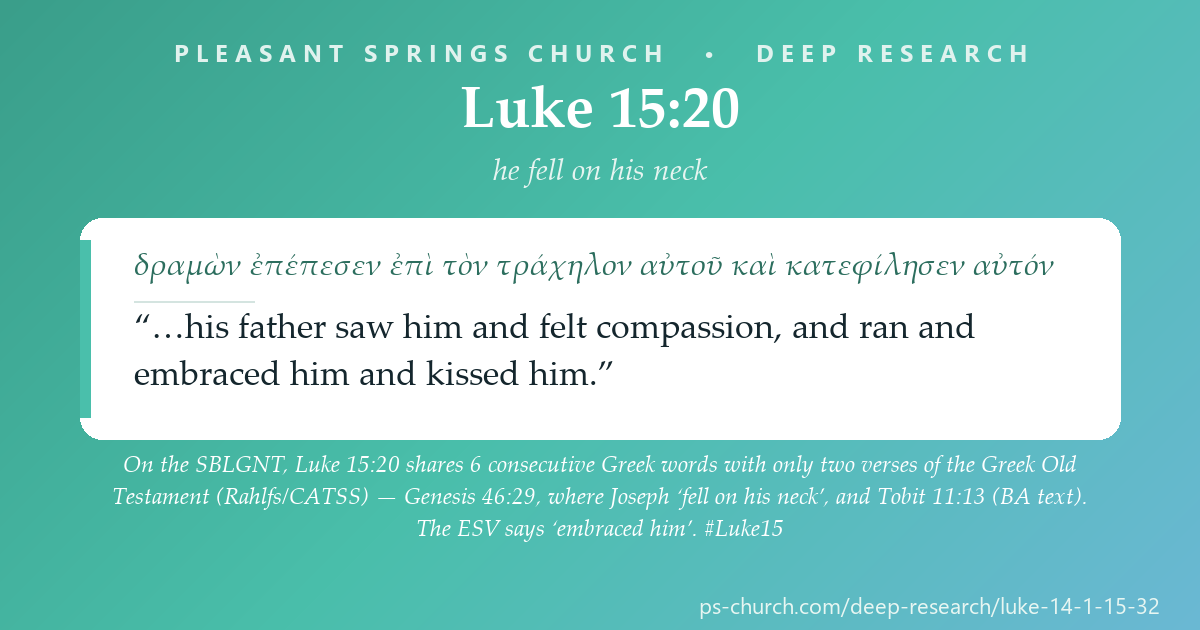
Every one of the 67 verses of Luke 14–15 was screened against all 30,348 screened verse units of the Greek Old Testament held here. The deepest contact of the two chapters is the father running to his son: “his father saw him and felt compassion, and ran and embraced him and kissed him”. Where the ESV has embraced him, the Greek has ἐπέπεσεν ἐπὶ τὸν τράχηλον αὐτοῦ καὶ, fell on his neck — and those six words stand in exactly two of the screened units. One is Genesis 46:29, where Joseph “fell on his neck and wept on his neck a good while”: a son on his father. The other is Tobit 11:13 in the BA text, a witness and not Scripture, where a father sees his son come home and falls on his neck. Esau’s embrace of Jacob (Genesis 33:4), the verse most often set beside Luke’s (reported), reaches five. So do two harder verses, Deuteronomy 21:19 and Zechariah 13:3, where a father and mother lay hands on their own son; their five words are an ordinary formula, and the page prints them so that the six are not read as more than they are. Beside that, the passage is almost all its own words: its deepest New Testament run is seven words about a debtor’s wife and children, and the great banquet shares three words in a row with Matthew’s wedding feast. The page measures Proverbs 25 beside the places at the feast, the blind and the lame of the Law, the hated wife, Ezekiel’s lost sheep, Pharaoh’s confession and Joseph’s ring, and never says which text depends on which. See the method →
Luke 14:1–15:32
Greek NT · ESV or our renderingVersification. Luke 14–15 has no offset: the SBLGNT, the ESV and the King James Version count 35 and 32 verses, verse for verse. There is no Septuagint column, because Luke is a New Testament book. The offsets are in the Old Testament texts measured. Proverbs 25:6–7 (Hebrew and ESV) = CATSS Proverbs 32:6–7, and Proverbs 28:7 = CATSS 35:7: the Greek Proverbs held here sets Hebrew chapters 25–29 in its own order and numbers them 32–36; the two verses were matched by content. Ezekiel 21:31 in the Hebrew and the Greek = ESV 21:26. Psalm 118:176 in the Greek = ESV 119:176 and Psalm 50:6 in the Greek = ESV 51:4. 1 and 2 Samuel = Greek 1 and 2 Kingdoms; 1 Kings = 3 Kingdoms, same verse numbers for 1 Samuel 2:7, 2 Samuel 5:8 and 8:10, and 1 Kings 3:23. Jeremiah in the Greek is in another order: Greek 27:6 = ESV 50:6, Greek 26:21 = ESV 46:21, Greek 28:34 = ESV 51:34. Sirach 33:20–24 is cited in Rahlfs’ numbers, which the King James Apocrypha numbers 33:19–23. Judges and Tobit are each held in two Greek texts (A and B; BA and S), named on every line. Genesis 29, 33, 41, 45 and 46, Exodus 10 and 21, Leviticus 21, Deuteronomy 21 and 33, Ezekiel 17 and 34, Judges 6 and Zechariah 13 have no offset in the verses printed. Sirach, Tobit, 1 and 3 Maccabees and 1 Esdras are Greek only and are witnesses, not Scripture.
The Shape of the Passage
A sequence of three panels, the third a sequence of three parables — NOT a chiasm| counted by lemma (MorphGNT) | the sheep, 15:3–7 | the coin, 15:8–10 | the sons, 15:11–32 |
|---|---|---|---|
| lost — ἀπόλλυμι | 3 (15:4, 15:4, 15:6) | 2 (15:8, 15:9) | 3 (15:17, 15:24, 15:32) |
| found — εὑρίσκω | 3 (15:4, 15:5, 15:6) | 3 (15:8, 15:9, 15:9) | 2 (15:24, 15:32) |
| joy — χαίρω, συγχαίρω, χαρά, εὐφραίνω | 3 (15:5, 15:6, 15:7) | 2 (15:9, 15:10) | 5 (15:23, 15:24, 15:29, 15:32, 15:32) |
| calls together — συγκαλέω | 1 (15:6) | 1 (15:9) | 0 |
| repent — μετανοέω, μετάνοια | 2 (15:7, 15:7) | 1 (15:10) | 0 |
| sinner — ἁμαρτωλός | 1 (15:7) | 1 (15:10) | 0 |
| I have sinned — ἁμαρτάνω | 0 | 0 | 2 (15:18, 15:21) |
What the count shows. All three parables have the lost and the found and the joy. The first two close on the same words, ἐπὶ ἑνὶ ἁμαρτωλῷ μετανοοῦντι (15:7, 15:10). The third has neither ἁμαρτωλός nor any word for repenting; the son says instead ἥμαρτον, I have sinned (15:18, 15:21), and the joy is mostly another word (four of its five tokens), εὐφραίνω, the joy of a feast. Two threads run through the whole passage. Calling: καλέω 11 times in the banquet scenes (14:7, 14:8, 14:8, 14:9, 14:10, 14:10, 14:12, 14:13, 14:16, 14:17, 14:24) and twice in chapter 15, both in the son’s words κληθῆναι υἱός σου (15:19, 15:21). Eating: 6 tokens of ἐσθίω and its compounds (14:1, 14:15, 15:2, 15:16, 15:23, 15:30), from the Sabbath meal to the pigs’ pods and the feast. Run against itself, the passage’s deepest internal pair is 15:18 and 15:21, the speech prepared and the speech spoken (run 9). The panels are labelled by content, and the page does not claim the writer drew them.
Two chapters, 67 verses: three scenes at a meal, sayings on the road, and three parables. The Greek is measured against the rest of the New Testament and the Greek Old Testament; the authorship is reported, not tested.
Author
Tradition from Irenaeus onward names Luke, Paul’s companion.
Luke also, the companion of Paul, recorded in a book the Gospel preached by him.Irenaeus, Against Heresies 3.1.1 (ANF 1)
The page cannot test that from the text and does not try; the shelf’s Luke 1–2 study states the same position.
What the text shows is wording found almost nowhere else in the New Testament. Of the 67 verses, one reaches seven words in a row with a verse outside Luke, and that verse (Matthew 18:25) is about something else; the great banquet shares at most 3 consecutive words with Matthew’s wedding feast, and the lost sheep 3 with Matthew’s. No other Gospel has the coin or the two sons, and their rows reach five words outside Luke only on formulas. The page reports where the words stand, and says nothing about who wrote first.
Audience
Theophilus, and readers like him (Luke 1:3–4; Acts 1:1), who had been taught already and were given an orderly account.
Inside the story, three audiences in turn: the guests and the host at a Pharisee’s table (14:7, 14:12), the crowds on the road (14:25), and the Pharisees and scribes who grumble at the company he eats with (15:2). The tax collectors and sinners of 15:1 are Jews too, and so are those who object; the page reads the parables as spoken to people in that room, not about a people.
Orient on the Sabbath and healing, meals and seating, hospitality and reciprocity, the poor and the disabled in the Law, the messianic banquet, discipleship and the cross, salt, shepherds, coins, inheritance, and repentance.
Search by reference and by topic: dropsy, Sabbath healing, places of honour, banquet, messianic banquet, invitation customs, the poor, blindness, lameness, blemish, hate (idiom), discipleship, cross-bearing, salt, sheep and shepherd, Ezekiel 34, drachma, inheritance, firstborn, pigs, carob, robe, signet ring, fattened calf, repentance, joy, the elder brother.
Which articles are relevant?
- Dictionary of Jesus and the Gospels (IVP, 2nd ed. 2013) — look under table fellowship and meals, the messianic banquet, parables, discipleship, the Sabbath, sinners, repentance, and the Gospel of Luke.
- Anchor Bible Dictionary — look under disease and healing, salt, inheritance and the firstborn, sheep and shepherds, coinage, and the parables of Luke 15.
- Dictionary of New Testament Background (IVP) — look under meals, patronage, honour and shame, family and household, and the Rule of the Congregation (1QSa).
- NIDNTTE — πρωτοκλισία, ἀναγκάζω, μισέω, ἀποτάσσομαι, μωραίνω, ἀπόλλυμι, σπλαγχνίζομαι, ἀσώτως.
Bibliography surfaced:
- Commentaries on Luke: Darrell L. Bock, Luke 9:51–24:53 (BECNT); Joseph A. Fitzmyer, The Gospel According to Luke X–XXIV (AB 28A); I. Howard Marshall (NIGTC); Joel B. Green (NICNT); John Nolland, Luke 9:21–18:34 (WBC 35B).
- On the parables: Kenneth E. Bailey, Poet and Peasant (1976) and The Cross and the Prodigal (1973, 2nd ed. 2005); Klyne Snodgrass, Stories with Intent (2008).
- On the use of the Old Testament: David W. Pao and Eckhard J. Schnabel, “Luke,” in Beale and Carson, Commentary on the New Testament Use of the Old Testament (2007).
The works above are named as places to look. None was re-read for this page, and no number on it comes from them. Stage 5 says so again.
What the world of the text supplies: a Sabbath meal, a seating order, invitations returned, the blemished kept from the altar, a son who asks for his share, pigs, a ring, and a father who runs.
Dropsy, and a meal on the Sabbath (14:1–6)
ὑδρωπικὸς is a medical word for a body swollen with fluid; it is reported from Greek medical writers (not held here). The meal is on the Sabbath, and the question of 14:3 is the question of 6:9. The appeal of 14:5 — a son or an ox fallen into a well — assumes that rescue on the Sabbath was allowed; the rules on this in the Damascus Document and the later rabbinic texts are reported (neither is held). In the Law, Deuteronomy 22:4 commands help for a brother’s donkey or ox fallen on the road, without mention of the Sabbath.
The places at the table (14:7–11)
τὰς πρωτοκλισίας ἐξελέγοντο: guests reclined on couches, and the place at the head of the couch was the place of honour (reported). The advice of 14:8–10 is the advice of Proverbs 25:6–7, and Stage 4 sets the two side by side. The shame of being moved down and the honour of being moved up assume a meal at which rank was public.
Invitations returned (14:12–14)
ἀντικαλέσωσίν σε: the host who invites friends will be invited back, ἀνταπόδομά σοι. Hospitality as an exchange of favours is well described for the Greco-Roman world (reported). Against it 14:14 sets οὐκ ἔχουσιν ἀνταποδοῦναί σοι and a repayment ἐν τῇ ἀναστάσει τῶν δικαίων.
The blind and the lame at the holy meal — Qumran, not held
The Rule of the Congregation from Qumran (1QSa 2:3–9) is reported to bar from the assembly and its meal anyone smitten in the flesh, lame, blind or deaf, on the ground that the holy angels are present; the War Scroll (1QM 7:4–5) is reported to have a similar list for the camp. No Dead Sea Scroll is held on this disk, so neither text is quoted, and the page does not count its words. What the page can measure is the Greek Old Testament’s own lists (Stage 4).
A double invitation (14:16–17)
The man ἐκάλεσεν πολλούς, and at the hour of the meal sends his slave to those τοῖς κεκλημένοις: a first invitation and a second summons. That this was the custom is reported from Esther 6:14 and from later sources; it is not tested here. The three refusals each give a reason that sounds acceptable, and each declines what was already accepted.
“Compel people” — read as coercion in the fifth century
Augustine, writing against the Donatists, read this command, in Latin compelle intrare (so the Vulgate), as a warrant for compelling schismatics back into the Catholic Church by the power of the state. In AD 408 he wrote to Vincentius:
You are of opinion that no one should be compelled to follow righteousness; and yet you read that the householder said to his servants, “Whomsoever ye shall find, compel them to come in.”Augustine, Letter 93.5, to Vincentius (NPNF1 1)
and in AD 416, to Donatus, a Donatist presbyter, he set the two summonses of the parable against each other: the first group was brought in, the later group compelled, because the Church now had power,
so that she may not only invite, but even compel men to embrace what is good. … The sheep which is compelled is driven whither it would not wish to go, but after it has entered, it feeds of its own accord in the pastures to which it was brought.Augustine, Letter 173.10, to Donatus (NPNF1 1)
That reading had a long history after him, and it is reported here in his own words so that it is not softened. The church does not hold it. Stage 5 sets out the readings of the word, and what the church does say about grace and refusal.
A son who asks for his share (15:11–13)
δός μοι τὸ ἐπιβάλλον μέρος τῆς οὐσίας: the younger son asks for his portion while his father lives, and the father διεῖλεν αὐτοῖς τὸν βίον. Under Deuteronomy 21:17 the firstborn received a double portion פִּי שְׁנַיִם; with two sons the younger’s share would be a third (reported arithmetic). Sirach, a witness, advises a father against exactly this: μὴ δῷς ἐξουσίαν ἐπὶ σὲ ἐν ζωῇ σου, do not give anyone power over you while you live (our rendering), and ἐν καιρῷ τελευτῆς διάδος κληρονομίαν, at the time of your end, share out the inheritance (our rendering). Whether the son’s request was heard as wishing his father dead is a modern reading (reported, Stage 5).
Pigs, carob pods and a famine (15:14–16)
Pigs were unclean under Leviticus 11:7 and Deuteronomy 14:8, where the Greek word is τὸν ὗν, not Luke’s χοῖρος. To herd them for a Gentile master is the lowest place the story could reach. κεράτιον is the carob pod, fodder for animals (reported). The Mishnah is reported to forbid raising pigs, and the Babylonian Talmud to curse the man who does; neither is held, and the report is not checked.
A father who runs, a robe, a ring and a calf (15:20–23)
That a man of standing did not run in public, so that the father’s δραμὼν is itself a humiliation, is argued by Kenneth Bailey from Middle Eastern village life (reported; Stage 5). The gifts are signs of standing: in Genesis 41:42 Pharaoh puts τὸν δακτύλιον on Joseph’s hand and ἐνέδυσεν αὐτὸν στολὴν βυσσίνην; in 1 Maccabees 6:15, a witness, the dying Antiochus gives Philip τὸ διάδημα καὶ τὴν στολὴν αὐτοῦ καὶ τὸν δακτύλιον to raise his son for the throne (our rendering). The calf kept for a feast, τὸν μόσχον τὸν σιτευτόν, is meat for many guests (reported).
Eleven words. Where a count is given it is a lemma count from the MorphGNT columns, re-checked by unanchored search; where letters mislead (near-homographs), the page says so.
Once in the Greek New Testament and in no screened unit of the Greek Old Testament, searched unanchored for hydrōp-. A medical word (Stage 2).
Five tokens in the Greek New Testament (Matthew 23:6, Mark 12:39, Luke 14:7, Luke 14:8, Luke 20:46): the guests at this meal, and the scribes of 20:46, Mark 12:39 and Matthew 23:6. In the screened Greek Old Testament the letters stand once, in 2 Maccabees 4:21, where they are usually taken to name a king’s enthronement festival (reported).
Nine tokens in the Greek New Testament (Matthew 14:22, Mark 6:45, Luke 14:23, Acts 26:11, Acts 28:19, 2 Corinthians 12:11, Galatians 2:3, Galatians 2:14, Galatians 6:12). Jesus ἠνάγκασεν the disciples into the boat (Matthew 14:22, Mark 6:45); Paul says the Corinthians forced him to boast (2 Corinthians 12:11) and that Titus was not compelled to be circumcised (Galatians 2:3). The range runs from urging to force; which the parable means is Stage 5.
Seven tokens in Luke (1:71, 6:22, 6:27, 14:26, 16:13, 19:14, 21:17). The verb stands with a word for mother in one New Testament verse, this one, searched unanchored. Stage 4 sets it beside Matthew’s loves more and the Old Testament’s hated wife.
Six tokens in the Greek New Testament (Mark 6:46, Luke 9:61, Luke 14:33, Acts 18:18, Acts 18:21, 2 Corinthians 2:13). Everywhere else it is leave-taking: the would-be follower who first wants to say goodbye at home (Luke 9:61), Jesus dismissing the crowds (Mark 6:46), Paul taking leave at Corinth, Ephesus and Troas (Acts 18:18, 18:21; 2 Corinthians 2:13). Only here is the object πᾶσιν τοῖς ἑαυτοῦ ὑπάρχουσιν.
Four tokens in the Greek New Testament (Matthew 5:13, Luke 14:34, Romans 1:22, 1 Corinthians 1:20). In Romans 1:22 and 1 Corinthians 1:20 it is to become a fool, to make foolish; only in the salt sayings is it said of salt. The ESV has has lost its taste.
Eight tokens in Luke 14–15 (15:4, 15:4, 15:6, 15:8, 15:9, 15:17, 15:24, 15:32): the sheep, the coin and the son are lost with it, and the son uses it of himself, λιμῷ ὧδε ἀπόλλυμαι (15:17).
In Luke three times (7:13, 10:33, 15:20): the widow of Nain’s son, the Samaritan, and this father. The verb is built on the word for the inward parts.
Six tokens in the Greek New Testament (Matthew 26:49, Mark 14:45, Luke 7:38, Luke 7:45, Luke 15:20, Acts 20:37): the woman at Simon’s table, Judas, this father, and the elders of Ephesus with Paul. Stage 4.
In the Greek New Testament only in this parable, three times (15:23, 27, 30). In the screened Greek Old Testament the adjective stands in 4 units (3 Kingdoms 5:3 (ESV 1 Kings 4:23), Jeremiah 26:21 in the Greek (ESV 46:21), Judges 6:25 (A text), Judges 6:28 (A text)), and every one has a form of calf beside it or in the same unit.
Two tokens in the Greek New Testament (Luke 15:24, Romans 7:9). Searched by letters, anaz- also catches ἀναζητοῦντες (Luke 2:44–45, Acts 11:25), a different verb, to search for; the lemma column separates them. In the screened Greek Old Testament no form of this verb stands: the forms there beginning anaz- or anez- belong to other verbs — to search, to boil up, to break camp, to gird, to rekindle — or to proper names.
Two near-homographs, set aside. Searched by letters, the screened Greek Old Testament has choir- in four units and kerati- in many; but every choir- form there is τὸν χοιρογρύλλιον, the rock badger, and every kerati- form belongs to κερατίσῃ (to gore) or to the words for horn. So χοῖρος and κεράτιον stand in no screened unit; the pig of the Law is τὸν ὗν.
The two chapters against the rest of the New Testament and against the whole Greek Old Testament; the Old Testament texts set beside them, measured one by one; and the counter-examples.
The two chapters against the New Testament outside Luke
Each of the 67 verses was screened against the 6,778 verses of the Greek New Testament outside Luke (MorphGNT on both sides, contiguous runs of whole word forms). The distribution, by deepest run:
| deepest run against the NT outside Luke | 7 | 5 | 4 | 3 | 2 | 1 |
|---|---|---|---|---|---|---|
| rows of Luke 14–15 | 1 | 5 | 14 | 32 | 14 | 1 |
Almost nothing here is shared. One row reaches seven, 14:26 with Matthew 18:25, and the seven words are a list, καὶ τὴν γυναῖκα καὶ τὰ τέκνα καὶ, in a verse about a debtor sold with his family. The five rows at five are two formulas (14:3, 15:29), the kingdom-of-God phrase of 14:15, the salt saying with Matthew 5:13 (14:34), and 15:18 with John 20:17, πρὸς τὸν πατέρα μου καὶ. One row, 14:13, shares no two consecutive word forms with any verse outside Luke. The sayings that have a parallel in another Gospel measure like this:
| Luke | the nearest saying elsewhere | longest shared run |
|---|---|---|
| 14:11 / 18:14 | Luke against Luke | 6 |
| 14:11 | Matthew 23:12 | 3 |
| 14:16–24, read whole | Matthew 22:2–14, the wedding feast | 3 |
| 14:24 (Robinson-Pierpont) | Matthew 22:14 | 7 (the SBLGNT has no such line) |
| 14:26 | Matthew 10:37 | 1 |
| 14:27 | Matthew 10:38; Luke 9:23 | 2; 2 |
| 14:34 | Matthew 5:13 | 5 |
| 14:34 | Mark 9:50 | 4 |
| 15:4–7, read whole | Matthew 18:12–14, the stray sheep | 3 |
| 15:2 | Luke 5:30, the meal at Levi’s | 4 |
Where the parallels are thin, the wording differs throughout: where Matthew 18:12 has the sheep that strays, ζητεῖ τὸ πλανώμενον, Luke has ἐπὶ τὸ ἀπολωλὸς ἕως εὕρῃ αὐτό; where Matthew 10:37 has ὁ φιλῶν πατέρα ἢ μητέρα ὑπὲρ ἐμὲ and οὐκ ἔστιν μου ἄξιος, Luke has οὐ μισεῖ τὸν πατέρα ἑαυτοῦ καὶ τὴν μητέρα and οὐ δύναται εἶναί μου μαθητής. The page reports the differences and does not say which form is older. One edition joins Luke’s banquet to Matthew’s: Robinson-Pierpont ends 14:24 with δείπνου WH Treg NA28 ] + Πολλοί γὰρ εἰσιν κλητοί ὀλίγοι δέ ἐκλεκτοί RP, the words of Matthew 22:14 (7 in a row, band 1); the SBLGNT, Westcott-Hort, Tregelles and NA28 do not. The Matthew 22 study reads Matthew’s wedding feast.
The places at the feast — Proverbs 25, measured
The advice of 14:8–10 is the advice of Proverbs 25:6–7: do not take the high place, for it is better to be invited up than sent down. The Greek words are not the same. Against the Greek of Proverbs (CATSS 32:6–7) the three verses share no two consecutive words — 1, 1 and 1. Where the Greek of Proverbs has ἀνάβαινε πρός με, Luke has προσανάβηθι ἀνώτερον; where Proverbs has ταπεινῶσαί σε, Luke has μετὰ αἰσχύνης and, in 14:11, ταπεινωθήσεται. The compound προσαναβαίνω stands in the Greek New Testament only here.
The places at the feast · Proverbs 25:6–7 (CATSS 32:6–7)
Hebrew · Greek OT · ESVTwo texts, two phrasings. The Hebrew has עֲלֵה־הֵנָּה, come up here; the Greek has come up to me. In the screened Greek Old Testament the phrase ἀνάβαινε πρός με (any unaugmented form of the verb; the augmented forms in Isaiah 37:29 and Judges 12:3, A text, make 7) stands in 5 units: Deuteronomy 10:1, Exodus 24:12, Exodus 34:1, Joshua 10:4 (B text), Proverbs 32:7 in CATSS (Hebrew and ESV 25:7) — three of them the Lord calling Moses up the mountain, as in ἀνάβηθι πρός με (Exodus 24:12). That is a fact about the Greek of Proverbs, not about Luke, whose verb is different.
Everyone who exalts himself — low and high, searched unanchored
πᾶς ὁ ὑψῶν ἑαυτὸν ταπεινωθήσεται (14:11) stands again, six words in a row, at Luke 18:14. Matthew 23:12 has the same thought in other forms (3 in a row).
The search. Any form with tapein- and any form with hyps- in the same verse or unit, at any distance, after setting aside the near-homographs (the letters ups inside ἔκυψεν, stooped, and inside forms of ἀποκαλύψει, uncover, which account for 6 more units). In the Greek New Testament: 9 verses (Matthew 23:12, Luke 1:52, Luke 14:11, Luke 18:14, Romans 12:16, 2 Corinthians 11:7, James 1:9, James 4:10, 1 Peter 5:6), among them Mary’s ὕψωσεν ταπεινούς (Luke 1:52). In the screened Greek Old Testament: 33 units, the reversal of high and low a commonplace of the prophets and the Psalms. The reflexive form, ὑψῶν ἑαυτὸν, is rarer: a hyps- form directly before a reflexive pronoun stands in 3 New Testament verses (Matthew 23:12, Luke 14:11, Luke 18:14) and in 1 screened Greek Old Testament unit, Sirach 1:30, a witness: μὴ ἐξύψου σεαυτόν, do not exalt yourself, and in the same verse the Lord καταβαλεῖ σε, will cast you down (1 word in a row with 14:11). (A letter search also returns Revelation 6:15, ἔκρυψαν ἑαυτοὺς, they hid themselves — another near-homograph.) The humbling of oneself, a tapein- form directly before a reflexive, stands in 3 screened units: Job 22:23, Proverbs 13:7, Sirach 3:18.
| text | the words | run with 14:11 |
|---|---|---|
| Ezekiel 21:31 Greek (ESV 21:26) | ἐταπείνωσας τὸ ὑψηλὸν καὶ τὸ ταπεινὸν ὕψωσας | 1 |
| 1 Kingdoms (1 Samuel) 2:7 | ταπεινοῖ καὶ ἀνυψοῖ | 1 |
| Sirach 3:18 (a witness) | ταπείνου σεαυτόν | 1 |
| Ezekiel 17:24 | ὁ ταπεινῶν ξύλον ὑψηλὸν καὶ ὑψῶν ξύλον ταπεινὸν | 2 |
| Proverbs 25:7 (CATSS 32:7) | ταπεινῶσαί σε | 0 |
Against all five texts 14:11 shares at most two consecutive words, ὁ ταπεινῶν with Ezekiel 17:24. Ezekiel 21:31 is printed whole because its Hebrew and Greek differ in a way the English hides:
Low and high · Ezekiel 21:31 (ESV 21:26); 1 Samuel 2:7
Hebrew · Greek OT · ESVThe poor, the crippled, the lame and the blind
πτωχούς, ἀναπείρους, χωλούς, τυφλούς (14:13) and τοὺς πτωχοὺς καὶ ἀναπείρους καὶ τυφλοὺς καὶ χωλοὺς (14:21). Searched unanchored — any typhl- form and any chōl- form in the same unit — the screened Greek Old Testament has 6 units. In four of them the blind and the lame, people or animals, are barred from the altar or the house; in one they are a taunt; in Job they are helped:
| screened Greek OT unit with a blind form and a lame form | what is said |
|---|---|
| Leviticus 21:18 | a priest with a blemish shall not approach to offer: χωλὸς ἢ τυφλὸς |
| Deuteronomy 15:21 | a firstborn animal that is lame or blind shall not be sacrificed |
| Malachi 1:8 | blind and lame animals brought for sacrifice are a contempt |
| 2 Kingdoms (ESV 2 Samuel) 5:6 | the Jebusites’ taunt: the blind and the lame will keep David out |
| 2 Kingdoms (ESV 2 Samuel) 5:8 | τυφλοὶ καὶ χωλοὶ οὐκ εἰσελεύσονται εἰς οἶκον κυρίου |
| Job 29:15 | Job: ὀφθαλμὸς ἤμην τυφλῶν ποὺς δὲ χωλῶν |
No screened unit has a poor form with the two (0). In the Greek New Testament the three together stand in 4 verses: Matthew 11:5, Luke 7:22, Luke 14:13, Luke 14:21 — the reply to John, which ends πτωχοὶ εὐαγγελίζονται, and the two lists of this chapter. The fourth word, ἀνάπηρος, stands in the New Testament only in 14:13 and 14:21; in the screened Greek Old Testament the adjective stands twice, in Tobit 14:2 (S text), of Tobit’s blindness, and 2 Maccabees 8:24 (wounded soldiers), and 2 Maccabees 12:22 has a different verb with the same letters, to pierce.
The words, measured. Against Leviticus 21:18 the two lists share no word form at all (0 and 0): Leviticus has the singular nominative χωλὸς ἢ τυφλὸς, Luke the accusative plural. Against 2 Samuel 5:8 they share 1 and 2. What can be said is narrower and plain: the Greek of 2 Samuel 5:8 says the blind and the lame οὐκ εἰσελεύσονται εἰς οἶκον κυρίου, and the master of 14:21–23 says εἰσάγαγε ὧδε and ἵνα γεμισθῇ μου ὁ οἶκος. The page sets the two side by side and does not say that either was written with the other in view.
The blind and the lame · Leviticus 21:18; 2 Samuel 5:8
Hebrew · Greek OT · ESVHating father and mother — the wording only
οὐ μισεῖ τὸν πατέρα ἑαυτοῦ καὶ τὴν μητέρα (14:26). Matthew 10:37 has ὁ φιλῶν πατέρα ἢ μητέρα ὑπὲρ ἐμὲ, loves more than me; against it the row shares 1 word. The verb μισέω with a mother form stands in 1 New Testament verse, this one; ὑπὲρ ἐμὲ stands in 1, Matthew 10:37.
The Old Testament has both words side by side. In Genesis 29:30 Jacob ἠγάπησεν δὲ Ραχηλ μᾶλλον ἢ Λειαν, loved Rachel more than Leah, and in the next verse μισεῖται Λεια, Leah was hated (Hebrew כִּי־שְׂנוּאָה). Deuteronomy 21:15 sets two wives side by side, μία αὐτῶν ἠγαπημένη καὶ μία αὐτῶν μισουμένη. Against both verses 14:26 measures 1 word; the page reports the idiom and does not claim a source.
Loved and hated · Genesis 29:30–31; Deuteronomy 21:15; Matthew 10:37
Hebrew · Greek · ESVTwo counter-examples. 14:26’s deepest Greek Old Testament run is five words with Exodus 21:5, ἠγάπηκα τὸν κύριόν μου καὶ τὴν γυναῖκα καὶ τὰ παιδία — the slave who loves his master, his wife and his children, and will not go free (run 5, tie band 1). Its deepest New Testament run is seven with Matthew 18:25 (band 1). Both are lists of a household, and lists repeat; they are printed so that a run of five or seven in a list is not read as a citation. Deuteronomy 33:9, where Levi ὁ λέγων τῷ πατρὶ καὶ τῇ μητρί οὐχ ἑόρακά σε, shares 3 words with the verse.
The lost sheep — Ezekiel 34, Psalm 119 and Matthew 18
ἐπὶ τὸ ἀπολωλὸς ἕως εὕρῃ αὐτό (15:4). The articular τὸ ἀπολωλὸς, the lost one, stands in 3 New Testament verses (Luke 15:4, Luke 15:6, Luke 19:10) — the two verses of this parable and Zacchaeus’s house, ζητῆσαι καὶ σῶσαι τὸ ἀπολωλός — and in 2 screened Greek Old Testament units: Ezekiel 34:4, against the shepherds, τὸ ἀπολωλὸς οὐκ ἐζητήσατε, and Ezekiel 34:16, the Lord’s promise, τὸ ἀπολωλὸς ζητήσω καὶ τὸ πλανώμενον ἐπιστρέψω. Those two verses, with Psalm 118:176 and Jeremiah 27:6 in the Greek, are the only screened units with a perfect lost form (apolōl-) and a stray form in the same unit (4): Ezekiel has both the word in Luke, lost, and the word in Matthew 18:12, ζητεῖ τὸ πλανώμενον, the straying one. With any form of the two verbs, Job 12:23 and Tobit 10:7 in both texts join them, where the words mean destroy, perish and deceive.
Measured, the contact is two words. 15:4 shares 2 with Ezekiel 34:16 and 1 with Psalm 118:176 (ἐπλανήθην ὡς πρόβατον ἀπολωλός ζήτησον τὸν δοῦλόν σου). A perfect lost form (apolōl-) with a sheep form stands in 2 screened units (Jeremiah 27:6 in the Greek (ESV 50:6), Psalm 118:176 in the Greek (ESV 119:176)) and in 4 New Testament verses (Matthew 10:6, Matthew 15:24, Luke 15:4, Luke 15:6), two of them Matthew’s lost sheep of the house of Israel. Against Matthew 18:12–14, read whole, Luke 15:4–7 shares at most 3 words in a row, ἑκατὸν πρόβατα καὶ, and where Luke closes on a sinner who repents, Matthew closes on the will of the Father, ἵνα ἀπόληται ἓν τῶν μικρῶν τούτων.
The lost sheep · Ezekiel 34:16; Psalm 119:176 (Greek 118:176); Matthew 18:12–13
Hebrew · Greek · ESV★ Falling on the neck — the six words, and the five
εἶδεν αὐτὸν ὁ πατὴρ αὐτοῦ, ἐσπλαγχνίσθη, δραμὼν ἐπέπεσεν ἐπὶ τὸν τράχηλον αὐτοῦ καὶ κατεφίλησεν αὐτόν (15:20). Against all 30,348 screened units the row reaches six consecutive words, and two units carry them — the tie band is 2. No other row of the two chapters reaches six. Every unit that reaches five or more is set out below, so that the six can be read against the fives:
| screened Greek OT unit | run with 15:20 | the shared words | who falls on whose neck |
|---|---|---|---|
| Genesis 46:29 | 6 | ἐπέπεσεν ἐπὶ τὸν τράχηλον αὐτοῦ καὶ | Joseph, on Israel his father, εἰς συνάντησιν Ισραηλ τῷ πατρὶ αὐτοῦ |
| Tobit 11:13 (BA text) | 6 | ἐπέπεσεν ἐπὶ τὸν τράχηλον αὐτοῦ καὶ | Tobit, ἰδὼν τὸν υἱὸν αὐτοῦ, on the son |
| Genesis 33:4 | 5 | ἐπὶ τὸν τράχηλον αὐτοῦ καὶ | Esau, on Jacob his brother |
| Tobit 11:13 (S text) | 5 | ἐπὶ τὸν τράχηλον αὐτοῦ καὶ | the father, on the son (the other Greek text of the same verse) |
| Deuteronomy 21:19 | 5 | αὐτὸν ὁ πατὴρ αὐτοῦ καὶ | no one: a father and mother seize a rebellious son and bring him to the elders |
| Zechariah 13:3 | 5 | αὐτὸν ὁ πατὴρ αὐτοῦ καὶ | no one: a father and mother turn on a son who prophesies falsely |
| Daniel 5:7 (Theodotion) | 5 | ἐπὶ τὸν τράχηλον αὐτοῦ καὶ | no one: a gold chain round the neck |
What the table shows. The two sixes are both reunions of a father and a son: in Genesis 46:29 the son falls on the father, in Tobit 11:13 the father on the son, as in Luke. Esau’s embrace of Jacob, the verse most often set beside the parable (reported), reaches five, because its verb is προσέπεσεν where Luke and Genesis 46:29 have ἐπέπεσεν. The exact verb with ἐπὶ τὸν τράχηλον stands in 4 screened units (Genesis 46:29, Tobit 11:9 (BA text), Tobit 11:13 (BA text), Tobit 11:9 (S text)), three of them in Tobit 11; with any form of the falling verb, in 8. In the Greek New Testament the exact phrase stands only here. And the other fives are a warning. In Deuteronomy 21:19 and Zechariah 13:3 the five words are αὐτὸν ὁ πατὴρ αὐτοῦ καὶ — a father and mother who seize their son to bring him to judgment, and who say to a son who prophesies falsely οὐ ζήσῃ, you shall not live. That is the same Greek formula, and the opposite of this father. A run of five is ordinary narrative Greek; the page prints these two so that the six above them are not read as more than they are.
Falling on the neck · Genesis 33:4; 45:14–15; 46:29
Hebrew · Greek OT · ESVBetween the Testaments · Tobit 11:9 and 11:13, the BA text
Greek · our renderingThe kiss. Falling on the neck and a kiss in the same unit: in the screened Greek Old Testament 3 units (3 Maccabees 5:49, Genesis 33:4, Tobit 7:6 (S text)), among them ἐπιπεσὼν ἐπὶ τὸν τράχηλον Τωβια, Raguel and Tobias, and the families of 3 Maccabees 5:49 who κατεφίλουν ἀλλήλους; in Genesis 45 the two stand in successive verses, ἐπιπεσὼν ἐπὶ τὸν τράχηλον Βενιαμιν and then καταφιλήσας. In the Greek New Testament, 2 verses (read from the lemma column): this one, and the elders of Ephesus with Paul, ἐπιπεσόντες ἐπὶ τὸν τράχηλον τοῦ Παύλου κατεφίλουν αὐτόν (Acts 20:37, 3 words in a row with 15:20). Outside Luke, 15:20’s deepest New Testament run is four words with Mark 9:42 and Matthew 18:6, τὸν τράχηλον αὐτοῦ καὶ (Mark: περίκειται μύλος ὀνικὸς περὶ τὸν τράχηλον αὐτοῦ) — a millstone round the neck, another accident.
What the run cannot say. It shows that the father’s embrace is told in the words used for Joseph and Jacob in Egypt and for Tobit and Tobias, and not in the words of Esau. It does not show that Luke had Genesis 46 in mind, or Tobit at all. The ESV’s embraced him is a fair rendering, and hides the phrase.
“I have sinned against heaven and before you” — and Pharaoh
ἥμαρτον εἰς τὸν οὐρανὸν καὶ ἐνώπιόν σου (15:18, 15:21). The words are set beside Pharaoh’s confession to Moses and Aaron, ἡμάρτηκα ἐναντίον κυρίου τοῦ θεοῦ ὑμῶν καὶ εἰς ὑμᾶς (Exodus 10:16). Measured, they share 1 word. The shape is the same — I have sinned against God and against you — but the verb is another tense, and the two prepositions change places: Exodus has ἐναντίον κυρίου and εἰς ὑμᾶς, Luke εἰς τὸν οὐρανὸν and ἐνώπιόν σου. The Hebrew of Exodus has חָטָאתִי לַיהֹוָה, to the Lord.
I have sinned · Exodus 10:16
Hebrew · Greek OT · ESVSearched unanchored, any form of to sin and then, at any distance, εἰς τὸν οὐρανὸν stands in 0 screened unit and in 2 New Testament verses, 15:18 and 15:21. The nearest in sense is 1 Esdras 6:14, a witness: ἥμαρτον εἰς τὸν κύριον τοῦ Ισραηλ τὸν οὐράνιον, against the heavenly Lord of Israel, with an adjective. Psalm 50:6 in the Greek (ESV 51:4), σοὶ μόνῳ ἥμαρτον καὶ τὸ πονηρὸν ἐνώπιόν σου ἐποίησα, shares 2 words, ἐνώπιόν σου.
The speech prepared and the speech spoken. From Πάτερ, the speech the son rehearses in 15:18–19 is 21 words; the speech he makes in 15:21 is 14, the first 14 of them in the same order (with the αὐτῷ before them, 15 in a row). The last seven, ποίησόν με ὡς ἕνα τῶν μισθίων σου, make me like one of your hired men, are not spoken: 15:21 ends at οὐκέτι εἰμὶ ἄξιος κληθῆναι υἱός σου, and 15:22 begins with the father. That is the SBLGNT, and with it Tregelles, NA28 and Robinson-Pierpont; Westcott-Hort print the seven words in 15:21 (σου Treg NA28 RP ] + ποίησόν με ὡς ἕνα τῶν μισθίων σου WH), and with them the two speeches share 22 words in a row. The apparatus compares printed editions, not manuscripts; the page makes no manuscript claim and does not say which form is older.
The robe, the ring, the sandals and the calf
στολὴν τὴν πρώτην, δακτύλιον εἰς τὴν χεῖρα αὐτοῦ, ὑποδήματα εἰς τοὺς πόδας (15:22). Against Genesis 41:42, where Pharaoh gives Joseph his ring and a robe of linen, the row shares 2 words, τὴν χεῖρα. A ring form and a robe form stand together in 2 screened units, Genesis 41:42 and 1 Maccabees 6:15, both a ruler conferring authority, and in 1 New Testament verse, this one. Sandals are in neither.
The calf. τὸν μόσχον τὸν σιτευτόν (15:23, again in 15:27) is four words in a row with Judges 6:25 in the A text, band 1: the Lord tells Gideon λαβὲ τὸν μόσχον τὸν σιτευτὸν τοῦ πατρός σου, take your father’s grain-fed calf (our rendering), to pull down the altar of Baal. The phrase stands in 1 screened unit. But the B text of the same verse has λαβὲ τὸν μόσχον τὸν ταῦρον, and the Hebrew has the bull, so the contact belongs to one Greek text of Judges, not to Judges. The adjective σιτευτός stands in 4 units, among them Jeremiah’s mercenaries, ὥσπερ μόσχοι σιτευτοὶ (Greek 26:21, ESV 46:21).
The ring, the robe and the calf · Genesis 41:42; Judges 6:25
Hebrew · Greek OT · ESVThe share, the far country and the rebellious son
δός μοι τὸ ἐπιβάλλον μέρος τῆς οὐσίας (15:12). Against Deuteronomy 21:17, the double portion of the firstborn, and against Sirach 33:20–24, a father warned not to hand over his goods while he lives, the row measures 1, 1 and 1. The phrase τὸ ἐπιβάλλον μέρος stands in 1 New Testament verse and in 0 screened unit. The page measures the comparison and claims no influence.
Deuteronomy 21:18–21, the stubborn and rebellious son, is often set beside the parable. Its Greek shares one word with 15:13 (1). What can be counted is a chain of words, not a citation. The Hebrew of Deuteronomy 21:20 calls the son זוֹלֵל וְסֹבֵא, a glutton and a drunkard. The same Hebrew word, as the ESV’s glutton, stands in 4 verses — Deuteronomy 21:20, Proverbs 23:20, 23:21 and 28:7 (the letters stand in two more, Jeremiah 15:19 and Lamentations 1:11, where they are a different word, worthless or despised). In Proverbs 28:7 the companion of gluttons shames his father; where the Hebrew has the gluttons, the Greek has ὃς δὲ ποιμαίνει ἀσωτίαν ἀτιμάζει πατέρα — the one screened unit where an asōt- form stands with a father form (1). Luke’s son lives ζῶν ἀσώτως and is sent βόσκειν χοίρους; the Greek of Proverbs has a man who ποιμαίνει, tends, dissipation. The Greek of Deuteronomy 21:20 has neither word: συμβολοκοπῶν οἰνοφλυγεῖ. The page sets the words out and draws no line between them.
Sons and fathers in the Law · Deuteronomy 21:17, 21:20; Proverbs 28:7 (CATSS 35:7); Exodus 21:5; Deuteronomy 33:9
Hebrew · Greek OT · ESVDead and alive, lost and found
νεκρὸς ἦν καὶ ἀνέζησεν, ἦν ἀπολωλὼς καὶ εὑρέθη (15:24); νεκρὸς ἦν καὶ ἔζησεν, καὶ ἀπολωλὼς καὶ εὑρέθη (15:32). The two verses share 3 words in a row in the SBLGNT; with the Robinson-Pierpont readings at both places (the row notes), 9. ἀναζάω stands in the Greek New Testament twice (Luke 15:24, Romans 7:9). Counter-example. 15:24’s deepest Greek Old Testament run is four words, band 1, with 3 Kingdoms (ESV 1 Kings) 3:23: οὗτος ὁ υἱός μου ὁ ζῶν καὶ ὁ υἱὸς ταύτης ὁ τεθνηκώς, this is my son, the living one, and her son the dead one — Solomon repeating the two mothers’ claims. The shared words are οὗτος ὁ υἱός μου; the living and the dead in that verse are other words. It is an accident, and a striking one.
The two chapters against the Greek Old Testament — and the counter-examples
Against all 30,348 screened units, by deepest run:
| deepest run against the screened Greek OT | 6 | 5 | 4 | 3 | 2 |
|---|---|---|---|---|---|
| rows of Luke 14–15 | 1 | 4 | 17 | 34 | 11 |
One row reaches six and four reach five, and the page prints all five so that 15:20 is read against the others:
| Luke row | run | tie band | partners | what it is |
|---|---|---|---|---|
| 15:20 | 6 | 2 | Genesis 46:29, Tobit 11:13 (BA text) | ἐπέπεσεν ἐπὶ τὸν τράχηλον αὐτοῦ καὶ — falling on the neck |
| 14:26 | 5 | 1 | Exodus 21:5 | a family list: καὶ τὴν γυναῖκα καὶ τὰ; the slave who loves his wife and children |
| 15:18 | 5 | 2 | 1 Kingdoms (ESV 1 Samuel) 19:3, Genesis 45:9 | formula: πρὸς τὸν πατέρα μου καὶ — Joseph’s message to his father, Jonathan’s promise to David |
| 15:22 | 5 | 2 | 4 Kingdoms (ESV 2 Kings) 18:21, Ezekiel 30:24 | formula: εἰς τὴν χεῖρα αὐτοῦ καὶ — a sword and a reed |
| 15:29 | 5 | 2 | Tobit 11:6 (BA text), Tobit 11:6 (S text) | formula, in two texts of one verse: εἶπεν τῷ πατρὶ αὐτοῦ· Ἰδοὺ |
Three of the four fives are formulas and the fourth is a household list. The six is a phrase for an embrace, and it stands in two units of the Greek Old Testament held here, both reunions of a father and son. The number does not make the judgement; the reader does. Lower down: 15:16 reaches four with Jeremiah 28:34 in the Greek (ESV 51:34), ἔπλησεν τὴν κοιλίαν αὐτοῦ ἀπὸ τῆς τρυφῆς μου, band one — and only in the reading the SBLGNT shares with Tregelles, Robinson-Pierpont and the NIV’s Greek text; Westcott-Hort and NA28 read otherwise (with theirs the row’s best is 2). 15:5 reaches four with Judges 9:48, Abimelech’s load of wood on his shoulders. No row is below two, so every row shares at least two consecutive word forms with some unit. The Odes. The 289 units of the Odes are excluded from the screen, because Ode 9 is Luke 1 and a screen that includes them finds Luke against itself. Letting them back in deepens no row of Luke 14–15.
Where the passage is read in more than one way, the readings are set out with their reported holders and what the texts held here show. Then the limits.
“Compel people to come in”
| 14:23: ἀνάγκασον εἰσελθεῖν | reported holders | what the texts held here show |
|---|---|---|
| 1. Urgent hospitality. The poor and the strangers on the roads would not believe the invitation was meant for them, and had to be pressed to come. | many commentators (reported) | The verb runs from urging to force in the New Testament (Stage 3). The parable has a slave sent with a message; it gives him no means of force. |
| 2. The urgency of the gospel to the Gentiles. The first summons is to the city’s streets, the second to the roads and hedges beyond it. | many commentators (reported) | 14:21 sends the slave εἰς τὰς πλατείας καὶ ῥύμας τῆς πόλεως; 14:23 εἰς τὰς ὁδοὺς καὶ φραγμοὺς. |
| 3. A warrant for coercion. The Church may compel the unwilling by force. | Augustine against the Donatists, Letters 93 and 173 (quoted in Stage 2), and those who later cited him | Augustine’s own words are on this page. The parable’s guests are invited, and the first ones refuse: ἤρξαντο ἀπὸ μιᾶς πάντες παραιτεῖσθαι (14:18). |
The church attributes no coercion to this verse. Its position is in its own words in /beliefs, Article 10, Hope: “no one is beyond the offer of grace — not that grace can never be refused”. The parable has guests who refuse, and the page reads the word as the urgency of an invitation.
Hating father and mother
| 14:26: οὐ μισεῖ τὸν πατέρα ἑαυτοῦ καὶ τὴν μητέρα | reported holders | what the texts held here show |
|---|---|---|
| 1. A Semitic idiom for preference: to hate is to love less, as Matthew 10:37 has it. | most commentators (reported) | Genesis 29:30–31 has loved more and hated in successive verses; the ESV renders the same Hebrew word hated in Genesis 29:31 and unloved in Deuteronomy 21:15. |
| 2. A real renunciation: the word is meant to shock, and the loyalty asked for may cost a family. | some (reported) | The same verse goes on: ἔτι τε καὶ τὴν ψυχὴν ἑαυτοῦ, one’s own life, which no one reads as a command to hate oneself in feeling. |
The page reports the wording and the readings. Whatever 14:26 means, it does not mean contempt for parents: the same Gospel has the command to honour father and mother (18:20).
The resurrection of the just
ἐν τῇ ἀναστάσει τῶν δικαίων (14:14). An ἀναστάσει form and a dikai- form stand together in 2 New Testament verses: this one, and Acts 24:15, ἀνάστασιν μέλλειν ἔσεσθαι δικαίων τε καὶ ἀδίκων, one resurrection of both. Some readers hold that 14:14 names a resurrection of the righteous distinct from the rest, as in the first resurrection of Revelation 20:5–6; premillennial readers commonly do (reported), and historic premillennialism is the church’s position. Others read 14:14 as naming only the side of the one resurrection at which the righteous are repaid (reported). The page does not make the verse carry that weight.
The two sons and the question of falling away
| the two sons, and the question of falling away | reported holders | what the text gives |
|---|---|---|
| 1. A believer who strays and is restored. The son never stops being a son; he returns to a father he already has. | many evangelical preachers (reported) | He calls him Πάτερ in 15:21, and the father says οὗτος ὁ υἱός μου (15:24). |
| 2. A sinner coming to God for the first time. The parable answers the grumbling of 15:2 about tax collectors and sinners; dead and lost describe them. | many commentators (reported) | 15:1–2 is the setting of all three parables; the sheep and the coin are lost before they are found, and 15:7 and 15:10 speak of ἑνὶ ἁμαρτωλῷ μετανοοῦντι. |
| 3. A son who was truly dead and truly lost, and was restored. Read as evidence that one may lose what one had. | some Arminian readers (reported) | The father uses the words νεκρός and ἀπόλλυμι; the parable does not use the words faith, believe or saved. |
The church’s position is in its own words in /beliefs, Article 10, Hope: “all who genuinely receive Christ are held secure”, and “Scripture’s warnings are themselves a real means by which He holds us fast.” The page does not make a parable about a father’s joy settle that question either way; it reports how it has been used.
The elder son
| the elder son (15:25–32) | reported holders | what the text gives |
|---|---|---|
| 1. The grumblers of 15:2. The parable is spoken to the Pharisees and scribes, and the elder son is their part in it: invited in, and the ending left open. | most commentators (reported) | 15:2 διεγόγγυζον; 15:28 the father παρεκάλει αὐτόν; 15:31 Τέκνον, σὺ πάντοτε μετ’ ἐμοῦ εἶ; the parable ends without his answer. |
| 2. Any reader who resents mercy shown to another. | many preachers (reported) | 15:29–30: τοσαῦτα ἔτη δουλεύω σοι and ὁ υἱός σου οὗτος. |
The page does not read the elder son as a people. He is a son, spoken to as Τέκνον, and told πάντα τὰ ἐμὰ σά ἐστιν. The objectors of 15:2 and the sinners of 15:1 are of one people, and the parable is addressed to the first on behalf of the second. The Greek verb of 15:2 is also the verb of Israel’s complaints in the wilderness (eight of its 10 screened units, e.g. Exodus 16:2 and Numbers 14:2); the page reports the vocabulary and builds no typology on it.
The running father, and the share asked for
That an older man of standing did not run, and that the father’s running drew on himself the shame the village would have heaped on the son, is Kenneth Bailey’s reading from Middle Eastern village custom (reported; Poet and Peasant and The Cross and the Prodigal are not held). That asking for the inheritance was heard as wishing the father dead is also his (reported). Both are widely repeated and also questioned for leaning on modern village custom (reported). The text says δραμὼν, and that he διεῖλεν αὐτοῖς τὸν βίον; the page does not decide what a first-century hearer felt.
What this page did NOT check, and where it is weakest:
- The headline rests on one Greek text of Genesis and two of Tobit. The Greek Old Testament here is Rahlfs as digitised by CATSS, with no apparatus. If some Greek manuscripts of Genesis 46:29 read the falling verb differently, as Genesis 33:4 does, the six would change. No Göttingen apparatus and no manuscript was searched. That is the weakest point, and it is named first.
- The six-word run is a fact about words, not about intention. It shows that Luke 15:20 tells an embrace in the words of Genesis 46:29 and Tobit 11:13; it does not show that Luke meant either, or that his hearers would have heard them. Two other units reach five on the same row with the opposite kind of father, and the page’s other fives are formulas and a list.
- Tobit is a witness, not Scripture, and is quoted in the BA text with the S text named. Its date and the relation of its two Greek texts are reported, not studied here.
- Qumran is not held. The Rule of the Congregation (1QSa) and the War Scroll (1QM) on the blind and the lame are reported only; neither was read, and their wording was not measured.
- The Mishnah, Josephus, the Talmud, the Damascus Document and Greek medical writers are not held. Every statement drawn from them — dropsy, Sabbath rescue, the double invitation, the curse on pig-breeders — is marked reported.
- The New Testament apparatus is held for Luke (SBLGNT; WH, Tregelles, NA28 and Robinson-Pierpont, with the NIV’s Greek text in some entries). It compares editions, not manuscripts; no papyrus, uncial, version or Father was collated for 14:24, 15:16, 15:21 or 15:32, and the page makes no manuscript claim.
- Augustine is quoted from NPNF1 1 (Letters 93 and 173). His later Letter 185, The Correction of the Donatists, uses the verse the same way and is held in NPNF1 4, but is not quoted. Bailey, Snodgrass and the commentaries were not consulted.
- The ESV of the 32 Luke verses whose English is not printed was deliberately not fetched, so our own renderings of those verses were checked by machine against the King James Version, the Berean Standard Bible and every ESV verse the page does print, not against the ESV of the same verse. The NRSV and NIV are not on this disk.
- Hebrew counts are of consonants, prefixes allowed; the six z-l-l verses include two of a different word, named where they are counted.
- The structure diagram is ours. It is built from lemma counts, not from a commentary’s outline, and it is labelled a sequence, expressly not a chiasm.
- Direction of influence is never asserted. Where Luke’s wording stands near Proverbs, Ezekiel, Genesis or Tobit, or far from Matthew, the page reports where the words stand and nothing more. There is no Matthew 18 or Ezekiel 34 study on the shelf yet.
The lost, the found, and the feast.
Name what you learned, why it matters, and one concrete response.
What should we carry away — and do?
- Invite those who cannot invite you back. “invite the poor, the crippled, the lame, the blind” — the blind and the lame among them, whom the Law barred from serving at the altar, brought to the table.
- The guests who refused were not forced. The house is filled, and the refusals stand (14:24). Urgency is not coercion.
- Three things lost, and each welcomed with joy. The shepherd goes, the woman searches, and the father, seeing his son far off, runs. The words for repenting stand in the first two parables; in the third the son says “I have sinned against heaven and before you”, and 15:21 stops before the last line of the speech he had prepared.
- “embraced him” is, word for word in the Greek, what Joseph did when he met his father again in Egypt. The joy is a feast, and the elder brother is begged to come in.
Step in response: read Genesis 46:28–30 and Luke 15:11–32 aloud, in that order. Then name one person you have written off, and one meal you could share with someone who cannot repay it.
Luke 15:20 · to share
Greek NT + ESVEvery Deep Research page traces its passage across the whole sweep — the Old Testament, the Second-Temple world between the testaments (historical witnesses, not Scripture), and the New Testament. Follow the thread:
Related on the shelf. Luke 12–13, the chapters before, and Luke 16–18, the chapters after (18:14); Matthew 22, the wedding feast; Matthew 8–10, loving father or mother more; Proverbs 25–31, the places at the king’s table; Ezekiel 17–22, low and high; 1 Samuel 1–2, Hannah’s song; Leviticus 21–22 and 2 Samuel 5–6, the blind and the lame; Genesis 29–30, Leah; Psalm 119:153–176, the lost sheep; Genesis 33, Genesis 45 and Genesis 46, the embraces; Tobit, the return; Exodus 10, Pharaoh’s confession; Genesis 41, Joseph’s ring; Judges 6–8, Gideon’s calf; Deuteronomy 19–21, the firstborn and the rebellious son; Exodus 21 and Deuteronomy 33–34, the household lists; 1 Kings 3–4, the living son and the dead; Sirach 29–36, the inheritance. There is no Ezekiel 34 or Matthew 18 study on the shelf yet.
Pleasant Springs Church — Deep Research
Research method after Michael S. Heiser’s Bible Research Method (examine dictionaries → ancient literature → important words → textual connections → academic publications → share), with the Pleasant Springs “Author & Audience” foundation. Scripture set in the Hebrew, the Greek editions named on each page and the ESV (Old Testament), and the Greek New Testament and the ESV (New Testament), per the practice of Pleasant Springs Church. Luke works named on this page (none re-read for it): Bock, Fitzmyer, Marshall, Green, Nolland, Bailey, Snodgrass, Pao and Schnabel — none of which were consulted for any number on this page. Text: Greek New Testament from the SBL edition as digitized by MorphGNT (text, parsing and lemma columns); SBLGNT apparatus, Michael W. Holmes (ed.), Society of Biblical Literature and Logos Bible Software / Faithlife, CC BY 4.0; Greek Old Testament from Rahlfs’ Septuaginta as digitized by CATSS; Hebrew from the Masoretic text as printed in Sefaria’s Miqra according to the Masorah; Irenaeus from the Ante-Nicene Fathers and Augustine from the Nicene and Post-Nicene Fathers. ⚠️ VERSE NUMBERING. Luke 14–15 is numbered alike in the SBLGNT, the ESV and the KJV (35 and 32 verses). Proverbs 25:6–7 and 28:7 = CATSS Proverbs 32:6–7 and 35:7. MT and LXX Ezekiel 21:31 = ESV 21:26. LXX Psalm 118:176 = ESV 119:176; LXX Psalm 50:6 = ESV 51:4. 1–2 Samuel = 1–2 Kingdoms, 1 Kings = 3 Kingdoms. LXX Jeremiah 26:21, 27:6, 28:34 = ESV 46:21, 50:6, 51:34. Rahlfs Sirach 33:20–24 = KJV Apocrypha 33:19–23. Judges and Tobit in two Greek texts each. ⚠️ The measurement, in full. Greek against Greek; MorphGNT normalised word; CATSS form column, beta-code transliterated first; both sides lowercased, accents and breathings dropped, final sigma folded, with the shelf’s edition-equivalence table on cross-corpus screens. Contiguous runs of whole word forms, never lemmas. 67 rows against 30,348 verse units — the 64 CATSS files less the Odes — and against the 6,778 verses of the Greek New Testament outside Luke; and each row against the other 66. Unanchored searches are regular expressions over the same normalised forms, augments and movable nu allowed for, near-homographs named and set aside. Hebrew word searches over 23,204 Masoretic verse units, consonants only, prefixes allowed. Exhaustive and deterministic. It finds verbatim contact, not allusion.
Scripture quotations marked ESV are from the ESV® Bible (The Holy Bible, English Standard Version®), © 2001 by Crossway, a publishing ministry of Good News Publishers. ESV Text Edition: 2016. Used by permission. All rights reserved. The ESV text may not be quoted in any publication made available to the public by a Creative Commons license, and the ESV may not be translated in whole or in part into any other language. www.esv.org
|
Did this study bless you today? 💚 Give to Support PS Church100% of gifts go to the General Fund — thank you. |