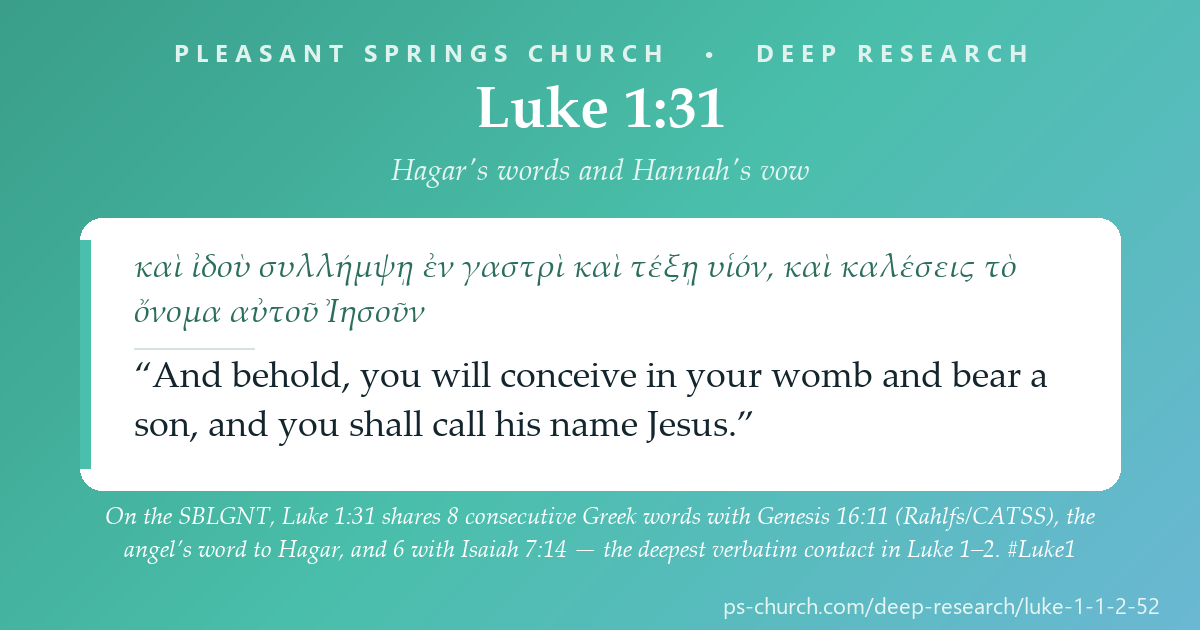
Every one of the 132 verses of Luke 1–2 was screened against all 30,348 screened verse units of the Greek Old Testament held here. The deepest verbatim contact in the two chapters is the angel’s word to Mary, “you will conceive in your womb and bear a son, and you shall call his name Jesus” — and its partner is not Isaiah 7:14. It is Genesis 16:11, the angel of the Lord to Hagar in the wilderness: eight consecutive Greek words, tie band one, against six with Isaiah. Then the second half of the surprise. The Magnificat is read beside Hannah’s song by most who comment on it, and verse by verse it shares at most two consecutive words with that song. Its five-word contact with Hannah is in her vow, before Samuel was conceived: “if you will indeed look on the affliction of your servant”. The page follows the two chapters from the prologue to the boy in the temple; prints the Odes trap that would make Luke “quote” itself; prints its counter-examples beside its findings — Simeon’s eyes stand nearer Jonathan tasting honey than Isaiah’s salvation, and John’s turning of hearts nearer the fathers’ iniquity in Exodus 34 than Malachi; and never says who borrowed from whom. See the method →
Luke 1:1–2:52
Greek NT · ESV or our renderingVersification. Luke 1–2 has no offset of its own: the SBLGNT and the ESV both count 80 verses in chapter 1 and 52 in chapter 2, verse for verse. There is no Septuagint column, because Luke is a New Testament book. The offsets are in the Old Testament texts measured, each checked against the Masoretic and CATSS files held here. Malachi has three chapters in Hebrew and Greek and four in English: the Elijah verse is ESV 4:5 = Hebrew 3:23 = Greek 3:22, and the turning of hearts is ESV 4:6 = Hebrew 3:24 = Greek 3:23, because the Greek moves the line about the law of Moses (ESV 4:4) to the end, Greek 3:24. Isaiah 9 runs one behind in Hebrew and Greek: Isaiah 9:1 (Hebrew, Greek) = ESV 9:2, 9:5 = ESV 9:6, 9:6 = ESV 9:7. The Psalms run one behind in Greek for the psalms on this page: Greek 40:14 = ESV 41:13 (Hebrew 41:14); Greek 71:18 = Psalm 72:18; Greek 105:48 = Psalm 106:48; Greek 106:9–10 = Psalm 107:9–10; Greek 102:1 = Psalm 103:1; Greek 103:1 = Psalm 104:1; Greek 145:1 = Psalm 146:1; Greek 17:3 = ESV 18:2 (Hebrew 18:3); Greek 90:4 = Psalm 91:4; Greek 139:8 = ESV 140:7 (Hebrew 140:8). 1 Samuel = Greek 1 Kingdoms, 2 Samuel = 2 Kingdoms, 1 Kings = 3 Kingdoms, 2 Kings = 4 Kingdoms, the same verse numbers in each case here. Micah 5:1 (Hebrew and Greek) = ESV 5:2. Jeremiah 9:22–23 (Hebrew and Greek) = ESV 9:23–24. Jeremiah 51:29 in the Greek = Hebrew and ESV 44:29, matched here by content for this one verse; Greek Jeremiah’s order is not derived on this page. Daniel is measured in both Greek columns, Old Greek and Theodotion, named on every line; Daniel 7:14, 8:16 and 9:21 carry the same numbers in Hebrew, Aramaic, Greek and English. Genesis 16, 18, 25, Exodus 13 and 40, Leviticus 5 and 12, Judges 13 and Isaiah 7, 40, 42, 49, 52 and 60 have no offset. Judges is measured in both CATSS columns, A and B; Tobit in S; Sirach, Judith, Tobit and the Psalms of Solomon are Greek only and are witnesses, not Scripture.
The Shape of the Passage
A parallel sequence — two annunciations, two births, two growth notices — NOT a chiasmTwo chapters, 132 verses, 2,035 Greek words. A preface in the manner of a Greek historian, then a narrative whose Greek carries the counted Septuagintal markers at a higher rate than the rest of the Gospel.
Author
Tradition from Irenaeus onward names Luke, Paul’s companion.
Luke also, the companion of Paul, recorded in a book the Gospel preached by him.Irenaeus, Against Heresies 3.1.1 (ANF 1)
This page cannot test that from the text and does not try; the shelf’s Luke 3 study states the same position.
What the text does show is a writer who changes register. The prologue (1:1–4) is one periodic sentence with κράτιστος and the vocabulary of inquiry. From 1:5 the Greek turns: the measured marker καὶ ἐγένετο stands in Luke 1–2 at more than twice its rate in Luke 3–24, and ἰδοὺ at nearly twice (Stage 4). The writer can do both; the page reports which he does where.
Audience
Theophilus, and readers like him. περὶ ὧν κατηχήθης λόγων: he had already been taught. The preface promises him an account he can rely on, and Acts 1:1 addresses him again. Who he was is not known; the honorific suggests rank, and the page reports that and no more.
Readers who knew the Greek Scriptures by ear. The deepest contacts in these chapters are not quotations with formulas (there are two, 2:23 and 2:24, and each measures two words against the law it names) but phrases that sound like Genesis, Judges and Samuel: the annunciation to Hagar, the births of Rebekah’s twins, Hannah’s vow. Such readers would hear the old stories under the new one without being told where to look.
Orient on the priestly divisions, Gabriel, the virgin birth, the census under Quirinius, Bethlehem and the inn, shepherds, purification and redemption of the firstborn, Simeon and Anna, and Passover pilgrimage.
Search by reference and by topic: Theophilus, prologue, Abijah, incense, Gabriel, annunciation, virgin birth, Magnificat, Benedictus, census, Quirinius, Bethlehem, manger, inn, shepherds, Gloria, circumcision, purification, firstborn, Nunc Dimittis, Anna, Passover.
Which articles are relevant?
- Dictionary of Jesus and the Gospels (IVP, 2nd ed. 2013) — “Birth of Jesus,” “Luke, Gospel of,” “Mary,” “Angels,” “Temple,” “Census.”
- Anchor Bible Dictionary — “Quirinius,” “Gabriel,” “Magnificat,” “Benedictus,” “Nunc Dimittis,” “Virgin Birth,” “Theophilus.”
- Dictionary of New Testament Background (IVP) — “Census,” “Priests and Levites,” “Temple,” “Purity.”
- NIDNTTE — παρθένος, χαριτόω, ἐπισκιάζω, ταπείνωσις, σωτήρ, εὐδοκία, πρωτότοκος, λύτρωσις.
Bibliography surfaced:
- Commentaries on Luke: Darrell L. Bock, Luke 1:1–9:50 (BECNT); Joseph A. Fitzmyer, The Gospel According to Luke I–IX (AB 28); I. Howard Marshall (NIGTC); Joel B. Green (NICNT); John Nolland, Luke 1–9:20 (WBC 35A).
- On the infancy narratives: Raymond E. Brown, The Birth of the Messiah (1977, updated 1993).
- On the use of the Old Testament: David W. Pao and Eckhard J. Schnabel, “Luke,” in Beale and Carson, Commentary on the New Testament Use of the Old Testament (2007).
- On the census: Emil Schürer, The History of the Jewish People in the Age of Jesus Christ, rev. Vermes, Millar and Black, vol. 1.
The works above are named as places to look. None was re-read for this page, and no number on it comes from them. Stage 5 says so again.
What the world of the text supplies: priests on rotation, a Roman registration, a cave near Bethlehem in the second century, and hymns that the church later gathered into its Greek psalter.
The priest on duty (1:5–10)
ἐξ ἐφημερίας Ἀβιά: the division of Abijah is the eighth of the twenty-four priestly courses, τῷ Αβια ὁ ὄγδοος (1 Chronicles 24:10). Each course served in the temple in turn, and within it the lot chose who would burn the incense (1:9). That one priest might do this once in a lifetime is a statement drawn from the Mishnah (Tamid 5) in the literature; the Mishnah is not held on this disk, and the statement is reported, not checked.
The census under Quirinius (2:1–2)
αὕτη ἀπογραφὴ πρώτη ἐγένετο ἡγεμονεύοντος τῆς Συρίας Κυρηνίου. Josephus is reported to date a census by Quirinius, governor of Syria, to AD 6, after Archelaus was removed; Luke dates the annunciations to Herod’s reign (1:5), and Matthew 2:1 the birth, a reign that ended before that. The proposed resolutions — an earlier registration, an earlier term for Quirinius, or reading πρώτη as before — are reported in the literature. Josephus is not held on this disk; none of the positions is checked here, and the page does not choose among them.
A cave near the village (2:7)
But when the Child was born in Bethlehem, since Joseph could not find a lodging in that village, he took up his quarters in a certain cave near the village; and while they were there Mary brought forth the Christ and placed Him in a manger, and here the Magi who came from Arabia found Him.Justin Martyr, Dialogue with Trypho 78 (ANF 1)
Justin, writing in the mid-second century, is the earliest witness held here for the cave. Luke says only ἐν φάτνῃ and that there was no place ἐν τῷ καταλύματι. Whether the katalyma was an inn, a guest room or a family house’s upper room is a debate the page reports without settling (Stage 3).
The canticles in the Odes
The Greek Old Testament as CATSS holds it carries a fourteen-song appendix, the Odes. Three of them are Luke: Ode 9 is the Magnificat and the Benedictus (the Benedictus headed, in the copy held here, προσευχὴ Ζαχαριου), Ode 13 is the Nunc Dimittis, and Ode 14 opens with the angels’ song of 2:14. Ode 3 is Hannah’s song again. The Odes are a Christian liturgical collection bound with the Septuagint in codices of the fifth century and later (reported); they are not an older source for Luke, and a screen that includes them finds Luke against itself. That is why this shelf screens 30,348 units, not the 30,637 it holds. Stage 4 prints what happens when the Odes are let back in.
Moreover, Mary said, My soul doth magnify the Lord, and my spirit hath rejoiced in God my salvation;Irenaeus, Against Heresies 4.7.1 (ANF 1)
By Irenaeus’ day Mary’s song was already being quoted as hers.
Eight words. Where a count is given it is a lemma count from the MorphGNT columns, re-checked by unanchored search.
Twice in 1:27 and nowhere else in Luke as the noun (1:27, both tokens). Luke 1:34 puts the same claim in Mary’s mouth without the word: ἄνδρα οὐ γινώσκω. Luke 1 does not cite Isaiah 7:14; Matthew 1:23 does. Stage 4 sets the two side by side, and Stage 5 reports the Hebrew הָעַלְמָה.
A perfect passive participle of χαριτόω; the verb stands twice in the Greek New Testament (Lk 1:28, Eph 1:6, with which he graced us). The Latin gratia plena (full of grace) is one rendering of it; the ESV has O favored one. Stage 5 on what has been built on the word.
In Luke here and at the transfiguration (1:35, 9:34). In the screened Greek Old Testament a form of the verb stands in 4 units, searched unanchored with the augment: Exodus 40:35, the cloud on the tent of meeting, and three of shelter (Psalm 90:4 and 139:8 LXX, Proverbs 18:11). At Exodus 40:35 the Greek ἐπεσκίαζεν ἐπ' αὐτὴν ἡ νεφέλη renders the Hebrew כִּי־שָׁכַן עָלָיו הֶעָנָן, the cloud settled on it.
The noun God sees or hears in the Greek Old Testament, among other places in three women’s stories: Hagar (Genesis 16:11, τῇ ταπεινώσει σου), Leah (29:32) and Hannah (1 Kingdoms 1:11). The Hebrew in each is a form of the noun ‘oni, affliction (Genesis 16:11: אֶל־עׇנְיֵךְ). The ESV has humble estate here and affliction for Hannah.
In Luke only here and in Mary’s τῷ σωτῆρί μου (1:47, 2:11): the title is given first to God, then to the child. In the same verse χριστὸς κύριος stands as two nouns side by side; in the screened Greek Old Testament the nominative χριστὸς κυρίου, the Lord’s anointed, stands in 4 units, and the two nominatives in none.
Three tokens in the New Testament (Mk 14:14, Lk 2:7, Lk 22:11): here, and the guest room where the Passover is eaten in Mark 14:14 and Luke 22:11. Luke 10:34 has a different word for an inn, πανδοχεῖον. The readings of 2:7 turn on this pair.
Eight times in the New Testament, once in the Gospels (Lk 2:7, Ro 8:29, Col 1:15, Col 1:18, Heb 1:6, Heb 11:28, Heb 12:23, Re 1:5). The law quoted at 2:23 is the law of the one who διανοῖγον μήτραν. Stage 5 sets out the readings.
Genitive in the SBLGNT, Westcott-Hort, Tregelles and NA28; nominative in Robinson-Pierpont (Stage 4). The genitive reads people of his good pleasure, the nominative good will among people.
ὕψιστος stands 4 times in Luke 1–2 (1:32, 1:35, 1:76, 2:14) — the Son of the Most High, the power of the Most High, the prophet of the Most High, glory in the highest — four of Luke’s seven verses with the word.
The two chapters against the whole Greek Old Testament; the canticles against what they are said to echo; the trap in the Odes; and the counter-examples.
The screen. Each of the 132 verses of Luke 1–2 (SBLGNT) was compared with each of the 30,348 screened verse units of the Greek Old Testament — the 64 CATSS files less the Odes — for the longest run of consecutive identical word forms (accents, breathings and case dropped; the shelf’s edition-equivalence table applied on both sides). The tie band is how many units reach that same length. A row that shares no two consecutive forms still scores 1 if any single word matches, so a 0 on this page means no word form in common at all. The screen hears verbatim contact only. It cannot hear an allusion, and it cannot say who borrowed.
★ The deepest verse in Luke 1–2 is spoken to Mary, and its partner is Hagar
“And behold, you will conceive in your womb and bear a son, and you shall call his name Jesus.”
καὶ εἶπεν αὐτῇ ὁ ἄγγελος κυρίου ἰδοὺ σὺ ἐν γαστρὶ ἔχεις καὶ τέξῃ υἱὸν καὶ καλέσεις τὸ ὄνομα αὐτοῦ Ισμαηλ ὅτι ἐπήκουσεν κύριος τῇ ταπεινώσει σου
“And the angel of the Lord said to her, ‘Behold, you are pregnant and shall bear a son. You shall call his name Ishmael, because the Lord has listened to your affliction.”
The run is the eight words καὶ τέξῃ υἱόν, καὶ καλέσεις τὸ ὄνομα αὐτοῦ — in Genesis καὶ τέξῃ υἱὸν καὶ καλέσεις τὸ ὄνομα αὐτοῦ — and no other screened unit reaches eight with this verse (tie band 1). Against Isaiah 7:14 LXX the same verse scores 6:
διὰ τοῦτο δώσει κύριος αὐτὸς ὑμῖν σημεῖον ἰδοὺ ἡ παρθένος ἐν γαστρὶ ἕξει καὶ τέξεται υἱόν καὶ καλέσεις τὸ ὄνομα αὐτοῦ Εμμανουηλ
Isaiah’s run, υἱόν καὶ καλέσεις τὸ ὄνομα αὐτοῦ, begins after the verb. Where Isaiah has ἐν γαστρὶ ἕξει ... τέξεται, she will have in the womb and she will bear, Luke has συλλήμψῃ ἐν γαστρὶ ... τέξῃ, you will conceive and you will bear, and so does Genesis 16:11, τέξῃ. The three words καὶ τέξῃ υἱόν stand in 6 screened units — Genesis 16:11 and five in Judges 13 (13:3, 13:5 and 13:7, counted once in each of the A and B columns where they have it; B lacks it at 13:3), the annunciation to Manoah’s wife — and Isaiah is not among them; τέξεται followed by υἱόν stands in 1, Isaiah 7:14 itself (Genesis 17:19 has τέξεταί σοι υἱόν, with a word between). The naming clause καὶ καλέσεις τὸ ὄνομα αὐτοῦ stands in 3 units: Genesis 16:11 and 17:19, and Isaiah 7:14.
Matthew stands the other way. Matthew 1:23 against Isaiah 7:14 LXX: 10 words, beginning with Ἰδοὺ ἡ παρθένος. Matthew 1:21 against Luke 1:31: 7 (υἱὸν καὶ καλέσεις τὸ ὄνομα αὐτοῦ Ἰησοῦν, tie band 1 across the New Testament outside Luke, and the deepest contact any verse of Luke 1–2 makes there). The two Gospels share the naming; where Matthew cites Isaiah’s virgin with a formula, Luke’s wording stands nearest Hagar’s angel, and the word virgin is in Luke’s narrative (1:27), not in the angel’s sentence.
What this does and does not show. It shows which Greek sentence Luke 1:31’s words stand nearest. It does not show that Luke is pointing to Hagar, or away from Isaiah: three annunciations of a son (Hagar, Manoah’s wife, Mary) share a form because the form is the form of an annunciation. Genesis 16:11 also has the word of 1:48, τῇ ταπεινώσει σου, your affliction — an observation, printed as one.
The Magnificat and Hannah’s song: at most two words
“And Hannah prayed and said, ‘My heart exults in the Lord; my horn is exalted in the Lord. My mouth derides my enemies, because I rejoice in your salvation.” “And Mary said, ‘My soul magnifies the Lord,” “and my spirit rejoices in God my Savior,”
Each verse of the Magnificat was run against each verse of Hannah’s song, 1 Kingdoms 2:1–10 LXX, and, separately, against every screened unit:
| Magnificat | best run with Hannah’s song (1 Kgdms 2:1–10) | best run with any screened unit | with the Odes held |
|---|---|---|---|
| 1:46 | 2 (2:1) | 5, band 6 | 6 (Ode 9:46) |
| 1:47 | 1 | 6, band 2 | 11 (Ode 9:47) |
| 1:48 | 1 | 5, band 1 | 18 (Ode 9:48) |
| 1:49 | 2 (2:10) | 3, band 122 | 7 (Ode 9:49) |
| 1:50 | 1 | 4, band 3 | 5 (Ode 9:50) |
| 1:51 | 1 | 3, band 2 | 10 (Ode 9:51) |
| 1:52 | 1 | 2, band 12 | 7 (Ode 9:52) |
| 1:53 | 1 | 2, band 10 | 7 (Ode 9:53) |
| 1:54 | 1 | 2, band 3 | 6 (Ode 9:54) |
| 1:55 | 1 | 4, band 23 | 12 (Ode 9:55) |
The deepest run of the Magnificat with Hannah’s song is two words. Every two-word sequence the two songs share was listed, and there are 3. One is the speech formula and she said (1:46 with 2:1). The other two are τὸν κύριον (1:46) and ὁ δυνατός (1:49) — and in 1 Kingdoms 2:10 both stand inside a long passage that the Hebrew of 1 Samuel 2:10 does not have: μὴ καυχάσθω ὁ φρόνιμος ἐν τῇ φρονήσει αὐτοῦ καὶ μὴ καυχάσθω ὁ δυνατὸς ἐν τῇ δυνάμει αὐτοῦ καὶ μὴ καυχάσθω ὁ πλούσιος ἐν τῷ πλούτῳ αὐτοῦ ἀλλ' ἢ ἐν τούτῳ καυχάσθω ὁ καυχώμενος συνίειν καὶ γινώσκειν τὸν κύριον let not the prudent boast in his prudence, and let not the mighty boast in his might, and let not the rich boast in his riches; but let the one who boasts boast in this, to understand and to know the Lord (our rendering). The Greek verse runs to 75 words; the Hebrew to 14, counted as written; the plus shares runs of ten words with Jeremiah 9:22 and with 9:23 LXX (ESV 9:23–24). So both of the song’s content contacts with Hannah’s fall in the Greek’s plus, and one of them names the opposite of Mary’s Mighty One: in 1 Kingdoms 2:10 ὁ δυνατὸς is the man who must not boast. Ode 3, the second copy of Hannah’s song in the Odes (held, not screened), gives the same maximum, 2. The ESV, which translates the Hebrew, has no boasting in the verse: “The adversaries of the Lord shall be broken to pieces; against them he will thunder in heaven. The Lord will judge the ends of the earth; he will give strength to his king and exalt the horn of his anointed.”
In every verse, the Magnificat’s best partner is somewhere other than Hannah’s song. Psalms 102 and 103 LXX for 1:46 (their opening lines, with Psalm 145:1, have its last five words); Habakkuk 3:18 and Micah 7:7 for 1:47 (six); Psalm 106:9 LXX for 1:53 (ἐνέπλησεν ἀγαθῶν). At Habakkuk 3:18 the Greek has ἐπὶ τῷ θεῷ τῷ σωτῆρί μου, in God my Savior, where the Hebrew has בֵּאלֹהֵי יִשְׁעִי, in the God of my salvation: “yet I will rejoice in the Lord; I will take joy in the God of my salvation.” And for 1:48 the five-word partner is Hannah after all — but in chapter 1, her vow: ἐπιβλέπων ἐπιβλέψῃς ἐπὶ τὴν ταπείνωσιν τῆς δούλης σου. “And she vowed a vow and said, ‘O Lord of hosts, if you will indeed look on the affliction of your servant and remember me and not forget your servant, but will give to your servant a son, then I will give him to the Lord all the days of his life, and no razor shall touch his head.’” The Hebrew behind it is אִם־רָאֹה תִרְאֶה בׇּעֳנִי אֲמָתֶךָ. The five words ἐπὶ τὴν ταπείνωσιν τῆς δούλης stand in one screened unit, and a search for a word in tapein- (augment allowed) with a word in doul- in the same unit finds 5: 1 Kingdoms 1:11, Genesis 15:13, Judith 5:11, Lamentations 1:3 and Leviticus 25:39; only 1 Kingdoms 1:11 has the two nouns, ταπείνωσιν and δούλης.
What the song shares with Hannah’s is words. The six stems of the reversal — pein- (hungry), tapein- (low), hyps- (exalt), plout- (rich), dynast- (mighty), thron- (throne) — are all in Luke 1:52–53 and all in 1 Kingdoms 2:5–8: “The Lord makes poor and makes rich; he brings low and he exalts.” “he has brought down the mighty from their thrones and exalted those of humble estate;” “he has filled the hungry with good things, and the rich he has sent away empty.” Searched unanchored, one screened unit has three or more of the six, 1 Kingdoms 2:7; in the New Testament one verse does, Luke 1:52. But no two of them stand side by side in the same order in both songs. The vocabulary of the reversal is Hannah’s; the sentences are not. The page reports both and does not weigh one above the other.
The list of six stems is ours; a different list could give a different count. Ode 3 is held and gives the same result as 1 Kingdoms 2.
⚠️ The Odes trap: Luke against itself
Let the Odes back into the screen — 30,637 units instead of 30,348 — and 26 rows of Luke 1–2 jump, every one of them to an Ode: the ten verses of the Magnificat and eleven of the Benedictus to Ode 9, the four verses of the Nunc Dimittis to Ode 13, and 2:14 to Ode 14. Luke 1:48 would “share” 18 words with the Greek Old Testament and 1:79 16. The remaining verse of the Benedictus, 1:74, keeps its depth and gains Ode 9:74 in its band. Every Ode partner is Luke’s own text in the church’s later psalter. Every figure on this page is from the screened units, with all the Odes excluded (Odes 3, 9, 13 and 14 among them), except where a figure is expressly marked “with the Odes held.”
| Benedictus | best run, screened | tie band | with the Odes held |
|---|---|---|---|
| 1:68 | 5 | 7 | 14 (Ode 9:68) |
| 1:69 | 2 | 192 | 6 (Ode 9:69) |
| 1:70 | 3 | 2 | 6 (Ode 9:70) |
| 1:71 | 5 | 3 | 11 (Ode 9:71) |
| 1:72 | 4 | 15 | 11 (Ode 9:72) |
| 1:73 | 4 | 1 | 8 (Ode 9:73) |
| 1:74 | 3 | 11 | unchanged; Ode 9:74 joins the band |
| 1:75 | 4 | 2 | 6 (Ode 9:75) |
| 1:76 | 3 | 3 | 9 (Ode 9:76) |
| 1:77 | 4 | 1 | 10 (Ode 9:77) |
| 1:78 | 3 | 2 | 7 (Ode 9:78) |
| 1:79 | 5 | 1 | 16 (Ode 9:79) |
The Benedictus: a blessing formula with one article more
“Blessed be the Lord God of Israel, for he has visited and redeemed his people”
εὐλογητὸς κύριος ὁ θεὸς Ισραηλ ἀπὸ τοῦ αἰῶνος καὶ εἰς τὸν αἰῶνα γένοιτο γένοιτο
“Blessed be the Lord, the God of Israel, from everlasting to everlasting! Amen and Amen.”
Three Psalm doxologies (Greek 40:14, 71:18, 105:48) close a book of the Psalter by blessing the Lord, the God of Israel, and each scores 4 against 1:68. The run stops at one word. Where a screened unit has εὐλογητὸς κύριος ὁ θεὸς Ισραηλ — 7 units: five blessings in Kingdoms and Chronicles (David to Abigail at 1 Kingdoms 25:32 among them) and Psalms 40:14 and 105:48 — there is no article before Israel; Luke has Εὐλογητὸς κύριος ὁ θεὸς τοῦ Ἰσραήλ. As six consecutive words they stand in no screened unit. Its first five, εὐλογητὸς κύριος ὁ θεὸς τοῦ, stand in 3 (Genesis 9:26 and 24:27 and the Old Greek of Daniel 3:95, each followed by another name); its last five, κύριος ὁ θεὸς τοῦ Ισραηλ, stand in 4 (Ezekiel 4:13 and 44:2, Malachi 2:16, 2 Maccabees 9:5): that is the band of seven at five. Tobit 13:18 (S) has εὐλογητὸς ὁ θεὸς τοῦ Ισραηλ, with the article and without Lord. Searched unanchored — a word beginning eulogēt-, a word beginning the- and Israel in one unit — there are 11 screened units, and all were read.
The rest of the Benedictus is shallow, verse by verse, with two rows at five: 1:71, a formula shared with three units (2 Kingdoms 3:18 and Judges 6:9 in both columns), and 1:79 against Psalm 106:10 LXX (ESV 107:10), ἐν σκότει καὶ σκιᾷ θανάτου, five words, tie band 1.
καθημένους ἐν σκότει καὶ σκιᾷ θανάτου πεπεδημένους ἐν πτωχείᾳ καὶ σιδήρῳ
“Some sat in darkness and in the shadow of death, prisoners in affliction and in irons,”
Isaiah 9:1 LXX (ESV 9:2), the verse Matthew 4:16 cites, scores 3: ὁ λαὸς ὁ πορευόμενος ἐν σκότει ἴδετε φῶς μέγα οἱ κατοικοῦντες ἐν χώρᾳ καὶ σκιᾷ θανάτου φῶς λάμψει ἐφ' ὑμᾶς “The people who walked in darkness have seen a great light; those who dwelt in a land of deep darkness, on them has light shone.” The phrase shadow of death, in this case, stands in 8 screened units (12 with any case of shadow); in darkness and the shadow of death in 1, the Psalm. 1:76 against Malachi 3:1 LXX: 1; against Isaiah 40:3 LXX: 1. 1:78 against Isaiah 60:1 LXX: 0 — no word form in common at all, and against 60:2 also 0 (1:79 against 60:2: 1); against Malachi 3:20 LXX (ESV 4:2), the rising sun of righteousness: 1. The prophets the commentaries hear in the Benedictus are heard in its ideas; the run screen hears a psalm.
1:17 and Malachi: one word — and Sirach in between
“and he will go before him in the spirit and power of Elijah, to turn the hearts of the fathers to the children, and the disobedient to the wisdom of the just, to make ready for the Lord a people prepared.”
ὃς ἀποκαταστήσει καρδίαν πατρὸς πρὸς υἱὸν καὶ καρδίαν ἀνθρώπου πρὸς τὸν πλησίον αὐτοῦ μὴ ἔλθω καὶ πατάξω τὴν γῆν ἄρδην
“And he will turn the hearts of fathers to their children and the hearts of children to their fathers, lest I come and strike the land with a decree of utter destruction.”
Luke 1:17 against Greek Malachi 3:23 (ESV 4:6): 1 word, and. The two verses share two word forms in all, καὶ and αὐτοῦ. Where Greek Malachi has ἀποκαταστήσει καρδίαν πατρὸς πρὸς υἱὸν — will restore the heart of father to son, singular — Luke has ἐπιστρέψαι καρδίας πατέρων ἐπὶ τέκνα, to turn the hearts of fathers to children, plural. The Hebrew of Malachi 3:24 has the fathers and sons in the plural: וְהֵשִׁיב לֵב־אָבוֹת עַל־בָּנִים, the heart of fathers upon sons. The second clause differs too: Greek Malachi has καρδίαν ἀνθρώπου πρὸς τὸν πλησίον αὐτοῦ, the heart of a man to his neighbour, where the Hebrew has וְלֵב בָּנִים עַל־אֲבוֹתָם and the ESV the hearts of children to their fathers.
Ben Sira’s Greek stands between them. Sirach 48:10, on Elijah: ὁ καταγραφεὶς ἐν ἐλεγμοῖς εἰς καιροὺς κοπάσαι ὀργὴν πρὸ θυμοῦ ἐπιστρέψαι καρδίαν πατρὸς πρὸς υἱὸν καὶ καταστῆσαι φυλὰς Ιακωβ. Against Malachi 3:23 LXX it runs 5 (καρδίαν πατρὸς πρὸς υἱὸν καὶ), tie band 1 — the figure the shelf’s Mark 9 study reports, re-measured here. Against Luke 1:17 it runs 1. Sirach has Luke’s verb, ἐπιστρέψαι, where Malachi has restore; Malachi has Sirach’s singular nouns. Luke has the verb of the one and the plural of the Hebrew. The page reports where the words stand.
The counter-example. Luke 1:17’s deepest run is not with Malachi at all. It is πατέρων ἐπὶ τέκνα καὶ, four words with Exodus 34:7 (run 4, tie band 1): ἐπάγων ἀνομίας πατέρων ἐπὶ τέκνα, bringing the iniquities of fathers upon children. “keeping steadfast love for thousands, forgiving iniquity and transgression and sin, but who will by no means clear the guilty, visiting the iniquity of the fathers on the children and the children’s children, to the third and the fourth generation.” The three words πατέρων ἐπὶ τέκνα stand in 4 screened units — Exodus 20:5 and 34:7, Numbers 14:18, Deuteronomy 5:9 — and in every one of them it is iniquity that comes down. Where those verses bring sin down from fathers upon children, Luke 1:17 has hearts turned.
The throne of David, the overshadowing, and nothing impossible
“He will be great and will be called the Son of the Most High. And the Lord God will give to him the throne of his father David,” “and he will reign over the house of Jacob forever, and of his kingdom there will be no end.”
Isaiah 9:6 LXX (ESV 9:7) has ἐπὶ τὸν θρόνον Δαυιδ καὶ τὴν βασιλείαν αὐτοῦ; the run with 1:32 is 3, with 1:33 2. “Of the increase of his government and of peace there will be no end, on the throne of David and over his kingdom, to establish it and to uphold it with justice and with righteousness from this time forth and forevermore. The zeal of the Lord of hosts will do this.” Where the ESV has no end, the Greek of Isaiah 9:6 has οὐκ ἔστιν ὅριον, no boundary. The promise to David in 2 Kingdoms 7:12–16 scores at most 2 (καὶ ἀνορθώσω τὸν θρόνον αὐτοῦ ἕως εἰς τὸν αἰῶνα, and I will set his throne upright for ever (our rendering)). Daniel 7:14 scores 1 in the Old Greek and 2 in Theodotion. The deepest run of 1:32 is with Solomon: ἐπὶ τὸν θρόνον Δαυιδ τοῦ πατρός μου (3 Kingdoms, ESV 1 Kings 2:24; run 5). The throne of David as three consecutive words stands in 4 screened units: 3 Kingdoms 2:24, 2 Kingdoms 3:10, Isaiah 9:6 and the Psalms of Solomon 17:6. With any case of throne followed by David the count is 12, five of the eight more in Jeremiah.
“And the angel answered her, ‘The Holy Spirit will come upon you, and the power of the Most High will overshadow you; therefore the child to be born will be called holy—the Son of God.” “And Moses was not able to enter the tent of meeting because the cloud settled on it, and the glory of the Lord filled the tabernacle.” The run is 1; the shared thing is one verb, and it is shared with only 4 units (Stage 3).
“For nothing will be impossible with God.” “Is anything too hard for the Lord? At the appointed time I will return to you, about this time next year, and Sarah shall have a son.”
μὴ ἀδυνατεῖ παρὰ τῷ θεῷ ῥῆμα εἰς τὸν καιρὸν τοῦτον ἀναστρέψω πρὸς σὲ εἰς ὥρας καὶ ἔσται τῇ Σαρρα υἱός
Where Genesis 18:14 LXX has μὴ ἀδυνατεῖ παρὰ τῷ θεῷ ῥῆμα, Luke has οὐκ ἀδυνατήσει παρὰ τοῦ θεοῦ πᾶν ῥῆμα. The SBLGNT text scores 1. The apparatus records τοῦ θεοῦ WH Treg NA28 ] τῷ θεῷ RP; with Robinson-Pierpont’s dative the run is 3, παρὰ τῷ θεῷ, in a tie band of 3. The printed edition moves Luke nearer Genesis or away from it by one case ending. Where Greek Genesis has τῷ θεῷ, the Hebrew has הֲיִפָּלֵא מֵיְהֹוָה דָּבָר, is a thing too wondrous for YHWH?, with the divine name.
The purification: the law of the poor, and a spelling
“And when the time came for their purification according to the Law of Moses, they brought him up to Jerusalem to present him to the Lord” “(as it is written in the Law of the Lord, ‘Every male who first opens the womb shall be called holy to the Lord’)” “and to offer a sacrifice according to what is said in the Law of the Lord, ‘a pair of turtledoves, or two young pigeons.’”
2:23. ἁγίασόν μοι πᾶν πρωτότοκον πρωτογενὲς διανοῖγον πᾶσαν μήτραν (Exodus 13:2 LXX) scores 1; πᾶν διανοῖγον μήτραν τὰ ἀρσενικά τῷ κυρίῳ (13:12) scores 2. “‘Consecrate to me all the firstborn. Whatever is the first to open the womb among the people of Israel, both of man and of beast, is mine.’” “you shall set apart to the Lord all that first opens the womb. All the firstborn of your animals that are males shall be the Lord’s.” The phrase ἅγιον τῷ κυρίῳ stands in 6 screened units, none of them in Exodus 13. The two quotations in these chapters that carry a formula, 2:23 and 2:24, measure two words each against the law they name.
2:24. “And if she cannot afford a lamb, then she shall take two turtledoves or two pigeons, one for a burnt offering and the other for a sin offering. And the priest shall make atonement for her, and she shall be clean.”
ἐὰν δὲ μὴ εὑρίσκῃ ἡ χεὶρ αὐτῆς τὸ ἱκανὸν εἰς ἀμνόν καὶ λήμψεται δύο τρυγόνας ἢ δύο νεοσσοὺς περιστερῶν μίαν εἰς ὁλοκαύτωμα καὶ μίαν περὶ ἁμαρτίας καὶ ἐξιλάσεται περὶ αὐτῆς ὁ ἱερεύς καὶ καθαρισθήσεται
Where Leviticus 12:8 has δύο τρυγόνας ἢ δύο νεοσσοὺς περιστερῶν, Luke has ζεῦγος τρυγόνων ἢ δύο νοσσοὺς περιστερῶν. Run with 12:8: 2. Run with Leviticus 5:11: 4, because Leviticus 5:11 has ζεῦγος τρυγόνων ἢ δύο νεοσσοὺς περιστερῶν, and ζεῦγος τρυγόνων stands in one screened unit, Leviticus 5:11. “But if he cannot afford two turtledoves or two pigeons, then he shall bring as his offering for the sin that he has committed a tenth of an ephah of fine flour for a sin offering. He shall put no oil on it and shall put no frankincense on it, for it is a sin offering.” And the run stops at a spelling: Luke’s νοσσοὺς is the form the Greek Old Testament spells νεοσσοὺς (7 screened units have two young pigeons so spelled; none has Luke’s spelling of the phrase). Respell that one word and 2:24 runs 6 with Leviticus 5:11 (tie band 1) and 4 with 12:8. The verbatim partner is the poor sinner’s offering in Leviticus 5; the law Luke means is the mother’s in Leviticus 12, which the narrative names (2:22). The run follows the wording, not the law. What Leviticus 12 prescribes is in Stage 5.
Simeon’s salvation, and Jonathan’s honey
“for my eyes have seen your salvation” “that you have prepared in the presence of all peoples,” “a light for revelation to the Gentiles, and for glory to your people Israel.”
Against the Isaiah texts the commentaries cite: 2:30 / Isaiah 40:5 LXX, 2; 2:30 / 52:10, 0 (no word form in common); 2:31 / 52:10, 2; 2:32 / 42:6, 1; 2:32 / 49:6, 1. “he says: ‘It is too light a thing that you should be my servant to raise up the tribes of Jacob and to bring back the preserved of Israel; I will make you as a light for the nations, that my salvation may reach to the end of the earth.’” A light for the nations — εἰς φῶς ἐθνῶν — stands in 3 screened units (Isaiah 42:6, 49:6, 51:4) and, in the New Testament, at Acts 13:47, where Paul cites it; Simeon’s φῶς εἰς ἀποκάλυψιν ἐθνῶν has the nouns with two words between.
The counter-example. The deepest run of 2:30 is ὅτι εἶδον οἱ ὀφθαλμοί μου, five words, tie band 1, with ἰδὲ δὴ ὅτι εἶδον οἱ ὀφθαλμοί μου ὅτι ἐγευσάμην βραχὺ τοῦ μέλιτος τούτου (1 Kingdoms 14:29). “Then Jonathan said, ‘My father has troubled the land. See how my eyes have become bright because I tasted a little of this honey.” Jonathan, having tasted honey against his father’s oath. And the contact exists only in the Greek: the Hebrew has כִּי־אֹרוּ עֵינַי, my eyes brightened. A tie band of one and a length of five, and no meaning at all. It is printed so that the other fives on this page are not read as more than they are.
Gabriel and the hour of the offering (1:5–25 and Daniel 9:21)
“while I was speaking in prayer, the man Gabriel, whom I had seen in the vision at the first, came to me in swift flight at the time of the evening sacrifice.”
καὶ ἔτι λαλοῦντός μου ἐν τῇ προσευχῇ μου καὶ ἰδοὺ ὁ ἀνήρ ὃν εἶδον ἐν τῷ ὕπνῳ μου τὴν ἀρχήν Γαβριηλ τάχει φερόμενος προσήγγισέ μοι ἐν ὥρᾳ θυσίας ἑσπερινῆς (Old Greek)
καὶ ἔτι ἐμοῦ λαλοῦντος ἐν τῇ προσευχῇ καὶ ἰδοὺ ὁ ἀνὴρ Γαβριηλ ὃν εἶδον ἐν τῇ ὁράσει ἐν τῇ ἀρχῇ πετόμενος καὶ ἥψατό μου ὡσεὶ ὥραν θυσίας ἑσπερινῆς (Theodotion)
Luke 1:10, 1:19 and 1:26, each against Daniel 9:21 in each Greek column: 1 every time. No two consecutive word forms are shared. What is shared is a name and an hour. Gabriel is named in four screened units (Daniel 8:16 and 9:21, both columns) and two Hebrew verses (the same two), and in the New Testament at Luke 1:19 and 1:26. Searched unanchored, a form of the noun ὥραν and a word beginning thysi- (sacrifice, altar) or thymiam- (incense) stand together in 2 screened units, and both are Daniel 9:21, in its two Greek columns. Luke has τῇ ὥρᾳ τοῦ θυμιάματος, the hour of the incense; Daniel ἐν ὥρᾳ θυσίας ἑσπερινῆς (Old Greek) and ὡσεὶ ὥραν θυσίας ἑσπερινῆς (Theodotion), and the Hebrew כְּעֵת מִנְחַת־עָרֶב, the time of the evening offering. An observation, not a citation; the measurement hears no sentence.
2:14 and its variant
“‘Glory to God in the highest, and on earth peace among those with whom he is pleased!’”
The SBLGNT apparatus is held for Luke (Faithlife/SBLGNT, CC BY 4.0). Its entry: εὐδοκίας WH Treg NA28 ] εὐδοκία RP — the genitive in Westcott-Hort, Tregelles and NA28, the nominative in Robinson-Pierpont. The apparatus compares printed editions, not manuscripts, and no manuscript was consulted for this page. Either reading scores the same against the screened units: run 3, tie band 2, and Δόξα ἐν ὑψίστοις stands in no screened unit (and in one other New Testament verse, Luke 19:38). Held but not screened, Ode 14 begins with this verse and reads ἐν ἀνθρώποις εὐδοκία — the nominative. That is a witness to the reading in a later liturgical text; it is not evidence of what Luke wrote, and the page does not choose.
Septuagintal style: counted, with the rule stated
The rule. Over MorphGNT’s normalised word forms (CATSS forms for the Greek Old Testament), count the adjacent pair kai egeneto, the adjacent pair egeneto de, and the token idou, and divide by the number of word tokens. Nothing else is counted; a verse with two counts twice.
| text | Greek words | kai egeneto | per 1,000 | egeneto de | per 1,000 | idou | per 1,000 |
|---|---|---|---|---|---|---|---|
| Luke 1-2 | 2,035 | 6 | 2.95 | 3 | 1.47 | 10 | 4.91 |
| Luke 3-24 | 17,411 | 23 | 1.32 | 14 | 0.80 | 47 | 2.70 |
| NT outside Luke | 118,108 | 31 | 0.26 | 20 | 0.17 | 143 | 1.21 |
| screened LXX | 619,498 | 619 | 1.00 | 60 | 0.10 | 1175 | 1.90 |
Luke 1–2 has kai egeneto at more than twice the rate of Luke 3–24, and more than twice the rate of the screened Greek Old Testament taken whole; idou at nearly twice Luke 3–24’s rate. The six kai egeneto verses are 1:23, 1:41, 1:59, 1:65, 2:15 and 2:46; the ten idou verses are 1:20, 1:31, 1:36, 1:38, 1:44, 1:48, 2:10, 2:25, 2:34 and 2:48. The prologue has none of the three. These are counts of three markers, not a measure of style; a different rule would give different numbers.
The two chapters, in one table
| Luke (a selection of the 25 rows that reach five) | deepest run | tie band | partner | what it is |
|---|---|---|---|---|
| 1:31 | 8 | 1 | Genesis 16:11 | the angel to Hagar — not Isaiah 7:14 (6) |
| 1:47 | 6 | 2 | Habakkuk 3:18, Micah 7:7 | in God my Savior, in two prophets’ psalms |
| 1:59 | 6 | 7 | Judges 14, Kingdoms, Judith | formula: it came about on the day |
| 2:33 | 6 | 8 | Judges 14, Deuteronomy 21:19, Zechariah 13:3 | formula: his father and mother |
| 2:49 | 6 | 2 | 4 Kingdoms 1:5, 12:8 | formula: and he said to them, Why |
| 1:11 | 5 | 1 | Exodus 3:2 | the angel at the bush |
| 1:32 | 5 | 1 | 3 Kingdoms (ESV 1 Kings) 2:24 | Solomon on David’s throne |
| 1:48 | 5 | 1 | 1 Kingdoms 1:11 | Hannah’s vow |
| 1:79 | 5 | 1 | Psalm 106:10 LXX | darkness and the shadow of death |
| 2:6 | 5 | 1 | Genesis 25:24 | Rebekah’s full term |
| 1:26 | 5 | 1 | Genesis 8:14 | counter-example: a month in the flood |
| 1:38 | 5 | 1 | Bel 9 (Theodotion) | counter-example: Daniel to the king |
| 1:42 | 5 | 1 | Judith 14:7 | counter-example: Achior to Judith |
| 2:12 | 5 | 1 | Jeremiah 51:29 LXX | counter-example: a sign of judgment |
| 2:30 | 5 | 1 | 1 Kingdoms 14:29 | counter-example: Jonathan’s honey |
| 2:1 | 5 | 1 | Exodus 2:11 | formula: it came about in the days |
The distribution:
| deepest run, at least | 8 | 6 | 5 | 4 | 3 | 2 | 1 |
|---|---|---|---|---|---|---|---|
| rows of Luke 1–2 | 1 | 5 | 25 | 75 | 115 | 130 | 132 |
Exactly two of the 132 rows share no two consecutive word forms with any screened unit: 1:3, from the prologue, and 2:5. Against the 6,778 verses of the Greek New Testament outside Luke the deepest is 1:31 with Matthew 1:21 (7, tie band 1); then 1:70 with Acts 3:21 and 2:1 with Acts 9:37 (six each).
The readings with their holders, the church’s frame in its own words, and everything this page could not check.
None of the modern works named on this page was re-read for it. Positions are reported as the literature commonly summarises them; a reader who wants to rely on an attribution should check it in the book. Two ancient writers are quoted from files on this disk, in nineteenth-century English: Irenaeus and Justin (ANF 1). Every number on the page was measured on files on this disk and can be re-derived.
⚠️ Isaiah 7:14: the virgin, the young woman, and what the Greek says
“Therefore the Lord himself will give you a sign. Behold, the virgin shall conceive and bear a son, and shall call his name Immanuel.”
The Hebrew word is הָעַלְמָה; the Greek of Isaiah 7:14 is ἡ παρθένος. That difference is real and is disclosed here, not smoothed. The Hebrew noun stands in seven verses held here (the musical heading ‘al-‘alamot set aside); the Greek renders it parthenos twice:
| Hebrew verse with the noun | the Greek word there |
|---|---|
| Genesis 24:43 | parthenos |
| Exodus 2:8 | neanis |
| Isaiah 7:14 | parthenos |
| Psalm 68:25 (Hebrew 68:26, Greek 67:26) | neanides |
| Proverbs 30:19 | neotēs (youth) |
| Song of Songs 1:3 | neanides |
| Song of Songs 6:8 | neanides |
Two more differences bear on the claims above. The Hebrew וְקָרָאת is pointed as a form that can be read she will call (so the ESV) or you will call (reported); the Greek has καλέσεις, you will call, and so does Genesis 16:11, whose Hebrew has the same form, וְקָרָאת. Matthew 1:23 has καλέσουσιν, they will call. And where the Greek of Isaiah has ἐν γαστρὶ ἕξει, will have in the womb, Rahlfs’ text is the one held; other Greek witnesses are reported to read differently, and no apparatus for the Greek Old Testament is held to check it.
| reading of Isaiah 7:14 | reported holders | what the texts held here say |
|---|---|---|
| 1. A prophecy of the virgin birth. The sign is the Messiah’s birth of a virgin. | Matthew 1:23 (which cites it); Irenaeus, below; the great majority of the church’s history (reported) | The Greek has ἡ παρθένος; Matthew 1:23 runs 10 words with it. |
| 2. A sign for Ahaz, with a fuller fulfilment. A child born in Ahaz’s day, and the word fulfilled again, fully, in Jesus. | many evangelical commentators (reported) | Isaiah 7:16 ties the sign to Ahaz’s kings; Isaiah 9:6 LXX (ESV 9:7) carries the child to David’s throne. |
| 3. A young woman of Ahaz’s day only. | many modern critical scholars (reported); Theodotion and Aquila rendered young woman, as Irenaeus reports | The Hebrew has הָעַלְמָה. |
Behold, a young woman shall conceive, and bring forth a son, as Theodotion the Ephesian has interpreted, and Aquila of Pontus, both Jewish proselytes.Irenaeus, Against Heresies 3.21.1 (ANF 1)
The church’s frame, in its own words. What we believe has no article on the virgin birth. Its Article 2 says: “We believe Jesus Christ is the full revelation of God’s love, grace, and truth.” The church recites the Apostles’ Creed, which confesses him “conceived by the Holy Spirit, born of the Virgin Mary.” Luke 1:34–35 is the narrative of that confession, and it rests on Luke’s own words, παρθένον and ἄνδρα οὐ γινώσκω, not on the translation of one word in Isaiah.
Mary: kecharitōmenē, the firstborn, and the doctrines built on them
“And he came to her and said, ‘Greetings, O favored one, the Lord is with you!’” “And she gave birth to her firstborn son and wrapped him in swaddling cloths and laid him in a manger, because there was no place for them in the inn.”
1:28. The Latin gratia plena (full of grace) has been read as a state of sinlessness and, with other arguments, as support for Mary’s immaculate conception (Catholic teaching, defined 1854; reported). Others read the participle as God’s favour shown to her in the calling itself, as Ephesians 1:6 uses the verb of every believer (reported). The SBLGNT apparatus records that Tregelles and Robinson-Pierpont add Εὐλογημένη σὺ ἐν γυναιξίν to 1:28; with it, 1:28 and 1:42 share those 4 words. The church teaches ancestral sin as inherited mortality, not inherited guilt (the lesson on original sin), and this page imports no original-guilt framing and no immaculate-conception framing as the church’s; it reports both readings of the word.
2:7 and Mary’s later life.
| reading of 2:7 and of Mary’s later life | reported holders | what the text says |
|---|---|---|
| 1. Firstborn of several. Mary and Joseph had other children after Jesus; the brothers of 8:19–21 are his half-brothers. | Helvidius (4th c.); most Protestant interpreters (reported) | 2:7 πρωτότοκος; 8:19 names his mother and brothers. |
| 2. Firstborn as a legal title. The child who opens the womb is firstborn under the law whether or not others follow; Mary remained a virgin. | Jerome, against Helvidius; Catholic and Orthodox teaching; some Reformers (reported) | 2:23 quotes the law of the one who διανοῖγον μήτραν. |
The church has ratified nothing on Mary beyond the Creed’s “born of the Virgin Mary”; the page gives the readings and does not choose. Mary’s assumption and other Marian doctrines are not addressed by Luke 1–2 and are not discussed here.
The throne of David and a kingdom with no end (1:32–33)
“and he will reign over the house of Jacob forever, and of his kingdom there will be no end.”
| reading | reported holders |
|---|---|
| Fulfilled in the risen Christ’s present reign; David’s throne is the right hand of God (Acts 2:30–36). | amillennial and many postmillennial interpreters (reported) |
| Begun at the resurrection and to be consummated on earth: Christ reigns now, and at his return reigns over the restored earth in a thousand-year kingdom that opens into the eternal one — the kingdom of which there will be no end. | historic premillennialism: Justin, Irenaeus, and in the modern period George Eldon Ladd (reported); the frame Pleasant Springs Church teaches |
| A literal Davidic throne for national Israel in a separate dispensation, with the church a parenthesis. | dispensationalism after Darby and Scofield (reported); the church does not hold this |
The church’s premillennialism is the historic kind, not the dispensational: one people of God, a future for Israel without supersessionism (Romans 11:25–29), and no two-track scheme. Luke 1:33’s no end is read on that frame as the eternal kingdom into which the millennial reign opens.
The purification: ritual impurity, and a sin offering
Leviticus 12 makes a mother ritually impure for a set time after birth and prescribes two offerings at its end. Ritual impurity is not sin: childbirth is not wrongdoing, and nothing in Leviticus 12 calls it so. But the text does prescribe a sin offering, and the page discloses it rather than smoothing it: the Greek of 12:6 and 12:8 has περὶ ἁμαρτίας (μίαν περὶ ἁμαρτίας at 12:8), and the Hebrew לְחַטָּאת and וְאֶחָד לְחַטָּאת, the chatta’t. “one for a burnt offering and the other for a sin offering”. Many scholars render the chatta’t here as a purification offering, one that cleanses the sanctuary from the impurity rather than atoning for a moral fault (reported; Milgrom and others). The page reports that rendering and does not make the Hebrew say less than it says. Luke’s τοῦ καθαρισμοῦ αὐτῶν (their purification) is itself read several ways, and the page does not choose.
What this page did NOT check, and where it is weakest:
- The headline rests on one Greek text of Genesis and one of Isaiah. The Greek Old Testament here is Rahlfs as digitised by CATSS, with no apparatus. Isaiah 7:14 is reported in other Greek witnesses with a different verb for conceiving; if a witness read the second-person you will bear there, the eight-to-six could close. No Göttingen apparatus and no manuscript was searched. That is the page’s weakest point, and it is named first.
- The Magnificat-and-Hannah finding is about consecutive words. The run screen hears sentences; the likeness most readers see between the two songs is in theme and vocabulary, and the stem test shows the shared vocabulary is real; it cannot say whether, or which way, one song drew on the other. The two-word maximum is the limit of one method, not a refutation of the comparison.
- The Odes are excluded on purpose (Odes 3, 9, 13, 14 and the rest). Their date and origin are reported, not checked; what is measured is only that they contain Luke’s text.
- The New Testament apparatus is held for Luke (SBLGNT; WH, Tregelles, NA28 and Robinson-Pierpont, with the Greek text behind the NIV in some entries). It compares editions, not manuscripts; no papyrus, uncial or version was consulted, and the page makes no manuscript claim about 1:28, 1:37, 1:76, 1:78 or 2:14.
- The Mishnah, Josephus, the Dead Sea Scrolls and the Protevangelium of James are not held. Every statement drawn from them — the incense lot, the census of AD 6, the Qumran hymns sometimes set beside the canticles, the cave and Mary’s later life — is marked reported.
- The style count uses three markers and one tokenisation. It is reported as a count, not as proof of a Hebrew or Aramaic source, which this page does not argue.
- The stem test and the unanchored searches depend on the lists: the six reversal stems, the episkia-/epeskia- forms, tapein- with doul-, a blessed form with God and Israel. Different lists could give different counts.
- The ESV of the 83 Luke verses whose English is not printed was deliberately not fetched, so our own renderings of those verses were checked by machine against the King James Version and against every ESV verse the page does print, not against the ESV of the same verse. The NRSV and NIV are not on this disk.
- The structure diagram is ours. It is built from measured links between the verses, not from a commentary’s outline, and it is labelled a parallel sequence, expressly not a chiasm.
- Sirach, Judith, Tobit, Bel and the Psalms of Solomon are witnesses, not Scripture. They are screened because CATSS holds them, and labelled where named.
- Direction of influence is never asserted. Where Luke’s wording stands nearer Genesis than Isaiah, nearer Hannah’s vow than her song, nearer Sirach’s verb than Malachi’s, or nearer Leviticus 5 than Leviticus 12, the page reports where the words stand and nothing more.
The God who saw Hagar and heard Hannah looked on Mary’s lowliness.
Name what you learned, why it matters, and one concrete response.
What should we carry away — and do?
- The words of the annunciation were spoken first, in Scripture’s order, to a slave woman in the wilderness. Mary hears, nearly word for word in the Greek, the promise Hagar heard — a son, and his name — and Hagar was told why: “the Lord has listened to your affliction”.
- Hannah’s prayer before the answer, not only her song after it. The phrase Mary sings, “he has looked on the humble estate of his servant”, stands nearest a vow made in tears.
- He keeps his word in the small print. “For nothing will be impossible with God” — and a chapter later a poor couple brings the offering of those who cannot afford a lamb.
- Ponder, as Mary did. Twice Luke says she kept the words in her heart (2:19, 2:51).
Step in response: read Genesis 16:7–13, 1 Samuel 1:9–20 and Luke 1:26–56 aloud, in that order. Then name one place where you have thought yourself too small or too far away to be seen, and read Luke 1:48 again.
Luke 1:31 · to share
Greek NT + ESVEvery Deep Research page traces its passage across the whole sweep — the Old Testament, the Second-Temple world between the testaments (historical witnesses, not Scripture), and the New Testament. Follow the thread:
Related on the shelf. 1 Samuel 1:1–2:11, Hannah; Genesis 16, Hagar and the angel; Genesis 18, nothing too hard for the Lord; Judges 13–16, the annunciation to Manoah’s wife; Daniel 8–11 and Daniel 9:24–27, Gabriel; Malachi 3–4, the messenger and Elijah; Isaiah 7:14, Isaiah 8–11 and Isaiah 9:6–7, the sign, the light and the throne; Isaiah 45–50, a light for the nations; Micah 5:2–5, Bethlehem; 2 Samuel 7, the throne of David; Exodus 13 and Leviticus 12, the firstborn and the purification; Matthew 1 and Matthew 2, the other birth narrative; The Two Genealogies of Jesus; Luke 3, where the story goes next.
Pleasant Springs Church — Deep Research
Research method after Michael S. Heiser’s Bible Research Method (examine dictionaries → ancient literature → important words → textual connections → academic publications → share), with the Pleasant Springs “Author & Audience” foundation. Scripture set in the Hebrew, the Greek editions named on each page and the ESV (Old Testament), and the Greek New Testament and the ESV (New Testament), per the practice of Pleasant Springs Church. Luke works named on this page (none re-read for it): Bock, Fitzmyer, Marshall, Green, Nolland, Brown, Pao and Schnabel, Schürer — none of which were consulted for any number on this page. Text: Greek New Testament from the SBL edition as digitized by MorphGNT (text, parsing and lemma columns); SBLGNT apparatus, Michael W. Holmes (ed.), Society of Biblical Literature and Logos Bible Software / Faithlife, CC BY 4.0; Greek Old Testament from Rahlfs’ Septuaginta as digitized by CATSS; Hebrew from the Masoretic text as printed in Sefaria’s Miqra according to the Masorah; Irenaeus and Justin from the Ante-Nicene Fathers. ⚠️ VERSE NUMBERING. Luke 1–2 is numbered alike in the SBLGNT and the ESV (80 and 52 verses). ESV Malachi 4:5 = MT 3:23 = LXX 3:22; ESV 4:6 = MT 3:24 = LXX 3:23. Isaiah 9:1, 9:5, 9:6 (MT and LXX) = ESV 9:2, 9:6, 9:7. LXX Psalm 40:14 = ESV 41:13; 71:18 = 72:18; 105:48 = 106:48; 106:10 = 107:10; 102:1 = 103:1; 17:3 = ESV 18:2; 90:4 = 91:4; 139:8 = ESV 140:7. 1 Samuel = 1 Kingdoms, 2 Samuel = 2 Kingdoms, 1 Kings = 3 Kingdoms, 2 Kings = 4 Kingdoms. Micah 5:1 (MT, LXX) = ESV 5:2. MT and LXX Jeremiah 9:22–23 = ESV 9:23–24; LXX Jeremiah 51:29 = MT and ESV 44:29. Genesis 16 and 18, Exodus 13, Leviticus 12 and Daniel 9 are numbered alike in all three. ⚠️ The measurement, in full. Greek against Greek; MorphGNT normalised word; CATSS form column, beta-code transliterated first; both sides lowercased, accents and breathings dropped, final sigma folded, with the shelf’s edition-equivalence table on cross-corpus screens. Contiguous runs of whole word forms, never lemmas. 132 rows against 30,348 verse units — the 64 CATSS files less the Odes, so less Odes 3, 9, 13 and 14, which hold Hannah’s song and Luke’s own canticles — and against the 6,778 verses of the Greek New Testament outside Luke; and each row against the other 131. Unanchored searches are regular expressions over the same normalised forms, augments and movable nu allowed for. Hebrew word counts as written, over 23,204 Masoretic verse units. Exhaustive and deterministic. It finds verbatim contact, not allusion.
Scripture quotations marked ESV are from the ESV® Bible (The Holy Bible, English Standard Version®), © 2001 by Crossway, a publishing ministry of Good News Publishers. ESV Text Edition: 2016. Used by permission. All rights reserved. The ESV text may not be quoted in any publication made available to the public by a Creative Commons license, and the ESV may not be translated in whole or in part into any other language. www.esv.org
|
Did this study bless you today? 💚 Give to Support PS Church100% of gifts go to the General Fund — thank you. |