Mark 9 opens on a mountain with Moses and Elijah and a voice from a cloud, and closes in Gehenna with the last verse of Isaiah. In between: a boy no disciple could heal and a father who says “I believe; help my unbelief!”, a second prediction of the cross, a child in Jesus’ arms, a stranger casting out demons in his name, a millstone, and salt. So we screened all 48 verses against 30,348 units of the Greek Old Testament. The Old Testament sentence the chapter reproduces, Isaiah 66:24, shares three consecutive Greek words with Mark 9:48 — tied with eight verses that share only the fire and a word beside it. “listen to him” shares one word with Deuteronomy 18:15. The two deepest runs in the chapter, five words each, are accidents. This is what we found, what it is worth, and where it stops. See the method →
Mark 9:1–50 — selected verses
Greek NT · ESVVersification — stated, including where there is none. Mark 9 itself. The SBLGNT on this disk holds 48 rows for Mark 9, numbered 1 to 50 with 9:44 and 9:46 absent; the ESV’s own text, as Crossway’s API returns Mark 9:40–50, carries the verse numbers 40, 41, 42, 43, 45, 47, 48, 49, 50 — no 44 and no 46 either. The two agree. What the missing verses would say is in the SBLGNT apparatus held here: at 9:43, ἄσβεστον WH NA28 ] + 44 ὅπου ὁ σκώληξ αὐτῶν οὐ τελευτᾷ καὶ τὸ πῦρ οὐ σβέννυται Treg RP; at 9:45, γέενναν WH NA28 ] + εἰς τὸ πῦρ τὸ ἄσβεστον 46 ὅπου ὁ σκώληξ αὐτῶν οὐ τελευτᾷ καὶ τὸ πῦρ οὐ σβέννυται Treg RP. In the editions marked there (Tregelles and Robinson–Pierpont) the line of 9:48 therefore stands three times; in Westcott–Hort, NA28 and the SBLGNT, once. The Old Testament texts. Malachi: the ESV’s 4:4–6 are the Hebrew 3:22–24, and the Greek numbers them 3:22–24 too, but in another order: Septuagint 3:22–23 (Elijah sent; the heart turned) are Hebrew 3:23–24 and ESV 4:5–6, and Septuagint 3:24 (remember the law of Moses) is Hebrew 3:22 and ESV 4:4 — the Greek has Moses at the end. Psalms: Psalm 2:7 is 2:7 in all three; Septuagint Psalm 21:7 = Hebrew 22:7 = ESV 22:6; Septuagint 88:39 = Hebrew 89:39 = ESV 89:38. Kingdoms: 1 Kings (3 Kingdoms) 3:22–23 and 19:2, 19:10; 2 Samuel (2 Kingdoms) 16:11 and 18:12; 2 Kings (4 Kingdoms) 23:10 and 23:21 — book names only. Jeremiah: Septuagint 36:9 = Hebrew and ESV 29:9; Septuagint 43:23 = Hebrew and ESV 36:23; Septuagint 39:35 = Hebrew and ESV 32:35. Leviticus 6:2, 5, 6 in the Hebrew and Greek are ESV 6:9, 12, 13. Daniel has two Greek texts, Old Greek and Theodotion, named on every line. Isaiah 66:24, Deuteronomy 18:15 and 9:19, Exodus 24 and 34, Leviticus 2:13, Ezekiel 43:24, Genesis 22:2 and 27:21, Numbers 11:28–29 and Daniel 7:9 and 12:2 are numbered alike in all three. Sirach and Judith have no Hebrew or ESV text here and are cited by the CATSS numbering.
The Shape of the Passage
A sequence — mountain, valley, road, house — joined by catchwords, NOT a chiasmWho wrote this, to whom, in what situation? Ask it before the measurement, and let the numbers test the answer afterwards.
Author
The book names no author. Tradition from Papias (in Eusebius, Hist. eccl. 3.39.15) onward names John Mark, Peter’s interpreter; most date the Gospel to about AD 65–75 (reported). Chapter 9 is the second station of the road that begins at Caesarea Philippi: three named disciples on a mountain, the other disciples, who could not cast out a spirit, and the Twelve arguing on the way about which of them was greatest.
The writer reports a failure of his heroes without softening it. Peter speaks without knowing what to say, ἔκφοβοι γὰρ ἐγένοντο (9:6); the disciples cannot heal the boy (9:18); they do not understand the prediction and are afraid to ask (9:32); they argue about rank (9:34); John tries to stop a man who was succeeding where they had failed (9:38).
Audience
Readers who needed Aramaic translated elsewhere in the book (5:41; 7:34; 15:34) and Jewish custom explained (7:3–4). In this chapter Mark leaves Ῥαββί (9:5) and γέεννα untranslated — but after the first γέεννα the sentence goes on εἰς τὸ πῦρ τὸ ἄσβεστον, and some read that as a gloss for readers who did not know the valley (reported; the text does not say so).
And readers under pressure. A chapter that tells disciples to cut off a hand rather than stumble, warns against tripping up the τῶν μικρῶν τούτων τῶν πιστευόντων, and ends with salted with fire, reads differently in a church that has seen its members handed over. Here is where the measurement lands: a chapter this full of the Old Testament — Moses, Elijah, the mountain, the cloud, the voice, it is written twice — reproduces one Old Testament sentence, and that sentence measures three consecutive words. The Scripture is in the scenes and the names, not in copied wording.
Orient on the transfiguration, Elijah, Gehenna, salt, faith and stumbling.
Search by reference and by topic: transfiguration, Tabor, Hermon, Elijah, Moses, prophet like Moses, Son of Man, exorcism, faith and unbelief, children, Gehenna, Hinnom, hell, millstone, salt, covenant of salt. Read the dictionary articles before the commentaries — they tell you which questions are live.
Which articles are relevant?
- Dictionary of Jesus and the Gospels (IVP, 2nd ed.) — “Transfiguration,” “Elijah and Elisha,” “Hell,” “Exorcism,” “Faith,” “Children,” “Son of Man,” “Predictions of Jesus’ Passion and Resurrection.”
- Anchor Bible Dictionary — “Transfiguration,” “Tabor, Mount,” “Hermon, Mount,” “Hinnom, Valley of,” “Gehenna,” “Salt,” “Mill, Millstone.”
- NIDNTTE — μεταμορφόω, γέεννα, σκανδαλίζω, ἅλας, ἀπιστία, ἀποκαθίστημι, ἐξουθενέω.
- Dictionary of New Testament Background (IVP) — “Elijah,” “Eschatologies of Late Antiquity,” “Exorcism,” “Salt.”
Bibliography surfaced:
- R. T. France, The Gospel of Mark (NIGTC, 2002); Joel Marcus, Mark 8–16 (Anchor Yale, 2009); Adela Yarbro Collins, Mark (Hermeneia, 2007); William Lane, The Gospel according to Mark (NICNT, 1974); James Edwards, The Gospel according to Mark (Pillar, 2002).
- Dale C. Allison, The New Moses: A Matthean Typology (1993), for the Moses typology the transfiguration is usually read with.
- Edward Fudge, The Fire That Consumes (1982; 3rd ed. 2011); William Crockett, ed., Four Views on Hell (1992); Preston Sprinkle, ed., Four Views on Hell (2nd ed., 2016).
- Richard Hays, Echoes of Scripture in the Gospels (2016), on Mark’s method of allusion.
- None of these were consulted for any number on this page. The measurements were run on the text files named in the footer.
An unnamed mountain, an expected Elijah, a valley outside Jerusalem, a donkey’s millstone and the salt of the altar.
Put each element beside the world it was spoken in, and be exact about dates and about what is held here. A parallel is evidence of a shared world, not of a source.
Which mountain?
Mark does not say. He writes εἰς ὄρος ὑψηλὸν and nothing more. The tradition that it was Tabor in Galilee is old; Cyril of Jerusalem, lecturing in the 340s, says of Moses and Elijah: “Moses was in a clift of the rock, and Elias was once in a clift of the rock: they being present with Him at His Transfiguration on Mount Tabor” (Catechetical Lectures 12.16, cut from the NPNF text held here). Many modern readers prefer Hermon, because the last place named is Caesarea Philippi at its foot (8:27) (reported). Neither is in the text, and the page takes no side. What the Greek does share with the Sinai story is the time-word and the cloud; Stage 4 measures both.
Why would anyone expect Elijah first?
Because the last lines of the prophets say so. In the ESV, “Behold, I will send you Elijah the prophet before the great and awesome day of the Lord comes.” In the Greek Malachi held here the line is 3:22, and it names Ηλιαν τὸν Θεσβίτην, Elijah the Tishbite, where the Hebrew has אֵלִיָּה הַנָּבִיא, Elijah the prophet. Ben Sira’s Greek has the line too: Sirach 48:10 has Elijah appointed ἐπιστρέψαι καρδίαν πατρὸς πρὸς υἱὸν — and against Malachi 3:23 that line runs 5 consecutive words. Sirach is a witness, not Scripture. Later Jewish tradition (for example the Mishnah, Eduyot 8:7) has Elijah coming to settle disputes and make peace (reported; not held here).
So the scribes’ question in 9:11 is a reading of Malachi, and Jesus accepts it “Elijah does come first to restore all things” — and then turns it: “Elijah has come, and they did to him whatever they pleased”. Mark has told the death of John at the hands of Herod and Herodias in 6:17–29, and most readers take 9:13 to mean John (reported); Matthew 17:13 says so outright.
What was Gehenna?
A valley on the south side of Jerusalem with a name. The Hebrew Bible calls it the valley of (the son, or sons, of) Hinnom — counted here, 13 occurrences in 11 verses of the Masoretic text, from the boundary lists of Joshua (15:8; 18:16) to Jeremiah’s oracles against child sacrifice there. “And they have built the high places of Topheth, which is in the Valley of the Son of Hinnom, to burn their sons and their daughters in the fire, which I did not command, nor did it come into my mind.” Josiah defiled Topheth there (2 Kings 23:10).
The Greek Old Testament held here never has the word γέεννα. No form beginning γεενν- stands in the 30,348 units screened or the 30,637 held. The Greek translators transliterate the Hebrew (Εννομ in 4 Kingdoms 23:10 and Jeremiah 7:31, 7:32, 19:6 and 39:35) or translate the word for valley; the closest form to the New Testament word is a single transliteration in the Greek of Joshua, Γαιεννα at 18:16, the only Greek text of that verse held here (Chronicles has longer transliterations with the same valley-word, at 2 Chronicles 28:3 and 33:6). In the Greek New Testament γέεννα occurs 12 times, three of them in Mark, all three in 9:43–47.
Two cautions. The often-repeated claim that the valley was a burning rubbish dump is usually traced to the medieval commentator David Kimchi (about AD 1200; reported); no ancient source for it is held here, and this page does not use it. And the use of the valley’s name for a place of final judgment is attested in Jewish writings around the New Testament — 1 Enoch 27 is the passage usually cited (reported; 1 Enoch is not yet on this shelf).
A millstone round the neck — was that a real punishment?
μύλος ὀνικὸς is a donkey’s millstone — the heavy upper stone of a mill turned by an animal, not a handmill (reported). Drowning with a weight was a known execution. Josephus reports Galileans drowning Herod’s partisans in the lake (Ant. 14.450), and Suetonius reports Augustus having men thrown into a river with weights tied to their necks (Augustus 67) (both reported; cited by reference). The Greek Old Testament has millstones — the woman who dropped one on Abimelech (Judges 9:53; 2 Samuel 11:21), the handmill not to be taken in pledge (Deuteronomy 24:6) — but, measured, none of its millstone verses has a neck or the sea in it.
Salt, sacrifice and fire
“You shall season all your grain offerings with salt. You shall not let the salt of the covenant with your God be missing from your grain offering; with all your offerings you shall offer salt.” The Greek of that verse differs from the Hebrew in its words for the offering: where the Hebrew has וְכׇל־קׇרְבַּן מִנְחָתְךָ, every offering of your grain offering (the ESV’s all your grain offerings), the Septuagint has πᾶν δῶρον θυσίας ὑμῶν, every gift of your sacrifice — the same frame, with the general word for sacrifice where the Hebrew names the grain offering; and where the Hebrew has the covenant of your God, the Greek has διαθήκης κυρίου, of the Lord. The covenant of salt recurs at Numbers 18:19 and 2 Chronicles 13:5; Ezekiel’s temple has the salt without the covenant: “You shall present them before the Lord, and the priests shall sprinkle salt on them and offer them up as a burnt offering to the Lord.”
The Roman world prized salt for preserving and for seasoning, and Pliny the Elder has a long chapter on it (Natural History 31; reported). Salt that has lost its saltiness is usually explained from the impure salt of the Dead Sea shore, whose sodium chloride could leach out and leave the rest (reported).
The boy: what do the symptoms tell us?
Mark gives a careful list — thrown down, foaming, grinding the teeth, going rigid (9:18), convulsed (9:20, 26), mute (9:17, 25), since childhood (9:21). Matthew’s telling uses σεληνιάζεται, is moonstruck. Ancient medicine knew the pattern and argued about it; the Hippocratic treatise On the Sacred Disease denies that it is divine (reported). The text calls it a spirit, Jesus addresses it as one, and this page does not diagnose a patient two thousand years dead. Note what the text does not say: no one asks whose sin caused it. The affliction began Ἐκ παιδιόθεν, and the church this page is written for teaches that what Adam passed on is mortality, not guilt; a child’s suffering is not a verdict on the child.
The vocabulary of the chapter, counted rather than asserted.
Every count below was taken from the MorphGNT text on disk over all 7,927 verses of the Greek New Testament (the lemma column where a chip counts a word, the form where it counts a form), and from the CATSS files for the Greek Old Testament. A unique form is not a unique word; the chips say which they mean.
v.2 — μετεμορφώθη. The verb stands in four verses of the Greek New Testament — Matthew 17:2 and this verse of the scene, Romans 12:2 and 2 Corinthians 3:18 of believers — and in no Greek Old Testament unit. Mark says only that he was changed and that the clothes shone; the face, in Matthew 17:2 and Luke 9:29, is not in Mark. See Matthew 14–17.
v.3 — Once in the Greek New Testament. With it, γναφεὺς (a fuller, once) and λευκᾶναι (to whiten, a form found nowhere else in the New Testament). In the Greek Old Testament the fuller appears only in the place-name the fuller’s field (2 Kings 18:17; Isaiah 7:3; 36:2), and the verb of whitening goes with snow at Isaiah 1:18 and Psalm 51:7 (Septuagint 50:9), though not at Joel 1:7, where a stripped vine is left white.
v.6 — ἔκφοβοι γὰρ ἐγένοντο — He had no idea what reply to make, for terror had taken hold of them. (our rendering; the ESV of this verse is not printed here) The adjective occurs twice in the Greek New Testament: here, and Ἔκφοβός εἰμι at Hebrews 12:21, which is Moses at Sinai — and those two words of Hebrews are, word for word, Septuagint Deuteronomy 9:19 (pair run 2). Mark 9:6 shares no word form with Deuteronomy 9:19 (pair run 0).
v.7 — νεφέλη ἐπισκιάζουσα. The verb occurs five times in the Greek New Testament (the three transfiguration accounts, Luke 1:35 and Acts 5:15). In the Greek Old Testament it covers the tent of meeting at Exodus 40:35, ἐπεσκίαζεν ἐπ' αὐτὴν ἡ νεφέλη — a different form, so Mark 9:7 against Exodus 40:35 runs 1.
v.12 — ἀποκαθιστάνει πάντα. The verb occurs eight times in the Greek New Testament, three of them in Mark: the withered hand (3:5), the blind man of Bethsaida (8:25) and Elijah here. Malachi’s Greek has the future, ἀποκαταστήσει; Matthew 17:11 has that same future form (ἀποκαταστήσει πάντα), Mark the present. The Hebrew is וְהֵשִׁיב, he will turn.
v.12 — ἐξουδενηθῇ. Spelt with δ, the verb occurs once in the Greek New Testament; spelt with θ (ἐξουθενέω), eleven times, never in Mark. The Greek Old Testament uses the δ-spelling freely. Stage 4 sets it beside the one Greek Old Testament verse that also has a worm.
v.24 — Πιστεύω· βοήθει μου τῇ ἀπιστίᾳ. Eleven times in the Greek New Testament, three in Mark (6:6; 9:24; 16:14), and in the Greek Old Testament once, as a word in a vice list (Wisdom 14:25). The imperative βοήθει stands twice: here and on the lips of the Canaanite woman, Κύριε, βοήθει μοι (Matthew 15:25). The form Πιστεύω, I believe, stands in four verses.
v.42 — μύλος ὀνικὸς. ὀνικός, belonging to a donkey, occurs twice in the Greek New Testament (here and Matthew 18:6) and in no Greek Old Testament unit as a form beginning ὀνικ-. Luke 17:2 says λίθος μυλικὸς instead, and the Robinson–Pierpont text reads Luke’s words in Mark too: μύλος ὀνικὸς WH Treg NA28 ] λίθος μυλικὸς RP.
vv.43, 45, 47 — twelve times in the Greek New Testament: Matthew seven, Mark three, Luke one, James one. Never in the Greek Old Testament (Stage 2).
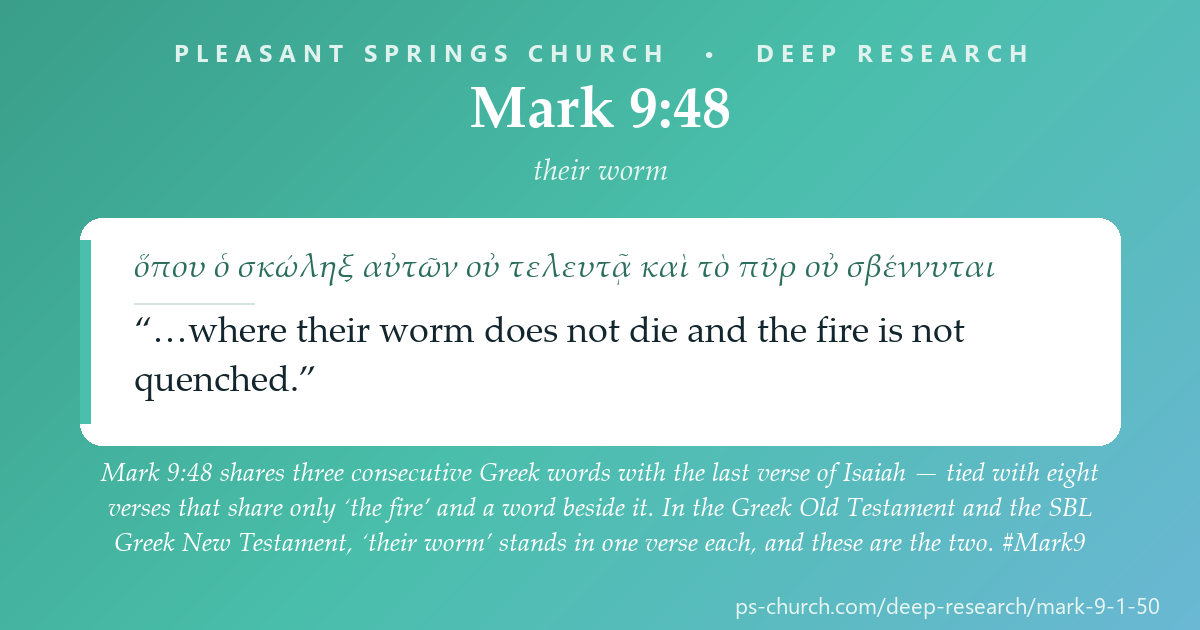
v.48 — Once in the Greek New Testament (the compound σκωληκόβρωτος, eaten by worms, once more, at Acts 12:23). In the Hebrew, תוֹלַעְתָּם, their worm, stands in one verse of the Masoretic text, and that verse is Isaiah 66:24.
v.49 — the verb occurs twice in the Greek New Testament (here and Matthew 5:13), and the form ἁλισθήσεται stands in one Greek Old Testament unit, Leviticus 2:13. ἄναλον, saltless (9:50), occurs once in the New Testament.
The words of the boy’s illness, and the help asked for
The father’s description is full of rare words: ἀφρίζω, to foam (twice, both in this scene, 9:18, 20), τρίζω, to grind (once), παιδιόθεν, from childhood (once), and ἄλαλος, mute (three occurrences, all in Mark). And the verb for help, βοηθέω, occurs two times in Mark, both in this scene: the father’s βοήθησον ἡμῖν (9:22) and then βοήθει μου τῇ ἀπιστίᾳ (9:24). He asks first for help with the boy, and then for help with himself.
The measurement: every verse of the chapter screened against the Greek Old Testament and the Greek New Testament, then the named texts one by one.
Greek against Greek. MorphGNT normalised word column on the New Testament side; the CATSS form column, beta-code transliterated, on the Old Testament side; both lowercased, accents and breathings dropped, final sigma folded, with the shelf’s edition-equivalence table (οὐ/οὐκ, ἐκ/ἐξ, the movable nu) on cross-corpus screens. Contiguous runs of whole word forms, never lemmas. The tie band — how many target verses reach the same maximum — is printed beside every run.
The whole chapter against the Greek Old Testament
Forty-eight rows against 30,348 screened units: all 48 reach two, 40 reach three, 10 reach four, 2 reach five, and nothing reaches six.
| Mark 9 | run | band | deepest match | what it is |
|---|---|---|---|---|
| 9:39 | 5 | 1 | Septuagint Jeremiah 36:9 (Hebrew and ESV 29:9) | accident — false prophets ἐπὶ τῷ ὀνόματί μου καὶ |
| 9:42 | 5 | 1 | Theodotion Daniel 5:29 | accident — a gold chain περὶ τὸν τράχηλον αὐτοῦ καὶ |
| 9:7 | 4 | 3 | 1 Kings 3:22, 3:23; 2 Samuel 16:11 | ὁ υἱός μου ὁ — the quarrelling mothers before Solomon; David’s son seeking his life |
| 9:12 | 4 | 1 | 2 Samuel 18:12 | ἐπὶ τὸν υἱὸν τοῦ — a hand against the king’s son, Absalom |
| 9:43 | 4 | 1 | Septuagint Jeremiah 43:23 (Hebrew and ESV 36:23) | the scroll thrown εἰς τὸ πῦρ τὸ |
| 9:48 | 3 | 9 | Isaiah 66:24 — and eight others | the one Old Testament sentence the chapter shares wording with, tied with eight verses that share and the fire or the fire … not |
The two deepest contacts in the chapter are accidents, and this page prints them as such. Jeremiah 36:9 (Septuagint numbering) shares in my name, and with 9:39 because both speak of things done in God’s or Jesus’ name; Daniel 5:29 shares around his neck, and with 9:42 because something is put round a man’s neck — a gold chain of honour in one, a millstone in the other. The same five words stand in Luke 17:2, which is the millstone saying; the run is a fact about Greek, not a link between Daniel and Jesus.
Isaiah 66:24 at Mark 9:48: the run, the band, and where it stops
Isa 66:24 ὁ γὰρ σκώληξ αὐτῶν οὐ τελευτήσει καὶ τὸ πῦρ αὐτῶν οὐ σβεσθήσεται
Mark 9:48 ὅπου ὁ σκώληξ αὐτῶν οὐ τελευτᾷ καὶ τὸ πῦρ οὐ σβέννυται
Three consecutive words, σκώληξ αὐτῶν οὐ, tie band 9. The run stops at the first verb: where Isaiah has the future τελευτήσει, Mark has the present τελευτᾷ; and where Isaiah has σβεσθήσεται, Mark has σβέννυται. Fold those two verbs to one token each and the run is 7 — and it then stops again, at the place where Isaiah says τὸ πῦρ αὐτῶν, their fire, and Mark says τὸ πῦρ οὐ, the fire … not. At the front, Isaiah’s ὁ γὰρ σκώληξ has a γάρ that Mark’s ὅπου clause does not. The fold is our check, not the shelf’s method; the published figure is three.
The Hebrew agrees with the Greek Isaiah on the point where Mark differs. The Masoretic text has תוֹלַעְתָּם לֹא תָמוּת וְאִשָּׁם לֹא תִכְבֶּה — their worm and their fire, וְאִשָּׁם, with the same suffix on both. The ESV prints “their worm shall not die, their fire shall not be quenched” in Isaiah and “where their worm does not die and the fire is not quenched” in Mark. Where Isaiah, in Hebrew and in Greek, has their fire, Mark has the fire. The Hebrew verbs are imperfects, which can be read as future or as ongoing; the Septuagint has futures. Hebrew was not screened against Greek, so this is a reading of the two texts side by side, not a run.
The band of nine, named. Eight of the nine verses reach three by sharing καὶ τὸ πῦρ or τὸ πῦρ οὐ (Genesis 22:6, Abraham carrying the fire; Exodus 9:24; Leviticus 6:2; Numbers 17:2 (ESV 16:37); Deuteronomy 18:16; 2 Chronicles 7:1; Isaiah 37:19; 4 Maccabees 5:32). Only the ninth shares the content. And on content Isaiah is alone: σκώληξ αὐτῶν, their worm, stands in exactly one screened Greek Old Testament unit (and one held, Odes included) and in exactly one verse of the SBLGNT, and these are the two (Tregelles and Robinson–Pierpont print the line at 9:44 and 9:46 as well). Isaiah’s future οὐ σβεσθήσεται stands in eleven screened units — three of them the altar fire of Leviticus 6 that must never go out (6:2, 5, 6; ESV 6:9, 12, 13) — while Mark’s οὐ σβέννυται stands in none. The Isaiah 62–66 page measured the same three, the same seven and the same stop.
Two Second-Temple texts put worm and fire together, unanchored. Searching every screened and held unit for a word containing σκωλη- and a word containing πυρ- in the same verse finds exactly three: Isaiah 66:24, Sirach 7:17 and Judith 16:17.
| text | Greek | pair run with Mark 9:48 | our rendering |
|---|---|---|---|
| Sirach 7:17 | ὅτι ἐκδίκησις ἀσεβοῦς πῦρ καὶ σκώληξ | 1 | because the payment of the godless man is fire and worm (our rendering; the ESV of this verse is not printed here) |
| Judith 16:17 | δοῦναι πῦρ καὶ σκώληκας εἰς σάρκας αὐτῶν | 1 | to give fire and worms into their bodies (our rendering; the ESV of this verse is not printed here) |
Both are witnesses, not Scripture; both put the pair in the order fire and worm; and neither shares two consecutive words with Mark 9:48 (pair run one each), though both share single words with it, πῦρ and καί among them. Daniel 12:2 shares Isaiah’s rare word for abhorrence, דֵרָאוֹן — “everlasting contempt” in the ESV of Daniel; the Daniel 12 page found it in exactly two verses of the Hebrew Bible, these two — but Mark’s sentence stops before that word.
“Listen to him”: Deuteronomy 18:15, Psalm 2:7, Genesis 22:2 and Mark 1:11
| text | Greek | pair run with Mark 9:7 |
|---|---|---|
| Deuteronomy 18:15 | αὐτοῦ ἀκούσεσθε | 1 |
| Psalm 2:7 — You are my Son; today I have begotten you | υἱός μου εἶ σύ | 2 |
| Genesis 22:2 — your only son Isaac, whom you love | τὸν υἱόν σου τὸν ἀγαπητόν | 1 |
| Genesis 27:21 and 27:24 | ὁ υἱός μου | 3 |
| Exodus 24:16 | τῆς νεφέλης | 2 |
| Mark 1:11 (the baptism) | Σὺ εἶ ὁ υἱός μου ὁ ἀγαπητός | 5 |
| Matthew 17:5 · Luke 9:35 · 2 Peter 1:17 | 7 · 6 · 5 |
The voice’s last words measure one against Moses. Where the Septuagint has αὐτοῦ ἀκούσεσθε — future indicative, pronoun first — Mark has ἀκούετε αὐτοῦ, present imperative, pronoun last. The phrase αὐτοῦ ἀκούσεσθε stands in two screened Greek Old Testament units (Deuteronomy 13:5, ESV 13:4, and 18:15) and one New Testament verse, Acts 3:22 (“You shall listen to him in whatever he tells you”), which introduces it with Moses said and measures 3 against Deuteronomy 18:15 (as does Acts 7:37). Mark’s word order is not the only one in the manuscripts: ἀκούετε αὐτοῦ WH Treg NA28 ] αὐτοῦ ἀκούετε RP. The Robinson–Pierpont order is Deuteronomy’s, and Luke 9:35 has it in the SBLGNT; the run with Deuteronomy is still one, because the verb is another tense. The MT and the Greek agree on the command (אֵלָיו תִּשְׁמָעוּן, to him you shall listen), but not on everything: the Hebrew’s מִקִּרְבְּךָ, from your midst, which the ESV prints as from among you, has no counterpart in the Greek.
Compare Mark 1. The Mark 1 page found the baptismal voice deepest against Genesis 27:21 and 27:24 — εἰ σὺ εἶ ὁ υἱός μου, blind Isaac to the disguised Jacob, five words, an accident. Mark 9:7 says this is instead of you are, so against the same two verses it measures 3, and its deepest Greek Old Testament run is 4, band 3 — ὁ υἱός μου ὁ in two mothers’ quarrel before Solomon and in David’s words about Absalom (2 Samuel 16:11). The words both voices share, ὁ υἱός μου ὁ ἀγαπητός, stand in no Greek Old Testament unit and in six New Testament verses (Matthew 3:17, 17:5; Mark 1:11, 9:7; Luke 3:22; 2 Peter 1:17). Genesis 22:2’s your son, the beloved is the same idea in another case and person, and measures 1.
Elijah and Malachi: which text, and what is written?
Malachi 4:4–6 (ESV) · Hebrew 3:22–24 · Greek 3:22–24, in another order
Hebrew (MT) · Greek (CATSS) · ESV| Mark | against | pair run |
|---|---|---|
| 9:11 | Malachi 3:22 (Septuagint) = Hebrew 3:23 = ESV 4:5 | 1 |
| 9:12 | Malachi 3:23 (Septuagint) = Hebrew 3:24 = ESV 4:6 | 1 |
| 9:13 | Malachi 3:22 / 3:23 | 1 / 1 |
| 9:13 | 1 Kings 19:2 / 19:10 (Jezebel; ‘they seek my life’) | 1 / 1 |
| Sirach 48:10 | Malachi 3:23 | 5 |
A run of one, every time. The scribes’ doctrine is Malachi’s, but the Greek wording is not: where Malachi’s Greek has ὃς ἀποκαταστήσει καρδίαν πατρὸς πρὸς υἱὸν, Mark has ἀποκαθιστάνει πάντα, and the variant reading is another present (ἀποκαθιστάνει WH Treg NA28 ] ἀποκαθιστᾷ RP). Ben Sira’s Greek, by contrast, shares five consecutive words with Malachi’s. The measurement shows that Mark 9:11–13 does not carry Malachi’s Greek wording; it cannot show that the saying is not about Malachi, and it plainly is.
“As it is written of him” — which text? Mark says it is written twice in two verses: of the Son of Man, πῶς γέγραπται ἐπὶ τὸν υἱὸν τοῦ ἀνθρώπου … that he should suffer many things and ἐξουδενηθῇ; and of Elijah, καθὼς γέγραπται ἐπ’ αὐτόν. For Elijah, this page knows of no Old Testament text that says what Mark says is written. Malachi promises Elijah’s coming, not his suffering. The nearest the Elijah narrative comes is the threat: “He said, ‘I have been very jealous for the Lord, the God of hosts. For the people of Israel have forsaken your covenant, thrown down your altars, and killed your prophets with the sword, and I, even I only, am left, and they seek my life, to take it away.’” — and that verse shares no two consecutive words with 9:13. The formula itself, καθὼς γέγραπται ἐπ’, reaches three against 4 Kingdoms 23:21, Josiah’s Passover kept as it is written in the book of the covenant (band 3). The readings proposed — that Mark has in view the Elijah story read as a pattern (Jezebel then, Herodias now), a text now lost, or the suffering of the righteous in Scripture generally — are reported, and this page cannot choose between them.
For the Son of Man, one verse of the Greek Psalter is worth setting beside 9:12, as a fact and not as a claim. The families of two of this chapter’s words that occur nowhere else in the Greek New Testament in this spelling — ἐξουδενηθῇ (9:12) and σκώληξ (9:48) — meet in one Greek Old Testament verse, and only one: Septuagint Psalm 21:7 (Hebrew 22:7, ESV 22:6), ἐγὼ δέ εἰμι σκώληξ καὶ οὐκ ἄνθρωπος … ἐξουδένημα λαοῦ. “But I am a worm and not a man, scorned by mankind and despised by the people.” But the psalm has the noun ἐξουδένημα and Mark the verb, so the pair run is 1; it is a shared word family, not shared wording, and Mark’s worm is Isaiah’s, not the psalmist’s. A verb of the same family, ἐξουδενόω (the verb the Robinson–Pierpont text reads at 9:12), stands with your anointed in Septuagint Psalm 88:39 (ESV 89:38: you have cast off and rejected). Isaiah 53:3 in the Greek held here (Rahlfs) does not use it; the later Greek versions of Isaiah are reported to, and are not held.
The mountain: Exodus 24 and 34, Daniel 7:9
| Mark | against | pair run |
|---|---|---|
| 9:2 | Exodus 24:1 / 24:15 / 24:16 | 1 / 1 / 1 |
| 9:3 | Exodus 34:29 (Moses’ face) | 1 |
| 9:3 | Daniel 7:9, Old Greek / Theodotion | 1 / 1 |
| Matthew 28:3 | Daniel 7:9, Theodotion | 4 |
A run of one, every time. “The glory of the Lord dwelt on Mount Sinai, and the cloud covered it six days. And on the seventh day he called to Moses out of the midst of the cloud.” The Greek has ἓξ ἡμέρας where Mark has μετὰ ἡμέρας ἓξ; Exodus has τὸ ὄρος and Mark ὄρος ὑψηλὸν. At Exodus 34:29 the Hebrew says the skin of Moses’ face קָרַן (the ESV: the skin of his face shone) and the Greek that its appearance δεδόξασται, had been glorified — and Mark has no face at all. Daniel’s Ancient of Days wears clothing white as snow (Theodotion: τὸ ἔνδυμα αὐτοῦ ὡσεὶ χιὼν λευκόν); Mark’s garments are λευκὰ λίαν and are not compared with snow — except in one tradition: λίαν WH Treg NA28 ] + ὡς χιών RP. The counter-example: Matthew’s angel at the tomb (28:3) does carry Daniel’s wording, four consecutive words. So the instrument can find a Danielic garment when one is there. In Mark 9:3 it finds none. Measured, not claimed: the Sinai and Daniel resemblances are of scene, not of words.
The millstone, the strange exorcist, and salt
Millstone (9:42). Every screened Greek Old Testament unit with a word beginning μυλ- was read: millstones and mills (Exodus 11:5; Numbers 11:8; Deuteronomy 24:6; Judges 9:53; 2 Samuel 11:21–22; Isaiah 47:2; Jeremiah 52:11) and, in the plural μύλαι, jaw-teeth (Job 29:17; Joel 1:6; Proverbs 30:14; Psalm 57:7, ESV 58:6; Psalms of Solomon 13:3). None has a neck, the sea or a drowning. μύλος ὀνικὸς stands in none, held or screened.
The strange exorcist (9:38–40) is often set beside Numbers 11:26–29, where Joshua asks Moses to stop two men prophesying in the camp, κύριε Μωυσῆ κώλυσον αὐτούς, and Moses refuses (reported). The scenes are alike; the wording is not: 9:38 against Numbers 11:28 runs 1, 9:39 against 11:29 runs 1. And 9:40 measures 5 against Luke 9:50 but 1 against the reversed saying of Matthew 12:30 (ὁ μὴ ὢν μετ’ ἐμοῦ κατ’ ἐμοῦ ἐστιν) — two sayings, both kept.
Salt (9:49). Πᾶς γὰρ πυρὶ ἁλισθήσεται against Leviticus 2:13 runs 1 — the single form ἁλισθήσεται — and against Ezekiel 43:24 it shares no word form at all (pair run 0). But the longer text of 9:49 runs further: ἁλισθήσεται WH NA28 ] + καὶ πᾶσα θυσία ἁλὶ ἁλισθήσεται Treg RP. With that clause added, the verse shares two consecutive words with Leviticus 2:13 — ἁλὶ ἁλισθήσεται, with salt shall be salted, a phrase that stands in one Greek Old Testament unit, this one. The edition this page measures does not print that clause, so the published run is one; the longer reading is reported because it is the place where the chapter’s text and the Greek Leviticus come closest, and it is the manuscripts, not this page, that draw the line from fire to sacrifice.
Now turn the screen around: Mark 9 against the rest of the Greek New Testament
Against the 7,254 verses outside Mark: all 48 reach two, 43 reach three, 27 reach four, 20 reach five, 13 reach six, 9 reach seven, 7 reach eight, 6 reach ten, 2 reach eleven, 1 reaches thirteen, and nothing reaches fourteen.
| Mark 9 | run | band | deepest match |
|---|---|---|---|
| 9:38 | 13 | 1 | Luke 9:49 — the strange exorcist |
| 9:1 | 11 | 1 | Luke 9:27 (Matthew 16:28: 8) |
| 9:2 · 9:5 | 10 · 10 | 1 · 1 | Matthew 17:1 · Matthew 17:4 |
| 9:37 · 9:42 | 10 · 10 | 1 · 1 | Luke 9:48 · Matthew 18:6 |
| 9:47 | 8 | 1 | Matthew 18:9 |
| 9:7 · 9:31 | 7 · 7 | 2 · 1 | Matthew 3:17 and 17:5 · Matthew 26:45 |
| 9:12 · 9:13 | 2 · 2 | — | against Matthew 17:11 and 17:12, the parallel Elijah sayings |
| 9:24 | 2 | 94 | nothing: the cry has no parallel |
| 9:48 | 2 | 133 | nothing: no other Gospel has the line |
The deepest New Testament contact in the chapter is the strange exorcist, thirteen words with Luke; the transfiguration’s best is ten. Of the two Elijah sayings, Matthew’s parallels share only two consecutive words with Mark’s. And the two verses a reader remembers best — the father’s cry and Isaiah’s worm — are among the five rows that reach no further than two against the rest of the New Testament, and neither has a parallel in Matthew or Luke. Direction of influence between the Gospels is not measured and not asserted.
Counter-examples this page prints against itself
- The two fives are accidents. Jeremiah’s false prophets and Belshazzar’s gold chain share five words each with 9:39 and 9:42, band one. If those counted as contact, Daniel 5 would be a source of the millstone saying.
- The citation ties with eight non-citations. Isaiah 66:24 reaches three at 9:48, and so do eight verses that only share and the fire or the fire … not — Genesis 22:6 among them. A band of nine at three is not, by itself, a signal; it is the content (their worm, once in the Greek Old Testament and once in the SBLGNT) that marks the contact.
- Two fours with a band of one are accidents too. 9:12 with 2 Samuel 18:12 (against the son of the king) and 9:43 with Jeremiah 43:23 (the scroll into the fire).
- Where a citation is signalled, the run is longer. Acts 3:22 says Moses said and measures 3 against Deuteronomy 18:15; Mark 9:7 signals nothing and measures 1. Matthew 28:3 signals no citation yet measures 4 against Daniel 7:9 (band one), so the instrument finds wording when it is there; Mark 9:3 measures 1.
- Another text does share Malachi’s Greek. Sirach 48:10 measures 5 against Malachi 3:23; Mark 9:12 measures 1. Shallow runs in Mark are not a property of the instrument.
- The ‘in my name’ formula is everywhere. 9:37 reaches four with eight Greek Old Testament verses, Deuteronomy 18:19 among them, in the same paragraph as listen to him. That is a formula, and the page does not build on it.
Cross-references worth following
- Matthew 14:1–17:27 — the transfiguration in Matthew; the μεταμορφόω count (four in the New Testament, none in the Greek Old Testament).
- Luke 9:1–10:42 — the Lukan tellings: the thirteen-word strange exorcist and the eleven-word some standing here.
- Malachi 3:1–4:6 — Elijah before the day; the Greek order of 3:22–24.
- Deuteronomy 18:15–19 and Deuteronomy 18 — the prophet like Moses and listen to him.
- Isaiah 62–66 — the last verse of Isaiah, measured from the other end.
- Daniel 12 — לְדִרְאוֹן, the word Daniel 12:2 shares with Isaiah 66:24.
- Exodus 24 · Exodus 33–34 — six days, the cloud, Moses’ face.
- Leviticus 2 — the salt of the covenant.
- Psalm 22 · Psalm 89 — the worm and the despised; the anointed cast off.
- Numbers 11 — Eldad and Medad.
- 1 Kings 17–19 — Elijah, Jezebel and Horeb.
- Mark 8 · Mark 10–11 — the first and third predictions; the road between the two blind men.
The commentaries, the live disputes, and an explicit list of what was not checked.
This is the section that makes the shelf trustworthy. Say what was not consulted, what could not be checked, and where the page is weakest — before someone else has to.
Commentaries & studies:
- France (NIGTC), Marcus (Anchor Yale), Yarbro Collins (Hermeneia), Lane (NICNT), Edwards (Pillar), Hooker (BNTC) — the standard Mark commentaries (none re-read for this page).
- Allison, The New Moses; Hays, Echoes of Scripture in the Gospels — on Moses and on allusion.
- On final judgment: Fudge, The Fire That Consumes; the two Four Views on Hell volumes (Crockett 1992; Sprinkle 2016); Robert Peterson, Hell on Trial (1995).
Live disputes we are not pretending to settle:
- What do the bystanders of 9:1 see? “And he said to them, ‘Truly, I say to you, there are some standing here who will not taste death until they see the kingdom of God after it has come with power.’” Four readings, each with long-standing holders: (1) the transfiguration that follows at once — Chrysostom on the Matthean parallel: “He willing to assure their very sight, and to show what kind of glory that is wherewith He is to come, so far as it was possible for them to learn it; even in their present life He shows and reveals this” (Homily 56 on Matthew, cut from the NPNF text held here), and among moderns Lane (reported); (2) the resurrection and Pentecost, the kingdom arriving in power after Easter (C. H. Dodd among others; reported); (3) the judgment on Jerusalem in AD 70 (N. T. Wright and preterist readers such as R. C. Sproul; reported); (4) the parousia itself — held by some as an expectation that failed (Albert Schweitzer; reported) and by others as an event the transfiguration previews, the reading 2 Peter 1:16–18 gives when it ties the mountain to δύναμιν καὶ παρουσίαν, power and arrival (and 2 Peter 1:17 measures 5 against Mark 9:7). The church this page is written for holds historic premillennialism, and the already and not-yet shape of the kingdom associated with George Eldon Ladd (reported) sits easily with readings (1), (2) and (4) together; that position does not by itself decide which event Mark 9:1 names, and this page does not decide it either.
- The nature and duration of final punishment. Mark 9:43–48 is one of the central texts. The readings: eternal conscious punishment (Augustine, Jonathan Edwards; in the recent debate Robert Peterson and Denny Burk; reported); conditional immortality, in which the wicked are finally destroyed (Edward Fudge, John Stott tentatively, Clark Pinnock; reported) — who read Isaiah’s worm and fire as consuming dead bodies, which is what Isaiah 66:24 says the people go out to look on, while holders of the first reply that a worm that does not die and a fire that is not quenched describe something without end; and restorative or universalist readings, ancient and modern (Gregory of Nyssa; Robin Parry; reported); with a metaphorical reading of the imagery available within the first two (William Crockett; reported). The church’s statement of beliefs has no article on the nature or duration of final punishment, and this page labels none of these readings the church’s. What the church does confess, in the form of the Apostles’ Creed recited at Pleasant Springs, is that “from thence He shall come to judge the quick and the dead”; and its /beliefs Article 6 says “We believe repentance is not driven by fear of punishment, but by encountering mercy.” — a sentence about why we repent, not about what final punishment is. The measurement adds only this: where Isaiah has their fire and two futures, Mark has the fire and two presents, and neither fact settles the question.
- Warnings to whom? 9:42 warns against tripping up τῶν πιστευόντων εἰς ἐμέ; 9:43–47 speaks to you, the disciples. Readings: that the warnings describe a real possibility of a believer finally falling away (the Arminian reading; I. Howard Marshall, Kept by the Power of God, 1969; reported); that they are addressed to genuine believers as the means by which God keeps them (Thomas Schreiner and Ardel Caneday, The Race Set Before Us, 2001; reported); and that they test the profession of those who are not genuine (held by others in the Reformed tradition, D. A. Carson among them; reported). The church’s position is its /beliefs Article 10, in its own words: “all who genuinely receive Christ are held secure. Our assurance rests not on the strength of our own grip on God, but on the finished work of Christ and the faithfulness of the One who keeps His own (Romans 8:39; Philippians 1:6) — and Scripture’s warnings are themselves a real means by which He holds us fast.” That is a statement about warnings as means; this page does not add to it.
- “It is written” and “whatever they pleased” in one verse. 9:12–13 sets what is written beside ἐποίησαν αὐτῷ ὅσα ἤθελον, they did to him whatever they wanted. The church reads Scripture’s foreknown plan and genuinely free human choices together in the Molinist way (Luis de Molina; William Lane Craig; reported), not in the way of the Synod of Dort; the verse states both and explains neither, and the framework is ours, not Mark’s.
- Who is the strange exorcist? A follower outside the Twelve, a Jewish exorcist using a powerful name (compare Acts 19:13), or a later church situation read back (reported). The text gives no more than οὐκ ἠκολούθει ἡμῖν.
- Prayer, or prayer and fasting? προσευχῇ WH NA28 ] + καὶ νηστείᾳ Treg RP. The ESV prints by anything but prayer.
What this page did NOT check — stated plainly
- The only apparatus consulted is the SBLGNT’s own, which reports four editions (Westcott–Hort, Tregelles, NA28, Robinson–Pierpont) and no manuscripts. The 9:44/46, 9:49, 9:7, 9:3, 9:29 and 9:42 readings above are those editions’ readings, read from the file; which manuscripts carry them was not checked. No Septuagint apparatus (Göttingen or Rahlfs) was consulted for Isaiah, Malachi, Deuteronomy or Leviticus.
- The later Greek versions were not held. The claim that Aquila, Symmachus or Theodotion use the verb of 9:12 at Isaiah 53:3 is reported, not verified; Field’s Hexapla is held here only as an extract from its first volume, and not for Isaiah.
- Hebrew was not screened against Greek. The Isaiah 66:24 and Deuteronomy 18:15 Hebrew points above are readings of the two texts side by side. If the sayings were first spoken in Aramaic against a Hebrew Isaiah, a Greek-to-Greek screen is blind to that by construction. This is the largest limitation of the page.
- 1 Enoch, the Mishnah, Qumran (for example the Elijah fragments) and the Targums were not screened; they are not held here in a comparable form. The Josephus, Suetonius, Pliny and Hippocratic references in Stage 2 are cited by reference, not by text search; Kimchi is reported at second hand.
- Unanchored searches depend on the stems chosen. The worm-and-fire search used σκωλη- and πυρ- anywhere in a word; πυρ- also catches πυρός, wheat, which is why salt-and-wheat verses had to be read and set aside. Other words for fire (φλόξ) and worm were not searched.
- The fold of the two verbs at 9:48 is a by-hand check, not the shelf’s method; the published run is three, and the seven is printed as the answer to where does it stop, not as a second measurement.
- Own renderings were tested only against the KJV on disk (no NRSV is held, and the ESV of the verses we render is deliberately not cached). 27 Mark verses are printed in the ESV, under a cap of 28.
- Not one commentary was used to derive a number. Every holder named in this stage is reported, not re-read.
Where this page is weakest
The catchword structure and the readings of 9:12–13. The repetitions in the structure diagram are counted, but the claim that they organise 9:33–50 is an inference shared with the commentators, not a measurement. The Psalm 21:7 observation is a word-family fact that a reader could easily over-read, and the page has tried to fence it. And on the two hardest questions in the chapter — what the bystanders of 9:1 saw, and what Gehenna’s fire is — the measurement has almost nothing to say. The defensible claim is the narrow one: Mark 9 carries the Old Testament in its scenes and names, and the one sentence it reproduces measures three consecutive words in the Greek.
From the mountain to the valley, and from the house to the salt.
Name what you learned, why it matters, and one concrete response.
What should we carry away — and do?
- The voice says one thing to do. On the mountain Peter wants to build; the voice from the cloud says “listen to him”. Moses and Elijah disappear and τὸν Ἰησοῦν μόνον remains.
- Half-belief is allowed to pray. “I believe; help my unbelief!” stands in no other Gospel and shares no three consecutive words with any other New Testament verse; Jesus answers it by healing the boy. Bring the faith you have.
- Greatness is measured downward. “If anyone would be first, he must be last of all and servant of all” — and then a child in his arms.
- Do not police the edges. For the one who is not against us is for us The disciples who could not cast out the spirit tried to stop a man who could.
- Take sin seriously in yourself before you take it seriously in others. The warnings of 9:43–47 are spoken to you; the millstone is for the one who trips up another.
- Salt is good — and the chapter that began with an argument about rank ends with be at peace with one another.
Step in response: read Mark 9 aloud in one sitting and listen for the repeated words — good, fire, name, cause to stumble. Then pray the father’s sentence in your own words this week, and name one person outside your own circle doing good in Jesus’ name whom you will thank rather than hinder.
Mark 9:48 · to share
Greek NT + ESVEvery Deep Research page traces its passage across the whole sweep — the Old Testament, the Second-Temple world between the testaments (historical witnesses, not Scripture), and the New Testament. Follow the thread:
Pleasant Springs Church — Deep Research
Research method after Michael S. Heiser’s Bible Research Method (examine dictionaries → ancient literature → important words → textual connections → academic publications → share), with the Pleasant Springs “Author & Audience” foundation. Scripture set in the Hebrew, the Greek editions named on each page and the ESV (Old Testament), and the Greek New Testament and the ESV (New Testament), per the practice of Pleasant Springs Church. Mark works named on this page (none re-read for it, all reported): France, Marcus, Yarbro Collins, Lane, Edwards, Hooker, Allison, Hays; on 9:1 Dodd, Wright, Sproul, Schweitzer and Ladd; on final judgment Fudge, Stott, Pinnock, Peterson, Burk, Crockett, Parry; on the warnings Marshall, Schreiner and Caneday; on providence Molina and Craig — none of which were consulted for any number on this page. Ancient writers cut from the NPNF translations held in the shelf’s library: Chrysostom (Homily 56 on Matthew) and Cyril of Jerusalem (Catechetical Lectures 12.16); Josephus, Suetonius, Pliny, the Hippocratic corpus, the Mishnah and Kimchi cited by reference only. Text: Greek New Testament from the SBL edition as digitized by MorphGNT (text and lemma columns), with the SBLGNT apparatus file; Greek Old Testament from Rahlfs’ Septuaginta as digitized by CATSS; Hebrew from the Masoretic text as printed in Sefaria’s Miqra according to the Masorah; English from the ESV via Crossway’s API. ⚠️ VERSE NUMBERING. Mark 9 has 48 rows in the SBLGNT, numbered 1–50 with 9:44 and 9:46 absent, and the ESV text omits the same two numbers. Malachi: ESV 4:4–6 = Hebrew 3:22–24; Septuagint 3:22–23 = Hebrew 3:23–24 (ESV 4:5–6) and Septuagint 3:24 = Hebrew 3:22 (ESV 4:4). Septuagint Psalm 21:7 = ESV 22:6; Septuagint 88:39 = ESV 89:38; Psalm 2:7 has no offset. 1 Kings = 3 Kingdoms; 2 Samuel = 2 Kingdoms; 2 Kings = 4 Kingdoms. Septuagint Jeremiah 36:9 = ESV 29:9; 43:23 = ESV 36:23; 39:35 = ESV 32:35. Leviticus 6:2, 5, 6 = ESV 6:9, 12, 13. Daniel cited by Old Greek or Theodotion, named. Numbers 17:2 = ESV 16:37; Deuteronomy 13:5 = ESV 13:4; Septuagint Psalm 57:7 = ESV 58:6. The other texts are numbered alike. ⚠️ The measurement, in full. Greek against Greek; MorphGNT normalised word; CATSS form column, beta-code transliterated first; both sides lowercased, accents and breathings dropped, final sigma folded, with the shelf’s edition-equivalence table on cross-corpus screens. Contiguous runs of whole word forms, never lemmas. 48 rows against 30,348 verse units — the 64 CATSS files less the Odes — against the 7,254 Greek New Testament verses outside Mark, and against the other 625 rows of Mark; absence claims also searched the 30,637 units held. Hebrew counts consonantal, over the Masoretic corpus. Exhaustive and deterministic. It finds verbatim contact, not allusion.
Scripture quotations marked ESV are from the ESV® Bible (The Holy Bible, English Standard Version®), © 2001 by Crossway, a publishing ministry of Good News Publishers. ESV Text Edition: 2016. Used by permission. All rights reserved. The ESV text may not be quoted in any publication made available to the public by a Creative Commons license, and the ESV may not be translated in whole or in part into any other language. www.esv.org
|
Did this study bless you today? 💚 Give to Support PS Church100% of gifts go to the General Fund — thank you. |