Hebrews 12 turns the roll-call of chapter 11 into a grandstand and the readers into runners: look to Jesus, take hardship as a father’s discipline, lift the drooping hands, do not sell your birthright like Esau — because you have not come to the mountain of fire but to Mount Zion, and the God who once shook the earth will shake heaven too. Hebrews 13 brings it to the ground: love, hospitality, prisoners, marriage, money, leaders, an altar outside the camp, and a benediction. The measurement finds three verses handed over whole from the Old Testament — and, at 13:5, a promise introduced with “he has said” whose Greek words stand together in no verse of the Greek Old Testament held here (Rahlfs, as digitized by CATSS). See the method →
Hebrews 12:1–13:25
Greek NT · ESVVersification. Hebrews 12–13 carries no offset: the Greek New Testament on this disk and the ESV both number chapter 12 to 29 verses and chapter 13 to 25, and there is no Septuagint column because Hebrews is a New Testament book. The offsets are in the Old Testament texts the page measures, and they were checked verse by verse against the Masoretic and CATSS files before being stated: Deuteronomy 29:18 (ESV) = 29:17 in the Hebrew and the Greek (the root of bitterness); Psalm 118:6 = Septuagint 117:6 (chapter only); Psalm 56:11 = Masoretic 56:12 = Septuagint 55:12; Psalm 110:1 = Septuagint 109:1; Psalm 89:5 = Masoretic 89:6 = Septuagint 88:6; Psalm 82:1 = Septuagint 81:1; Psalm 50:14 = Septuagint 49:14; Hosea 14:2 (ESV) = 14:3 in the Hebrew and the Greek; 1 Chronicles = 1 Paraleipomena. Proverbs 3:11–12 and 4:26, Isaiah 35:3 and 63:11, Haggai 2:6, Genesis 4:10, 25:33–34, 27:38 and 28:15, Exodus 19:12–13 and 33:7, Leviticus 16:27, Deuteronomy 4:11, 4:24, 9:19, 31:6, 31:8 and 33:2, Joshua 1:5 and Zechariah 9:11 are numbered alike in all three. Joshua is measured in the CATSS B text.
The Shape of the Passage
A sequence with measured brackets — NOT a chiasmHebrews 11 ended with a roll-call of the dead who trusted God and did not receive what was promised. Chapter 12 turns the roll-call into a grandstand — and the readers into runners. Chapter 13 is the letter coming down to the ground: love, hospitality, prisoners, marriage, money, leaders, an altar, a city, a benediction and a postscript.
Author
The writer is unnamed, and this page will not guess. What the last two chapters add to what we know of him is small and concrete. He knows Timothy, and calls him our brother Timothy; he hopes to come with him. He sends greetings from Those who come from Italy, which may mean Italians abroad or people in Italy; the Greek (οἱ ἀπὸ τῆς Ἰταλίας) allows both and this page does not choose. And he names his own work: “my word of exhortation”, written briefly. A sermon, by its author’s description, with a letter’s ending.
He argues from Scripture in two different ways in these chapters, and the measurement shows both. Three times he hands over a verse whole: Proverbs 3:11 and 3:12 at 12:5–6, Psalm 118:6 (LXX 117:6) at 13:6 — runs of 9, 11 and 9, each with a tie band of 1. Everywhere else that his wording meets the Old Testament’s, it differs: Isaiah 35:3 and Proverbs 4:26 in another order, Deuteronomy 4:24 with another pronoun, Haggai 2:6 with a not only… but also, Exodus 19:12–13 summed up, Abel and Esau named rather than quoted. And once, at 13:5, he introduces a promise with he has said and gives a wording that no Greek Old Testament verse on this disk holds.
Audience
People who had suffered, and had not yet bled. “In your struggle against sin you have not yet resisted to the point of shedding your blood.” They had been mistreated and had stood by prisoners (10:32–34, and here 13:3). The writer reads their hardship as discipline — the training a father gives a son — and he builds the reading on Proverbs rather than on his own authority.
People tempted to go back to the mountain they could see. The contrast of 12:18–24 is between a mountain that may be touched and a city that cannot yet be seen. Whatever the community’s exact background — and the page does not reconstruct it — the warning of 12:25 assumes that the voice from heaven could be refused, and the instruction of 13:9–14 assumes that teaching about foods and an altar had some pull on them.
A congregation with leaders, past and present. Remember your leaders (13:7) are those who spoke to you the word of God; 13:17 and 13:24 speak of leaders now. The page gives those verses as they stand and draws no present-day application from them.
Orient on discipline, the two mountains, the heavenly assembly, and the warnings.
Search by topic: discipline / paideia, sonship, Esau and the birthright, Sinai, Zion and the heavenly Jerusalem, angels, the firstborn, the divine council, the shaking of heaven and earth, hospitality, outside the camp, the sacrifice of praise, the benediction.
Which articles are relevant?
- Anchor Bible Dictionary — “Hebrews, Letter to the,” “Zion,” “Sinai,” “Esau,” “Hospitality.”
- Dictionary of the Later New Testament & Its Developments — “Hebrews,” “Apostasy,” “Old Testament in Hebrews.”
- NIDNTTE / TDNT — παιδεία (discipline, training), ἀρχηγός (founder), μετάνοια (repentance), πανήγυρις (festal gathering), ἀσάλευτος (unshakable).
- Dictionary of Deities and Demons in the Bible — “Angel,” “Sons of (the) God(s)” — background for the assembly of 12:22–24.
Bibliography surfaced:
- Harold W. Attridge (Hermeneia, 1989); William L. Lane, Hebrews 9–13 (WBC 47B, 1991); Paul Ellingworth (NIGTC, 1993); F. F. Bruce (NICNT, rev. 1990); Craig R. Koester (AB 36, 2001); Peter T. O’Brien (Pillar, 2010; withdrawn by the publisher in 2016 and not used here); Gareth Lee Cockerill (NICNT, 2012).
- N. Clayton Croy, Endurance in Suffering: Hebrews 12:1–13 in Its Rhetorical, Religious and Philosophical Context (1998).
- G. K. Beale & D. A. Carson, eds., Commentary on the New Testament Use of the Old Testament (Hebrews, by George H. Guthrie).
- Michael S. Heiser, The Unseen Realm (2015) — Sinai and Zion as the Bible’s two council mountains.
The athlete, the father, the assembly on the mountain, and a doxology everyone knew.
Read the martyr-athletes of 4 Maccabees, the angels of Sinai in the Greek Deuteronomy, and the heavenly assembly of the Psalms. Second Temple sources are witnesses to what people believed, not Scripture, and are labelled so.
Which parallels shed light on religion and worldview?
The race and the grandstand. The nearest ancient picture of 12:1–4 is 4 Maccabees 17, where the seven brothers and their mother are athletes of piety, the tyrant is their opponent and the world looks on: ἠθλοθέτει γὰρ τότε ἀρετὴ δι' ὑπομονῆς δοκιμάζουσα τὸ νῖκος ἀφθαρσία ἐν ζωῇ πολυχρονίῳ — virtue was the judge of the games, testing through endurance. Measured: Hebrews 12:1 shares two consecutive words with that verse, δι' ὑπομονῆς; Hebrews 12:2 shares one with 17:10, ἀφορῶντες, looking to (in 4 Maccabees, to God); 12:4 shares none with 17:14, where the tyrant ἀντηγωνίζετο and Hebrews has ἀνταγωνιζόμενοι. The picture is shared and the wording is not. 4 Maccabees is a witness to how Jews in the Greek world spoke about faithful suffering; nothing on this page treats it as a source of Hebrews.
A father who disciplines. Proverbs 3:11–12 is a father’s word to a son, and the Greek world shared the assumption Hebrews argues from — that a father who does not train his son does not care for him. νόθος, illegitimate, a New Testament hapax, is the legal word: a child without standing in the household and without a share of the inheritance.
Angels at Sinai, and an assembly in heaven. The Greek Deuteronomy names angels at the giving of the law: σὺν μυριάσιν Καδης ἐκ δεξιῶν αὐτοῦ ἄγγελοι μετ' αὐτοῦ, with myriads of Kadesh, at his right hand angels with him (the Hebrew, as the ESV renders it: “he came from the ten thousands of holy ones”, and at his right hand אֵשׁ דָּת, which the ESV renders as fire). The Greek Psalter calls the heavenly assembly an ekklēsia: ἐν ἐκκλησίᾳ ἁγίων (ESV Psalm 89:5, “in the assembly of the holy ones”; Hebrew בִּקְהַל קְדֹשִׁים). And Psalm 82 (LXX 81) has God standing in the assembly of the gods to judge: “God has taken his place in the divine council; in the midst of the gods he holds judgment:” Measured: Hebrews 12:22 shares one word with Deuteronomy 33:2 and 12:23 one with Septuagint Psalm 81:1. These are parallels of picture — a heavenly assembly, angels in their thousands, God as judge — and not of wording.
The divine council reading (Heiser). Michael Heiser reads Sinai and Zion as the two mountains where God meets with his heavenly host, and 12:22–24 as the moment the people of God are brought into that assembly (The Unseen Realm, reported, not re-read for this page). The reading has real footholds in the text: μυριάσιν ἀγγέλων and ἐκκλησίᾳ πρωτοτόκων stand in one list governed by one verb; κριτῇ θεῷ πάντων, God, the judge of all, presides; and the human members — πνεύμασι δικαίων τετελειωμένων, the spirits of the righteous made perfect — are there alongside the angels. What the text does not say is any word for council; the page reports the reading as a reading.
A doxology everyone knew. 13:21 ends with words that stand in 4 Maccabees 18:24, Galatians 1:5 and 2 Timothy 4:18. That is the liturgical Greek of the synagogue and the church, not a quotation.
- Proverbs 3:11–12 — the father’s discipline (see Proverbs 2–7, which measured the same two runs from the Proverbs side: 9 and 11).
- Exodus 19; Deuteronomy 4:11, 5:22–27, 9:19 — Sinai’s fire, darkness and voice (see Exodus 19).
- Genesis 25:29–34; 27:30–40 — Esau’s meal and his tears (see Genesis 25:19–34 and Genesis 27:1–40).
- Haggai 2:6–9 — yet once (see Haggai 2:6–9).
- 4 Maccabees 17:10–18:24; Wisdom 12:10 — martyr-athletes, a doxology, and a place of repentance (witnesses, not Scripture).
The cloud of witnesses is not an audience that has come to watch us. The word witnesses in 12:1 follows a chapter in which God bore witness to these people — Abel, Enoch, Noah, Abraham, Moses, the unnamed who were sawn in two. They are witnesses first in the sense that they testify: they ran, and they show the race can be run. And then the writer does something unexpected with the image. He takes the eyes off the crowd altogether. Looking to Jesus. The one at the end of the track is not a judge with a garland but a runner who has already finished — who endured the cross, despised its shame, and sat down. The athletic picture puts the glory at the finish line. Hebrews puts a cross there, and a throne beyond it, and tells the runner to look at the person who went through both.
Discipline, the scourge, the root, repentance, the gathering, the roll, and a promise.
Each count below was run against the corpora on this disk, not quoted from a lexicon: 7,927 verses of Greek New Testament (MorphGNT lemma column) and 30,348 verse units of Greek Old Testament screened out of the 64 CATSS files held (30,637 held; the 289 units of the Odes are held but not screened, by house convention). Every nowhere and only on this page was run twice — anchored on the start of the word and unanchored — because an anchored search misses augmented and reduplicated forms (the perfect at 12:23 is the standing example).
Discipline, training, the formation of a child. Measured: the noun stands 6 times in the New Testament and 4 of them are here; with the verb and the agent-noun, the family stands eight times in 12:5–11 and nowhere else in the two chapters. It is not punishment for its own sake: 12:10 gives the purpose, that we may share his holiness.
To scourge, to flog. The hard verb of the quotation, and the one the Masoretic pointing of Proverbs 3:12 does not have. Measured: 7 New Testament occurrences of the verb; the others are the flogging of Jesus and of his messengers (Matthew 10:17, 20:19, 23:34; Mark 10:34; Luke 18:33; John 19:1).
To trouble, to harass. Measured: the simple verb stands in two New Testament verses (Luke 6:18 and here) and in six Greek Old Testament units, none of them Deuteronomy — while Deuteronomy 29:17 has, at the same point in the sentence, ἐν χολῇ, the same letters in a different order.
Repentance, a change of mind. Whose? The verse does not say, and the readings divide on it (Stage 5). The only Greek Old Testament unit with a place of repentance is Wisdom 12:10, of God giving the Canaanites time.
A festal gathering — a whole people assembled for a feast. A New Testament hapax. In the Greek prophets it is Israel’s feast-days, in Hosea and Amos under judgment (Hosea 2:13 [ESV 2:11], 9:5; Amos 5:21). Here it is the gathering in heaven.
Enrolled, registered — the perfect: entered and still on the roll. With its noun the word stands six times in the New Testament, five of them the Roman census of Luke 2 and Acts 5:37 and one of them this. Compare Jesus in “rejoice that your names are written in heaven”.
Unshakable. The fifth shaking word in three verses (Hebrews 12:26 (×2), 12:27 (×2), 12:28). In the Greek Old Testament the adjective is used only of the sign set immovable before the eyes (Exodus 13:16; Deuteronomy 6:8, 11:18).
To let go, to loosen, to abandon. The first verb of the promise. Measured: Hebrews’ clause Οὐ μή σε ἀνῶ stands in no Greek Old Testament unit; the nearest is Deuteronomy 31:6, οὐ μή σε ἀνῇ, he will not let you go — third person.
Helper. A New Testament hapax, and a Psalter word: the nominative form alone stands in 39 Greek Old Testament units, God as Israel’s helper again and again.
Those who lead. The participle of to lead; the chapter has it three times (13:7, 13:17, 13:24) and the letter nowhere else as a title. The page gives the verses as they stand.
Word chains, counted rather than asserted:
- paid- ×8, huios ×6 — all in 12:5–11. The discipline section is the most lexically closed unit in the two chapters.
- proselēlythate ×2 — 12:18 and 12:22, in no Greek Old Testament unit and nowhere else in the New Testament: the hinge of the passage is one verb form, negated and then affirmed.
- Shaking ×5 — σαλεύω three times, σείω once, ἀσάλευτος once, all in 12:26–28.
- paraite- ×3 — Hebrews 12:19, 12:25 (×2): the Sinai hearers begged, and the readers must not refuse.
- Leaders ×3 — 13:7, 13:17, 13:24; exō ×3 — 13:11, 13:12, 13:13.
- Do not neglect ×2 — μὴ ἐπιλανθάνεσθε at 13:2 and 13:16, and nowhere else in the New Testament.
- Pleasing ×3 — εὐαρέστως (12:28), εὐαρεστέω (13:16), εὐάρεστος (13:21): acceptable worship, acceptable sacrifices, and God working in us what is acceptable.
- Grace ×4 — Hebrews 12:15, 12:28, 13:9, 13:25. The letter’s last noun.
Three verses given whole, other words everywhere else — and a promise with no Greek Old Testament verse here.
The method: every verse of Hebrews 12–13 (54 rows) was screened against the 30,348 screened Greek Old Testament units for the longest contiguous run of identical normalised word forms, with the tie band — how many units reach that depth — beside each run, and then against the other 7,873 verses of the Greek New Testament. Word forms, never lemmas; a reordering or a change of case breaks the run. It finds verbatim contact, not allusion. Then each Old Testament text the passage is said to use was set against its Hebrews verse one to one.
What the screen returned:
Against the Greek Old Testament, the 54 rows: 51 reach two, 28 reach three, 10 reach four, 4 reach six, 3 reach nine, 1 reaches eleven, and nothing reaches twelve. Against the rest of the Greek New Testament: 52 reach two, 27 reach three, 8 reach four, 3 reach five, 1 reaches six, and nothing reaches seven.
| Hebrews | deepest run | tie band | partner | what it is |
|---|---|---|---|---|
| 12:6 | 11 | 1 | Proverbs 3:12 | signalled citation (12:5), the whole verse |
| 12:5 | 9 | 1 | Proverbs 3:11 | the same citation; one word short of ten because of my |
| 13:6 | 9 | 1 | Psalm 117:6 (ESV 118:6) | signalled (we can confidently say); 6, band 2 on the NA28 text |
| 13:21 | 6 | 1 | 4 Maccabees 18:24 | a doxology formula; 9 on the NA28 text |
| 12:26 | 4 | 1 | Haggai 2:6 | signalled (he has promised); then different wording |
| 13:5 | 4 | 1 | Genesis 28:15 | signalled (he has said); see below |
| 13:20 | 4 | 1 | Isaiah 63:11 | no signal; a four-word phrase found once in each Testament |
| 12:13 | 4 | 1 | Daniel 1:10 (OG) | an accident — counter-example |
| 13:13 | 4 | 1 | Judith 6:11 | an accident — counter-example |
| 13:24 | 4 | 2 | Isaiah 58:3; Daniel 4:37a | your, and all the (Isaiah); and all the holy ones (Daniel) — formula |
Three verses are given whole: 12:5, 12:6 and 13:6. Everywhere else that the passage’s wording meets the Old Testament’s, the wording differs, and the screen cannot follow it. The table of the one-to-one comparisons is short and blunt:
| Hebrews | the text | pair run | why it is low |
|---|---|---|---|
| 12:2 | Psalm 109:1 (ESV 110:1) | 0 | en dexia for ek dexiōn; kekathiken for kathou |
| 12:12 | Isaiah 35:3 | 1 | another case, the other order, a different participle |
| 12:13 | Proverbs 4:26 | 1 | the other order; plural where Proverbs is singular |
| 12:15 | Deuteronomy 29:17 (ESV 29:18) | 2 | enochlē where Deuteronomy has en cholē |
| 12:16 | Genesis 25:33 | 2 | Genesis puts de Ēsau between verb and object; also one vowel, apedeto for apedoto |
| 12:18 | Deuteronomy 4:11 | 1 | every noun moved into the dative |
| 12:20 | Exodus 19:12, 19:13 | 2, 2 | a summary, beast for cattle |
| 12:21 | Deuteronomy 9:19 | 2 | the only Greek Old Testament unit with these two words |
| 12:24 | Genesis 4:10 | 1 | named, not quoted |
| 12:29 | Deuteronomy 4:24 | 2 | our God for your God |
| 13:11, 13:13 | Leviticus 16:27; Exodus 33:7 | 3, 3 | outside the camp — 31 times in the Greek Old Testament, 29 of them in the Pentateuch; Hebrews puts its own verb (13:11) or him (13:13) before it |
| 13:15 | Psalm 49:14 (ESV 50:14); Hosea 14:3 (ESV 14:2) | 2, 2 | two-word phrases |
| 13:20 | Zechariah 9:11 | 3 | in the blood of the covenant |
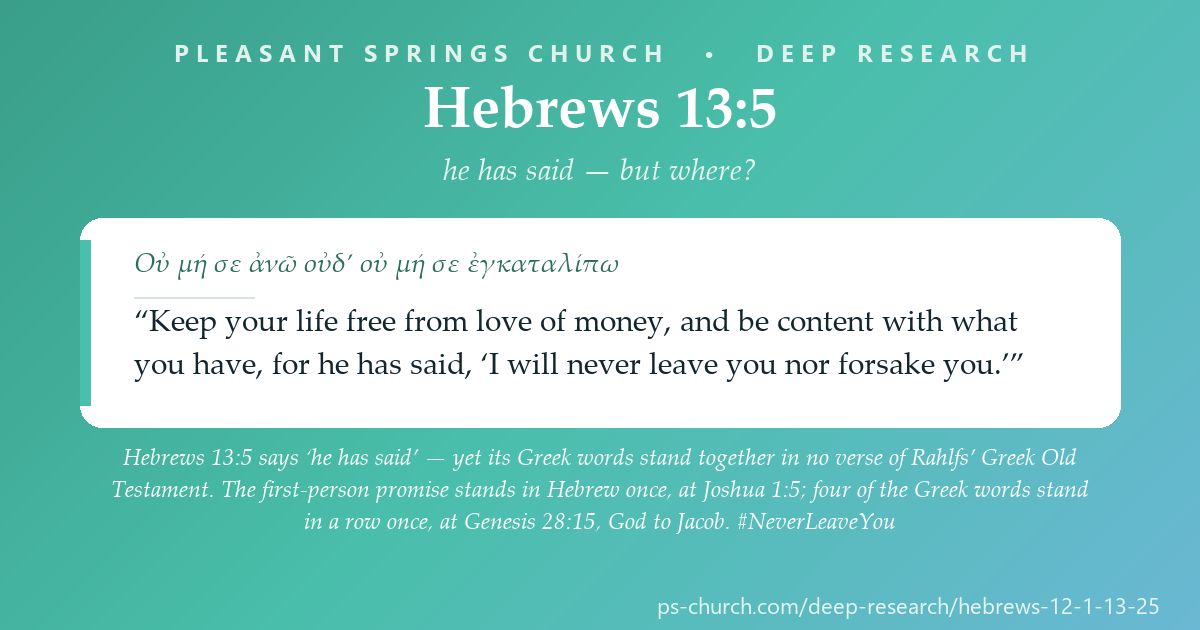
Hebrews 13:5 introduces the words as God’s. For he has said. The sentence that follows is two clauses, each with the emphatic double negative, each in the first person: Οὐ μή σε ἀνῶ οὐδ’ οὐ μή σε ἐγκαταλίπω. The commentaries send the reader to Deuteronomy 31:6, or to Joshua 1:5, or to both.
Set against all 30,348 Greek Old Testament units screened here, the sequence stands in none of them. Taken apart, the first clause, Οὐ μή σε ἀνῶ, stands in none; the second, οὐ μή σε ἐγκαταλίπω, stands in one — and it is not Deuteronomy or Joshua. It is Genesis 28:15, the promise to Jacob asleep at Bethel with a stone for a pillow: “Behold, I am with you and will keep you wherever you go, and will bring you back to this land. For I will not leave you until I have done what I have promised you.” Deuteronomy 31:6 has both verbs and both negatives, but in the third person — he will not let you go — and measures 3. Joshua 1:5, in Greek, measures 1: it has I will not forsake you with the verb in another tense and before the pronoun, with a single negative, and its second verb is a different word, overlook.
And then the Hebrew. In the Masoretic text the pair I will not leave you and I will not forsake you, both verbs in the first person, stands in exactly one verse of the Hebrew Bible: Joshua 1:5, לֹא אַרְפְּךָ וְלֹא אֶעֶזְבֶךָּ. The same pair in the third person — לֹא יַרְפְּךָ וְלֹא יַעַזְבֶךָּ — stands in three: Deuteronomy 31:6, 31:8 and 1 Chronicles 28:20. Genesis 28:15 has the second verb only, כִּי לֹא אֶעֱזׇבְךָ. So the first-person promise of Hebrews 13:5 stands whole in one Hebrew verse, Joshua 1:5, and in no Greek Old Testament verse screened here; the only Greek Old Testament verse here that holds four of its words in a row is God’s promise to Jacob.
What that means the measurement cannot say, and the page does not guess. It does not say Hebrews translated Joshua from the Hebrew; it does not say the writer was thinking of Jacob; it does not say he used a Greek text no longer extant, or a form of words already current in the synagogue — Philo is reported to give the promise in this same wording (On the Confusion of Tongues 166), and Philo’s Greek is not on this disk, so that report is not checked. What it does say is plain. The promise Hebrews calls God’s word was spoken in Scripture to Jacob fleeing to Haran, to Israel under Moses, to Joshua taking the land and to Solomon building the house — and the writer gives it to a congregation being told to be content with what they have. It is not one verse’s promise. It is the promise the Old Testament keeps making, and Hebrews says it in a wording of its own.
| verse | Greek (CATSS) | pair run with 13:5 | Hebrew (Masoretic) | person |
|---|---|---|---|---|
| Hebrews 13:5 | Οὐ μή σε ἀνῶ οὐδ’ οὐ μή σε ἐγκαταλίπω | — | — | I … I |
| Genesis 28:15 | οὐ μή σε ἐγκαταλίπω | 4 | כִּי לֹא אֶעֱזׇבְךָ | I (one verb only) |
| Deuteronomy 31:6 | οὐ μή σε ἀνῇ οὔτε μή σε ἐγκαταλίπῃ | 3 | לֹא יַרְפְּךָ וְלֹא יַעַזְבֶךָּ | he … he |
| 1 Chronicles 28:20 | οὐκ ἀνήσει σε καὶ οὐ μή σε ἐγκαταλίπῃ | 3 | לֹא יַרְפְּךָ וְלֹא יַעַזְבֶךָּ | he … he |
| Deuteronomy 31:8 | οὐκ ἀνήσει σε οὐδὲ μὴ ἐγκαταλίπῃ σε | 1 | לֹא יַרְפְּךָ וְלֹא יַעַזְבֶךָּ | he … he |
| Joshua 1:5 | οὐκ ἐγκαταλείψω σε οὐδὲ ὑπερόψομαί σε | 1 | לֹא אַרְפְּךָ וְלֹא אֶעֶזְבֶךָּ | I … I (Hebrew); I (Greek, a different second verb) |
Pair runs are against the CATSS Greek (Joshua in the B text). Hebrew phrase counts are consonantal and exhaustive over the 23,204 Masoretic verse units on this disk: first person 1 verse, third person 3 verses.
Two places where Hebrews has one text’s word and not the other’s:
- 12:5 — with the Hebrew. Υἱέ μου: the Masoretic text has בְּנִי, my son; the Greek Proverbs has υἱέ, son. The run is 9 rather than 10 because of it.
- 12:6 — with the Greek. μαστιγοῖ δὲ πάντα υἱὸν: the Greek Proverbs has it; the Masoretic pointing has וּכְאָב אֶת־בֵּן יִרְצֶה, and as a father the son he delights in. The run of 11 passes through it.
- Two more of the same kind, printed in the codex: Hebrews 13:15 has the Greek fruit of lips where Hosea’s Hebrew has bulls; 13:20 has the Greek singular shepherd where Isaiah’s Hebrew has shepherds. No direction is asserted for any of them. That Hebrews matches one text at one word is a measurement; why is a history this page cannot reach.
Four counter-examples this page prints against itself:
- 12:13 — run 4, tie band 1, Daniel 1:10. ὑμῶν ἵνα μὴ … a eunuch worried about the young men’s faces. As clean a number as the screen produces, and it means nothing; Proverbs 4:26, which shares the verse’s words in another order, scores 1.
- 13:13 — run 4, tie band 1, Judith 6:11. αὐτὸν ἔξω τῆς παρεμβολῆς: Achior led out of the Assyrian camp. Exodus 33:7 and Leviticus 16:27 score 3.
- 13:21 — run 6, tie band 1, 4 Maccabees 18:24 — the fourth-deepest row in the passage, and a doxology formula that Galatians 1:5 and 2 Timothy 4:18 share word for word. On the NA28 text it would tie 12:5 for second-deepest, at 9.
- 12:29 — run 3, tie band 118. For indeed the. The verse shares two words with Deuteronomy 4:24 and scores three on a conjunction and an article.
⚠️ Which Greek New Testament you read changes two rankings on this page:
The SBLGNT on this disk and NA28 differ at two points in these chapters that the measurement touches, and the page re-ran both rows on both texts rather than choose.
| verse | SBLGNT (this page’s Greek) | NA28 | the difference | the ESV |
|---|---|---|---|---|
| 13:6 | 9, band 1 (Psalm 117:6) | 6, band 2 (Psalm 117:6 and 55:12 tied) | οὐ WH ] καὶ οὐ Treg NA28 RP | consistent with either |
| 13:21 | 6, band 1 (4 Maccabees 18:24) | 9, band 1 (the whole of 4 Maccabees 18:24) | αἰῶνας Holmes ] + τῶν αἰώνων WH Treg NA28 RP | follows NA28: forever and ever |
On the SBLGNT, Psalm 118 stands level with the first Proverbs verse (12:5) and 4 Maccabees is fourth. On NA28, 4 Maccabees stands level with Proverbs and the psalm drops to a tie at six. Neither number is wrong; they measure different printed texts, and a reader should know that a single and can do this.
The readings of the warnings with their holders, the church’s frame labelled as the church’s, and everything this page could not check.
None of the modern works named on this page was re-read for it. Positions are reported as the literature commonly summarises them; a reader who wants to rely on an attribution should check it in the book. Every number on the page, by contrast, was measured on files on this disk and can be re-derived.
Commentaries & studies:
- Harold W. Attridge (Hermeneia, 1989); William L. Lane, Hebrews 9–13 (WBC 47B, 1991); Paul Ellingworth (NIGTC, 1993); F. F. Bruce (NICNT, rev. 1990); Craig R. Koester (AB 36, 2001); Peter T. O’Brien (Pillar, 2010; withdrawn by the publisher in 2016 and not used here); Gareth Lee Cockerill (NICNT, 2012).
- N. Clayton Croy, Endurance in Suffering (1998), on 12:1–13; George H. Guthrie in Beale and Carson, Commentary on the New Testament Use of the Old Testament (2007), on the citations.
- On the warnings: Herbert W. Bateman IV, ed., Four Views on the Warning Passages in Hebrews (2007); Scot McKnight, “The Warning Passages of Hebrews,” TrinJ 13 (1992); Thomas R. Schreiner and Ardel B. Caneday, The Race Set Before Us (2001).
- Michael S. Heiser, The Unseen Realm (2015), on the heavenly assembly.
- On the church’s frame: Timothy George, Amazing Grace (2nd ed. 2011), the ROSES acronym; Kenneth Keathley, Salvation and Sovereignty: A Molinist Approach (2010).
⚠️ The warnings: 12:16–17 and 12:25, with the readings fairly stated.
The text first. “For you know that afterward, when he desired to inherit the blessing, he was rejected, for he found no chance to repent, though he sought it with tears.” “See that you do not refuse him who is speaking. For if they did not escape when they refused him who warned them on earth, much less will we escape if we reject him who warns from heaven.” Genesis gives the scene the writer has in mind: “Esau said to his father, ‘Have you but one blessing, my father? Bless me, even me also, O my father.’ And Esau lifted up his voice and wept.” — and Isaac’s answer five verses earlier, “Yes, and he shall be blessed”.
The grammar leaves two questions open (codex note at 12:17): whether αὐτήν, it, is the blessing or repentance — both are feminine — and whose repentance a place of repentance means: Esau’s own, or a change of mind in Isaac, a reversal of what had been done. The commentators divide on both. Each reading below takes a side.
| reading | 12:17 — no chance to repent means | 12:25 — much less will we escape means | held by (reported) |
|---|---|---|---|
| 1. Loss of salvation | a believer who despises what God gives can come to a point where there is no way back | real eternal loss for one who turns from the voice from heaven | I. Howard Marshall, Kept by the Power of God (1969); Scot McKnight, TrinJ 13 (1992) |
| 2. False professors | Esau is the type of a man who had the privileges and never the faith; his tears were for the blessing, not for God | those who refuse show they never belonged | John Calvin, Commentary on Hebrews; John Owen, Exposition of Hebrews |
| 3. Loss of inheritance | Esau lost the birthright and the blessing — an inheritance in this life — and Isaac would not reverse what had been done (Genesis 27:33) | discipline and loss for a believer, not loss of eternal life | Zane C. Hodges (Bible Knowledge Commentary, 1983); Randall C. Gleason, BSac 155 (1998) |
| 4. Means of perseverance | a real and terrible example set before believers so that they do not follow it | a true warning, and the means God uses to keep his people listening | Thomas R. Schreiner and Ardel B. Caneday, The Race Set Before Us (2001) |
⚠️ The church’s frame — labelled as the church’s, not as a result:
Pleasant Springs teaches eternal security in the ROSES framing: a true believer cannot finally lose salvation; in the words of the church’s statement of faith, all who genuinely receive Christ are held secure, and Scripture’s warnings are themselves a real means by which God holds his people fast (see TULIP, DAISY and ROSES and what we believe). That is the church’s position. Nothing measured on this page establishes it and nothing measured on this page refutes it. On that frame readings 2, 3 and 4 are at home; reading 1 is the one it excludes.
What stays hard for the frame here, and the page will not hide it: 12:15 speaks to the whole congregation (See to it that no one fails to obtain the grace of God), and 12:25 says we, the writer included. What the frame can point to in these chapters: the discipline of 12:5–11 is the mark of sons, not of outsiders; 12:28 speaks of receiving a kingdom that cannot be shaken; 13:5 gives the promise “I will never leave you nor forsake you”; and 13:21 asks God to be working in us that which is pleasing in his sight. Beyond Hebrews: “I give them eternal life, and they will never perish, and no one will snatch them out of my hand.” and “They went out from us, but they were not of us; for if they had been of us, they would have continued with us. But they went out, that it might become plain that they all are not of us.”
What this page did NOT check, and where it is weakest:
- The finding at 13:5 is a measurement of the texts on this disk, and three things on it are not checked. Philo is reported to give the promise in Hebrews’ wording (Conf. 166); the only Philo held here is two of Yonge’s English translations (neither is On the Confusion of Tongues), and no Greek, so that report stands unverified. No Greek witness outside CATSS/Rahlfs — no Göttingen apparatus, no Codex Alexandrinus or Vaticanus readings — was searched for Deuteronomy 31:6, Joshua 1:5 or Genesis 28:15. And the Hebrew is the Masoretic text only: no Qumran manuscript of Joshua or Deuteronomy was consulted.
- The enochlē / en cholē report at 12:15 is not checked. That some Greek manuscripts of Deuteronomy 29:17 read enochlē is stated in the commentaries; no such manuscript is on this disk.
- Two rankings depend on the edition (Stage 4): 13:6 is 9 on the SBLGNT and 6 on NA28; 13:21 is 6 on the SBLGNT and 9 on NA28. The page prints the SBLGNT Greek and the ESV English, and at 13:21 they disagree.
- The run screen cannot see most of what this passage does with the Old Testament. Isaiah 35:3 scores 1, Proverbs 4:26 scores 1, Psalm 110:1 scores 0, Deuteronomy 4:24 scores 2. The page names these uses from the text and the commentaries, and reports their scores as the limit of the method, not as evidence against the use.
- Other Greek manuscripts of Proverbs were not checked at 3:11, where Hebrews has my son and the CATSS text has son.
- The structure diagram is ours. It is built from counted word chains in the two chapters, not from Vanhoye, Attridge or Lane, none of whom was re-read; it is labelled a sequence with brackets, expressly not a chiasm, and the frame rows are drawn at the edges for clarity although they stand inside the second and last panels.
- The divine-council reading of 12:22–24 is reported from Heiser, not re-read, and the text carries no word for council. The punctuation of 12:22–23 (whether festal gathering goes with the angels or with the assembly of the firstborn) is disputed and not settled here.
- 4 Maccabees, Wisdom and the Psalms of Solomon are witnesses, not Scripture. They were screened as part of the Greek Old Testament corpus because CATSS holds them, and are labelled wherever they are named.
- Direction of influence is never asserted. Where Hebrews matches the Greek against the Hebrew (12:6, 13:15, 13:20) or the Hebrew against the Greek (12:5, 13:5), the page reports the match and nothing more.
- The author of Hebrews is unknown, and so are the place of writing and the identity of Those who come from Italy.
He has said it more than once — and he has not stopped saying it.
Name what you learned, why it matters, and one concrete response.
What should we carry away — and do?
- Hardship can be a father’s training. The writer does not explain suffering; he reads it, from Proverbs, as the treatment of sons, and gives it a purpose: that we may share his holiness.
- We have not come to a mountain we can touch. Sinai was fire and darkness and a voice no one could bear. Zion is a city, a festal gathering, the righteous made perfect, and Jesus. That is where the people of God already stand.
- The promise is older than any one verse. Jacob heard it at Bethel, Israel heard it from Moses, Joshua heard it at the Jordan, Solomon heard it from David. Hebrews says it again to people being told to be content — “I will never leave you nor forsake you”.
- Therefore we can say it back. 13:6 is the answer to 13:5: “The Lord is my helper; I will not fear; what can man do to me?”
Step in response: read the five places the promise stands in some form — Genesis 28:15, Deuteronomy 31:6 and 31:8, Joshua 1:5, 1 Chronicles 28:20 — one a day this week, and notice who is hearing it and what they are about to face. Then read Hebrews 13:5–6 aloud, and say the second verse as your own.
Hebrews 13:5 · to share
Greek NT + ESVEvery Deep Research page traces its passage across the whole sweep — the Old Testament, the Second-Temple world between the testaments (historical witnesses, not Scripture), and the New Testament. Follow the thread:
Pleasant Springs Church — Deep Research
Research method after Michael S. Heiser’s Bible Research Method (examine dictionaries → ancient literature → important words → textual connections → academic publications → share), with the Pleasant Springs “Author & Audience” foundation. Scripture set in the Hebrew, the Greek editions named on each page and the ESV (Old Testament), and the Greek New Testament and the ESV (New Testament), per the practice of Pleasant Springs Church. Hebrews works named on this page (none re-read for it): Attridge, Lane, Ellingworth, Bruce, Koester, O’Brien (withdrawn by the publisher, 2016) and Cockerill, with Croy on 12:1–13, Guthrie on the citations, Heiser on the heavenly assembly and Bateman’s Four Views on the warnings — none of which were consulted for any number on this page. Text: Greek New Testament from the SBL edition as digitized by MorphGNT (text and lemma columns); SBLGNT apparatus, Michael W. Holmes (ed.), Society of Biblical Literature and Logos Bible Software, CC BY 4.0; Greek Old Testament from Rahlfs’ Septuaginta as digitized by CATSS; Hebrew from the Masoretic text as printed in Sefaria’s Miqra according to the Masorah. ⚠️ VERSE NUMBERING. Hebrews has no offset. ESV Deuteronomy 29:18 = Hebrew and Greek 29:17; Psalm 118:6 = Septuagint 117:6; Psalm 56:11 = Masoretic 56:12 = Septuagint 55:12; Psalm 110:1 = Septuagint 109:1; Psalm 89:5 = Masoretic 89:6 = Septuagint 88:6; Psalm 82:1 = Septuagint 81:1; Psalm 50:14 = Septuagint 49:14; ESV Hosea 14:2 = Hebrew and Greek 14:3; the other texts are numbered alike in all three. ⚠️ The measurement, in full. Greek against Greek; MorphGNT normalised word; CATSS form column, beta-code transliterated first; both sides lowercased, accents and breathings dropped, final sigma folded, with the shelf’s edition-equivalence table on cross-corpus screens. Contiguous runs of whole word forms, never lemmas. 54 rows against 30,348 verse units — the 64 CATSS files less the Odes — and against the other 7,873 verses of the Greek New Testament. Hebrew phrase counts consonantal, over 23,204 Masoretic verse units. Exhaustive and deterministic. It finds verbatim contact, not allusion.
Scripture quotations marked ESV are from the ESV® Bible (The Holy Bible, English Standard Version®), © 2001 by Crossway, a publishing ministry of Good News Publishers. ESV Text Edition: 2016. Used by permission. All rights reserved. The ESV text may not be quoted in any publication made available to the public by a Creative Commons license, and the ESV may not be translated in whole or in part into any other language. www.esv.org
|
Did this study bless you today? 💚 Give to Support PS Church100% of gifts go to the General Fund — thank you. |