Deep Research • Isaiah · 51:1–23

The Rock, the Arm, and the Cup of Wrath

Isaiah 51:1–23 — Abraham, Rahab, I am he, and the cup taken from Jerusalem’s hand, measured in Hebrew and Greek against the New Testament

Isaiah 51 opens with “look to the rock from which you were hewn”, calls on the arm of the Lord to wake as it did when it “cut Rahab in pieces”, says “I, I am he who comforts you”, and ends with Jerusalem holding “the cup of his wrath” — until it is taken from her hand. This page measured the chapter against the whole Greek New Testament and the whole Hebrew Bible. In the Greek Old Testament held here, cup and wrath stand together in two verses, 51:17 and 51:22, and in the New Testament in two, both in Revelation. Yet word for word Revelation 16:19 runs five with Jeremiah 25:15 and three with Isaiah 51:17 — tied with Paul’s cup of the Lord. No Gospel cup saying has a word for wrath. And the Greek of 51:9 wakes Jerusalem, not the arm of the Lord, and has no Rahab and no dragon. Every run is printed with its tie band, and the counter-examples beside them. See the method →

The Passage

Isaiah 51:1–23 (19 of the 23 verses)

Hebrew (Masoretic) · Greek (CATSS/Rahlfs) · ESV
שִׁמְעוּ אֵלַי רֹדְפֵי צֶדֶק מְבַקְשֵׁי יְהֹוָה הַבִּיטוּ אֶל־צוּר חֻצַּבְתֶּם וְאֶל־מַקֶּבֶת בּוֹר נֻקַּרְתֶּםἀκούσατέ μου οἱ διώκοντες τὸ δίκαιον καὶ ζητοῦντες τὸν κύριον ἐμβλέψατε εἰς τὴν στερεὰν πέτραν ἣν ἐλατομήσατε καὶ εἰς τὸν βόθυνον τοῦ λάκκου ὃν ὠρύξατε51:1 = MT 51:1 · CATSS Isa 51:1 · ESV 51:1“‘Listen to me, you who pursue righteousness, you who seek the Lord: look to the rock from which you were hewn, and to the quarry from which you were dug.”Translation noteThe first of three summonses to listen. שִׁמְעוּ אֵלַי opens this verse and 51:7; the two words stand in four verses of Isaiah (46:3, 46:12, 51:1, 51:7). What comes after it here, רֹדְפֵי צֶדֶק, pursuers of righteousness, stands in this verse alone of the Hebrew Bible; 51:7’s יֹדְעֵי צֶדֶק, knowers of righteousness, stands in that form in that verse alone (Psalm 36:11 (ESV 36:10) has the two words with other endings and another sense). The verb of 51:1’s quarry, חֻצַּבְתֶּם, returns at 51:9 for the cutting of Rahab (Stage 3). Against the New Testament the row reaches three, band 2, on τὸ δίκαιον καὶ and καὶ εἰς τὸν (Colossians 4:1, Mark 7:19) — particles. ⚠️ Hebrew and Greek differ here. The Hebrew hearers were hewn; the Greek hearers did the hewing. The Hebrew verbs are passive, חֻצַּבְתֶּם and נֻקַּרְתֶּם; the Greek has ἣν ἐλατομήσατε and ὃν ὠρύξατε, which you quarried and which you dug. The Greek rock is στερεὰν πέτραν, solid rock, a pair that stands in two verses of the Greek Old Testament screened here: this one, and 50:7, where the servant sets his face like solid rock; three more verses have the pair in other cases.
הַבִּיטוּ אֶל־אַבְרָהָם אֲבִיכֶם וְאֶל־שָׂרָה תְּחוֹלֶלְכֶם כִּי־אֶחָד קְרָאתִיו וַאֲבָרְכֵהוּ וְאַרְבֵּהוּἐμβλέψατε εἰς Αβρααμ τὸν πατέρα ὑμῶν καὶ εἰς Σαρραν τὴν ὠδίνουσαν ὑμᾶς ὅτι εἷς ἦν καὶ ἐκάλεσα αὐτὸν καὶ εὐλόγησα αὐτὸν καὶ ἠγάπησα αὐτὸν καὶ ἐπλήθυνα αὐτόν51:2 = MT 51:2 · CATSS Isa 51:2 · ESV 51:2“Look to Abraham your father and to Sarah who bore you; for he was but one when I called him, that I might bless him and multiply him.”Translation noteSarah is named here and nowhere else in the Hebrew Bible outside Genesis. The name, with or without and or to, stands outside Genesis in one verse; Hosea 12:4 has the same letters as a verb, he strove. אֶל־אַבְרָהָם אֲבִיכֶם, Abraham your father, as a sequence stands in this verse alone (Joshua 24:3 has both words apart). The deepest New Testament run is three, band 4: Αβρααμ τὸν πατέρα with Luke 1:73 (“our father Abraham”), tied with Matthew 5:16 and John 20:17, which share three words about your father, and with Colossians 3:15, whose three words are a different three, matched only once the accents are gone: εἰς ἣν καὶ, into which also, against Isaiah’s εἷς ἦν καὶ, one he was, and. John 8:56 has the same four words in another case, Ἀβραὰμ ὁ πατὴρ ὑμῶν (“Your father Abraham”), and runs one. ⚠️ Hebrew and Greek differ here. The Greek has four verbs; the Hebrew has three. Called, blessed and multiplied stand in both; the Greek also has ἠγάπησα αὐτὸν, and I loved him, a pair that stands in two verses of the Greek Old Testament held here: this one and Hosea 11:1 (“When Israel was a child, I loved him”). And where the Hebrew has כִּי־אֶחָד קְרָאתִיו, for one I called him, the Greek says ὅτι εἷς ἦν, that he was one.
כִּי־נִחַם יְהֹוָה צִיּוֹן נִחַם כׇּל־חׇרְבֹתֶיהָ וַיָּשֶׂם מִדְבָּרָהּ כְּעֵדֶן וְעַרְבָתָהּ כְּגַן־יְהֹוָה שָׂשׂוֹן וְשִׂמְחָה יִמָּצֵא בָהּ תּוֹדָה וְקוֹל זִמְרָהκαὶ σὲ νῦν παρακαλέσω Σιων καὶ παρεκάλεσα πάντα τὰ ἔρημα αὐτῆς καὶ θήσω τὰ ἔρημα αὐτῆς ὡς παράδεισον κυρίου εὐφροσύνην καὶ ἀγαλλίαμα εὑρήσουσιν ἐν αὐτῇ ἐξομολόγησιν καὶ φωνὴν αἰνέσεως51:3 = MT 51:3 · CATSS Isa 51:3 · ESV 51:3“For the Lord comforts Zion; he comforts all her waste places and makes her wilderness like Eden, her desert like the garden of the Lord; joy and gladness will be found in her, thanksgiving and the voice of song.”Translation noteComfort, the chapter’s first word for what God does for Zion. כִּי־נִחַם יְהֹוָה in that form stands in exactly three verses: 49:13, here, and 52:9 — the row’s Hebrew maximum, three, band 2. (Judges 2:18 has a different form of the verb after the same for.) Eden and garden together stand in ten verses of the Hebrew Bible; כְּגַן־יְהֹוָה in two, here and Genesis 13:10. ⚠️ Hebrew and Greek differ here. The Greek has one simile where the Hebrew has two: ὡς παράδεισον κυρίου, like a garden of the Lord, and no word for Eden. It speaks in the first person and the future, καὶ σὲ νῦν παρακαλέσω Σιων, and you now I will comfort, Zion, where the Hebrew says the Lord has comforted. Against the rest of the Greek Old Testament the row runs six, band 1, with 65:18; the Hebrew of the two verses runs one.
שְׂאוּ לַשָּׁמַיִם עֵינֵיכֶם וְהַבִּיטוּ אֶל־הָאָרֶץ מִתַּחַת כִּי־שָׁמַיִם כֶּעָשָׁן נִמְלָחוּ וְהָאָרֶץ כַּבֶּגֶד תִּבְלֶה וְיֹשְׁבֶיהָ כְּמוֹ־כֵן יְמוּתוּן וִישׁוּעָתִי לְעוֹלָם תִּהְיֶה וְצִדְקָתִי לֹא תֵחָתἄρατε εἰς τὸν οὐρανὸν τοὺς ὀφθαλμοὺς ὑμῶν καὶ ἐμβλέψατε εἰς τὴν γῆν κάτω ὅτι ὁ οὐρανὸς ὡς καπνὸς ἐστερεώθη ἡ δὲ γῆ ὡς ἱμάτιον παλαιωθήσεται οἱ δὲ κατοικοῦντες τὴν γῆν ὥσπερ ταῦτα ἀποθανοῦνται τὸ δὲ σωτήριόν μου εἰς τὸν αἰῶνα ἔσται ἡ δὲ δικαιοσύνη μου οὐ μὴ ἐκλίπῃ51:6 = MT 51:6 · CATSS Isa 51:6 · ESV 51:6“Lift up your eyes to the heavens, and look at the earth beneath; for the heavens vanish like smoke, the earth will wear out like a garment, and they who dwell in it will die in like manner; but my salvation will be forever, and my righteousness will never be dismayed.”Translation noteThe heavens vanish — in Hebrew. נִמְלָחוּ stands in this verse alone of the Hebrew Bible. ⚠️ Hebrew and Greek differ here. The Greek heaven does not vanish. It has ὁ οὐρανὸς ὡς καπνὸς ἐστερεώθη, the heaven was made firm like smoke; the verb form ἐστερεώθη stands in three verses of the Greek Old Testament screened here (the Odes’ copy of the Song of Hannah has it a fourth time). The earth wears out in both columns, ὡς ἱμάτιον παλαιωθήσεται. Against the New Testament the row reaches four, band 1 — τοὺς ὀφθαλμοὺς ὑμῶν καὶ with John 4:35, the eyes raised to the harvest fields, an accident. Matthew 24:35 runs three, one of 76 New Testament verses at three; Hebrews 1:11, two; 2 Peter 3:10, one. Stage 4 sets them out. A pun the consonants hide: מִתַּחַת, beneath, and תֵחָת, be shattered, have the same three letters, and 51:7 has the second again, אַל־תֵּחָתּוּ.
שִׁמְעוּ אֵלַי יֹדְעֵי צֶדֶק עַם תּוֹרָתִי בְלִבָּם אַל־תִּירְאוּ חֶרְפַּת אֱנוֹשׁ וּמִגִּדֻּפֹתָם אַל־תֵּחָתּוּἀκούσατέ μου οἱ εἰδότες κρίσιν λαός μου οὗ ὁ νόμος μου ἐν τῇ καρδίᾳ ὑμῶν μὴ φοβεῖσθε ὀνειδισμὸν ἀνθρώπων καὶ τῷ φαυλισμῷ αὐτῶν μὴ ἡττᾶσθε51:7 = MT 51:7 · CATSS Isa 51:7 · ESV 51:7“‘Listen to me, you who know righteousness, the people in whose heart is my law; fear not the reproach of man, nor be dismayed at their revilings.”Translation noteThe deepest New Testament run in the chapter that is not a formula: five words, band 1 — and it is an accident. ἐν τῇ καρδίᾳ ὑμῶν μὴ with James 3:14 (“bitter jealousy and selfish ambition in your hearts, do not boast”). The five stand in one verse of the Greek Old Testament held here, this one. Band 1, depth 5, and nothing between the verses but grammar. The fear of mortal man, אַל־תִּירְאוּ … אֱנוֹשׁ, returns at 51:12; this verse’s verb of fearing with that noun stands in two verses of the Hebrew Bible, these two. ⚠️ Hebrew and Greek differ here. The Greek has εἰδότες κρίσιν, knowing judgment, for יֹדְעֵי צֶדֶק, and ἐν τῇ καρδίᾳ ὑμῶν, your heart, where the Hebrew has בְלִבָּם, their heart.
כִּי כַבֶּגֶד יֹאכְלֵם עָשׁ וְכַצֶּמֶר יֹאכְלֵם סָס וְצִדְקָתִי לְעוֹלָם תִּהְיֶה וִישׁוּעָתִי לְדוֹר דּוֹרִיםὥσπερ γὰρ ἱμάτιον βρωθήσεται ὑπὸ χρόνου καὶ ὡς ἔρια βρωθήσεται ὑπὸ σητός ἡ δὲ δικαιοσύνη μου εἰς τὸν αἰῶνα ἔσται τὸ δὲ σωτήριόν μου εἰς γενεὰς γενεῶν51:8 = MT 51:8 · CATSS Isa 51:8 · ESV 51:8“For the moth will eat them up like a garment, and the worm will eat them like wool, but my righteousness will be forever, and my salvation to all generations.’”Translation noteThe one mirror the chapter measures. 51:6 ends וִישׁוּעָתִי לְעוֹלָם תִּהְיֶה … וְצִדְקָתִי: salvation is forever, righteousness is not shattered. 51:8 ends וְצִדְקָתִי לְעוֹלָם תִּהְיֶה … וִישׁוּעָתִי: the two nouns trade places. The Greek makes the same exchange, τὸ δὲ σωτήριόν μου εἰς τὸν αἰῶνα ἔσται / ἡ δὲ δικαιοσύνη μου εἰς τὸν αἰῶνα ἔσται. A moth and a garment in one verse: three verses of the Hebrew Bible — Isaiah 50:9, here, Job 13:28 (Job 9:9 and 5:2 hold the same letters and are a star-group and vexation). סָס stands in this verse alone. ⚠️ Hebrew and Greek differ here. The Greek moves the moth. Its garment is βρωθήσεται ὑπὸ χρόνου, eaten by time, and its wool is eaten ὑπὸ σητός, by a moth, where the Hebrew has the moth first and סָס, a grub, second.
עוּרִי עוּרִי לִבְשִׁי־עֹז זְרוֹעַ יְהֹוָה עוּרִי כִּימֵי קֶדֶם דֹּרוֹת עוֹלָמִים הֲלוֹא אַתְּ־הִיא הַמַּחְצֶבֶת רַהַב מְחוֹלֶלֶת תַּנִּיןἐξεγείρου ἐξεγείρου Ιερουσαλημ καὶ ἔνδυσαι τὴν ἰσχὺν τοῦ βραχίονός σου ἐξεγείρου ὡς ἐν ἀρχῇ ἡμέρας ὡς γενεὰ αἰῶνος οὐ σὺ εἶ51:9 = MT 51:9 · CATSS Isa 51:9 · ESV 51:9“Awake, awake, put on strength, O arm of the Lord; awake, as in days of old, the generations of long ago. Was it not you who cut Rahab in pieces, who pierced the dragon?”Translation note★ Half of the page’s second finding. ⚠️ Hebrew and Greek differ here. In Hebrew the arm of the Lord is woken; in Greek, Jerusalem is. The Hebrew has עוּרִי עוּרִי … זְרוֹעַ יְהֹוָה; the Greek has ἐξεγείρου ἐξεγείρου Ιερουσαλημ and then ἔνδυσαι τὴν ἰσχὺν τοῦ βραχίονός σου, put on the strength of your arm. The Greek has no Rahab and no dragon. It has no counterpart for הַמַּחְצֶבֶת רַהַב מְחוֹלֶלֶת תַּנִּין; its question, οὐ σὺ εἶ, runs on into 51:10 and the drying of the sea. The noun Rahab stands in six verses of the Hebrew Bible (Stage 3 gives the Greek of each). The doubled עוּרִי stands in three verses: Judges 5:12, here, and 52:1; the Hebrew run with 52:1 is three, band 1, עוּרִי עוּרִי לִבְשִׁי. Against the New Testament this row reaches two, band 57 — the chapter’s shallowest, with 51:3, 51:10, 51:11 and 51:19–21 beside it.
הֲלוֹא אַתְּ־הִיא הַמַּחֲרֶבֶת יָם מֵי תְּהוֹם רַבָּה הַשָּׂמָה מַעֲמַקֵּי־יָם דֶּרֶךְ לַעֲבֹר גְּאוּלִיםἡ ἐρημοῦσα θάλασσαν ὕδωρ ἀβύσσου πλῆθος ἡ θεῖσα τὰ βάθη τῆς θαλάσσης ὁδὸν διαβάσεως ῥυομένοις51:10 = MT 51:10 · CATSS Isa 51:10 · ESV 51:10“Was it not you who dried up the sea, the waters of the great deep, who made the depths of the sea a way for the redeemed to pass over?”Translation noteThe sea dried and the redeemed crossing: the exodus, in the words of creation’s deep. מֵי תְּהוֹם רַבָּה — the great deep of Genesis 7:11, the row’s partner at two. The Greek τὰ βάθη τῆς θαλάσσης runs four, band 3, with Amos 9:3, Micah 7:19 and Psalm 68:3 (LXX) (= Hebrew 69:3, ESV 69:2). גְּאוּלִים, redeemed ones, is the kinsman’s verb of Isaiah 43–44. ⚠️ Hebrew and Greek differ here. The Hebrew asks הֲלוֹא אַתְּ־הִיא a second time; the Greek does not, and opens ἡ ἐρημοῦσα θάλασσαν, who dries out the sea — a feminine participle, and in the Greek sentence the only addressee it has been given is Jerusalem. The Greek has ῥυομένοις, for those being rescued, for גְּאוּלִים.
וּפְדוּיֵי יְהֹוָה יְשׁוּבוּן וּבָאוּ צִיּוֹן בְּרִנָּה וְשִׂמְחַת עוֹלָם עַל־רֹאשָׁם שָׂשׂוֹן וְשִׂמְחָה יַשִּׂיגוּן נָסוּ יָגוֹן וַאֲנָחָהκαὶ λελυτρωμένοις ὑπὸ γὰρ κυρίου ἀποστραφήσονται καὶ ἥξουσιν εἰς Σιων μετ' εὐφροσύνης καὶ ἀγαλλιάματος αἰωνίου ἐπὶ γὰρ τῆς κεφαλῆς αὐτῶν ἀγαλλίασις καὶ αἴνεσις καὶ εὐφροσύνη καταλήμψεται αὐτούς ἀπέδρα ὀδύνη καὶ λύπη καὶ στεναγμός51:11 = MT 51:11 · CATSS Isa 51:11 · ESV 51:11“And the ransomed of the Lord shall return and come to Zion with singing; everlasting joy shall be upon their heads; they shall obtain gladness and joy, and sorrow and sighing shall flee away.”Translation noteThe deepest Hebrew run in the chapter is not new to this shelf. וּבָאוּ צִיּוֹן בְּרִנָּה וְשִׂמְחַת עוֹלָם עַל־רֹאשָׁם שָׂשׂוֹן וְשִׂמְחָה runs nine words, band 1, with Isaiah 35:10, and the Isaiah 31–35 study is built on it. What this page contributes: the Hebrew run stops because 51:11 reads יַשִּׂיגוּן where 35:10 reads יַשִּׂיגוּ — the same verb, one letter longer. The Greek runs ten, band 1, and over the other half of the verse: καὶ εὐφροσύνη καταλήμψεται αὐτούς ἀπέδρα ὀδύνη καὶ λύπη καὶ στεναγμός. ⚠️ Hebrew and Greek differ here. The Greek has λελυτρωμένοις ὑπὸ γὰρ κυρίου, those redeemed by the Lord, where 35:10’s Greek has συνηγμένοι διὰ κύριον; and three nouns flee in Greek, two in Hebrew.
אָנֹכִי אָנֹכִי הוּא מְנַחֶמְכֶם מִי־אַתְּ וַתִּירְאִי מֵאֱנוֹשׁ יָמוּת וּמִבֶּן־אָדָם חָצִיר יִנָּתֵןἐγώ εἰμι ἐγώ εἰμι ὁ παρακαλῶν σε γνῶθι τίνα εὐλαβηθεῖσα ἐφοβήθης ἀπὸ ἀνθρώπου θνητοῦ καὶ ἀπὸ υἱοῦ ἀνθρώπου οἳ ὡσεὶ χόρτος ἐξηράνθησαν51:12 = MT 51:12 · CATSS Isa 51:12 · ESV 51:12“‘I, I am he who comforts you; who are you that you are afraid of man who dies, of the son of man who is made like grass,”Translation noteThe longer pronoun, doubled, in both columns. אָנֹכִי אָנֹכִי הוּא stands in two verses of the Hebrew Bible, 43:25 and here; the doubled long pronoun alone in three (43:11, 43:25, 51:12); the doubled short pronoun, a different sequence, in three (Deuteronomy 32:39, Isaiah 48:15, Hosea 5:14). The Greek ἐγώ εἰμι ἐγώ εἰμι stands in three verses of the Greek Old Testament held here (43:25, 45:19, 51:12) and in no verse of the New; ἐγώ εἰμι ἐγώ εἰμι ὁ παρακαλῶν in this verse alone. This agrees with the Isaiah 43–44 and John 8:58 studies. Against the New Testament the row reaches three, band 12, every one on ἐγώ εἰμι ὁ (John 6:35, 10:11 and Revelation 1:17 among them); John 8:58 runs two. ⚠️ Hebrew and Greek differ here. The Hebrew comforts a plural you, מְנַחֶמְכֶם, and then asks a feminine singular one, מִי־אַתְּ; the Greek has σε throughout and has, besides, γνῶθι τίνα εὐλαβηθεῖσα ἐφοβήθης, know whom you dreaded and feared.
מִהַר צֹעֶה לְהִפָּתֵחַ וְלֹא־יָמוּת לַשַּׁחַת וְלֹא יֶחְסַר לַחְמוֹἐν γὰρ τῷ σῴζεσθαί σε οὐ στήσεται οὐδὲ χρονιεῖ51:14 = MT 51:14 · CATSS Isa 51:14 · ESV 51:14“He who is bowed down shall speedily be released; he shall not die and go down to the pit, neither shall his bread be lacking.”Translation note⚠️ A band-1 run of three particles. The Greek row’s New Testament maximum is ἐν γὰρ τῷ with 1 Corinthians 9:9, where Paul speaks of the law about the ox — three words, band 1, a sequence in six Greek Old Testament verses. ⚠️ Hebrew and Greek differ here. The Greek has no prisoner, no pit and no bread. Where the Hebrew has צֹעֶה, the one bent over, לַשַּׁחַת, to the pit, and לַחְמוֹ, his bread, the Greek has ἐν γὰρ τῷ σῴζεσθαί σε οὐ στήσεται οὐδὲ χρονιεῖ, for in your being saved he will not stand still or linger.
וְאָנֹכִי יְהֹוָה אֱלֹהֶיךָ רֹגַע הַיָּם וַיֶּהֱמוּ גַּלָּיו יְהֹוָה צְבָאוֹת שְׁמוֹὅτι ἐγὼ ὁ θεός σου ὁ ταράσσων τὴν θάλασσαν καὶ ἠχῶν τὰ κύματα αὐτῆς κύριος σαβαωθ ὄνομά μοι51:15 = MT 51:15 · CATSS Isa 51:15 · ESV 51:15“I am the Lord your God, who stirs up the sea so that its waves roar— the Lord of hosts is his name.”Translation noteSeven Hebrew words, band 1, with Jeremiah 31:35 — רֹגַע הַיָּם וַיֶּהֱמוּ גַּלָּיו יְהֹוָה צְבָאוֹת שְׁמוֹ (“who stirs up the sea so that its waves roar”). In Greek the same two verses run four (Jeremiah’s Greek is 38:36). רֹגַע הַיָּם stands in three verses: here, Jeremiah 31:35 and Job 26:12, the verse in which Rahab is shattered. The English hides the link: the ESV has stirs up twice and “stilled the sea” once, for one Hebrew verb. יְהֹוָה צְבָאוֹת שְׁמוֹ is a formula, twelve verses. ⚠️ Hebrew and Greek differ here. The Greek ends κύριος σαβαωθ ὄνομά μοι, my name, where the Hebrew has שְׁמוֹ, his name.
וָאָשִׂם דְּבָרַי בְּפִיךָ וּבְצֵל יָדִי כִּסִּיתִיךָ לִנְטֹעַ שָׁמַיִם וְלִיסֹד אָרֶץ וְלֵאמֹר לְצִיּוֹן עַמִּי־אָתָּהθήσω τοὺς λόγους μου εἰς τὸ στόμα σου καὶ ὑπὸ τὴν σκιὰν τῆς χειρός μου σκεπάσω σε ἐν ᾗ ἔστησα τὸν οὐρανὸν καὶ ἐθεμελίωσα τὴν γῆν καὶ ἐρεῖ Σιων λαός μου εἶ σύ51:16 = MT 51:16 · CATSS Isa 51:16 · ESV 51:16“And I have put my words in your mouth and covered you in the shadow of my hand, establishing the heavens and laying the foundations of the earth, and saying to Zion, ‘You are my people.’’”Translation noteSeven Greek words with Jeremiah 1:9 — and two Hebrew. τοὺς λόγους μου εἰς τὸ στόμα σου stands in three verses of the Greek Old Testament held here: this one, Jeremiah 1:9 (“Behold, I have put my words in your mouth”) and Jeremiah 5:14 — band 2. In Hebrew the same verses share דְּבָרַי בְּפִיךָ, two words; the verbs before them differ in both languages. λαός μου εἶ σύ stands in two verses, here and Hosea 2:25 (ESV 2:23). ⚠️ Hebrew and Greek differ here. The Hebrew plants the heavens. לִנְטֹעַ שָׁמַיִם stands in this verse alone; נוֹטֶה שָׁמַיִם, stretching out heavens, three verses earlier, is a phrase of seven verses, and the two verbs are a letter apart. The ESV prints “establishing the heavens”. The Greek has ἐν ᾗ ἔστησα τὸν οὐρανὸν, in which I set up the heaven, past, and opens θήσω, future, where the Hebrew opens past.
הִתְעוֹרְרִי הִתְעוֹרְרִי קוּמִי יְרוּשָׁלַ͏ִם אֲשֶׁר שָׁתִית מִיַּד יְהֹוָה אֶת־כּוֹס חֲמָתוֹ אֶת־קֻבַּעַת כּוֹס הַתַּרְעֵלָה שָׁתִית מָצִיתἐξεγείρου ἐξεγείρου ἀνάστηθι Ιερουσαλημ ἡ πιοῦσα τὸ ποτήριον τοῦ θυμοῦ ἐκ χειρὸς κυρίου τὸ ποτήριον γὰρ τῆς πτώσεως τὸ κόνδυ τοῦ θυμοῦ ἐξέπιες καὶ ἐξεκένωσας51:17 = MT 51:17 · CATSS Isa 51:17 · ESV 51:17“Wake yourself, wake yourself, stand up, O Jerusalem, you who have drunk from the hand of the Lord the cup of his wrath, who have drunk to the dregs the bowl, the cup of staggering.”Translation note★ The page’s finding. A form of ποτήριον and a form of θυμοῦ stand together in two verses of the Greek Old Testament held here — this one and 51:22 — and in two of the New, Revelation 14:10 and 16:19. The contiguous τὸ ποτήριον τοῦ θυμοῦ stands in this verse alone, and in no New Testament verse. The row’s New Testament maximum is three, band 2, and the band is Revelation 16:19 and 1 Corinthians 11:27 — τὸ ποτήριον τοῦ, Revelation’s cup of the wine of wrath tied with Paul’s “the cup of the Lord”. Stage 4 shows Revelation 16:19 running five with Jeremiah. In Hebrew, cup and wrath (אֶת־כּוֹס חֲמָתוֹ) stand together in three verses: here, 51:22 and Jeremiah 25:15. הִתְעוֹרְרִי, doubled, stands only here; 51:9 and 52:1 have the plain stem. ⚠️ Hebrew and Greek differ here. The Greek has τὸ ποτήριον γὰρ τῆς πτώσεως, the cup of falling, for כּוֹס הַתַּרְעֵלָה, and τὸ κόνδυ τοῦ θυμοῦ for אֶת־קֻבַּעַת: κόνδυ is Joseph’s silver cup in Genesis 44. In Greek the call is the doubled ἐξεγείρου ἐξεγείρου of 51:9 and 52:1.
אֵין־מְנַהֵל לָהּ מִכׇּל־בָּנִים יָלָדָה וְאֵין מַחֲזִיק בְּיָדָהּ מִכׇּל־בָּנִים גִּדֵּלָהκαὶ οὐκ ἦν ὁ παρακαλῶν σε ἀπὸ πάντων τῶν τέκνων σου ὧν ἔτεκες καὶ οὐκ ἦν ὁ ἀντιλαμβανόμενος τῆς χειρός σου οὐδὲ ἀπὸ πάντων τῶν υἱῶν σου ὧν ὕψωσας51:18 = MT 51:18 · CATSS Isa 51:18 · ESV 51:18“There is none to guide her among all the sons she has borne; there is none to take her by the hand among all the sons she has brought up.”Translation noteThe only verse of the chapter that shares no two consecutive words with any other verse of the Hebrew Bible. On this screen a zero means no two-word sequence in common; the verse still shares single words. In Greek it runs four, band 1, with Luke 7:35 — ἀπὸ πάντων τῶν τέκνων, Jerusalem with none among all her children, and “wisdom is justified by all her children”. The four stand in one verse of the Greek Old Testament held here and one of the New. Matthew 11:19, Luke’s parallel, reads by her works and runs one. ⚠️ Hebrew and Greek differ here. The Greek has ὁ παρακαλῶν σε, the one comforting you, for אֵין־מְנַהֵל, no one guiding; it addresses Jerusalem as you where the Hebrew speaks of her, and has two nouns, τέκνων and υἱῶν, for one Hebrew word said twice.
שְׁתַּיִם הֵנָּה קֹרְאֹתַיִךְ מִי יָנוּד לָךְ הַשֹּׁד וְהַשֶּׁבֶר וְהָרָעָב וְהַחֶרֶב מִי אֲנַחֲמֵךְδύο ταῦτα ἀντικείμενά σοι τίς σοι συλλυπηθήσεται πτῶμα καὶ σύντριμμα λιμὸς καὶ μάχαιρα τίς σε παρακαλέσει51:19 = MT 51:19 · CATSS Isa 51:19 · ESV 51:19“These two things have happened to you— who will console you?— devastation and destruction, famine and sword; who will comfort you?”Translation noteWords said over Nineveh, said here to Jerusalem. מִי יָנוּד stands in three verses of the Hebrew Bible: here, Jeremiah 15:5 (to Jerusalem) and Nahum 3:7 (“Wasted is Nineveh; who will grieve for her?”), where the next clause asks for comforters, מְנַחֲמִים. Two words, band 2, and the page prints them as a fact about wording. ⚠️ Hebrew and Greek differ here. The Hebrew asks in the first person, מִי אֲנַחֲמֵךְ, how shall I comfort you? (the ESV prints “who will comfort you?”); the Greek has τίς σε παρακαλέσει, who is the one to comfort you, third person. The Greek list, λιμὸς καὶ μάχαιρα, shares two words, scattered, with Romans 8:35 (with who, three), and runs one.
בָּנַיִךְ עֻלְּפוּ שָׁכְבוּ בְּרֹאשׁ כׇּל־חוּצוֹת כְּתוֹא מִכְמָר הַמְלֵאִים חֲמַת־יְהֹוָה גַּעֲרַת אֱלֹהָיִךְοἱ υἱοί σου οἱ ἀπορούμενοι οἱ καθεύδοντες ἐπ' ἄκρου πάσης ἐξόδου ὡς σευτλίον ἡμίεφθον οἱ πλήρεις θυμοῦ κυρίου ἐκλελυμένοι διὰ κυρίου τοῦ θεοῦ51:20 = MT 51:20 · CATSS Isa 51:20 · ESV 51:20“Your sons have fainted; they lie at the head of every street like an antelope in a net; they are full of the wrath of the Lord, the rebuke of your God.”Translation noteThe cup has been drunk: the sons are “full of the wrath of the Lord”. בְּרֹאשׁ כׇּל־חוּצוֹת stands in four verses of the Hebrew Bible: here, Lamentations 2:19 and 4:1, and Nahum 3:10 — the row’s maximum, three, band 3. Two of this chapter’s rarest Hebrew sequences, at 51:19 and 51:20, are shared with Nahum 3. ⚠️ Hebrew and Greek differ here. The Greek has no antelope. Its sons lie ὡς σευτλίον ἡμίεφθον, like a beet half boiled; both Greek words stand in this verse alone of the Greek Old Testament held here. And the Greek sons are οἱ καθεύδοντες, sleeping, where the Hebrew has שָׁכְבוּ, they lie down.
כֹּה־אָמַר אֲדֹנַיִךְ יְהֹוָה וֵאלֹהַיִךְ יָרִיב עַמּוֹ הִנֵּה לָקַחְתִּי מִיָּדֵךְ אֶת־כּוֹס הַתַּרְעֵלָה אֶת־קֻבַּעַת כּוֹס חֲמָתִי לֹא־תוֹסִיפִי לִשְׁתּוֹתָהּ עוֹדοὕτως λέγει κύριος ὁ θεὸς ὁ κρίνων τὸν λαὸν αὐτοῦ ἰδοὺ εἴληφα ἐκ τῆς χειρός σου τὸ ποτήριον τῆς πτώσεως τὸ κόνδυ τοῦ θυμοῦ καὶ οὐ προσθήσῃ ἔτι πιεῖν αὐτό51:22 = MT 51:22 · CATSS Isa 51:22 · ESV 51:22“Thus says your Lord, the Lord, your God who pleads the cause of his people: ‘Behold, I have taken from your hand the cup of staggering; the bowl of my wrath you shall drink no more;”Translation noteThe cup taken out of the hand that drank it. 51:17 and 51:22 share six Greek words, τῆς πτώσεως τὸ κόνδυ τοῦ θυμοῦ, and three Hebrew, אֶת־קֻבַּעַת כּוֹס. יָרִיב עַמּוֹ stands in this verse alone. ⚠️ The row’s New Testament maximum is a formula: λέγει κύριος ὁ θεὸς ὁ runs five, band 1, with Revelation 1:8 — a sequence in 12 verses of the Greek Old Testament, the counter-example the Isaiah 43–44 study prints three times. Against Revelation 14:10 the row runs two; against John 18:11, two, though οὐ μὴ πίω αὐτό and οὐ προσθήσῃ ἔτι πιεῖν αὐτό share a verb of drinking, its object, and a negation. ⚠️ Hebrew and Greek differ here. The Greek has ὁ κρίνων τὸν λαὸν αὐτοῦ, the one judging his people, for יָרִיב עַמּוֹ, he contends for his people; and λέγει κύριος ὁ θεὸς for your Lord, the Lord, and your God.
וְשַׂמְתִּיהָ בְּיַד־מוֹגַיִךְ אֲשֶׁר־אָמְרוּ לְנַפְשֵׁךְ שְׁחִי וְנַעֲבֹרָה וַתָּשִׂימִי כָאָרֶץ גֵּוֵךְ וְכַחוּץ לַעֹבְרִיםκαὶ ἐμβαλῶ αὐτὸ εἰς τὰς χεῖρας τῶν ἀδικησάντων σε καὶ τῶν ταπεινωσάντων σε οἳ εἶπαν τῇ ψυχῇ σου κύψον ἵνα παρέλθωμεν καὶ ἔθηκας ἴσα τῇ γῇ τὰ μετάφρενά σου ἔξω τοῖς παραπορευομένοις51:23 = MT 51:23 · CATSS Isa 51:23 · ESV 51:23“and I will put it into the hand of your tormentors, who have said to you, ‘Bow down, that we may pass over’; and you have made your back like the ground and like the street for them to pass over.’”Translation note⚠️ A counter-example from Gethsemane, printed on purpose. εἰς τὰς χεῖρας τῶν runs four, band 2, with Mark 14:41 (“The Son of Man is betrayed into the hands of sinners”) and Acts 28:17 (“into the hands of the Romans”). The four stand in one verse of the Greek Old Testament held here — and Mark 14:41 comes five verses after the cup of 14:36. But the run is two articles deep. Matthew 26:45, the same saying, has εἰς χεῖρας ἁμαρτωλῶν with no articles and runs one; εἰς τὰς χεῖρας without the second article stands in 55 Greek Old Testament verses. The Mark 14 study prints the same run and leans on it no more than this one does. ⚠️ Hebrew and Greek differ here. The Hebrew has בְּיַד־מוֹגַיִךְ, into the hand of your tormentors, one hand, one group; the Greek has hands, and two groups, ἀδικησάντων σε καὶ τῶν ταπεινωσάντων σε, those who wronged you and those who humbled you.
What the two screens found. All 23 CATSS rows of Isaiah 51 were run against all 7,927 verses of the Greek New Testament. Two reach five and none goes higher — 51:7 with James 3:14, an accident, and 51:22 with Revelation 1:8, a messenger formula. Three reach four (51:6, 51:18, 51:23, all accidents), eleven three, seven two. For scale: 74 of the 1,289 CATSS rows of the whole of Isaiah reach five or more, and the book’s deepest run is 24. The contacts readers know measure three or less: Revelation 16:19 with 51:17, three; Matthew 24:35 with 51:6, three; Revelation 14:10 with 51:17 and 51:22, two; Mark 14:36 with the cup verses, two; Hebrews 1:11 with 51:6, two; John 8:58 with 51:12, two; Matthew 3:9 with 51:1–2, one.

And the Hebrew. The chapter against the 23,181 verse units outside it: one row reaches nine (51:11, with Isaiah 35:10), one seven (51:15, with Jeremiah 31:35), five three, fifteen two, and one shares no two consecutive words with any other verse — 51:18.

Nineteen of the twenty-three verses are printed; 51:4, 51:5, 51:13 and 51:21 appear only as short Greek and Hebrew slices, in Stage 3 and the structure diagram. Bold marks exactly the words each note measures. Every row carries a Hebrew/Greek note, because in this chapter the two columns differ often, and at 51:1, 51:6, 51:9, 51:14 and 51:20 the difference reaches the picture itself. No direction of influence is asserted on this page.

The Shape of the Passage

Three summonses to listen, then two to wake — a sequence, not a chiasm
A¹51:1–3Listen. Opens שִׁמְעוּ אֵלַי רֹדְפֵי צֶדֶק; the rock, Abraham and Sarah; כִּי־נִחַם יְהֹוָה.
A²51:4–6Give ear. Opens הַקְשִׁיבוּ אֵלַי; law and justice for the peoples; the heavens like smoke; ends וִישׁוּעָתִי לְעוֹלָם תִּהְיֶה … וְצִדְקָתִי לֹא תֵחָת.
A³51:7–8Listen. Opens שִׁמְעוּ אֵלַי יֹדְעֵי צֶדֶק; do not fear man; the moth; ends וְצִדְקָתִי לְעוֹלָם תִּהְיֶה … וִישׁוּעָתִי לְדוֹר דּוֹרִים.
B¹51:9–11Wake. Opens עוּרִי עוּרִי, to זְרוֹעַ יְהֹוָה; Rahab, the sea, the redeemed crossing; the return to Zion (the nine words of 35:10).
Reply51:12–16Unpaired. Opens אָנֹכִי אָנֹכִי הוּא; do not fear man who dies; the sea stirred; words in the mouth; עַמִּי־אָתָּה.
B²51:17–23Wake, again. Opens הִתְעוֹרְרִי הִתְעוֹרְרִי, to יְרוּשָׁלַ͏ִם; the cup drunk (51:17) and the cup taken (51:22).
B³52:1 (next page)עוּרִי עוּרִי to צִיּוֹן — printed on the Isaiah 52–54 study.
This is not offered as a chiasm, and the colours say only what was counted. Teal (A¹–A³): the three units opened by a plural imperative of hearing followed by אֵלַי, to me (51:1, 51:4, 51:7). The first and third open with the same two words, and what comes after each — רֹדְפֵי צֶדֶק and יֹדְעֵי צֶדֶק — stands, in that form, in that verse alone of the Hebrew Bible. Blue (B¹–B³): the units opened by a doubled feminine imperative of waking. עוּרִי עוּרִי stands in three verses of the Hebrew Bible (Judges 5:12, 51:9, 52:1); 51:17 has another stem of the verb, doubled, in that verse alone. Grey (Reply): unpaired; nothing else in the chapter opens a unit with the pronoun. The order is A A A, B, the reply, B, and then B again on the next page — a run of three and a run of three, which is a sequence, and the page draws it as one. The indent shows the grouping, not a centre.

One small mirror is measured. 51:6 and 51:8 end with the same two nouns in the opposite order, in both columns (see the codex). And one difference changes the shape. In Greek all three wake-calls are the same doubled ἐξεγείρου ἐξεγείρου, and all three wake the city — Ιερουσαλημ at 51:9 and 51:17, Σιων at 52:1. In Hebrew the first wakes the arm of the Lord.
Author & Audience
The Method

This page fills chapter 51 on the shelf, between Isaiah 45–50 and Isaiah 52–54. The unit plainly runs on to 52:12 — the third wake-call is 52:1 — but 52:1–12 is printed on the next page, and this one stops at the chapter’s end so that no verse is studied twice.

Author

Who wrote Isaiah 40–55, and when, is a real question, and the page gives the answers as their holders give them.

(1) Isaiah of Jerusalem, in the eighth century BC, speaking ahead to an exile and a return. Held by, among others, E. J. Young, J. Alec Motyer and John N. Oswalt (reported).

(2) A prophet of the exile, about 550–539 BC, whose oracles were joined to Isaiah’s book. Associated with Bernhard Duhm (1892) and held in some form by most critical commentators, among them Claus Westermann and Joseph Blenkinsopp (reported).

(3) The book as one deliberate whole, whatever its prehistory. Brevard Childs and Christopher Seitz, in different ways (reported).

What the files can say, which is less. Chapter 51 shares nine Hebrew words with 35:10 and seven with Jeremiah 31:35, and three or two with 43:25, 49:13, 52:1 and 52:9. A shared sentence says that two places share a sentence; it does not say which came first, and the page does not use it to date anything. Pleasant Springs’ statement of beliefs has no article on the authorship or dating of the books of Scripture, and the church has not ratified a position on Isaiah’s.

Audience

Two audiences, named in turn. First, “you who pursue righteousness” and “you who know righteousness” — people who still seek the Lord and are afraid of the reproach of men. Then Jerusalem herself, addressed as a woman who has drunk the cup and whose sons lie in the streets (51:17–20).

People who feel few. The appeal to Abraham, one when I called him, speaks to hearers who think themselves too small to matter. Ezekiel 33:24 records people in the ruined land arguing the other way — Abraham was one and held the land, and we are many — with the same Hebrew word for one, אֶחָד, and Ezekiel is told to answer them.

And the readers of the New Testament, who would hear in these verses a cup in the hand of God, heavens that pass, and children of Abraham raised from stones. How many words of the chapter they would actually see is Stage 4’s question.

The Research, Stage by Stage
1Examine Bible Dictionaries

Orient on Rahab and the sea, on the cup of wrath, on Abraham and Sarah outside Genesis, and on the Greek of Isaiah.

The Method

Search by topic: Rahab; Leviathan; tannin / dragon; chaos and creation; cup of wrath; Abraham; Sarah; comfort (נִחַם); arm of the Lord; Zion; Second Isaiah; Rahlfs and Ziegler Isaiah.

Which articles are relevant?

  • Anchor Bible Dictionary — “Rahab (Dragon),” “Leviathan,” “Cup,” “Sarah,” “Isaiah, Book of (Second Isaiah).”
  • Dictionary of Deities and Demons in the Bible (van der Toorn, Becking, van der Horst) — “Rahab,” “Tannin,” “Sea,” “Leviathan.”
  • NIDOTTE / TDOT — רַהַב (Rahab), תַּנִּין (sea creature), חֻצַּבְתֶּם (hew), נִחַם (comfort), אֶת־כּוֹס חֲמָתוֹ (cup, wrath), each printed as it stands in this chapter.
  • On the Greek — any introduction to the Septuagint will say that Greek Isaiah is a free translation in places. Ziegler’s Göttingen Isaiah is not held here; the Greek on this page is the CATSS digitisation of Rahlfs. See Stage 5.

Bibliography surfaced:

  • John N. Oswalt, The Book of Isaiah, Chapters 40–66 (NICOT); J. Alec Motyer, The Prophecy of Isaiah; Claus Westermann, Isaiah 40–66 (OTL); Joseph Blenkinsopp, Isaiah 40–55 (Anchor); Klaus Baltzer, Deutero-Isaiah (Hermeneia); Brevard S. Childs, Isaiah (OTL).
  • John Day, God’s Conflict with the Dragon and the Sea (1985) — the standard study of Rahab, Leviathan and the sea in the Hebrew Bible.
  • Michael S. Heiser, The Unseen Realm (2015), on the sea and its creatures as powers God subdues.
  • Kenneth Keathley, Salvation and Sovereignty: A Molinist Approach (2010).
  • James B. Pritchard, ed., Ancient Near Eastern Texts (ANET) — the Babylonian creation epic, Enuma Elish (ANET 60–72), and the Ugaritic Baal texts (from ANET 129), held in this church’s research library.
  • John Chrysostom, Homilies on Matthew 11 (NPNF1 10); Tertullian, On the Resurrection of the Flesh 26 (ANF 3) — both held, both read for Stage 2.
2Ancient Literature & Culture

The sea and its monster, the cup in the prophets and after them, and two Fathers who read this chapter with a text unlike the Hebrew.

The Method

Read 51:9–10 beside Job 26:12 and Psalm 89:10, then read the Greek of each. Read 51:17 beside Jeremiah 25:15 and Psalms of Solomon 8:14. Count the shared words before deciding they belong together.

Rahab, the dragon and the sea

Israel’s neighbours told of a god who defeated the sea. In the Babylonian Enuma Elish Marduk splits the sea-goddess Tiamat; in the Ugaritic texts Baal defeats Yamm, “Sea” (reported; ANET is held in this church’s library, and the page did not re-read the translations for this study and does not quote them). Readers of 51:9 divide (all reported): that the prophet uses the old imagery as poetry for the exodus, since 51:10 goes straight to the dried sea and the redeemed crossing, and Rahab is a name for Egypt at Isaiah 30:7 and Psalm 87:4; that he turns it against its makers, giving the victory to the Lord alone; and, with Michael Heiser, that the sea and its creatures stand for real powers hostile to God, which he subdues. None of these is a position of Pleasant Springs Church.

What the text does, measured. The six Rahab verses (Stage 3) put the name beside the sea three times — in the same verse at Job 26:12, in the next verse at Isaiah 51:10, in the verse before Psalm 89:11, that is Hebrew 89:10 (ESV 89:9) — and in the same verse as Egypt once (Isaiah 30:7) and as Babylon once (Psalm 87:4). Only Psalm 89:11 (ESV 89:10) and Isaiah 51:9 have the arm and the strength with it: “You crushed Rahab like a carcass; you scattered your enemies with your mighty arm”. In Hebrew the two verses share the three nouns and only one word form, the name itself. And the Greek Bible names the monster in none of the six (Stage 3).

The cup — in the prophets, and between the Testaments

Psalms of Solomon 8:14 (a witness, not Scripture), from the first century BC, says of Jerusalem: διὰ τοῦτο ἐκέρασεν αὐτοῖς ὁ θεὸς πνεῦμα πλανήσεως ἐπότισεν αὐτοὺς ποτήριον οἴνου ἀκράτου εἰς μέθην — therefore God mixed for them a spirit of wandering; he made them drink a cup of unmixed wine, to drunkenness (the page’s rendering). It shares single words with Isaiah 51:17 (one in a row) and two with the Greek of Psalm 74:9 (= Hebrew 75:9, ESV 75:8), οἴνου ἀκράτου. The noun for a cup with ἀκράτου, unmixed, stands in three verses of the Greek Old Testament held here — Psalm 74:9, Jeremiah 32:15 (= Hebrew/ESV 25:15) and this one — and in one of the New, Revelation 14:10. Isaiah 51 has neither unmixed wine nor mixing. The Qumran commentary on Habakkuk is usually described as speaking of a cup of God’s wrath for its opponent (reported; not held here).

The prophets’ cup goes to the nations as well as to Jerusalem: in Jeremiah 25:15 it is to be given to all the nations, “Take from my hand this cup of the wine of wrath”; in Isaiah 51:23 it passes from Jerusalem to her tormentors.

Two Fathers, two texts

For it was like the birth of men out of stones, when a child came forth from that hardened womb. This accordingly the prophet also was intimating, when he said, "Look unto the hard rock, whence ye are hewn, and to the hole of the pit, whence ye are digged: look unto Abraham your father, and unto Sarah that bare you."John Chrysostom, Homilies on Matthew 11, NPNF1 10

Chrysostom joins Matthew 3:9 to Isaiah 51:1–2 — God able to raise children to Abraham from stones, and a child brought forth from that hardened womb, as if from stone. Hard rock and hole of the pit agree with the Greek column, στερεὰν πέτραν and βόθυνον τοῦ λάκκου. The English is the NPNF translator’s; the page did not check the Greek of the homily. Measured, Matthew 3:9 shares one word in a row with 51:2 and one with 51:1: stones and rock are different Greek words.

In the same way it is that both God's temple and Jerusalem (must be understood) when it is said by Isaiah: "Awake, awake, O Jerusalem! put on the strength of thine arm; awake, as in thine earliest time,"Tertullian, On the Resurrection of the Flesh 26, ANF 3

Tertullian’s Isaiah wakes Jerusalem at 51:9, as the Greek column does. His strength of thine arm is τὴν ἰσχὺν τοῦ βραχίονός σου. He reads the city as a figure, and the page reports his reading of 51:9 without adopting it or the polemic around it. A third-century Latin writer and the CATSS Greek agree against the Masoretic text here; the page does not say which reading is older.

Who drinks the cup? — the frame named

readingholders (reported)what 51:17–23 says
Decreethe Reformed tradition (e.g. Calvin, the Synod of Dort)God ordains the wrath Jerusalem drinks and the release; the cup comes from the hand of the Lord.
Simple foreknowledgeclassical ArminiansGod foresees the city’s choices and answers them with judgment and then mercy.
Middle knowledge (the church’s frame)Luis de Molina; William Lane Craig; Kenneth KeathleyGod knows what every person and city would freely do in any circumstances, and so governs a history in which judgment falls and mercy is still freely offered and freely refused or received.
Pleasant Springs holds a Molinist account of providence and salvation (Keathley’s ROSES) and labels it as ours, not as the text’s. The chapter says the cup was given from the Lord’s hand and taken back by him. It does not say how his will and Jerusalem’s relate, and each reading above is an answer to that.
3Important Words

Rahab, the piercing and the bearing, hewing, the cup, comfort, salvation and righteousness, I am he.

The Method

Every count below is an exhaustive search of the corpus named — 23,204 Masoretic verse units, 30,348 screened Greek Old Testament verse units, 7,927 Greek New Testament verses — and every only, never and nowhere was tested unanchored, with prefixes, augments, the article, both Hebrew spellings, accent-free forms and the written and read text, before it was printed. Where a stem hides a different word (the moth and the star-group of Job 9:9; beneath and shattered at 51:6; the Hebrew for princes beside the name Sarai) the page says so.

רַהַבrahab51:9 (and five other verses)

“Rahab,” the sea monster — not the Rahab of Jericho, whose name is spelled with another letter. The noun stands in six verses of the Hebrew Bible: Isaiah 30:7, 51:9, Psalm 87:4, 89:11, Job 9:13 and 26:12. The same three letters stand in 11 words in all, and the other five (Isaiah 3:5, Psalm 40:5 (ESV 40:4), 90:10, 138:3, Proverbs 6:3) are verbs and nouns of pride and pressing, separated by their vowels. The Greek names the monster in none of the six. It transliterates the name once, at Psalm 87:4 (LXX 86:4), where it is a nation beside Babylon, Ρααβ καὶ Βαβυλῶνος; has τὸ κῆτος and κήτη, sea creature, in Job; has ὑπερήφανον, the proud one, at Psalm 89:11 (LXX 88:11); and has no name or creature at Isaiah 30:7 or 51:9.

מְחוֹלֶלֶתməḥōlelet / təḥōlelkem51:2; 51:9

Sarah who brought you forth, and the arm that pierced the dragon, in the same consonants. תְּחוֹלֶלְכֶם (51:2) and מְחוֹלֶלֶת (51:9) are the only two words in Isaiah with the letters written in full; they stand in two verses of the book. Written short, the pattern stands in six verses of the Hebrew Bible (Deuteronomy 32:18, Judges 21:23, Isaiah 53:5, Psalm 87:7, Job 26:13 and 39:1), among them Isaiah 53:5, מְחֹלָל, and Job 26:13, חֹלְלָה, where a hand pierces the fleeing serpent, the verse after Rahab is shattered. Whether the forms at 51:9, 53:5 and Job 26:13 belong to the verb of piercing or the verb of writhing is a question for the lexicons, which were not consulted; the page reports the letters. The Greek has τὴν ὠδίνουσαν ὑμᾶς at 51:2 and nothing at 51:9.

חֻצַּבְתֶּםḥāṣab51:1; 51:9

“Hew, quarry.” The people were hewn from the rock (51:1); the arm hewed Rahab (51:9). The root stands in five verses of Isaiah: 5:2 (a wine vat), 10:15 (the one who hews with the axe), 22:16 (a tomb, twice), 51:1 and 51:9. Of the six Rahab verses, only 51:9 uses this verb; Job 26:12 has מָחַץ, shattered, and Psalm 89:11 דִכִּאתָ, crushed.

כּוֹסkôs · potērion51:17, 22

“Cup.” Hebrew כּוֹס stands in 26 verses of the Hebrew Bible as the noun cup, twice with the letters written short; three more verses have the same letters as the name of a bird. With חֲמָתוֹ or another form of the noun for wrath, in three (Isaiah 51:17, 51:22, Jeremiah 25:15), and with no other noun for anger in any. Greek: two verses with cup and wrath, both in this chapter; in the New Testament, two, both in Revelation. The noun for a cup stands in 28 New Testament verses, and outside Revelation none of them has a word for wrath — not Mark 14:36, Matthew 26:39, Luke 22:42 or John 18:11. The two rare words for the vessel: אֶת־קֻבַּעַת stands only in 51:17 and 51:22 (two verses), הַתַּרְעֵלָה in three (51:17, 51:22 and Psalm 60:5); the Greek κόνδυ in nine verses, seven of them Joseph’s cup in Genesis 44.

נִחַםniḥam · parakaleō51:3, 12, 18, 19

“Comfort.” The Hebrew verb stands four times in three verses (51:3 twice, 51:12, 51:19); the Greek παρακαλέσω family five times in four — the fourth is 51:18, where the Hebrew has guide. In Greek the chapter’s last verses ask twice for a comforter (51:18, 51:19) after God has said ἐγώ εἰμι ἐγώ εἰμι ὁ παρακαλῶν.

וִישׁוּעָתִיyəšūʿā · ṣədāqā51:5, 6, 8

“Salvation” and “righteousness,” as a pair three times: 51:5 (צִדְקִי … יִשְׁעִי), 51:6 and 51:8, with the two nouns trading places between the last two. The Greek renders the pair the same way all three times, ἡ δικαιοσύνη μου and τὸ σωτήριόν μου.

אָנֹכִי אָנֹכִי הוּאʾānōḵî ʾānōḵî hūʾ51:12; 43:25

“I, I am he.” Two verses of the Hebrew Bible, both in Isaiah; Greek ἐγώ εἰμι ἐγώ εἰμι in three of the Greek Old Testament and none of the New. In Greek, 43:25 and 51:12 share five words, ἐγώ εἰμι ἐγώ εἰμι ὁ; in Hebrew, three.

Counted here, not assumed:

  • The Hebrew, verse by verse, against the rest of the Hebrew Bible. 2, 2, 3, 2, 2, 2, 2, 2, 3, 2, 9, 3, 3, 2, 7, 2, 2, 0, 2, 3, 2, 2, 2. Zero means no two consecutive words shared.
  • The Greek, verse by verse, against the New Testament. 3, 3, 2, 3, 3, 4, 5, 3, 2, 2, 2, 3, 3, 3, 3, 3, 3, 4, 2, 2, 2, 5, 4. On the Greek screen a 1 means isolated words and a 0 no word at all; no row falls below 2.
  • The verses not printed in the codex. 51:4: εἰς φῶς ἐθνῶν stands in three Greek verses, 42:6, 49:6 and here, and runs three with Acts 13:47, band 7; the Isaiah 45–50 study shows 49:6 running twelve with Acts. 51:5: ἔθνη ἐλπιοῦσιν stands in 11:10, 42:4 and here, and in Matthew 12:21 and Romans 15:12, each of which prints another Isaiah verse. 51:13: שָׁמַיִם וְיֹסֵד אָרֶץ runs three, band 2, with Zechariah 12:1; its Greek runs three with Acts 4:24 and 14:15, τὸν οὐρανὸν καὶ, a formula of creation. 51:21: καὶ μεθύουσα οὐκ ἀπὸ οἴνου, drunk, and not from wine, stands as a sequence in this verse alone; Isaiah 29:9 has the same thought in other forms (שָׁכְרוּ וְלֹא־יַיִן) and the Hebrew run between the two verses is one.
  • The formulas, so they are not read as findings. λέγει κύριος ὁ θεὸς ὁ: 12 Greek verses and Revelation 1:8. יְהֹוָה צְבָאוֹת שְׁמוֹ: 12 verses. εἰς τὰς χεῖρας: 55 Greek verses.
4Textual Connections

Every New Testament contact the page names, with its depth; the cup set out in five verses; the heavens; and the counter-examples.

The Method

Read Revelation 16:19 beside Isaiah 51:17, then beside Jeremiah 25:15. Count the words in a row, then count the shared nouns. Then read Mark 14:36 and look for a word for wrath.

Every New Testament contact the page names:

IsaiahNew Testamentrunband / depthshared words
51:7James 3:1451 — an accident; the five in 1 Greek OT verseἐν τῇ καρδίᾳ ὑμῶν μὴ
51:22Revelation 1:851 — a formula in 12 Greek OT versesλέγει κύριος ὁ θεὸς ὁ
51:23Mark 14:41; Acts 28:1742 — the two; two articles deepεἰς τὰς χεῖρας τῶν
51:18Luke 7:3541 — Matthew 11:19 runs 1ἀπὸ πάντων τῶν τέκνων
51:6John 4:3541 — an accidentτοὺς ὀφθαλμοὺς ὑμῶν καὶ
51:17Revelation 16:19; 1 Corinthians 11:2732 — the twoτὸ ποτήριον τοῦ
51:2Luke 1:7334Αβρααμ τὸν πατέρα
51:12John 4:26, 6:35, 10:11 …312ἐγώ εἰμι ὁ
51:6Matthew 24:35376 NT verses at threeμου οὐ μὴ
51:4Acts 13:4737εἰς φῶς ἐθνῶν
51:17, 51:22Revelation 14:102—τοῦ θυμοῦ
51:17, 51:22Mark 14:36; John 18:112—τὸ ποτήριον
51:6Hebrews 1:112—ὡς ἱμάτιον
51:12John 8:582—ἐγώ εἰμι
51:62 Peter 3:101—isolated words
51:1–2Matthew 3:91—isolated words
for scaleRevelation 16:19 / Jeremiah 32:15 (ESV 25:15)51the cup verse
for scaleHebrews 1:11 / Psalm 101:27 (ESV 102:26)101a marked citation

Reading the table. The five rows at four and five are an accident, a formula, an article-dependent phrase and two more accidents. The contacts readers know start at row six, and they measure three, two and one. The last two rows are for scale: what a citation of the Psalm in Hebrews measures, and how far Revelation 16:19 runs with Jeremiah. A thematic heir and a verbal one are different things, and the screen sees only the second.

The cup and the wrath · Isaiah, Jeremiah and Revelation

Hebrew · Greek (CATSS; SBLGNT for Revelation) · ESV
הִתְעוֹרְרִי הִתְעוֹרְרִי קוּמִי יְרוּשָׁלַ͏ִם אֲשֶׁר שָׁתִית מִיַּד יְהֹוָה אֶת־כּוֹס חֲמָתוֹ אֶת־קֻבַּעַת כּוֹס הַתַּרְעֵלָה שָׁתִית מָצִיתἐξεγείρου ἐξεγείρου ἀνάστηθι Ιερουσαλημ ἡ πιοῦσα τὸ ποτήριον τοῦ θυμοῦ ἐκ χειρὸς κυρίου τὸ ποτήριον γὰρ τῆς πτώσεως τὸ κόνδυ τοῦ θυμοῦ ἐξέπιες καὶ ἐξεκένωσαςIsa 51:17“Wake yourself, wake yourself, stand up, O Jerusalem, you who have drunk from the hand of the Lord the cup of his wrath, who have drunk to the dregs the bowl, the cup of staggering.”
כֹּה־אָמַר אֲדֹנַיִךְ יְהֹוָה וֵאלֹהַיִךְ יָרִיב עַמּוֹ הִנֵּה לָקַחְתִּי מִיָּדֵךְ אֶת־כּוֹס הַתַּרְעֵלָה אֶת־קֻבַּעַת כּוֹס חֲמָתִי לֹא־תוֹסִיפִי לִשְׁתּוֹתָהּ עוֹדοὕτως λέγει κύριος ὁ θεὸς ὁ κρίνων τὸν λαὸν αὐτοῦ ἰδοὺ εἴληφα ἐκ τῆς χειρός σου τὸ ποτήριον τῆς πτώσεως τὸ κόνδυ τοῦ θυμοῦ καὶ οὐ προσθήσῃ ἔτι πιεῖν αὐτόIsa 51:22“Thus says your Lord, the Lord, your God who pleads the cause of his people: ‘Behold, I have taken from your hand the cup of staggering; the bowl of my wrath you shall drink no more;”
כִּי כֹה אָמַר יְהֹוָה אֱלֹהֵי יִשְׂרָאֵל אֵלַי קַח אֶת־כּוֹס הַיַּיִן הַחֵמָה הַזֹּאת מִיָּדִי וְהִשְׁקִיתָה אֹתוֹ אֶת־כׇּל־הַגּוֹיִם אֲשֶׁר אָנֹכִי שֹׁלֵחַ אוֹתְךָ אֲלֵיהֶםοὕτως εἶπεν κύριος ὁ θεὸς Ισραηλ λαβὲ τὸ ποτήριον τοῦ οἴνου τοῦ ἀκράτου τούτου ἐκ χειρός μου καὶ ποτιεῖς πάντα τὰ ἔθνη πρὸς ἃ ἐγὼ ἀποστέλλω σε πρὸς αὐτούςJer 25:15 (LXX 32:15)“Thus the Lord, the God of Israel, said to me: ‘Take from my hand this cup of the wine of wrath, and make all the nations to whom I send you drink it.”
καὶ ἐγένετο ἡ πόλις ἡ μεγάλη εἰς τρία μέρη, καὶ αἱ πόλεις τῶν ἐθνῶν ἔπεσαν· καὶ Βαβυλὼν ἡ μεγάλη ἐμνήσθη ἐνώπιον τοῦ θεοῦ δοῦναι αὐτῇ τὸ ποτήριον τοῦ οἴνου τοῦ θυμοῦ τῆς ὀργῆς αὐτοῦ·Rev 16:19“The great city was split into three parts, and the cities of the nations fell, and God remembered Babylon the great, to make her drain the cup of the wine of the fury of his wrath.”
καὶ αὐτὸς πίεται ἐκ τοῦ οἴνου τοῦ θυμοῦ τοῦ θεοῦ τοῦ κεκερασμένου ἀκράτου ἐν τῷ ποτηρίῳ τῆς ὀργῆς αὐτοῦ, καὶ βασανισθήσεται ἐν πυρὶ καὶ θείῳ ἐνώπιον ἀγγέλων ἁγίων καὶ ἐνώπιον τοῦ ἀρνίου.Rev 14:10“he also will drink the wine of God’s wrath, poured full strength into the cup of his anger, and he will be tormented with fire and sulfur in the presence of the holy angels and in the presence of the Lamb.”
Read the three columns against each other. By vocabulary, Revelation’s two cup verses belong with Isaiah 51: cup and wrath stand together in two Greek Old Testament verses held here, 51:17 and 51:22, and in no other. By word order, Revelation 16:19 belongs with Jeremiah: τὸ ποτήριον τοῦ οἴνου τοῦ runs five, band 1, with the Greek of Jeremiah 25:15, τὸ ποτήριον τοῦ οἴνου τοῦ — and parts at the next word, where Jeremiah’s Greek has ἀκράτου, unmixed, and Revelation has θυμοῦ. With Isaiah 51:17 it runs three. By sense, it agrees with the Hebrew of Jeremiah, אֶת־כּוֹס הַיַּיִן הַחֵמָה, the cup of the wine of the wrath, noun for noun. And Revelation 14:10, which has ἀκράτου too, runs three with Jeremiah’s Greek, two with Isaiah’s, one with Psalm 74:9; its deepest Greek Old Testament partner is Deuteronomy 13:18 (ESV 13:17), four words on his anger, band 1, an accident. What lay before John — Hebrew, a Greek Jeremiah, a Greek Isaiah, or the phrase as his churches already spoke it — the measurement cannot say, and the page does not guess. ⚠️ Hebrew and Greek differ here. Jeremiah 25:15: the Greek has ἀκράτου where the Hebrew has הַחֵמָה, wrath.

Gethsemane’s cup

“Remove this cup from me” — παρένεγκε τὸ ποτήριον τοῦτο. Against the whole Greek Old Testament, Mark 14:36 reaches two, band 354; τὸ ποτήριον with Isaiah 51:17 and 51:22 is two of those. John 18:11, “shall I not drink the cup that the Father has given me?”, runs two with 51:22. None of the Gospel cup sayings has a word for wrath (zero of the nine checked: Mark 14:36, 10:38, 10:39, Matthew 26:39, 26:42, 20:22, 20:23, Luke 22:42, John 18:11). Christian readers have long heard the cup of Isaiah 51 and Jeremiah 25 in Gethsemane, the cup of the Lord’s wrath that Jesus drinks so that it is taken out of his people’s hand (reported; the Matthew 26:36–46 study reads it so). The measurement leaves that reading where it was: the Gospels speak of a cup given by the Father; the prophets’ cup is given from the Lord’s hand; the shared Greek words are two. And Isaiah’s own cup is not drunk by a substitute: it is taken from Jerusalem and given to her tormentors (51:23).

The heavens and the garment: Matthew 24:35, Hebrews 1:11, 2 Peter 3:10

  • Matthew 24:35 — three, and the shape. “Heaven and earth will pass away, but my words will not pass away”. Against 51:6 it runs three, μου οὐ μὴ, one of 76 New Testament verses at three. Its own deepest Greek Old Testament partner is ὁ οὐρανὸς καὶ ἡ γῆ, five words, band 3 (Genesis 2:1, Joel 4:16, 1 Maccabees 2:37). The shape of 51:6 — heaven and earth fail, but what is mine does not — is in Jesus’ saying, and the verbs are not: Isaiah’s Greek has made firm, wear out and fail, Matthew has pass away twice.
  • Hebrews 1:11 — two with Isaiah, ten with the Psalm. “they will all wear out like a garment”. ὡς ἱμάτιον stands in eight Greek Old Testament verses. Hebrews 1:11 runs ten, band 1, with Psalm 101:27 (= Hebrew 102:27, ESV 102:26), the psalm that Hebrews 1:10 opens with a bare and in a chain of Old Testament lines, and two with Isaiah 51:6. Both Isaiah 51:6 and the psalm wear the earth out like a garment; Hebrews’ words are the psalm’s.
  • 2 Peter 3:10 — one. “the heavens will pass away with a roar”. No smoke and no garment; its deepest Greek Old Testament partner is four words with Isaiah 42:5, and the things in it.

The counter-examples, printed on purpose:

  • ⚠️ James 3:14 — five, band 1. The deepest New Testament run in the chapter that is not a formula, and it joins fear not the reproach of man to bitter jealousy. Band 1 at depth five can be grammar.
  • ⚠️ Revelation 1:8 — five, band 1. The messenger formula of 51:22, in 12 Greek Old Testament verses.
  • ⚠️ Mark 14:41 — four, band 2. Gethsemane, five verses after the cup — and two articles deep, as Matthew 26:45 shows. Acts 28:17 ties.
  • ⚠️ Luke 7:35 — four, band 1. Wisdom’s children and Jerusalem’s; Matthew 11:19 says works and runs one.
  • ⚠️ John 4:35 — four, band 1. Lift up your eyes: to the heavens in Isaiah, to the fields white for harvest in John.
  • ⚠️ 1 Corinthians 11:27 — three, tied with Revelation 16:19. The cup of the Lord and the cup of the wine of wrath measure the same against 51:17.
  • ⚠️ 1 Corinthians 9:9 — three, band 1, on three particles (51:14).

And the Hebrew parallels the screen found:

  • 51:11 ↔ Isaiah 35:10 — nine, band 1; the Isaiah 31–35 study prints it.
  • 51:15 ↔ Jeremiah 31:35 — רֹגַע הַיָּם וַיֶּהֱמוּ גַּלָּיו יְהֹוָה צְבָאוֹת שְׁמוֹ, seven, band 1.
  • 51:12 ↔ Isaiah 43:25 — אָנֹכִי אָנֹכִי הוּא, three, band 1.
  • 51:9 ↔ Isaiah 52:1 — עוּרִי עוּרִי לִבְשִׁי, three, band 1 (from 52:1’s side the band is 3).
  • 51:3 ↔ Isaiah 49:13, 52:9 — כִּי־נִחַם יְהֹוָה, three, band 2.
  • 51:20 ↔ Lamentations 2:19, 4:1; Nahum 3:10 — בְּרֹאשׁ כׇּל־חוּצוֹת, three, band 3.
  • 51:19 ↔ Jeremiah 15:5; Nahum 3:7 — מִי יָנוּד, two, band 2.
  • 51:16 ↔ Jeremiah 1:9, 5:14 — דְּבָרַי בְּפִיךָ, two (and seven in Greek).
  • 51:18 — zero.
5Academic Publications

What was not consulted, what could not be checked, and where this page is weakest.

The Method

Named first, because the honesty of the rest depends on it.

Named but not consulted:

  • Oswalt, Motyer, Young, Westermann, Blenkinsopp, Baltzer, Childs, Seitz, Duhm. None is held here; none was consulted. The authorship readings are summaries of well-known positions.
  • John Day, Heiser, Keathley, Craig, Calvin, Molina. Named so the reader can find the arguments. Not quoted, not consulted.
  • Ziegler’s Göttingen Isaiah, the Hexaplaric fragments, and studies of the translator of Greek Isaiah. Not held. These are what could say whether Jerusalem at 51:9, made firm at 51:6 or the beet at 51:20 stood in every early Greek copy.
  • The Great Isaiah Scroll (1QIsaa) and the Qumran Habakkuk commentary. Not held. Every Hebrew figure is a figure about the Masoretic text alone.
  • ANET’s Enuma Elish and Baal texts. Held; not re-read for this page, and not quoted.
  • The lexicons on מְחוֹלֶלֶת. Not consulted; the page reports letters and leaves the root to them.

What this page cannot do, stated plainly:

  • It cannot say what Revelation’s writer had before him. The finding is a profile: Isaiah’s vocabulary, Jeremiah’s word order, the Hebrew of Jeremiah’s sense. Translation, a Greek text unlike these files, or a phrase already current would each produce it. The page reports the profile and refuses the explanation.
  • It cannot see allusion. Gethsemane’s cup, the stones of Matthew 3:9 and the passing heavens of Matthew 24:35 are thematic, and two, one and three are floors, not measures of meaning.
  • The Hebrew zero at 51:18 is about word forms. Hebrew glues prefixes to words; the verse still shares single words, and ideas a run screen cannot see — Lamentations 1 says five times that the city has no one to comfort her (read by eye, not screened).
  • Lemma-level contact is reported by hand. John 8:56’s Abraham your father, John 18:11’s drinking, Isaiah 29:9’s drunkenness and Psalm 89:11’s arm were read by eye; the run screen counts forms.
  • The structure is the weakest thing on the page after the Rahab readings. The teal and blue groups are counted, but the third blue unit is on another page, and the reply is unpaired. Commentators divide the chapter differently (reported), and the page uses plain labels so as not to claim a certainty it has not measured.
  • The ESV prints 51:19’s last question in the third person and 51:16’s infinitive as establishing. The page prints the ESV as it stands and states the Hebrew beside it.
  • Renderings. English for Psalms of Solomon and the italic glosses of Hebrew and Greek words are the page’s own, and were tested against the KJV and the ESV for echoes; the NIV and NRSV were not available to test against. The ESV is printed for 19 verses of Isaiah.
  • It could not read the SBLGNT apparatus, so the New Testament forms are the edition’s printed text only.
  • Tooling scope. The Greek Old Testament corpus is 64 CATSS files holding 30,637 verse units, of which 30,348 are what a screen sees; the Odes are excluded as second copies. The Greek New Testament is MorphGNT/SBLGNT, compared with the edition’s spelling folds (ou/ouk/ouch, ek/ex, the movable nu). The Masoretic corpus is Sefaria’s Miqra according to the Masorah, read text, 23,204 verse units.
6Share Your Insights

Quarried from one man, comforted by the one who says I, I am he, and the cup taken from the hand.

The Method

Name what you learned, why it matters, and one concrete response.

What should we carry away — and do?

  • The cup in God’s hand is a real cup. Isaiah 51 does not soften it: Jerusalem drank it to the dregs, and her sons lie in the streets “full of the wrath of the Lord”. And the same chapter ends with the Lord taking it out of her hand: “the bowl of my wrath you shall drink no more”.
  • A reading of the cross through this cup, labelled as a reading. Christian readers hear Gethsemane’s cup as the cup of 51:17, drunk by the Son. The church holds an unlimited-provision atonement — Christ died for all, without universalism; its TULIP, DAISY & ROSES page names it Singular Redemption — so that the provision is for every hand that holds the cup and is received by faith. That is our theology, built on the New Testament, and the measurement does not supply it: the Gospels say cup, the prophets say wrath, and the shared Greek words are two.
  • Article 10 of our statement of beliefs, Hope, says: “We believe there is no depth of sin, addiction, failure, or despair beyond the reach of God's grace.” 51:17–22 is a city at the bottom of the cup, and a God who reaches into her hand.
  • You are not too few. “for he was but one when I called him”. The people afraid of “man who dies” are told to look back at one old man and one barren woman.
  • One concrete response. Read 51:12 aloud — “I, I am he who comforts you” — and name one person whose disapproval you fear more than you fear God. Then pray: Father, you are the one who comforts me, and the one who has taken the cup from your people’s hand. Make me afraid of you and of no one else. In the name of Jesus, Amen.

Isaiah 51:17 and Revelation 16:19 · to share

Hebrew · Greek (CATSS; SBLGNT) · ESV
הִתְעוֹרְרִי הִתְעוֹרְרִי קוּמִי יְרוּשָׁלַ͏ִם אֲשֶׁר שָׁתִית מִיַּד יְהֹוָה אֶת־כּוֹס חֲמָתוֹ אֶת־קֻבַּעַת כּוֹס הַתַּרְעֵלָה שָׁתִית מָצִיתἐξεγείρου ἐξεγείρου ἀνάστηθι Ιερουσαλημ ἡ πιοῦσα τὸ ποτήριον τοῦ θυμοῦ ἐκ χειρὸς κυρίου τὸ ποτήριον γὰρ τῆς πτώσεως τὸ κόνδυ τοῦ θυμοῦ ἐξέπιες καὶ ἐξεκένωσαςIsa 51:17“Wake yourself, wake yourself, stand up, O Jerusalem, you who have drunk from the hand of the Lord the cup of his wrath, who have drunk to the dregs the bowl, the cup of staggering.”
καὶ ἐγένετο ἡ πόλις ἡ μεγάλη εἰς τρία μέρη, καὶ αἱ πόλεις τῶν ἐθνῶν ἔπεσαν· καὶ Βαβυλὼν ἡ μεγάλη ἐμνήσθη ἐνώπιον τοῦ θεοῦ δοῦναι αὐτῇ τὸ ποτήριον τοῦ οἴνου τοῦ θυμοῦ τῆς ὀργῆς αὐτοῦ·Rev 16:19“The great city was split into three parts, and the cities of the nations fell, and God remembered Babylon the great, to make her drain the cup of the wine of the fury of his wrath.”
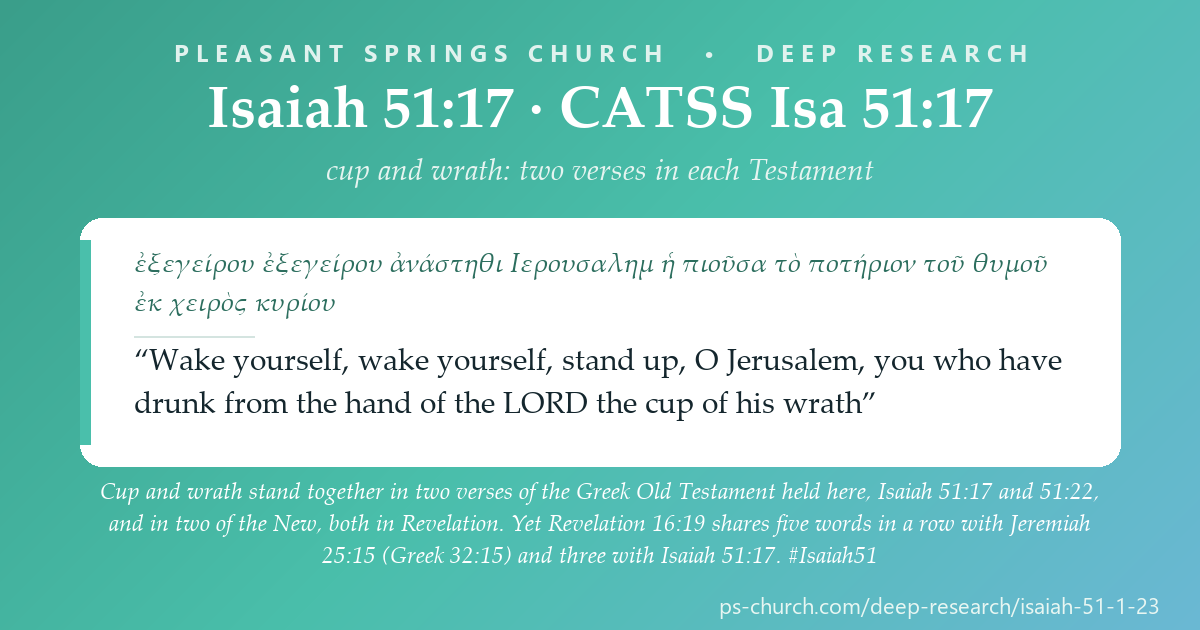
Caption to share: Cup and wrath stand together in two verses of the Greek Old Testament held here, Isaiah 51:17 and 51:22, and in two of the New, both in Revelation. Yet Revelation 16:19 shares five words in a row with Jeremiah 25:15 (Greek 32:15) and three with Isaiah 51:17. #Isaiah51
The Thread — OT · Between the Testaments · NT

Every Deep Research page traces its passage across the whole sweep — the Old Testament, the Second-Temple world between the testaments (historical witnesses, not Scripture), and the New Testament. Follow the thread:
Old TestamentIsaiah 51:1–23This study — the rock and Abraham, Rahab and the sea, I, I am he, and the cup of wrath given and taken, Hebrew and Greek measured against the New Testament.
→
Between the TestamentsPsalms of Solomon 8:14Jerusalem made to drink a cup of unmixed wine, to drunkenness — the words of the psalm and of Jeremiah’s Greek, not of Isaiah’s (a historical witness, not Scripture).
→New TestamentRevelation 14:10 · 16:19The only New Testament verses with cup and wrath together: Isaiah’s vocabulary, Jeremiah’s word order. The depths are reported; the reading is left to the reader.
Share this card Share card — Cup and wrath stand together in two verses of the Greek Old Testament held here, Isaiah 51:17 and 51:22, and in two of the New, both in Revelation. Yet Revelation 16:19 shares five words in a row with Jeremiah 25:15 (Greek 32:15) and three with Isaiah 51:17. #Isaiah51
Facebook X / Twitter Download

Pleasant Springs Church — Deep Research

Research method after Michael S. Heiser’s Bible Research Method (examine dictionaries → ancient literature → important words → textual connections → academic publications → share), with the Pleasant Springs “Author & Audience” foundation. Scripture set in the Hebrew, the Greek editions named on each page and the ESV (Old Testament), and the Greek New Testament and the ESV (New Testament), per the practice of Pleasant Springs Church. VERSE NUMBERING — Isaiah 51. There is no offset in this chapter, and that was derived from the files on this disk. The Masoretic text carries 23 verses in chapter 51; the CATSS Greek carries the same 23 labels, 51:1–51:23; every ESV verse printed here (19 of Isaiah) carries the same number. Isaiah’s one known seam, English 64:2–12 = Hebrew 64:1–11, lies outside this passage. Other books printed here: Jeremiah — Greek 32:15 = Hebrew/ESV 25:15; Greek 38:36 = Hebrew/ESV 31:35; 1:9, 5:14 and 15:5 have no offset. Psalms — Greek 101:27 = Hebrew 102:27 = ESV 102:26; Greek 74:9 = Hebrew 75:9 = ESV 75:8; Greek 86:4 = Hebrew/ESV 87:4; Greek 88:11 = Hebrew 89:11 = ESV 89:10; Greek 68:3 = Hebrew 69:3 = ESV 69:2; Psalm 60:5 in Hebrew is ESV 60:3. Hosea — Hebrew and Greek 2:25 = ESV 2:23; 11:1 and 12:4 in Hebrew are ESV 11:1 and 12:3. Joel — Hebrew and Greek 4:16 = ESV 3:16. Deuteronomy — Hebrew and Greek 13:18 = ESV 13:17. Judges 5:12 is held in two Greek columns (A and B). Job 9:13, 26:12 and 26:13, Ezekiel 33:24, Nahum 3:7 and 3:10, Lamentations 2:19 and 4:1, Genesis 2:1, 13:10 and 44, Zechariah 12:1 and Joshua 24:3 have the same numbers in Hebrew, Greek and English. Psalms of Solomon and 1 Maccabees have no Hebrew column and no ESV here; CATSS numbering. The New Testament references are SBLGNT numbering, which the ESV agrees with at every verse cited. Text: Hebrew from Sefaria’s Miqra according to the Masorah, the read text, markup and section marks stripped for display; Greek Old Testament from the CATSS digitisation of Rahlfs; Greek New Testament from MorphGNT/SBLGNT; ESV from Crossway’s API. No Greek or Hebrew on this page was typed by hand. The measurements: the Hebrew screen ran the chapter against the 23,181 verse units outside it, points and cantillation removed, final forms folded, maqqef treated as a separator; a zero there means no two consecutive words shared. The Greek screen ran all 23 CATSS rows against all 7,927 Greek New Testament verses with the cross-edition spelling folds, the 1,289 rows of the whole of Isaiah for scale, and the New Testament cup and heaven verses back against the whole Greek Old Testament. Lexical counts are exhaustive over 30,348 screened Greek Old Testament verse units (of 30,637 held) and 7,927 New Testament verses, and every uniqueness claim was tested unanchored. Every run is printed with its tie band, and the counter-examples — James 3:14, Revelation 1:8, Mark 14:41, Luke 7:35, John 4:35, 1 Corinthians 11:27, 1 Corinthians 9:9 — are printed so the findings are not read as more than they are. No direction of influence is asserted anywhere on this page. The literary shape is labelled a sequence, with its unpaired unit named and its last unit on the next page. The commentators and theologians in Stage 5 are named and were not consulted; Chrysostom and Tertullian were read in the NPNF and ANF translations held in this church’s research library. The providence frame of Stage 2 is Pleasant Springs’ Molinism, labelled as ours; on the authorship of Isaiah the church holds no ratified position.

Scripture quotations marked ESV are from the ESV® Bible (The Holy Bible, English Standard Version®), © 2001 by Crossway, a publishing ministry of Good News Publishers. ESV Text Edition: 2016. Used by permission. All rights reserved. The ESV text may not be quoted in any publication made available to the public by a Creative Commons license, and the ESV may not be translated in whole or in part into any other language. www.esv.org

Did this study bless you today?

💚  Give to Support PS Church

100% of gifts go to the General Fund — thank you.