In a synagogue in Pisidian Antioch, Paul retells Israel’s story from Egypt to David and then sets out Scripture line after line. Put the sermon on a scale and its two halves come apart. The five lines introduced with a formula from 13:33 on (four in the sermon, the fifth at 13:47 on the next sabbath) run twelve, eight, seven, six and five words deep against the Greek Old Testament, every one with a tie band of one. The one line God speaks inside the retelling — a man after my heart, who will do all my will — runs only four, tie band two, and the two verses that tie are Jeremiah 3:15 and Isaiah 44:28, not 1 Samuel 13:14. Its three longest pieces each stand in exactly one Greek verse, in a psalm, in Jeremiah and in Isaiah. This study works Acts 13:1–52 in the Greek New Testament and the ESV, sets every quotation beside the Hebrew and the Greek, measures the four hundred and fifty years and Saul’s forty, and prints its own counter-examples. See the method →
Acts 13:1–52 (selections)
Greek NT (SBLGNT) · ESVThe Shape of the Passage
A frame with two parallel panels — NOT a chiasmVersification of the texts measured. Psalms: the Greek numbering runs one lower through most of the Psalter, so Greek Psalm 15:10 = Hebrew and ESV 16:10, Greek 65:16 = Hebrew and ESV 66:16 and Greek 77:70–71 = 78:70–71; and three numberings for two verses, Greek 88:21 = Hebrew 89:21 = ESV 89:20 and Greek 48:10 = Hebrew 49:10 = ESV 49:9 (the Hebrew counts the title as verse 1). Psalm 2:7 carries the same number in all three. Kingdoms: 1–2 Samuel are Greek 1–2 Kingdoms and 1–2 Kings are Greek 3–4 Kingdoms; 1 Samuel 2:35, 13:14 and 16:1, 2 Samuel 2:10 and 1 Kings 2:10 and 6:1 carry the same chapter and verse in all three. 1 Samuel 13:1 has no Greek counterpart at all: the CATSS (Rahlfs) Greek of 1 Kingdoms 13 begins at verse 2. Isaiah 42:6, 44:28, 49:6, 51:4 and 55:3, Jeremiah 3:15, Habakkuk 1:5, Deuteronomy 1:31, 4:37 and 7:1 and Daniel 12:2 carry the same numbers in all three, as do Genesis 12:1, Exodus 6:6, Numbers 2:16, Amos 5:25 and Ecclesiastes 7:18 and 8:12; Nehemiah 7:2 is Greek 2 Esdras 17:2 and Ezra 2:15 is Greek 2 Esdras 2:15; Hosea 14:10 in the Hebrew and the Greek = ESV Hosea 14:9. Daniel 12:2 is held in two Greek texts, the Old Greek and Theodotion, named on every line. 1–2 Maccabees, Sirach, Bel and the Psalms of Solomon are Greek witnesses, not Scripture, and have no Hebrew numbering to differ from.
The first sermon of Paul that Acts gives at length, in a synagogue, to a mixed audience. This page measures the sermon before it interprets it.
Author
Luke opens the chapter with a list of names and closes it with a city emptied of the missionaries. In between he gives his hero a second name — “Saul, who was also called Paul” — and the pair is named in two orders: Βαρναβᾶν καὶ Σαῦλον at 13:7, and from 13:43 to the end of the chapter τῷ Παύλῳ καὶ τῷ Βαρναβᾷ. He gives the sermon as a retelling and then a run of quotations, and he marks each quotation with a formula.
How close his quotations stand to the Greek Old Testament is measurable, and Stage 4 measures it: the five lines introduced by a formula from 13:33 on run deep against the Greek Old Testament; the retelling itself runs shallow, and so does the one sentence God speaks inside it.
Audience
Inside the story, a synagogue on a sabbath. Paul addresses two groups and names both: “Men of Israel and you who fear God” (13:16), and again “sons of the family of Abraham, and those among you who fear God” (13:26). The phrase for the second group is measurable: the participle of fear with God directly after it stands in four New Testament verses, Acts 10:2, 10:22, 13:16 and 13:26; in the Greek Old Testament it stands in four units (Nehemiah 7:2, Greek 2 Esdras 17:2; Ecclesiastes 7:18 and 8:12; and Psalm 66:16, Greek 65:16), and the four words of 13:16, with the article, only in the psalm.
Outside it, Theophilus and every reader since. The chapter answers a question the book has carried since Acts 1:8: what happens when the word goes to people who were never in the synagogue. The answer comes in a quotation from Isaiah, and the reader watches two responses to it on the same day.
Orient on Antioch, Cyprus, the proconsul, the magus, Pisidian Antioch, the synagogue service and the God-fearers before reading a word of commentary.
Search by topic: Antioch (Syria) · Cyprus · Salamis · Paphos · Sergius Paulus · proconsul · Bar-Jesus / Elymas · magi · Perga · Antioch of Pisidia · synagogue · God-fearers · proselytes · Iconium.
Which articles are relevant?
- Anchor Bible Dictionary — “Antioch,” “Cyprus,” “Sergius Paulus,” “Elymas,” “Magic,” “Synagogue,” “God-fearers.”
- Dictionary of the Later New Testament / Dictionary of New Testament Background — “Speeches in Acts,” “Proselytism and Godfearers,” “Roman Administration.”
- NIDNTTE / TDNT — τάσσω, ὅσιος, διαφθορά, μάγος, δικαιόω.
- What dictionaries will not settle. The number of years at 13:20, the length of Saul’s reign at 13:21 and the sense of τεταγμένοι at 13:48 are each discussed with confidence in one direction or another. Stage 4 sets the texts side by side and reports what they show.
Bibliography surfaced:
- Craig Keener (Acts, 4 vols.), C. K. Barrett (ICC), Darrell Bock (BECNT), David Peterson (Pillar), F. F. Bruce (NICNT), Joseph Fitzmyer (AB), Richard Pervo (Hermeneia) on Acts 13.
- G. K. Beale and D. A. Carson (eds.), Commentary on the New Testament Use of the Old Testament, on Acts 13:22, 13:33–35, 13:41 and 13:47.
- Bruce Metzger, A Textual Commentary on the Greek New Testament, on Acts 13:18, 13:20, 13:33 and 13:48.
Josephus on Saul’s years and on the years to the temple, the Psalms of Solomon on eternal life, and the synagogue’s law and prophets.
Read the ancient witnesses for what they say, and say where each was read. Every quotation below is from a file on this disk.
“For forty years”: what the Old Testament and Josephus say about Saul
Paul says God gave them Saul “for forty years”. No verse of the Hebrew Bible or of the Greek Old Testament held here gives Saul a reign of forty years. Searched unanchored, the only Masoretic verse holding both the name Saul and the word forty is 2 Samuel 2:10, and the forty there is the age of Saul’s son Ish-bosheth (בֶּן־אַרְבָּעִים שָׁנָה אִישׁ־בֹּשֶׁת); the Greek of that verse is the only Greek unit with both words. The verse that ought to give the number, 1 Samuel 13:1, reads as damaged in the Hebrew and is absent from the Greek:
Josephus, in the Greek of Niese’s edition held here, gives two figures. At the end of his account of Saul’s death: ἐβασίλευσε δὲ Σαμουήλου ζῶντος ἔτη ὀκτὼ πρὸς τοῖς δέκα, τελευτήσαντος δὲ δύο καὶ εἴκοσι (Antiquities 6.378) — he was king while Samuel lived for eighteen years, and after Samuel died for two and twenty (our rendering). Eighteen and twenty-two make forty. Four books later, summing up the kings of David’s line, he says of Saul: ἐξ ὧν εἴκοσι τὴν ἀρχὴν κατέσχεν ὁ πρῶτος αὐτῶν βασιλεὺς Σαοῦλος (10.143) — of which years the first of their kings, Saul, held the rule for twenty (our rendering). So Josephus’s Greek, in this one edition, holds both forty (by addition) and twenty. Whether other manuscripts of Josephus read these numbers differently is not checkable here. A witness, not Scripture.
“About 450 years”: Josephus, the Greek and the Hebrew on the years to the temple
The nearest Old Testament number is the one in 1 Kings 6:1, which counts from the exodus to the fourth year of Solomon. The Hebrew counts בִשְׁמוֹנִים שָׁנָה וְאַרְבַּע מֵאוֹת, four hundred and eighty; the Greek of 3 Kingdoms 6:1 counts ἐν τῷ τεσσαρακοστῷ καὶ τετρακοσιοστῷ ἔτει, in the four hundred and fortieth year. Josephus counts the temple’s founding μετὰ ἔτη πεντακόσια καὶ ἐνενήκοντα καὶ δύο (8.61) — after five hundred and ninety-two years (our rendering) (counted, he goes on, from the Israelites’ going out of Egypt). Three texts, three numbers: four hundred and eighty, four hundred and forty, five hundred and ninety-two. Stage 4 sets Acts’ four hundred and fifty beside them and reports where it falls in the sentence. Josephus is a witness, not Scripture.
Eternal life in a Second Temple poem: the Psalms of Solomon
The phrase εἰς ζωὴν αἰώνιον stands in three units of the Greek Old Testament held here: Daniel 12:2 in both Greek texts, and Psalms of Solomon 3:12, a Second Temple poem: οἱ δὲ φοβούμενοι τὸν κύριον ἀναστήσονται εἰς ζωὴν αἰώνιον — in G. B. Gray’s translation (1913), “But they that fear the Lord shall rise to life eternal” (3:12). The same verse joins three things Acts 13 joins: those who fear (13:16, 13:26), rising (13:30–37) and eternal life (13:46, 13:48). Measured, Acts 13:48 shares three consecutive words with it, the phrase itself, and Acts 13:16 shares two (φοβούμενοι τὸν; the psalm has the Lord where Acts has God). A witness, not Scripture, and a shared idea, not a measured link. See the Psalms of Solomon 1–9 study.
The law and the prophets, read in a synagogue
Acts 13:15 has the service begin μετὰ δὲ τὴν ἀνάγνωσιν τοῦ νόμου καὶ τῶν προφητῶν. The phrase τοῦ νόμου καὶ τῶν προφητῶν runs 5 words, tie band 2, with two Second Temple Greek texts: 2 Maccabees 15:9, where Judas encourages his men ἐκ τοῦ νόμου καὶ τῶν προφητῶν, and the first line of the Greek prologue to Sirach, διὰ τοῦ νόμου καὶ τῶν προφητῶν. The pairing of the two collections as the Scripture read aloud is older than Acts. That the synagogue service had readings from both is the general description given in the handbooks (reported); the order of service in first-century Pisidia is not checkable here.
Every number in Paul’s retelling has a history of harmonising. The texts on this disk are enough to show that the ancient sources do not agree with each other: the Hebrew and the Greek of 1 Kings 6:1 give different totals, Josephus gives a third, and Josephus gives Saul both forty and twenty. Paul’s numbers stand inside a world of differing chronologies. That is a description, not a verdict.
Appointed, corruption, holy things, scoffers, a verb one letter from another, set apart, and a magus.
Lemmas from the MorphGNT columns; word forms from the SBLGNT and the CATSS Greek Old Testament. Every search is unanchored (substring matching on normalised forms), and every homograph found is named.
“Appointed.” The verb τάσσω stands in eight New Testament verses (Matthew 28:16; Luke 7:8; Acts 13:48, 15:2, 22:10, 28:23; Romans 13:1; 1 Corinthians 16:15), five of them in Luke or Acts. The form here is a perfect participle, and in this verb the perfect middle and passive are spelled alike; MorphGNT parses it passive. The exact phrase τεταγμένοι εἰς ζωὴν αἰώνιον stands nowhere else in the Greek New Testament or in the Greek Old Testament held here (searched unanchored, every form containing the stem). Stage 6 gives the readings.
Corruption, decay. Six times in the New Testament, every one of them in Acts and every one in the same form: twice in Peter’s Pentecost sermon (2:27, 2:31) and four times in four consecutive verses here. The Greek of Psalm 16:10 (Greek 15:10) has the word; the Hebrew has another (Stage 4).
Holy things — the neuter plural of the adjective whose masculine is τὸν ὅσιόν σου in the next verse. The adjective stands eight times in the New Testament, three in Acts (2:27, 13:34, 13:35). The two verses share the adjective and the verb give and no word form but διαφθοράν.
Scoffers, despisers. Once in the New Testament. In the Greek Old Testament the plural with the article, οἱ καταφρονηταί, stands once, in Habakkuk 1:5, where the Hebrew has among the nations (Stage 4).
Bore with their ways. Once in the New Testament, and no form of it in the Greek Old Testament held here. Deuteronomy 1:31 has the verb one letter away, ἐτροφοφόρησέν, carried like a nurse; it stands in two units, Deuteronomy 1:31 and 2 Maccabees 7:27.
“Set apart.” Ten times in the New Testament, twice in Acts. Paul uses the same verb of himself in Galatians 1:15 and Romans 1:1.
Magus. Six times in the New Testament: four in Matthew 2 and two here. In the Greek Old Testament forms of the noun stand only in Daniel, in ten units: chapters 1, 2, 4 and 5 in Theodotion and chapter 2 in the Old Greek, among the king’s wise men. The noun names a class of expert, and Luke sets beside it ψευδοπροφήτην.
Verbs and nouns of one stem, kept apart
Filled. πίμπλημι (13:9, 13:45) and πληρόω (13:25, 13:27, 13:52) are two verbs; the structure diagram links only the first. Justified. The verb δικαιόω stands 39 times in the New Testament and twice in Acts, both here: δικαιωθῆναι (13:38) and δικαιοῦται (13:39). Eternal. The adjective αἰώνιος stands 69 times in the New Testament and in Acts only at 13:46 and 13:48, each time with life; in the order adjective–noun at 13:46, τῆς αἰωνίου ζωῆς, and noun–adjective at 13:48. Corruption. Only the noun διαφθορά; the verb of the same stem does not stand in the chapter.
Where the New Testament picks these up:
- Hebrews 1:5; 5:5 — the same eight words of Psalm 2:7. See the Hebrews 1 study and the Hebrews 5–7 study.
- Acts 2:25–31 — Peter’s use of Psalm 16 at Pentecost; see the Psalms in the New Testament study.
- Luke 2:32 — Simeon’s light for the Gentiles; see the Luke 1–2 study.
- Acts 18:6; 28:28 — two more turns to the Gentiles, at Corinth and at Rome.
- Acts 14 — Iconium, Lystra, and the return to Antioch εἰς τὸ ἔργον; see the Acts 14–16 study.
Five quotations that run deep, one sentence of God’s that is a mosaic, and the numbers.
Method: longest contiguous run of identical normalised word forms, with the tie band — the number of target units reaching the same maximum. Runs find verbatim contact, not allusion. Greek screens use the unigram fallback, so a reported 1 means shares only isolated word forms and 0 would mean shares no word form at all. The Greek Old Testament is Rahlfs as encoded by CATSS: 30,348 units screened (the Odes set aside, because they repeat other books), 30,637 held with the Odes. Every figure on this page is about these editions.
First: the chapter against the whole Greek Old Testament
Every one of the 52 verses of Acts 13 was screened against the 30,348 Greek Old Testament units.
| deepest run against the Greek OT | rows of Acts 13 |
|---|---|
| 12 | 1 |
| 8 | 1 |
| 7 | 1 |
| 6 | 2 |
| 5 | 2 |
| 4 | 12 |
| 3 | 25 |
| 2 | 7 |
| 1 | 1 |
One row, 13:28, shares only isolated word forms. Seven rows reach a run of five or more, and five of them carry a citation formula (four in the sermon, and 13:47 on the next sabbath).
| Acts | deepest Greek OT partner | run | tie band | what it is |
|---|---|---|---|---|
| 13:47 | Isaiah 49:6 | 12 | 1 | a marked citation — οὕτως γὰρ ἐντέταλται ἡμῖν ὁ κύριος |
| 13:33 | Psalm 2:7 | 8 | 1 | a marked citation — ἐν τῷ ψαλμῷ γέγραπται τῷ δευτέρῳ |
| 13:41 | Habakkuk 1:5 | 7 | 1 | a marked citation — τὸ εἰρημένον ἐν τοῖς προφήταις (13:40) |
| 13:35 | Psalm 16:10 (Greek 15:10) | 6 | 1 | a marked citation — ἐν ἑτέρῳ λέγει |
| 13:36 | 1 Maccabees 2:69; Bel 1:1 (Th) | 6 | 2 | a formula for a death: Mattathias (1 Maccabees 2:69) and Astyages (Bel 1, Theodotion) |
| 13:15 | 2 Maccabees 15:9; Sirach prologue | 5 | 2 | a formula: the law and the prophets (2 Maccabees 15:9; Sirach, prologue) |
| 13:34 | Isaiah 55:3 | 5 | 1 | a marked citation — οὕτως εἴρηκεν ὅτι |
The five marked citations run 12, 8, 7, 6 and 5, every one with a tie band of one: no other unit of the Greek Old Testament reaches the same depth with any of them. The two rows that are not citations are the page’s own counter-examples. Acts 13:36, “was laid with his fathers”, runs six — as deep as the Psalm 16 citation beside it — with the deaths of Mattathias in 1 Maccabees and of Astyages in Greek Bel, a burial formula that also stands, in the plural, at Judges 2:10. And Acts 13:15 runs five with two Second Temple texts on the phrase the law and the prophets. Both tie, with a band of two where each marked citation has a band of one; depth alone does not tell a citation from a stock phrase, and no measurement here can say which a line is by itself.
Then the sixth quotation. At 13:22 Paul introduces a saying of God with ᾧ καὶ εἶπεν μαρτυρήσας — “of whom he testified and said” — and the saying runs only 4, with a tie band of 2: Jeremiah 3:15 and Isaiah 44:28. Neither is 1 Samuel 13:14, the verse the commentaries trace the saying to (reported), which runs 3.
Second: one sentence of God’s, four homes (13:22)
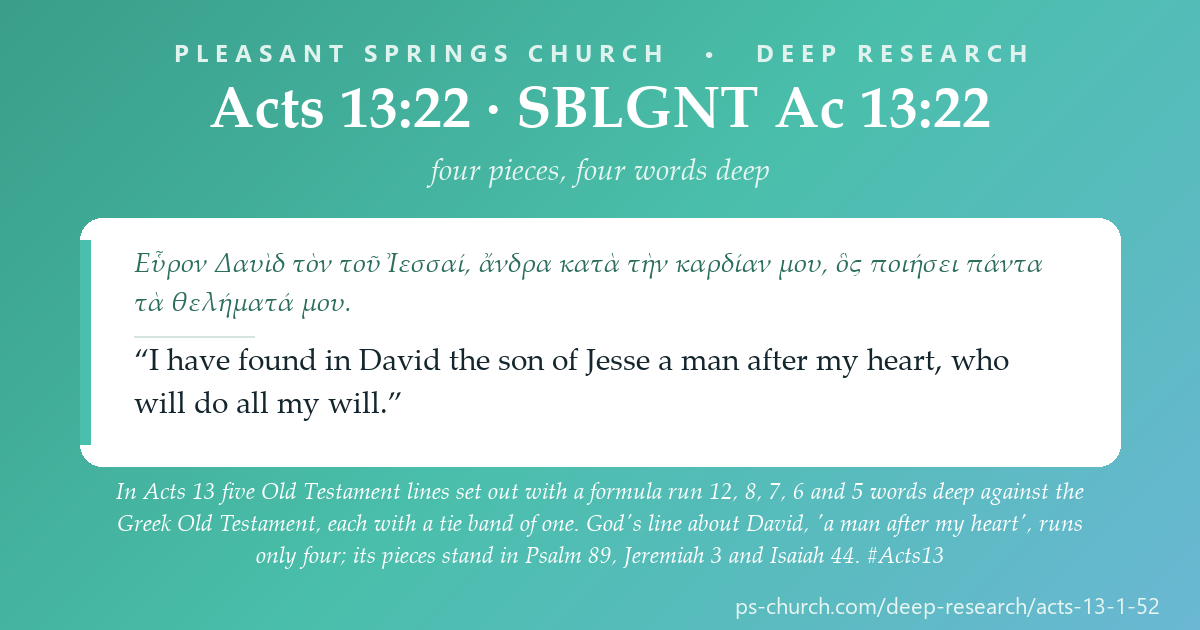
And when he had removed him, he raised up David to be their king, of whom he testified and said, ‘I have found in David the son of Jesse a man after my heart, who will do all my will.’ The quoted words, Εὗρον Δαυὶδ τὸν τοῦ Ἰεσσαί, ἄνδρα κατὰ τὴν καρδίαν μου, ὃς ποιήσει πάντα τὰ θελήματά μου, are 16 word forms. Searched unanchored against every screened unit, every one of the 16 lies inside a shared run of at least two, and no run is longer than four. The three longest pieces each stand in exactly one unit, and the three units are in three different books:
| piece of 13:22 | where the Greek Old Testament has it (unanchored) | what the verse is |
|---|---|---|
| Εὗρον Δαυὶδ τὸν | Psalm 89:20 (Greek 88:21) — one unit | God, of David: εὗρον Δαυιδ τὸν δοῦλόν μου; Acts goes on τοῦ Ἰεσσαί |
| κατὰ τὴν καρδίαν μου | Jeremiah 3:15 — one unit | God, of the shepherds he will give: ποιμένας κατὰ τὴν καρδίαν μου |
| κατὰ τὴν καρδίαν | Seven units, among them 1 Samuel 13:14 | Samuel to Saul, of his successor: ἄνθρωπον κατὰ τὴν καρδίαν αὐτοῦ — a man (another noun) after his heart |
| πάντα τὰ θελήματά μου | Isaiah 44:28 — one unit | God, of Cyrus: καὶ πάντα τὰ θελήματά μου ποιήσει |
| ἄνδρα κατὰ τὴν καρδίαν | no unit | — |
The verse usually named, 1 Samuel 13:14, has κατὰ τὴν καρδίαν αὐτοῦ, the third person, and another noun for man; Acts shares six word forms with it, three in a row (εἰς, καὶ, καρδίαν, κατὰ, τὴν, τὸν). The first-person κατὰ τὴν καρδίαν μου stands in one Greek Old Testament unit, Jeremiah 3:15, where God promises shepherds. Psalm 89:20 runs 3 and then parts company — the psalm says τὸν δοῦλόν μου, Acts τὸν τοῦ Ἰεσσαί — with five forms shared in all. Isaiah 44:28 runs 4, and its ποιήσει is shared out of order, after the clause in Isaiah and before it in Acts. 1 Samuel 2:35, where God promises a faithful priest ὃς πάντα τὰ ἐν τῇ καρδίᾳ μου … ποιήσει, shares six forms with Acts 13:22 and runs only two.
A reader’s observation, not a measured link. In the Hebrew, both verses that tie at four have a word for shepherd: רֹעִים at Jeremiah 3:15 and רֹעִי at Isaiah 44:28. In the Greek only Jeremiah does (ποιμένας). Psalm 78:70–71 (Greek 77:70–71) is the psalm in which God chooses David from the sheepfolds to shepherd Jacob (ποιμαίνειν Ιακωβ). The page reports the coincidence and claims nothing from it.
Third: Psalm 2:7, eight words (13:33)
“as also it is written in the second Psalm”. Acts 13:33 runs 8 with Psalm 2:7, band 1: Υἱός μου εἶ σύ, ἐγὼ σήμερον γεγέννηκά σε — the whole of the psalm’s saying and nothing before it. Against the rest of the New Testament the same eight stand in two verses, Hebrews 1:5 and Hebrews 5:5 (band 2); Luke’s own baptism voice, Luke 3:22, shares two (υἱός μου). The phrase υἱός μου εἶ σύ stands in one Greek Old Testament unit and in those three New Testament verses. This is the one place in the New Testament where a psalm is named by its number (searched: a form of psalm and an ordinal in one verse). See the Psalms 1–2 study.
An edition-dependent detail. The SBLGNT file marks a variation unit spanning ψαλμῷ … δευτέρῳ. That some ancient witnesses number the psalm differently (as the first) is reported; no Acts apparatus is held.
Fourth: two lines joined by a word that is not shared (13:34–35)
And as for the fact that he raised him from the dead, no more to return to corruption, he has spoken in this way, “‘I will give you the holy and sure blessings of David.’ Therefore he says also in another psalm, “‘You will not let your Holy One see corruption.’ Acts 13:34 runs 5 with Isaiah 55:3 (τὰ ὅσια Δαυὶδ τὰ πιστά, band 1; ὑμῖν also shared, out of order), and Acts 13:35 runs 6 with Psalm 16:10 (δώσεις τὸν ὅσιόν σου ἰδεῖν διαφθοράν, band 1). The two Acts verses share no word form with each other but διαφθοράν, which comes from Paul’s own lead-in to 13:34, not from Isaiah. What joins the two quotations is two lemmas: δίδωμι (Δώσω / δώσεις) and ὅσιος (ὅσια / ὅσιόν). The link holds in the Hebrew too, where Isaiah has חַסְדֵי and the psalm חֲסִידְךָ, both built on the letters ḥ-s-d; the give link does not, because at that point Isaiah has וְאֶכְרְתָה, and I will cut (a covenant), and its Greek διαθήσομαι: the verb Δώσω is Acts’ own wording of the line. That the pairing is a recognised technique of Jewish exegesis is reported; the measurement shows only that the words are there.
Peter and Paul on the same psalm. Acts 2:27 runs 15 with Psalm 15:10, the whole of its 15 word forms; Acts 13:35 has the last six, with Οὐ where the psalm and Acts 2:27 have οὐδὲ. Against each other, Acts 13:35 and Acts 2:27 run 6, band 1 against the whole New Testament. And both sermons draw the same conclusion in the same two words: εἶδεν διαφθοράν, said of David at 13:36 and of the one God raised at 13:37, stands in three New Testament verses, Acts 2:31, 13:36 and 13:37, and in no Greek Old Testament unit held here; ἰδεῖν διαφθοράν stands in one, Psalm 15:10. A verb of seeing (its common forms searched) with a noun from the stem of corruption stands in six Greek Old Testament units, Psalm 15:10 and Psalm 49:9 (Greek 48:10, οὐκ ὄψεται καταφθοράν) among them. The noun διαφθορά stands in the New Testament six times, all in these two sermons. Peter’s verses in Greek, with our rendering: ὅτι οὐκ ἐγκαταλείψεις τὴν ψυχήν μου εἰς ᾅδην, οὐδὲ δώσεις τὸν ὅσιόν σου ἰδεῖν διαφθοράν. — since you will not forsake my soul to Hades, and you will not give your holy one over to look upon decay (our rendering; the ESV of this verse is not printed here); and οὔτε ἡ σὰρξ αὐτοῦ εἶδεν διαφθοράν.
Fifth: Habakkuk’s scoffers (13:41)
“‘Look, you scoffers, be astounded and perish; for I am doing a work in your days, a work that you will not believe, even if one tells it to you.’” Acts 13:41 runs 7 with Habakkuk 1:5, band 1 in both directions (Habakkuk 1:5’s deepest New Testament partner is this verse): ὃ οὐ μὴ πιστεύσητε ἐάν τις ἐκδιηγῆται. Counting forms in order with gaps allowed, 20 of Acts’ 24 forms stand in Habakkuk’s order (Habakkuk has 25). Habakkuk has three forms Acts 13:41 does not (καὶ ἐπιβλέψατε, θαυμάσια, διότι), and Acts has ὅτι and a closing ὑμῖν that Habakkuk does not. The run breaks where Acts has ἐργάζομαι ἐγὼ against Habakkuk’s ἐγὼ ἐργάζομαι, and again at Acts’ second ἔργον. The Habakkuk study reports the same seven and the same mutual band; see the Habakkuk study.
An edition-dependent figure. The SBLGNT file marks variation units at both places the run breaks: ἐργάζομαι ἐγὼ and the second ἔργον. With Habakkuk’s word order and without the second noun, the run would be 14, not 7. Which manuscripts read what cannot be checked here.
Sixth: a light for the nations (13:47)
For so the Lord has commanded us, saying, “‘I have made you a light for the Gentiles, that you may bring salvation to the ends of the earth.’” The deepest row of the chapter: 12 consecutive words with Isaiah 49:6, band 1, εἰς φῶς ἐθνῶν τοῦ εἶναί σε εἰς σωτηρίαν ἕως ἐσχάτου τῆς γῆς, after a separate run of two (Τέθεικά σε). Between the two runs the Greek Isaiah has εἰς διαθήκην γένους, which Acts 13:47 does not, and which the Hebrew of Isaiah 49:6 does not have either. The Isaiah 45–50 study measures the same twelve; see the Isaiah 45–50 study.
Why Isaiah 49:6 and not 42:6 or 51:4. εἰς φῶς ἐθνῶν stands in three Greek Old Testament units, Isaiah 42:6, 49:6 and 51:4 (the figure the Luke 1–2 study reports), and in one New Testament verse, this one. Against Acts 13:47, 42:6 gives 3, 51:4 gives 3 and 49:6 gives 12.
The counter-examples. Simeon’s line in Luke 2:32, “a light for revelation to the Gentiles”, has the two nouns with two words between (φῶς εἰς ἀποκάλυψιν ἐθνῶν) and shares with Acts 13:47 only one isolated form; Paul’s own later summary at Acts 26:23, φῶς μέλλει καταγγέλλειν, likewise runs 1. The deepest New Testament partner of Acts 13:47 is Acts 1:8 at 4, on ἕως ἐσχάτου τῆς γῆς — four words that stand in five Greek Old Testament units (Isaiah 8:9, 48:20, 49:6, 62:11 and Psalms of Solomon 1:4), so that Acts 1:8 on its own cannot be traced to one of them.
Seventh: the numbers in the retelling (13:17–21)
About four hundred and fifty years (13:20). All this took about 450 years. And after that he gave them judges until Samuel the prophet. In the SBLGNT the number stands before καὶ μετὰ ταῦτα ἔδωκεν κριτὰς, after the conquest of 13:19 and before the judges; in the King James Version it stands with the judges: “And after that he gave [unto them] judges about the space of four hundred and fifty years, until Samuel the prophet.” (KJV, 1769 text on disk). The SBLGNT file marks a variation unit over exactly that span (Codex, above). The number therefore measures two different periods in the two editions. The page does not reconcile it with 1 Kings 6:1, which gives four hundred and eighty in the Hebrew and four hundred and forty in the Greek; Acts 13:20 shares only isolated forms with that verse (run 1). The words for four hundred and fifty, joined by and as Acts joins them, stand in four Greek Old Testament units, none of them a chronology: the total of Reuben’s camp (Numbers 2:16), the prophets of Baal (1 Kings 18:19, 18:22) and Solomon’s gold (2 Chronicles 8:18); without the and, the two words also stand in Adin’s four hundred and fifty-four (Ezra 2:15, Greek 2 Esdras 2:15, and 1 Esdras 5:14). How commentators reach the four hundred and fifty (for instance four hundred in Egypt, forty in the wilderness and a few years of conquest) is reported.
Forty years, twice (13:18, 13:21). And for about forty years he put up with them in the wilderness. Then they asked for a king, and God gave them Saul the son of Kish, a man of the tribe of Benjamin, for forty years. Stage 2 reports that no Old Testament verse gives Saul forty years, and that Josephus gives both forty and twenty. The compound at 13:18, τεσσερακονταετῆ, stands in two New Testament verses: here, and in Stephen’s speech at Acts 7:23, of Moses’ age. No Greek Old Testament unit has the compound in either spelling. A spelling the normaliser does not fold: the SBLGNT writes τεσσεράκοντα and the CATSS Greek Old Testament τεσσαράκοντα, so no run through the word forty can join Acts to any Greek Old Testament verse.
The verb of 13:18. Acts 13:18 runs 3 with Deuteronomy 1:31 (ἐν τῇ ἐρήμῳ), and the verbs differ by one letter, as the Codex note says; the deepest partners of 13:18 are 9 units at 4 on αὐτοὺς ἐν τῇ ἐρήμῳ. The seven nations of 13:19 are Deuteronomy 7:1’s count in the other order (ἔθνη ἑπτὰ against ἑπτὰ ἔθνη), so the two verses run only 2. And the uplifted arm of 13:17, μετὰ βραχίονος ὑψηλοῦ, has the Greek Old Testament’s two words in another case: the genitive phrase stands in no Greek Old Testament unit, and the dative ἐν βραχίονι ὑψηλῷ in twelve, Exodus 6:6 among them. Acts 13:17 and Exodus 6:6 share four isolated forms and no two in a row.
Eighth: against the New Testament, and against Stephen
The 52 verses against the 7,875 Greek New Testament verses outside Acts 13.
| deepest run | rows |
|---|---|
| 8 | 1 |
| 6 | 1 |
| 5 | 3 |
| 4 | 18 |
| 3 | 25 |
| 2 | 4 |
| row | partner | run | band |
|---|---|---|---|
| Acts 13:33 | Hebrews 1:5; Hebrews 5:5 | 8 | 2 |
| Acts 13:35 | Acts 2:27 | 6 | 1 |
| Acts 13:15 | Romans 3:21 | 5 | 1 |
| Acts 13:43 | Acts 15:2 | 5 | 1 |
| Acts 13:44 | Acts 19:10 | 5 | 1 |
Two more counter-examples, both about Luke against Luke. When the missionaries shake the dust from their feet (13:51), the verse runs 4 with Jesus’ command in Matthew 10:14 (τὸν κονιορτὸν τῶν ποδῶν, band 1) and only 2 with the same command in Luke’s own Gospel, 9:5 and 10:11. When John the Baptist speaks of the sandal (13:25), the verse runs 4 with John 1:27 and 3 with Luke 3:16. The same writer does not always run deepest with himself.
Paul’s retelling and Stephen’s. Stephen’s speech in Acts 7 retells the same history (his from Abraham to Solomon’s house, Paul’s from Egypt to David). Measured verse pair by verse pair, Stephen’s fifty-two verses (7:2–53) against Paul’s 13:16–41 reach 4 once, and that four is τὸ ὑπόδημα τῶν ποδῶν — John’s sandal at 13:25 against Moses’ at the bush, Acts 7:33; of 1,352 verse pairs, 1,227 share no two consecutive forms. Against the retelling proper (13:17–22) the deepest pairs reach 3, seven of them, on phrases like ἐν τῇ ἐρήμῳ. The two retellings share a vocabulary — the compound for forty years above, κἀκεῖθεν (Acts 7:4 and 13:21) — and no sentence.
And they differ in where they run deep. Measured here against the Greek Old Testament, Stephen’s retelling runs deepest in reported speech, most of it God’s: God to Abraham at Acts 7:3 runs 11 with Genesis 12:1, and God through Isaiah at 7:49 runs 15 with Isaiah 66:1. Three more rows tie at eleven: the Lord at the bush (7:34, Exodus 3:7), the Lord through Amos (7:43, Amos 5:26) and a man’s retort to Moses (7:28, Exodus 2:14); the people’s demand of Aaron (7:40, Exodus 32:1) runs ten. See the Acts 7–8 study. Paul’s retelling has one sentence of God’s, and it runs four. Paul’s depths come afterwards, in the five lines he introduces with a formula.
Ninth: the words of 13:48, counted
And when the Gentiles heard this, they began rejoicing and glorifying the word of the Lord, and as many as were appointed to eternal life believed. τεταγμένοι εἰς ζωὴν αἰώνιον stands in no other verse of the Greek New Testament and in no unit of the Greek Old Testament held here (searched unanchored on every form containing τεταγμένοι’s stem, compounds included). εἰς ζωὴν αἰώνιον alone stands in 9 New Testament verses and three Greek Old Testament units (Daniel 12:2 in both Greek texts, and Psalms of Solomon 3:12). In Acts, eternal life in any order and case stands only at 13:46 and 13:48, two verses apart: the synagogue “judge yourselves unworthy of eternal life”, and the Gentiles “as many as were appointed to eternal life believed”.
Theodotion: καὶ πολλοὶ τῶν καθευδόντων ἐν γῆς χώματι ἐξεγερθήσονται οὗτοι εἰς ζωὴν αἰώνιον καὶ οὗτοι εἰς ὀνειδισμὸν καὶ εἰς αἰσχύνην αἰώνιονDan 12:2And many of those who sleep in the dust of the earth shall awake, some to everlasting life, and some to shame and everlasting contempt.Translation note⚠ Greek and Hebrew differ here. Both Greek texts have εἰς ζωὴν αἰώνιον for the Hebrew לְחַיֵּי עוֹלָם, to everlasting life. The Old Greek has a third group, οἱ δὲ εἰς διασπορὰν, others to dispersion, which the Hebrew and Theodotion do not have.
Paul’s sermon has two halves, and the measurement shows them. The retelling, from Egypt to John, runs shallow against the Greek Bible: its deepest rows reach four. Then come five lines introduced by a formula (the fifth, Isaiah 49, a sabbath later), and every one of them runs deep with a tie band of one — Psalm 2 at eight, Isaiah 55 at five, Psalm 16 at six, Habakkuk at seven, Isaiah 49 at twelve. Two formulae that are not citations reach the same depths, and the page prints them, so that the five are not read as more than they are.
The one line God speaks inside the retelling is the surprise. “I have found in David the son of Jesse a man after my heart, who will do all my will.” It reads as one sentence, and no Old Testament verse holds more than four of its words in a row. Its pieces stand in a psalm about David, in Jeremiah’s promise of shepherds and in Isaiah’s word to Cyrus, each in exactly one Greek verse; the verse readers hear in it, 1 Samuel 13:14, holds three of the words in a row, with a different noun for man and a different person for heart.
What was consulted, what was not, and where this page is weakest.
This section is what makes the shelf trustworthy. Read it before using anything above.
Commentaries and studies a reader should consult:
- Craig S. Keener, Acts: An Exegetical Commentary; C. K. Barrett (ICC); Darrell L. Bock (BECNT); David G. Peterson (Pillar); F. F. Bruce (NICNT); Joseph A. Fitzmyer (Anchor); Richard I. Pervo (Hermeneia). None was opened for this page; they are named as the standard discussions a reader should consult.
- G. K. Beale and D. A. Carson (eds.), Commentary on the New Testament Use of the Old Testament (reported; not held).
- Bruce Metzger, A Textual Commentary on the Greek New Testament, on Acts 13:18, 13:20, 13:33 and 13:48 (reported; not held).
What this page could NOT check — stated plainly
- No apparatus for Acts is held. The SBLGNT apparatus on this disk covers Luke, Romans, Jude and Revelation. The SBLGNT file for Acts marks 68 variation-unit signs in chapter 13, and several fall exactly where a finding on this page stands or would change: 13:20 (the span ὡς … ταῦτα, which decides what the four hundred and fifty years measure), 13:33 (ἡμῶν, and the span ψαλμῷ … δευτέρῳ), 13:41 (ἐργάζομαι ἐγὼ and the second ἔργον, where the Habakkuk run breaks) and 13:48 (ἔχαιρον and κυρίου). What the other editions read at these places is not verifiable here.
- The Western text is reported only. The commentaries report that Codex Bezae and its allies differ from the SBLGNT at several places in this chapter — among them the number of the psalm at 13:33 and the wording of 13:48 — and none of it is checked here.
- Acts 13:18. The SBLGNT reads ἐτροποφόρησεν and marks no variation unit there; that a large part of the manuscript tradition of Acts reads the Deuteronomy verb ἐτροφοφόρησέν, and that some manuscripts of Deuteronomy read the Acts verb, is reported, not checked.
- One Greek Old Testament edition. Rahlfs, as encoded by CATSS, with no Göttingen apparatus. Every run on this page is a run against that text. 1 Samuel 13:1 is not in it, and that some Greek manuscripts supply the verse (with thirty for Saul’s age, among other readings) is reported. The Odes are set aside from the screen and checked separately in the selfcheck.
- Hebrew: the Masoretic text only. No Qumran Samuel and no Targum was read, so the damage at 1 Samuel 13:1 is described from the Masoretic line alone. The ketiv and qere of the word for holy one at Psalm 16:10 are discussed in the commentaries (reported); the edition held prints one form and marks no note on it.
- Josephus in one Greek edition. Niese, as encoded by Perseus. Whether manuscripts of Antiquities 6.378 or 10.143 give other numbers for Saul is not checkable here.
- A spelling the normaliser does not fold (τεσσεράκοντα in the SBLGNT, with a in the CATSS forms) means no run through the word forty is possible. Every figure is a figure about two encoded editions and the frozen normaliser.
- Word forms, not lemmas, for every run. Lemma counts are labelled as lemma counts (the MorphGNT column). The filled link in the structure diagram is a lemma link and is labelled so, and the link between 13:34 and 13:35 is a lemma link and is labelled so.
- The historical questions are untouched. Sergius Paulus and the inscriptions reported to name a proconsul of that name, the route from Perga to Pisidian Antioch, John Mark’s departure, and how the four hundred and fifty years and Saul’s forty are to be reckoned are history. NOT VERIFIABLE FROM LOCAL CORPORA.
- The Isaiah 44:28 Cyrus clause is discussed only as far as Acts 13:22 needs it; this page reports the Hebrew and the Greek and says nothing further about either.
Where this page is weakest
First, its headline is a contrast between six lines, and six is a small number. Five marked citations run deep, and the sixth does not is exact, and it rests on what this page counts as a citation formula. A reader who counts 13:22’s ᾧ καὶ εἶπεν μαρτυρήσας as no formula at all removes the contrast. The page does not show that 13:22 is a composite in Luke’s mind; it shows where its words stand in the Greek Old Testament held here.
Second, the mosaic is a statement about one edition. A Greek manuscript of 1 Samuel 13:14 or Psalm 89:20 with other wording would change the table, and none was consulted.
Third, the structure diagram is a reading. The units are not in dispute; the three colour pairs are measured (a phrase, a lemma and a verb form) and the rest is editorial.
Fourth, several findings move with the edition — 13:20 entirely, 13:41 at the two breaks, 13:18 at the verb, and 13:33 at the pronoun. They are flagged where they stand.
Fifth, the doctrinal readings in Stage 6 are reported, and the church’s own positions are given in its own words. The church’s /beliefs page has no article on election; the page says so and does not invent one.
Five quotations, one mosaic, and two responses on one sabbath.
Name what you learned, why it matters, and one concrete response.
Readings, given fairly — and what the church holds
1. “As many as were appointed to eternal life believed” (13:48). And when the Gentiles heard this, they began rejoicing and glorifying the word of the Lord, and as many as were appointed to eternal life believed. This is one of the verses on which the doctrine of election is most often argued. The readings (all reported, with the holders named as the commentaries name them):
- Unconditional election. The perfect passive participle describes an appointment by God that comes before the believing and explains it: those God had appointed believed. This is the Reformed reading (Calvin and the Reformed commentators, reported), and it has an ancient form in Augustine, who asks in On Rebuke and Grace (chapter 10 in the NPNF; Latin 6.10): “Who could be ordained to eternal life save by the gift of perseverance?” (NPNF translation).
- Disposition or readiness. The participle describes the hearers’ state — those who were disposed toward, or ready for, eternal life believed — without saying who set the disposition. This is a common Arminian and Wesleyan reading (reported).
- The middle voice. Because the perfect middle and passive are spelled alike, some read τεταγμένοι as middle, as many as had set themselves toward eternal life (reported). The measurement can add the New Testament’s own usage of the verb, which is mixed: it has a reflexive object once, ἔταξαν ἑαυτούς (1 Corinthians 16:15), is middle at Matthew 28:16 and Acts 28:23, and is passive with God named as the one who appoints at Romans 13:1 (ὑπὸ θεοῦ τεταγμέναι). The usage does not decide the verse.
- Middle knowledge (Molinism). God’s appointing is real and comes first, and it works through his knowledge of what each person would freely do in the circumstances he ordains: those appointed believed, and their believing was their own (Luis de Molina, and modern Molinists such as William Lane Craig and Kenneth Keathley, reported).
- Others. That the verse speaks of the Gentiles as a group set alongside the synagogue’s refusal two verses earlier (a corporate reading, reported); and John Chrysostom, preaching on this verse, glosses the verse’s ordained unto eternal life (the NPNF wording) with “i.e., set apart for God.” and later goes on, “But ‘ordained,’ not in regard of necessity: ‘whom He foreknew,’ saith the Apostle, ‘He did predestinate.’” (Homilies on Acts 30, NPNF translation).
What the church holds, in its own words. The church’s /beliefs page has no article on election or predestination. Its Article 10, Hope, says that “no one is beyond the offer of grace” — and, of those who receive Christ, that “all who genuinely receive Christ are held secure” and that “Scripture’s warnings are themselves a real means by which He holds us fast.” The church’s teaching on election is set out in its discipleship lesson TULIP, DAISY & ROSES, which says: “Pleasant Springs Church stands in this evangelical Molinist tradition.” and, of election, “Election is real and unconditional in one sense (God’s choice of the world) and conditional in another (each believer’s faith is a true free act).” That is the church’s frame, and the page labels it as the church’s. Acts 13:48 does not by itself prove it, and the page does not claim that it does; the same lesson lists the verse among the texts the Calvinist reading appeals to. What the text itself puts side by side is two verses: those who “thrust it aside and judge yourselves unworthy of eternal life”, and those who “were appointed to eternal life”. A reading of 13:48 should be able to say something about 13:46 as well.
2. “Everyone who believes is freed” (13:38–39). Let it be known to you therefore, brothers, that through this man forgiveness of sins is proclaimed to you, and by him everyone who believes is freed from everything from which you could not be freed by the law of Moses. The offer is made to the whole synagogue, Israelites and God-fearers alike, and its scope is πᾶς ὁ πιστεύων — a phrase that stands in six New Testament verses in this form (eleven in any case) and in no Greek Old Testament unit held here in any case. The church holds an unlimited-provision atonement, offered for all, without universalism, received by faith; its lesson puts it so: “Christ’s death is sufficient for the sins of all humanity without exception and is genuinely offered to all.” Acts 13:39 does not argue that position, and the page does not press it on the verse.
3. “To continue in the grace of God” (13:43). And after the meeting of the synagogue broke up, many Jews and devout converts to Judaism followed Paul and Barnabas, who, as they spoke with them, urged them to continue in the grace of God. The same missionaries who announce that everyone who believes is freed urge the believers to continue. Readers weigh exhortations like this differently (reported). The church’s Article 10 counts Scripture’s warnings among the means by which God holds his own; the page notes that the text puts the exhortation and the promise in the same scene and draws nothing further.
4. Antioch’s synagogue (13:45, 13:50), and the history of reading it. But when the Jews saw the crowds, they were filled with jealousy and began to contradict what was spoken by Paul, reviling him. But the Jews incited the devout women of high standing and the leading men of the city, stirred up persecution against Paul and Barnabas, and drove them out of their district. In the story these are the members and leaders of one synagogue in one city, and the chapter itself shows that city’s Jewish community divided: “many Jews and devout converts to Judaism followed Paul and Barnabas”. Paul is a Jew preaching Israel’s Scriptures in a synagogue, and the light for the nations he sets out is Israel’s own prophet. Passages like this have been misused in Christian history as a charge against the Jewish people as a whole (reported; a matter of record in the history of interpretation). The text does not support that, and this page reads it as the account of one city’s synagogue.
5. “Saw corruption” (13:36). For David, after he had served the purpose of God in his own generation, fell asleep and was laid with his fathers and saw corruption, David served, died and decayed. The church teaches ancestral sin as inherited mortality, not inherited guilt (see Original Sin); the verse speaks of David’s death and decay and says nothing of guilt, and the page claims no more for it than that.
What should we carry away — and do?
- Know the lines the preacher used. Paul’s preaching at Antioch, over two sabbaths, leans its weight on five lines of Scripture, and the Greek shows his wording close to the Greek Bible’s. A church that wants to preach the resurrection the way Acts does should know Psalm 2, Isaiah 55, Psalm 16, Habakkuk 1 and Isaiah 49.
- Hear God’s word about David whole. The sentence in 13:22 gathers a psalm, a prophet and a promise of shepherds into one line. What God wanted in a king is said by the whole of Scripture, not by one verse.
- Watch the two responses. And the disciples were filled with joy and with the Holy Spirit. On the same day the word was refused and received, and the joy came to the people who stayed.
- The offer is to everyone. The sermon says “everyone who believes is freed”. It makes the offer before it gives the warning.
Step in response: this week, read Acts 13:16–41 aloud and mark every line that is a quotation. Then look up one of them where it stands in the Old Testament and read the verses around it.
Acts 13:22 · to share
Greek NT + ESVEvery Deep Research page traces its passage across the whole sweep — the Old Testament, the Second-Temple world between the testaments (historical witnesses, not Scripture), and the New Testament. Follow the thread:
Pleasant Springs Church — Deep Research
Research method after Michael S. Heiser’s Bible Research Method (examine dictionaries → ancient literature → important words → textual connections → academic publications → share), with the Pleasant Springs “Author & Audience” foundation. Scripture set in the Hebrew, the Greek editions named on each page and the ESV (Old Testament), and the Greek New Testament and the ESV (New Testament), per the practice of Pleasant Springs Church. Acts 13:1–52 measured with dr_tools against the SBLGNT (via MorphGNT, 7,927 verses) and the CATSS Greek Old Testament (30,348 units screened, 30,637 held with the Odes); longest-contiguous-run screens with tie bands throughout, word forms and not lemmas, unigram fallback on. Masoretic Hebrew from Sefaria; Josephus in Niese’s Greek (Perseus); the Psalms of Solomon in G. B. Gray’s translation; Chrysostom and Augustine from the NPNF. No direction of influence is asserted anywhere on this page. Stage 5 states what could not be checked: no Acts apparatus, the Western text reported only, one Greek edition of each Testament, no Qumran, no Targum, and the edition-dependence of 13:18, 13:20, 13:33 and 13:41.
Scripture quotations marked ESV are from the ESV® Bible (The Holy Bible, English Standard Version®), © 2001 by Crossway, a publishing ministry of Good News Publishers. ESV Text Edition: 2016. Used by permission. All rights reserved. The ESV text may not be quoted in any publication made available to the public by a Creative Commons license, and the ESV may not be translated in whole or in part into any other language. www.esv.org
|
Did this study bless you today? 💚 Give to Support PS Church100% of gifts go to the General Fund — thank you. |