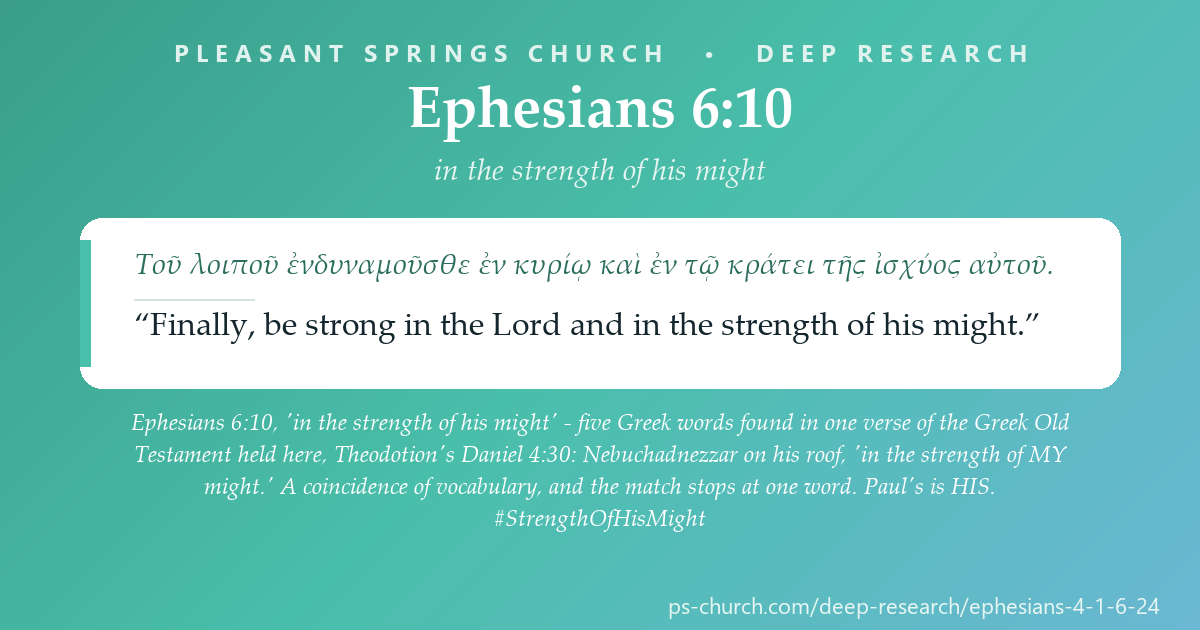
The armour of God opens with a phrase: be strengthened in the Lord and in the strength of his might. We measured its five Greek words against every verse of the Greek Old Testament held here, and they stand in exactly one: Nebuchadnezzar on the roof of his palace, is not this great Babylon, which I have built by my mighty power? (ESV; Theodotion’s Greek reads, word for word, in the strength of my might) The match runs five words and stops at the sixth — my in Daniel, his in Ephesians. The run alone proves nothing, and this page says why. But the two nouns behind it stand together only fourteen times in the whole Greek Bible held here, and where a man calls them mine it is a boast the text takes from him. In the New Testament they are never anyone’s but God’s, and two of their three appearances are Ephesians 1:19 and 6:10 — the power that raised Christ above the rulers, and the power the church stands in against them. This study works Ephesians 4:1–6:24: the one body and the gifts, the new self, the walk in love and light, the household code, and the armour. See the method →
Ephesians 4:1, 4–6, 8, 11, 22, 24–26, 30; 5:2, 14, 18, 21–22, 25, 31–32; 6:2–3, 5, 9–12, 14–17
Greek NT (SBLGNT) · ESVVersification. Ephesians is a New Testament book, and its numbering in the SBLGNT (via MorphGNT) and in the ESV agrees exactly: chapters 4, 5 and 6 run 32 / 33 / 24 = 89 verses in both, and there is no offset anywhere in these chapters. Every Ephesians reference on this page means the same verse in the Greek and the English. The offsets are in the Old Testament texts the page cites, and each is printed both ways. The Greek Psalter runs one number behind the Hebrew from Psalm 9/10 to 147 and, like the Hebrew, counts most superscriptions as verse 1: so Psalm 68:18 in the ESV is 68:19 in the Hebrew and 67:19 in the Greek; ESV 68:14 = Hebrew 68:15 = Greek 67:15; ESV 68:15 = Hebrew 68:16 = Greek 67:16; ESV 68:22 = Hebrew 68:23 = Greek 67:23; ESV Psalm 4:4 = Hebrew and Greek 4:5; ESV 51:11 = Hebrew 51:13 = Greek 50:13; ESV 120:4 = Greek 119:4; ESV 18:30 = Hebrew 18:31 = Greek 17:31; ESV 53:5 = Greek 52:6. Daniel 4 in the ESV runs three verses ahead of the Aramaic (the Aramaic counts ESV 4:1–3 as 3:31–33), so ESV Daniel 4:30 = Aramaic 4:27, ESV 4:31 = Aramaic 4:28, ESV 4:34 = Aramaic 4:31 and ESV 4:37 = Aramaic 4:34; both Greek columns of Daniel on this disk (Old Greek and Theodotion) number chapter 4 as the ESV does. The Greek Proverbs held here numbers the Hebrew chapters 25–29 as 32–36, so CATSS Proverbs 34:24 = Proverbs 27:24 and 35:7 = 28:7; Proverbs 23:31 is 23:31 in all three. Greek 3 Kingdoms 5:20 = Hebrew 1 Kings 5:20 = ESV 1 Kings 5:6. Genesis 2:24, Exodus 20:12, Deuteronomy 5:16, 8:17 and 10:17, Isaiah 11:5, 26:19, 40:26, 52:7, 59:17, 60:1 and 63:10, Zechariah 8:16, Job 12:16, 2 Samuel 15:14 and 22:31 and 2 Chronicles 20:12 are numbered identically in the Hebrew, the Greek and the English. Judith is cited in the CATSS (Rahlfs) numbering.
The Shape of the Passage
Five walks, three pairs, one stand — a sequence, not a chiasmEphesians 1–3 is a long blessing, a rescue and a prayer: God chose, God made alive, God made one new humanity out of Jew and Gentile, and Paul knelt to pray that they would grasp it. Chapter 4 begins with Παρακαλῶ οὖν, I urge you therefore, and the therefore is the hinge of the letter: everything from here on is what the first three chapters look like when people live them.
Author
Paul, writing as a prisoner. He calls himself ὁ δέσμιος ἐν κυρίῳ, the prisoner in the Lord (4:1), and near the end πρεσβεύω ἐν ἁλύσει, an ambassador in a chain (6:20). An ambassador in chains is a contradiction in terms, and Paul does not soften it: he asks them to pray that he will speak boldly as I ought to speak. The letter’s authorship is disputed in critical scholarship, where many hold Ephesians to be the work of a later Pauline writer; the letter names Paul twice (1:1, 3:1), speaks as the prisoner at 4:1, and asks prayer for its author at 6:19–20; this page reads it, with the church’s historic confession, as his.
A courier, and a twin letter. Tychicus carries it (6:21–22), and the two verses that say so are, almost word for word, Colossians 4:7–8: seventeen consecutive Greek words in 6:22, tie band 1, the deepest contact between Ephesians 4–6 and any other book, exactly as the Colossians study measured it. The two letters travelled together. Their household codes and their old-and-new-self paragraphs say much the same things in different words (Stage 4).
Audience
Gentiles told not to walk as Gentiles. “You must no longer walk as the Gentiles do” (4:17) is said to people who are Gentiles by birth. Ephesians 2 made them fellow citizens; Ephesians 4 tells them what that costs: the darkened understanding, the callousness, the deceitful desires of the old self are to be put off like clothes.
A whole household in the room. The letter was read aloud to an assembly, and the household code addresses, by name, every member of an ancient household who would be in it: wives and husbands, children (6:1 — children were present and are spoken to directly), fathers, slaves and masters. Slaves and their masters heard the same sentences in the same room; “whether he is a bondservant or is free” (6:8) is said to both. Ephesus itself is the city of Acts 19: magic books burned in public, and a riot for Artemis. A congregation formed there would not need to be told that there are powers; it needed to be told whose power is greater.
Orient on unity and gifts, the old and new self, the household code, the powers, and the armour.
Search by topic: unity, spiritual gifts, ascension and descent, new man, Holy Spirit (grieving, sealing), household codes, headship, marriage, slavery, principalities and powers, armour of God, divine warrior.
Which articles are relevant?
- Anchor Bible Dictionary — “Household Codes,” “Slavery (Greco-Roman),” “Principalities and Powers,” “Armor,” “Ephesians, Epistle to the.”
- Dictionary of Paul and His Letters — “Household Codes,” “Head,” “Marriage and Divorce, Adultery and Incest,” “Slave, Slavery,” “Principalities and Powers,” “Armor of God,” “Gifts of the Spirit,” “Ascension.”
- Dictionary of Deities and Demons in the Bible — “Kosmokrator,” “Rulers,” “Powers,” “Prince,” for 6:12 and Daniel 10.
- NIDNTT / TDNT — κράτος and ἰσχύς, ὑποτάσσω, κεφαλή, δοῦλος, πανοπλία, λυπέω.
Bibliography surfaced:
- Harold Hoehner (exegetical, 2002), Andrew Lincoln (WBC 42), Frank Thielman (BECNT), Clinton Arnold (ZECNT), Ernest Best (ICC), Markus Barth (AB 34A), Lynn Cohick (NICNT, 2020) on Ephesians.
- Andrew Lincoln, “The Use of the OT in Ephesians,” JSNT 14 (1982); W. Hall Harris III, The Descent of Christ: Ephesians 4:7–11 and Traditional Hebrew Imagery (1996); Timothy Gombis, “Cosmic Lordship and Divine Gift-Giving: Psalm 68 in Ephesians 4:8,” NovT 47 (2005).
- Michael S. Heiser, The Unseen Realm (2015); Clinton Arnold, Ephesians: Power and Magic (1989); Thomas R. Yoder Neufeld, ‘Put on the Armour of God’: The Divine Warrior from Isaiah to Ephesians (1997).
- John Chrysostom, Homilies on Ephesians (Homily 20 is his long treatment of 5:22–33); John Calvin, Commentary on Ephesians.
The household as the ancient world described it, the slaves in the room, the psalm whose verb Ephesians does not share, and the powers in the heavenly places.
Read the household code against the household-management tradition, the slavery section against what the text itself shows, Ephesians 4:8 against the Hebrew and Greek psalm and its Jewish reading, and 6:12 against the Greek Bible’s language of rulers and princes — and say plainly which of those sources are on this disk.
Which parallels shed light on the household, and on the slaves in it?
The three pairs are an old list. Aristotle opens his discussion of household management (Politics 1.3, 1253b) by naming the smallest parts of a household as master and slave, husband and wife, father and children — the same three relationships, and every later Greek writer on household management works from some version of the list. Ephesians and Colossians address the same three, in the order wives/husbands, children/fathers, slaves/masters. Aristotle is not on this disk, and that sentence is reported from the standard literature on the household codes (Stage 5), not checked here.
What the text itself shows about the code’s form. Three things can be read off the Greek without any outside source. First, each subordinate member is addressed directly, as a hearer with a moral choice to make, and each is addressed before the member with power over them. Second, every superior member is given an obligation, not a right: husbands are told to love (ἀγαπάω, six times in nine verses), fathers not to provoke (μὴ παροργίζετε), masters to stop threatening. Third, every pair is referred upward: as to the Lord, in the Lord, as to Christ, their Master and yours is in heaven. Whether that is a Christian adoption of the ancient form, a transformation of it from within, or a strategy for living inside it is exactly where the readings of the code divide, and Stage 4 sets them out without choosing.
The slaves in the room — what the letter says, and what it does not. The Greek word is δοῦλοι, slaves; the ESV prints bondservants. The text shows these things about the institution it addresses: slaves were members of the assembly and heard the letter read (6:5–8); they could be watched and could serve for the eye, ὀφθαλμοδουλία (6:6, and Colossians 3:22 — a word the Greek Old Testament held here does not have); masters could threaten, and are told to stop (6:9); the Lord’s repayment does not distinguish slave or free (6:8); and the slave’s master and the master’s Master are named with the same word. The letter does not instruct masters to free their slaves, and it does not instruct slaves to seek freedom; it addresses the relationship as it existed in the households hearing it. The letter that travelled with this one was carried by Tychicus together with Onesimus (Colossians 4:9), the slave whose return to his master is the subject of Paul’s letter to Philemon. This page gives the historical setting the text itself supplies, and makes no application of it.
Men-pleasers. ἀνθρωπάρεσκος, people-pleasers, stands twice in the New Testament (here and Colossians 3:22) and five times in the Greek Old Testament held here: once in the Psalter, at Psalm 52:6 (= ESV 53:5), where God scatters the bones of the men-pleasers and the Hebrew has instead the one who encamps against you, and four times in the fourth Psalm of Solomon — its title and three of its verses — which is addressed against them by name (a witness, not Scripture).
And Psalm 68 — what Jewish readers did with it?
Ephesians 4:8 reads he gave gifts to men where the psalm, in Hebrew and Greek alike, reads you received gifts among men. The commentators regularly report that the Targum of Psalms reads the verse as you gave gifts to the sons of men and applies it to Moses going up to receive the Law and giving it to Israel, and that the Peshitta also reads gave. Neither the Targum nor the Peshitta is on this disk. NOT VERIFIABLE FROM LOCAL CORPORA. If they read as reported, Paul’s verb has company in Jewish and Syriac tradition; this page cannot confirm the wording, the date or the direction of any of it, and the Psalm 68 study declined to as well.
What the Greek psalm does have, four verses earlier, is Ephesians’ own adjective. Psalm 67:15 in the Greek (= ESV 68:14) reads ἐν τῷ διαστέλλειν τὸν ἐπουράνιον βασιλεῖς ἐπ' αὐτῆς χιονωθήσονται ἐν Σελμων — when the heavenly one scatters kings on it. Where the Greek has τὸν ἐπουράνιον, the Hebrew has שַׁדַּי, Shaddai, and the ESV the Almighty: “When the Almighty scatters kings there, let snow fall on Zalmon.” The adjective ἐπουράνιος stands in four Greek Old Testament units screened here (the Odes, held and not screened, add a fifth at Odes 14:11), and three of them are 2 and 3 Maccabees; the only one in a book of the Hebrew canon is this verse of the psalm Ephesians quotes. In Ephesians the word stands five times in a single phrase, in the heavenly places, the place where Christ is seated (1:20) and the rulers and authorities are (3:10; 6:12). That is a fact about where a word stands. The measurement cannot say whether it means anything, and the contiguous-run screen does not see it at all: Ephesians 4:8 against Psalm 67:15 shares no word.
And the powers — where the Greek Bible names rulers in the heavens?
Pleasant Springs reads Ephesians 6:12 through Michael Heiser’s divine-council method: the rulers, authorities and world-rulers are personal spiritual beings who were given or seized dominion over the nations, who are in rebellion against God, who were already put under Christ’s feet when he was seated in the heavenly places (1:20–22), and against whom the church now stands. The texts that reading rests on are on this disk, and they are printed here column by column, because at each of them the columns differ.
Deuteronomy 32:8. The Greek: κατὰ ἀριθμὸν ἀγγέλων θεοῦ, according to the number of the angels of God. The Hebrew of the Masoretic text: לְמִסְפַּר בְּנֵי יִשְׂרָאֵל, according to the number of the sons of Israel. Heiser’s reading follows a Hebrew text from Qumran that is reported to read sons of God; the Dead Sea Scrolls are not on this disk, and that reading is reported, not checked.
Daniel 10. The Hebrew calls the being who withstands the angel וְשַׂר מַלְכוּת פָּרַס, the prince of the kingdom of Persia, and Michael one of the chief princes. Theodotion keeps the word: ὁ ἄρχων βασιλείας Περσῶν. The Old Greek does not: ὁ στρατηγὸς βασιλέως Περσῶν, the general of the king of Persia. One Greek column uses the word for a ruler or prince, the other the word for a military commander; the reading of 6:12 that draws on Daniel 10 draws on the Hebrew and on Theodotion, and this page says so.
Daniel 7:27. The pair Ephesians uses for the powers, ἀρχή with ἐξουσία, stands together in a single verse unit of the Greek Old Testament only four times, and three of the four are Daniel 7 — Theodotion 7:14 and 7:27, and the Old Greek 7:27, where all the authorities shall be subjected to him, πᾶσαι αἱ ἐξουσίαι αὐτῷ ὑποταγήσονται. (The fourth, Proverbs 17:14, is not about powers at all.) In the New Testament the pair stands in ten verses; three are about human officials (Luke 12:11, 20:20; Titus 3:1), and the other seven are all Paul’s and all cosmic: 1 Corinthians 15:24, Ephesians 1:21, 3:10, 6:12, Colossians 1:16, 2:10, 2:15.
The readings this page names and does not adopt. Walter Wink (Naming the Powers, 1984) read the powers as the inner spirituality of institutions; Hendrik Berkhof (Christ and the Powers) read them as the structures of earthly life — tradition, state, morality — turned against God; Clinton Arnold reads them, as Heiser does, as personal spirits, and sets them against the magical practice of Ephesus. The text’s own words are the test the house applies: the powers are in the heavenly places, they have schemes (6:11), and the alternative to them is blood and flesh (6:12).
The armour of God is the best-known paragraph in Ephesians and the one most often read as a call to effort: stand, resist, take up, put on. The first verse of it says something else first. It says be strengthened — the verb's form can be read as passive — in the Lord, and in the strength of his might. In the Greek Old Testament we can search, those two nouns of strength stand together in eleven verse units, and in the three where a human being says 'my' they are a boast the text takes from him: the Israelite who must not say in his heart that his own power got him his wealth, and the king on his roof who said it and was answered from heaven while the words were still in his mouth. In the New Testament the pair is never anyone's but God's, and two of the three places it stands are the two ends of Ephesians: the power that raised Christ and seated him above every ruler and authority, and the power the church is told to be strengthened in when it stands against those same rulers and authorities. The armour is not equipment for people who are strong. It is what God's strength looks like when it is worn.
The walk, the one, the verb that is missing, and the strength that is never ours.
Every count below is a lexeme or lemma screen over the corpora held here — 7,927 verses of the Greek New Testament (SBLGNT via MorphGNT, headwords from its lemma column) and 30,348 screened verse units of Greek Old Testament (CATSS/Rahlfs, 64 files; the Odes are held but left out of screening by house convention, because two of them are Luke 1–2 and ten are second copies of other books). Witness books — Sirach, Wisdom, Judith, Tobit, the Maccabees, the Psalms of Solomon, 1 Esdras — are labelled a witness, not Scripture wherever they supply a result.
Eight occurrences in seven verses of Ephesians (2:2, 2:10, 4:1, 4:17, 5:2, 5:8, 5:15). Two describe the old life and the good works prepared for the new (2:2, 2:10); the five in chapters 4–5 each stand in the opening sentence of a paragraph (5:2 continues the sentence begun at 5:1), and they are the frame of the structure diagram. ἀξίως περιπατῆσαι in this order stands only here.
Twice in the Greek New Testament, both in this chapter: the unity of the Spirit to be kept (4:3) and the unity of the faith to be reached (4:13). None in the Greek Old Testament held here. One is a gift to guard, the other a goal to grow into.
Seven forms in 4:4–6 — one body, one Spirit, one hope, one Lord, one faith, one baptism, one God and Father. The densest three verses for this lemma in the Greek New Testament, tied only with Romans 5:15–19. The Nicene Creed carries the list into its own wording: one God, one Lord Jesus Christ, one baptism for the forgiveness of sins.
Eighteen times in seventeen verses of the Greek New Testament, and only here of an office in the church. Four are the shepherds of Luke 2 and one the shepherd who separates sheep from goats (Matthew 25:32); the rest are Jesus’ images — sheep without a shepherd, the struck shepherd, the good shepherd of John 10 — and Christ himself (Hebrews 13:20; 1 Peter 2:25). The Greek Old Testament held here has it eighty-one times in sixty-eight units, much of it in Ezekiel 34.
The form μὴ λυπεῖτε stands only here; the verb is everywhere in 2 Corinthians 2 and 7. You can only grieve a person. At Isaiah 63:10 the Hebrew has the people grieving God’s Holy Spirit and the Greek has them provoking him; Ephesians’ verb is the Hebrew’s sense.
Ten verses in the Greek New Testament, three of them in Ephesians (1:7, 1:14, 4:30). In all sixty-four CATSS files on this disk, Odes included, the noun stands once: Old Greek Daniel 4:34, ὁ χρόνος μου τῆς ἀπολυτρώσεως ἦλθε, the time of my redemption came, said by Nebuchadnezzar after the seven years. ⚠️ That clause is the Old Greek’s alone; the Aramaic and Theodotion say his reason returned to him, as the ESV does: “At the end of the days I, Nebuchadnezzar, lifted my eyes to heaven, and my reason returned to me, and I blessed the Most High, and praised and honored him who lives forever, for his dominion is an everlasting dominion, and his kingdom endures from generation to generation;” A fact about one word in one column, and printed as one.
Three times in Ephesians: God subjecting all things under Christ’s feet (1:22), the participle of 5:21, and the church submitting to Christ (5:24). The household codes elsewhere carry it too (Colossians 3:18; Titus 2:5, 9; 1 Peter 2:18; 3:1, 5). Ephesians 5:22 does not: it has no verb. Children and slaves are given a different verb, ὑπακούω, obey (6:1, 6:5), and wives are not.
Four times in Ephesians: Christ given as head over all things to the church (1:22), the head into whom the body grows (4:15), and twice in 5:23. Whether head here means authority over, source, or prominence is a long and specialist debate, summarised in Stage 5 and not settled here.
Literally face-taking. Four times in the Greek New Testament (Romans 2:11; Ephesians 6:9; Colossians 3:25; James 2:1), never in the Greek Old Testament, which says it with a phrase. In Colossians it is said to slaves; in Ephesians, to masters.
Twelve verses in the Greek New Testament, half of them doxologies (to him be glory and dominion). Only three carry it with ἰσχύς: Ephesians 1:19, Ephesians 6:10, and 1 Peter 4:11. Stage 4 counts the pair in the Greek Old Testament.
Three in the Greek New Testament: Ephesians 6:11, 6:13, and Luke 11:22, where “one stronger than he” strips the strong man of τὴν πανοπλίαν αὐτοῦ, his armour in which he trusted. Ten units in the Greek Old Testament: soldiers’ equipment in 2 Samuel 2:21, the Maccabees and Judith; the war-horse God clothed in Job 39:20; Joshua’s in Sirach 46:6; and in Wisdom 5:17 the Lord’s own — he will take his zeal as his full armour (Sirach and Wisdom are witnesses, not Scripture).
Once in the Greek New Testament and never in the Greek Old Testament. The word is reported from astrological and magical texts of the period, of planetary and ruling powers; none of that literature is on this disk. Paul attaches it to this darkness.
Eleven units in the Greek Old Testament carry this participle, and in five of them it is the word of the Lord, refined: 2 Samuel 22:31, Psalm 11:7 (= ESV 12:6), Psalm 17:31 (= ESV 18:30), Psalm 118:140 (= ESV 119:140), Proverbs 30:5. Three of those five go straight on to make God a shield — τὸ ῥῆμα κυρίου κραταιόν πεπυρωμένον ὑπερασπιστής, “This God—his way is perfect; the word of the Lord proves true; he is a shield for all those who take refuge in him.” In Ephesians the participle means flaming, it is the devil’s arrows that are on fire, the shield is τὸν θυρεὸν not the Psalter’s word, and the next line names the word of God as the sword. The same participle in a different sense, and no shared run; the cluster is printed as a cluster.
How the New Testament fills out the gifts, the new self and the armour:
- Romans 12:4–8; 1 Corinthians 12 — one body, many members, gifts distributed: the other two places Paul lists gifts (see Romans 12, 1 Corinthians 12–14).
- Colossians 3:5–4:1 — put to death, put off, put on, and the household: the closest parallel to Ephesians 4:17–6:9 in thought, and a shallow one in wording (see Colossians 2–4).
- Romans 6:6; 13:12–14 — the old self crucified; put on the armour of light… put on the Lord Jesus Christ: the same put on joining the new self and the armour.
- 1 Thessalonians 5:8 — the breastplate of faith and love and the helmet of the hope of salvation: Paul’s earlier armour, measuring one against Ephesians (see 1 Thessalonians).
- Luke 11:21–22; Colossians 2:15; Hebrews 2:14 — the strong man disarmed, the rulers and authorities stripped and paraded, the one who has the power of death destroyed (see Hebrews 2).
- Matthew 19:4–6; Mark 10:6–9; 1 Corinthians 6:16 — Genesis 2:24 in the mouth of Jesus and in Paul (see Matthew 19, Genesis 2:18–25).
The measurement: a five-word run that stops at one word, the count behind it, every Old Testament text in these chapters, Psalm 68 word by word, and Colossians.
All 89 Greek rows of Ephesians 4–6 were screened against 30,348 Greek Old Testament verse units (the cross-edition comparator on both sides, because the two Greek corpora spell the movable nu and ou/ouk differently) and against the other 7,838 verses of the Greek New Testament. Contiguous runs of whole normalised word forms, never lemmas. Every run is printed with its tie band — the number of target verses reaching the same depth. On this screen a row sharing no two words in a row still scores 1 if it shares one, so 0 means no word in common at all. Co-occurrence counts are a separate screen on the lemma columns, and they say so.
★ The five words of 6:10, and where else they stand
Ephesians 6:10: Τοῦ λοιποῦ ἐνδυναμοῦσθε ἐν κυρίῳ καὶ ἐν τῷ κράτει τῆς ἰσχύος αὐτοῦ.
Theodotion’s Daniel 4:30: ἀπεκρίθη ὁ βασιλεὺς καὶ εἶπεν οὐχ αὕτη ἐστὶν Βαβυλὼν ἡ μεγάλη ἣν ἐγὼ ᾠκοδόμησα εἰς οἶκον βασιλείας ἐν τῷ κράτει τῆς ἰσχύος μου εἰς τιμὴν τῆς δόξης μου
The longest run they share is five — ἐν τῷ κράτει τῆς ἰσχύος — and across all 30,348 Greek Old Testament units no other verse reaches five against 6:10; the tie band is 1. The five-word string stands in exactly one Greek Old Testament unit and one New Testament verse. And the run ends at the word that differs. The king says ἰσχύος μου, of my might; Paul says τῆς ἰσχύος αὐτοῦ, of his. In English: “and the king answered and said, ‘Is not this great Babylon, which I have built by my mighty power as a royal residence and for the glory of my majesty?’” “While the words were still in the king’s mouth, there fell a voice from heaven, ‘O King Nebuchadnezzar, to you it is spoken: The kingdom has departed from you,”
The Old Greek tells the same story with the same two nouns, inverted: ἐν ἰσχύι κράτους μου, in the might of my strength — so a five-word run against it is impossible (it measures 1), and the boast is in both Greek columns. The Aramaic has it too: בִּתְקָף חִסְנִי, by the might of my power (Aramaic 4:27). The pair of nouns and the my are not a quirk of one Greek translator; they are what the king said in every text we hold.
⚠️ What this page does not claim. The shelf’s Daniel 1–6 study measured the same run from Daniel’s side, printed it as “a coincidence of vocabulary,” and said it would build nothing on it. This page agrees, and does not argue that Paul had Daniel 4 in view. A run of five with a band of one is not, by itself, evidence of use: five rows in these three chapters reach four or more with a band of one, and two of them are quotations everyone recognises (5:31, 4:26) while two are stock phrases in witness books (4:17 against Psalms of Solomon 17:14, just as the Gentiles also; 6:6 against 1 Esdras 8:16, the will of God). The run is printed because it is the deepest unquoted contact in the passage and because it ends where it ends. What the page rests on is the count below, which does not depend on any one row.
The count: two nouns of strength, side by side, in the whole Greek Bible
Set the five words aside and ask a plainer question. In how many verse units do κράτος and ἰσχύς stand together, in any form and any order? The CATSS lemma column answers for the Greek Old Testament: eleven units out of 30,348 — the first noun stands in 52 units and the second in 345, and they meet in eleven. Every one is listed, with the Hebrew where there is a Hebrew.
| where | the Greek | whose | the Hebrew or Aramaic behind it |
|---|---|---|---|
| Deuteronomy 8:17 | ἡ ἰσχύς μου καὶ τὸ κράτος τῆς χειρός μου | a man’s — ‘my’; the sentence Israel is told not to say in its heart | כֹּחִי וְעֹצֶם יָדִי — two nouns of strength, my |
| Daniel 4:30 (Theodotion) | ἐν τῷ κράτει τῆς ἰσχύος μου | a king’s — ‘my’; answered from heaven in the next verse | בִּתְקָף חִסְנִי — Aramaic 4:27, two nouns, my |
| Daniel 4:30 (Old Greek) | ἐν ἰσχύι κράτους μου | a king’s — ‘my’; the same boast, the nouns in the other order | the same Aramaic |
| Daniel 11:1 (Theodotion) | ἔστην εἰς κράτος καὶ ἰσχύν | a heavenly messenger’s, in the war with the princes of Persia and Greece (10:20–21) | עׇמְדִי לְמַחֲזִיק וּלְמָעוֹז לוֹ — to confirm and strengthen him; the Old Greek reads ἐνισχῦσαι καὶ ἀνδρίζεσθαι |
| Isaiah 40:26 | ἐν κράτει ἰσχύος | God’s — who brings out the heavenly host by number and calls them by name | מֵרֹב אוֹנִים וְאַמִּיץ כֹּחַ |
| Job 12:16 | κράτος καὶ ἰσχύς | God’s — with him | עִמּוֹ עֹז וְתוּשִׁיָּה — strength and sound wisdom: the Hebrew has one noun of strength, the Greek two |
| Proverbs 27:24 (CATSS 34:24) | ἀνδρὶ κράτος καὶ ἰσχύς | a man’s — and not for ever | כִּי לֹא לְעוֹלָם חֹסֶן — riches: the Hebrew has no pair here at all |
| Judith 5:3 | τὸ κράτος αὐτῶν καὶ ἡ ἰσχὺς αὐτῶν | Israel’s — Holofernes asking where it lies (and told, in 5:5–21, that it lies in their God) | a witness, not Scripture |
| Judith 9:8 | κάταξον τὸ κράτος αὐτῶν | the Assyrians’ — which Judith asks God to break | a witness, not Scripture |
| Judith 11:7 | ζῇ τὸ κράτος αὐτοῦ | Nebuchadnezzar’s might and his general’s strength (your) — in Judith’s flattery | a witness, not Scripture |
| Judith 13:11 | ἰσχὺν ἐν Ισραηλ καὶ κράτος | given by God to Israel, against its enemies | a witness, not Scripture |
Three of the eleven put the pair in a human mouth with my — Deuteronomy 8:17 and both Greek columns of Daniel 4:30 — and in all three a man is claiming as his own what the text then takes from him. Deuteronomy forbids the sentence before it is said: “Beware lest you say in your heart, ‘My power and the might of my hand have gotten me this wealth.’” Daniel’s king says it, and is answered while the words are still in his mouth. Where the pair belongs to God (Isaiah 40:26, Job 12:16), is given by God (Judith 13:11), or is held by a heavenly messenger (Theodotion Daniel 11:1), nobody says my. Where it belongs to a man or a nation in the third person, it is not for ever (Proverbs 27:24), or it is asked about, or flattered, or broken (Judith).
⚠️ And the Hebrew does not always have a pair. At Job 12:16 the Hebrew has strength and sound wisdom; at Proverbs 27:24 it has riches; at Daniel 11:1 it has two verbs of support. The pattern in the table is a pattern in the Greek, and it is printed as one.
In the New Testament the pair stands in three verses, and none of them is a human being’s. 1 Peter 4:11 has the strength God supplies and the dominion that is his. The other two are both Ephesians, and they are the two places the letter sets the power of God beside the powers:
| Ephesians 1:19–21 | Ephesians 6:10–12 | |
|---|---|---|
| the strength | τοῦ κράτους τῆς ἰσχύος αὐτοῦ | ἐν τῷ κράτει τῆς ἰσχύος αὐτοῦ |
| the place | ἐν τοῖς ἐπουρανίοις (1:20) | ἐν τοῖς ἐπουρανίοις (6:12) |
| the powers | ὑπεράνω πάσης ἀρχῆς καὶ ἐξουσίας (1:21) | πρὸς τὰς ἀρχάς, πρὸς τὰς ἐξουσίας (6:12) |
In 1:19–21 that strength raised Christ from the dead and seated him far above all rule and authority (1:19–20). In 6:10–12 the church is told to be strengthened in it to stand against the rulers, the authorities. The phrase τῆς ἰσχύος αὐτοῦ stands in three New Testament verses — Ephesians 1:19, 6:10, and 2 Thessalonians 1:9, where it is part of a run shared with the Greek of Isaiah 2:10, 19 and 21, the glory of his strength from which the wicked hide. That is the frame this page rests on, and it is the letter’s own wording: the armour is put on in the power of the resurrection.
The counter-example the instrument hands us. Isaiah 40:26 carries the same three content words as 6:10 — ἐν κράτει ἰσχύος, of God over the host of heaven — and measures two against 6:10, because Isaiah has no articles and the run breaks on the. Theodotion’s boast has the articles, and so it measures five. The run screen saw the king and missed the Creator, for a reason that has nothing to do with meaning. That is why the count above is a lemma count, and why the five-word run is not the argument.
Every Old Testament text in Ephesians 4–6, measured
Across the 89 rows against the Greek Old Testament: all 89 reach two, 64 reach three, 14 reach four, 4 reach five, 2 reach seven, 1 reaches eight, and nothing reaches nine. Here is every row that touches a named Old Testament text, with the two marked quotations flagged.
| Ephesians | Old Testament text (Greek numbering) | marked? | run | tie band | note |
|---|---|---|---|---|---|
| 4:8 | Psalm 67:19 (= ESV 68:18) | yes — therefore it says | 2 | 37 | the Hebrew and the Greek agree with each other at every slot; Ephesians departs at five of nine |
| 4:25 | Zechariah 8:16 | no | 3 | 22 | the phrase speak truth itself stands once in each corpus |
| 4:26 | Psalm 4:5 (= ESV 4:4) | no | 4 | 1 | the Hebrew verb is tremble; the Greek and Ephesians, be angry |
| 4:30 | Isaiah 63:10 | no | 4 | 5 | the Hebrew grieved, the Greek provoked |
| 5:2 | Exodus 29:18 and 25 others | no | 3 | 30 | a sacrificial formula |
| 5:14 | Isaiah 26:19 · 60:1 | yes — therefore it says | 1 · 1 | — | neither shares anything with the quotation but and and an article; the quoted words reach 2, band 396, against the whole corpus |
| 5:18 | Proverbs 23:31 | no | 3 | 8 | the Hebrew says do not look at wine |
| 5:31 | Genesis 2:24 | no | 8 | 1 | and 10, band 1, against Matthew 19:5 — on the SBLGNT reading |
| 6:2 | Exodus 20:12 · Deuteronomy 5:16 | yes — the first commandment with a promise | 7 | 2 | the same seven in three Gospel verses |
| 6:3 | the same two, and five more in Deuteronomy | (continues 6:2) | 5 | 7 | the Hebrew of Exodus has no go well |
| 6:14 | Isaiah 11:5 · 59:17 | no | 2 · 1 | — | the article breaks the breastplate |
| 6:15 | Isaiah 52:7 | no | 1 | — | |
| 6:17 | Isaiah 59:17 · 49:2 | no | 1 · 1 | — | and the helmet |
| 6:10 | Daniel 4:30 (Theodotion) | no — and not a quotation | 5 | 1 | my against his |
The two places Ephesians says therefore it says are the two places it shares least with any Greek Old Testament text — 4:8 at two in a band of 37, 5:14 sharing nothing but and and an article with either of the passages usually proposed. The deepest contacts are unannounced (5:31 at eight, 4:26 at four) or announced by naming the commandment rather than by a formula (6:2 at seven). Run depth measures shared wording; it does not measure use, and this table is the clearest demonstration of that on the Ephesians pages.
Consistency with the rest of the shelf. Every row here agrees with what the shelf has already printed from the other side: 4:8 at two in a band of 37 (the Ephesians 3 and Psalm 68 studies); 4:25 at three (Zechariah 1–8); 4:26 at four, band 1 (Psalms 3–5); 5:18 at three, once in each corpus (Proverbs); 5:31 at eight, band 1, and 6:2 at seven, band 2 (Ephesians 3); Isaiah 59:17 at one against 6:14 and 6:17 (Isaiah 56–60).
Psalm 68:18 at Ephesians 4:8 — the Hebrew, the Greek and Ephesians, word by word
| slot | Hebrew 68:19 | Greek 67:19 | Ephesians 4:8 | |
|---|---|---|---|---|
| 1 | עָלִיתָ | ἀνέβης | Ἀναβὰς | differs — you ascended becomes having ascended |
| 2 | לַמָּרוֹם | εἰς | εἰς | same |
| 3 | ὕψος | ὕψος | same | |
| 4 | שָׁבִיתָ | ᾐχμαλώτευσας | ᾐχμαλώτευσεν | differs — you led captive becomes he |
| 5 | שֶּׁבִי | αἰχμαλωσίαν | αἰχμαλωσίαν | same |
| 6 | לָקַחְתָּ | ἔλαβες | ἔδωκεν | differs in the word itself — received becomes gave |
| 7 | מַתָּנוֹת | δόματα | δόματα | same |
| 8 | בָּאָדָם | ἐν | τοῖς | differs — in becomes to |
| 9 | ἀνθρώπῳ | ἀνθρώποις | differs — a man becomes men | |
| … | וְאַף סוֹרְרִים | καὶ γὰρ ἀπειθοῦντες | — | Ephesians stops; the psalm goes on, even the rebellious |
Of nine Greek positions, four agree and five differ, and the longest unbroken run is two, εἰς ὕψος — the count the Psalm 68 study gives. Four of the five differences are person, number and preposition: the psalm speaks to God in the second person, Ephesians speaks about him in the third, so you ascended becomes a participle and you led captive becomes he led; and in a man becomes to men. One is not grammar. The Hebrew לָקַחְתָּ and the Greek ἔλαβες both mean you took, you received; the Hebrew and the Greek agree with each other here as at every other slot. Ephesians has ἔδωκεν, he gave, and repeats the verb three verses later in καὶ αὐτὸς ἔδωκεν. The ESV prints both, so an English reader can see it: “You ascended on high, leading a host of captives in your train and receiving gifts among men, even among the rebellious, that the Lord God may dwell there.” against “Therefore it says, ‘When he ascended on high he led a host of captives, and he gave gifts to men.’”
Two more places where Psalm 68’s columns part, and both matter for the divine-council reading. Where the Hebrew has שַׁדַּי (68:15 Hebrew = ESV 68:14), the Greek has τὸν ἐπουράνιον, the heavenly one — the adjective of Ephesians’ heavenly places, in its only appearance in a canonical book of the Greek Old Testament. And where the Hebrew names הַר־בָּשָׁן, the mountain of Bashan (68:16 Hebrew = ESV 68:15), the Greek has ὄρος πῖον, a fat mountain: the Greek does not name Bashan there. It does at 67:23 (ἐκ Βασαν, Hebrew מִבָּשָׁן). Readings of 4:8–10 that run through Bashan as the realm of the hostile powers — Heiser’s among them — are reading the Hebrew at 68:15 and both texts at 68:22, and this page says which.
Genesis 2:24 at Ephesians 5:31 — nearer Matthew than Genesis, on one reading
| Genesis 2:24 (Greek) | Matthew 19:5 | Ephesians 5:31 (SBLGNT) | |
|---|---|---|---|
| therefore | ἕνεκεν τούτου | Ἕνεκα τούτου | ἀντὶ τούτου |
| father and mother | τὸν πατέρα αὐτοῦ καὶ τὴν μητέρα αὐτοῦ | τὸν πατέρα καὶ τὴν μητέρα | τὸν πατέρα καὶ τὴν μητέρα |
| hold fast | προσκολληθήσεται | κολληθήσεται | προσκολληθήσεται |
| to his wife | πρὸς τὴν γυναῖκα αὐτοῦ | τῇ γυναικὶ αὐτοῦ | τῇ γυναικὶ αὐτοῦ |
| one flesh | καὶ ἔσονται οἱ δύο εἰς σάρκα μίαν — identical in all three | ||
On the SBLGNT, Ephesians 5:31 against the Greek Genesis is eight, tie band 1; against Matthew 19:5 it is ten, tie band 1, with a second run of nine in the first half of the verse. Ephesians agrees with Matthew in dropping Genesis’s two hises and in the dative to his wife; it agrees with Genesis in προσκολληθήσεται; and it agrees with neither in ἀντὶ τούτου. ⚠️ The SBLGNT marks four variants in this verse — on both articles, on father, and on to his wife. The standard editions report that many manuscripts read to his wife as Genesis does, πρὸς τὴν γυναῖκα αὐτοῦ. On that reading the Genesis run rises to thirteen, the Matthew run falls to nine, and Mark 10:7–8 read as one sentence reaches sixteen. So the ranking is the editor’s, not the measurement’s, and this page prints it as such; the apparatus that would decide it is not on this disk.
The household code: what is measured, and the readings this page does not choose between
Measured facts both readings work from. (1) 5:22 has no verb; it takes submit from the participle of 5:21. (2) That participle, ὑποτασσόμενοι ἀλλήλοις, submitting to one another, is the fifth of five present participles hanging on be filled with the Spirit (5:18): λαλοῦντες, ᾄδοντες, ψάλλοντες, εὐχαριστοῦντες, ὑποτασσόμενοι. (3) The phrase ὑποτασσόμενοι ἀλλήλοις stands once in the New Testament. (4) Wives are not given ὑπακούω, obey; children and slaves are (6:1, 6:5). (5) κεφαλή stands four times in the letter, and twice in 5:23. (6) Husbands get nine verses to the wives’ three, and the verb love six times.
The complementarian reading. 5:21 introduces the code, and one another is then specified by the pairs that follow: wives to husbands, children to parents, slaves to masters, each submitting to the one set over them in the household. Head carries the sense of authority or leadership, and the husband’s headship is defined and limited by Christ’s self-giving love (5:25). Proponents include George W. Knight III and Wayne Grudem (in Recovering Biblical Manhood and Womanhood, ed. Piper and Grudem, 1991), Andreas Köstenberger (God, Marriage, and Family), Thomas Schreiner, and Harold Hoehner in his commentary.
The egalitarian reading. 5:21 governs the whole code: one another means mutual submission among all believers, and the wife’s submission in 5:22, which has no verb of its own, is an instance of that mutual submission rather than a separate rule. Head carries the sense of source, or of the one who gives life and nurture (5:29), more than of command; and the code takes up the ancient household form in order to transform it from within. Proponents include Gilbert Bilezikian (Beyond Sex Roles), Craig Keener (Paul, Women and Wives, 1992), Gordon Fee, Philip Payne (Man and Woman, One in Christ, 2009) and Lynn Cohick in her commentary.
Pleasant Springs Church has not ratified a position on how the household code applies. This page sets out the text, the measurements and the two main readings with their proponents, and does not choose between them. Both readings take the text as Scripture; both make Christ’s love for the church the measure of the husband; they divide on the hinge.
And against Colossians — old self, household code, courier
Ephesians 4–6 against Colossians, verse by verse, measured here and agreeing, on every row it also prints, with the Colossians 2–4 study:
| Colossians | Ephesians | run | the shared words |
|---|---|---|---|
| 3:9 the old self | 4:22 | 3 | τὸν παλαιὸν ἄνθρωπον |
| 3:10 the new self | 4:24 | 1 | καὶ |
| 3:8 the vice list | 4:31 | 1 | καὶ |
| 3:13 forgiving as the Lord forgave | 4:32 | 3 | καθὼς καὶ ὁ |
| 3:6 the wrath of God | 5:6 | 10 | ἔρχεται ἡ ὀργὴ τοῦ θεοῦ ἐπὶ τοὺς υἱοὺς τῆς ἀπειθείας |
| 3:16 psalms, hymns, songs | 5:19 | 2 | ᾠδαῖς πνευματικαῖς |
| 3:18 wives | 5:22 | 2 | Αἱ γυναῖκες |
| 3:19 husbands | 5:25 | 5 | Οἱ ἄνδρες, ἀγαπᾶτε τὰς γυναῖκας |
| 3:20 children | 6:1 | 5 | Τὰ τέκνα, ὑπακούετε τοῖς γονεῦσιν |
| 3:21 fathers | 6:4 | 3 | οἱ πατέρες, μὴ |
| 3:22 slaves | 6:5 | 4 | τοῖς κατὰ σάρκα κυρίοις |
| 3:23 | 6:7 | 6 | ὡς τῷ κυρίῳ καὶ οὐκ ἀνθρώποις |
| 3:24 | 6:8 | 2 | εἰδότες ὅτι |
| 4:1 masters | 6:9 | 3 | εἰδότες ὅτι καὶ |
| 4:7 Tychicus | 6:21 | 10 | πάντα γνωρίσει ὑμῖν Τυχικὸς ὁ ἀγαπητὸς ἀδελφὸς καὶ πιστὸς διάκονος |
| 4:8 the courier’s errand | 6:22 | 17 | the whole verse |
The doctrinal paragraphs barely touch; the errand is identical. The old self is three words and the new self one. The household code, which every reader sets side by side, peaks at six. The deepest contacts are the wrath of God (ten, and only on the longer reading of Colossians 3:6, which the ESV does not print), Tychicus’ credentials (ten, on one word order of Ephesians 6:21), and the courier’s errand (seventeen, both verses entire) — the three caveats the Colossians study prints, printed again here. Whatever the relation between the two letters, it is not that one was copied out of the other paragraph by paragraph.
Against the whole New Testament, Ephesians 4–6 reaches: all 89 rows two, 69 three, 31 four, 11 five, 8 six, 7 seven, 4 ten, and 1 seventeen. Take Ephesians and Colossians both out of the target and the deepest row left is 5:31 at ten (Matthew 19:5); then three rows at seven — 6:2 against the Gospels’ commandment, and two formulas shared with 2 Thessalonians (5:20, 6:23).
The counter-examples this page prints against itself.
1. A tie band of three, and one of the three is perfect. Ephesians 6:12 opens ὅτι οὐκ ἔστιν ἡμῖν, and those four words reach four against the Greek Old Testament in a band of three. One of the three is 2 Chronicles 20:12, Jehoshaphat before the armies: ὅτι οὐκ ἔστιν ἡμῖν ἰσχὺς, “O our God, will you not execute judgment on them? For we are powerless against this great horde that is coming against us. We do not know what to do, but our eyes are on you.” — and three verses later he is told the battle is not his but God’s. It could not be more apt, and it is an accident: the other two are David fleeing Absalom (2 Samuel 15:14, there will be no escape for us) and Solomon writing to Hiram for timber (3 Kingdoms 5:20 = 1 Kings 5:6, there is no one among us who knows how to cut timber). A stock phrase, and the page will not build on the one that preaches well.
2. Bands of one that mean nothing. 4:11’s and he gave reaches three, band 1, against Sirach 38:6 — the physician’s skill. 6:16’s τὰ βέλη τοῦ reaches three, band 1, against Psalm 119:4 in the Greek (= ESV 120:4): “A warrior’s sharp arrows, with glowing coals of the broom tree!” Arrows and fire, and an accident. 4:1 reaches three, band 1, against 2 Maccabees 9:26, Antiochus IV’s letter.
3. The marked quotation that measures two. 4:8, above, in a band of 37.
4. The Creator the run screen missed. Isaiah 40:26, above, carrying 6:10’s three content words and measuring two because of the article.
Why these are on the page. The 6:10 row is only worth printing if a reader can see what the same instrument does with rows that are not worth anything. It gives them bands of one, perfect-sounding bands of three, and blindness to an article. That is the calibration, and a page that printed only its best row would be hiding it.
The scholarship, the readings named and not adopted, and what this page did not and could not check.
The commentators on Ephesians 4–6; the Psalm 68, household-code, headship and powers literature; and an honest accounting of this page’s limits.
Commentaries & studies:
- Harold W. Hoehner, Ephesians: An Exegetical Commentary (2002); Andrew T. Lincoln (WBC 42); Frank Thielman (BECNT); Clinton E. Arnold (ZECNT); Ernest Best (ICC); Markus Barth (AB 34A); Lynn H. Cohick, The Letter to the Ephesians (NICNT, 2020).
- Psalm 68 and 4:8–10. Andrew Lincoln, “The Use of the OT in Ephesians,” JSNT 14 (1982); Richard A. Taylor, “The Use of Psalm 68:18 in Ephesians 4:8 in Light of the Ancient Versions,” Bibliotheca Sacra 148 (1991); W. Hall Harris III, The Descent of Christ (1996); Timothy G. Gombis, NovT 47 (2005); G. K. Beale & D. A. Carson, eds., Commentary on the NT Use of the OT (Ephesians).
- The household code. James E. Crouch, The Origin and Intention of the Colossian Haustafel (1972); David L. Balch, Let Wives Be Submissive (1981); John Piper & Wayne Grudem, eds., Recovering Biblical Manhood and Womanhood (1991); Ronald W. Pierce & Rebecca Merrill Groothuis, eds., Discovering Biblical Equality (2004); Craig S. Keener, Paul, Women and Wives (1992); Philip B. Payne, Man and Woman, One in Christ (2009); Andreas J. Köstenberger, God, Marriage, and Family.
- ‘Head’. Stephen Bedale, JTS 5 (1954); Wayne Grudem, Trinity Journal 6 (1985); Richard Cervin, Trinity Journal 10 (1989); Joseph Fitzmyer, NTS 35 (1989).
- Slavery. J. Albert Harrill, Slaves in the New Testament (2006); Jennifer A. Glancy, Slavery in Early Christianity (2002).
- The powers and the armour. Michael S. Heiser, The Unseen Realm (2015); Clinton E. Arnold, Ephesians: Power and Magic (1989); Walter Wink, Naming the Powers (1984); G. B. Caird, Principalities and Powers (1956); Thomas R. Yoder Neufeld, ‘Put on the Armour of God’ (1997).
- John Chrysostom, Homilies on Ephesians; John Calvin, Commentary on Ephesians; Bruce M. Metzger, A Textual Commentary on the Greek New Testament.
Interpretation notes worth keeping:
- 4:9–10, the descent. He descended into the lower regions, the earth: read as the incarnation (the lower regions which are the earth), as a descent to the dead before the ascent, or as the Spirit’s descent at Pentecost after it. The Greek allows each; the SBLGNT marks a variant on descended (many manuscripts add first). The divine-council reading takes the ascent as a conqueror’s procession over defeated powers, with Colossians 2:15. This page names the three and does not choose.
- 4:30, sealed for the day of redemption. Pleasant Springs reads this with the eternal security of the believer. The seal is God’s act (ἐσφραγίσθητε, a passive aorist), its term is stated (εἰς ἡμέραν ἀπολυτρώσεως), and in 1:13–14 the same Spirit is the down-payment until we acquire possession. The command not to grieve him is spoken to people already sealed: a warning about the relationship, set inside the seal, not a threat to break it. The text does not say the seal can be broken; it says what the seal is for.
- 5:2 and 5:25, ‘for us’ and ‘for her’. Christ gave himself up for us and for her, the church. Read with the house’s unlimited-provision view of the atonement, these name whom the self-giving was for in the relationship being described — love to a bride — without limiting its provision; Paul elsewhere says he gave himself as a ransom for all (1 Timothy 2:6).
- 5:14, the source. Most commentators take it as a fragment of an early Christian hymn, often linked with baptism; ancient readers proposed lost prophetic books. None of that can be checked here, and no Greek Old Testament text shares its wording.
- 5:32, ‘this mystery is profound’. The Latin Vulgate renders μυστήριον here as sacramentum, one root of the later teaching of marriage as a sacrament; Paul’s own gloss is I am speaking about Christ and the church. The Clementine Vulgate on this disk reads Sacramentum hoc magnum est.
- 6:2, ‘the first commandment with a promise’. The second commandment also carries a promise of steadfast love (Exodus 20:6); readers take first as first in importance for children, first of the second table, or first with a promise attached to the commandment itself.
- 6:12, the powers. Read here through the divine-council method (Stage 2), with the readings of Wink and Berkhof named and not adopted.
- The household code. Two readings, set out in Stage 4 with their proponents; the church has no ratified position, and this page takes none.
What this page could not check, and where it is weakest.
No critical apparatus was consulted. The local text is the SBLGNT via MorphGNT, which marks that a variant exists and not what it is. In Ephesians 4–6, 38 of the 89 verses carry at least one marker. Several fall exactly on what this page measures: 4:8 on he gave itself; 4:9 on descended; 5:22 on husbands, the verse whose missing verb carries the household-code debate (the standard editions report that the earliest witnesses have no verb and later ones supply one or another form of submit); 5:30, where many later manuscripts add of his flesh and of his bones from Genesis 2:23 — the reading of the King James Version, and a second Genesis echo this page could not measure because the text it screens does not carry it; 5:31, four markers, on which the Matthew-versus-Genesis ranking entirely depends; 6:10 on finally; and 6:12 on darkness, where later manuscripts add of this age. We did not weigh any of that evidence. Everything said here about what the variants are is reported from the standard editions and commentaries.
The Targum and the Peshitta of Psalm 68, Aristotle’s Politics, the astrological and magical sources for world-ruler, and the Qumran text of Deuteronomy 32:8 are not on this disk. Every sentence on this page that relies on them says so where it stands.
Which Greek Daniel? The run this page leads with is against Theodotion’s Daniel. The Theodotionic text is traditionally dated to the second century AD, after Ephesians, while readings of its type are reported in the New Testament itself; when it took its present form, and which Greek Daniel a first-century reader had, are questions this page cannot settle. It is one more reason the page asserts no dependence in either direction. The Old Greek and the Aramaic both carry the boast with the two nouns and the my, and that is the fact the page uses.
The co-occurrence count is a lemma count in a verse unit, on the CATSS lemma column, whose lemmatisation is the CATSS team’s and not ours. A verse unit is not a sentence: some Judith units run to sixty words. The count says the two nouns stand in the same unit, not that they are joined.
The ownership column of that table is a reading, not a measurement. The screen finds the eleven units; whose strength each one is was read off the verses by us. Every verse is printed so that a reader can check every row.
Where the page is weakest. Its lead row is a five-word run that the shelf’s own Daniel study judged a coincidence of vocabulary, and nothing measured here overturns that judgement. The page’s argument rests instead on two distribution facts — where the pair of nouns stands in the Greek Old Testament, and that in the New Testament it stands only at Ephesians 1:19, 6:10 and 1 Peter 4:11 — and on the letter’s own repetition of the phrase at 1:19 and 6:10. A reader who thinks the Daniel row is noise loses nothing the page depends on; a reader who thinks it is a signal should notice that the measurement cannot tell the difference.
We did not read the commentaries against the measurement. The works above are named as the bibliography a reader should go to; this page’s numbers were derived independently. Where a claim is a commonplace of the commentaries — the five walks, the verbless 5:22, the change from received to gave — it is offered as ours by measurement, not ours by discovery. The summaries of the household-code readings and of the headship debate are summaries of positions their proponents have published, not adjudications of them.
Direction of influence is not asserted anywhere on this page — not for Daniel 4, not for Proverbs 23:31, not for the Hebrew verb at Isaiah 63:10, and not between Ephesians and Colossians.
One body, a new self, a household turned toward its Lord, and a strength that is never ours.
Name what you learned, why it matters, and one concrete response.
What should we carry away — and do?
- The gifts are given, not earned. Where the psalm, in Hebrew and Greek, says received, Ephesians says gave: the ascended Christ does not receive gifts from men, he gives them — apostles, prophets, evangelists, shepherds and teachers — to equip the saints. Your place in the body was handed to you.
- The new self is put on like a garment, and so is the armour. The same verb does both. Taking off the old life and standing against the powers are one act of dressing, done in the same strength.
- Every pair in the household is turned toward the Lord. As to the Lord, in the Lord, as to Christ, their Master and yours is in heaven. Whatever a reader concludes about the code, no one in it is answerable only to the person beside them.
- His might, not mine. In the Greek Bible, when a man calls those two nouns of strength his own, he is about to lose them. Ephesians tells us to be strengthened in his.
Step in response: before the week starts, read Ephesians 6:10–18 aloud and notice the first verb — be strengthened — before any of the others. Then do what the paragraph ends with and the church most often forgets: pray for one named person who is speaking for Christ somewhere hard, as Paul asked to be prayed for, that words may be given (6:19).
Ephesians 6:10 · to share
Greek NT + ESVEvery Deep Research page traces its passage across the whole sweep — the Old Testament, the Second-Temple world between the testaments (historical witnesses, not Scripture), and the New Testament. Follow the thread:
Pleasant Springs Church — Deep Research
Research method after Michael S. Heiser’s Bible Research Method (examine dictionaries → ancient literature → important words → textual connections → academic publications → share), with the Pleasant Springs “Author & Audience” foundation. Scripture set in the Hebrew, the Greek editions named on each page and the ESV (Old Testament), and the Greek New Testament and the ESV (New Testament), per the practice of Pleasant Springs Church. Ephesians 4:1–6:24 measured on the corpora held here — 7,927 verses of the Greek New Testament (SBLGNT via MorphGNT; text column for printing, normalised-word and lemma columns for measuring) and 30,348 screened verse units of Greek Old Testament (CATSS/Rahlfs, 64 files, the Odes held and not screened by house convention; witness books labelled wherever they supply a result), with the Masoretic text (Sefaria, Miqra according to the Masorah) printed beside the Greek wherever the columns differ. Every run is reported with its tie band; the kratos/ischys count is a lemma co-occurrence in a verse unit and is labelled as such. Direction of influence is asserted nowhere. Ephesians 4:8 and 5:14 are printed as the page’s own counter-examples (marked quotations measuring 2), with 6:12 against 2 Chronicles 20:12 (band 3) and Isaiah 40:26 against 6:10 (the article). The structure diagram is labelled a sequence, not a chiasm. The household code is set out with its two main readings and their proponents; Pleasant Springs has ratified no position on its application, and the page takes none. Ephesians 6:12 is read through Heiser’s divine-council method, with Wink and Berkhof named and not adopted. Every Greek and Hebrew string is read from the corpora at build time; the English is the ESV as returned by Crossway’s API.
Scripture quotations marked ESV are from the ESV® Bible (The Holy Bible, English Standard Version®), © 2001 by Crossway, a publishing ministry of Good News Publishers. ESV Text Edition: 2016. Used by permission. All rights reserved. The ESV text may not be quoted in any publication made available to the public by a Creative Commons license, and the ESV may not be translated in whole or in part into any other language. www.esv.org
|
Did this study bless you today? 💚 Give to Support PS Church100% of gifts go to the General Fund — thank you. |