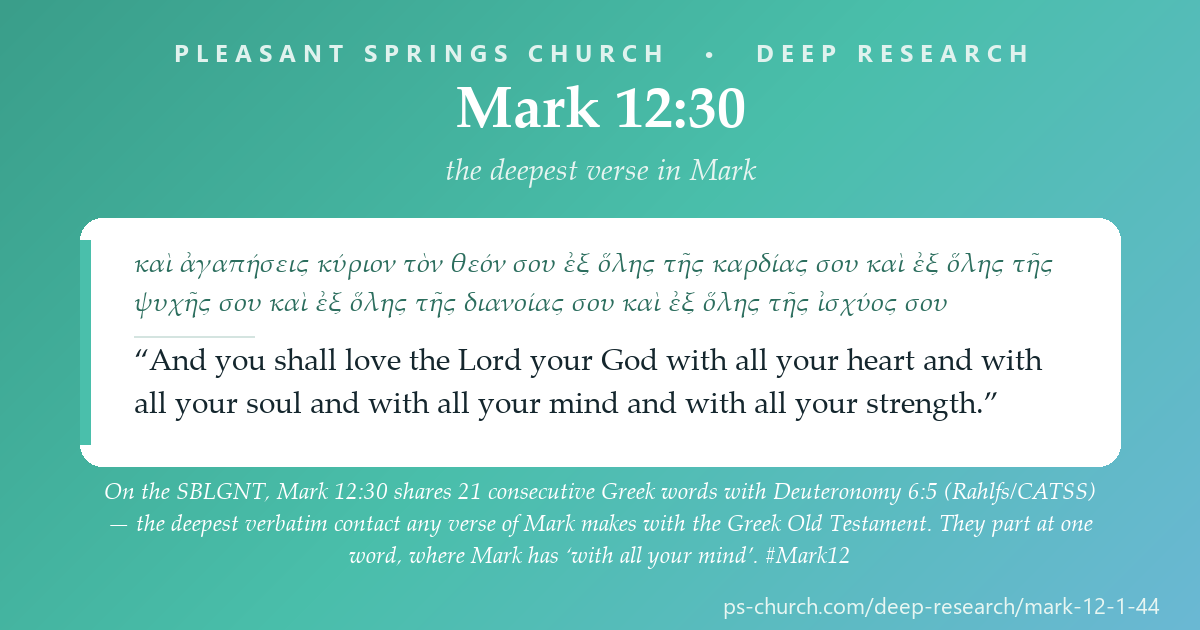
Every one of the 673 verses of Mark in the SBLGNT was screened against all 30,348 screened verse units of the Greek Old Testament held here. The deepest verbatim contact any verse of the Gospel makes is in this chapter, at 12:30: “And you shall love the Lord your God with all your heart and with all your soul” — twenty-one consecutive Greek words with Deuteronomy 6:5, tie band one, and thirty if the count runs on from 12:29. Then the run stops, at one word. Where the Greek of Deuteronomy has power, Mark has “with all your mind”, and then a fourth phrase, with all your strength, whose Greek stands in no unit of the screened Greek Old Testament. The second-deepest verse in Mark is also here (12:36, Psalm 110:1, fourteen words), and so are five of the seven verses of the Gospel that reach nine. The page follows the chapter from the vineyard to the widow; shows that the depth of three of its quotations moves with the printed Greek text; prints its counter-examples beside its findings — the scribe’s reply stands nearer to Asa’s covenant than to Deuteronomy, and the Sadducees’ law nearer to Onan than to Moses; and never says who borrowed from whom. See the method →
Mark 12:1–44
Greek NT · ESV or our renderingVersification. Mark 12 has no offset of its own: the SBLGNT and the ESV both count 44 verses, verse for verse. There is no Septuagint column, because Mark is a New Testament book. The offsets are in the Old Testament texts measured, each checked against the Masoretic and CATSS files held here. The Psalms run one behind in Greek for the psalms on this page: Psalm 118:22–23 (Hebrew and ESV) = Greek 117:22–23; Psalm 110:1 = Greek 109:1; Psalm 14:4 = Greek 13:4. Psalm 40:6 (ESV) = Hebrew 40:7 = Greek 39:7, because the Hebrew counts the title as verse 1; Psalm 48:14 (ESV) = Hebrew 48:15 = Greek 47:15; Psalm 8:6 (ESV) = Hebrew and Greek 8:7. 1 Samuel = Greek 1 Kingdoms, 2 Samuel = 2 Kingdoms, 2 Kings = 4 Kingdoms, same verse numbers here. Malachi 4:3 (ESV) = Hebrew and Greek 3:21; Exodus 8:10 (ESV) = Hebrew and Greek 8:6; Joel 3:13 (ESV) = Hebrew and Greek 4:13. Isaiah 5 has no offset — thirty verses in the Hebrew, the Greek and the ESV — and neither do Exodus 3, Deuteronomy 4, 6 and 25, Leviticus 19, Genesis 22, 37, 38 and 40, Hosea 6, 2 Chronicles 15, Joshua 22 or Isaiah 45 and 66; Genesis 31:53 is numbered alike in all three, though its chapter is not (ESV 31:55 = Hebrew 32:1); Jeremiah 38:20 (Greek) = 31:20 (Hebrew and ESV). Joshua is measured in the CATSS B text; 2 Maccabees, Tobit and Sirach are Greek only and are witnesses, not Scripture.
The Shape of the Passage
A sequence of seven scenes in the temple, with counted words marked — NOT a chiasmOne day in the temple, seven scenes, 44 verses. The hearers change scene by scene — the leaders of 11:27, Pharisees and Herodians, Sadducees, one scribe, the crowd, the disciples — and Jesus is the one speaker present in all seven.
Author
Tradition from Papias onward names Mark, interpreter of Peter. This page cannot test that from the text and does not try; the shelf’s Mark 1 study states the same position.
What the text does show is a writer who explains money. At 12:42 Mark gives a Greek coin and then its Roman value: λεπτὰ δύο, ὅ ἐστιν κοδράντης. The gloss ὅ ἐστιν stands in 9 verses of Mark; elsewhere it mostly explains Aramaic (5:41, 7:34) and once sets a Latin word beside a Greek one (15:16); here a coin. Three Latin money words stand in this chapter in Greek letters — census, denarius, quadrans — and none of them has a form anywhere in the Greek Old Testament held here.
Audience
Most locate Mark’s first readers in Rome in the 60s. A congregation that paid Caesar’s tax, handled his coin and counted in quadrantes would hear 12:13–17 and 12:41–44 as their own. This page reports that location and does not argue it.
Readers who were taught the Scriptures by being asked about them. Four of the seven scenes turn on an Old Testament text, and five of the seven verses of the whole Gospel that reach nine words with the Greek Old Testament stand here. Jesus answers a question about taxes with a question about an image, a question about the resurrection with Exodus, and a question about the first commandment with the Shema — and then asks the one question no one answers (12:35–37).
Orient on vineyards and tenants, the imperial tax, the Sadducees, the Shema, the son of David, and the temple treasury.
Search by reference and by topic: parable of the tenants, vineyard, cornerstone, Herodians, tribute, denarius, Sadducees, levirate marriage, resurrection, Shema, great commandment, son of David, scribes, widow, treasury, lepton, quadrans.
Which articles are relevant?
- Dictionary of Jesus and the Gospels (IVP, 2nd ed. 2013) — “Parables,” “Son of David,” “Love Command,” “Resurrection,” “Taxes,” “Scribes,” “Temple.”
- Anchor Bible Dictionary — “Sadducees,” “Herodians,” “Shema,” “Levirate Law,” “Coinage,” “Vine, Vineyard.”
- Dictionary of New Testament Background (IVP) — “Roman Administration,” “Taxation,” “Coinage: Greco-Roman,” “Pharisees,” “Sadducees.”
- NIDNTTE — ἀγαπάω, διάνοια, ἰσχύς, χήρα, εἰκών, κληρονόμος, ἀνάστασις.
Bibliography surfaced:
- Commentaries on Mark: R. T. France (NIGTC); Joel Marcus, Mark 8–16 (AYB); Adela Yarbro Collins (Hermeneia); Craig A. Evans, Mark 8:27–16:20 (WBC 34B); William L. Lane (NICNT).
- On the parable: Klyne Snodgrass, The Parable of the Wicked Tenants (1983).
- On the widow: Addison G. Wright, “The Widow’s Mites: Praise or Lament?” CBQ 44 (1982).
- On the use of the Old Testament: Rikki E. Watts, “Mark,” in Beale and Carson, Commentary on the New Testament Use of the Old Testament (2007).
The works above are named as places to look. None was re-read for this page, and no number on it comes from them. Stage 5 says so again.
An absentee owner, a coin with a face on it, a law about a brother’s widow, a confession said daily, and a treasury that held widows’ money.
Set each scene beside the texts held on this disk. Where a background claim rests on a text that is not held, it is labelled reported.
The vineyard and the tenants
The vineyard is Isaiah’s before it is Mark’s. “Let me sing for my beloved my love song concerning his vineyard: My beloved had a vineyard on a very fertile hill.” Isaiah 5:7 names it: ὁ γὰρ ἀμπελὼν κυρίου σαβαωθ οἶκος τοῦ Ισραηλ ἐστίν. In Isaiah the vineyard itself fails and is laid waste (5:5–6); in Mark the owner sends for his share of the fruit (12:2), and the failure is in the tenants who will not hand it over. That difference is in the texts; Stage 5 reports what readers have made of it.
Absentee owners and tenant farmers are reported widely in the papyri of Ptolemaic and Roman Egypt and in Galilee; a lease to tenants for a share of the crop, with an owner abroad, is the setting the parable assumes (καὶ ἀπεδήμησεν). No papyrus is held on this disk; the background is reported, not checked.
The coin
The question is a trap with two jaws: Pharisees and Herodians together (12:13), and the question is about the census, the head tax. Acts remembers a rising over a registration: Ἰούδας ὁ Γαλιλαῖος ἐν ταῖς ἡμέραις τῆς ἀπογραφῆς (Acts 5:37), Judas the Galilean, at the time of the registration (our rendering). The denarius of the period is reported to have carried the emperor’s portrait and a title; Jesus asks for one and asks whose εἰκὼν it bears. The word is Genesis’s: κατ' εἰκόνα θεοῦ (Greek Genesis 1:27).
Two early readings, verbatim. Justin, around 155:
Whence to God alone we render worship, but in other things we gladly serve you, acknowledging you as kings and rulers of menJustin Martyr, First Apology 17 (ANF 1)Tertullian, a half-century later, reads the image itself:
that is, the image of Cæsar, which is on the coin, to Cæsar, and the image of God, which is on man, to God; so as to render to Cæsar indeed money, to God yourself.Tertullian, On Idolatry 15 (ANF 3)Both are reported here as historic readings. The church has ratified no position on church and state, and this page does not supply one.
The Sadducees and the seven brothers
“And Sadducees came to him, who say that there is no resurrection. And they asked him a question, saying,” Acts says the same in its own words: Σαδδουκαῖοι μὲν γὰρ λέγουσιν μὴ εἶναι ἀνάστασιν μήτε ἄγγελον μήτε πνεῦμα, Φαρισαῖοι δὲ ὁμολογοῦσιν τὰ ἀμφότερα. — Sadducees hold that no one rises and that there is no angel and no spirit; Pharisees affirm both (our rendering). Hippolytus, in the third century, says the same and adds a second mark that bears on this scene:
And they deny that there is a resurrection not only of flesh, but also they suppose that the soul does not continue after death.Hippolytus, Refutation of All Heresies 9.24 (ANF 5)
They do not, however, devote attention to prophets, but neither do they to any other sages, except to the law of Moses onlyHippolytus, Refutation 9.24If that report is right, a reply from the book of Moses (12:26) meets them on the only ground they granted. It is a third-century report, and the page does not lean on it.
The law of the brother-in-law is Deuteronomy 25:5–6: “Her husband’s brother shall go in to her and take her as his wife”. Its story is Genesis 38, Judah and Tamar, and Stage 4 shows that Mark’s wording stands nearer that story than the law.
The Shema and the commandment
Deuteronomy 6:4–5 was a confession said, not only a law read. The Mishnah opens with the times for reciting it (m. Berakhot 1:1, reported; no rabbinic text is held on this disk). Deuteronomy itself tells Israel to speak these words at home and on the road and to bind them on the hand (6:7–9). A scribe who asked which commandment was first would have known the answer as words he said daily. In 12:28–31 the two commandments are given numbers: first, second.
Love of God and love of neighbour stood side by side before Mark in Second-Temple writing — the Testaments of the Twelve Patriarchs are the usual witnesses (reported; not held here). The page measures only what is on its disk.
The treasury and the widow
The temple treasury held widows’ money before it received this widow’s coins. 2 Maccabees 3, a witness and not Scripture, tells of an attempt on the treasury of Jerusalem, τὸ ἐν Ιεροσολύμοις γαζοφυλάκιον (3:6), and has the high priest reply that the deposits were παρακαταθήκας εἶναι χηρῶν τε καὶ ὀρφανῶν — deposits belonging to widows and orphans (our rendering). In Mark the scribes κατεσθίοντες τὰς οἰκίας τῶν χηρῶν (12:40), and in the next verse Jesus sits facing the treasury.
Cyprian read the two coins as a rebuke to the rich, in the third century:
The widow, the widow needy in means, is found rich in works.Cyprian, On Works and Alms 15 (ANF 5)His wording (“the offerings of God”) is Luke’s scene (21:1–4), not Mark’s.
A beloved son, a rejected stone, a fourth noun, three Latin coins, and eight wholes.
Counts are exhaustive over the SBLGNT held here (7,927 verses) and the CATSS Greek Old Testament (30,348 screened units; the Odes, held but not screened, are left out so that the psalms they copy are not counted twice). Lemma counts are from the MorphGNT lemma column; every Greek Old Testament count is a search over word forms from the start of the word, augment included (re-run unanchored, no printed result changes). A negative is a negative on these files.
Three times in Mark (1:11, 9:7, 12:6), and every one is said of the son: the voice at the baptism, the voice on the mountain, and the owner’s last son. Greek Genesis 22:2 calls Isaac τὸν υἱόν σου τὸν ἀγαπητόν where the Hebrew has your only one (אֶת־יְחִידְךָ). The bigram υἱὸν ἀγαπητόν itself stands in no unit of the screened Greek Old Testament; the nominative, υἱὸς ἀγαπητὸς Εφραιμ, stands in one, Jeremiah 38:20 LXX (ESV 31:20), of Ephraim.
The builders’ verb, from Psalm 117:22 LXX. Mark has it twice: here and at 8:31, the first passion prediction (ἀποδοκιμασθῆναι). Two places in Mark, both of the Son of Man or the stone.
Once in the Greek New Testament. In the screened Greek Old Testament a form of it stands in 4 units (Isaiah 16:10, Joel 4:13, Haggai 2:16, Zechariah 14:10) — and not in Isaiah 5:2, which has καὶ προλήνιον ὤρυξα, a fore-vat, the only prolēnion in the screened units (Ode 10, held but not screened, copies Isaiah’s song and has it too). Matthew 21:33 has ληνὸν.
Once in Mark, at the point where the run with Deuteronomy 6:5 stops. The phrase ἐξ ὅλης τῆς διανοίας stands in one unit of the screened Greek Old Testament: Joshua 22:5 (B text), ἐξ ὅλης τῆς διανοίας ὑμῶν, where the Hebrew has בְּכׇל־לְבַבְכֶם, with all your heart. Greek Deuteronomy 4:39 also has τῇ διανοίᾳ where the Hebrew has אֶל־לְבָבֶךָ. The Greek translators could put mind for the Hebrew heart.
The fourth noun. ἐξ ὅλης τῆς ἰσχύος stands in two New Testament verses (12:30 and 12:33) and in no unit of the screened Greek Old Testament; neither does the shorter ὅλης τῆς ἰσχύος. The Hebrew phrase Greek Deuteronomy renders with dynamis, וּבְכׇל־מְאֹדֶךָ, with all your mə’ōd, stands in two verses of the Masoretic text: Deuteronomy 6:5 and 2 Kings 23:25, Josiah. There Greek 4 Kingdoms has ἐν ὅλῃ ἰσχύι αὐτοῦ.
Once in the Greek New Testament; no form of the verb in the screened Greek Old Testament.
Once in the Greek New Testament. In the Greek Old Testament it is a hunter’s and a seducer’s verb (Proverbs 5:22, 6:25–26; Hosea 5:2; Job 10:16): 5 units.
The Latin census. With δηνάριον and κοδράντης (quadrans) it makes three Latin money words in one chapter. No form of any of the three, and none of Καῖσαρ, stands in the screened Greek Old Testament.
Eighteen tokens in Mark; 8 of them in this chapter (12:30, 12:33, 12:44). Four times in the commandment, three times in the scribe’s answer, and the last for the widow’s whole living.
Three times in Mark, all in this chapter (12:40, 12:42, 12:43). 26 tokens in the Greek New Testament, nine of them in Luke.
Three verses of the Greek New Testament (Mark 12:42; Luke 12:59, 21:2). The adjective leptos, thin, fine, in its plain degree stands in 25 units of the screened Greek Old Testament (one more, Wisdom 7:23, has the superlative) — thin cows, fine incense, a thin breeze — and read one by one, none of them is a coin.
Three times in Mark (6:11, 7:28, 12:36). On the SBLGNT Mark never uses hypopodion (Tregelles and Robinson–Pierpont read it at 12:36), the footstool of the Greek psalm.
What the word counts show
The chapter is full of rare words. Five words stand once in the whole Greek New Testament — hypolēnion, kephalioō, agreuō, ekthaumazō, nounechōs — and three Latin money words stand in Greek letters. And the love-words gather here: ἀγαπάω stands five times in Mark, and four of them are in 12:30–33; the other is 10:21, where Jesus loved the rich man.
εἷς, one, stands five times in the chapter: the owner had ἕνα son left (12:6); εἷς τῶν γραμματέων came (12:28); the Lord is κύριος εἷς ἐστιν (12:29), and the scribe repeats it (12:32); and μία χήρα came (12:42). It is the commonest of numbers, and the page offers the pattern as something to notice, not an argument.
Six quotations, measured against every Greek Old Testament verse we hold; where the runs stop; and what moves them.
Method: every verse of Mark 12 was screened for its longest run of consecutive shared word forms against the CATSS Greek Old Testament held here — 30,348 screened verse units, the 64 files less the Odes (30,637 held) — with the shelf’s frozen normaliser (accents, breathings and final sigma folded; word order not) and the cross-edition spelling fold the shelf applies to every CATSS-against-MorphGNT screen (ex to ek, ouk and ouch to ou, the movable nu). The same screen was run over all 673 verses of Mark in the SBLGNT (which has no 7:16, 9:44, 9:46, 11:26 or 15:28), and the chapter against the 7,254 verses of the Greek New Testament outside Mark. The tie band is the number of target units reaching the same depth, and it is printed every time.
What the screen returned
The distribution first.
| deepest run, at least | 21 | 14 | 10 | 9 | 8 | 6 | 5 | 4 | 3 | 2 |
|---|---|---|---|---|---|---|---|---|---|---|
| rows of Mark 12 (of 44) | 1 | 2 | 4 | 5 | 6 | 8 | 9 | 12 | 34 | 44 |
Across the whole Gospel, the top of that table is the top of Mark. Of the 673 verses of Mark, the deepest is 12:30 (21, Deuteronomy 6:5), the second 12:36 (14, Psalm 109:1 LXX), the third 1:3 (13, Isaiah 40:3). Seven verses of Mark reach nine or more, and five of them are in this chapter: 12:30, 12:36, 12:10, 12:11 and 12:29.
| Mark | deepest run | tie band | partner | what it is |
|---|---|---|---|---|
| 12:30 | 21 | 1 | Deuteronomy 6:5 | The deepest verse in Mark. With 12:29, 30. |
| 12:36 | 14 | 1 | Psalm 109:1 LXX (ESV 110:1) | The second-deepest. Stops at footstool. |
| 12:10 | 10 | 1 | Psalm 117:22 LXX (ESV 118:22) | The whole Greek verse. |
| 12:11 | 10 | 1 | Psalm 117:23 LXX (ESV 118:23) | The whole Greek verse; 20 with 12:10. |
| 12:29 | 9 | 1 | Deuteronomy 6:4 | The Shema, after the Greek preface. |
| 12:33 | 8 | 1 | 2 Chronicles 15:12 | Counter-example. The scribe; Deuteronomy 6:5 only 4. |
| 12:26 | 6 | 1 | Genesis 31:53 | Counter-example. Laban’s oath; Exodus 3:6 only 3. |
| 12:31 | 6 | 1 | Leviticus 19:18 | The neighbour, and no other unit. |
| 12:32 | 5 | 1 | Isaiah 45:21 | Unsignalled; Deuteronomy 4:35 has 4. |
| 12:19 | 4 | 1 | Genesis 38:9 | Counter-example. Onan; Deuteronomy 25:5 only 2. |
| 12:7 | 4 | 2 | Genesis 37:20 · Psalm 47:15 LXX | Joseph’s brothers, tied with four small words of a psalm. |
| 12:1 | 2 | 145 | — | And he began. Isaiah 5:2 scores 1. |
★ The Shema: thirty words, and where they part
The run. From Ἄκουε, Ἰσραήλ in 12:29 to the third ἐξ ὅλης τῆς in 12:30, Mark and Greek Deuteronomy 6:4–5 share 30 consecutive word forms; the screen, which measures one verse at a time, scores 12:29 at 9 and 12:30 at 21, each with a tie band of one. Then they part. Greek Deuteronomy ends ἐξ ὅλης τῆς δυνάμεώς σου. Mark goes on διανοίας σου καὶ ἐξ ὅλης τῆς ἰσχύος σου.
Three texts, three lists. The Hebrew has three nouns, בְּכׇל־לְבָבְךָ וּבְכׇל־נַפְשְׁךָ וּבְכׇל־מְאֹדֶךָ: heart, soul, and mə’ōd, the ESV’s might. The Greek has three, heart, soul, power. Mark has four, heart, soul, mind, strength. No unit of the screened Greek Old Testament has a heart, a soul and a mind word together; three units have heart, soul and strength (2 Chronicles 35:19b, a Greek plus worded as 4 Kingdoms 23:25 is, Josiah’s praise; 4 Kingdoms 23:25; Sirach 5:2). In the New Testament, Mark 12:30 and Luke 10:27 have all four. Matthew 22:37 has three — ἐν ὅλῃ τῇ διανοίᾳ σου is its third — and with ἐν ὅλῃ τῇ καρδίᾳ σου where Greek Deuteronomy has ex holēs, it measures only 5 against the Greek Old Testament, tie band 8 (the Matthew 22 page reports the band). Luke 10:27 measures 11.
What the corpus has at Deuteronomy 6:5. The CATSS file on this disk reads ἐξ ὅλης τῆς καρδίας σου and records no variant, because CATSS carries no apparatus. Whether any Greek manuscript of Deuteronomy reads dianoias here, and which reading Rahlfs’ printed apparatus or the Göttingen edition records, cannot be checked from the files held here. The finding stands on the CATSS text as it is; if a witness reads mind at 6:5, the place where Mark and the Greek part could be different, and Stage 5 says so first.
And it moves with the edition. The SBLGNT apparatus records one article missing in Westcott–Hort: τῆς Treg NA28 RP ] – WH. On that text the first ex holēs kardias loses its tēs and the run with Deuteronomy 6:5 falls to 12.
The scribe gives it back, and his words stand nearer Asa
“And to love him with all the heart and with all the understanding and with all the strength, and to love one’s neighbor as oneself, is much more than all whole burnt offerings and sacrifices.”
The scribe’s list has three nouns — ἐξ ὅλης τῆς καρδίας καὶ ἐξ ὅλης τῆς συνέσεως καὶ ἐξ ὅλης τῆς ἰσχύος — and on the SBLGNT soul is not among them; Tregelles and Robinson–Pierpont print it (συνέσεως WH NA28 ] + καὶ ἐξ ὅλης τῆς ψυχῆς Treg RP). Without the your, his wording reaches Deuteronomy 6:5 for only 4 words. The deepest partner the screen finds is ἐξ ὅλης τῆς καρδίας καὶ ἐξ ὅλης τῆς ψυχῆς, tie band 1: 2 Chronicles 15:12, where Judah under Asa entered into a covenant to seek the Lord. With Robinson–Pierpont’s soul restored, the partner and the depth stay the same. Nobody thinks the scribe is quoting Chronicles. Verbal depth is not citation, and this is the chapter’s plainest example.
Then the sacrifices, unsignalled. “much more than all whole burnt offerings and sacrifices”. Against 1 Kingdoms 15:22, Hosea 6:6 and Psalm 39:7 LXX (ESV 40:6) the run is 1 word each. The pair itself is common: a form of holokautōma, then kai, then a form of thysia stands in 14 screened units, among them 1 Kingdoms 15:22 (ὁλοκαυτώματα καὶ θυσίαι, burnt offerings and sacrifices); a holokaut- form and a thysi- form (the noun, or thysiastērion, altar) stand together anywhere in 131; Mark’s genitive ὁλοκαυτωμάτων καὶ θυσιῶν in none. Hosea 6:6 has the nouns the other way round with words between: διότι ἔλεος θέλω καὶ οὐ θυσίαν καὶ ἐπίγνωσιν θεοῦ ἢ ὁλοκαυτώματα (steadfast love and not sacrifice). No unit of the screened Greek Old Testament has a burnt-offering word, a sacrifice word and a love word (agap-) together. The scribe’s sentence has the thought of those prophets and the words of none of them.
The stone: twenty words, edge to edge
Mark introduces it as Scripture (τὴν γραφὴν ταύτην) and then gives the two Greek verses whole: ten words each, tie band one each, 20 consecutive across the line. The run begins after the formula and ends where Greek 117:23 ends; no other run in the chapter covers its Greek verse from first word to last. In the New Testament, 12:10 ties at ten with Matthew 21:42 and Luke 20:17 (band 2); 1 Peter 2:7 has λίθος ὃν ἀπεδοκίμασαν, the nominative, and Acts 4:11 says it in other words. The Hebrew, as held: in 118:22 the verb הָיְתָה is feminine, as stone is, where the Greek has the masculine οὗτος; in 118:23 the Greek αὕτη and θαυμαστὴ are feminine, as זֹּאת and נִפְלָאת are. The same psalm was sung at the entry a chapter earlier: Mark 11:9 has Εὐλογημένος ὁ ἐρχόμενος ἐν ὀνόματι κυρίου, six words with Psalm 117:26 LXX (ESV 118:26; Mark 10–11; Psalm 118).
The vineyard: a score of one, and a co-occurrence of one
The run screen hears nothing. Mark 12:1 scores 1 word against Greek Isaiah 5:1 and 1 against 5:2; its deepest partner anywhere is and he began, two words, tie band 145. The Greek of Isaiah speaks in the first person and puts the hedge first: καὶ φραγμὸν περιέθηκα καὶ ἐχαράκωσα; Mark has καὶ περιέθηκεν φραγμὸν. A co-occurrence screen hears one verse. Of the 30,348 screened units, exactly one has a vine or vineyard word (ampel-), a hedge word and a tower word: Isaiah 5:2, where the word is ampelos, the vine; none has ampelōn, vineyard, with both. In the New Testament, Mark 12:1 and Matthew 21:33. The Odes, held but not screened, copy Isaiah’s song as Ode 10, and its second verse has the same words.
Where the Greek and the Hebrew of Isaiah part, Mark’s nouns and verbs stand with the Greek — on two details. The Hebrew of 5:2 begins with two verbs, וַיְעַזְּקֵהוּ וַיְסַקְּלֵהוּ, the ESV’s He dug it and cleared it of stones; there is no hedge noun in the Hebrew of 5:2 (its first verb is the only one of its root in the Hebrew Bible; the ESV reads it dug, the KJV fenced; the hedge noun is 5:5, מְשׂוּכָּתוֹ). The Greek of 5:2 has the hedge, and so does Mark. The Hebrew וְגַם־יֶקֶב חָצֵב בּוֹ is hewed out (hewed out a wine vat in it); the Greek has καὶ προλήνιον ὤρυξα, dug, and Mark has καὶ ὤρυξεν ὑπολήνιον. The noun is neither text’s: Greek Isaiah has pro-, Mark hypo-. These are lemma agreements, not shared phrases, and the page claims no more for them.
At the bush: the words cannot tell Exodus 3:6 from three other verses
Mark 12:26 has Ἐγὼ ὁ θεὸς Ἀβραὰμ καὶ ὁ θεὸς Ἰσαὰκ καὶ ὁ θεὸς Ἰακώβ. Greek Exodus 3:6 has ἐγώ εἰμι ὁ θεὸς… θεὸς Αβρααμ καὶ θεὸς Ισαακ καὶ θεὸς Ιακωβ: the verb, and no articles before the names. So on the SBLGNT the run is 3. The articled form of Mark stands in no unit of the screened Greek Old Testament, and it stands in two New Testament verses, Mark 12:26 and Matthew 22:32; against everything, Mark’s deepest partner is ὁ θεὸς Αβρααμ καὶ ὁ θεὸς Ναχωρ — The God of Abraham and the God of Nahor — six words, tie band 1, the same counter-example the Matthew 22 page prints for 22:32.
Change two articles and Exodus comes back: Westcott–Hort and Tregelles print the names without them (ὁ θεὸς … καὶ ὁ NA28 RP ] θεὸς … καὶ WH Treg), and on that text the run is 8 — with a tie band of 4, because the same eight words stand in Exodus 3:6, 3:15, 3:16 and 4:5. The words cannot pick out the verse; the bush can. ἐπὶ τοῦ βάτου stands in no unit of the screened Old Testament; its last two words, as ἐκ τοῦ βάτου, stand in two, Exodus 3:2 and 3:4, and the only one of the four with the pronoun egō in it is 3:6. The Hebrew of 3:6 has no verb (אָנֹכִי אֱלֹהֵי); where the Greek has egō eimi, Mark has Ἐγὼ ὁ θεὸς and Matthew 22:32 has egō eimi.
David’s Lord: fourteen words, and the footstool
Fourteen words, tie band 1, from kyrios to sou. The run starts at kyrios, not at eipen, because the Greek psalm has the article (ho kyrios) and the SBLGNT of Mark does not; and it stops at one word, ὑποπόδιον τῶν ποδῶν σου against ὑποκάτω τῶν ποδῶν σου. Matthew 22:44 is the same against the psalm, 14, with the same hypokatō; Mark 12:36 and Matthew 22:44 share 19 consecutive words with each other. Luke 20:42–43, Acts 2:34–35 and Hebrews 1:13 have hypopodion.
The figure nineteen, and where it belongs. On the SBLGNT, nineteen is the run between Mark 12:36 and Matthew 22:44, not between Mark and the psalm. Against the psalm it is fourteen. But the apparatus records 6 entries in the verse, and Robinson–Pierpont differs from the SBLGNT in five of them (among them κύριος WH Treg NA28 ] ὁ κύριος RP; ὑποκάτω WH NA28 ] ὑποπόδιον Treg RP); on Robinson–Pierpont’s text, with ho kyrios and hypopodion, the run with Psalm 109:1 LXX is 19, tie band 1. Hypopodion alone gives 18; on Tregelles’ text, which also has kathison for kathou, it is 13.
Where Mark’s three words stand. ὑποκάτω τῶν ποδῶν stands in three units of the screened Greek Old Testament: 2 Kingdoms 22:10, Malachi 3:21 (ESV 4:3), and Psalm 8:7 (ESV 8:6), πάντα ὑπέταξας ὑποκάτω τῶν ποδῶν αὐτοῦ (you have put all things under his feet). The page reports where the phrase stands and asserts no merging of psalms.
The Hebrew, and the argument of 12:37. The Hebrew has two different words where the Greek has one twice: יְהֹוָה לַאדֹנִי, the divine name and my lord; the Greek and Mark have kyrios and kyriō. The Hebrew’s footstool, הֲדֹם לְרַגְלֶיךָ, is the Greek’s. 12:37 argues from my lord, which both texts have.
The neighbour, the scribe’s one, and three more counter-examples
Leviticus 19:18. ἀγαπήσεις τὸν πλησίον σου ὡς σεαυτόν (you shall love your neighbor as yourself) — six words, tie band 1, and no other unit of the screened Greek Old Testament has them; Leviticus 19:34 has ἀγαπήσεις αὐτὸν ὡς σεαυτόν, of the stranger. The same six stand in six New Testament verses: Matthew 19:19, 22:39, Mark 12:31, Romans 13:9, Galatians 5:14, James 2:8; Luke 10:27 has the last five. The Hebrew has וְאָהַבְתָּ לְרֵעֲךָ כָּמוֹךָ, love to your neighbour, with a preposition the Greek does not have. The scribe’s version, τὸν πλησίον ὡς ἑαυτὸν, reaches Leviticus for only 2.
The scribe’s one. οὐκ ἔστιν ἄλλος πλὴν αὐτοῦ: its first four words stand in two units, Exodus 8:6 (ESV 8:10) and Isaiah 45:21, καὶ οὐκ ἔστιν ἄλλος πλὴν ἐμοῦ, which ties the row at five; Deuteronomy 4:35 has καὶ οὐκ ἔστιν ἔτι πλὴν αὐτοῦ, four counting the word before (ἐστιν καὶ οὐκ ἔστιν).
Three more against our own grain. At 12:19 Moses is named and Deuteronomy 25 is meant, but the words stand nearer Genesis 38: σπέρμα τῷ ἀδελφῷ αὐτοῦ (Onan), four, tie band 1. At 12:7 and 12:3 the tenants speak like Joseph’s brothers — δεῦτε ἀποκτείνωμεν αὐτὸν stands in one Old Testament unit, καὶ λαβόντες αὐτὸν in one — but 12:7’s four-word run is tied with four words of Psalm 47:15 LXX that mean nothing here. We have not checked whether any commentator argues the Joseph echo, and we do not claim it. And at 12:40 the scribes’ devouring scores two with Psalm 13:4 LXX, who devour my people, in a band of 16.
The readings with their holders, the church’s frame labelled as the church’s, and everything this page could not check.
None of the modern works named on this page was re-read for it. Positions are reported as the literature commonly summarises them; a reader who wants to rely on an attribution should check it in the book. Five ancient texts are quoted from files on this disk, in nineteenth-century English: Justin, Tertullian, Irenaeus, Hippolytus and Cyprian (ANF). Every number on the page was measured on files on this disk and can be re-derived.
⚠️ The tenants (12:1–12) — three readings
| reading | reported holders | what the text on this page says |
|---|---|---|
| 1. The tenants are the temple leadership. The vineyard is God’s people, as in Isaiah 5:7; the tenants are its rulers; others (12:9) are new keepers of the same vineyard. | Snodgrass, Evans and many commentators (reported) | The hearers are named at 11:27; πρὸς αὐτοὺς (12:12); the crowd is on his side (12:12, 12:37). The vineyard is given, not destroyed (12:9). |
| 2. Israel is replaced. The vineyard passes from the Jews to the Gentile church. | Irenaeus, quoted below; a long tradition after him (reported) | Irenaeus is reading Matthew’s form, which has 21:43. Mark has no counterpart: Matthew 21:43’s deepest run against any verse of Mark is 4, tie band 4. |
| 3. The parable is about the son. The beloved son is the one the voice called beloved (1:11, 9:7); the stone the builders rejected is the one 8:31 says will be rejected. | most interpreters, alongside 1 or 2 (reported) | Beloved three times in Mark, all of the son; rejected twice, 8:31 and 12:10 (Stage 3). |
For inasmuch as the former have rejected the Son of God, and cast Him out of the vineyard when they slew Him, God has justly rejected them, and given to the Gentiles outside the vineyard the fruits of its cultivation.Irenaeus, Against Heresies 4.36.2 (ANF 1), reading Matthew 21:33–43
Irenaeus is quoted because his reading has been the most influential, not because this page adopts it. This page’s reading, not a ratified church position: in Mark the parable is spoken against named men (11:27; 12:12), while the crowd hears Jesus gladly (12:37); the vineyard is given, not destroyed; and the Mark text has no sentence that takes the kingdom from a people. The page reads 12:1–12 as judgement on the vineyard’s keepers and as the son’s story, and leaves the question of Israel to the texts that address it (Romans 9–11).
Caesar and God (12:17)
“Jesus said to them, ‘Render to Caesar the things that are Caesar’s, and to God the things that are God’s.’ And they marveled at him.” Readings range from a two-realm settlement, to a challenge that leaves Caesar only his coin, to a refusal to be trapped that answers nothing about taxes at all. Justin and Tertullian are quoted in Stage 2. The church has ratified no position on church–state questions, and this page does not supply one.
The resurrection (12:18–27), and what the church confesses
“And as for the dead being raised, have you not read in the book of Moses, in the passage about the bush, how God spoke to him, saying, ‘I am the God of Abraham, and the God of Isaac, and the God of Jacob’?” “He is not God of the dead, but of the living. You are quite wrong.”
| reading of 12:25 | what it says |
|---|---|
| 1. Like the angels in not marrying. | The comparison is limited to the point at issue, marriage. |
| 2. Like the angels in kind of life. | The risen live a life of a different order, deathless. |
The church’s frame, in its own words. What we believe, Article 2: “In His life, death, and resurrection, Jesus entered our shame, bore our sin, and defeated death”. And the creed the church recites (the Apostles’ Creed) ends: “the resurrection of the body and the life everlasting.” Beyond that the church has no ratified statement on the nature of the resurrection body, and the page offers both readings of 12:25 without choosing.
The widow (12:41–44) — praise or lament
| reading | reported holders | what the text says |
|---|---|---|
| 1. Praise. She is held up as the giver who gave everything. | the common reading; Cyprian (Stage 2) | 12:43–44: more than all of them; everything she had. |
| 2. Lament. She is the widow whose house is being devoured, and the system that took her last coins is the one 12:40 condemns and 13:2 says will fall. | Addison Wright, CBQ 1982 (reported) | 12:40 and 12:42 are two verses apart, and widow stands in Mark only in these three verses. |
The two readings are not exclusive: a woman can be honoured for what she gave and the men who took it condemned in the same breath. The page does not choose. It notes only that the chapter’s last whole is hers.
What this page did NOT check, and where it is weakest:
- The headline rests on one Greek text of Deuteronomy. The Greek Old Testament here is Rahlfs as digitised by CATSS, and CATSS carries no apparatus. Its Deuteronomy 6:5 reads kardias. If any Greek witness reads dianoias at Deuteronomy 6:5, the place where Mark and the Greek part could move, and the twenty-one would be a different number. No Göttingen apparatus and no manuscript was searched. That is the page’s weakest point, and it is named first.
- Four of the chapter’s depths move with the printed Greek New Testament (12:26, 12:30, 12:33, 12:36), and the headline with them: on Westcott–Hort, 12:30 falls to twelve, below 12:36 (fourteen) and 1:3 (thirteen), and 12:33, which also loses its first tēs, falls from eight to five. The reconstructions apply only the variants the SBLGNT apparatus records, one verse at a time; the apparatus compares printed editions, not manuscripts, and no manuscript was consulted.
- Isaiah 5 is measured in Greek and Hebrew only. No Qumran Isaiah, no Targum and no Aramaic text is held, so the readings that connect the parable to the temple through the Targum of Isaiah 5 are not reported here at all.
- The run screen hears verbatim contact only. The vineyard scores one, the sacrifices one, the Sadducees’ law two. The page names those uses from the text and reports the scores as the limit of the method, not as evidence against the use.
- The co-occurrence tests depend on the word lists: vine or vineyard as ampel-, hedge as phragm-, tower as pyrg-; heart, soul, mind, strength, power as kardi-, psych-, dianoi-, ischy-, dynam-; offerings as holokaut- and thysi-. A different list could give a different count.
- The Mishnah, the Testaments of the Twelve Patriarchs, the papyri and Josephus are not held. Every statement drawn from them is marked reported.
- The ESV of the 22 Mark verses whose English is not printed was deliberately not fetched, so our own renderings of those verses were checked by machine against the King James Version (and against every ESV verse the page does print), not against the ESV of the same verse. The NRSV is not on this disk.
- The structure diagram is ours. It is built from counted words, not from a commentary’s outline, and it is labelled a sequence, expressly not a chiasm.
- 2 Maccabees, Tobit and Sirach are witnesses, not Scripture. They are screened because CATSS holds them, and labelled where named.
- Direction of influence is never asserted. Where Mark’s wording stands nearer the Greek of Isaiah 5:2 than the Hebrew, nearer Chronicles than Deuteronomy, or nearer Genesis 38 than Deuteronomy 25, the page reports where the words stand and nothing more.
The first commandment is the deepest Scripture in Mark, and the last whole in the chapter is a widow’s.
Name what you learned, why it matters, and one concrete response.
What should we carry away — and do?
- The commandment Jesus calls first is the Scripture Mark gives most exactly. Twenty-one words of Deuteronomy, and then a word its Greek does not have there: “with all your mind”. Loving God is not only feeling; it is thinking too.
- The second is joined to the first. “There is no other commandment greater than these” — these, plural.
- God is the God of the living. “He is not God of the dead, but of the living”. Jesus answers a question about death with a sentence from the bush: the God of Abraham, Isaac and Jacob is God of the living.
- He watches what is given. “she out of her poverty has put in everything she had” — and two verses earlier he condemned those who “devour widows’ houses”.
Step in response: read Deuteronomy 6:4–9 and Mark 12:28–34 aloud, side by side. Then ask which of the four — heart, soul, mind, strength — you have been leaving out, and which neighbour the second commandment puts in front of you this week.
Mark 12:30 · to share
Greek NT + ESVEvery Deep Research page traces its passage across the whole sweep — the Old Testament, the Second-Temple world between the testaments (historical witnesses, not Scripture), and the New Testament. Follow the thread:
Related on the shelf. Matthew 22, the same questions in Matthew, where Psalm 110:1 is the deepest run and the Shema is shallow; Mark 10–11, the entry and the temple the day before; Mark 13, the discourse that follows the widow; Deuteronomy 6:4–9 and Deuteronomy 6, the Shema; Leviticus 19, the neighbour; Exodus 3:1–15, the bush; Isaiah 1–6, the vineyard song; Psalm 118 and Psalm 110, the stone and David’s Lord; 1 Samuel 14–15 and Hosea 4–8, obedience and mercy over sacrifice; Genesis 38, Judah and Tamar.
Pleasant Springs Church — Deep Research
Research method after Michael S. Heiser’s Bible Research Method (examine dictionaries → ancient literature → important words → textual connections → academic publications → share), with the Pleasant Springs “Author & Audience” foundation. Scripture set in the Hebrew, the Greek editions named on each page and the ESV (Old Testament), and the Greek New Testament and the ESV (New Testament), per the practice of Pleasant Springs Church. Mark works named on this page (none re-read for it): France, Marcus, Yarbro Collins, Evans, Lane, Snodgrass, Wright and Watts — none of which were consulted for any number on this page. Text: Greek New Testament from the SBL edition as digitized by MorphGNT (text, parsing and lemma columns); SBLGNT apparatus, Michael W. Holmes (ed.), Society of Biblical Literature and Logos Bible Software, CC BY 4.0; Greek Old Testament from Rahlfs’ Septuaginta as digitized by CATSS; Hebrew from the Masoretic text as printed in Sefaria’s Miqra according to the Masorah; Justin, Irenaeus, Tertullian, Hippolytus and Cyprian from the Ante-Nicene Fathers. ⚠️ VERSE NUMBERING. Mark 12 is numbered alike in the SBLGNT and the ESV (44 verses). Psalm 118:22–23 = LXX 117:22–23; Psalm 110:1 = LXX 109:1; Psalm 14:4 = LXX 13:4; ESV Psalm 40:6 = MT 40:7 = LXX 39:7; ESV 48:14 = MT 48:15 = LXX 47:15; ESV 8:6 = MT and LXX 8:7. 1 Samuel = 1 Kingdoms, 2 Samuel = 2 Kingdoms, 2 Kings = 4 Kingdoms. ESV Malachi 4:3 = MT and LXX 3:21; ESV Exodus 8:10 = MT and LXX 8:6; ESV Joel 3:13 = MT and LXX 4:13. Isaiah 5, Exodus 3, Deuteronomy 6 and Leviticus 19 are numbered alike in all three. ⚠️ The measurement, in full. Greek against Greek; MorphGNT normalised word; CATSS form column, beta-code transliterated first; both sides lowercased, accents and breathings dropped, final sigma folded, with the shelf’s edition-equivalence table on cross-corpus screens. Contiguous runs of whole word forms, never lemmas. 44 rows, and all 673 SBLGNT verses of Mark, against 30,348 verse units — the 64 CATSS files less the Odes — and the 44 rows against the 7,254 verses of the Greek New Testament outside Mark. Co-occurrence tests are unanchored regular expressions over the same normalised forms. Hebrew phrase counts consonantal, over 23,204 Masoretic verse units. Exhaustive and deterministic. It finds verbatim contact, not allusion.
Scripture quotations marked ESV are from the ESV® Bible (The Holy Bible, English Standard Version®), © 2001 by Crossway, a publishing ministry of Good News Publishers. ESV Text Edition: 2016. Used by permission. All rights reserved. The ESV text may not be quoted in any publication made available to the public by a Creative Commons license, and the ESV may not be translated in whole or in part into any other language. www.esv.org
|
Did this study bless you today? 💚 Give to Support PS Church100% of gifts go to the General Fund — thank you. |