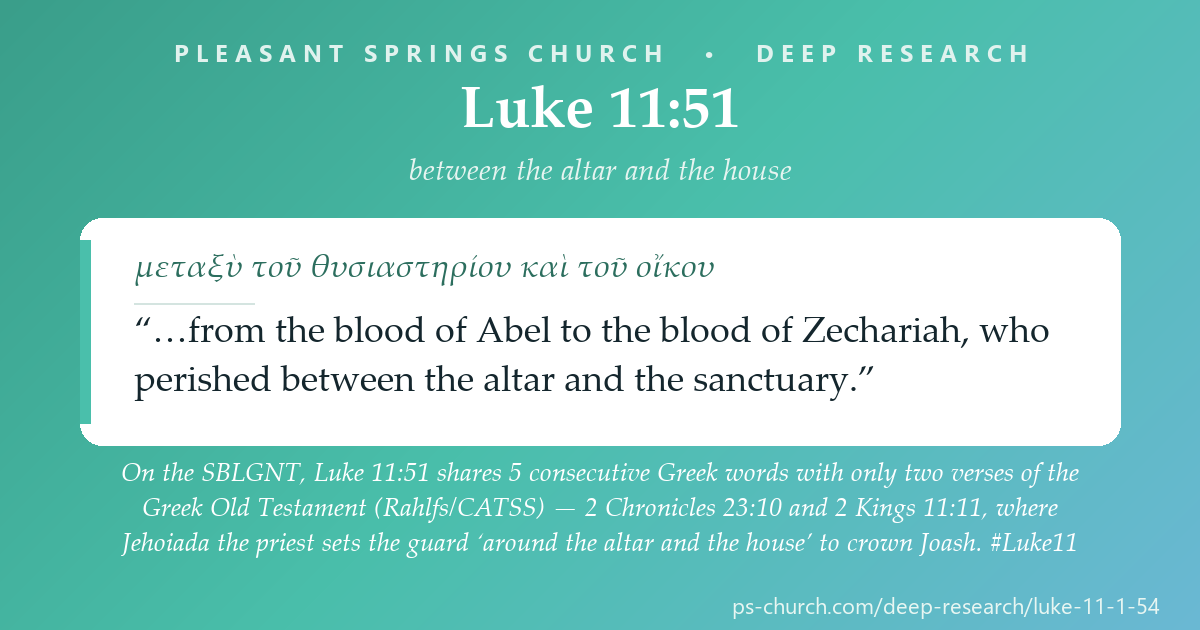
Every one of the 54 verses of Luke 11 was screened against all 30,348 screened verse units of the Greek Old Testament held here. The woes close with “the blood of Abel to the blood of Zechariah, who perished between the altar and the sanctuary” — and five consecutive Greek words of that verse, τοῦ θυσιαστηρίου καὶ τοῦ οἴκου, stand in exactly two of those units. Both are the same scene told twice: 2 Chronicles 23:10 and 2 Kings 11:11, where Jehoiada the priest sets armed men “around the altar and the house” to make the boy Joash king. In the next chapter of Chronicles, Joash has Jehoiada’s son stoned in the court of the house of the Lord — the Hebrew names him Zechariah; the Greek held here names him Azarias. The verse before him is the only screened unit with Luke’s αὐτοὺς προφήτας. Beside that, the chapter’s most famous Old Testament echo measures almost nothing: the finger of God shares one and two words with the three Greek Old Testament verses that have it, and an unanchored search finds exactly those three. The page sets Luke’s shorter prayer beside Matthew’s clause by clause, reproduces the Matthew 12 page’s figures from Luke’s side, prints the chapter’s other two five-word rows — a formula and an accident — beside this one, and never says who borrowed from whom. See the method →
Luke 11:1–54
Greek NT · ESV or our renderingVersification. Luke 11 has no offset: the SBLGNT, the ESV and the King James Version all count 54 verses, verse for verse. There is no Septuagint column, because Luke is a New Testament book. The offsets are in the Old Testament texts measured. Exodus 8 runs four behind in Hebrew and Greek: the finger of God is Exodus 8:15 in the Masoretic and the Greek = ESV 8:19, because the Hebrew and the Greek put ESV 8:1–4 at the end of chapter 7. Psalm 11:8 in the Greek = ESV 12:7 (Hebrew 12:8). 1 Kings = Greek 3 Kingdoms and 2 Kings = 4 Kingdoms, with the same verse numbers here (1 Kings 10:1, 2 Kings 11:11). Chronicles (Greek Paralipomenon) has the same numbers in all three for 2 Chronicles 9, 23 and 24. Ezra 7:25 stands in the Greek 2 Esdras (Ezra–Nehemiah) under the same number; 1 Esdras is a different book. Jonah 3–4 is numbered alike in all three (the offset in Jonah is at 1:17 = Hebrew and Greek 2:1, not used here). Genesis 4, Exodus 31, Leviticus 27, Numbers 19, Deuteronomy 9 and 14, Proverbs 22–23, Zechariah 1 and Isaiah 8 have no offset in the verses printed. 2 Kingdoms 3:6 and 4:11 are 2 Samuel 3:6 and 4:11; Greek Psalms 62:1 and 141:1 are the titles of ESV Psalms 63 and 142 (Hebrew 63:1, 142:1). Proverbs 28:22 is cited from the Hebrew only: the Greek Proverbs held here does not carry that label in its own order, and it was not matched by content. Sirach, Wisdom, the Psalms of Solomon and 1 Esdras are Greek only and are witnesses, not Scripture.
The Shape of the Passage
A sequence of three panels, threaded by repeated words — NOT a chiasmOne chapter, 54 verses: a prayer and its teaching, a controversy, and a meal that ends in a plot. The Greek is measured against the rest of the New Testament and the Greek Old Testament; the authorship is reported, not tested.
Author
Tradition from Irenaeus onward names Luke, Paul’s companion.
Luke also, the companion of Paul, recorded in a book the Gospel preached by him.Irenaeus, Against Heresies 3.1.1 (ANF 1)
The page cannot test that from the text and does not try; the shelf’s Luke 1–2 study states the same position.
What the text shows is a writer who sets familiar sayings in his own frame. The asking, the Beelzebul debate and the sign of Jonah reach ten to twenty-four words in a row with Matthew; the woes at the table reach six at most. Where Matthew sets the prayer in a sermon, Luke sets it after a request; where Matthew’s woes are spoken to the crowds and the disciples (23:1) before he leaves the temple (24:1), Luke’s are spoken at a meal. The page reports where the words stand, and says nothing about who wrote first.
Audience
Theophilus, and readers like him (Luke 1:3–4; Acts 1:1), who had been taught already and were given an orderly account. Nothing in Luke 11 names a new audience.
Readers who knew the Greek Scriptures. The chapter assumes them: the magicians’ finger of God, the preaching of Jonah, the queen who came to Solomon, the tithe, the uncleanness of a grave, and the blood of Abel and of Zechariah are named without being explained. The chapter’s woes are spoken by a Jewish teacher at a Pharisee’s table, to Pharisees and lawyers; the page reads them as addressed to those named, not to a people.
Orient on prayer and the Lord’s Prayer, hospitality, exorcism and Beelzebul, the kingdom of God, Jonah and Nineveh, Sheba, light and the eye, Pharisees and lawyers, tithing, purity and graves, and the two Zechariahs.
Search by reference and by topic: Lord’s Prayer, daily bread, friend at midnight, Beelzebul, finger of God, exorcism, strong man, unclean spirit, sign of Jonah, Nineveh, queen of Sheba, lamp, eye, Pharisees, lawyers (nomikoi), tithe, corpse impurity, tombs of the prophets, Wisdom, Abel, Zechariah son of Jehoiada, Zechariah son of Berechiah.
Which articles are relevant?
- Dictionary of Jesus and the Gospels (IVP, 2nd ed. 2013) — “Lord’s Prayer,” “Prayer,” “Demon, Devil, Satan,” “Kingdom of God,” “Pharisees,” “Scribes,” “Wisdom,” “Luke, Gospel of.”
- Anchor Bible Dictionary — “Beelzebul,” “Finger of God,” “Jonah, Sign of,” “Sheba, Queen of,” “Zechariah (Person),” “Abel,” “Tithe.”
- Dictionary of New Testament Background (IVP) — “Purity,” “Exorcism,” “Meals,” “Burial Practices.”
- NIDNTTE — ἐπιούσιος, ἀναίδεια, δάκτυλος, σημεῖον, μετανοέω, ἁπλοῦς, νομικός, ἐκζητέω.
Bibliography surfaced:
- Commentaries on Luke: Darrell L. Bock, Luke 9:51–24:53 (BECNT); Joseph A. Fitzmyer, The Gospel According to Luke X–XXIV (AB 28A); I. Howard Marshall (NIGTC); Joel B. Green (NICNT); John Nolland, Luke 9:21–18:34 (WBC 35B).
- On the prayer: Joachim Jeremias, The Prayers of Jesus (1967).
- On the use of the Old Testament: David W. Pao and Eckhard J. Schnabel, “Luke,” in Beale and Carson, Commentary on the New Testament Use of the Old Testament (2007).
The works above are named as places to look. None was re-read for this page, and no number on it comes from them. Stage 5 says so again.
What the world of the text supplies: teachers who taught their disciples to pray, a village night, exorcists among Jesus’ hearers, a second-century reader of the finger of God, washing before meals, and graves that defile.
As John taught his disciples (11:1)
Luke has already noted John’s disciples at prayer: Οἱ μαθηταὶ Ἰωάννου νηστεύουσιν πυκνὰ καὶ δεήσεις ποιοῦνται (Luke 5:33). A teacher’s prayer marked his circle; the request of 11:1 assumes that custom. No prayer of John’s survives in the texts held here.
A friend at midnight (11:5–8)
A guest arriving late, a house with no bread, a neighbour asleep with his children in one room: the story assumes a village where hospitality to a traveller was owed and bread was baked daily (reported in the literature; no village ethnography is held here). The point of the story turns on ἀναίδεια (Stage 3).
Your sons cast them out (11:19)
The saying assumes that exorcism was practised by others among Jesus’ hearers. Josephus is reported to describe a Jewish exorcist, Eleazar, before Vespasian (Antiquities 8.46–49); Josephus is not held on this disk, and the report is not checked. Tobit, which is held, has a demon driven off by the smell of a fish’s heart and liver on the incense ashes, and bound by Raphael (Tobit 8:2–3, the S text); it is a witness, not Scripture.
The finger of God, read in the second century
For the magicians who stood before Pharaoh and resisted Moses called the power of the Creator "the finger of God."Tertullian, Against Marcion 4.26 (ANF 3)
Tertullian, writing against Marcion around 207–208 (reported), reads Luke 11:20 back to Exodus 8: the magicians named the power, and Jesus used their word. That is a reader’s connection, and a very early one. Stage 4 measures what the Greek words themselves share.
Washing before the meal (11:38)
ἐβαπτίσθη: the Pharisee is surprised that Jesus did not wash first. Mark 7:3–4 describes the custom of washing hands and vessels. The rule for hand-washing before ordinary meals is reported from the Mishnah and later rabbinic texts, which are not held on this disk; whether it was general practice in Jesus’ day is debated (reported).
Graves that defile (11:44)
Under Numbers 19:16 anyone who touched a grave was unclean for seven days. A grave no one could see was a grave one might touch without knowing. The later custom of whitewashing tombs before the pilgrim feasts, so that they could be seen and avoided, is reported from the Mishnah (not held). Where Matthew has tombs whitewashed and seen (23:27), Luke has tombs unmarked and unseen.
Tombs of the prophets (11:47–48)
Monuments over the graves of the righteous were built in Jesus’ time; Josephus is reported to describe Herod building a monument at the tomb of David (Antiquities 16.179–183, reported, not held). The saying turns the building into testimony: those who build are witnesses that their fathers killed.
Eight words. Where a count is given it is a lemma count from the MorphGNT columns, re-checked by unanchored search.
Twice in the Greek New Testament (Matthew 6:11, Luke 11:3) and in no screened unit of the Greek Old Testament, searched unanchored. Whether it means for today, for the coming day, needed for existence or something more is an old question (Stage 5); the ESV has daily. A word found almost nowhere else cannot be settled by counting.
Once in the Greek New Testament (Luke 11:8). In Sirach 25:22 (a witness) the noun stands among words of blame, ὀργὴ καὶ ἀναίδεια. The ESV has impudence. Stage 5 on whose shamelessness it is.
Seven tokens in the Greek New Testament (Matthew 23:4, Mark 7:33, Luke 11:20, Luke 11:46, Luke 16:24, John 20:25, John 20:27); Luke has 3, and two of them are in this chapter: the finger of God that drives out demons (11:20) and the one finger the lawyers will not lift (11:46).
In the Greek Jonah held here the verb stands in 3 verses (Jonah 3:9, Jonah 3:10, Jonah 4:2), and in all of them God is its subject. Of the Ninevites the Greek says ἐνεπίστευσαν οἱ ἄνδρες Νινευη τῷ θεῷ (3:5) and ἀπέστρεψαν (3:8, 3:10). The form μετενόησαν stands in 9 New Testament verses and in no screened unit of the Greek Old Testament.
Twice in the Greek New Testament (Matthew 6:22, Luke 11:34). The ESV has healthy. The cognate noun ἁπλότης stands in 7 verses of Paul, four of them about giving (Romans 12:8; 2 Corinthians 8:2, 9:11, 9:13). Stage 4 on the Hebrew good eye of Proverbs 22:9.
Nine tokens in the Greek New Testament (Matthew 22:35, Luke 7:30, Luke 10:25, Luke 11:45, Luke 11:46, Luke 11:52, Luke 14:3, Titus 3:9, Titus 3:13): six in Luke, one in Matthew (22:35), two in Titus. Three of Luke’s are in this chapter (11:45, 11:46, 11:52). Luke also has νομοδιδάσκαλοι (5:17), a different word.
Twice in the Greek New Testament as the adjective (Luke 11:44, 1 Corinthians 14:8, the indistinct trumpet call). The ESV has unmarked.
Seven tokens in the Greek New Testament (Luke 11:50, Luke 11:51, Acts 15:17, Romans 3:11, Hebrews 11:6, Hebrews 12:17, 1 Peter 1:10); Luke’s two are 11:50 and 11:51. In the screened Greek Old Testament a form of the verb stands with a form of αἷμα in the same unit 10 times, among them Genesis 9:5 and 42:22, 2 Kingdoms 4:11, Psalm 9:13 (ESV 9:12) and Ezekiel 3:18, 3:20, 33:6 and 33:8 — blood required of someone. 2 Chronicles 24:22 is not among them (Stage 4).
The chapter against the rest of the New Testament and against the whole Greek Old Testament; the prayer clause by clause; the Matthew 12 figures from Luke’s side; the woes against Matthew 23; and the Old Testament texts the chapter names.
The chapter against the New Testament outside Luke
Each of the 54 verses was screened against the 6,778 verses of the Greek New Testament outside Luke (MorphGNT on both sides, contiguous runs of whole word forms). The distribution, by deepest run:
| deepest run against the NT outside Luke | 24 | 16 | 15 | 14 | 13 | 11 | 10 | 7 | 6 | 5 | 4 | 3 | 2 |
|---|---|---|---|---|---|---|---|---|---|---|---|---|---|
| rows of Luke 11 | 1 | 1 | 2 | 2 | 1 | 3 | 1 | 5 | 3 | 5 | 6 | 16 | 8 |
The deep rows are all in the asking and the signs. Every row of 10 or more is in 11:9–32, and every one has a partner in Matthew 7:7–11 or 12:27–45. The deepest is 11:32, 24 words with Matthew 12:41, tie band 1. The prayer runs 4, 5 and 6; the woes at the table run 6 at most.
The prayer, clause by clause
Luke’s prayer, from Πάτερ to the end of 11:4, is 38 words in the SBLGNT; Matthew’s, from Πάτερ to the end of 6:13, is 57. 22 of Luke’s 38 stand inside a run of three or more words shared with Matthew’s prayer (24 inside runs of two or more). The longest shared run, read across the verse breaks, is 8: the name and the kingdom petitions together.
| clause | Luke 11:2–4 (SBLGNT) | Matthew 6:9–13 (SBLGNT) | longest shared run |
|---|---|---|---|
| address | Πάτερ | Πάτερ ἡμῶν ὁ ἐν τοῖς οὐρανοῖς | 1 — Robinson-Pierpont: Πάτερ WH Treg NA28 ] + ἡμῶν ὁ ἐν τοῖς οὐρανοις RP |
| the name | ἁγιασθήτω τὸ ὄνομά σου | ἁγιασθήτω τὸ ὄνομά σου | 4 |
| the kingdom | ἐλθέτω ἡ βασιλεία σου | ἐλθέτω ἡ βασιλεία σου | 4 (with the name clause, 8 in a row) |
| the will | — | γενηθήτω τὸ θέλημά σου, ὡς ἐν οὐρανῷ καὶ ἐπὶ γῆς | absent from the SBLGNT, WH, Tregelles and NA28 of Luke; Robinson-Pierpont: σου WH Treg NA28 ] + Γενηθήτω τὸ θέλημά σου ὡς ἐν οὐρανῳ καὶ ἐπὶ τῆς γῆς RP |
| bread | τὸν ἄρτον ἡμῶν τὸν ἐπιούσιον δίδου ἡμῖν τὸ καθ’ ἡμέραν· | τὸν ἄρτον ἡμῶν τὸν ἐπιούσιον δὸς ἡμῖν σήμερον· | 5 |
| forgiveness | καὶ ἄφες ἡμῖν τὰς ἁμαρτίας ἡμῶν, καὶ γὰρ αὐτοὶ ἀφίομεν παντὶ ὀφείλοντι ἡμῖν | καὶ ἄφες ἡμῖν τὰ ὀφειλήματα ἡμῶν, ὡς καὶ ἡμεῖς ἀφήκαμεν τοῖς ὀφειλέταις ἡμῶν· | 3 |
| temptation | καὶ μὴ εἰσενέγκῃς ἡμᾶς εἰς πειρασμόν | καὶ μὴ εἰσενέγκῃς ἡμᾶς εἰς πειρασμόν | 6 |
| deliverance | — | ἀλλὰ ῥῦσαι ἡμᾶς ἀπὸ τοῦ πονηροῦ | absent from the SBLGNT, WH, Tregelles and NA28 of Luke; Robinson-Pierpont: πειρασμόν WH Treg NA28 ] + ἀλλὰ ῥῦσαι ἡμᾶς ἀπὸ τοῦ πονηροῦ RP |
Two hidden ties. Verse 11:2’s best run against the whole New Testament outside Luke is 4, band 2: Matthew 6:9 and Matthew 6:10, and they are two different four-word runs, one per petition. The temptation line, 6 words, stands in these two verses and in no other verse of the New Testament.
The other editions. The SBLGNT apparatus records that Westcott-Hort, Tregelles and NA28 print Luke’s prayer as the SBLGNT does, and that Robinson-Pierpont adds three things: the fuller address, the petition for God’s will, and the deliverance from evil. Each addition is Matthew’s wording, nearly word for word (the will petition has the article before earth, where the SBLGNT of Matthew has none). With them, Luke’s prayer is 60 words, 44 of them in runs of three or more with Matthew’s; the longest shared run becomes 23; and screened against the New Testament, the Robinson-Pierpont 11:2 reaches 13 with Matthew 6:10 (band 1) and 11:4 reaches 12 with Matthew 6:13 (band 1). The apparatus line for the will petition does not say which of the verse’s two σου it follows; the page measures it after the kingdom petition, where Matthew has it. The apparatus compares printed editions; it does not say which manuscripts carry which form, and this page makes no manuscript claim. It does not say which form is older, or who wrote first.
Matthew 6:9–13 · beside Luke 11:2–4
Greek NT · ESVBeelzebul, Jonah and the queen: the Matthew 12 page, from Luke’s side
The shelf’s Matthew 12 study screened Matthew against Luke. Screened here the other way, Luke against Matthew, every figure that page printed for these verses comes back the same:
| Luke | Matthew 12 | run (Luke’s side) | the Matthew 12 page | Luke row’s band vs the whole NT outside Luke |
|---|---|---|---|---|
| 11:19 | 12:27 | 15 | 15 | 1 |
| 11:20 | 12:28 | 11 | 11 | 1 |
| 11:21–22 | 12:29 | 1, 2 | — | — |
| 11:23 | 12:30 | 15 | 15 | 1 |
| 11:24 | 12:43 | 14 | 14 | 1 |
| 11:26 | 12:45 | 14 | 14 | 1 |
| 11:29 | 12:39 | 10 | 10 | 2 (Matthew 16:4 ties) |
| 11:30 | 12:40 | 4 | 4 | row’s best is 5, band 6 (a formula) |
| 11:31 | 12:42 | 16 | 16 | 1 |
| 11:32 | 12:41 | 24 | 24 | 1 |
Two things the reverse screen adds. First, the strong-man parable (11:21–22) parts company — 1 and 2 words with Matthew 12:29, where 11:19 and 11:23 on either side run fifteen. Second, the queen and the Ninevites trade places: in Matthew the Ninevites come first (12:41) and the queen second (12:42), in Luke the queen first (11:31) and the Ninevites second (11:32), and each verse still runs 16 and 24 words with its partner. A contiguous-run screen measures each verse separately and cannot see order; the order is read off the references.
The finger of God: a famous echo that measures one
ἐν δακτύλῳ θεοῦ (11:20). Where Matthew 12:28 has ἐν πνεύματι θεοῦ, Luke has the finger. The phrase is set beside three Old Testament verses — the magicians’ δάκτυλος θεοῦ ἐστιν τοῦτο (Exodus 8:15, ESV 8:19), and the tablets γεγραμμένας τῷ δακτύλῳ τοῦ θεοῦ (Exodus 31:18; Deuteronomy 9:10 γεγραμμένας ἐν τῷ δακτύλῳ τοῦ θεοῦ). Against them the run engine measures 1, 2 and 2. In Exodus 8:15 the noun is nominative; in Exodus 31:18 and Deuteronomy 9:10 an article stands between finger and God. No two consecutive words of the finger phrase match, and the twos are the τοῦ θεοῦ of Luke’s kingdom clause.
The finger of God · Exodus 8:15 (ESV 8:19), 31:18; Deuteronomy 9:10
Hebrew · Greek OT · ESVAn unanchored search sees what the run engine cannot. Searching every screened unit for any form beginning daktyl- followed, at any distance in the same unit, by theou finds 3 units: Exodus 8:15, Exodus 31:18 and Deuteronomy 9:10, and in the Greek New Testament 1, Luke 11:20. The Hebrew אֶצְבַּע אֱלֹהִים, prefixes allowed, stands in the same three verses and no others. The phrase Matthew has, ἐν πνεύματι θεοῦ, stands with the preposition in 3 New Testament verses (Matthew 12:28, 1 Corinthians 6:11, 1 Corinthians 12:3); the dative Spirit of God, with or without the preposition and with or without the article in 6 New Testament verses (Matthew 12:28, Romans 8:14, 1 Corinthians 6:11, 1 Corinthians 12:3, 2 Corinthians 3:3, Philippians 3:3). The row’s deepest partner in the whole Greek Old Testament is none of these: it is ἡ βασιλεία τοῦ θεοῦ ἡμῶν (Psalms of Solomon 17:3, run 4, tie band 1) — the phrase the kingdom of God, which with the article stands in no other screened unit (the anarthrous accusative stands at Wisdom 10:10). Two readings of the same fact are possible, and the page gives both: the shared phrase is so rare that three verses of the Greek Old Testament held here carry it (and one of the New), or the screen that counts word forms is simply blind to a phrase whose case has changed. The second is certainly true; the first is a count. With the Westcott-Hort, Tregelles and NA28 reading, θεοῦ RP ] + ἐγὼ WH Treg NA28, the run with Matthew 12:28 rises from 11 to 13.
Nineveh repented — in whose Greek?
ὅτι μετενόησαν εἰς τὸ κήρυγμα Ἰωνᾶ (11:32). The Greek Jonah held here never uses that verb of the Ninevites. It says they ἐνεπίστευσαν οἱ ἄνδρες Νινευη τῷ θεῷ (3:5) and that they ἀπέστρεψαν ἀπὸ τῶν ὁδῶν αὐτῶν τῶν πονηρῶν (3:10). Every form of the verb in Greek Jonah — μετανοήσει ὁ θεὸς (3:9), μετενόησεν ὁ θεὸς (3:10), and the creed of 4:2, μετανοῶν ἐπὶ ταῖς κακίαις — has God as its subject, 3 verses of 3, searched unanchored for metano- and meteno-. The Hebrew has the same division: its verb of relenting (3:10 וַיִּנָּחֶם הָאֱלֹהִים) stands for God in 3:9, 3:10 and 4:2, and the verb of turning for the people (3:8, 3:10) — and for God too, in 3:9. The form μετενόησαν stands in no screened Greek Old Testament unit. Against Jonah 3:2, where the prophet is sent κατὰ τὸ κήρυγμα, the row shares 2 words, the preaching.
Nineveh · Jonah 3:5, 3:10
Hebrew · Greek OT · ESVThe queen of the South is βασίλισσα Σαβα in the Greek of 3 Kingdoms 10:1, and the row measures 1 against that verse and 2 against 2 Chronicles 9:1. The Greek Old Testament held here spells the king Σαλωμων (304 screened units; the spelling with omicron stands in 1, 2 Kingdoms 8:7); Luke has τὴν σοφίαν Σολομῶνος, so even Solomon does not match form for form.
“the Wisdom of God said” — and no screened text has the words
ἡ σοφία τοῦ θεοῦ εἶπεν (11:49) introduces a saying that no screened Greek Old Testament unit contains in these words. The ESV’s capital in the Wisdom of God said is an editorial choice; the Greek has no capital letter to decide it. Screened against the blocks of the Greek Old Testament where Wisdom speaks or sends:
| block of the Greek OT | 11:49 best run | tie band |
|---|---|---|
| Proverbs 1, the whole chapter (Wisdom calls in the streets at 1:20–33) | 1 | 22 |
| Wisdom of Solomon 7 (a witness) | 2 | 3 |
| Wisdom of Solomon 10 (a witness) | 2 | 3 |
| Sirach 24 (a witness) | 2 | 3 |
| the whole screened Greek OT | 4 | 1 (Ezra 7:25, ὡς ἡ σοφία τοῦ θεοῦ) |
| the saying alone (from Ἀποστελῶ) | 3 | 8 |
Proverbs 1:20–33, where Wisdom cries in the streets and is refused, shares one word with the verse. Wisdom 7:27, which says that wisdom φίλους θεοῦ καὶ προφήτας κατασκευάζει, measures 1. The four-word row is Ezra 7:25, the Persian king’s letter, ὡς ἡ σοφία τοῦ θεοῦ — an accident of a common phrase. The noun with θεοῦ beside it, in either order, stands in 5 New Testament verses (Luke 11:49, 1 Corinthians 1:21, Ephesians 3:10, 1 Corinthians 1:24, 1 Corinthians 2:7) and in 2 screened Greek Old Testament units (1 Esdras 8:23 and Ezra 7:25), both of them the decree to Ezra. The screen finds no source for the saying, and the page does not supply one. Where Matthew 23:34 has ἰδοὺ ἐγὼ ἀποστέλλω πρὸς ὑμᾶς προφήτας καὶ σοφοὺς καὶ γραμματεῖς, Luke has the wisdom of God speaking.
★ From the blood of Abel to the blood of Zechariah
Abel. φωνὴ αἵματος τοῦ ἀδελφοῦ σου βοᾷ πρός με (Genesis 4:10). The row measures 1 against it. Abel’s name with αἵματος Ἅβελ stands in two New Testament verses, here and Matthew 23:35, and in no screened Greek Old Testament unit.
Zechariah, and the five words. Luke 11:51 is one of the three rows of the chapter that reach the chapter’s deepest run against the Greek Old Testament, five words. Its five are τοῦ θυσιαστηρίου καὶ τοῦ οἴκου, and the band is 2: τοῦ θυσιαστηρίου καὶ τοῦ οἴκου in 2 Chronicles 23:10 and τοῦ θυσιαστηρίου καὶ τοῦ οἴκου in 4 Kingdoms (ESV 2 Kings) 11:11. Searched unanchored in the genitive, with or without the second article, the phrase stands in those 2 units and in 1 New Testament verse, this one. In another case the pair stands once more, τὸ θυσιαστήριον καὶ ὁ οἶκος (Judith 4:3, a witness), and with a pronoun between, at Isaiah 60:7; a screen of word forms does not see them. The Hebrew לַמִּזְבֵּחַ וְלַבָּיִת, as written, stands in the same two verses and no others. Both are the same event: Jehoiada the priest arms the guard round the altar and the house and crowns the boy Joash. In the next chapter of Chronicles, after Jehoiada dies, Joash has his son stoned ἐν αὐλῇ οἴκου κυρίου (בַּחֲצַר בֵּית יְהֹוָה, 24:21) — in the court of the house of the Lord, not between the altar and the house. So the words of the place where Luke says Zechariah died are the words of the place where Jehoiada, the father of the Zechariah of 2 Chronicles 24 in the Hebrew, stationed the guard, one chapter earlier.
Jehoiada, Joash and the priest · 2 Chronicles 23:10; 24:19–22
Hebrew · Greek OT · ESVThree more contacts in the same two chapters. (1) Ἀποστελῶ εἰς αὐτοὺς προφήτας (11:49) and ἀπέστειλεν πρὸς αὐτοὺς προφήτας (24:19, the verse before the murder) share 2 consecutive words, them prophets; searched unanchored, αὐτοὺς προφήτας stands in 1 screened unit, 2 Chronicles 24:19, and 1 New Testament verse, Luke 11:49. Two words could be chance, and the page says so. (2) The dying priest’s words: the Hebrew יֵרֶא יְהֹוָה וְיִדְרֹשׁ, may the Lord see and require; the Greek ἴδοι κύριος καὶ κρινάτω, see and judge, which stands in 1 screened unit. Luke has ἐκζητηθήσεται — the verb the Greek Old Testament uses elsewhere for blood required (Stage 3), where the Greek of Chronicles has judge. (3) The name. The Hebrew of 24:20 has אֶת־זְכַרְיָה בֶּן־יְהוֹיָדָע — the only verse in the Hebrew Bible where Zechariah and Jehoiada stand within four words — and the ESV follows it. The Greek held here has τὸν Αζαριαν τὸν τοῦ Ιωδαε: no screened unit of 2 Chronicles 24 has a Zachari- form. Rahlfs’ text is printed without an apparatus here, and whether some Greek manuscripts read Zacharias was not checked.
Matthew’s Zechariah. Where Luke names no father, Matthew 23:35 has Ζαχαρίου υἱοῦ Βαραχίου, and where Luke has the altar and the house, Matthew has μεταξὺ τοῦ ναοῦ καὶ τοῦ θυσιαστηρίου — the two places in the other order, and ναοῦ where Luke has οἴκου. In the Hebrew Bible Zechariah and Berechiah stand together in 3 verses: Zechariah 1:1 and 1:7, the prophet (אֶל־זְכַרְיָה בֶּן־בֶּרֶכְיָה; Greek Ζαχαριαν τὸν τοῦ Βαραχιου υἱὸν Αδδω), and Isaiah 8:2, a witness named וְאֶת־זְכַרְיָהוּ בֶּן יְבֶרֶכְיָהוּ. None of the three verses records a murder. Stage 5 sets out the readings; the page marks every identification reported.
Abel, and the queen · Genesis 4:10; 1 Kings 10:1; Matthew 12:28; Matthew 23:35
Greek · ESVTithes, graves and the eye
Mint and rue (11:42). The law of the tithe in Greek uses the noun, πᾶσα δεκάτη τῆς γῆς (Leviticus 27:30), and the verb, δεκάτην ἀποδεκατώσεις (Deuteronomy 14:22). Against each the row measures 1: Luke’s ἀποδεκατοῦτε is the same verb as Deuteronomy’s in another form. ἡδύοσμον stands in the Greek New Testament twice (Luke 11:42, Matthew 23:23) and πήγανον once; neither stands in a screened Greek Old Testament unit. That rue was exempt from the tithe is reported from the Mishnah (Shebiit 9:1), which is not held; the page does not check it.
Unmarked graves (11:44). Numbers 19:16 makes a grave a source of seven days’ uncleanness: ἢ μνήματος, the Hebrew בְקָבֶר. The row measures 1 against it: Numbers has mnēma, and Luke has μνημεῖον, a different noun from the same root.
The law behind the woes · Leviticus 27:30; Deuteronomy 14:22; Numbers 19:16; Proverbs 22:9
Hebrew · Greek OT · ESVThe eye (11:34). The Hebrew has an idiom for a generous person and a grudging one: טוֹב־עַיִן, good of eye, in 1 verse (Proverbs 22:9), and רַע עָיִן, evil of eye, in 2 (Proverbs 23:6, 28:22), searched as adjacent words. The Greek of Proverbs 22:9 has no eye in it at all — ὁ ἐλεῶν πτωχὸν αὐτὸς διατραφήσεται τῶν γὰρ ἑαυτοῦ ἄρτων ἔδωκεν τῷ πτωχῷ — and Proverbs 23:6 has ἀνδρὶ βασκάνῳ, a grudging man. Greek Jewish wisdom does keep the phrase: ὀφθαλμὸς πονηρὸς φθονερὸς ἐπ' ἄρτῳ (Sirach 14:10, a witness), an evil eye is stingy over bread. Luke’s ὁ ὀφθαλμός σου ἁπλοῦς ᾖ … ἐπὰν δὲ πονηρὸς ᾖ stands seven verses before δότε ἐλεημοσύνην (11:41). The page reports the vocabulary and leaves the reading to Stage 5.
The chapter against the Greek Old Testament — and the counter-examples
Against all 30,348 screened units, by deepest run:
| deepest run against the screened Greek OT | 5 | 4 | 3 | 2 | 1 |
|---|---|---|---|---|---|
| rows of Luke 11 | 3 | 16 | 25 | 9 | 1 |
Three rows tie at the chapter’s maximum of five, and the page prints all three so that 11:51 is read against the other two:
| Luke row | run | tie band | partner | what it is |
|---|---|---|---|---|
| 11:1 | 5 | 4 | Genesis 4:8 and 2 Kingdoms 3:6; with a different five words, Psalms 62:1 and 141:1 (Greek; ESV 63 and 142, titles) | formula: καὶ ἐγένετο ἐν τῷ εἶναι αὐτοὺς ἐν τῷ πεδίῳ — Cain and Abel in the field |
| 11:39 | 5 | 1 | Job 2:3 | accident: εἶπεν δὲ ὁ κύριος πρὸς τὸν διάβολον |
| 11:51 | 5 | 2 | 2 Chronicles 23:10; 4 Kingdoms (2 Kings) 11:11 | τοῦ θυσιαστηρίου καὶ τοῦ οἴκου — Jehoiada’s coup |
A narrative formula, an accident and the coup. The opening of the chapter, Καὶ ἐγένετο ἐν τῷ εἶναι, stands in Genesis 4:8, the verse in which Cain kills Abel, and in 2 Kingdoms (ESV 2 Samuel) 3:6; Psalms 62:1 and 141:1 in the Greek (the titles of ESV Psalms 63 and 142) tie with a different five words, ἐν τῷ εἶναι αὐτὸν ἐν, so the band is 4. (The Greek of Genesis 4:8 has Cain’s words to Abel, διέλθωμεν εἰς τὸ πεδίον, which the Hebrew does not; the five shared words are not among them.) The Lord’s words to the Pharisee, εἶπεν δὲ ὁ κύριος πρὸς, are the Lord’s words to the devil in Job 2:3, tie band one — a tie band of one is not a citation. The five words of 11:51 are rarer than either: they name a place, and the place is named in those words in only these two verses of the Greek Old Testament held here, both of one event. The number does not make the judgement; the reader does. Lower down, 11:50 and 11:32 reach four with Psalm 11:8 in the Greek (ESV 12:7), band one each — 11:50 with ἀπὸ τῆς γενεᾶς ταύτης and 11:32 with τῆς γενεᾶς ταύτης καὶ — another accident.
One row shares no two consecutive word forms with any screened unit: 11:25 (the convention here counts a single shared word as 1, so this row scores 1). The Odes. The 289 units of the Odes are excluded from the screen, because Ode 9 is Luke 1 and a screen that includes them finds Luke against itself. Letting them back in deepens no row of Luke 11.
Where the chapter is read in more than one way, the readings are set out with their reported holders and what the texts held here show. Then the limits.
Abel to Zechariah: which Zechariah?
| who is the Zechariah of Luke 11:51 / Matthew 23:35? | reported holders | what the texts held here show |
|---|---|---|
| 1. Zechariah son of Jehoiada, stoned in the temple court (2 Chronicles 24:20–22). Abel and Zechariah are the first and the last murders in the Hebrew Bible’s order, Genesis to Chronicles. | most commentators (reported) | The Masoretic order held here ends with 2 Chronicles. The dying words ask the Lord to see and require (in the Hebrew); 11:51’s five-word run is in the chapter before. The Greek of 24:20 names the priest τὸν Αζαριαν τὸν τοῦ Ιωδαε. |
| 2. Zechariah son of Berechiah, the prophet (Zechariah 1:1), Matthew’s patronym; the father’s name in Matthew is explained as a conflation or as a scribal matter, or the prophet is held to have been murdered too. | various (reported); later Jewish legend reported to tell of a prophet’s blood in the temple | Matthew 23:35 has Ζαχαρίου υἱοῦ Βαραχίου; Zechariah 1:1 has Ζαχαριαν τὸν τοῦ Βαραχιου υἱὸν Αδδω. No text held here records the prophet’s death. |
| 3. Zacharias son of Baris, killed in the temple by the Zealots in AD 67–68 (Josephus, Jewish War 4.334–344, reported). | some modern scholars (reported) | Josephus is not held; the report is not checked. |
The page does not choose. It reports that the five-word run, the two-word run and the dying words all point into 2 Chronicles 23–24, and that the father’s name in Matthew points to Zechariah 1:1; and it does not treat either fact as settling who Luke or Matthew meant.
The Holy Spirit to those who ask
| 11:13: the Holy Spirit, where Matthew 7:11 has good things | reported holders | what the texts held here show |
|---|---|---|
| 1. The gift named. Luke names the gift that the good things of Matthew include at their best; Luke and Acts give the Spirit unusual prominence. | many commentators (reported) | The run with Matthew 7:11 is 11 and stops at the gift; δώσει πνεῦμα ἅγιον τοῖς αἰτοῦσιν αὐτόν against δώσει ἀγαθὰ τοῖς αἰτοῦσιν αὐτόν. |
| 2. A different saying in the two Gospels, each preserving its own form. | some (reported) | The page measures the difference and does not say which form is older. |
| 3. Variant readings. Some manuscripts of Luke are reported to read good gift or good spirit. | textual commentaries (reported) | The SBLGNT apparatus records no difference at 11:13 among the editions it compares. No manuscript was collated. |
The page attributes no doctrine of the church to this verse. It reports the readings of what the Spirit given to those who ask is, and when it is given, without choosing among them for the church.
A Spirit petition in the prayer?
Tertullian, going through Luke’s prayer petition by petition against Marcion, writes in this order:
To whom can I say, "Father?" … Of whom can I ask for His Holy Spirit? … Whose kingdom shall I wish to comeTertullian, Against Marcion 4.26 (ANF 3)
Because the Spirit question stands between the address and the kingdom, it is reported as evidence that Marcion’s text of Luke, or Tertullian’s, had a petition for the Holy Spirit; a petition your Holy Spirit come upon us and cleanse us is reported in Gregory of Nyssa and in two late minuscules. None of those witnesses is held here except Tertullian, and the SBLGNT apparatus, which compares printed editions, records no such reading. The page reports it and does not adjudicate it.
The spirit that returns
| 11:24–26: the spirit that returns | reported holders | what the text gives |
|---|---|---|
| 1. A warning about an empty house. Deliverance that is not followed by allegiance (11:23) and by hearing and keeping the word (11:28) leaves a person exposed. | many commentators (reported) | 11:23 stands before the saying; 11:27–28 after it. |
| 2. A parable of a generation. The person is the people of that day, briefly cleansed by John’s and Jesus’ ministry. | many commentators (reported) | Matthew 12:45 closes with οὕτως ἔσται καὶ τῇ γενεᾷ ταύτῃ τῇ πονηρᾷ; Luke 11:26 has no such line, and 11:29 turns to Ἡ γενεὰ αὕτη. |
| 3. A text in the debate over falling away. Read as a person once delivered who ends worse. | various traditions (reported) | The saying speaks of a spirit leaving and returning; it does not use the words faith, believe or saved. |
The church’s position is in its own words in /beliefs, Article 10, Hope: “all who genuinely receive Christ are held secure”, and “Scripture’s warnings are themselves a real means by which He holds us fast.” The page reads the warning as a warning, and as one of those means.
The finger and the Spirit
Where Matthew has the Spirit of God and Luke the finger of God, some readers hold that Luke’s wording is the older and Matthew’s an interpretation, others the reverse, and others that the two say the same thing in two idioms (all reported). The page measures the phrase and does not say which is older.
The daily bread
ἐπιούσιος has been taken as for today, for tomorrow (the coming day), necessary for existence, and, by Jerome in Matthew, supersubstantial (all reported). Origen is reported to have said the word was coined by the evangelists; the counts on this page (two New Testament tokens, no screened Greek Old Testament unit) are consistent with that and do not prove it.
Whose shamelessness? (11:8)
The asker’s persistence (the usual English reading), or the sleeper’s sense of shame, who gets up rather than be disgraced as a host (reported). The pronoun αὐτοῦ can carry either. The page does not choose.
Graves, uncleanness and sin
Ritual impurity is not sin. To touch a grave under Numbers 19:16 was to become unclean for seven days, not to do wrong, and the remedy was washing, not repentance. But the vocabulary of Numbers 19 is disclosed, not smoothed: the Hebrew uses the root of the word for sin for the cleansing itself — יִתְחַטָּא־בוֹ, he shall purify himself (19:12), and חַטָּאת הִוא for the water of cleansing (19:9) — in 6 verses of the chapter, and the Greek renders those verses with οὗτος ἁγνισθήσεται and ἅγνισμά ἐστιν, words of purifying, in the same 6. Luke’s saying is about people who make others unclean without their knowing it; it does not say that uncleanness is guilt.
The woes, and who they are spoken to
Six woes, by count of οὐαί (Matthew 23 has 7 in the SBLGNT). Three are spoken to Pharisees and three to lawyers, but only four name their hearers (11:42, 11:43, 11:46, 11:52); 11:44 and 11:47 are assigned by position. They are spoken at a meal, by a guest, to the teachers of his own people. The page reads them as a prophet’s woes on named leaders, and does not extend them to a people.
What this page did NOT check, and where it is weakest:
- The headline rests on one Greek text of Chronicles and Kings. The Greek Old Testament here is Rahlfs as digitised by CATSS, with no apparatus. If some Greek manuscripts of 2 Chronicles 24:20 read Zacharias, or word 23:10 differently, the page’s description of the Greek would change. No Göttingen apparatus and no manuscript was searched. That is the weakest point, and it is named first.
- The five-word run is a fact about words, not about intention. It shows that Luke 11:51 and 2 Chronicles 23:10 name the same place in the same words; it does not show that Luke meant the coup, or that his readers would have heard it. Two of the chapter’s three five-word rows are an accident and a formula.
- The finger of God measures one and two by run, three units by search. Both are printed because the run screen is blind to a phrase whose case changes; the unanchored count depends on the pattern used (daktyl- followed by theou in the same unit).
- The New Testament apparatus is held for Luke (SBLGNT; WH, Tregelles, NA28 and Robinson-Pierpont, with the Greek text behind the NIV in some entries). It compares editions, not manuscripts; no papyrus, uncial, version or Father was collated for 11:2, 11:4, 11:13 or 11:20, and the page makes no manuscript claim.
- The Mishnah, Josephus, the Targums, the Talmud and the midrashim are not held. Every statement drawn from them — hand-washing, whitewashed tombs, rue and the tithe, Eleazar the exorcist, Herod’s monument, Zacharias son of Baris, the legend of the prophet’s blood — is marked reported.
- Gregory of Nyssa, Origen’s On Prayer and Jerome on Matthew are not held; what they are said to have written is reported. Tertullian is quoted from the Ante-Nicene Fathers.
- The Greek of Proverbs 28:22 was not located: the Greek Proverbs held here orders its chapters differently from the Hebrew, and the verse was not matched by content. The evil-eye count is Hebrew only.
- The ESV of the 24 Luke verses whose English is not printed was deliberately not fetched, so our own renderings of those verses were checked by machine against the King James Version and against every ESV verse the page does print, not against the ESV of the same verse. The NRSV and NIV are not on this disk.
- The structure diagram is ours. It is built from measured word links, not from a commentary’s outline, and it is labelled a sequence, expressly not a chiasm.
- Sirach, Wisdom, Tobit, 1 Esdras and the Psalms of Solomon are witnesses, not Scripture. They are screened because CATSS holds them, and labelled where named.
- Direction of influence is never asserted. Where Luke’s wording stands nearer Mark than Matthew (11:15), where it parts from Matthew (11:21–22, the woes), or where it shares five words with Chronicles, the page reports where the words stand and nothing more. There is no Matthew 6 or Matthew 23 study on the shelf yet; the comparisons with those chapters are made here and nowhere else.
Ask, seek, knock — and the blood that is sought.
Name what you learned, why it matters, and one concrete response.
What should we carry away — and do?
- The prayer is short enough to know by heart. “Father, hallowed be your name. Your kingdom come”. Luke’s form is 38 Greek words; it was given because a disciple asked.
- Seeking runs through the whole chapter. The disciple who seeks finds (11:10); a generation that seeks a sign is given Jonah (11:29); and the blood of the prophets is sought from those who build their tombs (11:50). The same verb asks what we are looking for.
- One finger. In 11:20 the finger of God drives out demons; in 11:46 the lawyers would not lift one of your fingers to ease another’s load. The chapter sets the two side by side.
- Luke names the place of Zechariah’s death in the words Chronicles uses for the place where Jehoiada, the father of Chronicles’ Zechariah, once set the guard for the king. If Luke’s Zechariah is that priest (Stage 5 sets out the readings and does not choose), the kindness Joash forgot (2 Chronicles 24:22) is part of the story the woes close with.
Step in response: read 2 Chronicles 23:1–24:22 and Luke 11:37–54 aloud, in that order. Then pray the prayer of Luke 11:2–4 slowly, in the ESV, and name one burden you can help someone carry this week.
Luke 11:51 · to share
Greek NT + ESVEvery Deep Research page traces its passage across the whole sweep — the Old Testament, the Second-Temple world between the testaments (historical witnesses, not Scripture), and the New Testament. Follow the thread:
Related on the shelf. Matthew 12, Beelzebul, Jonah and the queen from Matthew’s side; Matthew 7, ask, seek, knock; The Lord’s Prayer, the church’s page; Luke 9–10, the chapter before, and Luke 12–13, the chapter after; Exodus 8 and Exodus 30–31, the finger of God; Deuteronomy 9–10, the tablets; Jonah, Nineveh; 1 Kings 9–11, the queen of Sheba; Leviticus 27 and Deuteronomy 14–15, the tithe; Numbers 18–19, the uncleanness of the grave; Proverbs 16–22, the good eye; Proverbs 1–9 and Wisdom 1–9, Wisdom who calls and sends; Genesis 4, Abel; 2 Chronicles 21–28 and 2 Chronicles 23–27, Jehoiada, Joash and Zechariah.
Pleasant Springs Church — Deep Research
Research method after Michael S. Heiser’s Bible Research Method (examine dictionaries → ancient literature → important words → textual connections → academic publications → share), with the Pleasant Springs “Author & Audience” foundation. Scripture set in the Hebrew, the Greek editions named on each page and the ESV (Old Testament), and the Greek New Testament and the ESV (New Testament), per the practice of Pleasant Springs Church. Luke works named on this page (none re-read for it): Bock, Fitzmyer, Marshall, Green, Nolland, Jeremias, Pao and Schnabel — none of which were consulted for any number on this page. Text: Greek New Testament from the SBL edition as digitized by MorphGNT (text, parsing and lemma columns); SBLGNT apparatus, Michael W. Holmes (ed.), Society of Biblical Literature and Logos Bible Software / Faithlife, CC BY 4.0; Greek Old Testament from Rahlfs’ Septuaginta as digitized by CATSS; Hebrew from the Masoretic text as printed in Sefaria’s Miqra according to the Masorah; Irenaeus and Tertullian from the Ante-Nicene Fathers. ⚠️ VERSE NUMBERING. Luke 11 is numbered alike in the SBLGNT, the ESV and the KJV (54 verses). MT and LXX Exodus 8:15 = ESV 8:19. LXX Psalm 11:8 = ESV 12:7 (MT 12:8). 1 Kings = 3 Kingdoms, 2 Kings = 4 Kingdoms; Ezra = LXX 2 Esdras; 1 Esdras is a separate book. Genesis 4, Exodus 31, Leviticus 27, Numbers 19, Deuteronomy 9 and 14, 2 Chronicles 9, 23 and 24, Jonah 3–4, Proverbs 22–23, Zechariah 1 and Isaiah 8 are numbered alike in all three. ⚠️ The measurement, in full. Greek against Greek; MorphGNT normalised word; CATSS form column, beta-code transliterated first; both sides lowercased, accents and breathings dropped, final sigma folded, with the shelf’s edition-equivalence table on cross-corpus screens. Contiguous runs of whole word forms, never lemmas. 54 rows against 30,348 verse units — the 64 CATSS files less the Odes — and against the 6,778 verses of the Greek New Testament outside Luke; and each row against the other 53. Unanchored searches are regular expressions over the same normalised forms, augments and movable nu allowed for. Hebrew word searches over 23,204 Masoretic verse units, consonants only, prefixes allowed. Exhaustive and deterministic. It finds verbatim contact, not allusion.
Scripture quotations marked ESV are from the ESV® Bible (The Holy Bible, English Standard Version®), © 2001 by Crossway, a publishing ministry of Good News Publishers. ESV Text Edition: 2016. Used by permission. All rights reserved. The ESV text may not be quoted in any publication made available to the public by a Creative Commons license, and the ESV may not be translated in whole or in part into any other language. www.esv.org
|
Did this study bless you today? 💚 Give to Support PS Church100% of gifts go to the General Fund — thank you. |