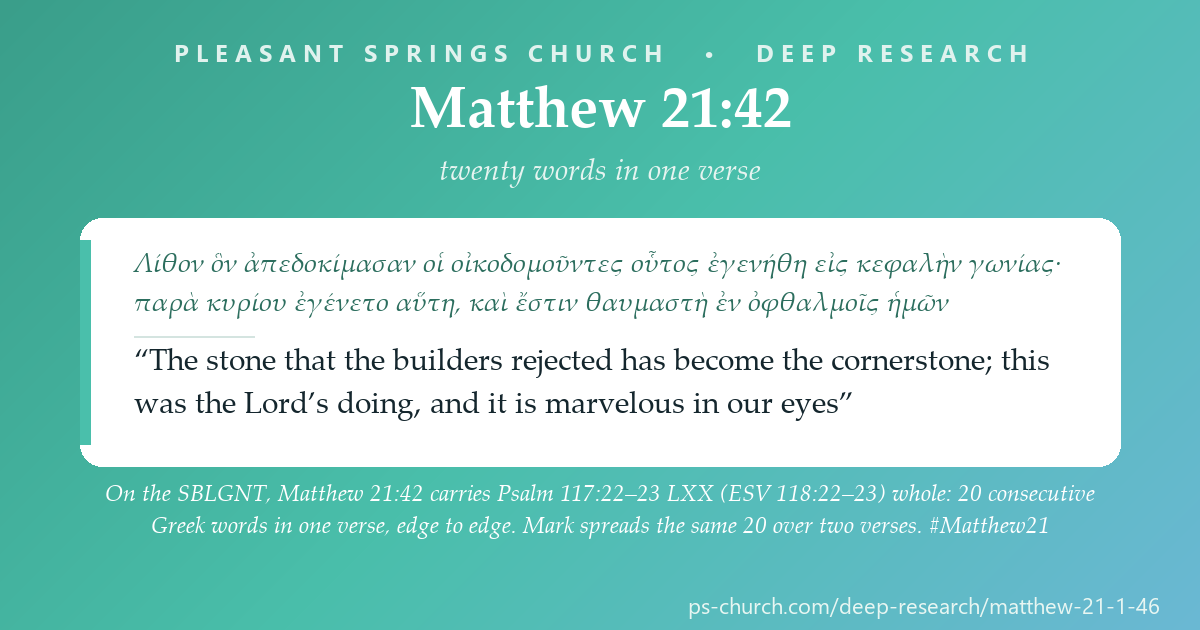
Screened one Greek verse at a time against all 30,348 screened units of the Greek Old Testament held here, Matthew 21:42 reaches ten consecutive words with Psalm 117 LXX (ESV 118) — and the two verses that tie at ten are the psalm’s own 117:22 and 117:23. Read across the psalm’s verse line, the run is twenty: “The stone that the builders rejected has become the cornerstone; this was the Lord’s doing, and it is marvelous in our eyes”, both Greek verses whole, edge to edge, inside one verse of Matthew. Mark carries the same twenty over two verses. On a joined screen of all 1,068 verses of Matthew, this is the second-deepest verse of the Gospel. And the chapter’s first quotation is a seam: its first five words are Isaiah 62:11, the next six are Zechariah 9:9, and the two share one word, behold. The page follows the chapter from the Mount of Olives to the stone; sets the Hebrew beside the Greek wherever they part — strength in the Hebrew of Psalm 8 where Matthew and the Greek psalm have praise; prints its counter-examples beside its findings; gives the readings of 21:43 fairly and labels its own; and never says who borrowed from whom. See the method →
Matthew 21:1–46
Greek NT · ESV or our renderingVersification. Matthew 21 has no offset of its own: the SBLGNT and the ESV both count 46 verses, verse for verse. There is no Septuagint column, because Matthew is a New Testament book. The offsets are in the Old Testament texts measured, each checked against the Masoretic and CATSS files held here. The Psalms run one behind in Greek for the psalms on this page: Psalm 118:22–26 (Hebrew and ESV) = Greek 117:22–26; Psalm 110:5–6 = Greek 109:5–6. Psalm 8:2 (ESV) = Hebrew and Greek 8:3, because the Hebrew and the Greek count the title as verse 1. Zechariah 9:9 and 14:4, Isaiah 5:1–2, 56:7 and 62:11, Jeremiah 7:11 and 8:13 and Daniel 2:34–45 have no offset in the Hebrew, the Greek and the ESV (the Greek of Isaiah 56, Jeremiah 7 and Exodus 28 lacks some verses the Hebrew has, but the verses measured here carry the same numbers and the same content). Isaiah 8:14–15 is numbered alike in all three, though the chapter is not: its last verse, Hebrew and Greek 8:23, is ESV 9:1. Daniel 2 is Aramaic in the Masoretic text and has two Greek texts, the Old Greek and Theodotion, both held and both named on every line. Deuteronomy 9:23 and 20:6, Genesis 9:20, 18:9, 37:20 and 37:24, Exodus 19:6 and 28:10 have no offset. 2 Kings = Greek 4 Kingdoms, same verse numbers here. 1 and 2 Maccabees, Wisdom and the Psalms of Solomon are Greek only, and are witnesses, not Scripture.
The Shape of the Passage
A sequence of six scenes, with three word-links recurring in the same order — NOT a chiasmOne chapter, two days, 46 verses. The crowds, the chief priests and the elders, the children in the temple, the disciples by the fig tree; and, in the last fifteen verses, men who realise that the parables are about them (21:45).
Author
Church tradition from Papias onward names Matthew the tax collector (Matt 9:9; 10:3). This page cannot test that from the text and does not try; the shelf’s Matthew 22 study reports the same tradition.
What the text does show is a writer who quotes and joins. Six Old Testament passages stand in the words of this chapter (Zechariah 9, Isaiah 62, Psalm 118 twice, Isaiah 56, Jeremiah 7 and Psalm 8), and three of the quotations measure as seams: two prophets at 21:5, two more at 21:13, and two verses of one psalm in a single verse at 21:42. Matthew introduces the first with a fulfilment formula, ἵνα πληρωθῇ τὸ ῥηθὲν διὰ τοῦ προφήτου, and the last two, Psalm 8 at 21:16 and the stone at 21:42, with a question, have you never read?
Audience
Most locate Matthew’s first readers among Jewish believers in Jesus, often at Antioch, in the decades between the 60s and the 80s. The page reports that location and does not argue it. A community in that situation would hear 21:43 as a sentence about itself and about the synagogue next door, which is why the verse has carried so much weight in the centuries since, and why Stage 5 sets out its readings with care.
Inside the story the audience changes scene by scene. The crowds call him ὁ προφήτης Ἰησοῦς; the children cry what the crowds cried; the leaders ask for his authority and will not answer about John’s; and the last verse finds them wanting to seize him and afraid of the people who call him a prophet.
Orient on Bethphage and the Mount of Olives, the Hallel, the temple market, fig trees, the Baptist, and tenant farming.
Search by reference and by topic: triumphal entry, Bethphage, Mount of Olives, Hosanna, Hallel, money-changers, temple tax, den of robbers, fig tree, authority, John the Baptist, tax collectors, parable of the two sons, tenants, cornerstone, stone of stumbling.
Which articles are relevant?
- Dictionary of Jesus and the Gospels (IVP, 2nd ed. 2013) — “Triumphal Entry,” “Temple Cleansing,” “Fig Tree,” “Parables,” “Son of David,” “Old Testament in the Gospels.”
- Anchor Bible Dictionary — “Bethphage,” “Hosanna,” “Hallel,” “Money-changer,” “Fig, Fig Tree,” “Cornerstone.”
- Dictionary of New Testament Background (IVP) — “Temple, Jewish,” “Coinage,” “Agriculture,” “Festivals and Holy Days: Jewish.”
- NIDNTTE — ὡσαννά, πραΰς, ἐξουσία, μεταμέλομαι, καρπός, ἔθνος, λίθος.
Bibliography surfaced:
- Commentaries on Matthew: W. D. Davies and Dale C. Allison, Matthew 19–28 (ICC); Ulrich Luz, Matthew 21–28 (Hermeneia); R. T. France (NICNT); Craig S. Keener; John Nolland (NIGTC).
- On the use of the Old Testament: Craig L. Blomberg, “Matthew,” in Beale and Carson, Commentary on the New Testament Use of the Old Testament (2007); Robert H. Gundry, The Use of the Old Testament in St. Matthew’s Gospel (1967); Krister Stendahl, The School of St. Matthew.
- On the parable: Klyne Snodgrass, The Parable of the Wicked Tenants (1983) and Stories with Intent.
- On Matthew and Israel: Anthony J. Saldarini, Matthew’s Christian-Jewish Community (1994); Graham Stanton, A Gospel for a New People (1992).
The works above are named as places to look. None was re-read for this page, and no number on it comes from them. Stage 5 says so again.
A pilgrim festival, a psalm sung at it, a market in the temple courts, and a fig tree in leaf.
Set each scene beside its world. Where this page has not read a source on the disk, the statement is marked reported.
Which parallels shed light on religion and worldview?
An entry with branches and song had recent precedents. 1 Maccabees 13:51 has the citadel entered μετὰ αἰνέσεως καὶ βαί̈ων, with praise and palm fronds (our rendering), and 2 Maccabees 10:7 has the rededicated temple greeted with θύρσους καὶ κλάδους ὡραίους ἔτι δὲ καὶ φοίνικας, wands wreathed in leaves, fair boughs, and palms besides (our rendering). The run screen scores Matthew 21:8–9 against both at one word each: these are parallels of custom, not of wording, and both books are witnesses, not Scripture (1 Maccabees 12–16, 2 Maccabees 6–10).
The crowd’s words come from the Hallel. Psalms 113–118 were sung at the pilgrim feasts, and Psalm 118 closes the set (reported: the Mishnah, which says so, is not held here). The crowd takes up 118:25–26; the children take up the crowd; and Jesus answers the leaders with 118:22. Three verses of one festival psalm frame the chapter, and they are measured in Stage 4.
The market served the temple. Pilgrims needed unblemished animals and the temple tax in an approved coinage, commonly said to be the Tyrian shekel (reported). The tables and the doves of 21:12 are that trade. Which of its features the act protests — the trade itself, its place in the courts, or the men who ran it — is a reading question, and Stage 5 sets the readings out.
A fig tree in leaf at Passover. Fig trees in that country put out leaves in spring and carry early green fruit with them (reported, from agricultural descriptions not held here). Mark says ὁ γὰρ καιρὸς οὐκ ἦν σύκων (Mark 11:13); Matthew does not, and Matthew’s tree withers παραχρῆμα, at once. John Chrysostom (4th c.) already faced the question of why a tree out of season was cursed, and answered it for the disciples’ sake:
Wherefore then was it cursed? For the disciples' sakes, that they might have confidence.John Chrysostom, Homilies on Matthew 67.1 (NPNF1 10)
Tenants and absentee owners were ordinary. Large estates leased to tenant farmers, with the owner abroad and the rent paid in a share of the crop, are attested in Galilee and in the Egyptian papyri (reported; the papyri are not held). A tenant who could claim a vineyard by use, if the heir were gone, is the legal situation 21:38 assumes (reported).
The entry has the shape of a royal welcome with a different mount: the king of Zechariah 9:9 comes πραὺ̈ς καὶ ἐπιβεβηκὼς ἐπὶ, gentle, and riding, and Matthew’s verse has that word. The temple act is set in the festival and sets a prophet’s sentence against its market. The vineyard parable has Isaiah’s hedge and tower, and its trouble is tenants who would not pay, where Isaiah’s was a vineyard that failed.
A Hebrew cry in Greek letters, a gentle king, a cave of bandits, praise for strength, and fruit.
Headwords are the MorphGNT lemmas. New Testament counts are over the 7,927 verses of the SBLGNT held here, by lemma; Greek Old Testament counts are over the 30,348 screened CATSS units, by unanchored search on normalised forms, so augmented and prefixed forms are found. A count is a count on these files and no others.
Hebrew hōshī‘ā nā’, save, please, in Greek letters. 6 tokens in the Greek New Testament (3 of them in this chapter), in 5 verses, all in the entry and temple scenes of Matthew, Mark and John. No form of it stands in the Greek Old Testament held here, whose Psalm 117:25 translates the Hebrew.
Gentle, meek. Greek Zechariah 9:9 has it; the Hebrew has עָנִי, ‘ānī, poor, afflicted, which the ESV renders humble. 4 times in the Greek New Testament, three of them in Matthew (5:5; 11:29; 21:5).
Beast of burden. In the Greek New Testament 2 times: here and 2 Peter 2:16, Balaam’s donkey. Greek Zechariah 9:9 has the word, as the first animal; Matthew has it in the genitive, as the colt’s mother. The run screen, which matches forms, cannot see the shared word.
Cave. With λῃστής, bandits, it stands in one unit of the Greek Old Testament held here, Jeremiah 7:11, and in three verses of the New, the three Gospel accounts of this saying. The Hebrew has הַמְעָרַת פָּרִצִים, a cave of violent men.
Praise. The last word of Matthew’s quotation and of Greek Psalm 8:3’s first clause. The Hebrew has עֹז, ‘ōz, strength. Stage 4.
Fruit. 5 times in this chapter and not once in the next: the tree with no fruit, the tenants who would not give it, and the people who will produce it.
Authority. All 4 of the chapter’s tokens are in the five verses of the question about it.
To think better of it, to regret. Not the usual word for repentance. 6 tokens in the Greek New Testament, in 5 verses, among them Matthew 27:3 (Judas). The first son does it (21:29); the leaders did not (21:32).
Vineyard. 10 tokens in Matthew, all in 20:1–8 and this chapter. Greek Isaiah 5:2 has the vine, ἄμπελον, where Matthew has the vineyard. Stage 4.
Nation, people, in the singular. Greek Exodus 19:6 calls Israel ἔθνος ἅγιον, a holy nation; 1 Peter 2:9 gives the same two words to the church. Stage 5.
To winnow, to scatter as chaff. In the Greek New Testament 2 times, here and Luke 20:18. In the screened Greek Old Testament some form of it, or its noun, stands in 21 units, Ruth 3:2 among them, where Boaz λικμᾷ τὸν ἅλωνα τῶν κριθῶν, winnows at the barley floor (our rendering).
To be smashed to pieces. 2 times in the Greek New Testament, here and Luke 20:18. In the screened Greek Old Testament it stands in 8 units, counting the augmented forms; two of them are Psalm 109:5–6 LXX (ESV 110:5–6), the psalm Matthew 22:44 quotes. An observation only.
What the word counts actually show
The chapter is held together by small words that return. Fruit is the clearest: a tree with leaves and no fruit (21:19), tenants who keep the fruit from its owner (21:34, 21:41), and a people who will produce it (21:43). The page does not make that a doctrine of the fig tree; it reports where the word stands.
Two words in the entry stand where the Hebrew of Zechariah has something else. πραῢς for עָנִי, and Greek Zechariah’s first animal, ὑποζύγιον, for עַל־חֲמוֹר, on a donkey. In the first, Matthew and the Greek agree against the Hebrew; in the second, Matthew’s verse has the Greek word in another slot. Stage 4 sets out the slots.
Six Old Testament passages in the words of the chapter, measured one by one, with their tie bands, their counter-examples, and the Hebrew wherever it parts from the Greek.
Method: every verse of Matthew 21 (SBLGNT) was screened for its longest run of consecutive shared word forms against the CATSS Greek Old Testament held here — 30,348 screened units, the 64 files less the Odes (30,637 held with them) — using the shelf’s frozen normaliser and its cross-edition comparator. The tie band is the number of target units that reach the same depth. A second screen, run for this page, reads every pair of adjacent units of one Greek book as one text (30,290 joined pairs), so that a quotation which crosses a verse line in the psalm is counted whole. The two screens are different conventions, and every figure below says which it is.
What the screen returned
The distribution first. Across the 46 verses of Matthew 21, screened one unit at a time:
| deepest run, at least | 10 | 7 | 6 | 5 | 4 | 3 | 2 |
|---|---|---|---|---|---|---|---|
| verses of Matthew 21 | 1 | 2 | 4 | 5 | 19 | 40 | 46 |
All 46 reach two, 40 reach three, 19 reach four, 5 reach five, 4 reach six, 2 reach seven, and one reaches ten. Nothing stands at eight or nine.
| Matthew | deepest run | tie band | partner | what it is |
|---|---|---|---|---|
| 21:42 | 10 per unit; 20 joined | 2 per unit; 1 joined | Psalm 117:22 and 117:23 LXX | Both psalm verses whole, edge to edge |
| 21:16 | 7 | 1 | Psalm 8:3 LXX | The psalm’s first seven words |
| 21:5 | 6 | 1 | Zechariah 9:9 LXX | With Isaiah 62:11 (5) before it, joined at one word |
| 21:9 | 6 | 1 | Psalm 117:26 LXX | The blessing; the Hosanna is not in the Greek psalm |
| 21:13 | 5 | 1 | Isaiah 56:7 LXX | With two words of Jeremiah 7:11 after it |
| 21:1 | 4 | 1 | Zechariah 14:4 | The Mount of Olives: an observation |
| 21:33 | 4 | 1 | Deuteronomy 20:6 | Counter-example: not Isaiah 5 |
| 21:38 | 4 | 1 | Genesis 37:20 | Joseph’s brothers: an observation |
| 21:43 | 4 | 1 | Psalms of Solomon 17:3 | A witness, not Scripture |
| 21:29, 21:30 | 4 | 1 | Genesis 18:9 | Counter-example: a formula with a band of one |
| 21:44 | 3 | 2 | Exodus 28:10; Zechariah 3:9 | On the stone, three words; not Daniel, not Isaiah 8 |
| 21:19 | 4 | 43 | — | Counter-example: a formula |
★ 21:42 — the whole stone
Greek Psalm 117:22 is ten words, λίθον ὃν ἀπεδοκίμασαν οἱ οἰκοδομοῦντες οὗτος ἐγενήθη εἰς κεφαλὴν γωνίας, and 117:23 is ten more, παρὰ κυρίου ἐγένετο αὕτη καὶ ἔστιν θαυμαστὴ ἐν ὀφθαλμοῖς ἡμῶν. Matthew 21:42, after its question Οὐδέποτε ἀνέγνωτε ἐν ταῖς γραφαῖς, has all twenty in order and stops where 117:23 stops; the next Greek verse begins αὕτη ἡ ἡμέρα, and Matthew does not go on.
Per unit, the screen gives 10, tie band 2, and the band is the psalm’s two verses — the quotation is cut in two by the Greek psalm’s own verse line. On that convention seven verses of Matthew go deeper, and 1:23 ties it. Joined, the run is 20, tie band 1, and the order of the whole Gospel changes:
| on the joined screen | run | partner |
|---|---|---|
| Matthew 13:15 | 24 | Isaiah 6:10, with the verse on either side |
| Matthew 21:42 | 20 | Psalm 117:22 + 117:23 |
| Matthew 22:44 | 14 | Psalm 109:1 (ESV 110:1) |
The shelf’s Matthew 22 page reports 22:44 as the second-deepest verse of Matthew; on the per-unit screen it uses, it is, and that statement stands. On the joined screen 21:42 is second and 22:44 is third. Both are true; they answer different questions.
Mark has the same twenty. Mark 12:10 carries 117:22 and Mark 12:11 carries 117:23; joined, Mark’s two verses give 20 against the psalm, and 20 against Matthew’s one verse (the Mark 12 page reports its figure as 10 + 10, joined 20). The quotation is word for word the same; the frame is not: Mark asks οὐδὲ τὴν γραφὴν ταύτην ἀνέγνωτε. Luke 20:17 has the first half only (10 against Matthew); 1 Peter 2:7 has 9 of the first ten; Acts 4:11, which renders the line in other words, shares 3.
The Hebrew and the Greek agree here. Psalm 118:22–23 in the Masoretic text has the stone the builders rejected and the head of the corner, and the Lord’s doing, marvellous in our eyes (The stone that the builders rejected has become the cornerstone; it is marvelous in our eyes). One feature the Greek carries that the English cannot show: in 117:23 the Greek demonstrative is feminine, αὕτη, where the Hebrew has the feminine זֹּאת, this; both texts agree, and Matthew has it too.
★ 21:5 — two prophets, joined at one word
Matthew 21:4 promises the words of the prophet. The words that follow stand in two:
| Matthew 21:5 | Isaiah 62:11 LXX | Zechariah 9:9 LXX |
|---|---|---|
| Εἴπατε τῇ θυγατρὶ Σιών· Ἰδοὺ | εἴπατε τῇ θυγατρὶ Σιων ἰδού | — (Zechariah opens χαῖρε σφόδρα θύγατερ Σιων) |
| Ἰδοὺ ὁ βασιλεύς σου ἔρχεταί σοι | — (Isaiah goes on ἰδού σοι ὁ σωτὴρ παραγίνεται) | ἰδοὺ ὁ βασιλεύς σου ἔρχεταί σοι |
| — | — | δίκαιος καὶ σῴζων αὐτός |
| πραῢς καὶ ἐπιβεβηκὼς ἐπὶ | — | πραὺ̈ς καὶ ἐπιβεβηκὼς ἐπὶ |
| ὄνον καὶ ἐπὶ πῶλον υἱὸν ὑποζυγίου | — | ὑποζύγιον καὶ πῶλον νέον |
Measured. Matthew 21:5 is 20 words. Words 1–5 are a run of 5 with Greek Isaiah 62:11; words 5–10 a run of 6 with Greek Zechariah 9:9; and word 5, Ἰδοὺ, belongs to both. After a gap of four words of Zechariah that Matthew does not have — δίκαιος καὶ σῴζων αὐτός, righteous and saving is he — words 11–14 are four more of Zechariah’s, πραὺ̈ς καὶ ἐπιβεβηκὼς ἐπὶ. The last six words, ὄνον καὶ ἐπὶ πῶλον υἱὸν ὑποζυγίου, share no two consecutive forms with either prophet.
Where the texts differ, stated without a motive. Where Greek Zechariah has χαῖρε σφόδρα θύγατερ Σιων, rejoice greatly, daughter of Zion, Matthew has Isaiah’s εἴπατε τῇ θυγατρὶ Σιων ἰδού. Where Greek Zechariah has δίκαιος καὶ σῴζων αὐτός, Matthew has nothing; John 12:15 has nothing there either, and opens Μὴ φοβοῦ, θυγάτηρ Σιών (its run with Zechariah 9:9 is 5). Where Isaiah goes on ἰδού σοι ὁ σωτὴρ παραγίνεται, behold, your saviour is coming, Matthew has Zechariah’s king. The page does not say why: the measurement shows where the words stand, and no more.
The Hebrew parts from the Greek in both prophets, and the page will not smooth it. In Isaiah 62:11 the Hebrew is אִמְרוּ לְבַת־צִיּוֹן הִנֵּה יִשְׁעֵךְ בָּא, say to the daughter of Zion: behold, your salvation comes (the ESV: Behold, your salvation comes), where the Greek has your saviour. In Zechariah 9:9 the Hebrew has צַדִּיק וְנוֹשָׁע הוּא: וְנוֹשָׁע is passive in form, saved or victorious, where the Greek σῴζων is active, saving; the ESV’s righteous and having salvation is he renders the Hebrew. And the Hebrew king is עָנִי, poor or afflicted, where the Greek and Matthew have πραῢς, gentle.
The animals, slot by slot (our alignment; the glosses are ours):
| slot | Hebrew (Masoretic) | Greek Zechariah 9:9 | Matthew 21:5 |
|---|---|---|---|
| riding on the first animal | וְרֹכֵב עַל־חֲמוֹר riding on a donkey | ἐπιβεβηκὼς ἐπὶ ὑποζύγιον mounted on a beast of burden | ἐπιβεβηκὼς ἐπὶ ὄνον mounted on a donkey |
| the second | וְעַל־עַיִר and on a colt | καὶ πῶλον and a colt | καὶ ἐπὶ πῶλον and on a colt |
| the colt described | בֶּן־אֲתֹנוֹת son of she-donkeys | νέον young | υἱὸν ὑποζυγίου son of a beast of burden |
Read slot by slot, Matthew’s clause has the Hebrew’s shape — the preposition repeated before the colt, and a son where the Hebrew has בֶּן־אֲתֹנוֹת — where the Greek has one preposition and young; and Matthew’s last word is the Greek’s first animal, in another slot. The ESV’s Zechariah, on a donkey, on a colt, the foal of a donkey, prints no and before the second phrase where the Hebrew has one (וְעַל־עַיִר). Whether the Hebrew means one animal described twice or two animals is a reading of its parallelism; Matthew has two (21:2, 21:7), and Mark, Luke and John one.
On the Robinson–Pierpont text, which lacks the second ἐπὶ (ἐπὶ WH Treg NA28 ] – RP), Matthew’s πῶλον stands right after and, as in the Greek of Zechariah, and the shared pair καὶ πῶλον becomes a run of 2; the verse’s deepest run stays 6.
21:9 — a Hebrew cry and a Greek blessing
The crowds’ Ὡσαννὰ is the Hebrew of Psalm 118:25, הוֹשִׁיעָה נָּא, save, please, carried into Greek letters. Greek Psalm 117:25 translates it instead: ὦ κύριε σῶσον δή ὦ κύριε εὐόδωσον δή (the ESV: Save us, we pray, O Lord!). Measured, Matthew 21:9 and Greek Psalm 117:25 share no word forms at all — a zero on the convention that counts single words, so a true zero — and no form containing the letters of Ὡσαννὰ stands in any of the 30,637 held units, Odes included. The next verse is another matter: εὐλογημένος ὁ ἐρχόμενος ἐν ὀνόματι κυρίου, blessed is the one who comes in the name of the Lord, run 6, tie band 1. The same six words stand in five verses of the Greek New Testament (Matthew 21:9 and 23:39, Mark 11:9, Luke 13:35, John 12:13). In the Masoretic text the two words הוֹשִׁיעָה נָּא stand together at Psalm 118:25, and the suffixed save us, please at 2 Kings 19:19, Hezekiah’s prayer.
21:13 — Isaiah, then Jeremiah
He said to them, “It is written, ‘My house shall be called a house of prayer,’ but you make it a den of robbers.”
The first half is Greek Isaiah 56:7, ὁ γὰρ οἶκός μου οἶκος προσευχῆς κληθήσεται πᾶσιν τοῖς ἔθνεσιν: Matthew’s run with it is 5, tie band 1, and it stops where Isaiah goes on πᾶσιν τοῖς ἔθνεσιν, for all the nations. Mark 11:17 has those words (πᾶσιν τοῖς ἔθνεσιν) and runs 8 with Isaiah; Luke 19:46 runs 4. The Hebrew has לְכׇל־הָעַמִּים, for all the peoples (the ESV: for all peoples).
The second half is Jeremiah’s: σπήλαιον λῃστῶν stands in Greek Jeremiah 7:11 (μὴ σπήλαιον λῃστῶν ὁ οἶκός μου οὗ ἐπικέκληται τὸ ὄνομά μου ἐπ' αὐτῷ ἐκεῖ ἐνώπιον ὑμῶν καὶ ἐγὼ ἰδοὺ ἑώρακα λέγει κύριος), and cave and bandits stand together in no other unit of the Greek Old Testament held here, Odes included; in the New, in the three Gospel accounts of this verse. The Hebrew is הַמְעָרַת פָּרִצִים, a cave of violent men (the ESV: a den of robbers). Jeremiah asks it as a question of the house; Matthew states it of the hearers, ὑμεῖς δὲ αὐτὸν ποιεῖτε σπήλαιον λῃστῶν.
Counter-example, printed against the page’s own case. Measured pair by pair, Matthew 21:13 scores 3 with Jeremiah 7:11 — but the three words are ὁ οἶκός μου, my house, and in Matthew’s verse they belong to the Isaiah half (Ὁ οἶκός μου οἶκος προσευχῆς κληθήσεται). The two words that really are Jeremiah’s make a run of two. A pair score does not say which words carry it.
★ 21:16 — praise, where the Hebrew has strength
Matthew 21:16 ends with Ἐκ στόματος νηπίων καὶ θηλαζόντων κατηρτίσω αἶνον: Greek Psalm 8:3 begins with the same seven words, ἐκ στόματος νηπίων καὶ θηλαζόντων κατηρτίσω αἶνον ἕνεκα τῶν ἐχθρῶν σου τοῦ καταλῦσαι ἐχθρὸν καὶ ἐκδικητήν. Run 7, tie band 1; the run is the psalm’s first seven words and Matthew’s last seven, and Matthew stops before ἕνεκα τῶν ἐχθρῶν σου.
This is the chapter’s plainest difference between the Hebrew and the Greek, and the argument of the verse rests on it. The Hebrew has יִסַּדְתָּ עֹז, you have founded strength; the Greek has αἶνον, praise; and the leaders have just complained about what the children are saying. The ESV of Psalm 8:2 follows the Hebrew — you have established strength — and the ESV of Matthew 21:16 follows the Greek — you have prepared praise. The page argues from the Greek here because Matthew’s text does, and prints the Hebrew so that no reader mistakes one for the other. The shelf’s Psalms 6–8 study treats the same divergence from the psalm’s side.
21:43–44 — the stone that crushes
21:43 has no counterpart in Mark. Its deepest run against any verse of Mark is 4, tie band 4 (the Mark 12 page reports the same figure); against Luke, 5 with Luke 13:18, on the kingdom of God and. Against the screened Greek Old Testament it is 4, and the one partner is a Second Temple psalm, not Scripture: καὶ ἡ βασιλεία τοῦ θεοῦ ἡμῶν εἰς τὸν αἰῶνα ἐπὶ τὰ ἔθνη ἐν κρίσει, and the kingdom of our God is for ever over the nations in judgement (our rendering) (Psalms of Solomon 17:3). As kingdom followed directly by the article and of God, the phrase stands in that unit only; a word beginning basilei- followed within three words by of God stands in four screened units (in 1 Chronicles 25:5 it is to the king, not kingdom), and in two of them, Wisdom 10:10 and this one, it means the kingdom of God.
21:44 has no verbatim contact with Isaiah’s or Daniel’s stone. Against Isaiah 8:14 and 8:15 the run is 1; against Daniel 2:34, 35, 44 and 45, in either Greek text, it is one or two. Its deepest run anywhere in the screened Greek Old Testament is three words, ἐπὶ τὸν λίθον, on the stone, shared with Exodus 28:10 and Zechariah 3:9, tie band 2. What it shares are words, not runs:
- Isaiah 8:14–15. The Hebrew makes the LORD וּלְאֶבֶן נֶגֶף, a stone of striking (the ESV: a stone of offense and a rock of stumbling), and 8:15 has many fall and be broken. The Greek of 8:14 negates it: καὶ οὐχ ὡς λίθου προσκόμματι συναντήσεσθε αὐτῷ, and you will not meet him as a stone of stumbling. Greek 8:15 has καὶ πεσοῦνται καὶ συντριβήσονται, and they will fall and be crushed. Matthew’s ὁ πεσὼν shares the verb of falling; his verb of breaking, συνθλασθήσεται, is not Isaiah’s.
- Daniel 2:44 (Theodotion). λεπτυνεῖ καὶ λικμήσει πάσας τὰς βασιλείας, it will grind and winnow all the kingdoms. The exact form λικμήσει stands in two screened units, this one and Job 27:21 (with the second person and the compound, five: Isaiah 30:22 and 41:16, Wisdom 5:23 as well); and a kingdom word (basilei-; Proverbs 20:26 has king beside a winnower) and a winnowing word stand together in one screened unit, this one. The same verse says καὶ ἡ βασιλεία αὐτοῦ λαῷ ἑτέρῳ οὐχ ὑπολειφθήσεται, and its kingdom will not be left to another people; the Old Greek has καὶ αὕτη ἡ βασιλεία ἄλλο ἔθνος οὐ μὴ ἐάσῃ, and this kingdom will not let another nation …; the Aramaic, וּמַלְכוּתָה לְעַם אׇחֳרָן לָא תִשְׁתְּבִק, and its kingdom will not be left to another people (the ESV: nor shall the kingdom be left to another people). Matthew 21:43 has a kingdom given to ἔθνει. The shared words are on the page; the run between the two verses is 1.
- Luke 20:18 has the saying too: πᾶς ὁ πεσὼν ἐπ’ ἐκεῖνον τὸν λίθον συνθλασθήσεται· ἐφ’ ὃν δ’ ἂν πέσῃ, λικμήσει αὐτόν.. Run 8, tie band 1 against the New Testament outside Matthew. Mark has nothing like it: against every verse of Mark, 21:44 reaches 2, tie band 28.
21:33 — Isaiah’s vineyard, and a counter-example
Hear another parable. There was a master of a house who planted a vineyard and put a fence around it and dug a winepress in it and built a tower and leased it to tenants, and went into another country.
Greek Isaiah 5:2 has a hedge, a vat and a tower, καὶ φραγμὸν περιέθηκα καὶ ἐχαράκωσα καὶ ἐφύτευσα ἄμπελον σωρηχ καὶ ᾠκοδόμησα πύργον ἐν μέσῳ αὐτοῦ καὶ προλήνιον ὤρυξα ἐν αὐτῷ καὶ ἔμεινα τοῦ ποιῆσαι σταφυλήν ἐποίησεν δὲ ἀκάνθας. A co-occurrence search of the screened Greek Old Testament for a vine or vineyard word, a hedge word and a tower word in one unit finds Isaiah 5:2 alone (Ode 10:2, a second copy of the song, is held but not screened); in the New Testament, Matthew 21:33 and Mark 12:1. But the vine word in Isaiah 5:2 is ἄμπελον σωρηχ, a sorek vine, where Matthew has ἐφύτευσεν ἀμπελῶνα, planted a vineyard; and the run screen scores the pair at 2 (καὶ φραγμὸν). The Mark 12 page found the same vine-for-vineyard difference in Mark.
Counter-example. The verse’s deepest run with the screened Greek Old Testament is not Isaiah at all. It is Deuteronomy 20:6, ὅστις ἐφύτευσεν ἀμπελῶνα καὶ, the man excused from battle because he has planted a vineyard and not yet enjoyed it (is there any man who has planted a vineyard): four words, tie band 1. ἐφύτευσεν ἀμπελῶνα stands in two units of the Greek Old Testament, Deuteronomy 20:6 and Genesis 9:20, Noah (ἐφύτευσεν ἀμπελῶνα), and in two verses of the New, Matthew 21:33 and Luke 20:9; Mark 12:1 has the words in the other order, and scores 1 with Deuteronomy. Nobody thinks the parable is about exemption from military service. A band of one is a property of the corpus, not of the author.
Observations, and the counter-examples beside them
- 21:1, the Mount of Olives. τὸ Ὄρος τῶν Ἐλαιῶν is four words, tie band 1, with Zechariah 14:4 — τὸ ὄρος τῶν ἐλαιῶν — and the phrase stands in that unit of the screened Greek Old Testament and no other. Four verses later come the words of Zechariah 9:9. The page notes the neighbourhood and does not claim it as a citation.
- 21:38–39, Joseph’s brothers. δεῦτε ἀποκτείνωμεν αὐτὸν (Genesis 37:20) is four, tie band 1; καὶ λαβόντες αὐτὸν (37:24) is three, tie band 1. δεῦτε ἀποκτείνωμεν stands in one unit of the Greek Old Testament and two verses of the New (here and Mark 12:7). An observation; the page has not checked whether any commentator argues it.
- 21:25 and 21:32, unbelief. καὶ οὐκ ἐπιστεύσατε αὐτῷ (Deuteronomy 9:23) is three and four, tie band one each. The verb form ἐπιστεύσατε stands, alone or inside the compound ἐνεπιστεύσατε, in four units of the screened Greek Old Testament, and all four are rebukes for not believing: Moses and Aaron at Meribah (Numbers 20:12), Israel at Kadesh (Deuteronomy 1:32 and 9:23), and Judah (Jeremiah 25:8).
- Counter-example: 21:29 and 21:30. ὁ δὲ ἀποκριθεὶς εἶπεν is four words with a tie band of one, both verses, and the partner is Genesis 18:9, Abraham answering the visitors. It is a narrative formula, and he answered and said. A band of one does not make it a connection.
- Counter-example: 21:19, the fig tree. The verse that carries the chapter’s strangest act has no verbatim Old Testament contact at all beyond εἰς τὸν αἰῶνα· καὶ, four words in a band of 43. The prophets’ fig trees (Jeremiah 8:13: nor figs on the fig tree) are a reading, not a measurement.
The readings with their holders, the church’s frame labelled as the church’s, and everything this page could not check.
None of the modern works named on this page was re-read for it. Positions are reported as the literature commonly summarises them; a reader who wants to rely on an attribution should check it in the book. Two ancient writers are quoted from files on this disk, in nineteenth-century English: Irenaeus (ANF) and John Chrysostom (NPNF). Every number on the page was measured on files on this disk and can be re-derived.
⚠️ 21:43 — four readings
| reading of 21:43 | reported holders | what the text on this page says |
|---|---|---|
| 1. Transfer to the Gentile church. The kingdom passes from Israel to a church of the nations. | Irenaeus, quoted below; a long tradition after him (reported) | The verse says ἔθνει, singular, defined by what it does, ποιοῦντι τοὺς καρποὺς αὐτῆς; it does not say the nations, πάντα τὰ ἔθνη, the phrase of 28:19. |
| 2. The leaders lose the vineyard. You are the chief priests and Pharisees; the kingdom passes from their keeping to a new people or leadership, and Israel as such is not in view. | Anthony J. Saldarini and many recent commentators (reported) | 21:45: ἔγνωσαν ὅτι περὶ αὐτῶν λέγει; and 21:41, the vineyard is let to other farmers, not destroyed. |
| 3. One people. The new nation is the messianic community of Jews and Gentiles together, continuous with Israel’s faithful remnant rather than its replacement. | R. T. France and others (reported) | Exodus 19:6 LXX calls Israel ἔθνος ἅγιον; 1 Peter 2:9 gives ἔθνος ἅγιον to the church. |
| 4. A word about AD 70. The saying looks to the loss of the temple and of the leaders’ stewardship within a generation. | commentators who read 22:7 the same way (reported) | The page cannot date a saying, and does not. |
For inasmuch as the former have rejected the Son of God, and cast Him out of the vineyard when they slew Him, God has justly rejected them, and given to the Gentiles outside the vineyard the fruits of its cultivation.Irenaeus, Against Heresies 4.36.2 (ANF 1), reading Matthew 21:33–43
Irenaeus is quoted because his reading has been the most influential, not because this page adopts it. This page’s reading, not a ratified church position: the sentence is spoken to men whom 21:45 names, about a vineyard that 21:41 says will be let, not razed; the people who receive the kingdom are defined by fruit, not by birth; and the same Gospel ends by sending the eleven to πάντα τὰ ἔθνη, all the nations — on this reading, Israel among them. The page reads 21:43 as judgement on the vineyard’s keepers and as a promise about fruit, and does not read it as God finished with the Jewish people — a question Paul answers in his own words, μὴ ἀπώσατο ὁ θεὸς τὸν λαὸν αὐτοῦ, God has not thrust away his people, has he? (our rendering) (Romans 9–11).
The fig tree — three readings
| reading of the fig tree (21:18–22) | reported holders | what the text says |
|---|---|---|
| 1. An enacted parable of judgement on a fruitless people or temple leadership, read with Jeremiah 8:13, Micah 7:1 and Hosea 9:10. | many modern commentators (reported) | Fruit joins the tree (21:19) to the tenants (21:34, 21:41, 21:43); the screen finds no verbatim prophet in 21:19. |
| 2. A demonstration of power, for the disciples’ faith. | John Chrysostom, quoted in Stage 2 and below | 21:21–22 turn at once to faith and prayer. |
| 3. A lesson on prayer alone, with the tree as occasion. | some devotional readings (reported) | 21:22: πάντα ὅσα ἂν αἰτήσητε … πιστεύοντες. |
But if it was not yet time, vainly do some say the law is here meant.John Chrysostom, Homilies on Matthew 67.1 (NPNF1 10), rejecting the first reading
Chrysostom’s own answer is the second reading, and he knew the first in some form and set it aside. The church has ratified no position on the fig tree, and the page offers the readings without choosing.
The temple act — four readings
| reading of the temple act (21:12–17) | reported holders | what the text says |
|---|---|---|
| 1. A protest against the trade or its abuse. Some add that a bandits’ cave is where bandits retreat, not where they rob (reported). | the common reading (reported) | 21:12: sellers and buyers, the changers’ tables, the dove-sellers’ benches; 21:13: σπήλαιον λῃστῶν. |
| 2. A sign of the temple’s judgement, as in Jeremiah 7, where the house is warned it will be like Shiloh. | many commentators (reported) | Jeremiah 7:11 is the second half of 21:13. |
| 3. A messianic act: the Son of David cleanses and heals in the temple. | reported | 21:14: the blind and the lame are healed there; 21:15: the children cry Ὡσαννὰ τῷ υἱῷ Δαυίδ. |
| 4. One act or two? John sets a temple act at the start of the ministry (John 2:13–17). | Chrysostom held two (quoted below); many modern scholars one (reported) | The page does not adjudicate a question of chronology it cannot measure. |
This John likewise saith, but he in the beginning of his Gospel, this at the end. Whence it is probable this was done twice, and at different seasons.John Chrysostom, Homilies on Matthew 67.1 (NPNF1 10)
The church has ratified no position on the temple act, and none is supplied here.
21:7 — on them
They brought the donkey and the colt and put on them their cloaks, and he sat on them. Readers have taken the plural ἐπάνω αὐτῶν as the cloaks (he sat on the garments), as the animals in turn, or as a sign that Matthew read Zechariah’s two lines as two animals (reported, all three). The Greek does not decide it, and neither does the page.
What this page did NOT check, and where it is weakest:
- The headline depends on a convention, and the page names it first. Per unit, 21:42 is ten and seven verses of Matthew go deeper; joined across adjacent units, it is twenty and one goes deeper. The joined screen was run for this page; it lets a source verse match across one verse line of the target and no more, and it was run against Matthew only. The Matthew 22 page’s claim for 22:44 is a per-unit claim and remains true as stated.
- One Greek text of the Old Testament. The Greek Old Testament here is Rahlfs as digitised by CATSS, with no apparatus. If Greek witnesses of Zechariah 9:9, Isaiah 62:11, Psalm 8:3 or Psalm 117:22–26 read otherwise, the runs could move. No Göttingen apparatus and no manuscript was searched.
- 21:44 is checked against printed editions, not manuscripts. The SBLGNT encloses the verse in its variant-unit marks, and its apparatus lists Westcott–Hort, Tregelles, NA28 and Robinson–Pierpont for the verse and only Westcott–Hort’s margin against it. Whether any of those editions prints it in brackets, and which manuscripts lack it, cannot be read from that apparatus; that some early witnesses omit the verse is reported, not checked. The ESV prints it. The page measures it as the SBLGNT prints it and says no more than that.
- The two sons depend on the printed text. Westcott–Hort reverse the sons’ answers (Οὐ θέλω ὕστερον δὲ μεταμεληθεὶς Treg NA28 RP ] Ἐγώ κύριε καὶ οὐκ WH) and read the latter at 21:31 (πρῶτος NA28 RP ] ὕστερος WH Treg). The sense — the son who thought better of it did the will — survives the reversal; the order does not. Tregelles, by the same apparatus, has the usual order and also reads the latter at 21:31, so on its text the son who said yes and did not go did the will; the page reports that and does not weigh it.
- The count of kingdom of God in Matthew moves with the edition. On the SBLGNT it is four verses; Tregelles, NA28 and Robinson–Pierpont add 6:33 (βασιλείαν WH ] + τοῦ θεοῦ Treg NA28 RP), which makes five.
- The Hebrew is the Masoretic text only. No Qumran Psalms, Isaiah or Zechariah scroll, no Targum and no Aramaic paraphrase is held, so readings that rest on the Targum of Psalm 118 or of Isaiah 5 are not reported here at all. Matthew was screened against the Greek only; the Hebrew is quoted, not screened.
- The run screen hears verbatim contact only. Isaiah 5 scores two, Jeremiah 8 one, Daniel 2 one or two. The page names those connections from the words and reports the scores as the limit of the method, not as evidence against the connection.
- The co-occurrence and form searches depend on the stems chosen: ampel-, phragm-, pyrg-; spēlai- with lēst-; likm-; synthla- and synethla-; ōsann-. They are unanchored, so prefixes and augments are found, and a different list could give a different count.
- The Mishnah, Josephus, the papyri and the Targums are not held. Every statement drawn from them is marked reported.
- The ESV of the 26 Matthew verses whose English is not printed was deliberately not fetched, so our renderings of those verses were checked by machine against the King James Version and against every ESV verse the page does print, not against the ESV of the same verse. No New Testament verse outside Matthew is printed in the ESV.
- The structure diagram is ours. It is built from counted words, not from a commentary’s outline, and it is labelled a sequence, expressly not a chiasm.
- 1 and 2 Maccabees, Wisdom and the Psalms of Solomon are witnesses, not Scripture. They are screened because CATSS holds them, and labelled where named.
- Direction of influence is never asserted. Where Matthew’s words stand with Isaiah before Zechariah, with the Hebrew’s slots in one clause and the Greek’s vocabulary in another, or with the Greek of Psalm 8 against its Hebrew, the page reports where the words stand and nothing more.
The stone is quoted whole, the king rides gently, and the leaders are afraid of the crowd.
Name what you learned, why it matters, and one concrete response.
What should we carry away — and do?
- The rejected stone is given whole. Twenty words of a festival psalm, not a phrase of it: “The stone that the builders rejected has become the cornerstone”. The verdict of the builders is reversed in the builders’ hearing.
- The king comes gently. “humble, and mounted on a donkey”. Where Greek Zechariah also calls the king righteous and saving, Matthew’s verse has the gentleness and the donkey.
- The children say what the leaders will not. “Hosanna to the Son of David!” — and Jesus answers the complaint with a psalm: “you have prepared praise”.
- Thinking better of it is the turn that counts. “you did not afterward change your minds and believe him”. The first son said no and went.
- The question is fruit. “given to a people producing its fruits” — a word about what is produced, before it is a word about anyone else.
Step in response: read Psalm 118 aloud, all of it, and then Matthew 21. Notice where the crowd’s words come from, and where Jesus’ come from. Then ask which son you have been this week, and what fruit the owner would find if he came today.
Matthew 21:42 · to share
Greek NT + ESVEvery Deep Research page traces its passage across the whole sweep — the Old Testament, the Second-Temple world between the testaments (historical witnesses, not Scripture), and the New Testament. Follow the thread:
Related on the shelf. Matthew 22, the next chapter, where the third parable of judgement ends and Psalm 110:1 is the deepest run on the per-unit screen; Mark 10–11, the entry and the temple in Mark; Mark 12, the tenants in Mark, 10 + 10 against Psalm 118; Luke 19–21, the same days in Luke; Psalm 118, the Hallel psalm; Zechariah 9:9–10 and Zechariah 9–14, the king and the Mount of Olives; Isaiah 62–66, the daughter of Zion; Isaiah 56–60, the house of prayer; Jeremiah 7–10, the temple sermon and the bare fig trees; Psalms 6–8, praise and strength; Isaiah 1–6, the vineyard song; Isaiah 8–11, the stone of stumbling; Daniel 1–6, the stone cut without hands; Genesis 37, Joseph’s brothers; Deuteronomy 9–10, Kadesh-barnea; Exodus 19, a holy nation; 1 Peter, the living stone; Romans 9–11, Israel.
Pleasant Springs Church — Deep Research
Research method after Michael S. Heiser’s Bible Research Method (examine dictionaries → ancient literature → important words → textual connections → academic publications → share), with the Pleasant Springs “Author & Audience” foundation. Scripture set in the Hebrew, the Greek editions named on each page and the ESV (Old Testament), and the Greek New Testament and the ESV (New Testament), per the practice of Pleasant Springs Church. Matthew works named on this page (none re-read for it): Davies and Allison, Luz, France, Keener, Nolland, Blomberg, Gundry, Stendahl, Snodgrass, Saldarini and Stanton — none of which were consulted for any number on this page. Text: Greek New Testament from the SBL edition as digitized by MorphGNT (text, parsing and lemma columns); SBLGNT apparatus, Michael W. Holmes (ed.), Society of Biblical Literature and Logos Bible Software, CC BY 4.0; Greek Old Testament from Rahlfs’ Septuaginta as digitized by CATSS; Hebrew and Aramaic from the Masoretic text as printed in Sefaria’s Miqra according to the Masorah; Irenaeus from the Ante-Nicene Fathers and John Chrysostom from the Nicene and Post-Nicene Fathers. ⚠️ VERSE NUMBERING. Matthew 21 is numbered alike in the SBLGNT and the ESV (46 verses). Psalm 118:22–26 = LXX 117:22–26; Psalm 110:5–6 = LXX 109:5–6; ESV Psalm 8:2 = MT and LXX 8:3. Zechariah 9:9 and 14:4, Isaiah 5, 56:7 and 62:11, Jeremiah 7:11 and 8:13, Daniel 2 are numbered alike in all three; Isaiah 8:14–15 too, though MT and LXX 8:23 = ESV 9:1. ⚠️ The measurement, in full. Greek against Greek; MorphGNT normalised word; CATSS form column, beta-code transliterated first; both sides lowercased, accents and breathings dropped, final sigma folded, with the shelf’s edition-equivalence table on cross-corpus screens. Contiguous runs of whole word forms, never lemmas. 46 rows, and all 1,068 SBLGNT verses of Matthew, against 30,348 verse units — the 64 CATSS files less the Odes — one unit at a time and as 30,290 adjacent pairs; and the 46 rows against the 6,859 verses of the Greek New Testament outside Matthew. Form and co-occurrence searches are unanchored regular expressions over the same normalised forms. Hebrew phrase counts consonantal, over 23,204 Masoretic verse units. Exhaustive and deterministic. It finds verbatim contact, not allusion.
Scripture quotations marked ESV are from the ESV® Bible (The Holy Bible, English Standard Version®), © 2001 by Crossway, a publishing ministry of Good News Publishers. ESV Text Edition: 2016. Used by permission. All rights reserved. The ESV text may not be quoted in any publication made available to the public by a Creative Commons license, and the ESV may not be translated in whole or in part into any other language. www.esv.org
|
Did this study bless you today? 💚 Give to Support PS Church100% of gifts go to the General Fund — thank you. |