Every one of the 49 verses of Luke 6 was screened against every verse of Matthew, every verse of Mark, the rest of the Greek New Testament, and all 30,348 screened verse units of the Greek Old Testament held here. The deepest contact the Sermon on the Plain makes with Matthew is not a blessing. It is the speck in a brother’s eye: Luke 6:41 and Matthew 7:3 share fourteen consecutive Greek words, tie band one. The first blessing, “Blessed are you who are poor”, shares three with Matthew’s first, “Blessed are the poor in spirit” — blessed, the article, the poor — and then the sayings part. The four woes share no two consecutive words with any of Matthew’s beatitudes. And the command this chapter is best known for, “Love your enemies”, turns on three Greek words, τοὺς ἐχθροὺς ὑμῶν, that stand, in that form, in four screened units of the Greek Old Testament — every one of them about war; the texts usually set beside the command (Exodus 23:4–5, Proverbs 25:21–22, Leviticus 19:18) share at most two consecutive word forms with Luke 6:27–36, and the only two are a preposition and an article. The page follows the chapter from the grain fields to the two builders; prints its counter-examples beside its findings — the deepest Greek Old Testament contact in the chapter is David entering the house of God after his child died (2 Kingdoms 12:20, seven words), not David at Nob (four) — and never says who borrowed from whom. See the method →
Luke 6:1–49
Greek NT · ESV or our renderingVersification. Luke 6 has no offset of its own: the SBLGNT, the KJV and the ESV all count 49 verses, verse for verse. There is no Septuagint column, because Luke is a New Testament book. The offsets are in the Old Testament texts measured, each checked here against the Masoretic and CATSS files. 1 Samuel 21 (Greek 1 Kingdoms) runs one ahead of the ESV in Hebrew and Greek: the bread is given at 21:7 = ESV 21:6, and the priest is named at 21:2 = ESV 21:1. 2 Samuel = 2 Kingdoms, 1 Kings = 3 Kingdoms, the same verse numbers here (2 Kingdoms 12:20; 3 Kingdoms 12:20, 13:4). Deuteronomy 23: the Hebrew counts one verse more than the ESV (Hebrew 23:1 = ESV 22:30), so plucking grain by hand is Hebrew 23:26 = ESV 23:25 — and the Greek, which keeps the ESV’s number for it, reverses the order of the two harvest laws: Greek 23:25 is the grain and 23:26 the vineyard, where the Hebrew has the vineyard first (23:25) and the grain second (23:26). Proverbs 25:21–22 is filed by the CATSS Greek as 32:21–22, because the Greek Proverbs arranges its last chapters in another order; matched here by content. The Psalms run one behind in Greek: Greek 78:12 = Psalm 79:12; Greek 81:6 = Psalm 82:6; Greek 102:8 = Psalm 103:8; Greek 144:8–9 = Psalm 145:8–9; Greek 85:15 = Psalm 86:15; Greek 77:38 = Psalm 78:38; Greek 110:4 = Psalm 111:4; Greek 111:4 = Psalm 112:4; Greek 108:12 = Psalm 109:12. Joel has four chapters in Hebrew and Greek and three in English: Greek 4:13 = ESV 3:13; Joel 2:24 and 2:13 are numbered alike. Tobit 4:15 exists in only one of the two Greek texts held here: the CATSS file of the long text (S, Sinaiticus) passes from 4:7 to 4:19, so the golden-rule verse is measured in the short text (BA) alone. Leviticus 19, 24 and 26, Exodus 23 and 34, Isaiah 5, 61 and 65, Amos 6, Lamentations 3, Job 40:23 and Genesis 8:11 have no offset. Sirach, Tobit, Judith and the Psalms of Solomon are Greek only, and are witnesses, not Scripture.
The Shape of the Passage
A sequence of panels with three measured frames — NOT a chiasmOne chapter, 49 verses: two Sabbath disputes, a night of prayer, twelve names and a sermon of thirty verses, 6:20–49, spoken on a level place.
Author
Tradition from Irenaeus onward names Luke, Paul’s companion.
Luke also, the companion of Paul, recorded in a book the Gospel preached by him.Irenaeus, Against Heresies 3.1.1 (ANF 1)
This page cannot test that from the text and does not try; the shelf’s Luke 7–8 study states the same position, and its Luke 5 study names Luke too.
What the text does show is a sermon shorter than Matthew’s and spoken to its hearers directly. Matthew 5 has six sayings introduced by a form of ἐρρέθη, it was said; Luke 6 has none. Matthew’s first eight beatitudes speak of them; Luke’s four speak to you, and four times say νῦν, now.
Audience
Theophilus, and readers like him (1:3–4), who are told what was said to disciples on whom Jesus ἐπάρας τοὺς ὀφθαλμοὺς αὐτοῦ εἰς τοὺς μαθητὰς αὐτοῦ (6:20), in the hearing of a crowd from Judea, Jerusalem and the coast of Tyre and Sidon (6:17).
A sermon whose outsiders are sinners, not Gentiles. Where Matthew 5:46–47 names tax collectors and Gentiles as the people who love only their own, Luke 6:32–34 names sinners, three times. The page reports the difference in the words and does not say why it is there.
Orient on gleaning and the Sabbath, the bread of the Presence, the Pharisees and scribes, the Twelve, the level place, blessings and woes as forms, lending, the lap of a garment, and thorns, figs and bramble.
What do the dictionaries orient us to?
- Plucking grain was permitted. “If you go into your neighbor’s standing grain, you may pluck the ears with your hand, but you shall not put a sickle to your neighbor’s standing grain.” The charge in 6:2 is not theft but the day: ὃ οὐκ ἔξεστιν τοῖς σάββασιν. The verb Luke has and Mark and Matthew do not, ψώχω, rubbing the heads in the hands, is the detail later Sabbath law would count as work (reported; the Mishnah is not held here, Stage 5).
- The bread of the Presence (τοὺς ἄρτους τῆς προθέσεως) was the twelve loaves set before the Lord each Sabbath and eaten by the priests: “And it shall be for Aaron and his sons, and they shall eat it in a holy place, since it is for him a most holy portion out of the Lord’s food offerings, a perpetual due.” Against Luke 6:4 the Greek of that verse shares 1 word; the rule Luke cites, οὓς οὐκ ἔξεστιν φαγεῖν εἰ μὴ μόνους τοὺς ἱερεῖς, is in content, not in words.
- David at Nob, 1 Samuel 21:1–9 (Greek and Hebrew 21:2–10): “So the priest gave him the holy bread, for there was no bread there but the bread of the Presence, which is removed from before the Lord, to be replaced by hot bread on the day it is taken away.” The Hebrew names the priest Ahimelech, אֲחִימֶלֶךְ (21:2); the Greek calls him Αβιμελεχ and names him again in 21:7, where the Hebrew says only the priest; Mark 2:26 names Ἀβιαθὰρ; Luke and Matthew name nobody.
- The Twelve. “And when day came, he called his disciples and chose from them twelve, whom he named apostles:” Luke’s list agrees with Acts 1:13, not with Mark and Matthew, at two names (Stage 4): Simon the Zealot and Judas of James, where Mark and Matthew have the Cananaean and Thaddaeus.
- A level place. Matthew’s sermon is on a mountain (5:1). Luke’s is spoken after the descent from the mountain of prayer: Καὶ καταβὰς μετ’ αὐτῶν ἔστη ἐπὶ τόπου πεδινοῦ (6:17). Whether the two are one occasion remembered twice or two occasions is not decided by any count; Stage 5.
- Blessings and woes are both Old Testament forms: the blessing (happy the one who…, Psalm 1:1) and the prophetic woe. “Woe to those who are at ease in Zion, and to those who feel secure on the mountain of Samaria, the notable men of the first of the nations, to whom the house of Israel comes!” “Woe to those who rise early in the morning, that they may run after strong drink, who tarry late into the evening as wine inflames them!” Luke pairs them, four and four.
- The lap (κόλπος) is commonly explained as the fold of a garment above the belt, used to carry grain. The measure that is πεπιεσμένον σεσαλευμένον ὑπερεκχυννόμενον is grain trodden down, shaken and running over.
- Lending (δανείζω) among Israelites was to be without interest (Exodus 22:24 in the Hebrew and the Greek, ESV 22:25), and the Greek Proverbs says δανίζει θεῷ ὁ ἐλεῶν πτωχόν (19:17), the one who pities the poor lends to God (our rendering).
The golden rule in its negative form; the Most High’s sons in Sirach; early Christian readings of the command.
Where does the golden rule stand outside the Gospels?
Tobit 4:15, the other way round. καὶ ὃ μισεῖς μηδενὶ ποιήσῃς — Whatever you hate, do to nobody. (our rendering) Against Luke 6:31 the run is 1 (and); against Matthew 7:12, also 1. The two words ὃ μισεῖς stand in one screened unit, this one, and in no verse of the New Testament. The Gospels put the rule as a thing to do; Tobit as a thing not to do. The verse exists only in the short Greek text (BA) held here; the long text (S) as held passes from 4:7 to 4:19. Tobit is a witness, not Scripture.
Sirach 31:15, νόει τὰ τοῦ πλησίον ἐκ σεαυτοῦ (judge your neighbour’s wants by your own (our rendering)), shares 1 word with Luke 6:31. Hillel’s saying in the Babylonian Talmud (Shabbat 31a) and the Letter of Aristeas 207 are reported to give the negative form too; neither is held here, and neither is quoted.
An early Christian handbook sets the negative form beside the commands of Luke 6.
and all things whatsoever thou wouldst should not occur to thee, thou also to another do not do.Didache 1.2 (ANF 7, “The Teaching of the Twelve Apostles”)
Bless them that curse you, and pray for your enemies, and fast for them that persecute you.Didache 1.3 (ANF 7)
The Didache is a witness to how the sayings were taught; the page draws no line either way.
“Sons of the Most High” and the merciful Father
υἱοὶ Ὑψίστου (6:35) stands in one screened Greek Old Testament unit, καὶ υἱοὶ ὑψίστου πάντες — “I said, ‘You are gods, sons of the Most High, all of you;” (Greek 81:6) — the verse of God’s council of the gods, which Michael Heiser’s work made central to his reading of the unseen realm (reported). The run with Luke is 2. Counting any form of the noun son with that genitive anywhere in the unit, three more units, among them Sirach 4:10, καὶ ἔσῃ ὡς υἱὸς ὑψίστου — and you will be as a son of the Highest (our rendering) — said to the one who is a father to orphans. Sirach is a witness, not Scripture.
Justin Martyr already sets a merciful Father beside the command:
For He taught us to pray for our enemies also, saying, Love your enemies; be kind and merciful, as your heavenly Father isJustin Martyr, Dialogue with Trypho 96 (ANF 1)
“Woe to you” in the Second Temple writings
The plural second-person woe, οὐαὶ ὑμῖν, stands side by side in two screened Greek Old Testament units, both in Sirach: οὐαὶ ὑμῖν τοῖς ἀπολωλεκόσιν τὴν ὑπομονήν (2:14) and 41:8. Against Luke 6:24 Sirach 2:14 runs 3 (οὐαὶ ὑμῖν τοῖς), tie band 1 — the woe’s frame, not its content: Sirach laments those who have lost endurance, Luke the rich.
Nine words, each counted across the screened Greek Old Testament and the SBLGNT.
Which words carry the chapter?
In the screened Greek Old Testament the adjective stands in 17 units: 13 of God (Exodus 34:6 first; one of them Sirach), 3 of people (Lamentations 4:10, Psalm 109:12, Judges 5:30 in one Greek text), and Psalm 112:4 (Greek 111:4), where the subject can be read either way. In the New Testament it stands 3 times in two verses: twice here and once in James 5:11, of the Lord. Luke 6:36 is the one New Testament verse that says it of people.
In this form, the accusative, τοὺς ἐχθροὺς ὑμῶν stands in four screened Greek Old Testament units — Deuteronomy 20:3 and 20:4, Judges 3:28 (A text), Leviticus 26:7 — all of battle; other cases of the plural with the same pronoun stand in 17 more, most of them in Leviticus 26, Deuteronomy and Joshua. A form containing agap- or ēgap- (love, beloved) and a form of echthr- (enemy, enmity) stand together in four units, and in none of them is the enemy the one loved.
Five New Testament verses, all in the speck saying (Matthew 7:3–5, Luke 6:41–42). In the screened Greek Old Testament, one unit: Genesis 8:11, the dove’s olive twig, φύλλον ἐλαίας κάρφος.
No other New Testament verse. In the screened Greek Old Testament the stem stands in three units, two of them Joel’s vats: “The threshing floors shall be full of grain; the vats shall overflow with wine and oil.” and “Put in the sickle, for the harvest is ripe. Go in, tread, for the winepress is full. The vats overflow, for their evil is great.” (Greek 4:13) — the same verb for the harvest of blessing and the harvest of judgment.
No other New Testament verse. In the screened Greek Old Testament the verb, augmented or not, stands in four units (Isaiah 29:19, Judith 9:11, 2 Maccabees 9:18, an addition to Esther), each meaning to despair. The ESV renders the participle here expecting nothing in return; another reading takes it in the Greek Old Testament’s sense, despairing of no one (reported). The page prints both and decides nothing.
New Testament: here and 2 Timothy 3:2. Greek Old Testament: the stem (adjective or adverb) stands in five screened units, all in Sirach, Wisdom and 4 Maccabees — none in a book of the Hebrew canon.
In the screened Greek Old Testament, five units: four of them the bush of Exodus 3:2–4 and Deuteronomy 33:16, one Job 31:40. Luke uses the word again at 20:37 for Moses’ bush. (MorphGNT files the liquid measure of Luke 16:6 under the same headword; it is another word.)
No other New Testament verse. One screened Greek Old Testament unit, Job 40:23: the beast that is not troubled when the river floods. Where Matthew 7:25 has rain, rivers and winds, Luke has this word and one river.
A form of the noun stands in eight screened Greek Old Testament units: six times θεὸς ζηλωτὴς, a jealous God, and twice of men in the Maccabean books (Onias, 2 Maccabees 4:2; Phinehas, 4 Maccabees 18:12). The New Testament list of the Twelve in Acts 1:13 has the same title; Mark and Matthew call the same Simon the Cananaean.
Words found nowhere else. By MorphGNT’s lemma column, folded for case and accent, 16 words of Luke 6 stand in no other verse of the SBLGNT, among them ψώχω (6:1), διανυκτερεύω (6:12), πεδινός (6:17), γελάω (6:21, 25), ἀπελπίζω (6:35), πιέζω and ἀντιμετρέω (6:38), βαθύνω, πλήμμυρα and προσρήγνυμι (6:48–49), and ῥῆγμα (6:49). The noun for laughter, γέλως, stands once, in James 4:9, where laughter is turned to mourning.
Luke 6 against Mark and Matthew; the Byzantine readings; the whole Greek Old Testament; and the texts most often set beside the chapter.
Contiguous runs of whole word forms, never lemmas, with the tie band beside every run. New Testament against New Testament: MorphGNT’s normalised forms. New Testament against the Greek Old Testament: the shelf’s cross-edition comparator on both sides. Zero means no word form in common; one means single words only. Counts of words and phrases are unanchored searches over normalised forms, augments included. The page compares the Gospels’ wording; it does not explain it.
Luke 6:1–19 against Mark and Matthew
The Sabbath disputes and the list of the Twelve stand in Mark 2:23–3:19 in the same order, and in Matthew 12:1–14 and 10:2–4. Screened against every verse of each Gospel:
| Luke | best run with Mark | tie band | best run with Matthew | tie band | named pair |
|---|---|---|---|---|---|
| 6:3 | 6 | 1 | 4 | 2 | Mark 2:25: 6; Matthew 12:3: 4 |
| 6:4 | 6 | 1 | 11 | 1 | Mark 2:26: 6; Matthew 12:4: 11 |
| 6:5 | 4 | 9 | 7 | 1 | Mark 2:28: 4; Matthew 12:8: 7 |
| 6:9 | 6 | 1 | 3 | 18 | Mark 3:4: 6 |
| 6:10 | 5 | 1 | 3 | 1 | Mark 3:5: 5; Matthew 12:13: 2 |
| 6:11 | 2 | 8 | 2 | 14 | Mark 3:6 and Matthew 12:14: 1 each |
| 6:15 | 6 | 1 | 2 | 3 | Mark 3:18: 6 |
| 6:16 | 4 | 1 | 2 | 1 | Mark 3:19: 4 |
What the table shows. In the bread verse (6:4) and the Son-of-Man verse (6:5), Luke stands nearer Matthew than Mark: 11 against 6, 7 against 4. In the hand (6:9–10), the hunger (6:3) and the names (6:15–16) it stands nearer Mark. Mark 2:27, Τὸ σάββατον διὰ τὸν ἄνθρωπον ἐγένετο, has no counterpart in Luke 6 or Matthew 12. The Twelve are where Luke parts from both:
| Luke 6:14–16 | Acts 1:13 | Mark 3:16–19 | Matthew 10:2–4 | |
|---|---|---|---|---|
| the second Simon | Σίμωνα τὸν καλούμενον Ζηλωτὴν | Σίμων ὁ ζηλωτὴς | Σίμωνα τὸν Καναναῖον | Σίμων ὁ Καναναῖος |
| the other Judas | Ἰούδαν Ἰακώβου | Ἰούδας Ἰακώβου | Θαδδαῖον | Θαδδαῖος |
| Judas Iscariot | ὃς ἐγένετο προδότης | — (dead, Acts 1:18) | ὃς καὶ παρέδωκεν αὐτόν | ὁ καὶ παραδοὺς αὐτόν |
Luke’s two names agree with the list in Acts 1:13, not with Mark’s and Matthew’s. The fullest discussion of the Sabbath block is on the shelf’s Mark 2–3 and Matthew 12 studies; this page does not redo them.
The Sermon on the Plain against all of Matthew
Each of the thirty verses of 6:20–49 screened against all 1,068 verses of Matthew. The partner column gives the whole tie band where it is three verses or fewer.
| Luke | deepest run with any verse of Matthew | tie band | partner(s) in Matthew | partner’s chapter |
|---|---|---|---|---|
| 6:20 | 4 | 2 | 12:28, 21:43 | outside 5–7 |
| 6:21 | 3 | 1 | 5:6 | 5–7 |
| 6:22 | 4 | 5 | a formula, 5 verses tie | outside 5–7 |
| 6:23 | 5 | 1 | 5:12 | 5–7 |
| 6:24 | 2 | 7 | a formula, 7 verses tie | outside 5–7 |
| 6:25 | 2 | 8 | a formula, 8 verses tie | 5–7 and elsewhere |
| 6:26 | 2 | 8 | a formula, 8 verses tie | 5–7 and elsewhere |
| 6:27 | 4 | 1 | 5:44 | 5–7 |
| 6:28 | 2 | 1 | 20:24 | outside 5–7 |
| 6:29 | 3 | 3 | 14:26, 5:39, 5:40 | 5–7 and elsewhere |
| 6:30 | 3 | 1 | 14:26 | outside 5–7 |
| 6:31 | 5 | 1 | 7:12 | 5–7 |
| 6:32 | 3 | 1 | 5:46 | 5–7 |
| 6:33 | 3 | 2 | 5:46, 5:47 | 5–7 |
| 6:34 | 2 | 10 | a formula, 10 verses tie | 5–7 and elsewhere |
| 6:35 | 5 | 1 | 5:44 | 5–7 |
| 6:36 | 3 | 7 | a formula, 7 verses tie | 5–7 |
| 6:37 | 3 | 1 | 13:14 | outside 5–7 |
| 6:38 | 3 | 1 | 7:7 | 5–7 |
| 6:39 | 3 | 1 | 15:14 | outside 5–7 |
| 6:40 | 6 | 1 | 10:24 | outside 5–7 |
| 6:41 | 14 | 1 | 7:3 | 5–7 |
| 6:42 | 9 | 1 | 7:3 | 5–7 |
| 6:43 | 3 | 2 | 3:10, 7:19 | 5–7 and elsewhere |
| 6:44 | 2 | 17 | a formula, 17 verses tie | 5–7 and elsewhere |
| 6:45 | 7 | 1 | 12:35 | outside 5–7 |
| 6:46 | 3 | 1 | 21:30 | outside 5–7 |
| 6:47 | 2 | 17 | a formula, 17 verses tie | 5–7 and elsewhere |
| 6:48 | 5 | 1 | 7:25 | 5–7 |
| 6:49 | 3 | 9 | a formula, 9 verses tie | 5–7 and elsewhere |
Eight of the thirty reach five words or more. Six find that partner in Matthew 5–7: the speck (6:41–42, 14 and 9), the reward in heaven (6:23, 5), the rule (6:31, 5), the second command to love enemies (6:35, 5) and the house that stood (6:48, 5). Two find it elsewhere: οὐκ ἔστιν μαθητὴς ὑπὲρ τὸν διδάσκαλον with Matthew 10:24 (6), and the good treasure of 6:45 with Matthew 12:35 (7). In all, 10 of the thirty have their deepest Matthew partner only outside Matthew 5–7.
The speck. τί δὲ βλέπεις τὸ κάρφος τὸ ἐν τῷ ὀφθαλμῷ τοῦ ἀδελφοῦ σου, τὴν δὲ ἐν τῷ σῷ ὀφθαλμῷ δοκὸν οὐ κατανοεῖς; Why look at the chip in your brother’s eye, and not consider the beam that is your own? (our rendering) Against Luke 6:41 the run is 14, τί δὲ βλέπεις τὸ κάρφος τὸ ἐν τῷ ὀφθαλμῷ τοῦ ἀδελφοῦ σου, τὴν δὲ, tie band 1 — the deepest in the chapter against Matthew, deeper than the bread of the Presence (11).
The four blessings and the four woes, against Matthew 5:3–12
Every verse of Luke 6:20–26 against every verse of Matthew 5:3–12. Runs of three or more are in bold.
| Luke | Mt 5:3 | Mt 5:4 | Mt 5:5 | Mt 5:6 | Mt 5:7 | Mt 5:8 | Mt 5:9 | Mt 5:10 | Mt 5:11 | Mt 5:12 |
|---|---|---|---|---|---|---|---|---|---|---|
| 6:20 | 3 | 2 | 2 | 2 | 2 | 2 | 2 | 3 | 1 | 1 |
| 6:21 | 2 | 2 | 2 | 3 | 2 | 2 | 2 | 2 | 1 | 1 |
| 6:22 | 1 | 1 | 1 | 1 | 1 | 1 | 1 | 1 | 3 | 1 |
| 6:23 | 1 | 1 | 1 | 1 | 1 | 1 | 1 | 1 | 1 | 5 |
| 6:24 | 1 | 1 | 1 | 1 | 1 | 1 | 1 | 1 | 1 | 1 |
| 6:25 | 1 | 1 | 1 | 1 | 1 | 1 | 1 | 1 | 1 | 1 |
| 6:26 | 1 | 1 | 1 | 1 | 1 | 1 | 1 | 1 | 1 | 1 |
The first blessing shares 3 words with Matthew 5:3, Μακάριοι οἱ πτωχοί; then Matthew has τῷ πνεύματι and Luke does not. The three words Μακάριοι οἱ πτωχοί stand, across the screened Greek Old Testament and the New Testament, in these two verses only. “Blessed are you who are poor” — “Blessed are the poor in spirit”. The best any Lukan blessing does with any Matthean one is 5 (6:23 / 5:12), and that run is tied across the New Testament by 2 Timothy 1:18. The woes share no two consecutive words with any of Matthew 5:3–12, and no more than two with any verse of Matthew (οὐαὶ ὑμῖν in six verses of Matthew 23, and πλὴν οὐαὶ in Matthew 18:7, for 6:24).
Where the wording diverges.
| Luke 6 | Matthew 5 | |
|---|---|---|
| the poor | οἱ πτωχοί, ὅτι ὑμετέρα ἐστὶν ἡ βασιλεία τοῦ θεοῦ | οἱ πτωχοὶ τῷ πνεύματι, ὅτι αὐτῶν ἐστιν ἡ βασιλεία τῶν οὐρανῶν |
| the hungry | οἱ πεινῶντες νῦν, ὅτι χορτασθήσεσθε | οἱ πεινῶντες καὶ διψῶντες τὴν δικαιοσύνην, ὅτι αὐτοὶ χορτασθήσονται |
| tears | οἱ κλαίοντες νῦν, ὅτι γελάσετε | οἱ πενθοῦντες, ὅτι αὐτοὶ παρακληθήσονται |
| the reviled | ἕνεκα τοῦ υἱοῦ τοῦ ἀνθρώπου | ἕνεκεν ἐμοῦ |
| rejoice | χάρητε ἐν ἐκείνῃ τῇ ἡμέρᾳ καὶ σκιρτήσατε | χαίρετε καὶ ἀγαλλιᾶσθε |
| the prophets | κατὰ τὰ αὐτὰ γὰρ ἐποίουν τοῖς προφήταις οἱ πατέρες αὐτῶν | οὕτως γὰρ ἐδίωξαν τοὺς προφήτας τοὺς πρὸ ὑμῶν |
| the woes | πλὴν οὐαὶ ὑμῖν τοῖς πλουσίοις … (6:24–26) | — none |
Luke’s four blessings are in the second person (ὑμετέρα, χορτασθήσεσθε, γελάσετε, ἐστε); Matthew’s first eight are in the third (αὐτῶν and six times αὐτοὶ), turning to the second at 5:11. Luke says νῦν 4 times in 6:20–26; Matthew 5:3–12, 0. The page reports the differences and does not say which is older.
Isaiah 61, unsignalled — and the comfort that goes to the rich
Two chapters earlier Jesus reads Isaiah 61 aloud, and Luke 4:18 runs 12 words with the Greek of Isaiah 61:1. “The Spirit of the Lord God is upon me, because the Lord has anointed me to bring good news to the poor; he has sent me to bind up the brokenhearted, to proclaim liberty to the captives, and the opening of the prison to those who are bound;” “to proclaim the year of the Lord’s favor, and the day of vengeance of our God; to comfort all who mourn;” Against Luke 6:20 the same verse runs 1, and Luke 6:21 shares no word form at all with Isaiah 61:1, 2 or 3. What the blessings and woes share with Isaiah 61:1–3 includes three stems, each in a different form (beside day, 6:23 / 61:2): poor (πτωχοί / πτωχοῖς), comfort (παράκλησιν / παρακαλέσαι) and mourn (πενθήσετε / πενθοῦντας). Matthew 5:3–4 has the same three stems, and its poor are in Luke’s form. Where the stems fall is the difference: in Isaiah the mourners are comforted, and in Matthew 5:4 the mourners will be; in Luke the comfort belongs to the rich — “you have received your consolation” (6:24) — and mourning is the future of those who laugh now (6:25). No form of comfort stands in Luke’s blessings. The page reports where the words stand.
Woes in the Prophets’ shape and in Luke’s
The woe formulas that recur in the Prophets are third-person. οὐαί, οἱ (woe, those who) stands in 11 screened units — six of them in Isaiah 5 (5:8, 11, 18, 20, 21, 22), and Amos 5:18; οὐαὶ τοῖς (woe to those) stands in 5, Amos 6:1 among them. The second-person οὐαὶ ὑμῖν stands side by side in 2 screened units, both in Sirach, and the two words stand in the same unit in 3, adding Amos 5:18; the singular, οὐαί σοι, stands in 3 (Numbers 21:29, Jeremiah 13:27, Ecclesiastes 10:16); in the New Testament, in 13 verses, all in Luke 6, Luke 11 and Matthew 23. Luke 6:24 against Amos 6:1: 1 word. And in the SBLGNT one woe of Luke 6 has the Prophets’ shape: οὐαί, οἱ γελῶντες νῦν runs 2 with Isaiah 5:11 — the only New Testament verse with οὐαί, οἱ side by side. The Byzantine text reads οὐαὶ ὑμῖν there too (οὐαί WH Treg NA28 ] + ὑμῖν RP), and with it the two-word run is gone.
“Love your enemies” — and where its last three Greek words stand
The command itself, ἀγαπᾶτε τοὺς ἐχθροὺς ὑμῶν, stands in no screened unit of the Greek Old Testament. In the New Testament it stands three times: Luke 6:27, Luke 6:35 and Matthew 5:44. Its last three words, in this form, τοὺς ἐχθροὺς ὑμῶν, stand in four screened units, and all four are war: Deuteronomy 20:3 (εἰς πόλεμον ἐπὶ τοὺς ἐχθροὺς ὑμῶν), Deuteronomy 20:4 (God συνεκπολεμῆσαι ὑμῖν τοὺς ἐχθροὺς ὑμῶν), Judges 3:28 in the A text (παρέδωκεν κύριος ὁ θεὸς τοὺς ἐχθροὺς ὑμῶν) and Leviticus 26:7: “You shall chase your enemies, and they shall fall before you by the sword.” (Other cases of the plural with the same pronoun — of, to your enemies — stand in 17 more units, most of them in Leviticus 26, Deuteronomy and Joshua; the page has not classified them.) Luke 6:35 runs 4 with that verse, tie band 1 — the deepest Greek Old Testament contact of the second command to love enemies is the promise that Israel will chase them. That is a coincidence of four words, printed as the page’s sharpest counter-example, not as an allusion.
The texts usually set beside the command are about the enemy’s animal, the enemy’s hunger and the neighbour (in Exodus 23:5 the Hebrew has שֹׂנַאֲךָ, one who hates you, as the ESV does; the Greek has τοῦ ἐχθροῦ σου):
“If you meet your enemy’s ox or his donkey going astray, you shall bring it back to him.” “If you see the donkey of one who hates you lying down under its burden, you shall refrain from leaving him with it; you shall rescue it with him.”
“If your enemy is hungry, give him bread to eat, and if he is thirsty, give him water to drink,” “for you will heap burning coals on his head, and the Lord will reward you.”
“You shall not take vengeance or bear a grudge against the sons of your own people, but you shall love your neighbor as yourself: I am the Lord.”
Against every verse of Luke 6:27–36, the deepest run with Exodus 23:4 is 1, with 23:5 1, with Proverbs 25:21 (Greek 32:21) 1, with Proverbs 25:22 2 (ἐπὶ τὴν, on the), and with Leviticus 19:18 1. Luke 6 has no form of πλησίον, neighbour; Matthew 5:43, which quotes Leviticus 19:18 before the command, runs 4 with it, Ἀγαπήσεις τὸν πλησίον σου. And a form of love (agap-, ēgap-) and a form of enemy stand together in four screened units — Judges 5:31 in both Greek texts, Jeremiah 12:7, Lamentations 1:2 — in none of which is an enemy loved. The likeness between these texts and Luke 6 is in what they ask, not in their words; this page measures only the words. The nearest Greek Old Testament sentence is a rebuke: in 2 Kingdoms 19:7 (ESV 19:6) Joab charges David τοῦ ἀγαπᾶν τοὺς μισοῦντάς σε, with loving the ones who hate him; against Luke 6:27–36 it runs at most 2 (τοὺς ἀγαπῶντάς, 6:32).
“Be merciful” — holy, perfect, merciful
Three verses with one frame: an adjective for the hearers, then the same adjective for God.
| the hearers | God | the ESV | |
|---|---|---|---|
| Leviticus 19:2 | ἅγιοι ἔσεσθε | ὅτι ἐγὼ ἅγιος | “You shall be holy, for I the Lord your God am holy” |
| Matthew 5:48 | Ἔσεσθε οὖν ὑμεῖς τέλειοι | τέλειός ἐστιν | “You therefore must be perfect, as your heavenly Father is perfect.” |
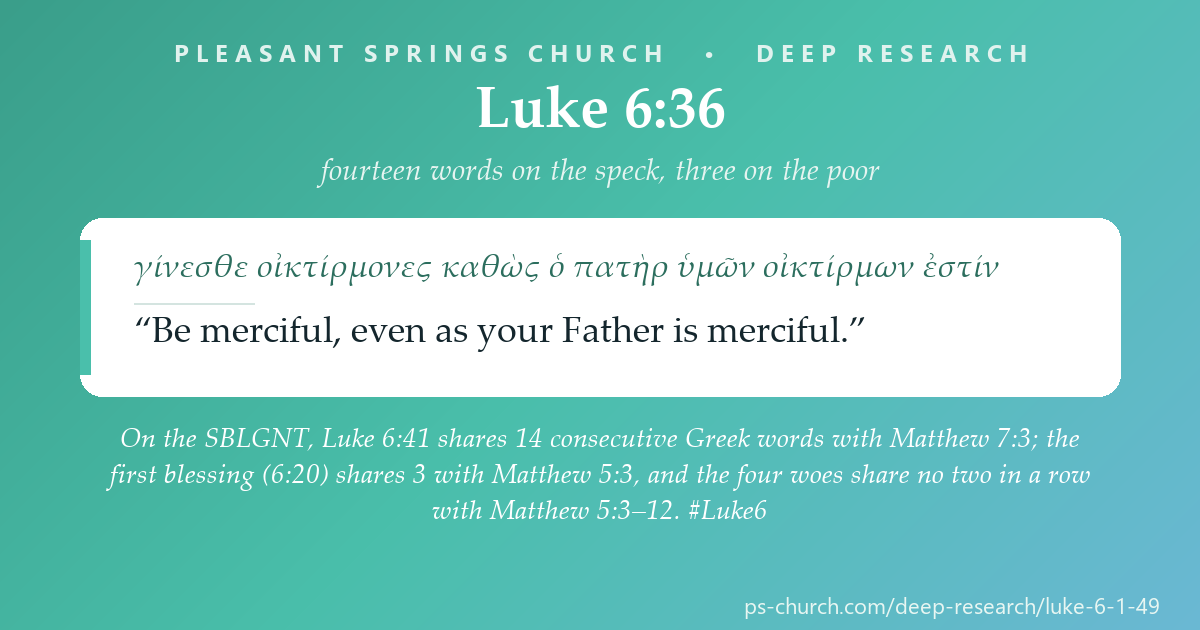
| Luke 6:36 | γίνεσθε οἰκτίρμονες | οἰκτίρμων ἐστίν | “Be merciful, even as your Father is merciful.” |
The frame is shared; the words are not. Luke 6:36 against Matthew 5:48 runs 3 (ὁ πατὴρ ὑμῶν, tied with six other verses of Matthew 5–7); against Leviticus 19:2, 1; Matthew 5:48 against Leviticus 19:2, 1, and against “You shall be blameless before the Lord your God,” — the Greek has τέλειος ἔσῃ — 1. The two words ἅγιοι ἔσεσθε stand side by side in 3 screened units and in the same unit in 7; τέλειος ἔσῃ in one.
Luke’s adjective is the one God gives himself. “The Lord passed before him and proclaimed, ‘The Lord, the Lord, a God merciful and gracious, slow to anger, and abounding in steadfast love and faithfulness,” The Greek has ὁ θεὸς οἰκτίρμων καὶ ἐλεήμων for the Hebrew אֵל רַחוּם וְחַנּוּן. Of the 17 screened units with the adjective, 13 say it of God (one of them Sirach 2:11, a witness), 3 of people, and one can be read either way (Greek Psalm 111:4, ESV 112:4). The pair merciful and gracious recurs, in one order or the other, in twelve of them. Against Exodus 34:6 Luke 6:36 runs 1: the word, not the phrase. Luke 6:36 is the only New Testament verse that says it of people.
“Into your lap”
εἰς τὸν κόλπον ὑμῶν (6:38). The three words εἰς τὸν κόλπον stand in 10 screened units of the Greek Old Testament; εἰς τὸν κόλπον αὐτῶν in three, and in all three what goes into the lap is requital:
“both your iniquities and your fathers’ iniquities together, says the Lord; because they made offerings on the mountains and insulted me on the hills, I will measure into their lap payment for their former deeds.” “Return sevenfold into the lap of our neighbors the taunts with which they have taunted you, O Lord!”
Luke 6:38 runs 3 with each (the three words into the lap). A difference between the two texts bears on the link: the Hebrew of Isaiah 65:7 has the verb measure, וּמַדֹּתִי, which the ESV renders I will measure into their lap; the Greek has ἀποδώσω, I will repay. Luke’s verse is full of measuring (μέτρον, μέτρῳ μετρεῖτε); the measure-into-the-lap shared with Isaiah is in the Hebrew, not the Greek. In Luke what comes into the lap is a gift.
The tree, the treasure and the two builders
Figs and grapes, crosswise. οὐ γὰρ ἐξ ἀκανθῶν συλλέγουσιν σῦκα, οὐδὲ ἐκ βάτου σταφυλὴν τρυγῶσιν — μήτι συλλέγουσιν ἀπὸ ἀκανθῶν σταφυλὰς ἢ ἀπὸ τριβόλων σῦκα. Thorns give Luke’s figs and Matthew’s grapes. The run is 1; with Matthew 7:20, 0.
The treasure. Luke 6:45 runs 7 with Matthew 12:35 but 2 with Matthew 12:34, though both end on the same thought: ἐκ γὰρ περισσεύματος καρδίας λαλεῖ τὸ στόμα αὐτοῦ — ἐκ γὰρ τοῦ περισσεύματος τῆς καρδίας τὸ στόμα λαλεῖ. The articles and the order differ, and a run screen keeps both.
The builders. Luke 6:48 against Matthew 7:25 runs 5, 6:49 against 7:26 3, 6:47 against 7:24 1. Matthew’s ἀνδρὶ φρονίμῳ and ἀνδρὶ μωρῷ, ἡ βροχὴ, οἱ ἄνεμοι and τὴν ἄμμον are not in Luke 6; Luke’s ἔσκαψεν καὶ ἐβάθυνεν and θεμέλιον are not in Matthew 7:24–27.
The Proverbs of the standing house, often set beside the parable:
“When the tempest passes, the wicked is no more, but the righteous is established forever.” “The wicked are overthrown and are no more, but the house of the righteous will stand.” “The house of the wicked will be destroyed, but the tent of the upright will flourish.”
Against Luke 6:48 and 6:49 each of the three runs 1 (but). A difference between the two texts bears on the link: the Hebrew of 10:25 says the righteous is יְסוֹד עוֹלָם, an everlasting foundation; the Greek has no foundation at all, δίκαιος δὲ ἐκκλίνας σῴζεται εἰς τὸν αἰῶνα, the righteous turns aside and is saved for ever (our rendering). The foundation shared with Luke’s θεμέλιον is in the Hebrew only.
⚠️ The Byzantine text, nearer the parallels
The SBLGNT apparatus gives the Byzantine reading (RP, Robinson–Pierpont) at each place below. Measured against the parallel, the Byzantine wording stands nearer Mark or Matthew in seven of the ten comparisons below, and further only at 6:5, where nearing Mark means leaving Matthew. The ten are a selection, not the whole apparatus: measured the same way, the Byzantine readings at 6:1, 6:2, 6:15, 6:16, 6:28, 6:30 and 6:39 also stand nearer their parallels, and at 6:38 (ᾧ γὰρ μέτρῳ WH Treg NA28 ] Τᾧ γὰρ αὐτῷ μέτρῳ ᾧ RP) further from both Matthew 7:2 and Mark 4:24. At 6:9 the table measures one entry; with all four Byzantine readings of the verse the run with Mark 3:4 is ten.
| Luke | the apparatus entry | parallel | run, SBLGNT | run, RP |
|---|---|---|---|---|
| 6:5 | τοῦ σαββάτου ὁ υἱὸς τοῦ ἀνθρώπου WH NA28 ] ὁ υἱὸς τοῦ ἀνθρώπου καὶ τοῦ σαββάτου Treg RP | Mark 2:28 | 4 | 9 |
| 6:5 | (the same) | Matthew 12:8 | 7 | 4 |
| 6:9 | ἀπολέσαι WH Treg NA28 ] ἀποκτεῖναι RP | Mark 3:4 | 6 | 7 |
| 6:10 | αὐτοῦ WH NA28 ] + ὡς ἡ ἄλλη Treg; + ὑγιὴς ὡς ἡ ἄλλη RP | Matthew 12:13 | 2 | 4 |
| 6:42 | τὸ κάρφος … σου ἐκβαλεῖν WH NA28 ] ἐκβαλεῖν τὸ κάρφος … σου Treg RP | Matthew 7:5 | 4 | 6 |
| 6:45 | πονηρὸς WH Treg NA28 ] + ἄνθρωπος RP; πονηροῦ WH Treg NA28 ] + θησαυροῦ τῆς καρδίας αὑτοῦ NIV RP; περισσεύματος WH Treg NA28 ] τοῦ περισσεύματος τῆς RP | Matthew 12:34 | 2 | 6 |
| 6:45 | (the same three) | Matthew 12:35 | 7 | 8 |
| 6:48 | διὰ τὸ καλῶς οἰκοδομῆσθαι αὐτήν WH Treg NA28 ] τεθεμελίωτο γὰρ ἐπὶ τὴν πέτραν RP | Matthew 7:25 | 5 | 5 (a second run of five) |
| 6:49 | εὐθὺς συνέπεσεν WH Treg NA28 ] εὐθὲως ἔπεσεν RP | Matthew 7:27 | 1 | 2 |
| 6:31 | ἄνθρωποι WH NA28 ] + καὶ ὑμεῖς Treg RP | Matthew 7:12 | 5 | 5 |
At 6:48 the Byzantine text ends τεθεμελίωτο γὰρ ἐπὶ τὴν πέτραν, the last five words of Matthew 7:25, giving a second run of five beside the first. The page reports where each reading stands; how the readings arose is a question of the manuscripts, which it does not hold. The page’s Greek is the SBLGNT throughout.
The Greek Old Testament screen, whole
Every verse of the chapter against all 30,348 screened units: all 49 reach two, 39 reach three, 13 reach four, 5 reach five, nothing reaches six, and one row reaches seven. With the Odes held (30,637 units) no row deepens; 7 bands grow, by one to ten units, because the Odes repeat passages already counted.
| Luke | run | tie band | partner | what it is |
|---|---|---|---|---|
| 6:4 | 7 | 1 | 2 Kingdoms 12:20 | David εἰσῆλθεν εἰς τὸν οἶκον τοῦ θεοῦ after his child’s death — a coincidence of phrasing |
| 6:6 | 5 | 1 | 3 Kingdoms 12:20 | Jeroboam εἰς τὴν συναγωγὴν — coincidence |
| 6:12 | 5 | 1 | Exodus 2:11 | the formula ἐγένετο δὲ ἐν ταῖς ἡμέραις |
| 6:17 | 5 | 2 | 2 Chronicles 31:1; 1 Esdras 1:37 | place names |
| 6:23 | 5 | 3 | Deuteronomy 31:22, 32:44; 1 Maccabees 11:48 | ἐν ἐκείνῃ τῇ ἡμέρᾳ καὶ, a formula |
| 6:20 | 4 | 1 | Psalms of Solomon 17:3 | ἡ βασιλεία τοῦ θεοῦ — a witness, not Scripture |
| 6:35 | 4 | 1 | Leviticus 26:7 | the enemies chased — the counter-example above |
| 6:10 | 4 | 7 | Exodus (5), Joshua 8:18 (B), Sirach 7:32 | the formula stretch out your hand |
| 6:24 | 3 | 1 | Sirach 2:14 | the plural second-person woe |
| 6:27 | 3 | 4 | Deuteronomy 20:3, 20:4; Judges 3:28 (A); Leviticus 26:7 | your enemies, in war |
| 6:38 | 3 | 10 | ten units | into the lap |
David at Nob is not the deepest contact. Luke 6:4 runs 4 with 1 Kingdoms 21:7, the bread itself (τοὺς ἄρτους τῆς προθέσεως, which in this form, the accusative with the article, stands in 2 screened units, 1 Kingdoms 21:7 and 1 Chronicles 23:29 (other forms of the phrase stand in three more: Exodus 40:23, 1 Chronicles 9:32, 2 Chronicles 4:19), and in 3 New Testament verses), and 7 with 2 Kingdoms 12:20:
“Then David arose from the earth and washed and anointed himself and changed his clothes. And he went into the house of the Lord and worshiped. He then went to his own house. And when he asked, they set food before him, and he ate.”
The seven words, εἰσῆλθεν εἰς τὸν οἶκον τοῦ θεοῦ καὶ, stand in one screened unit. A difference between the two texts bears on the run: the Hebrew has בֵית־יְהֹוָה, the house of the Lord, and so does the ESV; the run of seven exists only in the Greek, which has the house of God. The same run is measured from Matthew 12:4 on the shelf’s Matthew 12 study. And 1 Samuel 21 gives no hunger: the Greek of 21:1–16 has no form beginning pein-, the Hebrew of the chapter no form of the root for hunger; when he was hungry is Luke’s and Mark’s and Matthew’s.
The withered hand. “And when the king heard the saying of the man of God, which he cried against the altar at Bethel, Jeroboam stretched out his hand from the altar, saying, ‘Seize him.’ And his hand, which he stretched out against him, dried up, so that he could not draw it back to himself.” Against Luke 6:6 the Greek runs 3, ἡ χεὶρ αὐτοῦ: three words of a common phrase.
Sabbath words: profane and lawful
Where Matthew 12:5 has τὸ σάββατον βεβηλοῦσιν, profane the Sabbath, Luke 6 has no form of the verb. In the screened Greek Old Testament a form containing bebel- (augmented ebebel- included) and a form of Sabbath stand together in 15 units — the figure the shelf’s Matthew 12 study prints, reproduced here by its own count; in the New Testament a form containing bebel- stands in 7 verses, and Matthew 12:5 is the only one in the Gospels.
Luke’s word is εἰ ἔξεστιν τῷ σαββάτῳ — is it lawful. The forms of ἔξεστιν (with ἐξὸν, exēn, exestai, exeinai) stand in 8 screened Greek Old Testament units, none with a Sabbath word, all in Esther, 2 Esdras and Maccabees. In the New Testament they stand in 29 verses, and in 9 of them beside the Sabbath — every one a Gospel dispute.
What scholars debate, what the readings of 6:27–35 are, and what this page could not check.
What do the studies debate?
- The sayings Luke and Matthew share without Mark are most often explained by a lost sayings source called Q (reported; the Critical Edition of Q, Robinson, Hoffmann and Kloppenborg, 2000, is not held), and by others through Luke’s use of Matthew (the Farrer–Goodacre view, reported) or Matthew’s of Luke. This page adjudicates none of them. What it adds is a number per verse: where the shared wording runs fourteen words (the speck) and where three (the poor).
- One sermon or two — a mountain in Matthew, a level place in Luke — is argued both ways in the commentaries (reported). No count decides it.
- “The poor” and “the poor in spirit” are read by some as one blessing said two ways, by others as two emphases, material and spiritual (reported). The page shows the three shared words and the divergence after them, and stops there.
- Luke works named on this page — Bock, Fitzmyer, Marshall, Nolland, Green; on the sermons Betz, Allison and Kloppenborg — none were consulted for any number on this page.
⚖️ The commands of 6:27–35: the readings, fairly
Pleasant Springs has no ratified position on non-resistance, war, lending or wealth. Its statement of beliefs has no article on them, and this page labels none of the readings below as the church’s. What /beliefs does say, in Article 9 (Love), is this: “We believe love is the highest calling of the Christian life — not sentimentality, but costly, forgiving, self-giving love.”
- Early Christian non-violence. Several early writers read the cheek and the cloak literally and drew a line at military service. Tertullian:
But how will a Christian man war, nay, how will he serve even in peace, without a sword, which the Lord has taken away?Tertullian, On Idolatry 19 (ANF 3)
- Anabaptist. The commands bind the disciple community now, the sword is set aside, and the church is a visible alternative (the Schleitheim Confession of 1527, article 6, and John Howard Yoder, The Politics of Jesus, 1972; reported, neither held).
- Just war and the inward disposition. Augustine read the commands as binding the heart without forbidding every outward act of defence or justice:
that these precepts pertain rather to the inward disposition of the heart than to the actions which are done in the sight of menAugustine, Letter 138.13, to Marcellinus (NPNF 1.1)
Aquinas’s criteria for just war (Summa II–II q. 40) are reported, not held. - Lutheran two kingdoms. The Christian, as a private person, does not resist for himself, and as a holder of office may bear the sword for his neighbour (Luther, On Temporal Authority, 1523; reported, not held).
- Liberationist. Luke’s blessing of the poor and woe on the rich are read as God’s preference for the materially poor, binding on the church’s practice (Gustavo Gutiérrez, A Theology of Liberation, 1971; reported, not held).
- Lending. 6:34–35 has been read as forbidding interest altogether (the medieval usury rule), as forbidding it only to the poor, and as a call to give without expecting return (reported). The Greek Old Testament’s lending laws (Exodus 22:24 and Deuteronomy 23:20 in the Greek; ESV 22:25 and 23:19) forbid interest to a brother.
The page does not choose among these. The text it measures is the same for all of them.
⚠️ The house that fell (6:49)
“But the one who hears and does not do them is like a man who built a house on the ground without a foundation. When the stream broke against it, immediately it fell, and the ruin of that house was great.” Some read the fallen house as a believer who loses salvation; others as one who never truly heard. The church’s own words, from /beliefs Article 10 (Hope), are that “all who genuinely receive Christ are held secure. Our assurance rests not on the strength of our own grip on God, but on the finished work of Christ and the faithfulness of the One who keeps His own (Romans 8:39; Philippians 1:6) — and Scripture’s warnings are themselves a real means by which He holds us fast.” The parable is read here as one of those warnings: it contrasts hearing that does and hearing that does not, and Luke says the second was χωρὶς θεμελίου, without a foundation.
⚠️ What this page could not check
- No source theory is tested. The runs measure shared wording between texts as they stand in the SBLGNT. They cannot say who wrote first, or whether a lost source lies behind both Gospels.
- The Sabbath law of the period is not held. The Mishnah’s list of labours forbidden on the Sabbath (Shabbat 7:2, where reaping and threshing are reported to be listed), the Damascus Document’s Sabbath code, and Jubilees 50 on this point are reported, not read, here. The page cannot say how rubbing grain was judged in Jesus’ day.
- The negative golden rule outside Tobit — Hillel (Babylonian Talmud, Shabbat 31a), the Letter of Aristeas 207 — is not held and not quoted. Nor is 1QS 1:10, the Qumran rule to hate the sons of darkness, which is often set beside Matthew 5:43.
- Tobit 4:15 is measured in one Greek text. The CATSS file of Sinaiticus passes from 4:7 to 4:19; the Old Latin and the Qumran fragments of Tobit are not held.
- No Aramaic retroversion. Proposals that Luke’s and Matthew’s differences (the poor / the poor in spirit; merciful / perfect) go back to one Aramaic word are reported in the literature and not tested.
- The manuscripts are not held. The Byzantine readings are read from the SBLGNT apparatus, which reports editions (WH, Treg, NA28, RP), not manuscripts.
- The CATSS lemma column under-counts augmented forms. It finds six units for leap where a form search finds eight; every count on this page is by form, and the lemma column is used only for the Greek New Testament.
- Who the adjective merciful describes in each of its 17 Greek Old Testament units is the page’s reading of each verse, not a measurement; Psalm 112:4 (Greek 111:4) is left open.
- Our renderings. Nineteen verses of Luke are given in our own English, because this page prints the ESV of no more than 30; they were tested against the KJV and the cached ESV for shared runs, but they are ours, and this is where the page is weakest as a translation.
- The structure diagram is ours. It is built from measured links between the verses, and labelled a sequence, expressly not a chiasm.
- Heiser’s reading of Psalm 82 is reported from his published work, not re-argued; the page measures only that the two words sons of the Most High stand in one Greek Old Testament unit.
- Direction of influence is never asserted. Where Luke stands nearer Matthew than Mark, nearer Acts than either in the names, nearer Leviticus 26 than Exodus 23, or nearer the Hebrew of Isaiah 65 than its Greek, the page reports where the words stand and nothing more.
The word God gives himself in Exodus 34 is the word Jesus gives his disciples on the level place.
Name what you learned, why it matters, and one concrete response.
What should we carry away — and do?
- The command has no Old Testament wording to lean on. “Love your enemies” stands in no screened unit of the Greek Old Testament; its last three Greek words, in this form, stand there only in war. Jesus gives his hearers a sentence the Greek Scriptures held here never put together.
- Mercy is God’s own word for himself, given to us. “Be merciful, even as your Father is merciful” — and in the Greek of Exodus 34:6 the Lord proclaims himself “a God merciful and gracious”. The church’s first article says the same of Jesus: “God's heart is revealed most clearly in Jesus Christ, who shows us that mercy triumphs over judgment and love over fear.”
- Look at your own eye first. The saying the two Gospels share at greatest length is the speck and the log: “first take the log out of your own eye”.
- Hear and do. “Why do you call me ‘Lord, Lord,’ and not do what I tell you?”
Step in response: read Exodus 34:6–7 and Luke 6:27–36 aloud, in that order. Then name one person you count an enemy, and do one of the four things in 6:27–28 for that person this week.
Luke 6:36 · to share
Greek NT + ESVEvery Deep Research page traces its passage across the whole sweep — the Old Testament, the Second-Temple world between the testaments (historical witnesses, not Scripture), and the New Testament. Follow the thread:
Related on the shelf. Matthew 5:1–12, the Beatitudes; Matthew 7 and Matthew 7:1–6, judging and the speck; Matthew 12, the grain fields and the treasure of the heart; Mark 2–3, the Sabbath block and the Twelve; Luke 4:16–30, Isaiah 61 read aloud; Luke 5, where the chapter comes from; Luke 7–8, where it goes next; 1 Samuel 18–24, David at Nob; Leviticus 24, the bread of the Presence; Deuteronomy 22–23, the grain by hand; Isaiah 61:1–3; Isaiah 1–6 and Amos 6–9, the woes; Exodus 23 and Proverbs 25–31, the enemy’s ox and the enemy’s bread; Exodus 33–34, the merciful God; Psalms 79–83, the lap and the sons of the Most High; Isaiah 62–66, the measure into the lap; Proverbs 10–15, the house that stands; Tobit.
Pleasant Springs Church — Deep Research
Research method after Michael S. Heiser’s Bible Research Method (examine dictionaries → ancient literature → important words → textual connections → academic publications → share), with the Pleasant Springs “Author & Audience” foundation. Scripture set in the Hebrew, the Greek editions named on each page and the ESV (Old Testament), and the Greek New Testament and the ESV (New Testament), per the practice of Pleasant Springs Church. Luke works named on this page (none re-read for it): Bock, Fitzmyer, Marshall, Nolland, Green, Betz, Allison, Kloppenborg, Robinson–Hoffmann–Kloppenborg, Yoder, Gutiérrez — none of which were consulted for any number on this page. Text: Greek New Testament from the SBL edition as digitized by MorphGNT (text, parsing and lemma columns); SBLGNT apparatus, Michael W. Holmes (ed.), Society of Biblical Literature and Logos Bible Software / Faithlife, CC BY 4.0; Greek Old Testament from Rahlfs’ Septuaginta as digitized by CATSS; Hebrew from the Masoretic text as printed in Sefaria’s Miqra according to the Masorah; Irenaeus, Justin, Tertullian and the Didache from the Ante-Nicene Fathers; Augustine from the Nicene and Post-Nicene Fathers. ⚠️ VERSE NUMBERING. Luke 6 is numbered alike in the SBLGNT, the KJV and the ESV (49 verses). 1 Samuel 21:2 and 21:7 (MT, LXX) = ESV 21:1 and 21:6; 1 Samuel = 1 Kingdoms, 2 Samuel = 2 Kingdoms, 1 Kings = 3 Kingdoms. Deuteronomy 23: MT 23:26 = ESV 23:25 = LXX 23:25, and the LXX reverses the order of 23:25–26. Proverbs 25:21–22 = CATSS 32:21–22. LXX Psalm 78:12 = ESV 79:12; 81:6 = 82:6; 102:8 = 103:8; 111:4 = 112:4. Joel 4:13 (MT, LXX) = ESV 3:13. Tobit 4:15 in the BA text only. ⚠️ The measurement, in full. Greek against Greek; MorphGNT normalised word; CATSS form column, beta-code transliterated first; both sides lowercased, accents and breathings dropped, final sigma folded, with the shelf’s edition-equivalence table on cross-corpus screens. Contiguous runs of whole word forms, never lemmas. 49 rows against 30,348 verse units — the 64 CATSS files less the Odes — and against the 1,068 verses of Matthew, the 673 of Mark and the 6,778 of the Greek New Testament outside Luke; and each row against the other 48. Unanchored searches are substring matches over the same normalised forms, augments and movable nu allowed for. Hebrew word forms as written, over 23,204 Masoretic verse units. Exhaustive and deterministic. It finds verbatim contact, not allusion.
Scripture quotations marked ESV are from the ESV® Bible (The Holy Bible, English Standard Version®), © 2001 by Crossway, a publishing ministry of Good News Publishers. ESV Text Edition: 2016. Used by permission. All rights reserved. The ESV text may not be quoted in any publication made available to the public by a Creative Commons license, and the ESV may not be translated in whole or in part into any other language. www.esv.org
|
Did this study bless you today? 💚 Give to Support PS Church100% of gifts go to the General Fund — thank you. |