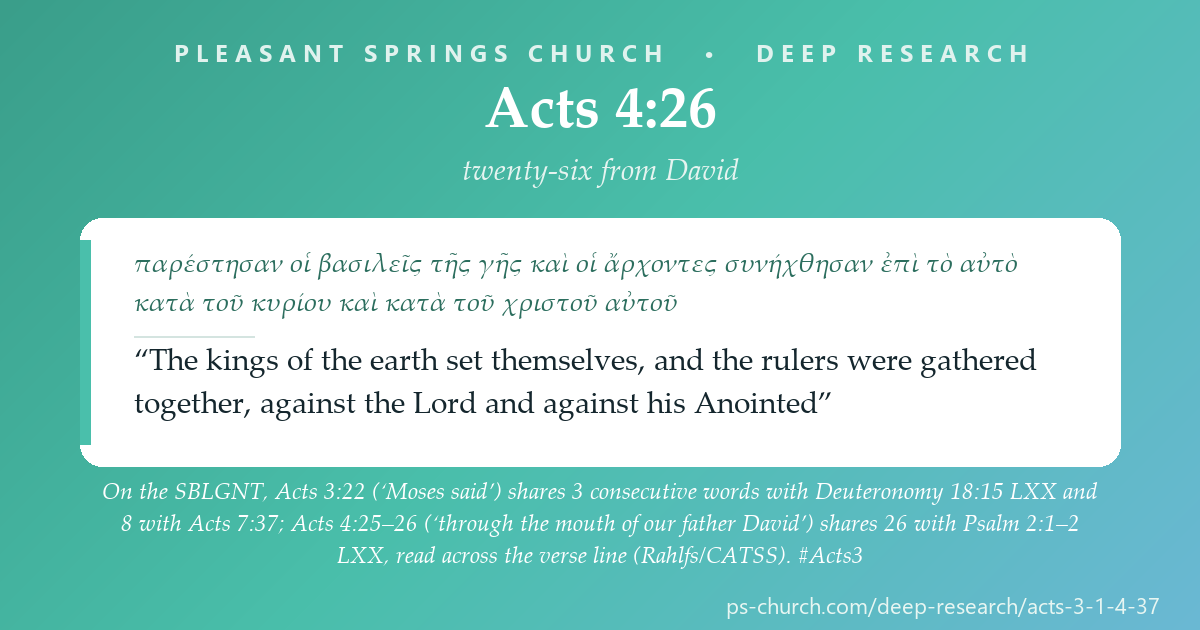
Two verses of Acts 3–4 name the human mouth of the Scripture they introduce. At 3:22 it is Μωϋσῆς μὲν εἶπεν — “Moses said” — and against Deuteronomy 18:15 in the Greek the verse shares three consecutive words, κύριος ὁ θεὸς. Against Stephen’s use of the same line in Acts 7:37 it shares eight. At 4:25 it is God speaking στόματος Δαυὶδ, and against Greek Psalm 2:1–2, read across the verse line, Acts 4:25–26 shares twenty-six (twenty-eight if the SBLGNT’s one-word Ἱνατί is split as the Greek Psalter held here prints it). Between those two, the prayer’s opening address names no source at all, and its thirteen words τὸν οὐρανὸν καὶ τὴν γῆν καὶ τὴν θάλασσαν καὶ πάντα τὰ ἐν αὐτοῖς stand together in one Greek Old Testament unit of the 30,637 held: Exodus 20:11, the Sabbath commandment. That thirteen rests on an and before the sea that the Hebrew of Exodus 20:11 does not have. Around these the page prints what else the corpora show — the stone of Psalm 118 at three words where the Gospels have ten; a warning in 3:23 whose outer words are Leviticus 23:29 and whose middle is Deuteronomy 18:19; a servant glorified who shares no word form with Isaiah 52:13 but the article and and — and it never says which text came first. See the method →
Acts 3:1–4:37
Greek NT · ESV or our renderingVersification. Acts 3–4 has no offset: the SBLGNT, the ESV and the King James Version all count 26 verses in chapter 3 and 37 in chapter 4, verse for verse. There is no Septuagint column, because Acts is a New Testament book. The offsets are in the Old Testament texts measured. Greek Psalm 117:22 = Hebrew and ESV 118:22; Greek 145:6 = Hebrew and ESV 146:6; Greek 21:28 = Hebrew 22:28 = ESV 22:27; Greek 15:8 = Hebrew and ESV 16:8; Psalm 2 is numbered alike. Nehemiah 9:6 = Greek 2 Esdras 19:6. 1 and 2 Samuel, 1 and 2 Kings = Greek 1–4 Kingdoms: 1 Kings 18:36 is 3 Kingdoms 18:36, 2 Kings 5:27 and 19:15 are 4 Kingdoms 5:27 and 19:15, and Greek 3 Kingdoms 20:27 is Hebrew and ESV 1 Kings 21:27 (the Greek orders those two chapters the other way round). 1 Chronicles 12:39 (Greek and Hebrew) = ESV 12:38. Malachi 3:23 (Greek) = Hebrew 3:24 = ESV 4:6. Exodus 8:11 (Greek and Hebrew) = ESV 8:15. Deuteronomy 5:27 (Greek and ESV) = Hebrew 5:24, and Deuteronomy 13:5 (Greek and Hebrew) = ESV 13:4. Joel 3:5 (Greek and Hebrew) = ESV 2:32. Daniel 4:37 is cited from the Old Greek text, Judges 8:16 from the A text and Joshua 1:18 from the B text. Genesis 12, 18, 22, 26 and 28, Exodus 3, 20 and 30, Leviticus 23, Deuteronomy 15, 17 and 18, Isaiah 1, 35, 37 and 52, Zechariah 4 and 1 Chronicles 29 have no offset in the verses printed. Judith, 1–3 Maccabees, Tobit, Sirach and Wisdom are Greek only and are witnesses, not Scripture. Josephus is cited by Niese’s sections.
The Shape of the Passage
A sequence of seven panels, joined at one verse — NOT a chiasmTwo chapters, 63 verses: a healing, two speeches, a hearing, a prayer and a summary. The Greek is measured against the rest of the New Testament and the Greek Old Testament held here; the authorship is reported, not tested.
Author
Acts names no author; tradition names Luke, the writer of the Third Gospel, and Acts 1:1 addresses the same Theophilus as Luke 1:3 (reported, not tested).
What the measurement does show is speeches that share wording with each other. Acts 3:22 meets Stephen’s Acts 7:37 at 8 words, 3:13 meets 7:32 at 7, the prayer of 4:24 meets the speech at Lystra (14:15) at 13, and the lame man of 3:2 is described in the five words used of the lame man of 14:8. The deepest contact of 3:21 outside Acts is 6 words with Luke 1:70. The page reports where the words stand and says nothing about how the speeches were composed.
Audience
Inside the story: a temple crowd addressed as Ἄνδρες Ἰσραηλῖται and ἀδελφοί; then the rulers, elders and scribes; then the believers’ own company. Outside it: Theophilus and readers like him (Luke 1:3–4, Acts 1:1). The speeches assume hearers who know Abraham, Moses, Samuel and David without being told who they were.
A caution the text itself supplies. The speaker is a Jew addressing fellow Jews as brothers (3:17), about acts done κατὰ ἄγνοιαν ἐπράξατε, and the offer is made ὑμῖν πρῶτον (3:26). The prayer then names Herod, Pontius Pilate, the nations and the peoples of Israel together (4:27). The page reads the you of 3:13–15 and 4:10 as the crowd and council of that year in Jerusalem, as the text addresses them, and not as a people for all time.
Orient on the temple and its gates, the hour of prayer, Solomon’s colonnade, the Servant of the Lord, the prophet like Moses, the Abrahamic promise, the Sadducees and the high-priestly family, the Sanhedrin, the cornerstone, the name of Jesus, Psalm 2 in early Christian use, and the community of goods.
Search by reference and by topic: Beautiful Gate, Nicanor Gate, hour of prayer, Solomon’s portico, servant (pais), Author / Prince of life (archegos), prophet like Moses, refreshing (anapsyxis), restoration of all things (apokatastasis), Abrahamic covenant, Sadducees, Annas, Caiaphas, Sanhedrin, cornerstone, name, boldness (parrhesia), Psalm 2, Herod Antipas, Pontius Pilate, predestine (proorizo), community of goods, Barnabas.
Which articles are relevant?
- Anchor Bible Dictionary — entries on the Jerusalem temple and its gates, the Sadducees, Annas, Caiaphas, the Sanhedrin, Barnabas and the Servant of the Lord.
- Dictionary of New Testament Background (IVP) — entries on the temple, priests and priesthood, the Sadducees and prayer.
- Dictionary of the Later New Testament and Its Developments (IVP) — entries on Acts, Christology, the restoration of Israel, and wealth and poverty.
- NIDNTTE — παῖς, ἀρχηγός, ἀνάψυξις, ἀποκατάστασις, παρρησία, προορίζω, δεσπότης, ὄνομα.
Bibliography surfaced:
- Commentaries on Acts: F. F. Bruce, The Book of the Acts (NICNT) and The Acts of the Apostles: Greek Text; C. K. Barrett, Acts (ICC, 2 vols.); Darrell L. Bock (BECNT); Craig S. Keener, Acts: An Exegetical Commentary (4 vols.); Joseph A. Fitzmyer (AB 31); Luke Timothy Johnson (Sacra Pagina).
- On the Old Testament in Acts: I. Howard Marshall, “Acts,” in Beale and Carson, Commentary on the New Testament Use of the Old Testament (2007).
- On the text of Acts: Bruce M. Metzger, A Textual Commentary on the Greek New Testament (2nd ed. 1994), whose Acts section discusses the Western readings at length (reported).
The works above are named as places to look. None was re-read for this page, and no number on it comes from them. Stage 5 says so again.
What the world of the text supplies: an hour of sacrifice, a gate, a party that denied the resurrection, a high-priestly family Josephus names, and readers in the second and third centuries who held these chapters close.
The ninth hour (3:1)
Josephus, held here in Niese’s Greek, describes the priests during Pompey’s siege as δὶς τῆς ἡμέρας πρωΐ τε καὶ περὶ ἐνάτην ὥραν ἱερουργούντων ἐπὶ τοῦ βωμοῦ (Antiquities 14.65) — offering sacrifice at the altar twice a day, at dawn and about the ninth hour (our rendering). Acts calls the hour τὴν ὥραν τῆς προσευχῆς τὴν ἐνάτην; Josephus speaks of sacrifice, not prayer, and the page draws no more from the pair than that both name the hour.
The gate called Beautiful (3:2, 3:10)
Neither the Greek Old Testament held nor Josephus’s Antiquities (Niese) has a form of the adjective in the same unit or section as a word for gate or door. Josephus describes the inner court with gates to north and south and, toward the sunrise, κατὰ δὲ ἡλίου βολὰς ἕνα τὸν μέγαν (Antiquities 15.418), facing the sun’s rising, one, the great one (our rendering). Its identification with the gate of Acts 3 — often as the Nicanor Gate of the Mishnah, or the bronze gate Josephus describes in the Jewish War — is reported, not checked: neither the Mishnah nor the War is held.
The Sadducees and the high-priestly family (4:1–6)
Josephus: Σαδδουκαίοις δὲ τὰς ψυχὰς ὁ λόγος συναφανίζει τοῖς σώμασι (Antiquities 18.16), for the Sadducees, the teaching has souls vanish together with bodies (our rendering) — set beside 4:2, where they are vexed at the proclaiming of τὴν ἀνάστασιν τὴν ἐκ νεκρῶν. He records that Quirinius Ἄνανον τὸν Σεθὶ καθίσταται ἀρχιερέα (18.26), appoints Ananus son of Seth high priest (our rendering); that Ἰώσηπος ὁ καὶ Καϊάφας διάδοχος ἦν αὐτῷ (18.35), Joseph, who was also Caiaphas, was his successor (our rendering) — successor to Simon son of Camithus, the third high priest Gratus appointed after removing Ananus (18.34); and of the elder Ananus that πέντε γὰρ ἔσχε παῖδας καὶ τούτους πάντας συνέβη ἀρχιερατεῦσαι τῷ θεῷ (20.198), he had five sons, and it fell to every one of them to serve God as high priest (our rendering). Acts 4:6 names Ἅννας ὁ ἀρχιερεὺς καὶ Καϊάφας; whether its John and Alexander are among those sons is reported in the literature and not checked here.
Irenaeus reads Acts 3–4 (about AD 180)
Again, when Peter, accompanied by John, had looked upon the man lame from his birth, before that gate of the temple which is called Beautiful, sitting and seeking alms,Irenaeus, Against Heresies 3.12.3 (ANF 1)
These [are the] voices of the Church from which every Church had its origin;Irenaeus, Against Heresies 3.12.5 (ANF 1), of the prayer of 4:24–30
Irenaeus sets out both speeches and the prayer at length against teachers who divided the Creator from the Father of Jesus. His Greek survives only in part, and the ANF translates the Latin (reported). Three of the translator’s notes bear on this page. Of three readings in Irenaeus’s text, at 3:13, 3:14 and 3:17, the same note says: These interpolations are also found in the Codex Bezæ. Of 3:21 his text reads the times of the arrangement of all things, where the note gives the Latin, dispositionis. And of 4:27: "In hac civitate" are words not represented in the textus receptus, but have a place in all modern critical editions of the New Testament. Codex Bezae (D), the chief witness to the Western text of Acts, is not held here; these are the ANF editor’s reports, printed as such.
Goods held in common: three ancient witnesses (4:32–35)
Josephus says of the Essenes τὰ χρήματά τε κοινά ἐστιν αὐτοῖς (Antiquities 18.20), their property is shared among them (our rendering). The Didache, a church manual usually dated to the late first or early second century (reported), and Tertullian about AD 197:
Thou shalt not turn away from him that is in want, but thou shalt share all things with thy brother, and shalt not say that they are thine own;Didache 4.8 (ANF 7)
One in mind and soul, we do not hesitate to share our earthly goods with one another. All things are common among us but our wives.Tertullian, Apology 39 (ANF 3)
The Didache’s shalt not say that they are thine own answers to 4:32’s ἴδιον εἶναι; Tertullian’s one in mind and soul to καρδία καὶ ψυχὴ μία. Both are the ANF translators’ English; neither Greek nor Latin is held. The Qumran community’s rule on property, and the Greek proverb that friends hold things in common, are often set beside 4:32 (reported); neither text is held.
Twelve words. Where a count is given it is a lemma count from the MorphGNT columns, re-checked by unanchored search; Greek Old Testament counts are of units with a matching form.
Twenty-four tokens in the Greek New Testament, five in Acts 3–4 (3:13, 3:26, 4:25, 4:27, 4:30). By our reading it is used of Jesus as God’s servant five times in the New Testament: Matthew 12:18, where Matthew sets out Isaiah 42:1, and the four in these chapters (and once more, as a child, at Luke 2:43, Ἰησοῦς ὁ παῖς); at 4:25 it is David, and at Luke 1:54 and 1:69 Israel and David. Elsewhere in Acts it is a boy (20:12). The King James Version gives it as Son (3:13, 3:26) and child (4:27, 4:30); the ESV, servant.
Nine tokens in Acts 3–4 — 3:6, 3:16 (twice), 4:7, 4:10, 4:12, 4:17, 4:18, 4:30 — in six of the seven panels of the structure diagram; 60 in Acts. The seven words ἐν τῷ ὀνόματι Ἰησοῦ Χριστοῦ τοῦ Ναζωραίου stand at 3:6 and 4:10 and in no other verse of the New Testament.
Four New Testament tokens (Acts 3:15, Acts 5:31, Hebrews 2:10, Hebrews 12:2). The ESV has the Author of life here.
Once in the Greek New Testament. The noun stands in one Greek Old Testament unit held here, Exodus 8:11 (ESV 8:15): γέγονεν ἀνάψυξις, there was a respite — Pharaoh’s relief from the frogs. Forms of the related verb stand in seven more units, three of them beginning anapsyx- and four with the augment, anepsy-.
Once in the Greek New Testament, and no Greek Old Testament unit held has a form beginning apokatastas-. The verb ἀποκαθίστημι stands eight times (Matthew 12:13, Matthew 17:11, Mark 3:5, Mark 8:25, Mark 9:12, Luke 6:10, Acts 1:6, Hebrews 13:19), at Acts 1:6 in the disciples’ question ἀποκαθιστάνεις τὴν βασιλείαν τῷ Ἰσραήλ, and often in the Greek Old Testament, among them Malachi 3:23 (ESV 4:6) of Elijah: ἀποκαταστήσει καρδίαν πατρὸς πρὸς υἱὸν.
Eleven New Testament tokens (Luke 18:9, Luke 23:11, Acts 4:11, Romans 14:3, Romans 14:10, 1 Corinthians 1:28, 1 Corinthians 6:4, 1 Corinthians 16:11, 2 Corinthians 10:10, Galatians 4:14, 1 Thessalonians 5:20); Mark 9:12 has the by-form ἐξουδενηθῇ. The Greek Psalm has ἀπεδοκίμασαν. The builders are οἰκοδόμος, a noun found once in the New Testament, where the psalm has the participle οἱ οἰκοδομοῦντες.
Five tokens in Acts, three of them here (4:13, 4:29, 4:31): what the council sees, what the prayer asks for, and what comes after the shaking.
The form stands once in the Greek New Testament and once in the Greek Old Testament held, Psalm 2:1. Other verb forms of the stem stand in 2 Maccabees 7:34 and 3 Maccabees 2:2, and the noun in six more units. The Hebrew of Psalm 2:1 has רָגְשׁוּ, the ESV rage.
Six New Testament tokens (Acts 4:28, Romans 8:29, Romans 8:30, 1 Corinthians 2:7, Ephesians 1:5, Ephesians 1:11); no form of the verb in the Greek Old Testament held. The one Greek Old Testament form beginning proor-, or prōr- with the augment, is προωρώμην (Psalm 15:8, ESV 16:8), of a different verb, to see beforehand.
Ten New Testament tokens of the noun (Luke 2:29, Acts 4:24, 1 Timothy 6:1, 1 Timothy 6:2, 2 Timothy 2:21, Titus 2:9, 1 Peter 2:18, 2 Peter 2:1, Jude 1:4, Revelation 6:10); the vocative form only here and at Luke 2:29, Simeon’s δέσποτα. In the Greek Old Testament held the vocative stands in 33 units, Abraham’s first (Genesis 15:2, 15:8).
Once in the Greek New Testament. The form stands in 9 Greek Old Testament units, three of them in Deuteronomy 15 (15:4, 15:7, 15:11) and the rest in Proverbs.
Four New Testament tokens (Matthew 23:27, Acts 3:2, Acts 3:10, Romans 10:15): whitewashed tombs that look fair, the gate twice, and the feet of those who bring good news. No Greek Old Testament unit held has a form of it beside a word for gate or door.
Every verse of Acts 3–4 screened against the New Testament outside Acts and against the whole Greek Old Testament held here; then the named passages, one by one; then the echoes inside Acts.
What the screens find
Against the New Testament outside Acts (6,925 verses), three rows reach six and none goes further: 3:21 with Luke 1:70 (διὰ στόματος τῶν ἁγίων ἀπ’ αἰῶνος), 4:24 with Revelation 14:7 (τὸν οὐρανὸν καὶ τὴν γῆν καὶ) and 4:26 with Revelation 6:15 (οἱ βασιλεῖς τῆς γῆς καὶ οἱ), each with a tie band of one.
| deepest run against the NT outside Acts | 6 | 5 | 4 | 3 | 2 |
|---|---|---|---|---|---|
| rows of Acts 3–4 | 3 | 3 | 14 | 33 | 10 |
Against the 30,348 screened units of the Greek Old Testament (the Odes excluded; letting them back in deepens no row), two rows stand apart: 4:26 at 20 with Psalm 2:2 and 4:24 at 13 with Exodus 20:11, each with a band of one. Then 3:13 and 4:25 at six. The six rows at five are the counter-examples this page prints first: 3:9 with Leviticus 9:24 (καὶ εἶδεν πᾶς ὁ λαὸς, fire on the altar), 4:4 with 1 Kingdoms 27:7 (a count), 4:5 with Judges 8:16 (a list), 3:20 with 3 Kingdoms 20:27 (ἀπὸ προσώπου τοῦ κυρίου καὶ), 4:10 with two formulas, and 3:25, whose five are shared by a promise to Jacob and two curses.
| deepest run against the screened Greek OT | 20 | 13 | 6 | 5 | 4 | 3 | 2 |
|---|---|---|---|---|---|---|---|
| rows of Acts 3–4 | 1 | 1 | 2 | 6 | 13 | 31 | 9 |
So the measurement sees the psalm the prayer names, and finds the prayer’s unnamed opening words in one Greek verse, the Sabbath commandment; it barely sees the Moses and the stone the speeches name. That is a fact about verbatim contact, not about allusion, and the sections below take each passage in turn.
The prophet like Moses (3:22–23; Deuteronomy 18:15–19; Leviticus 23:29)
The prophet like Moses · Deuteronomy 18:15, 18:18–19; Leviticus 23:29
Hebrew · Greek OT · ESV| New Testament verse | Deuteronomy 18:15 | word forms shared, in any order | Acts 7:37 |
|---|---|---|---|
| Acts 3:22 (Moses said) | 3 — κύριος ὁ θεὸς | 12 | 8 |
| Acts 7:37 (the Moses who said) | 3 — ἐκ τῶν ἀδελφῶν | 9 | — |
| Mark 9:7 (no source named) | 1 | 3 | 1 (against Acts 3:22) |
Three with Moses, eight with Stephen. Acts 3:22 opens Μωϋσῆς μὲν εἶπεν and measures 3 against Deuteronomy 18:15 — κύριος ὁ θεὸς — and it shares 12 word forms with the verse in another order. The Greek Deuteronomy puts the brothers first, προφήτην ἐκ τῶν ἀδελφῶν σου ὡς ἐμὲ, and the raising after, ἀναστήσει σοι κύριος ὁ θεός σου; Acts 3:22 and Acts 7:37 both put the raising first, both have the plural you where Deuteronomy has the singular, and against each other they run 8: ὁ θεὸς ἐκ τῶν ἀδελφῶν ὑμῶν ὡς ἐμέ. Acts 7:37 measures 3 against Deuteronomy 18:15 as well. Reproducing the shelf’s Mark 9 study: Acts 3:22 runs 3 against Deuteronomy 18:15, and Mark 9:7’s ἀκούετε αὐτοῦ, which names no source, runs 1; the phrase αὐτοῦ ἀκούσεσθε stands in two Greek Old Testament units (Deuteronomy 13:5, ESV 13:4, and 18:15) and in one New Testament verse, Acts 3:22.
The row’s deepest Old Testament run is not Deuteronomy 18. Against the screened Greek Old Testament, 3:22’s deepest run is four words (tie band 8), and the band is formulas: κατὰ πάντα ὅσα ἂν λαλήσῃ πρὸς ὑμᾶς shares πάντα ὅσα ἂν λαλήσῃ with Deuteronomy 5:27 — the people at Horeb asking Moses to speak to them all that the Lord our God will speak to you — and κύριος ὁ θεὸς ἐκ shares four with Genesis 3:23 and Exodus 13:9, and κατὰ πάντα ὅσα ἂν four with Exodus 25:22, Leviticus 13:51, Judges 10:15 (A text) and 3 Kingdoms 2:3 and 8:43. Deuteronomy 18:16 recalls that same Horeb request, but Deuteronomy 5:27 is one of eight in the band, and the page reads it as an accident of the instrument.
3:23: Leviticus outside, Deuteronomy inside. ἔσται δὲ πᾶσα ψυχὴ ἥτις … μὴ ἀκούσῃ τοῦ προφήτου ἐκείνου ἐξολεθρευθήσεται ἐκ τοῦ λαοῦ. The opening three words, πᾶσα ψυχὴ ἥτις, stand in three Greek Old Testament units (Leviticus 17:15, 23:29, 23:30), and the closing four, ἐξολεθρευθήσεται ἐκ τοῦ λαοῦ, in two (Leviticus 23:29, Exodus 30:33); only Leviticus 23:29 has both, πᾶσα ψυχή ἥτις … ἐξολεθρευθήσεται ἐκ τοῦ λαοῦ αὐτῆς, where the middle is μὴ ταπεινωθήσεται, shall not humble itself, of the Day of Atonement. In Acts the middle is μὴ ἀκούσῃ, which stands in Deuteronomy 18:19 (μὴ ἀκούσῃ) and two other units. So the Leviticus wording breaks off and resumes on each side of μὴ ἀκούσῃ. Two things on the Hebrew side bear on it: Acts opens ἔσται δὲ, and it shall be, which matches the Hebrew opening of Deuteronomy 18:19, וְהָיָה, and not the Greek, καὶ ὁ ἄνθρωπος; and Acts ends ἐξολεθρευθήσεται ἐκ τοῦ λαοῦ, without the Greek Leviticus’s αὐτῆς; the Hebrew has the possessive too, on the plural וְנִכְרְתָה מֵעַמֶּיהָ. The verb ἐξολεθρεύω is the Greek’s; the Hebrew’s is cut off. The page reports the seam and does not say how it was made.
In your offspring (3:25; Genesis 12, 18, 22, 26, 28)
In your offspring · Genesis 12:3, 22:18, 26:4, 28:14
Hebrew · Greek OT · ESV| Greek OT verse (to whom) | run with Acts 3:25 | has Καὶ ἐν τῷ σπέρματί σου? | its ‘all … of the earth’ |
|---|---|---|---|
| Genesis 12:3 (Abram) | 2 | no | πᾶσαι αἱ φυλαὶ τῆς γῆς |
| Genesis 18:18 (Abraham) | 2 | no | πάντα τὰ ἔθνη τῆς γῆς |
| Genesis 22:18 (Abraham) | 4 | yes (four words; καὶ ἐνευλογηθήσονται before it) | πάντα τὰ ἔθνη τῆς γῆς |
| Genesis 26:4 (Isaac) | 4 | yes (four words) | πάντα τὰ ἔθνη τῆς γῆς |
| Genesis 28:14 (Jacob) | 5 | yes, all five, as its last words | πᾶσαι αἱ φυλαὶ τῆς γῆς |
| Psalm 21:28 (ESV 22:27) | 3 | no | πᾶσαι αἱ πατριαὶ τῶν ἐθνῶν |
Which verse is closest depends on what is counted. By contiguous run it is Genesis 28:14, five words, καὶ ἐν τῷ σπέρματί σου, the last words of the verse — but the same five stand in 4 Kingdoms 5:27, καὶ ἐν τῷ σπέρματί σου (the leprosy of Naaman on you and on your offspring, to you and to your descendants forever), and in Deuteronomy 28:46, both curses, so the band is three. Without the opening and, ἐν τῷ σπέρματί σου stands in five Greek Old Testament units, the three Genesis promises and the two curses. Among the verses spoken to Abraham, as 3:25 says (λέγων πρὸς Ἀβραάμ), Genesis 22:18 is closest at four, tied with 26:4, spoken to Isaac. Genesis 28:14 is spoken to Jacob.
The families. Acts has πᾶσαι αἱ πατριαὶ τῆς γῆς. The Greek Old Testament held has πᾶσαι αἱ φυλαὶ τῆς γῆς in three units (Genesis 12:3, 28:14 and Psalm 71:17, ESV 72:17) and πάντα τὰ ἔθνη τῆς γῆς in seven, but αἱ πατριαὶ τῆς γῆς in none. πᾶσαι αἱ πατριαὶ itself stands in two units, 1 Chronicles 4:27 and Psalm 21:28, πᾶσαι αἱ πατριαὶ τῶν ἐθνῶν (all the families of the nations). The Hebrew of Genesis 12:3 and 28:14 has מִשְׁפְּחֹת הָאֲדָמָה, the families of the ground, and the ESV renders those two verses and Acts 3:25 alike, all the families of the earth, over two different Greek nouns, φυλαὶ and πατριαὶ. The form ἐνευλογηθήσονται stands in exactly five Greek Old Testament units, the five Genesis promises, and in two New Testament verses, Acts 3:25 and Galatians 3:8.
The God of the fathers, and the servant glorified (3:13; Exodus 3; Isaiah 52:13)
The God of the fathers, and the servant · Exodus 3:6, 3:15; Isaiah 52:13
Hebrew · Greek OT · ESVActs 3:13 opens ὁ θεὸς Ἀβραὰμ καὶ Ἰσαὰκ καὶ Ἰακώβ, ὁ θεὸς τῶν πατέρων ἡμῶν. Exodus 3:6 and 3:15 repeat θεὸς before each name, θεὸς Αβρααμ καὶ θεὸς Ισαακ καὶ θεὸς Ιακωβ, and the SBLGNT does not, so Exodus 3:6 measures 3 and 3:15 4 (ὁ θεὸς τῶν πατέρων ὑμῶν against ὁ θεὸς τῶν πατέρων ἡμῶν). The six-word runs are with ὁ θεὸς Αβρααμ καὶ Ισαακ καὶ Ισραηλ (David, 1 Chronicles 29:18) and ὁ θεὸς Αβρααμ καὶ Ισαακ καὶ Ισραηλ (Elijah, 3 Kingdoms 18:36), which do not repeat the noun either but end with Israel. Inside Acts, Stephen’s 7:32 has ὁ θεὸς Ἀβραὰμ καὶ Ἰσαὰκ καὶ Ἰακώβ, seven with 3:13.
This finding moves with the edition. The ESV prints The God of Abraham, the God of Isaac, and the God of Jacob, and some editions are reported to print the repeated ὁ θεὸς in brackets; Irenaeus’s text, in the ANF English, repeats it too. No Acts apparatus is held, so the reading is reported, not verified. Rebuilt with the article and noun before Isaac and before Jacob, as that reading has them, 3:13 would fall to 4 against 1 Chronicles 29:18 and 3 Kingdoms 18:36 and to 4 against Acts 7:32, and Exodus 3:6 and 3:15 would not move (3 and 4), because the reported text has the article that Exodus lacks. On that text the row’s deepest run against the screened Greek Old Testament would stay at six, with Genesis 31:53 alone (ὁ θεὸς Αβρααμ καὶ ὁ θεὸς, Laban’s oath), and against the New Testament outside Acts it would rise to eleven, with Matthew 22:32 and Mark 12:26, Jesus’ answer at the bush passage.
The servant. ἐδόξασεν τὸν παῖδα αὐτοῦ Ἰησοῦν is often read beside Isaiah 52:13, ὁ παῖς μου … δοξασθήσεται (reported). The two verses share no word form but the article and and: the noun stands in another case and the verb in another voice and tense. Of the Greek Old Testament units held, three have a form of παῖς and a form of the verb δοξάζω: Isaiah 52:13 and the twin accounts of Hanun (2 Kingdoms 10:3, 1 Chronicles 19:3), where the noun means the king’s servants and the verb is David honouring a father. And the verb of glory is in the Greek of Isaiah 52:13 only: the Hebrew is יָרוּם וְנִשָּׂא וְגָבַהּ. So the link the reading rests on is a link of lemmas, in the Greek, and the measurement can say no more than that.
The stone that the builders rejected (4:11; Psalm 118:22)
| verse | run with Greek Psalm 117:22 (ESV 118:22) | its tie band | run with Acts 4:11 |
|---|---|---|---|
| Matthew 21:42 | 10 (and 10 with 117:23) | 2 (the psalm’s two verses) | 3 |
| Mark 12:10 | 10 (12:11: 10 with 117:23) | 1 | 3 |
| Luke 20:17 | 10 | 1 | 3 |
| 1 Peter 2:7 | 9 | 1 | 3 |
| Acts 4:11 | 3 — εἰς κεφαλὴν γωνίας | 12 | — |
Ten, ten, ten, nine — and three. Reproducing the shelf’s Matthew 21 and Mark 12 studies: Matthew 21:42 and Mark 12:10 each measure ten against Greek Psalm 117:22, every word of it, and ten more against 117:23 (Matthew in one verse, Mark in 12:11). Luke 20:17 measures ten against 117:22, and 1 Peter 2:7 nine (λίθος ὃν ἀπεδοκίμασαν οἱ οἰκοδομοῦντες οὗτος ἐγενήθη εἰς κεφαλὴν γωνίας). Acts 4:11 measures 3, εἰς κεφαλὴν γωνίας, and those three words are tied with 11 other units. It has ὁ λίθος ὁ ἐξουθενηθεὶς ὑφ’ ὑμῶν τῶν οἰκοδόμων: a participle of ἐξουθενέω for the psalm’s ἀπεδοκίμασαν, and the noun οἰκοδόμος for its participle. Against each of the four other New Testament verses Acts 4:11 also measures three. The Hebrew is אֶבֶן מָאֲסוּ הַבּוֹנִים, and here Hebrew and Greek agree. In the Greek Old Testament held, one unit has an exouth- or exoud- verb beside a stone-word: Zechariah 4:10, τίς ἐξουδένωσεν, the plumb-stone in Zerubbabel’s hand. It shares no run of more than two with Acts 4:11; the selfcheck prints it.
Who made the heaven and the earth and the sea (4:24)
Heaven, earth and sea · Exodus 20:11; Psalm 146:6; Nehemiah 9:6
Hebrew · Greek OT · ESV| Greek OT unit | run with Acts 4:24 | the sea-clause |
|---|---|---|
| Exodus 20:11 (the Sabbath commandment) | 13, tie band 1 | τὸν οὐρανὸν καὶ τὴν γῆν καὶ τὴν θάλασσαν καὶ πάντα τὰ ἐν αὐτοῖς |
| Psalm 145:6 (ESV 146:6) | 7 | τὸν οὐρανὸν καὶ τὴν γῆν τὴν θάλασσαν καὶ πάντα τὰ ἐν αὐτοῖς |
| Isaiah 37:16 (Hezekiah’s prayer) | 5 | σὺ ἐποίησας τὸν οὐρανὸν καὶ τὴν γῆν — no sea |
| 2 Esdras 19:6 (ESV Nehemiah 9:6) | 4 | τὰς θαλάσσας καὶ πάντα τὰ ἐν αὐταῖς |
| 3 Maccabees 2:2 (a witness) | 1 | βασιλεῦ τῶν οὐρανῶν καὶ δέσποτα πάσης κτίσεως — no sea |
The prayer addresses God as Δέσποτα, σὺ ὁ ποιήσας and names no source. The thirteen words after it stand, contiguous, in one of the 30,637 Greek Old Testament units held: Exodus 20:11, the Sabbath commandment, where they are followed by κατέπαυσεν τῇ ἡμέρᾳ τῇ ἑβδόμῃ. In the New Testament they stand in two verses, here and in the speech at Lystra, ὃς ἐποίησεν τὸν οὐρανὸν … (Acts 14:15; see the shelf’s Acts 14–16 study, which measures the same thirteen). Allowing gaps and any form of the four nouns, four Greek Old Testament units name heaven, earth, sea and all things in them in that order: Exodus 20:11, Psalm 145:6, 2 Esdras 19:6 and Daniel 4:37 (Old Greek); Psalm 68:35 (ESV 69:34) has the three nouns and then πάντα τὰ ἕρποντα ἐν αὐτοῖς, with a word between. Two of the four have an and before the sea: Exodus, with καὶ τὴν θάλασσαν, and Daniel 4:37, with καὶ τὰς θαλάσσας καὶ τοὺς ποταμοὺς, the seas and the rivers, so only Exodus carries the thirteen. The Hebrew of Exodus has no and there (see the warning above). Hezekiah’s prayer under threat, σὺ ἐποίησας τὸν οὐρανὸν καὶ τὴν γῆν (Isaiah 37:16; 4 Kingdoms 19:15 alike), measures five and has no sea; it is often read beside 4:24–29 (reported), but against 4:29, with its ἔπιδε ἐπὶ τὰς ἀπειλὰς αὐτῶν, Isaiah 37:17 measures one, the two shared forms being and and Lord.
Through the mouth of David (4:25–27; Psalm 2:1–2)
The nations and the kings · Psalm 2:1–2
Hebrew · Greek OT · ESVTwenty-six across the verse line. 4:25’s introduction, ὁ τοῦ πατρὸς ἡμῶν διὰ πνεύματος ἁγίου στόματος Δαυὶδ παιδός σου εἰπών, is hard Greek (reported) and is not in the psalm. Then Ἱνατί ἐφρύαξαν ἔθνη καὶ λαοὶ ἐμελέτησαν κενά runs 6 against Psalm 2:1, and 4:26 runs 20 against Psalm 2:2, both with a band of one, and the two verses read as one line run 26 against the psalm’s two. This number moves with the printed spelling. The SBLGNT prints Ἱνατί as one word, as it does 6 times in the New Testament; the CATSS Greek Psalter prints ἵνα τί as two, as in 143 Greek Old Testament units, and has the one-word form nowhere. Split as CATSS has it, 4:25 runs 8 against Psalm 2:1 — the whole verse — and the join runs 28.
Then the prayer reads the psalm. 4:27 names who συνήχθησαν ἐν τῇ πόλει ταύτῃ: Ἡρῴδης τε καὶ Πόντιος Πιλᾶτος σὺν ἔθνεσιν καὶ λαοῖς Ἰσραήλ. Against Psalm 2:2 it measures 1: the verb συνήχθησαν is the Greek psalm’s, and the Hebrew there has נוֹסְדוּ־יָחַד, take counsel together; the other forms the two verses share are upon and and. The anointed of 4:26, κατὰ τοῦ χριστοῦ αὐτοῦ (Hebrew מְשִׁיחוֹ), becomes ὃν ἔχρισας in 4:27. Where the psalm has kings, rulers, nations and peoples, 4:27 has Herod, Pilate, nations and λαοῖς Ἰσραήλ — the same four groups, the nations and peoples in another case and the kings and rulers by name. The page describes the correspondence; it makes no claim about how the prayer was composed.
No needy one among them (4:32–35; Deuteronomy 15:4)
No needy one · Deuteronomy 15:4, 15:11; 1 Chronicles 12:38
Hebrew · Greek OT · ESVοὐδὲ γὰρ ἐνδεής τις ἦν ἐν αὐτοῖς is read by many beside Deuteronomy 15:4, ὅτι οὐκ ἔσται ἐν σοὶ ἐνδεής (reported). Measured, the pair shares one run of one word, ἐνδεής, and three word forms in all. The adjective stands once in the Greek New Testament and in three verses of Deuteronomy 15, one of which is οὐ γὰρ μὴ ἐκλίπῃ ἐνδεὴς ἀπὸ τῆς γῆς. The link is real at the level of one rare word, and no more.
One heart and soul. καρδία καὶ ψυχὴ μία stands in no other New Testament verse. The Greek Old Testament held has ψυχὴ μία in three units, but in two of them it means any one person who sins (Leviticus 4:27, Numbers 15:27); in the third, 1 Chronicles 12:39, all Israel is ψυχὴ μία to make David king — and there the Hebrew has לֵב אֶחָד, one heart. No Greek Old Testament unit held has a heart-word, a soul-word and one together. Common. ἦν αὐτοῖς πάντα κοινά (4:32) and εἶχον ἅπαντα κοινά (2:44) are the only two New Testament verses with the plural κοινά; in the Greek Old Testament held the form stands in two units, 1 Maccabees 1:47, where κτήνη κοινὰ are unclean beasts, and 1:62, of unclean food — the sense Acts 10:14 gives the word. The counter-example is printed so the form is not read as one word with one meaning.
No other name (4:12)
ἐν ἄλλῳ οὐδενὶ ἡ σωτηρία, οὐδὲ γὰρ ὄνομά ἐστιν ἕτερον ὑπὸ τὸν οὐρανὸν … ἐν ᾧ δεῖ σωθῆναι ἡμᾶς. The row’s deepest Greek Old Testament run (run 4, tie band 10) is καὶ οὐκ ἔστιν ἐν, a formula; against Joel 3:5 (ESV 2:32), where everyone who calls on the name of the Lord is saved, it measures 1, though the two share four word forms out of order, ὄνομά among them. The zeros, with their convention: no Greek Old Testament unit held (all 30,637, Odes included) has, anywhere in it, a form beginning onom-, a form of other (heter-, or a form of allos other than the ambiguous alla) and a form of save or salvation (sōth-, sōtēr-, sōz- and their augmented forms) together. In the New Testament, Acts 4:12 is the only verse that has all three. ὑπὸ τὸν οὐρανὸν stands in 9 Greek Old Testament units and four New Testament verses (Luke 17:24; Acts 2:5, 4:12; Colossians 1:23). These are facts about word forms; they are not an argument for the verse’s meaning, which Stage 5 sets out.
The gate, the lame man leaping, and the times (3:2–10, 3:20–21)
Acts 3:8’s ἐξαλλόμενος and ἁλλόμενος are often read beside Isaiah 35:6 (reported). Of the 12 Greek Old Testament units held with a form beginning chōl-, one has a leaping verb too — Isaiah 35:6 — and that holds when skirtaō and pēdaō, the other leaping verbs, are searched as well. The two verses share no word form but and; the lame man of Acts 3 is χωλός in 3:2, not in 3:8. The gate: no Greek Old Testament unit held has a form of ὡραῖος beside a word for gate or door (the zero counts any form beginning pyl- and any thyr- form except thyrsos, a wand, and thyreos, a shield). The times: ἀνάψυξις and ἀποκατάστασις are each found once in the New Testament; the first stands in Exodus 8:11 (ESV 8:15) and the second in no Greek Old Testament unit held, though its verb is in Malachi 3:23 (ESV 4:6), where the Greek reads καρδίαν ἀνθρώπου πρὸς τὸν πλησίον αὐτοῦ for the Hebrew וְלֵב בָּנִים עַל־אֲבוֹתָם. ⚠️ Malachi 3:23 (Greek) = Hebrew 3:24 = ESV 4:6: the ESV’s the hearts of children to their fathers renders the Hebrew; the Greek’s second clause is the heart of a man toward his neighbour.
Echoes inside Acts
| verse in Acts 3–4 | elsewhere in Acts | run | the words |
|---|---|---|---|
| 4:24 | 14:15 (Lystra) | 13 | τὸν οὐρανὸν καὶ τὴν γῆν καὶ τὴν θάλασσαν καὶ πάντα τὰ ἐν αὐτοῖς |
| 3:22 | 7:37 (Stephen) | 8 | ὁ θεὸς ἐκ τῶν ἀδελφῶν ὑμῶν ὡς ἐμέ |
| 3:13 | 7:32 (Stephen) | 7 | ὁ θεὸς Ἀβραὰμ καὶ Ἰσαὰκ καὶ Ἰακώβ |
| 3:2 | 14:8 (Lystra) | 5 | χωλὸς ἐκ κοιλίας μητρὸς αὐτοῦ |
| 4:35 | 2:45; and 4:37 / 5:2 | 5 | καθότι ἄν τις χρείαν εἶχεν |
| 4:32 | 2:44 | 1 | ἦν αὐτοῖς πάντα κοινά / εἶχον ἅπαντα κοινά |
For 3:22, and for 3:13 on the SBLGNT’s text, the deepest contact anywhere, Old Testament or New, is another verse of Acts, and 4:24’s contact with Acts 14:15 ties its contact with Exodus 20:11. The prayer and the speech at Lystra share the thirteen words of Exodus 20:11; Peter and Stephen share eight words of their Deuteronomy line and seven of their patriarchs. 4:32 and 2:44 describe the same practice and share one word.
Where the passage is read in more than one way, the readings are set out with their reported holders and what the texts held here show. Then the limits.
Times of relief and the restoration of all things (3:19–21)
| 3:19–21: refreshing and restoration | reported holders | what the text gives |
|---|---|---|
| Historic premillennial. The refreshing is God’s gift to those who repent, now and at the end; the restoration comes when Christ returns from heaven and reigns over a renewed creation, and includes what the prophets promised Israel. | Justin and Irenaeus in the early church; George Eldon Ladd (reported) | 3:21 has heaven receiving him ἄχρι χρόνων, and bounds the restoration by ὧν ἐλάλησεν ὁ θεὸς. |
| Dispensational. The offer of 3:19–21 is the kingdom offered to Israel; the restoration is the kingdom restored to Israel (1:6) in a future dispensation distinct from the church. | Darby, Scofield, Walvoord, Ryrie (reported) | Acts 1:6 asks ἀποκαθιστάνεις τὴν βασιλείαν τῷ Ἰσραήλ; 3:21 uses the noun of the same verb. |
| Amillennial / inaugurated. The refreshing is the present gift of forgiveness and the Spirit; the restoration is the new creation at the last day, with no intermediate kingdom. | the Augustinian tradition; many Reformed commentators (reported) | 3:19 sets the blotting out of sins and the refreshing in one sentence. |
| Universal restoration. The restoration of all things includes the restoration of every rational creature, the lost among them. | Origen and, later, Gregory of Nyssa (reported) | Origen’s words, in the ANF English, are below; the passage does not name Acts 3:21, and whether the phrase there carries this sense is the point in dispute. |
restitution of all things, when the whole universe will come to a perfect terminationOrigen, De Principiis 2.3.5 (ANF 4), in the ANF English; the work survives mainly in Rufinus’s Latin (reported)
The church’s frame. The church’s End Times Series L3 — The Millennium, Israel, and the Church says: “Pleasant Springs Church affirms historic premillennialism on Revelation 20, combined with a covenantal reading of Israel and the Church.” It declines the dispensational system of Darby and Scofield, and universal restoration is not its teaching; both are set out here in their holders’ terms. The page does not claim that 3:21 settles the question between the first three readings.
Your hand and your plan (4:28)
| 4:28: whatever your hand and plan had decided beforehand | reported holders | what the text gives |
|---|---|---|
| Reformed. God’s decree ordains whatever comes to pass, the free acts of Herod and Pilate among them, without making God the author of their sin. | Calvin; the Westminster Confession 3.1 (reported) | ἡ χείρ σου καὶ ἡ βουλὴ προώρισεν γενέσθαι; the object is ὅσα, whatever things. |
| Arminian. What God fixed beforehand is the outcome — that the Christ should suffer — and the agents acted freely; God foreknew their acts and did not cause them. | Arminius; Wesley; many Wesleyan commentators (reported) | 3:18 has God fulfil παθεῖν τὸν χριστὸν αὐτοῦ; 3:17 calls the acts done in ignorance. |
| Molinist. God, knowing what each free creature would do in any circumstances, chose to bring about a world in which their free acts accomplish his plan; the plan is sovereign, and the choices are theirs. | Luis de Molina; William Lane Craig (reported) | Acts 2:23 sets τῇ ὡρισμένῃ βουλῇ καὶ προγνώσει τοῦ θεοῦ (by God’s fixed purpose and foreknowledge (our rendering)) beside διὰ χειρὸς ἀνόμων, the human agents. |
The church’s frame. Pleasant Springs teaches the Molinist account, not the Canons of Dort (see TULIP, DAISY & ROSES). That is the frame the church reads 4:28 in; the verse itself states the plan and the agents together and does not adjudicate between the three readings, and the page does not pretend it does.
No other name (4:12)
| 4:12: salvation in no one else | reported holders | what the text gives |
|---|---|---|
| Exclusivist (particularist). Salvation is through Christ alone and is received by conscious faith in him. | most evangelical commentators (reported) | ἐν ἄλλῳ οὐδενὶ ἡ σωτηρία; ἐν ᾧ δεῖ σωθῆναι ἡμᾶς. |
| Inclusivist. Salvation is through Christ alone, but may reach some who never heard his name, by his work and not by their knowledge. | C. S. Lewis; Clark Pinnock; some Catholic theologians (reported) | 4:12 speaks of the name τὸ δεδομένον ἐν ἀνθρώποις. |
| Pluralist. Many religions are paths to the same end. | John Hick (reported) | The verse’s οὐδενὶ and ἕτερον stand against it, as most readers of every other view hold (reported). |
The church’s frame. The church teaches that the atonement is unlimited in provision: Christ died for all, and the offer is to all. /beliefs itself has no article on the extent of the atonement, and the page does not attribute that wording to it. What /beliefs does say, in Article 2, Jesus Christ, is: “We believe Jesus Christ is the full revelation of God’s love, grace, and truth.”
Destroyed from the people (3:23), and kept
3:23’s ἐξολεθρευθήσεται ἐκ τοῦ λαοῦ is a warning, and it is read in the debate over assurance from every side (reported). The church’s position is in its own words in /beliefs, Article 10, Hope: “all who genuinely receive Christ are held secure”, and “Scripture’s warnings are themselves a real means by which He holds us fast.” The page sets the warning beside those words and goes no further than they do.
Everything in common (4:32–37)
| 4:32–37: possessions | reported holders | what the text gives |
|---|---|---|
| Voluntary, as need arose. Owners sold property from time to time and the proceeds met needs; ownership was not abolished. | many commentators (reported) | The verbs of 4:34–35 are imperfects (πωλοῦντες ἔφερον); at 5:4 Peter says of Ananias’s field οὐχὶ μένον σοὶ ἔμενεν (unsold, did it not stay yours? (our rendering)). |
| A pattern for a community of goods. The church at its best holds property in common. | monastic rules; Anabaptist communities such as the Hutterites (reported) | ἦν αὐτοῖς πάντα κοινά; εἶχον ἅπαντα κοινά. |
| A sign that Deuteronomy 15:4 has come true. The point is the outcome — no needy one — not the method. | Luke Timothy Johnson and others (reported) | οὐδὲ γὰρ ἐνδεής τις ἦν ἐν αὐτοῖς (Stage 4: one shared word). |
| An early arrangement, not repeated. The practice belongs to the first Jerusalem church; later letters speak of giving and collections instead. | some commentators (reported) | Barnabas’s field (4:37) is named because it is notable, and Ananias comes next (5:1–11). |
The church has no ratified position on how 4:32–37 bears on property or economics, and this page attributes none to it. The readings are set out with the words they rest on.
Whom you crucified (3:13–15; 4:10)
3:13–15 and 4:10 say ὃν ὑμεῖς μὲν παρεδώκατε καὶ ἠρνήσασθε and ὃν ὑμεῖς ἐσταυρώσατε. Read in their setting, these are words of Jews to Jews in Jerusalem: the speaker calls the crowd ἀδελφοί, says they acted κατὰ ἄγνοιαν ἐπράξατε (3:17), and the prayer names Pilate and the nations beside the peoples of Israel (4:27). Readings that turned such verses against the Jewish people as a whole are a matter of church history (reported); the page does not read them so, and the text does not.
What this page did NOT check, and where it is weakest:
- No SBLGNT apparatus for Acts is held on this disk (held: Jude, Luke, Rev, Rom). So every variant point is reported, not verified: the repeated ὁ θεὸς of 3:13 (on which the 3:13 runs depend); the SBLGNT’s προκεχειρισμένον where the King James Version has which before was preached unto you; 3:21, where the King James Version has all his holy prophets; the hard opening of 4:25, which the King James Version gives as Who by the mouth of thy servant David hast said; and ἐν τῇ πόλει ταύτῃ in 4:27, which the King James Version does not represent. Only the King James Version and the ANF notes to Irenaeus are held for any of them.
- The Western text of Acts is not held. Codex Bezae (D) is the main witness to a text of Acts that differs widely from the SBLGNT; it is reported, never verified, and the only report printed here is the ANF editor’s note on Irenaeus.
- The Greek Old Testament is Rahlfs as CATSS digitised it, with no apparatus. No Göttingen volume, no manuscript of Deuteronomy, Leviticus, Genesis or the Psalms, and no other Greek version (Aquila, Symmachus, Theodotion) was searched. If a Greek witness of Deuteronomy 18:15 has the raising first, or Exodus 20:11 lacks the and, the page’s description of the Greek would change.
- Runs depend on printed spelling. The Psalm 2 join is 26 or 28 depending on whether Ἱνατί is one word or two; the page prints both. The shelf’s comparator folds the edition differences it knows and this is not one of them.
- The Hebrew comparisons are by eye and by consonant search, not by a Hebrew-Greek run screen. The MT/LXX differences named (Deuteronomy 18:15 and 18:19, Leviticus 23:29, Exodus 20:11, Isaiah 52:13, Psalm 2:1–2, Deuteronomy 15:4, 1 Chronicles 12:39, Malachi 3:23) are the ones that bear on the page’s claims; others in the same verses were not catalogued.
- The Dead Sea Scrolls are not held, so the scroll that strings Deuteronomy 18:18–19 with other texts (4QTestimonia), the Qumran rule on property and the Florilegium on Psalm 2 are all reported, not read. The Mishnah and Josephus’s Jewish War are not held either, so nothing about the gate’s identity is checked.
- Josephus is quoted from Niese’s Greek; the English beside it is ours. No English translation of Antiquities 14, 15, 18 or 20 is held.
- The Fathers are quoted from the ANF translations, Latin and Greek alike rendered into Victorian English; the original texts of Irenaeus, Origen, Tertullian and the Didache are not held.
- The commentaries named in Stage 1 were not consulted, and every holder named in this stage is reported.
- The ESV of the 27 Acts 3–4 verses whose English is not printed was deliberately not fetched, so our renderings of those verses were checked by machine against the King James Version, the Berean Standard Bible and every ESV verse the page does print, not against the ESV of the same verse. The NRSV and NIV are not on this disk.
- The servant reading of 3:13 is a reading of lemmas. With no word form shared but the article and and, and the verb of glory present in the Greek of Isaiah 52:13 only, the measurement can neither confirm nor rule it out.
- ‘Of Jesus’ for παῖς is our classification, not a measurement; the token list is printed so it can be checked.
- The structure diagram is ours. It is built from measured word links, not from a commentary’s outline, and it is labelled a sequence, expressly not a chiasm.
- Judith, 1–3 Maccabees, Tobit, Sirach and Wisdom are witnesses, not Scripture. They are screened because CATSS holds them, and labelled where named.
- Direction of influence is never asserted. Where Acts stands near Deuteronomy, Leviticus, Exodus, the Psalms, Luke or another chapter of Acts, the page reports where the words stand and nothing more.
A man who walked, two speeches, a prayer, and a shared table.
Name what you learned, why it matters, and one concrete response.
What should we carry away — and do?
- What Peter had. “I have no silver and gold, but what I do have I give to you”: the gift was the name, and the name is the thread of both chapters (Stage 3).
- Boldness is something the church asked for. The council saw it (4:13); the believers prayed for it, “grant to your servants to continue to speak your word with all boldness”; and 4:31 says they continued to speak the word of God with boldness.
- The prayer began with the Creator. Under threat, the first thing said was “Sovereign Lord, who made the heaven and the earth and the sea and everything in them” — words that, in the Greek Old Testament held here, stand together only in the Sabbath commandment — and then Psalm 2.
- No needy one. “There was not a needy person among them”. The text reports the outcome; how a church gets there is left to its members’ generosity (Stage 5).
Step in response: read the believers’ prayer (4:24–30) aloud, and Psalm 2 beside it. Then name one need in this congregation you could meet this week, and meet it quietly.
Acts 4:26 · to share
Greek NT + ESVEvery Deep Research page traces its passage across the whole sweep — the Old Testament, the Second-Temple world between the testaments (historical witnesses, not Scripture), and the New Testament. Follow the thread:
Related on the shelf. Acts 2:1–21, the chapter before; Acts 5–6, Ananias and the apostles before the council again; Acts 1:6–11, the question about restoring the kingdom; Acts 14–16, the lame man at Lystra and the same thirteen words; Acts 22–23, where Stephen’s speech is measured; Mark 9, listen to him; Matthew 21, Mark 12 and Luke 19–21, the stone in the Gospels; 1 Peter, the stone again; Psalm 118 and Psalm 2; Psalms 146–150, heaven, earth and sea; Deuteronomy 18:15–19, the prophet like Moses; Deuteronomy 5, Horeb; Deuteronomy 14–15, no needy one; Leviticus 23, the Day of Atonement; Exodus 20:1–17, the Sabbath commandment; Exodus 3, the God of the fathers; Genesis 12:1–9, Genesis 22, Genesis 26 and Genesis 28:10–22, the promise; Isaiah 52:13–53:12, the servant; Isaiah 31–35, the lame leaping; Isaiah 36–39, Hezekiah’s prayer; 1 Chronicles 10–12, one heart for David; 1 Chronicles 28–29, David’s prayer; 1 Kings 17–19, Elijah on Carmel; Malachi 3–4, Elijah who restores; Joel 2:28–32, calling on the name; 3 Maccabees and Judith 8–16, prayers addressed to the Master of heaven.
Pleasant Springs Church — Deep Research
Research method after Michael S. Heiser’s Bible Research Method (examine dictionaries → ancient literature → important words → textual connections → academic publications → share), with the Pleasant Springs “Author & Audience” foundation. Scripture set in the Hebrew, the Greek editions named on each page and the ESV (Old Testament), and the Greek New Testament and the ESV (New Testament), per the practice of Pleasant Springs Church. Acts works named on this page (none re-read for it): Bruce, Barrett, Bock, Keener, Fitzmyer, Johnson, Marshall, Metzger — none of which were consulted for any number on this page. Text: Greek New Testament from the SBL edition as digitized by MorphGNT (text, parsing and lemma columns); no SBLGNT apparatus for Acts is held; Greek Old Testament from Rahlfs’ Septuaginta as digitized by CATSS; Hebrew from the Masoretic text as printed in Sefaria’s Miqra according to the Masorah; Josephus from B. Niese (1885–1890) as digitized by the Perseus Digital Library (CC BY-SA 4.0); Irenaeus, Origen, Tertullian and the Didache from the Ante-Nicene Fathers; the King James Version (1769) for its wording of 3:13, 3:20, 3:21, 4:25 and 4:27. ⚠️ VERSE NUMBERING. Acts 3–4 is numbered alike in the SBLGNT, the ESV and the KJV (26 and 37 verses). LXX Psalm 117:22 = ESV 118:22; LXX 145:6 = ESV 146:6; LXX 21:28 = ESV 22:27. 2 Esdras 19:6 = Nehemiah 9:6. 3 and 4 Kingdoms = 1 and 2 Kings. 1 Chronicles 12:39 = ESV 12:38. LXX Malachi 3:23 = ESV 4:6. Exodus 8:11 = ESV 8:15. Deuteronomy 5:27 = MT 5:24. Joel 3:5 = ESV 2:32. ⚠️ The measurement, in full. Greek against Greek; MorphGNT normalised word; CATSS form column, beta-code transliterated first; both sides lowercased, accents and breathings dropped, final sigma folded, with the shelf’s edition-equivalence table on cross-corpus screens. Contiguous runs of whole word forms, never lemmas. 63 rows against 30,348 verse units — the 64 CATSS files less the Odes — and against the 6,925 verses of the Greek New Testament outside Acts; and each row against the other 62. A run of 1 means one shared word; 0 means no shared word form at all. Unanchored searches are regular expressions over the same normalised forms, augments, articles and movable nu allowed for; a search said to cover the whole Greek Old Testament held here covers all 30,637 units, Odes included. Hebrew word searches over 23,204 Masoretic verse units, consonants only, prefixes allowed. Exhaustive and deterministic. It finds verbatim contact, not allusion.
Scripture quotations marked ESV are from the ESV® Bible (The Holy Bible, English Standard Version®), © 2001 by Crossway, a publishing ministry of Good News Publishers. ESV Text Edition: 2016. Used by permission. All rights reserved. The ESV text may not be quoted in any publication made available to the public by a Creative Commons license, and the ESV may not be translated in whole or in part into any other language. www.esv.org
|
Did this study bless you today? 💚 Give to Support PS Church100% of gifts go to the General Fund — thank you. |