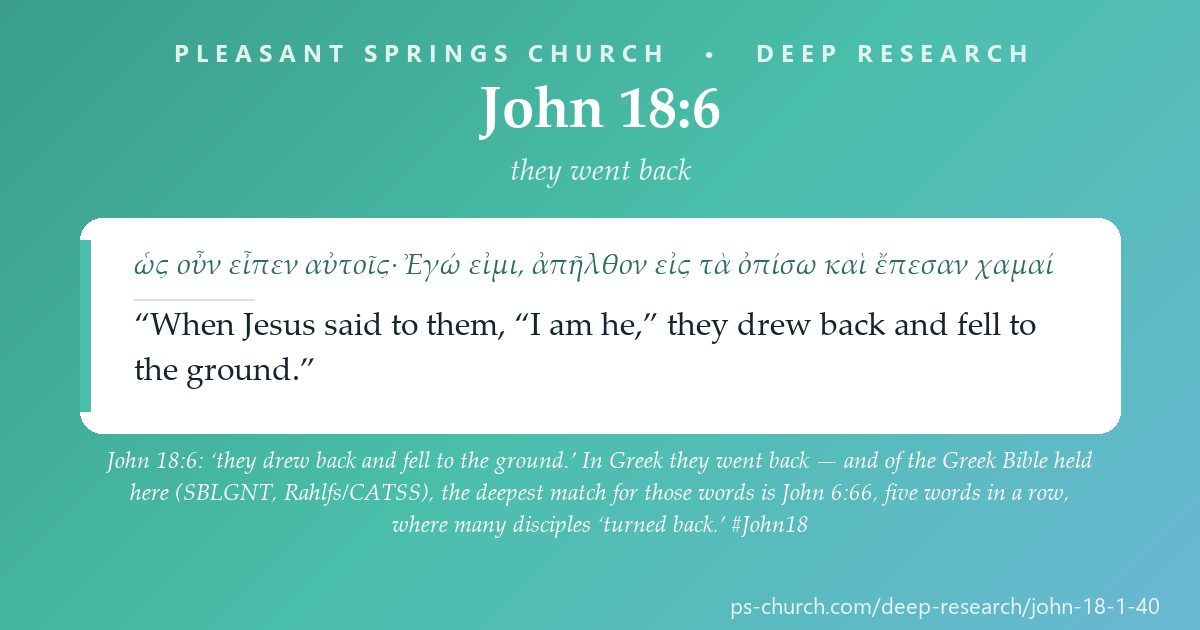
When Jesus said Ἐγώ εἰμι in the garden, the men who had come for him “drew back and fell to the ground”. The Greek for drew back is four words, ἀπῆλθον εἰς τὰ ὀπίσω, and the psalms of enemies turned back have three of them (Psalms 34:4 and 69:3 in the Greek). But when John 18:6 is screened against every verse of the Greek New Testament and all 30,637 Greek Old Testament units held here, its deepest verbatim partner is neither psalm: they reach four words in a tie band of seven that also holds Lot’s wife looking back (Genesis 19:26). The deepest partner is John 6:66, five words, tie band one: ἀπῆλθον εἰς τὰ ὀπίσω, where after the bread of life many of his disciples “turned back”. The ESV renders the same Greek two ways, and Peter is in both scenes. This page prints that measurement beside its counter-examples: the Kidron of David’s flight measures one word against 18:1, while an accident, the brook Besor, measures four; the cup of the prophets measures two; and the two word forms ἔπεσαν χαμαί stand together nowhere else in the Greek Bible held here — the nearest is Job falling to the ground to worship. See the method →
John 18:1–40
Greek NT · ESV or our renderingThe Shape of the Passage
A sequence of eight scenes, two of them repeated in alternation — NOT a chiasmForty verses: an arrest, two hearings, three denials and a trial that is still going on when the chapter ends. The Greek is measured against the rest of the New Testament, the Greek Old Testament and Josephus; the authorship is reported, not tested.
Author
Tradition names John, the disciple of the Lord, and the shelf’s John 3–4 study prints Irenaeus on it. This page cannot test authorship from the text and does not try.
What the text shows is a writer who knows names and places the other Gospels do not give. Only here is the servant named, Μάλχος; only here is the place a κῆπος across the Kidron; only here is a relative of Malchus in the courtyard (18:26); and only here is the other disciple γνωστὸς τῷ ἀρχιερεῖ. The writer also points back into his own book three times in this chapter — to 11:50 (18:14), and twice to words Jesus had said (18:9, 18:32). The page reports where the words stand, and says nothing about who wrote first.
Audience
Readers who need the customs explained: why the accusers would not go in (18:28), what the custom at Passover was (18:39), and why the high priest’s counsel mattered (18:14). The book says why it was written: that they may believe and have life in his name (20:31).
Readers who had read John 6. The deepest verbatim partner of 18:6 is a scene the chapter does not name, where many disciples ἀπῆλθον εἰς τὰ ὀπίσω and Peter stayed (6:66–68). The people in this chapter — Judas, Peter, Annas, Caiaphas, the attendants, Pilate — are read here as persons, not as types of a people.
Orient on the arrest, the hearings and the trial, and settle the numbering.
Search by topic: Kidron; Gethsemane and the garden; Annas; Caiaphas; high priest; Peter; praetorium; Pontius Pilate; Passover; ritual purity; Roman capital jurisdiction; kingdom of God; truth; Barabbas; the Jews in John.
Which articles are relevant?
- Anchor Bible Dictionary — “Kidron,” “Annas,” “Caiaphas,” “Pilate, Pontius,” “Barabbas,” “Praetorium,” “Sanhedrin.”
- Dictionary of Jesus and the Gospels (IVP) — “Trial of Jesus,” “Peter,” “Passover,” “Kingdom of God,” “Jews, Judaism.”
- NIDNTTE / TDNT — βασιλεία, ἀλήθεια, μιαίνω, λῃστής, ποτήριον.
- These were not consulted for any measurement below. Every number on this page came from the text files named in the footer.
Settle the numbering first
Versification. John 18 has no offset: the SBLGNT, the ESV and the King James Version all count 40 verses, verse for verse. There is no Septuagint column, because John is a New Testament book. The offsets are in the Old Testament texts measured. Greek Psalm 26:2 = Hebrew and ESV 27:2; Greek 34:4 = Hebrew and ESV 35:4; Greek 69:3 = Hebrew 70:3 = ESV 70:2; Greek 9:4 = Hebrew 9:4 = ESV 9:3; Greek 55:10 = Hebrew 56:10 = ESV 56:9; Greek 74:9 = Hebrew 75:9 = ESV 75:8. Greek Jeremiah 32:15 = Hebrew and ESV 25:15 (the cup), because the Greek Jeremiah orders its chapters differently; Greek Jeremiah 25:15 is the Hebrew and ESV 49:35, the bow of Elam. 1 and 2 Samuel = Greek 1 and 2 Kingdoms; 2 Kings = Greek 4 Kingdoms (1:9–14 alike). Greek and Hebrew Joel 4:2 = ESV 3:2. Genesis 19:26 and 49:17, Numbers 9:6, Job 1:20, Isaiah 28:13, 51:17 and 51:22, and Daniel 2:46 (the Old Greek) carry the same numbers in all three. Josephus is cited by Niese’s sections of the Antiquities; Augustine by tractate and paragraph. Sirach and 4 Maccabees are Greek only and are witnesses, not Scripture.
A cohort and a tribune, a high-priestly family, a feast that defiles, and a governor’s sword.
Annas and Caiaphas — what Josephus has, and what he does not
Josephus names Caiaphas twice in the Antiquities held here. Gratus appoints Ἰώσηπος ὁ καὶ Καϊάφας (18.35), Joseph, who was also called Caiaphas (our rendering); Vitellius later removes τὸν ἀρχιερέα Ἰώσηπον τὸν Καϊάφαν ἐπικαλούμενον ἀπαλλάξας τῆς ἱερωσύνης (18.95), the high priest Joseph, surnamed Caiaphas, relieving him of the priesthood (our rendering). Of the elder Ananus — John’s Ἅννας, by the usual identification (reported) — Josephus says πέντε γὰρ ἔσχε παῖδας καὶ τούτους πάντας συνέβη ἀρχιερατεῦσαι τῷ θεῷ (20.198), for he had five sons, and it fell to every one of them to serve God as high priest (our rendering).
What the sections held here do not say: in neither of the two sections that name Caiaphas does Josephus call him Annas’s son-in-law. In the Greek New Testament the noun πενθερός stands only here (18:13). Why John calls Caiaphas high priest τοῦ ἐνιαυτοῦ ἐκείνου (11:49, 11:51, 18:13) when Josephus has him in office for years is discussed in the commentaries (reported); this page does not settle it.
“It is not lawful for us” — 18:31 and a sentence in Josephus
At 18:31 the accusers tell Pilate “It is not lawful for us to put anyone to death” — Ἡμῖν οὐκ ἔξεστιν ἀποκτεῖναι οὐδένα. Whether the Jewish council of the time could carry out a death sentence under Roman rule is a standing historical debate (reported): A. N. Sherwin-White is reported to have argued that capital jurisdiction lay with the governor; others point to cases where it seems to have been exercised (reported). The rabbinic tradition that capital cases were taken from Israel forty years before the temple fell is reported from the Jerusalem Talmud; no rabbinic text is held on this disk, so it is not checked here.
What is held is Josephus on the stoning of James. Between two governors (in 62, by the usual reckoning; reported), the younger Ananus convened a council and παρέδωκε λευσθησομένους (20.200), handed them over to be stoned (our rendering). Some of the city’s people then went to meet the new governor and told him ὡς οὐκ ἐξὸν ἦν Ἀνάνῳ χωρὶς τῆς ἐκείνου γνώμης καθίσαι συνέδριον (20.202), that Ananus had had no right to convene a sanhedrin without his consent (our rendering). The word there, ἐξὸν, is a form of the same verb as John’s οὐκ ἔξεστιν. The page reports the sentence; it does not decide what it proves about the year of the crucifixion, and the two cases are about thirty years apart (reported).
What John does with the sentence is measurable. The next verse reads ἵνα ὁ λόγος τοῦ Ἰησοῦ πληρωθῇ, and it closes with σημαίνων ποίῳ θανάτῳ ἤμελλεν ἀποθνῄσκειν — five words shared with 12:33, where the word in view is And I — if I am lifted high from the earth — will pull everyone to myself (our rendering) (12:32). The narrator ties the accusers’ sentence about the law to a death by lifting up. The verb for killing, ἀποκτείνω, stands 12 times in John, from 5:18 to 18:31; this is the last.
“So that they would not be defiled” — Passover, and an impurity that is not a sin
Then they led Jesus from the house of Caiaphas to the governor’s headquarters. It was early morning. They themselves did not enter the governor’s headquarters, so that they would not be defiled, but could eat the Passover.
The Greek is ἵνα μὴ μιανθῶσιν ἀλλὰ φάγωσιν τὸ πάσχα. The verb μιαίνω stands in 4 New Testament verses (John 18:28, Titus 1:15, Hebrews 12:15, Jude 8); here alone the setting is ritual purity. The Law already knew men who could not keep the feast: ἀκάθαρτοι ἐπὶ ψυχῇ ἀνθρώπου καὶ οὐκ ἠδύναντο ποιῆσαι τὸ πασχα, men who were unclean through a human corpse and were unable to hold the Passover that day (our rendering) (Numbers 9:6), and it gave them a second date (9:10–11). Why entering a Gentile’s house would defile is reported from later rabbinic texts (reported; not held).
Ritual impurity is not sin. The men of Numbers 9 had done nothing wrong; they had come into contact with the dead. Uncleanness in the Law concerns fitness for the sanctuary and the feast. John does not call the accusers sinful for keeping it. Readers often point to the irony (reported) that they guard the feast while handing a man over to death.
The eating of the Passover is measured, not adjudicated: the New Testament verses with τὸ πάσχα and a verb of eating are Matthew 26:17, Mark 14:12, Mark 14:14, Luke 22:8, Luke 22:11, Luke 22:15 and John 18:28. In the first three Gospels the Passover is eaten with the disciples before the arrest; in John it is still to be eaten on the morning of the trial. How the two accounts relate is a long discussion (reported); the page does not settle it.
The cohort and the tribune
σπεῖρα is a Roman cohort; in the Gospels it stands only at John 18:3, 18:12, Mark 15:16 and Matthew 27:27, and the last two are soldiers in the governor’s headquarters. χιλίαρχος, a tribune, stands 21 times in the New Testament: once in Mark (6:21, Herod’s banquet), once here, and the rest in Acts and Revelation. Whether John means a full cohort or a detachment, and why Roman soldiers came with the temple attendants, are reported questions; the text says only that both came.
A cold night and a charcoal fire
Now the servants and officers had made a charcoal fire, because it was cold, and they were standing and warming themselves. Peter also was with them, standing and warming himself.
ψῦχος, cold, stands 3 times in the New Testament: here, Acts 28:2 (the shipwrecked at Malta, a fire lit because of the cold) and 2 Corinthians 11:27. The verb of warming, θερμαίνομαι, stands in 5 verses: Mark 14:54 and 14:67 (Peter), John 18:18 twice and 18:25 (Peter), and James 2:16. Of its 6 tokens, five are in the Gospels, and four of the five are Peter; the fifth is the servants and attendants beside him, καὶ ἐθερμαίνοντο (18:18). The fire itself is ἀνθρακιὰν πεποιηκότες, and the word returns only at 21:9, ἀνθρακιὰν κειμένην: “they saw a charcoal fire in place” (see The Charcoal Fire).
The vocabulary, counted on MorphGNT’s lemma column; and five places where readers divide.
Each figure is an exhaustive count over the 7,927 verses of the SBLGNT or the Greek Old Testament held here. Where a word is counted the count is on MorphGNT’s lemma column; where a phrase is counted it is on the normalised word form, contiguous and in order, with no ^-anchored search, articles and augments allowed for. Nothing is sampled.
“They went back.” The three words eis ta opisō stand in six New Testament verses and 30 Greek Old Testament units. With a form of ἀπέρχομαι (“go away”) in front of them they stand twice in the Greek New Testament — John 6:66 and 18:6 — and nowhere in the Greek Old Testament held here.
“Fell to the ground.” χαμαί stands twice in the New Testament, both in John (9:6, the spittle on the ground; 18:6). In the Greek Old Testament held here it stands in eight units, and only two of them have a verb of falling with it: Job 1:20 and Daniel 2:46, both of a man falling down to worship.
“I am.” Twenty-four verses of John have the two words side by side in that order; the last three are 18:5, 6 and 8. In ten of them nothing comes after the two words before the punctuation — and one of those ten is the healed blind man’s Ἐγώ εἰμι (9:9), it is me (our rendering).
“I am not.” As the closing words of a reply, followed by a full stop, the pair stands four times in the Greek New Testament: Luke 22:58 (Peter), John 1:21 (the Baptist), and John 18:17 and 18:25 (Peter).
A garden. Five tokens in the New Testament: Luke 13:19 (the mustard seed), and four in John — this garden (18:1, 18:26) and the garden of the tomb (19:41, twice). The gardener of 20:15 is a different word, κηπουρός.
A charcoal fire. Twice in the New Testament, 18:18 and 21:9. Distinguish it from ἄνθραξ, a live coal (Romans 12:20), one stem and another word.
To defile. Four New Testament verses, 5 tokens (Titus 1:15 has two).
Kingdom, kingship. 162 tokens in the New Testament; in John only five, in three verses: 3:3, 3:5, and three times in 18:36. Distinguish βασιλεύς, king, which John has 16 times.
Truth. 25 tokens in John, in 20 verses; the last is 18:38. The adjectives and adverb of the stem are counted separately: ἀληθινός 9, ἀληθής 14, ἀληθῶς 7.
Bandit. 15 New Testament verses; in John three: the thief and bandit who does not come in by the door (10:1), those who came before (10:8), and Barabbas.
18:9 — “I have lost not one”, and Peter
This was to fulfill the word that he had spoken: “Of those whom you gave me I have lost not one.”
The word fulfilled is not quoted word for word from any of the three sayings of John measured for it. Against 17:12 the verse measures 2 words, δέδωκάς μοι; against 6:39 and 10:28, 1 each. 17:12 reads “not one of them has been lost except the son of destruction”; 6:39 has ἵνα πᾶν ὃ δέδωκέν μοι μὴ ἀπολέσω ἐξ αὐτοῦ, that out of all he has handed me I lose nothing (our rendering).
Readers divide on what 18:9 applies the word to.
- Their bodies, that night. The narrator applies the saying to the disciples being let go in the garden (18:8) — a present, physical keeping (reported in many commentaries).
- Their faith, because they did not yet believe as they would. Augustine: But were they not afterwards to die? How then, if they died now, should He lose them, were it not that as yet they did not believe in Him, as all believe who perish not? (Tractates on John 112.4).
- A physical keeping that is also a sign of the keeping promised in 6:39 and 10:28 (reported).
The page does not choose among them. And it does not set Peter against Judas. 17:12 names the son of destruction; John 18 names Judas three times (18:2, 3, 5) without comment beyond ὁ παραδιδοὺς αὐτὸν. Peter, kept from arrest in the garden, says Οὐκ εἰμί twice that night, and chapter 21 is where John shows what becomes of him (John 21). The church’s confession speaks to this in its own words, Article 10, Hope: “all who genuinely receive Christ are held secure” … “Scripture’s warnings are themselves a real means by which He holds us fast”. It also says: “No story is finished.” The page quotes those sentences as the church wrote them and puts no gloss on them.
18:14 — “one man should die for the people”
It was Caiaphas who had advised the Jews that it would be expedient that one man should die for the people. — pointing to Nor do you understand that it is better for you that one man should die for the people, not that the whole nation should perish. (11:50). The narrator’s comment at 11:51–52 reads Caiaphas’s counsel as prophecy: ἔμελλεν Ἰησοῦς ἀποθνῄσκειν ὑπὲρ τοῦ ἔθνους, Jesus was going to die on behalf of the nation (our rendering), καὶ οὐχ ὑπὲρ τοῦ ἔθνους μόνον, ἀλλ’ ἵνα καὶ τὰ τέκνα τοῦ θεοῦ τὰ διεσκορπισμένα συναγάγῃ εἰς ἕν, and not on behalf of the nation alone, but also to bring God’s scattered children together into one (our rendering).
Readers divide on how wide the “for” reaches. Some read it as a provision for all people, offered to all, received by faith; some as a death effective for a definite people, God’s children, whom it gathers (both reported). Pleasant Springs teaches an unlimited provision: Christ died for all, and the gift is received by faith. /beliefs itself has no article on the extent of the atonement, and this page does not attribute one to it. What the text measures is narrower: ὑπὲρ τοῦ λαοῦ stands in the New Testament only at 11:50 and 18:14, and 11:52 widens the “for” past the nation in so many words.
18:36 — a kingship “not from” this world
The Greek preposition is ἐκ, out of, from; and the verse ends οὐκ ἔστιν ἐντεῦθεν, it does not come from here (our rendering). The phrase ἐκ τοῦ κόσμου τούτου stands in the New Testament at John 8:23, 13:1 and twice here; against 8:23 the verse measures 4 words, and against 17:14 and 17:16, where the disciples too are ἐκ τοῦ κόσμου οὐκ εἰσὶν, not out of the world (our rendering), it measures 3. Revelation 11:15 says Ἐγένετο ἡ βασιλεία τοῦ κόσμου τοῦ κυρίου ἡμῶν καὶ τοῦ χριστοῦ αὐτοῦ, the kingship over the world has come to belong to our Lord and to his Christ (our rendering).
Readers divide.
- Spiritual only. The kingdom is inward or heavenly and has no earthly future of its own (reported in several readings, existential and idealist among them).
- Present and future. The kingship’s source is not this world; it is present now in the king, and its fullness is still to come on the earth (reported; G. E. Ladd is commonly cited).
- Source, not sphere. The verse says where the kingship comes from and how it does not advance — those who serve me would be in the fight (our rendering) — and leaves its future to other texts (reported).
- A rule of conduct. The servants not fighting is read as a standing word against advancing the kingdom by force (reported).
Pleasant Springs holds historic premillennialism: the kingship is present now and will be fulfilled on the earth at his return; the dispensational scheme of Darby and Scofield is not the church’s. That is the church’s teaching position, not a /beliefs article — /beliefs has no eschatology article — and the verse alone does not decide between the readings above. Nor does this page derive a doctrine of church and state from it: the church has ratified no position on that question.
18:38 — the question, and the last word for truth in John
Pilate’s question is three words, Τί ἐστιν ἀλήθεια. The New Testament has the question once, here; no Greek Old Testament unit held here has it, with the article or without. It is the last of John’s 25 tokens of ἀλήθεια, one verse after ἵνα μαρτυρήσω τῇ ἀληθείᾳ and πᾶς ὁ ὢν ἐκ τῆς ἀληθείας ἀκούει μου τῆς φωνῆς. ἐκ τῆς ἀληθείας stands three times in the New Testament: here, 1 John 2:21 and 3:19. A form of the verb of witness with τῇ ἀληθείᾳ stands at John 5:33 (the Baptist), here, and 3 John 3. The question is asked of the speaker of 14:6, ἡ ἀλήθεια, the truth (our rendering); against 14:6 the verse measures three words, λέγει αὐτῷ ὁ, a speech formula and nothing more.
“The Jews” in John 18 — a word that needs care
Ἰουδαῖος stands 71 times in John, in 67 verses; nine of those verses are in this chapter. In John 18 it names the attendants of the authorities (18:12), those Caiaphas advised (18:14), the people who gather in the temple (18:20), the accusers before Pilate (18:31, 38), those to whom he would be handed over (18:36), the nation Pilate says he does not belong to (18:35), and the title “King of the Jews” (18:33, 39). Pilate’s Μήτι ἐγὼ Ἰουδαῖός εἰμι and τὸ ἔθνος τὸ σὸν count Jesus himself with the nation, and in 4:9 he is called σὺ Ἰουδαῖος ὢν, you, a Jew (our rendering).
Scholars discuss whether the word in John often means the Judean authorities rather than a people, whether “Judeans” is a better English rendering in places, and how the word reflects the setting in which the Gospel was written (all reported). The page does not resolve that. It does refuse one use of the chapter: the people of this scene are particular persons — a high priest, his father-in-law, attendants, accusers, a Roman governor — and nothing in the text makes the Jewish people the guilty party of the passion. Jesus, his mother, Peter and the disciples were Jews.
The run screens, with the tie band beside each one; then the garden, the brook, the formulas and the cup.
Method: every verse of John 18 (MorphGNT normalised forms) screened for the longest contiguous run of identical word forms against a whole corpus: the 7,061 verses of the Greek New Testament outside John; the 826 verses of John outside chapter 18; and the 30,348 Greek Old Testament units screened (the 64 CATSS files less the Odes; 30,637 are held), with the shelf’s cross-edition comparator. The tie band is the number of target verses that reach the same depth. With unigram fallback on, a 1 means one shared word and a 0 means no shared word form at all. Exhaustive and deterministic; it finds verbatim contact, not allusion.
1. The screens
| screen | rows reaching | deepest rows (run, band, a partner) |
|---|---|---|
| against the NT outside John | 6: 2 · 5: 1 · 4: 11 · 3: 22 · 2: 4 | 18:33 (run 6, tie band 4; Matthew 27:11, Mark 15:2, Luke 23:3, 23:37); 18:39 (run 6, tie band 1; Mark 15:9); 18:15 (run 5, tie band 2; Matthew 26:3, Mark 14:54) |
| against the rest of John | 7: 1 · 6: 1 · 5: 3 · 4: 13 · 3: 17 · 2: 5 | 18:31 (run 7, tie band 1; 19:6); 18:33 (run 6, tie band 1; 3:10); 18:6, 18:32 and 18:25 (each run 5, band 1; 6:66, 12:33, 7:52) |
| against the Greek OT (30,348 units) | 4: 7 · 3: 26 · 2: 7 | seven rows at four, six of them with a band of one or two and all coincidental; 18:6 at four with a band of seven (below). No row reaches five; every row reaches two. Letting the Odes back in deepens no row. |
Read the bands. The two deepest New Testament rows are tied at six, and they are not alike: 18:33 has a band of four because the question Σὺ εἶ ὁ βασιλεὺς τῶν Ἰουδαίων stands in every Gospel; 18:39 has a band of one, Mark 15:9. The deepest row against the Greek Old Testament, 18:1 with the brook Besor (run 4, tie band 1), is an accident.
2. They went back — 18:6 against everything held
When Jesus said to them, “I am he,” they drew back and fell to the ground.
| partner | run | the shared words / what it is |
|---|---|---|
| John 6:66 | 5 | ἀπῆλθον εἰς τὰ ὀπίσω καὶ — band one against all John, and the deepest partner of 18:6 in the whole Greek New Testament. After this many of his disciples turned back and no longer walked with him. |
| Psalm 34:4 (ESV 35:4) | 4 | ἀποστραφήτωσαν εἰς τὰ ὀπίσω — “Let them be turned back”; inside a band of seven |
| Psalm 69:3 (ESV 70:2) | 4 | ἀποστραφείησαν εἰς τὰ ὀπίσω — “Let them be turned back”; same band |
| Isaiah 28:13 | 4 | πέσωσιν εἰς τὰ ὀπίσω — “fall backward”; same band ⚠️ MT/LXX: the Hebrew has וְכָשְׁלוּ אָחוֹר, stumble backward, where the Greek has fall; and the first half of the verse differs wholly (the Hebrew’s precept upon precept is, in the Greek, affliction upon affliction, hope upon hope). |
| Genesis 19:26 | 4 | ἐπέβλεψεν ἡ γυνὴ αὐτοῦ εἰς τὰ ὀπίσω, his wife looked back behind her (our rendering) — Lot’s wife; same band, and a counter-example |
| Psalm 9:4 (ESV 9:3) | 3 | ἐν τῷ ἀποστραφῆναι τὸν ἐχθρόν μου εἰς τὰ ὀπίσω — “When my enemies turn back, they stumble” ⚠️ MT/LXX: the Hebrew has יִכָּשְׁלוּ, stumble; the Greek has ἀσθενήσουσιν, grow weak. |
| Psalm 55:10 (ESV 56:9) | 3 | ἐπιστρέψουσιν οἱ ἐχθροί μου εἰς τὰ ὀπίσω — “my enemies will turn back” |
| Genesis 49:17 | 3 | πεσεῖται ὁ ἱππεὺς εἰς τὰ ὀπίσω — “his rider falls backward” |
| Psalm 26:2 (ESV 27:2) | 2 | αὐτοὶ ἠσθένησαν καὶ ἔπεσαν — “it is they who stumble and fall” ⚠️ MT/LXX: the Hebrew has כָשְׁלוּ וְנָפָלוּ, stumble and fall; the Greek has grew weak and fell. Neither has backward. |
| 2 Kings 1:12 (4 Kingdoms) | 2 | εἰ ἄνθρωπος τοῦ θεοῦ ἐγώ εἰμι — “If I am a man of God”; the shared words are Ἐγώ εἰμι ⚠️ MT/LXX: the Hebrew is אָנִי, I, with no verb, in both 1:10 and 1:12; the Greek has εἰ ἄνθρωπος τοῦ θεοῦ ἐγώ at 1:10 and has εἰμι only at 1:12. |
| 2 Kings 1:9–14, the other five verses | 1 each | the captains sent with fifty men are burned twice; the third ἔκαμψεν ἐπὶ τὰ γόνατα αὐτοῦ, bent down on his knees (our rendering) (1:13). No verse of the six has a verb of falling or the word for backward. |
| Job 1:20 | 1 | πεσὼν χαμαὶ προσεκύνησεν — “fell on the ground and worshiped” |
What the table shows. 18:6 has two halves, and each half has a different measured neighbourhood. The going back: ἀπῆλθον εἰς τὰ ὀπίσω stands with that verb in front twice in the whole Greek Bible held here, at John 6:66 and 18:6; the three words εἰς τὰ ὀπίσω alone stand in 30 Greek Old Testament units, and the band of seven at four words holds the psalms of enemies turned back (Psalms 34:4, 39:15, 69:3; Greek 39:15 = ESV 40:14) beside Lot’s wife, Jonathan’s bow (2 Kingdoms 1:22) and Isaiah 28:13 and 44:25. The falling: no other New Testament verse has a verb of falling, simple or compound, with εἰς τὰ ὀπίσω or a word for backward; in the Greek Old Testament three units do — Genesis 49:17, the rider; ἔπεσεν ἀπὸ τοῦ δίφρου ὀπισθίως (1 Kingdoms 4:18), he fell from the seat backward (our rendering), Eli; and Isaiah 28:13. And ἔπεσαν χαμαί, in those two forms, stands together nowhere else in either Testament as held here; the only other falling verb set directly before χαμαί is Job 1:20, πεσὼν χαμαὶ, and the two units of the Greek Old Testament with a falling verb and the word anywhere in them are Job 1:20 and πεσὼν ἐπὶ πρόσωπον χαμαὶ προσεκύνησε (Daniel 2:46), falling on his face to the ground, he did obeisance (our rendering), both of worship.
Readers divide on what the falling means, and the measurements do not decide it: the enemies of the psalmist turned back and falling (reported in many commentaries); men falling before a theophany, at the divine name (reported; R. E. Brown is commonly cited); or a mark of Jesus’ freedom — he is not taken until he allows it, and he bargains for his disciples (18:8). Augustine joined the second and the third: His own single voice uttering the words, “I am [He],” without any weapon, smote, repelled, prostrated that great crowd, with all the ferocity of their hatred and terror of their arms. … What will He do when He cometh as judge, who did this when giving Himself up to be judged? (Tractates on John 112.3). The same paragraph then turns the scene against the Jews of his own day; this page does not follow him there.
The counter-example this page owes you. The two words Ἐγώ εἰμι are also ordinary Greek. Of the ten verses of John in which Ἐγώ εἰμι is followed by punctuation, one is the healed blind man answering his neighbours (9:9). Mark 14:62 has the same two words before the high priest, and against 18:6 it measures 2.
3. The brook Kidron — and a brook that measures deeper
When Jesus had spoken these words, he went out with his disciples across the brook Kidron, where there was a garden, which he and his disciples entered.
David, fleeing Absalom, crosses the same brook: And all the land wept aloud as all the people passed by, and the king crossed the brook Kidron, and all the people passed on toward the wilderness. Eight verses later he is told “Ahithophel is among the conspirators with Absalom”. The scene of a king crossing the Kidron, betrayed by his own counsellor, is a parallel many readers draw (reported).
| John 18:1 against | run | the shared words |
|---|---|---|
| 2 Samuel 15:23 (2 Kingdoms) | 1 | ὁ βασιλεὺς διέβη τὸν χειμάρρουν Κεδρων — the shared form is only the name ⚠️ MT/LXX: the Greek names the brook twice, ἐν τῷ χειμάρρῳ Κεδρων for the people and again for the king; the Hebrew names it once, בְּנַחַל קִדְרוֹן. |
| 1 Samuel 30:10 (1 Kingdoms) | 4 | πέραν τοῦ χειμάρρου τοῦ Βοσορ — “the brook Besor”: the deepest Greek Old Testament partner of 18:1, band one, and an accident ⚠️ MT/LXX: the Hebrew says the two hundred were too exhausted מֵעֲבֹר אֶת־נַחַל, to cross the brook; the Greek says they sat beyond it. |
The phrase “the brook of Kidron”, χείμαρρος with Κεδρών (the article between them optional), stands in eight Greek Old Testament units: 2 Kingdoms 15:23, 3 Kingdoms 2:37 (Shimei) and 15:13, 4 Kingdoms 23:6 and 23:12, and 2 Chronicles 15:16, 29:16 and 30:14 (Greek Jeremiah 38:40, Hebrew and ESV 31:40, has the brook too, but transliterates the Hebrew word for it, and is not counted) — and in six of them idols, altars or uncleanness are burned or thrown there. The famous parallel measures one word; the accident measures four. The page prints both, and treats neither number as a reading of 18:1.
4. Two fulfilment formulas that point to Jesus’ own words
John’s fulfilment clauses with this verb, counted (19:28 uses another verb and is not counted; a form of πληρωθῇ with ὁ λόγος or with the word for Scripture in the same verse):
| what is fulfilled | verses |
|---|---|
| the Scripture | 13:18, 17:12, 19:24, 19:36 |
| the word of Isaiah / in their law | 12:38, 15:25 |
| the word Jesus spoke | 18:9, 18:32 |
The two clauses in this chapter use the formula of the Scripture citations for a saying of Jesus. Neither quotes its saying exactly: 18:9 measures 2 against 17:12; 18:32 measures 0 against 12:32 (no shared word form at all) and 5 against 12:33, the narrator’s own gloss, τοῦτο δὲ ἔλεγεν σημαίνων ποίῳ θανάτῳ ἤμελλεν ἀποθνῄσκειν, this he was saying as a sign of what death he would die (our rendering). The formula σημαίνων ποίῳ θανάτῳ stands three times in the New Testament, all in John: 12:33, 18:32 and 21:19, the last of Peter (see John 21).
5. The cup
The Greek of 18:11 ends τὸ ποτήριον ὃ δέδωκέν μοι ὁ πατὴρ; ποτήριον stands once in John. The prophets’ cup of wrath is the background most readers name (reported):
| 18:11 against | run | the text |
|---|---|---|
| Psalm 74:9 (ESV 75:8) | 1 | ποτήριον ἐν χειρὶ κυρίου — For in the hand of the Lord there is a cup with foaming wine, well mixed, and he pours out from it, and all the wicked of the earth shall drain it down to the dregs. ⚠️ MT/LXX: the Hebrew has חָמַר, foaming wine, and the wicked drain the dregs; the Greek has οἴνου ἀκράτου πλῆρες κεράσματος, unmixed wine, and says its dregs were not emptied, ἐξεκενώθη. |
| Isaiah 51:17 | 2 | τὸ ποτήριον τοῦ θυμοῦ — “the cup of his wrath” ⚠️ MT/LXX: the Hebrew’s כּוֹס הַתַּרְעֵלָה, the cup of staggering, is in the Greek τὸ ποτήριον γὰρ τῆς πτώσεως, the cup of falling. |
| Isaiah 51:22 | 2 | εἴληφα ἐκ τῆς χειρός σου τὸ ποτήριον τῆς πτώσεως, out of your hand I have lifted the cup of falling (our rendering) |
| Jeremiah 32:15 (ESV 25:15) | 2 | λαβὲ τὸ ποτήριον τοῦ οἴνου τοῦ ἀκράτου τούτου — “Take from my hand this cup of the wine of wrath” ⚠️ MT/LXX: the Hebrew has הַיַּיִן הַחֵמָה, the wine of wrath; the Greek has unmixed wine. |
| Jeremiah 25:15 in the Greek | 1 | συντριβήτω τὸ τόξον Αιλαμ, let the bow of Elam be broken (our rendering) — a different verse (Hebrew and ESV 49:35), printed so the numbering is not confused |
| Matthew 20:22 / Mark 10:38 | 3 | πιεῖν τὸ ποτήριον ὃ ἐγὼ μέλλω πίνειν, drain the cup I am soon to drink (our rendering) — the shared words are τὸ ποτήριον ὃ |
| Mark 14:36 / Matthew 26:39 / Luke 22:42 | 2 each | παρένεγκε τὸ ποτήριον τοῦτο ἀπ’ ἐμοῦ, carry this cup past me (our rendering) — the Gethsemane prayer |
Against the prophets’ cup the verse measures two words at most, the noun and its article. Against the Gethsemane prayer in the other Gospels it measures two. Its deepest contact on the cup is the saying to James and John (three). And its deepest Greek Old Testament partner of all is Jeremiah 15:3, τὴν μάχαιραν εἰς (run 3, tie band 1) — the sword, not the cup, and an accident. Matthew’s sword-saying, Ἀπόστρεψον τὴν μάχαιράν σου εἰς τὸν τόπον αὐτῆς, return your sword to its place (our rendering), measures two against 18:11. There is no Isaiah 51 or Jeremiah 25 study on the shelf yet.
6. One man for the people — 18:14 and 11:50
| comparison | run | the words |
|---|---|---|
| 18:14 / 11:50 | 3 | ὑπὲρ τοῦ λαοῦ — and the rest said differently: 11:50 has ἵνα εἷς ἄνθρωπος ἀποθάνῃ, 18:14 ἕνα ἄνθρωπον ἀποθανεῖν |
| 18:14 / 11:51 | 2 | ὑπὲρ τοῦ — 11:51 says nation |
| 18:13 / 11:49 | 3 | τοῦ ἐνιαυτοῦ ἐκείνου |
| 18:14 / 2 Samuel 10:12 | 3 | ὑπὲρ τοῦ λαοῦ ἡμῶν, for the sake of our people (our rendering) — Joab; the deepest Greek Old Testament partner, tied with two others |
The page’s point is the shape, not the depth: the narrator repeats Caiaphas’s counsel in new grammar, holds on to συμφέρει (a verb John has only at 11:50, 16:7 and 18:14), and retains the three words ὑπὲρ τοῦ λαοῦ, which stand in the New Testament only in these two verses.
7. Barabbas
They cried out again, “Not this man, but Barabbas!” Now Barabbas was a robber.
John says one thing about him: ἦν δὲ ὁ Βαραββᾶς λῃστής. Mark says μετὰ τῶν στασιαστῶν δεδεμένος, in chains with the rebels (our rendering); Luke διὰ στάσιν τινὰ γενομένην ἐν τῇ πόλει καὶ φόνον, over a riot in the city, and a killing (our rendering). In Josephus’ Antiquities the word family of λῃστής stands in 56 of the 7,396 sections held here; that it often means armed insurgents is reported, not measured. In John the word links Barabbas to 10:1 and 10:8 by vocabulary only: the verse measures 1 against each.
Jesus Barabbas. The SBLGNT prints Ἰησοῦν Βαραββᾶν at Matthew 27:16 and Ἰησοῦν τὸν Βαραββᾶν at 27:17. The SBLGNT apparatus for Matthew, held here, gives at 27:16 Ἰησοῦν NA28 ] – WH Treg NIV RP — NA28 has the name; Westcott–Hort, Tregelles, the NIV’s Greek and Robinson–Pierpont do not — as the Matthew 27 study reports. John 18:40 has no Jesus before the name in the SBLGNT; whether any witness of John has one is not checked here (no John apparatus is held).
8. Peter at the fire, and the frame
| pair | run | the words |
|---|---|---|
| 18:17 / 18:25 | 6 | Μὴ καὶ σὺ ἐκ τῶν μαθητῶν |
| 18:2 / 18:5 | 6 | δὲ καὶ Ἰούδας ὁ παραδιδοὺς αὐτὸν |
| 18:18 / 18:25 | 3 | ἑστὼς καὶ θερμαινόμενος |
| 18:18 / 21:9 | 1 | one word, καὶ; the link is the noun ἀνθρακιά, not a phrase |
The two deepest pairs inside the chapter are tied at six. One frames the high priest’s questioning with the same question to Peter; the other names Judas twice. The noun for the charcoal fire is counted: two New Testament tokens, 18:18 and 21:9. Searching the Greek Old Testament held here for any word beginning with the letters of ἀνθρακιὰν up to its ending returns five units, the figure the John 21 study prints (4 Maccabees 9:20, Esther 1:7, Sirach 11:32 and Tobit 13:17 in both texts); but only two of them have the noun itself — ὁ σωρὸς τῆς ἀνθρακιᾶς (4 Maccabees 9:20), the heap of the coal-fire (our rendering), and Sirach 11:32. Esther 1:7 has an adjective, ἀνθράκινον, of carbuncle; Tobit 13:17 has ἄνθρακι, a carbuncle stone. One stem, three words.
9. What the measurements add up to
Screened against everything held, the deepest partner of 18:6 is in John 6. After the bread of life, many disciples ἀπῆλθον εἰς τὰ ὀπίσω and Jesus asked the Twelve whether they too wished to go; Peter answered Κύριε, πρὸς τίνα ἀπελευσόμεθα, Lord, who is there for us to go away to? (our rendering). In the garden the same four words describe the men who came to take him.
The measurement does not say why. It does not say the writer meant it, and the ESV, rendering the words turned back in one verse and drew back in the other, makes it hard for an English reader to see it. What it says is that the two verses share five words in a row that no other verse of the Greek Bible held here contains, and that Peter stands in both scenes: in chapter 6 he stays, and in chapter 18 he goes after him into the courtyard and says Οὐκ εἰμί.
The scholarship, and an honest account of where this page is thin.
This is the section that makes the shelf trustworthy. It names what was not consulted, what could not be checked, and which claims above would fall first.
Commentaries & studies (none of which produced any number above):
- Raymond E. Brown, The Gospel According to John (Anchor) and The Death of the Messiah; D. A. Carson (Pillar); Craig S. Keener; J. Ramsey Michaels (NICNT); C. K. Barrett; Rudolf Bultmann; Andreas J. Köstenberger (BECNT); Andrew T. Lincoln; George R. Beasley-Murray (WBC).
- A. N. Sherwin-White, Roman Society and Roman Law in the New Testament, on capital jurisdiction (reported); Helen K. Bond on Caiaphas and on Pilate (reported).
- George Eldon Ladd on the kingdom as present and future (reported).
- Bruce M. Metzger, A Textual Commentary on the Greek New Testament, for the variants named below (reported; not re-read for this page).
⚠️ What was NOT consulted, and what could NOT be checked
- No SBLGNT apparatus for John is held. The Greek is the SBL edition as MorphGNT carries it, read as a running text with the edition’s sigla stripped. Variants are reported only: at 18:1 a reading of the cedars and another with a singular article are reported beside τοῦ Κεδρὼν; at 18:5 a longer reading with the name after the two words is reported in some witnesses; and a different order of 18:13–24 is reported in the Sinaitic Syriac. None of these was checked.
- The page’s headline depends on spelling. The run engine matches word forms, never lemmas. 18:6 and 6:66 both read ἀπῆλθον in the SBLGNT. An edition or manuscript that spells the verb with the other aorist ending in one verse and not the other (a common spelling difference in Greek manuscripts, reported) would score the pair four, not five, and put it level with the psalms. That has not been checked for any edition but the SBLGNT.
- Every “nowhere else” is scoped to the SBLGNT (7,927 verses) and to Rahlfs’ Septuaginta as CATSS digitizes it (30,637 units held, 30,348 screened; the Odes held and added back for every search said to cover the whole Greek Old Testament). The Greek Old Testament has no apparatus here either.
- No rabbinic text is held. The forty-years tradition about capital cases and the rule that a Gentile’s dwelling defiles are reported, not checked.
- Only Josephus’ Antiquities is held (Niese, via Perseus). The Jewish War is not; nor is Philo. The statements about Annas, Caiaphas and the younger Ananus are from the sections printed, read in Greek; the readings of them in the scholarship are reported.
- Roman law and the Passover chronology are not adjudicated. The page measures which verses have which words; it does not settle whether the council could execute, nor how John’s Passover relates to the other Gospels’.
- “The Jews” in John is a large scholarly discussion; it is reported in Stage 3, not resolved.
- Hebrew and Greek Old Testament differ in several verses printed (Psalms 9:4, 26:2, 74:9; Isaiah 28:13, 51:17; Jeremiah 25:15 / 32:15; 1 Samuel 30:10; 2 Kings 1:10–12; 2 Samuel 15:23). Each difference that bears on a measurement is marked beside it. The measurements are Greek against Greek.
- Direction of influence is never asserted. Where John’s wording stands near a psalm, the Kidron of 2 Samuel 15, Mark, Matthew or Luke, the page reports where the words stand and nothing more.
Where this page is weakest — ranked
- 1. The 6:66 link is one phrase. Five words, band one, is rare; it is not proof of design. A reader who thinks the shared words are the ordinary Greek for going back has the numbers in Stage 4 to argue with: the same three words stand in 30 Greek Old Testament units.
- 2. The spelling dependency above. The headline holds on the SBLGNT and was not tested on any other edition.
- 3. The falling counts are small. Three Greek Old Testament units with a falling verb and a word for backward; two with a falling verb and the word for the ground; one with the two side by side. Small counts are exact, and they are also easily moved by one more text.
- 4. The structure is labelled, not discovered. The two alternations are measured; the scene boundaries and names are the page’s.
- 5. The readings sections report positions and name a few holders; they are not a survey of the literature.
Interpretation notes worth keeping:
- He goes out to them. Then Jesus, knowing all that would happen to him, came forward and said to them, “Whom do you seek?” The arrest begins with his question, not theirs.
- He bargains for the others. Jesus answered, “I told you that I am he. So, if you seek me, let these men go.” The narrator reads it as a word kept (18:9).
- Two fires, two answers. Peter says Οὐκ εἰμί twice beside a charcoal fire; in chapter 21 he is asked three times beside another (John 21).
- Inside and outside. Pilate goes back and forth between the accusers, who will not come in, and the accused, who speaks of a kingship that does not come from here.
Two who went back, a man at a fire, and a question about truth.
Name what you learned, why it matters, and one concrete response.
What should we carry away — and do?
- He is not taken until he gives himself. “they drew back and fell to the ground”; then he asks again, and lets them take him, and asks only that his own go free.
- The same words for two kinds of going back. In John 6 disciples left him; in John 18 his captors fell back from him. In Greek it is one phrase. Peter is in both scenes, and in the second he stays close and still says Οὐκ εἰμί.
- No story is finished. The church’s confession says so (Article 10, Hope), and John lights a second charcoal fire in chapter 21.
- A kingship that does not come from here does not advance by the sword: those who serve me would be in the fight (our rendering) — and when Peter drew a sword in the garden, he was told to sheathe it (18:10–11).
Step in response: read John 6:60–71 and John 18:1–27 aloud, one after the other. Then name one place where you have gone back from him, and bring it to him by name this week.
John 18:6 · to share
Greek NT + ESVEvery Deep Research page traces its passage across the whole sweep — the Old Testament, the Second-Temple world between the testaments (historical witnesses, not Scripture), and the New Testament. Follow the thread:
Related on the shelf. John 6:35, the bread of life, in the chapter where many went back; John 13, the prediction of the denials; John 16–17, the prayer of 17:12; John 19, the crucifixion; John 21, the second charcoal fire; John 14:6, the truth; John 10:11, the thief and the bandit; John 8:58, I am; John 3–4, the kingdom of 3:3, 5; Mark 14, the arrest and the denials in Mark; Mark 15:1–16:20, Pilate and Barabbas; Matthew 27, Jesus Barabbas and the apparatus; Luke 23, Pilate and Herod; Luke 22, the cup prayer, the arrest, the council and Peter’s denials in Luke; Psalm 35, Psalms 70–72, Psalms 9–10, Psalms 56–60 and Psalms 26–28, enemies turned back and falling; Psalms 74–77, the cup in the Lord’s hand; Isaiah 27–29, falling backward; Genesis 49, the rider; Genesis 19, Lot’s wife; 1 Samuel 2–4, Eli; 2 Samuel 13–18, David across the Kidron; 1 Samuel 25–31, the brook Besor; 2 Kings 1–2, the captains sent to Elijah; Job 1–3, falling to the ground in worship; Numbers 9, the second Passover; Sirach 10–19 and 4 Maccabees 8–18, the other charcoal fires; Revelation 9–11, the kingship of the world.
Pleasant Springs Church — Deep Research
Research method after Michael S. Heiser’s Bible Research Method (examine dictionaries → ancient literature → important words → textual connections → academic publications → share), with the Pleasant Springs “Author & Audience” foundation. Scripture set in the Hebrew, the Greek editions named on each page and the ESV (Old Testament), and the Greek New Testament and the ESV (New Testament), per the practice of Pleasant Springs Church. John works named on this page (none re-read for it): Brown, Carson, Keener, Michaels, Barrett, Bultmann, Köstenberger, Lincoln, Beasley-Murray, Sherwin-White, Bond, Ladd, Metzger — none of which were consulted for any number on this page. Text: Greek New Testament from the SBL edition as digitized by MorphGNT (text, parsing and lemma columns); no SBLGNT apparatus for John is held; the SBLGNT apparatus for Matthew is quoted once; Greek Old Testament from Rahlfs’ Septuaginta as digitized by CATSS; Hebrew from the Masoretic text as printed in Sefaria’s Miqra according to the Masorah; Josephus from B. Niese (1885–1890) as digitized by the Perseus Digital Library (CC BY-SA 4.0); Augustine from the Nicene and Post-Nicene Fathers, first series, volume 7. ⚠️ VERSE NUMBERING. John 18 is numbered alike in the SBLGNT, the ESV and the KJV (40 verses). LXX Psalm 26:2, 34:4, 69:3, 9:4, 55:10 and 74:9 = ESV 27:2, 35:4, 70:2, 9:3, 56:9 and 75:8. LXX Jeremiah 32:15 = ESV 25:15; LXX Jeremiah 25:15 = ESV 49:35. 1–2 Samuel = 1–2 Kingdoms; 2 Kings = 4 Kingdoms. Joel 4:2 = ESV 3:2. The other Old Testament verses printed are numbered alike in all three. ⚠️ The measurement, in full. Greek against Greek; MorphGNT normalised word; CATSS form column, beta-code transliterated first; both sides lowercased, accents and breathings dropped, final sigma folded, with the shelf’s edition-equivalence table on cross-corpus screens. Contiguous runs of whole word forms, never lemmas. 40 rows against 30,348 verse units — the 64 CATSS files less the Odes — against the 7,061 verses of the Greek New Testament outside John, and against the 826 verses of John outside chapter 18. Unanchored searches are regular expressions over the same normalised forms, augments, articles and movable nu allowed for; a search said to cover the whole Greek Old Testament held here covers all 30,637 units, Odes included. Exhaustive and deterministic. It finds verbatim contact, not allusion.
Scripture quotations marked ESV are from the ESV® Bible (The Holy Bible, English Standard Version®), © 2001 by Crossway, a publishing ministry of Good News Publishers. ESV Text Edition: 2016. Used by permission. All rights reserved. The ESV text may not be quoted in any publication made available to the public by a Creative Commons license, and the ESV may not be translated in whole or in part into any other language. www.esv.org
|
Did this study bless you today? 💚 Give to Support PS Church100% of gifts go to the General Fund — thank you. |