Screened one verse at a time against all 30,348 screened units of the Greek Old Testament held here, Matthew 27 reaches five consecutive word forms twice, and neither run is Psalm 22. The psalm the chapter is read under measures 3 at 27:35, 2 at 27:43, 1 at 27:46 and 1 at 27:39. The deepest contact of the chapter’s one fulfilment formula is inside Matthew. The formula of 27:9, “Then was fulfilled what had been spoken by the prophet Jeremiah”, runs nine words, tie band 1, with Matthew 2:17 — the only other verse of the Greek New Testament with τότε ἐπληρώθη, and the only other fulfilment formula that names Jeremiah. What comes after the two formulas is not alike: 2:18 runs 4 with Jeremiah 38:15 LXX (ESV 31:15), while 27:9–10 reach 2 against Zechariah 11:13 and 2 against Jeremiah 39:7–9 LXX (ESV 32:7–9). Two more threads run back to the birth narrative: all six New Testament verses with the noun onar, dream, are Matthew’s, five in chapters 1–2 and one at 27:19; and in Matthew King of the Jews stands at 2:2 and in this chapter only. The page prints its counter-examples: the chapter’s deepest Old Testament run, with 27:29, is 27:25, tied between the people’s answer to a curse at Ebal and a complaint of the Philistines of Ashdod, neither of them about blood. It gives the readings of 27:9, 27:25 and 27:51–53 with their holders, says plainly how 27:25 has been misused, and never asserts which text depends on which. See the method →
Matthew 27:1–66
Greek NT · ESV or our renderingVersification. Matthew 27 has no offset: the SBLGNT, the KJV and the ESV all number it 1–66. There is no Septuagint column, because Matthew is a New Testament book; the KJV, from the Textus Receptus, prints a fulfilment formula at the end of 27:35 that the SBLGNT does not have. The offsets are in the Old Testament texts measured, each checked against the Masoretic and CATSS files held here and the KJV’s chapter lengths. The Psalms run one behind in Greek, and where the Hebrew counts a title as a verse the English runs one behind the Hebrew as well: ESV Psalm 22:1 = Hebrew 22:2 = Greek 21:2; ESV 22:7 = Hebrew 22:8 = Greek 21:8; ESV 22:8 = Hebrew 22:9 = Greek 21:9; ESV 22:18 = Hebrew 22:19 = Greek 21:19; ESV 69:21 = Hebrew 69:22 = Greek 68:22; ESV 18:19 = Hebrew 18:20 = Greek 17:20; ESV 68:8 = Hebrew 68:9 = Greek 67:9. Without a title offset: Psalm 26:6 = Greek 25:6; Psalm 73:13 = Greek 72:13; Psalm 109:25 = Greek 108:25; Psalm 14:3 = Greek 13:3, whose Greek is longer than the Hebrew. ESV Psalm 5:9 = Hebrew and Greek 5:10.Jeremiah in Greek has a different order: Jeremiah 32:6–15 (Hebrew and ESV) = Greek 39:6–15; Jeremiah 31:15 = Greek 38:15; Jeremiah 26:15 = Greek 33:15; Jeremiah 51:29 and 49:21 = Greek 28:29 and 30:15; Jeremiah 18–19 carry the same numbers in all three. 1–2 Samuel are the Greek 1–2 Kingdoms and 1 Kings is 3 Kingdoms, with the same chapter and verse numbers in every passage cited (1 Samuel 5:7, 17:5, 19:11; 2 Samuel 1:16, 3:28–29, 17:23, 23:16–17; 1 Kings 18:24, 22:38). Nehemiah 8:6 = Greek 2 Esdras 18:6. Hosea 12:14 (ESV) = Hebrew and Greek 12:15. Joel 3:15–16 (ESV) = Hebrew and Greek 4:15–16; Joel 2:10 has no offset. Daniel 6:17 (ESV) = Hebrew and Greek 6:18, and Daniel 4:15, 4:23, 4:26 (ESV) = Aramaic 4:12, 4:20, 4:23. Zechariah 11 and 14, Exodus, Leviticus, Deuteronomy, Joshua 2, Judges 5, 2 Chronicles, Isaiah, Lamentations, Ezekiel, Daniel 12, Amos, Jonah and Ezra 6:7 have no offset in the verses cited. Wisdom, Susanna, Tobit, Judith, the Letter of Jeremiah and 1–4 Maccabees are Greek only on this shelf, and are witnesses, not Scripture.
The Shape of the Passage
A sequence of twelve scenes between morning and evening — NOT a chiasmOne chapter, 66 verses, from the morning council to the sealed stone. The shelf has the parallel accounts already: Mark 15–16, Luke 23 and John 19:16–30. This page does not redo them; it measures what Matthew’s chapter has.
Author
Church tradition from Papias onward names Matthew the tax collector (Matt 9:9; 10:3). This page reports that tradition, as the shelf’s other Matthew studies do, and does not test it.
What the text shows is a writer who cites. Ten verses of the Gospel join τὸ ῥηθὲν to a form of fulfil; 27:9 is the last of them, and the chapter’s material found only in Matthew — Judas’ end, the dream, the washed hands, the people’s answer, the opened tombs, the guard — carries seven of the twelve words Stage 3 sets out.
Audience
Most locate Matthew’s first readers among Jewish believers in Jesus, often at Antioch, between the 60s and the 80s, in sharp dispute with synagogue leaders (reported).
Read in that setting, the chapter is a Jewish writer’s account to Jewish readers of how their own leaders, a Roman governor and a crowd handed over a Jewish teacher, whose followers were Jews. The use of 27:25 against Jews as a people came later, and Stage 5 reports it plainly.
Orient on Pilate, Judas, the potter’s field, crucifixion, Golgotha, the temple curtain, burial and the guard.
Search by reference and by topic: Pontius Pilate, praetorium, Barabbas, Passover amnesty, Judas Iscariot, Akeldama, Field of Blood, potter, Topheth, Hinnom, thirty pieces of silver, handwashing, blood guilt, scourging, crucifixion, titulus, Golgotha, gall, sour wine, curtain of the temple, centurion, Joseph of Arimathea, rock-cut tomb, guard, seal.
Which articles are relevant?
- Dictionary of Jesus and the Gospels (IVP, 2nd ed. 2013) — “Passion Narrative,” “Trial of Jesus,” “Death of Jesus,” “Burial of Jesus,” “Judas Iscariot,” “Pilate.”
- Anchor Bible Dictionary — “Akeldama,” “Barabbas,” “Crucifixion,” “Golgotha,” “Joseph of Arimathea,” “Veil of the Temple.”
- Dictionary of New Testament Background (IVP) — “Roman Administration,” “Burial Practices,” “Temple, Jewish.”
- NIDNTTE — ἀθῷος, μεταμέλομαι, κεραμεύς, ὄναρ, ῥύομαι, καταπέτασμα, ἔγερσις, ἑκατόνταρχος.
Bibliography surfaced:
- Commentaries on Matthew: W. D. Davies and Dale C. Allison, Matthew 19–28 (ICC); Ulrich Luz, Matthew 21–28 (Hermeneia); R. T. France (NICNT); Craig S. Keener; John Nolland (NIGTC).
- On the passion: Raymond E. Brown, The Death of the Messiah (2 vols., 1994).
- On the citations: Krister Stendahl, The School of St. Matthew (1954); Robert H. Gundry, The Use of the Old Testament in St. Matthew’s Gospel (1967); Maarten J. J. Menken, Matthew’s Bible (2004).
- On 27:25: Timothy B. Cargal, “‘His Blood Be upon Us and upon Our Children’: A Matthean Double Entendre?” NTS 37 (1991).
The works above are named as places to look. None was re-read for this page, and no number on it comes from them. Stage 5 says so again.
A governor, a custom, a dream, a basin of water, a Roman cross and a sealed stone.
Set each scene beside the texts and practices it names. Where a practice is known only from texts this shelf does not hold — Josephus, Philo, the Mishnah, Roman law — it is marked reported.
Pilate, the custom and the dream
Pilate. Pontius Pilate governed Judea from about AD 26 to 36 (reported). Josephus and Philo are reported to describe him as harsh and provocative toward his Jewish subjects, and an inscription naming him is reported from Caesarea (all reported; none held). Matthew calls him the governor seven times in the chapter (τῷ ἡγεμόνι at 27:2).
The custom. Κατὰ δὲ ἑορτὴν εἰώθει ὁ ἡγεμὼν ἀπολύειν (27:15): no source outside the Gospels is reported to attest a Passover release, and a passage of the Mishnah on releasing a prisoner for the Passover meal is sometimes cited (reported; not held).
The dream. “Have nothing to do with that righteous man, for I have suffered much because of him today in a dream”. The noun ὄναρ is not in the Greek Old Testament held here at all, and in the New Testament it is Matthew’s alone: Joseph’s dreams and the magi’s (1:20; 2:12, 13, 19, 22) and this one. Later tradition is reported to name her Procla or Procula (reported).
Judas, Ahithophel, and the field
The death. “he went and hanged himself”. The verb ἀπήγξατο has three Greek Old Testament units: καὶ ἀπήγξατο καὶ ἀπέθανεν (2 Kingdoms 17:23), “He set his house in order and hanged himself” — Ahithophel, David’s counsellor, after his counsel against David failed — and Tobit 3:10, where Sarah thinks of it and does not. The pair 27:5 / 2 Kingdoms 17:23 measures 2. Acts 1:18–19 gives another account of Judas’ death and the field; the two are often harmonised (reported), and the page measures them only: 27:5 against Acts 1:18 is 1.
The field. “bought with them the potter’s field as a burial place for strangers”; “the Field of Blood”. The site is traditionally placed in the Hinnom valley south of Jerusalem (reported) — the valley of Jeremiah 19, where the prophet breaks a potter’s flask before ἀπὸ τῶν πρεσβυτέρων τοῦ λαοῦ καὶ ἀπὸ τῶν πρεσβυτέρων τῶν ἱερέων (19:1), “some of the elders of the people and some of the elders of the priests”. Stage 4 measures it.
Washing the hands, and who washed them
The law. When a slain man is found and the killer is unknown, “all the elders of that city nearest to the slain man shall wash their hands over the heifer” — Greek νίψονται τὰς χεῖρας, Hebrew יִרְחֲצוּ אֶת־יְדֵיהֶם — and say, “Our hands did not shed this blood”. The psalmist’s “I wash my hands in innocence” is Greek νίψομαι ἐν ἀθῴοις τὰς χεῖράς μου (Psalm 25:6 LXX) and Hebrew אֶרְחַץ בְּנִקָּיוֹן כַּפָּי; the Greek innocent there, ἀθῴοις, stands where the Hebrew has innocence, and the same words, with the verb in the past, stand at Psalm 72:13 LXX (“washed my hands in innocence”). Handwashing as a gesture of disavowal is also reported from Greek and Roman custom (reported).
A second-century telling. The Gospel of Peter, a fragment usually dated to the second century (reported), opens: But of the Jews none washed his hands, neither Herod nor any one of his judges. (Gospel of Peter 1). There it is Herod, not Pilate, who gives the order. Interpreters report that such retellings move the responsibility away from Rome and onto the Jewish authorities and people (reported); the page prints the line as a witness to that history, not as a source for Matthew.
Crucifixion, Golgotha, the curtain, and the tomb
- The Roman penalty. Flogging before crucifixion, the condemned carrying the crossbeam, a written charge, soldiers dividing the clothing: all are reported from Roman sources (reported; none held). φραγελλόω and πραιτώριον are Latin words in Greek letters, and neither has a form in the Greek Old Testament held here.
- The place. Γολγοθᾶ is explained in the verse itself as Skull Place. Its location is debated (reported).
- The curtain. The Greek Old Testament has καταπέτασμα in 36 screened units, most of them the tabernacle hangings of Exodus; at Exodus 26:33 the curtain διοριεῖ τὸ καταπέτασμα ὑμῖν, divides for you, the holy place from the holy of holies. Which of the temple’s curtains Matthew means, the inner or the outer, is debated, and Josephus is reported to describe both (reported).
- The tomb and the guard. A rock-cut tomb closed by a rolling stone is reported from first-century Jerusalem (reported). κουστωδία is the Latin custodia; whether the guard is Roman or the temple’s own is debated (reported).
Augustine set out the problem of 27:9 at length, and the Fathers held here let him speak for himself. He reports that this ascription of the passage to Jeremiah is not contained in all the codices of the Gospels, that some read only by the prophet, and against them that a majority of codices contain the name of Jeremiah (Harmony of the Gospels 3.7.29). He allows that the word Jeremiah occurred to his mind, in accordance with a familiar experience, instead of Zechariah (3.7.30), and gives a second reason: It is stated in Jeremiah that he bought a field from the son of his brother, and paid him money for it. (3.7.31). The page reports these as Augustine’s; it checked no codex.
Innocent, regret, potter, dream, gall, curtain, rising, guard — the chapter’s small words carry its rarest counts.
Counts below are exhaustive over the SBLGNT held here (7,927 verses, MorphGNT lemma column) and the CATSS Greek Old Testament (30,348 screened units; 30,637 held with the Odes). A no form claim means an unanchored substring search over normalised word forms found none. It is a claim about word forms in these files, not about every word for the thing.
In the Greek New Testament 2 verses, both in this chapter: Judas’ innocent blood and Pilate’s I am innocent of this blood. In the Greek Old Testament the pair aima athōon stands in 13 screened units in that form, and in 17 in any case form.
5 verses of the Greek New Testament: Matthew 21:29, Matthew 21:32, Matthew 27:3, 2 Corinthians 7:8, Hebrews 7:21. The verb of repentance, metanoeō, stands in Matthew at 3:2, 4:17, 11:20, 11:21, 12:41, and not in this chapter.
1 verse of the Greek New Testament. Mark 7:11 has the related word korban, an offering, under another lemma. No form in the Greek Old Testament held here.
3 verses of the Greek New Testament: Matthew 27:7, Matthew 27:10, Romans 9:21. In the Greek Old Testament 14 units have a form of it, three of them in Jeremiah 18, and none in Zechariah, whose 11:13 has chōneutērion, a furnace, where the Hebrew has the potter.
6 verses of the Greek New Testament, all in Matthew: Matthew 1:20, Matthew 2:12, Matthew 2:13, Matthew 2:19, Matthew 2:22, Matthew 27:19. No form in the Greek Old Testament held here (searched unanchored; monarchēs and onarion, which contain the same letters, set aside). The New Testament’s other word for a dream, enypnion, stands at Acts 2:17, and its verb, dream, at Acts 2:17, Jude 1:8.
2 verses of the Greek New Testament: Matthew 27:34, Acts 8:23, Peter to Simon in Samaria. In the Greek Old Testament the noun stands with wine in no unit; Psalm 68:22 has it with food.
The lemma stands in 15 verses of the Greek New Testament; the form ῥυσάσθω, let him rescue, in this verse only, and in the screened Greek Old Testament only at Psalm 21:9 (ESV 22:8).
3 verses of the Greek New Testament, one in each of Matthew, Mark and John; none in the Greek Old Testament held here.
6 verses of the Greek New Testament: the three synoptic accounts of this moment and three in Hebrews (6:19; 9:3; 10:20). 36 screened Greek Old Testament units; none has of the naos after it, and none has a form of the verb schizō beside it.
1 verse of the Greek New Testament, this one. In the Greek Old Testament held here, 1 Esdras 5:59, Judges 7:19 (A text) and Psalm 138:2; Psalms of Solomon 4:15 has the compound exegersis.
Matthew’s form, in 3 verses of the Greek New Testament: Matthew 8:5, Matthew 8:8, Matthew 27:54, the centurion of Capernaum and this one. Mark’s Latin kentyriōn stands only in Mark 15 (Mark 15:39, Mark 15:44, Mark 15:45).
3 verses of the Greek New Testament: Matthew 27:65, Matthew 27:66, Matthew 28:11. The Latin custodia.
What the word counts show
Innocence is the chapter’s first word about blood, and its first two speakers disown it. Blood stands at 27:4, 27:6, 27:8, 27:24, 27:25: Judas’ αἷμα ἀθῷον, the priests’ τιμὴ αἵματός, the Ἀγρὸς Αἵματος, Pilate’s Ἀθῷός εἰμι ἀπὸ τοῦ αἵματος τούτου, and the people’s answer. The priests answer Judas with σὺ ὄψῃ (27:4) and Pilate answers the crowd with ὑμεῖς ὄψεσθε (27:24), the same verb in the singular and the plural.
Regret, not repentance. μεταμεληθεὶς is metamelomai; Matthew’s verb for repentance is another word (3:2, 4:17, 11:20, 11:21, 12:41). What comes of that difference is debated, and Stage 5 sets out the readings.
The names of the two prisoners. As the SBLGNT prints it, the chapter offers the crowd Ἰησοῦν τὸν Βαραββᾶν or Ἰησοῦν τὸν λεγόμενον χριστόν — two men called Jesus. Four of the editions the apparatus compares print no Jesus before Barabbas (Stage 5).
Sixty-six verses screened against the Greek Old Testament and the rest of the New: most of the deepest contacts are coincidences of phrasing.
Method: each of the 66 verses was screened for its longest run of consecutive shared word forms against all 30,348 screened units of the CATSS Greek Old Testament — the 64 files less the Odes, which hold New Testament canticles — and against the 6,859 verses of the Greek New Testament outside Matthew, and against the rest of Matthew, with the shelf’s frozen normaliser (accents, breathings and final sigma folded; word order not). The tie band is the number of target units that reach the same depth, and it is printed with every screened run. A pair run is one verse against one named verse, and has no band; a pair figure of 0 means the two share no word form at all.
The chapter against the Greek Old Testament
Distribution of the deepest run per verse:
| deepest run, at least | 5 | 4 | 3 | 2 | 1 |
|---|---|---|---|---|---|
| verses of Matthew 27 | 2 | 12 | 49 | 64 | 66 |
Two verses reach five and none reaches six; ten reach four. The table below gives the deepest rows and the rows with a passion text in them. Most of the deep rows are coincidences of phrasing, and the page labels them as counter-examples; the rows with a passion text in them sit at three, inside wide bands. With the Odes put back (30,637 units), no run moves, and seven bands widen, all on rows that reach three or less.
| Matthew | deepest run | tie band | partner | what it is |
|---|---|---|---|---|
| 27:25 | 5 | 2 | Deuteronomy 27:15; 1 Kingdoms 5:7 | Counter-example: a liturgical answer and the Philistines’ complaint |
| 27:29 | 5 | 3 | 1 Kingdoms 17:5; 2 Kingdoms 1:2; Judges A 16:29 | Counter-example: on his head and |
| 27:19 | 4 | 1 | 1 Kingdoms 19:11 | Counter-example: Michal warns David |
| 27:53 | 4 | 1 | Isaiah 66:20 LXX | into the holy city: the Hebrew has my holy mountain |
| 27:56 | 4 | 1 | 4 Maccabees 15:22 | Counter-example: the mother of the seven |
| 27:44 | 4 | 1 | Letter of Jeremiah 60 | Counter-example: and the same also |
| 27:27 | 4 | 1 | Judges B 16:2 | Counter-example: Samson’s watchers |
| 27:9 | 3 | 13 | 2 Chronicles 36:12; 1 Esdras 1:45 … | Ιερεμιου τοῦ προφήτου: the formula’s name, twice in the Greek Old Testament |
| 27:35 | 3 | 40 | Psalm 21:19 LXX … | the psalm, inside a band of 40 |
| 27:43 | 3 | 9 | Isaiah 10:20 … | upon God; Psalm 21:9 is not in the band |
| 27:46 | 3 | 4 | Ezekiel 9:1 … | with a loud voice saying; the psalm is not in the band |
| 27:34 | 3 | 2 | 2 Kingdoms 23:16, 23:17 | Counter-example: David refuses the water |
| 27:42 | 3 | 1 | 2 Chronicles 18:31 | Counter-example: it is the king of Israel |
27:9–10 — spoken by Jeremiah
Then was fulfilled what had been spoken by the prophet Jeremiah, saying, “And they took the thirty pieces of silver, the price of him on whom a price had been set by some of the sons of Israel, and they gave them for the potter’s field, as the Lord directed me.
Zechariah 11:12–13 · Jeremiah 32:9 (Greek 39:9); 18:2; 19:1, 4, 11
Hebrew · Greek OT · ESVWhat the texts show. The sentence Matthew prints is closest in content to Zechariah 11:12–13: thirty pieces of silver, a price set on the speaker, silver thrown into the house of the Lord, and — in the Hebrew — the potter. It is not close to Zechariah’s Greek words: 27:9 measures 1 and 2 against 11:12 and 11:13, and 27:10 measures 2, and the Greek of 11:13 has no potter at all. The field bought with silver is Jeremiah’s: κτῆσαι σεαυτῷ τὸν ἀγρόν μου τὸν ἐν Αναθωθ (39:7 LXX), καὶ ἐκτησάμην τὸν ἀγρὸν … καὶ ἔστησα αὐτῷ ἑπτὰ σίκλους καὶ δέκα ἀργυρίου (39:9 LXX), with the deed sealed εἰς ἀγγεῖον ὀστράκινον, in an earthen vessel (39:14). So are the potter’s house of 18:2, εἰς οἶκον τοῦ κεραμέως, and the potter’s flask, the elders and the innocent blood of 19:1–4 — Greek αἱμάτων ἀθῴων, Hebrew דַּם נְקִיִּם. Measured as runs, none of these Jeremiah texts comes closer than 2 to Matthew’s words, and 27:9 against Jeremiah 39:7 shares no word form at all.
| Matthew | the text | pair run | what is shared |
|---|---|---|---|
| 27:9 | Zechariah 11:12 LXX | 1 | and |
| 27:9 | Zechariah 11:13 LXX | 2 | kai elabon, the same form in both |
| 27:10 | Zechariah 11:13 LXX | 2 | into the |
| 27:9 | Jeremiah 39:7 LXX (ESV 32:7) | 0 | no word form at all |
| 27:9 | Jeremiah 39:8 / 39:9 LXX | 1 / 1 | and |
| 27:10 | Jeremiah 39:7 / 39:8 / 39:9 LXX | 2 / 2 / 2 | the field |
| 27:10 | Jeremiah 18:2 / 18:3 | 2 / 2 | of the potter / into the |
| 27:9 / 27:10 | Jeremiah 19:1 | 1 / 1 | one word |
| 27:9 | Exodus 21:32 | 1 | and; the price of a gored slave |
| 27:9 | Matthew 2:17 | 9 | the whole formula |
| 2:18 | Jeremiah 38:15 LXX (ESV 31:15) | 4 | Φωνὴ ἐν Ῥαμὰ ἠκούσθη |
The words, counted. The phrase τοῦ κεραμέως, of the potter, stands in four screened Greek Old Testament units — Isaiah 29:16 and Jeremiah 18:2, 18:3, 18:6 — and in none of Zechariah. On the Hebrew side the definite the potter stands nine times in seven verses of the Hebrew Bible held here: Isaiah 29:16, Jeremiah 18:2, 18:3, 18:4 (twice), 18:6, 19:11, and Zechariah 11:13 (twice). The field, τὸν ἀγρόν, is an ordinary phrase, in 24 screened units. Thirty beside a form of silver stands in 21 screened units, most of them the offerings of Numbers 7; one is Exodus 21:32, ἀργυρίου τριάκοντα δίδραχμα, “thirty shekels of silver” for a slave gored by an ox. In the Greek New Testament the pair stands only in Matthew (Matthew 26:15, Matthew 27:3, Matthew 27:9).
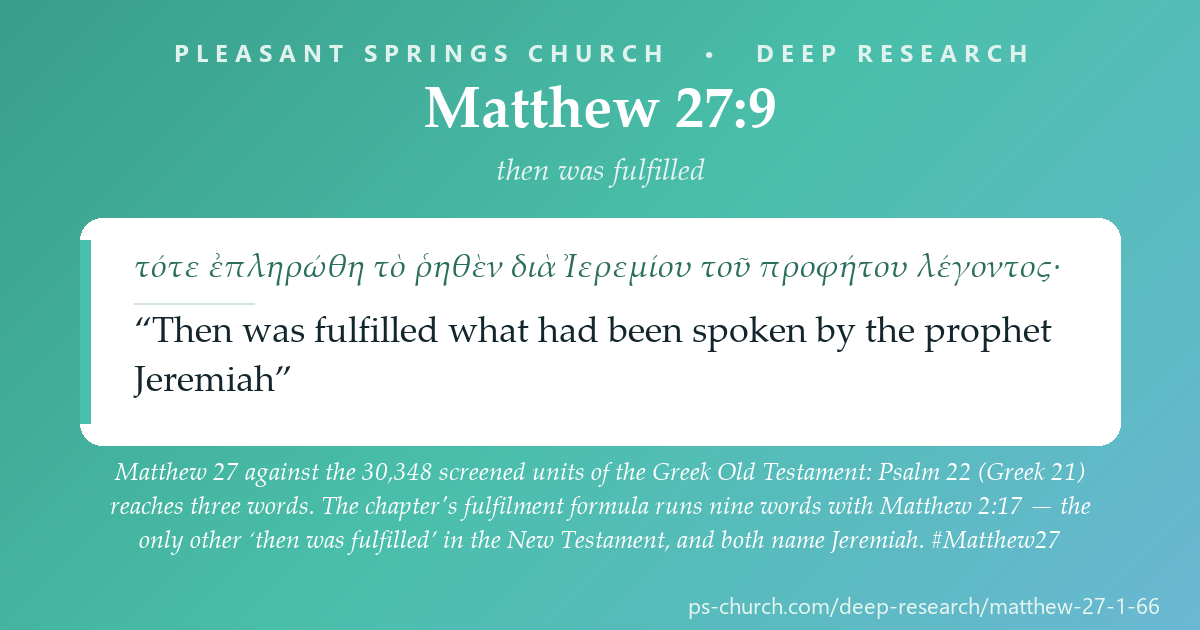
The formula. τότε ἐπληρώθη τὸ ῥηθὲν διὰ Ἰερεμίου τοῦ προφήτου λέγοντος (27:9) and τότε ἐπληρώθη τὸ ῥηθὲν διὰ Ἰερεμίου τοῦ προφήτου λέγοντος (2:17) are the same nine words, and the only two verses of the Greek New Testament with τότε ἐπληρώθη. Of the ten Matthew verses that join τὸ ῥηθὲν to a form of fulfil, the other eight have ἵνα πληρωθῇ or hopōs plērōthē, that it might be fulfilled; only 2:17 and 27:9 say then it was fulfilled, and both name Jeremiah, the only fulfilment formulas in the Gospel that do (the name stands in the New Testament at Matthew 2:17, Matthew 16:14, Matthew 27:9). Both stand beside a death: the children of Bethlehem, and the man whose price bought the field. And the two citations measure differently: 2:18 shares Φωνὴ ἐν Ῥαμὰ ἠκούσθη with Jeremiah 38:15 LXX, 4 words; 27:9–10 reach no more than 2 against any text named. Against the Greek Old Testament, 27:9’s own deepest run is 3, tie band 13, and two of the thirteen are Ιερεμιου τοῦ προφήτου at 2 Chronicles 36:12 and 1 Esdras 1:45: even the name in the formula is a phrase the Greek Old Testament has, and that is one more reason a run screen cannot settle the attribution.
⚠️ What this does and does not show. It shows where the words stand. It does not show what Matthew was reading, whether he had a Hebrew text, a Greek text unlike the one held here, or a collection of testimonies; and it does not decide why the verse says Jeremiah. Stage 5 gives the readings.
The psalm at the cross — Psalm 21 LXX (ESV 22), and Psalm 68 LXX (ESV 69)
Psalm 22:1 and 22:18 (Greek 21:2 and 21:19)
Hebrew · Greek OT · ESV| Matthew | Psalm (Greek / ESV) | pair run | the verse’s own deepest run, band | what is shared |
|---|---|---|---|---|
| 27:35 | 21:19 / 22:18 | 3 | 3, 40 | διεμερίσαντο τὰ ἱμάτιά |
| 27:43 | 21:9 / 22:8 | 2 | 3, 9 | he desires him |
| 27:46 | 21:2 / 22:1 | 1 | 3, 4 | the |
| 27:39 | 21:8 / 22:7 | 1 | 3, 8 | the |
| 27:41 | 21:8 / 22:7 | 1 | — | the |
| 27:44 | 21:7 / 22:6 | 1 | — | but |
| 27:39 | 108:25 / 109:25 | 2 | — | their heads |
| 27:34 | 68:22 / 69:21 | 1 | 3, 2 | they gave |
| 27:48 | 68:22 / 69:21 | 1 | 3, 20 | and |
Where the psalm is visible, it is visible as single words, not runs. The aorist διεμερίσαντο τὰ ἱμάτια (27:35) stands in one screened Greek Old Testament unit, διεμερίσαντο τὰ ἱμάτιά at Psalm 21:19 (and no other form of the verb stands there beside ta himatia), and in the New Testament in this form only here and at John 19:24; Mark 15:24 has the present διαμερίζονται τὰ ἱμάτια and Luke 23:34 διαμεριζόμενοι δὲ τὰ ἱμάτια. Matthew then has βάλλοντες κλῆρον where the psalm has ἔβαλον κλῆρον. At 27:43, let him rescue and he desires him — ῥυσάσθω νῦν εἰ θέλει αὐτόν — each stand in one screened Greek Old Testament unit, and it is the same one: ἤλπισεν ἐπὶ κύριον ῥυσάσθω αὐτόν σωσάτω αὐτόν ὅτι θέλει αὐτόν (Psalm 21:9), “let him deliver him; let him rescue him, for he delights in him”. The pair run is only 2, because the psalm has ἤλπισεν ἐπὶ κύριον where Matthew has πέποιθεν ἐπὶ τὸν θεόν, and ὅτι θέλει αὐτόν where Matthew has if. The same two verbs stand in Psalm 17:20 LXX, ῥύσεταί με ὅτι ἠθέλησέν με (“he rescued me, because he delighted in me”), whose pair run with 27:43 is 1.
⚠️ The Hebrew and the Greek of Psalm 22:8 differ. The ESV’s He trusts renders the Hebrew גֹּל, which is reported to be an imperative or infinitive, commit (reported); the Greek has ἤλπισεν ἐπὶ κύριον, he hoped in the Lord, and Matthew πέποιθεν ἐπὶ τὸν θεόν, he has trusted in God.
The cry (27:46). And about the ninth hour Jesus cried out with a loud voice, saying, “Eli, Eli, lema sabachthani?” that is, “My God, my God, why have you forsaken me?” The words Matthew gives in another tongue, Ἠλὶ ἠλὶ λεμὰ σαβαχθάνι, stand beside the Hebrew of Psalm 22:2, אֵלִי אֵלִי לָמָה עֲזַבְתָּנִי: ēli matches the Hebrew my God, and lema is close to the Hebrew lāmā. Sabachthani is not the Hebrew, which has ‘azavtāni; it is reported to be the Aramaic shəvaqtani (reported). No Aramaic of the cry is held here — no Targum of the Psalms — but the verb’s root, sh-b-q, stands in the Aramaic of the Hebrew Bible itself, in four verses (the names Ishbak and Joshbekashah aside): Daniel 4:12, 4:20, 4:23 (ESV 4:15, 4:23, 4:26), of the stump left in the ground, and Ezra 6:7, let the work go on. In the Hebrew Bible the pair ēli ēli stands only in Psalm 22:2, and so does לָמָה עֲזַבְתָּנִי; the form ‘azavtāni by itself stands in one other verse, Deuteronomy 28:20. Mark’s form of the cry is Ἐλωῒ ἐλωῒ λεμὰ σαβαχθάνι, and Westcott–Hort and the NIV’s Greek print Mark’s Eloï in Matthew too: Ἠλὶ ἠλὶ Treg RP NA28 ] Ἐλωῒ ἐλωῒ WH NIV.
Then Matthew glosses it in Greek, Θεέ μου θεέ μου, ἱνατί με ἐγκατέλιπες, and the gloss is not the Septuagint’s: ὁ θεὸς ὁ θεός μου πρόσχες μοι ἵνα τί ἐγκατέλιπές με. The pair run is 1. Matthew has the vocative thee mou where the Greek psalm has ho theos; he has the reversed order me enkatelipes; and the Greek psalm has πρόσχες μοι, attend to me, which is in neither the Hebrew nor Matthew. The Mark 15 page on this shelf measures Mark’s gloss at 3 against the same verse. The verse’s deepest Old Testament run, 3, tie band 4, is with a loud voice, saying, and the psalm is not among the four.
The mockers’ heads (27:39). κινοῦντες τὰς κεφαλὰς αὐτῶν: Psalm 21:8 LXX has ἐκίνησαν κεφαλήν (Hebrew יָנִיעוּ רֹאשׁ, “they wag their heads”), a pair run of 1; Psalm 108:25 LXX has ἐσάλευσαν κεφαλὰς αὐτῶν (“when they see me, they wag their heads”), 2. The screened units with a passing-by verb and the moving of heads are two: Jeremiah 18:16, in the potter’s chapter, all who pass through her will be appalled and shake their heads (our rendering; pair run 1), and Lamentations 2:15, πάντες οἱ παραπορευόμενοι ὁδόν … ἐκίνησαν τὴν κεφαλὴν αὐτῶν (“All who pass along the way clap their hands at you; they hiss and wag their heads”) — the city, not a man — and its pair run is 1.
Gall and sour wine (27:34, 27:48). καὶ ἔδωκαν εἰς τὸ βρῶμά μου χολὴν καὶ εἰς τὴν δίψαν μου ἐπότισάν με ὄξος (Psalm 68:22), “They gave me poison for food, and for my thirst they gave me sour wine to drink”. ⚠️ The ESV’s poison renders the Hebrew רֹאשׁ; the Greek has χολὴν, gall, and it is the Greek word Matthew has. Matthew’s οἶνον μετὰ χολῆς μεμιγμένον measures 1 against the psalm, and πλήσας τε ὄξους 1: the psalm has the accusative oxos and the aorist epotisan, Matthew the genitive and the imperfect. The one screened unit with a sour-wine form beside a form of give to drink is the psalm (ἐπότισάν με ὄξος; Hebrew יַשְׁקוּנִי חֹמֶץ). Gall beside wine stands in no screened unit; Mark 15:23 has ἐσμυρνισμένον οἶνον, wine mixed with myrrh, and the pair 27:34 / Mark 15:23 measures 1. And Robinson–Pierpont read the psalm’s own word at 27:34: οἶνον WH Treg NA28 ] ὄξος RP.
A counter-example the page prints against its own subject: 27:34’s deepest run is οὐκ ἠθέλησεν πιεῖν, tie band 2 — καὶ οὐκ ἠθέλησεν πιεῖν αὐτό, “Therefore he would not drink it”, David pouring out the water his men risked their lives for. Three words; it is a phrase, and with Robinson–Pierpont’s ēthelen the run would break.
27:43 and Wisdom 2 — the righteous man taunted
The Wisdom of Solomon, a Greek witness and not Scripture, has the ungodly plot against the righteous man who παῖδα κυρίου ἑαυτὸν ὀνομάζει (2:13), names himself a servant of the Lord (our rendering); who ἀλαζονεύεται πατέρα θεόν (2:16), vaunts God as his father (our rendering); and then εἰ γάρ ἐστιν ὁ δίκαιος υἱὸς θεοῦ ἀντιλήμψεται αὐτοῦ καὶ ῥύσεται αὐτὸν ἐκ χειρὸς ἀνθεστηκότων (2:18), for if the righteous one is God’s son, he will come to his aid and pull him out of his opponents’ grip (our rendering), ending in θανάτῳ ἀσχήμονι καταδικάσωμεν αὐτόν (2:20), let us sentence him to a death without honour (our rendering).
Measured, the scene is close and the words are not. 27:43 measures 1, 1, 1, 1, 1, 1 against Wisdom 2:13, 2:16, 2:17, 2:18, 2:19 and 2:20, and 2 against Psalm 21:9. The nominative singular huios beside theou, in either order, stands in one screened Greek Old Testament unit, Wisdom 2:18, and in Matthew’s verse the two are parted by a verb, Θεοῦ εἰμι υἱός. Two words of Wisdom 2:17, ἴδωμεν εἰ, stand at 27:49, ἴδωμεν εἰ. The scene of Wisdom 2:12–20 and the scene of 27:39–44 are alike; a run-length screen cannot see likeness of scene, and the page prints the low figures rather than hide them. The shelf’s Wisdom 1–9 and Mark 15–16 pages measure the same pairs.
27:24 — the washed hands
So when Pilate saw that he was gaining nothing, but rather that a riot was beginning, he took water and washed his hands before the crowd, saying, “I am innocent of this man’s blood; see to it yourselves.”
Against the law of Deuteronomy 21 the verse measures 2 with 21:6 (νίψονται τὰς χεῖρας / ἀπενίψατο τὰς χεῖρας) and 0 with 21:7, where the elders say αἱ χεῖρες ἡμῶν οὐκ ἐξέχεαν τὸ αἷμα τοῦτο — no word form in common. It measures 2 with Psalm 25:6 LXX and 2 with Psalm 72:13 LXX, the same two words, the hands; a form of the washing verb niptō beside the form cheiras, hands, stands in eight screened units. Pilate’s compound ἀπονίπτω stands in three Greek Old Testament units, and one is καὶ ἀπένιψαν τὸ ἅρμα (3 Kingdoms 22:38), washing Ahab’s chariot where the dogs licked his blood.
The words I am innocent of the blood measure 2 with David’s ἀθῷός εἰμι ἐγὼ (2 Kingdoms 3:28, “guiltless before the Lord for the blood of Abner”), and 3 with Daniel’s cry in Susanna 46 (Theodotion), καθαρὸς ἐγὼ ἀπὸ τοῦ αἵματος ταύτης, I am clean of this woman’s blood (our rendering). Against the New Testament the verse’s deepest run is 4, tie band 1, with Paul at Miletus: καθαρός εἰμι ἀπὸ τοῦ αἵματος πάντων (Acts 20:26), clean am I from the blood of every one (our rendering). ἀπὸ τοῦ αἵματος stands in three verses of the Greek New Testament: Matthew 23:35, Matthew 27:24, Acts 20:26.
27:25 — the answer, measured
καὶ ἀποκριθεὶς πᾶς ὁ λαὸς εἶπεν· Τὸ αἷμα αὐτοῦ ἐφ’ ἡμᾶς καὶ ἐπὶ τὰ τέκνα ἡμῶν.
This is one of the chapter’s two deepest Old Testament runs (27:29 is the other), and the page reports it with care. At 5 consecutive words the band is 2, and the two are different halves of the verse. καὶ ἀποκριθεὶς πᾶς ὁ λαὸς runs five with καὶ ἀποκριθεὶς πᾶς ὁ λαὸς ἐροῦσιν γένοιτο (Deuteronomy 27:15; Hebrew וְעָנוּ כׇל־הָעָם וְאָמְרוּ אָמֵן), “And all the people shall answer and say, ‘Amen.’” — the liturgy in which all Israel answers each of twelve curses; and the words of him upon us and upon run five with the Philistines of Ashdod, σκληρὰ χεὶρ αὐτοῦ ἐφ' ἡμᾶς καὶ ἐπὶ Δαγων θεὸν ἡμῶν (1 Kingdoms 5:7, “his hand is hard against us and against Dagon our god”). Neither sentence is about blood. The one is a formula and the other an accident, and the next measurements say so.
The answering people. In Matthew the nominative πᾶς ὁ λαὸς stands in this verse only. In the Greek Old Testament a form of answer stands before all the people in five screened units: the people answering at Sinai, ἀπεκρίθη δὲ πᾶς ὁ λαὸς ὁμοθυμαδὸν (Exodus 19:8) and 24:3; at Ebal, Deuteronomy 27:15; at Carmel, 3 Kingdoms 18:24; and at Ezra’s reading of the law, 2 Esdras 18:6 (Nehemiah 8:6). It is the form in which a whole people takes a word on itself. The page reports where the words stand; it draws no curse out of Deuteronomy 27, and it does not read 27:25 through it.
The blood formula. Τὸ αἷμα αὐτοῦ ἐφ’ ἡμᾶς καὶ ἐπὶ τὰ τέκνα ἡμῶν: the four words the blood of him upon stand in six screened units, and they are two kinds of sentence. In four the blood is the responsibility for a death, left on the one who bears it: τὸ αἷμα αὐτοῦ ἐπ' αὐτὸν ἔσται (Ezekiel 18:13), τὸ αἷμα αὐτοῦ ἐπὶ τῆς κεφαλῆς αὐτοῦ ἔσται (33:4, “his blood shall be upon his own head”), 33:5, and τὸ αἷμα αὐτοῦ ἐπ' αὐτὸν ἐκχυθήσεται (Hosea 12:15). In two it is the blood of a sacrifice: τὸ αἷμα αὐτοῦ ἐπὶ τὸ θυσιαστήριον (Leviticus 1:11), and on the Day of Atonement ῥανεῖ τὸ αἷμα αὐτοῦ ἐπὶ τὸ ἱλαστήριον (Leviticus 16:15), the blood carried ἐσώτερον τοῦ καταπετάσματος, “inside the veil” — the word for the curtain torn at 27:51. The run cannot tell the two kinds apart, and the page does not choose between them.
| the text | pair run with 27:25 | what is shared | what the sentence is |
|---|---|---|---|
| Deuteronomy 27:15 | 5 | and answering, all the people | the first of twelve curses at Ebal; the people answer so be it |
| 1 Kingdoms 5:7 | 5 | his … upon us and upon | the Philistines: God’s hand is heavy on them and on Dagon |
| Ezekiel 18:13; 33:4; 33:5 | 4 / 4 / 4 | the blood of him upon | the one who dies for his own sin; the watchman’s warning |
| Hosea 12:15 (ESV 12:14) | 4 | the blood of him upon | Ephraim’s bloodguilt left on him |
| Leviticus 1:11; 16:15 | 4 / 4 | the blood of him upon | sacrifice: the burnt offering’s blood on the altar; the Day of Atonement, blood on the mercy seat |
| Exodus 19:8; 24:3; 1 Kings 18:24 | 3 / 3 / 3 | all the people | Sinai, twice; Carmel |
| Exodus 24:8 | 2 | the blood | the blood of the covenant, thrown on the people |
| 2 Kingdoms 1:16 | 2 | the blood | David to the Amalekite |
| Jeremiah 33:15 LXX (ESV 26:15) | 2 | and upon | Jeremiah: innocent blood on you and on this city |
| Jonah 1:14 | 2 | upon us | the sailors: do not put innocent blood on us |
| Joshua 2:19 | 1 | and | the spies to Rahab; the Greek has no blood |
The texts often set beside the verse (reported) measure two or less. David’s τὸ αἷμά σου ἐπὶ τὴν κεφαλήν σου (2 Kingdoms 1:16; Hebrew דָּמְךָ עַל־רֹאשֶׁךָ, “Your blood be on your head”) measures 2. Jeremiah’s αἷμα ἀθῷον δίδοτε ἐφ' ὑμᾶς καὶ ἐπὶ τὴν πόλιν ταύτην (33:15 LXX; Hebrew כִּי־דָם נָקִי אַתֶּם נֹתְנִים עֲלֵיכֶם; “you will bring innocent blood upon yourselves and upon this city”) measures 2. Joshua 2:19 measures 1: the Hebrew has דָּמוֹ בְרֹאשׁוֹ, “his blood shall be on his own head”, and the Greek held here has no blood, ἔνοχος ἑαυτῷ ἔσται, he shall be liable to himself. The sailors of Jonah 1:14, μὴ δῷς ἐφ' ἡμᾶς αἷμα δίκαιον (“lay not on us innocent blood”), measure 2. And ἰδοὺ τὸ αἷμα τῆς διαθήκης, behold the blood of the covenant, thrown on the people at Exodus 24:8, measures 2.
Against the New Testament the verse’s deepest run is 4, tie band 1, and it is Luke 23:28, Jesus to the women of Jerusalem on the way to the cross: ἐφ’ ἑαυτὰς κλαίετε καὶ ἐπὶ τὰ τέκνα ὑμῶν, for yourselves you should weep, and for your children (our rendering). ἐπὶ τὰ τέκνα ἡμῶν stands in no screened Greek Old Testament unit and in no other verse of the Greek New Testament, and no other New Testament verse has blood beside a form of teknon, child (Hebrews 2:14 has paidia, children, with blood and flesh). The high priest’s complaint in Acts 5:28, ἐφ’ ἡμᾶς τὸ αἷμα τοῦ ἀνθρώπου τούτου, measures 2; Matthew 23:35, ἐφ’ ὑμᾶς πᾶν αἷμα δίκαιον, measures 1.
⚠️ What this does and does not show. The runs say where these words stand. They do not say what the crowd meant, what Matthew meant by recording it, or what God did with it. Those are the readings, and they are in Stage 5.
27:45–53 — darkness, curtain, earthquake, tombs
Now from the sixth hour there was darkness over all the land until the ninth hour.
The darkness measures 2 against Exodus 10:22, ἐγένετο σκότος γνόφος θύελλα ἐπὶ πᾶσαν γῆν Αἰγύπτου (“there was pitch darkness in all the land of Egypt three days”), 1 against Amos 8:9, συσκοτάσει ἐπὶ τῆς γῆς ἐν ἡμέρᾳ τὸ φῶς (“I will make the sun go down at noon and darken the earth in broad daylight”), and 0 against Joel 2:10 — no word form in common. Darkness and came together, in either order, stand in two screened units, Exodus 10:22 and 14:20. The verse’s deepest run, 4, is over all the earth, tie band 20.
The curtain and the earth. No screened Greek Old Testament unit has καταπέτασμα with of the naos, and none has it beside a form of the verb of 27:51. γῆ ἐσείσθη, the earth shook, stands in seven screened units: in three in that order without the article, in the other four as eseisthē hē gē; in Matthew’s order with the article, in none. Psalm 67:9 LXX (ESV 68:8) and Judges 5:4, the earth shaking when God goes out before his people, measure 3 each. Zechariah 14:4, σχισθήσεται τὸ ὄρος τῶν ἐλαιῶν (“the Mount of Olives shall be split in two”), measures 1, and 14:5, with its holy ones, 1. A splitting word beside a rock stands in three screened units: Isaiah 2:19 and 2:21, the clefts of the rocks on the day of the Lord, and 48:21, σχισθήσεται πέτρα, water from the rock.
The tombs also were opened. And many bodies of the saints who had fallen asleep were raised, and coming out of the tombs after his resurrection they went into the holy city and appeared to many.
The tombs. In the screened Greek Old Testament a form of mnēm- or taph- beside a form of open stands in four units (forms of kataphagō, devour, which contain the same letters, set aside). In two, Psalm 5:10 LXX (ESV 5:9) and the Greek of Psalm 13:3, it is τάφος ἀνεῳγμένος ὁ λάρυγξ αὐτῶν, the throat an opened grave, the line Romans 3:13 cites; the Hebrew has it at Psalm 5:10 and not at 14:3, where the Greek 13:3 is longer than the Hebrew. In the other two God opens the graves, and they are Ezekiel 37:12 and 37:13: ἀνοίγω ὑμῶν τὰ μνήματα καὶ ἀνάξω ὑμᾶς ἐκ τῶν μνημάτων ὑμῶν (Hebrew פֹתֵחַ אֶת־קִבְרוֹתֵיכֶם וְהַעֲלֵיתִי אֶתְכֶם מִקִּבְרוֹתֵיכֶם; “Behold, I will open your graves and raise you from your graves, O my people”). The pair runs are 1 for 27:52 and 2 for 27:53, because Ezekiel’s tomb-word is mnēma and Matthew’s mnēmeion. Isaiah 26:19 LXX has ἐγερθήσονται οἱ ἐν τοῖς μνημείοις, those in the tombs will be raised (our rendering); ⚠️ the Hebrew there has no tomb: נְבֵלָתִי יְקוּמוּן הָקִיצוּ וְרַנְּנוּ שֹׁכְנֵי עָפָר, “their bodies shall rise. You who dwell in the dust, awake”. Its pair run with 27:52 is 1. Daniel 12:2, πολλοὶ τῶν καθευδόντων ἐν γῆς χώματι ἐξεγερθήσονται (Theodotion; “many of those who sleep in the dust of the earth shall awake”), measures 1. Matthew’s τῶν κεκοιμημένων is Paul’s word at 1 Corinthians 15:20, ἀπαρχὴ τῶν κεκοιμημένων, a pair run of 2.
The holy city. 27:53’s εἰς τὴν ἁγίαν πόλιν runs 4, tie band 1, with εἰς τὴν ἁγίαν πόλιν Ιερουσαλημ (Isaiah 66:20), the nations bringing Israel’s scattered brothers home; ⚠️ the Hebrew there has עַל הַר קׇדְשִׁי יְרוּשָׁלִַם, “to my holy mountain Jerusalem” — the run is with the Greek alone. Within Matthew the same words run 5 with 4:5, where the devil takes Jesus εἰς τὴν ἁγίαν πόλιν. The accusative hagian polin, in that order, stands in two screened units (2 Maccabees 9:14; Isaiah 66:20).
27:54 — the centurion, against Mark and Luke
The three Gospels give the centurion three sentences. Matthew: Ἀληθῶς θεοῦ υἱὸς ἦν οὗτος. Mark 15:39: Ἀληθῶς οὗτος ὁ ἄνθρωπος υἱὸς θεοῦ ἦν, in truth, this man was God’s Son (our rendering). Luke 23:47: Ὄντως ὁ ἄνθρωπος οὗτος δίκαιος ἦν, this man really was righteous (our rendering). Matthew’s five words are all in Mark’s sentence, in a different order, and the pair run is 1; Luke shares this and was, and the run is 1. Within Matthew, the words run 4 with 14:33, the disciples in the boat: Ἀληθῶς θεοῦ υἱὸς εἶ. The three words Ἀληθῶς θεοῦ υἱὸς stand in two verses of the Greek New Testament, those two. And the mockers’ εἰ υἱὸς εἶ τοῦ θεοῦ at 27:40 runs 5 with the tempter’s Εἰ υἱὸς εἶ τοῦ θεοῦ at 4:3 and 4:6. Tregelles prints Mark’s order in Matthew: θεοῦ υἱὸς WH NA28 RP ] υἱὸς θεοῦ Treg. The page reports the shared wording; it does not decide what the centurion meant (Stage 5).
27:57–66 — the rich man, the tomb and the seal
When it was evening, there came a rich man from Arimathea, named Joseph, who also was a disciple of Jesus.
Isaiah 53:9 is the text read beside the burial, and its Hebrew and Greek differ. The Hebrew: וַיִּתֵּן אֶת־רְשָׁעִים קִבְרוֹ … וְאֶת־עָשִׁיר בְּמֹתָיו, “And they made his grave with the wicked and with a rich man in his death”. The Greek: καὶ δώσω τοὺς πονηροὺς ἀντὶ τῆς ταφῆς αὐτοῦ … τοὺς πλουσίους ἀντὶ τοῦ θανάτου αὐτοῦ, and I will give the wicked in return for his burial, and the rich in return for his death (our rendering). The Hebrew has one rich man, in the third person; the Greek has the rich in the plural, given by God in the first person, in return for his death. Measured, the passage is far from Matthew’s words: 27:57 measures 1 against the Greek, and 27:60 2. A form of rich beside a form of burial stands in one screened unit, Isaiah 53:9 itself. Matthew cites no text here.
and laid it in his own new tomb, which he had cut in the rock. And he rolled a great stone to the entrance of the tomb and went away. So they went and made the tomb secure by sealing the stone and setting a guard.
The seal. A form of sphragizō beside a form of lithos stands in seven screened Greek Old Testament units. In five the stones are engraved gems (Exodus 28 and 36; Sirach 45:11); in the other two, the two Greek forms of Daniel 6:18 (ESV 6:17), a stone is laid on the lions’ den and sealed: ἤνεγκαν λίθον … καὶ ἐσφραγίσατο ὁ βασιλεὺς. 27:66 against it measures 1.
Against the other Gospels
Against the 6,859 verses of the Greek New Testament outside Matthew, the distribution is:
| deepest run, at least | 9 | 7 | 6 | 5 | 4 | 3 | 2 |
|---|---|---|---|---|---|---|---|
| verses of Matthew 27 | 3 | 5 | 7 | 17 | 34 | 58 | 66 |
Three rows reach nine, each with a band of one: 27:11 with Luke 23:3, 27:56 with Mark 16:1, 27:58 with Luke 23:52 — and nine is also 27:9’s run with Matthew 2:17, so the formula ties the chapter’s deepest contacts anywhere. Then 27:31 and 27:39 with Mark 15 at seven, 27:1 and 27:42 at six. The verses where Matthew alone has the material — 27:3–10, 27:19, 27:24–25, 27:52–53, 27:62–66 — reach no more than five against the rest of the New Testament, and the five is 27:62’s the chief priests and the Pharisees, tie band 3. Which way the shared material travelled, or whether all drew on something older, the measurement cannot decide, and the page does not.
Where the chapter is read in more than one way, the readings are set out with their reported holders and what the texts show; then the history of 27:25; then the limits.
27:9 — why Jeremiah?
| why does 27:9 say Jeremiah? | reported holders | what the texts held here show |
|---|---|---|
| 1. A composite citation: Zechariah’s words with Jeremiah’s field, potter and Hinnom, and the more prominent prophet named. | many modern commentators (reported); Augustine gives a form of it (held) | The field bought with silver is Jeremiah 32 (Greek 39); the potter’s house, flask and innocent blood are Jeremiah 18–19; the thirty pieces and the potter of the Hebrew are Zechariah 11. Augustine: It is stated in Jeremiah that he bought a field from the son of his brother, and paid him money for it. (Harmony 3.7.31). |
| 2. A slip of memory, left to stand, under the Spirit’s guidance, to teach that the prophets speak as one. | Augustine (held) | Augustine: the word Jeremiah occurred to his mind, in accordance with a familiar experience, instead of Zechariah (3.7.30). |
| 3. Copies that read otherwise: some manuscripts are reported to read Zechariah, to read only the prophet, or to lack the name. | reported in the textual handbooks; Augustine reports codices without the name (held) | The SBLGNT apparatus held here has no entry at 27:9: the editions it compares agree on Jeremiah. Augustine: this ascription of the passage to Jeremiah is not contained in all the codices of the Gospels (3.7.29). No manuscript was checked for this page. |
| 4. Jeremiah as the name of a scroll: Jeremiah heading the collection of the later prophets in one ordering, so that his name could stand for the books under it. | some (reported); the ordering is reported from the Talmud (not held) | No ordering of the prophets is held here. |
| 5. A Jeremiah writing now lost that held the words. | Jerome is reported to mention such a writing (reported; not held) | No such text is held here. |
The page does not choose among these. What it contributes is the measurement: the formula is Matthew’s own, nine words shared with 2:17; the citation’s wording is close to no Greek text held here; and the two prophets between them hold all its pieces.
27:16–17 — Jesus Barabbas
The SBLGNT prints Ἰησοῦν Βαραββᾶν at 27:16 and Ἰησοῦν τὸν Βαραββᾶν at 27:17. The apparatus: Ἰησοῦν NA28 ] – WH Treg NIV RP; Ἰησοῦν τὸν NA28 ] τὸν WH; – Treg NIV RP. So NA28 has the name in both verses; Westcott–Hort have only the article at 27:17; Tregelles, the NIV’s Greek and Robinson–Pierpont print no Jesus in either. Which manuscripts carry the name is reported in the handbooks (reported), and Origen is reported to have known manuscripts with it (reported; not checked here). The page reports what the apparatus shows and makes no manuscript claim.
27:25 — the readings
| 27:25: what does the people’s answer mean? | reported holders | what the text shows |
|---|---|---|
| 1. The crowd present that day takes responsibility for the death it demands; the sentence describes that crowd, and binds no one else. | many modern interpreters (reported) | The speakers are πᾶς ὁ λαὸς gathered before Pilate (27:15–24); the Greek has no verb. |
| 2. Fulfilled in the generation that saw AD 70: our children are the next generation in Jerusalem, and the destruction of the city is read as the judgement Matthew has in view (cf. 23:35–36). | many (reported) | Matthew 23:36 has ἐπὶ τὴν γενεὰν ταύτην; Luke 23:28, the deepest New Testament run with this verse, is Jesus telling the women of Jerusalem to weep for themselves and your children. |
| 3. An irony: the people ask for his blood to be on them, and the Gospel has already called his blood the blood of the covenant shed on behalf of many for the release of sins (26:28) — so the words say more than the speakers know. | some (reported; the double sense is argued, for example, in an article by T. B. Cargal, reported) | The four words the blood of him upon stand both in sentences of guilt (Ezekiel 18:13; 33:4–5; Hosea 12:15) and in sentences of sacrifice (Leviticus 1:11; 16:15). The run cannot choose. |
| 4. A hereditary curse on the Jewish people, passing to all their descendants. | widely held in Christian history (reported); in the Fathers held here, Tertullian, Against Marcion 2.15 | Nothing in the verse names later generations beyond our children. This page rejects this reading, and the church holds that what passes from Adam to every human being is mortality, not guilt; guilt is not inherited. |
How 27:25 has been used
Matthew 27:25 is reported to be the verse most used in Christian history to blame Jews as a people for the death of Jesus, and the page says so plainly. It is reported to have stood behind the charge of ‘deicide’ and to have been cited in sermons, laws and violence against Jewish communities across centuries (reported). The Fathers held here show the reading early: Tertullian speaks of the people on whom recoils the sentence of the Judge, when requiting on sons the sins of their fathers (Against Marcion 2.15). The same Fathers also show its limit being drawn. John Chrysostom, preaching on this verse, says: Nevertheless, the lover of man, though they acted with so much madness, both against themselves, and against their children, so far from confirming their sentence upon their children, confirmed it not even on them, but from the one and from the other received those that repented, and counts them worthy of good things beyond number. — For indeed even Paul was of them, and the thousands that believed in Jerusalem (Homilies on Matthew 86.2).
In the twentieth century, after the Holocaust, many churches are reported to have rejected the collective reading formally (reported). The texts on this page support only what they say. The people who answer are those gathered before Pilate; the man they answer about was a Jew, as were his mother, his disciples, the women at the cross and the rich man who buried him; the chapter’s writer is reported to have been a Jew writing to Jewish believers (Author & Audience); and in the Gospel’s own words the blood of Jesus is περὶ πολλῶν ἐκχυννόμενον εἰς ἄφεσιν ἁμαρτιῶν (26:28), shed on behalf of many, for the release of sins (our rendering).
This church attributes no collective guilt to the Jewish people, then or now. It holds that what every human being inherits from Adam is mortality, not guilt, and that Christ’s death makes provision for every person; on those terms no one is born guilty of another’s sin, and no one is outside the reach of that blood.
27:51–53 — the opened tombs
| 27:51–53: the opened tombs and the raised saints | reported holders | what the text shows |
|---|---|---|
| 1. A historical event, reported by Matthew as it happened. | many (reported) | Matthew alone has it; 27:52–53 measure two and three against the rest of the New Testament. |
| 2. A sign told in the language of Ezekiel 37 and Daniel 12: the death of Jesus marked as the turn of the ages, without a claim about what an observer saw. | some (reported) | Tomb + open stands in the Greek Old Testament four times, and God opens graves only at Ezekiel 37:12–13; the runs are one and two. |
| 3. Two moments: the tombs open at the death, the saints come out μετὰ τὴν ἔγερσιν αὐτοῦ, after his rising. | many, and the ESV’s punctuation (reported) | The phrase stands between coming out of the tombs and went into the holy city, and may be read with either. |
| 4. A firstfruits of the general resurrection. | some (reported) | Matthew’s τῶν κεκοιμημένων is Paul’s word for those whose firstfruits Christ is (1 Corinthians 15:20). |
The church’s eschatology is historic premillennial and rejects the Darby–Scofield scheme; it has ratified no reading of these verses, and the page chooses none.
Judas — the readings
| Judas’ regret and death | reported holders | what the text shows |
|---|---|---|
| 1. Remorse without repentance: he regrets the outcome, returns the money, and does not turn to God. | many (reported) | Matthew’s verb is metamelomai, not metanoeō; he confesses to the priests, Ἥμαρτον. |
| 2. A real repentance cut short, the confession genuine and the despair its end. | some (reported) | The same verb stands at 21:29 for a son who regretted his refusal and went, and at 21:32 for hearers who did not. |
| 3. The text does not say, and the reader is not asked to decide Judas’ end. | some (reported) | Acts 1:18–19 tells the death differently. |
The church’s frame, labelled as its frame. The church reads God’s foreknowledge through a Molinist account: God knows what every free creature would freely do in any circumstance, and orders his providence with that knowledge, so that Judas acts freely and is answerable, and God’s purpose is not defeated. That frame explains how 26:24 and 27:3–5 can stand together; it does not tell us Judas’ end, and the page does not claim it does. Nor does the page use Judas to settle the question of assurance. The church’s Statement of Beliefs, Article 10, Hope, says that all who genuinely receive Christ are held secure, and that Scripture’s warnings are themselves a real means by which He holds us fast.
27:46 and 27:54 — two more readings
The cry. Some read 27:46 as real abandonment borne in the place of sinners; some as the opening line that calls up the whole psalm, which ends in praise and vindication; some as a felt desolation that is not a breach within God (all reported). Matthew prints the first line only, in another tongue and in Greek; the rest of the psalm is not quoted in the chapter, though its words stand at 27:35, 27:39 and 27:43 at the depths Stage 4 gives.
The centurion. Ἀληθῶς θεοῦ υἱὸς ἦν οὗτος has no article: some read the Son of God, a full confession; some a son of God, a pagan’s awe; some argue that the grammar allows the first and the context requires it (all reported). The page notes only that Matthew’s words are the disciples’ words of 14:33.
What this page could not check — and where it is weakest
- No manuscript apparatus was consulted. The SBLGNT apparatus held here compares printed editions (Westcott–Hort, Tregelles, NA28, the NIV’s Greek, Robinson–Pierpont), not manuscripts. It has no entry at 27:9, so the reported readings Zechariah, the prophet or no name could not be checked; Augustine’s report of codices without the name is quoted, not tested. The manuscripts for Jesus Barabbas, and the KJV’s longer 27:35, were not examined.
- Rahlfs only. The Greek Old Testament is one printed text. Whether other Greek texts of Zechariah 11:13 read potter, of Jeremiah 19:11 carry the burial clause, or of Joshua 2:19 carry blood, was not checked. No Aquila, Symmachus or Theodotion of these books is held.
- No Aramaic of the cry. No Targum of the Psalms is held, so sabachthani could be set only beside the Aramaic root in Daniel and Ezra, not beside an Aramaic Psalm 22.
- Not held: Josephus, Philo, the Mishnah, the Talmud, Roman legal sources, Jerome’s commentary on Matthew, Origen’s commentary on Matthew, and the lexicons. Every statement drawn from them — Pilate’s character, the Passover release, the curtains of the temple, the order of the prophets, the lost Jeremiah writing, the name Procla, the meaning of sabachthani and of the Hebrew gōl — is marked reported and is unchecked. Augustine, Chrysostom and the Gospel of Peter are quoted from the Ante-Nicene and Nicene Fathers held here.
- The runs see words, not scenes. Wisdom 2:12–20 and the mockery of 27:39–44 are one scene; the screen gives one word. Psalm 22 stands behind the whole crucifixion in the reading of the church, and the screen finds three words at most. Both are limits of the instrument, and the page prints them as such.
- The structure counts depend on the page’s own cuts. Twelve scenes, cut where place or time shifts; nouns, verbs and adjectives by the MorphGNT part-of-speech column, less be and say. Other cuts would move the counts.
- Our renderings were checked by machine against the KJV, the BSB and every ESV verse cached for this page, and by eye against the ESV, NRSV and NIV wording, which this shelf does not hold in full.
- Tie bands are properties of the corpus searched. A band of one over 30,348 units is not a claim about every Greek text that existed. With the Odes put back (30,637 units) every run on this page stands.
- Nothing here establishes direction of influence. The page reports where words stand in Matthew, the other Gospels and the Greek Old Testament, and does not say which text depends on which.
Innocent blood, a dream ignored, a basin of water, and a cry in another tongue.
Name what you learned, why it matters, and one concrete response.
What should we carry away — and do?
- Everyone in the chapter tries to put the blood somewhere else. “What is that to us? See to it yourself”; “I am innocent of this man’s blood; see to it yourselves”. The chapter is a mirror before it is a record.
- The verse that was turned against a people names those gathered before Pilate, and the Gospel has already called this blood the blood of the covenant (26:28). A Christian who reads 27:25 against Jews has read it against the Gospel’s own words at 26:28.
- The cry is a psalm. “My God, my God, why have you forsaken me?” The forsaken one prays Israel’s prayer, in Israel’s words.
- The Gospel’s infancy story and its passion name the same prophet in the same words. “Then was fulfilled what had been spoken by the prophet Jeremiah” — the words of 2:17, over Bethlehem’s children; here, over a field bought with a price of blood.
- The burial is careful. “a rich man from Arimathea, named Joseph, who also was a disciple of Jesus”; and the women καθήμεναι ἀπέναντι τοῦ τάφου, sitting opposite the tomb. The guard and the seal only make the morning harder to explain.
Step in response: read 27:3–26 aloud and mark every place someone hands the responsibility to another. Then read 26:28 and 27:46 together.
Matthew 27:9 · to share
Greek NT + ESVEvery Deep Research page traces its passage across the whole sweep — the Old Testament, the Second-Temple world between the testaments (historical witnesses, not Scripture), and the New Testament. Follow the thread:
Related on the shelf. Mark 15–16, the same hours, with Mark’s Eloï and the centurion’s other order; Luke 23, Herod, the women of Jerusalem and the righteous man; John 19:16–30, the garments with the formula; Matthew 26:26–29, the blood of the covenant; Matthew 26:36–46, Gethsemane; Matthew 28:16–20, after the guard; Matthew 2, the other then was fulfilled and the dreams; Matthew 4:1–11, if you are the Son of God and the holy city; Matthew 14–17, the confession in the boat; Matthew 23, the righteous blood on this generation; Psalm 22; Psalm 69, gall and sour wine; Psalms 26–28 and Psalm 73, hands washed in innocence; Psalms 108–109, the wagging heads; Zechariah 9–14, the thirty pieces and the Mount of Olives; Jeremiah 16–20, the potter and the flask; Jeremiah 26–30, innocent blood on this city; Wisdom 1–9, the righteous one taunted; Deuteronomy 19–21, the washed hands over the heifer; Deuteronomy 27, the people’s answer at Ebal; 1 Samuel 5–7, the hand on Ashdod; 2 Samuel 1–4, your blood on your head; 2 Samuel 13–18, Ahithophel; 2 Samuel 19–24, the water David would not drink; Joshua 2, Rahab’s house; Exodus 10, the darkness; Exodus 24, the blood of the covenant; Leviticus 16, the blood inside the veil; Ezekiel 37:1–14, the opened graves; Daniel 12, those who sleep in the dust; Isaiah 52:13–53:12, the rich man in his death; Isaiah 62–66, the holy city; Amos 6–9, the sun at noon; Jonah, the sailors’ prayer; Susanna, I am clean of this blood. Our church’s Statement of Beliefs.
Pleasant Springs Church — Deep Research
Research method after Michael S. Heiser’s Bible Research Method (examine dictionaries → ancient literature → important words → textual connections → academic publications → share), with the Pleasant Springs “Author & Audience” foundation. Scripture set in the Hebrew, the Greek editions named on each page and the ESV (Old Testament), and the Greek New Testament and the ESV (New Testament), per the practice of Pleasant Springs Church. Matthew works named on this page (none re-read for it): Davies and Allison, Luz, France, Keener, Nolland, Brown, Stendahl, Gundry, Menken and Cargal — none of which were consulted for any number on this page. Text: Greek New Testament from the SBL edition as digitized by MorphGNT (text, parsing and lemma columns); SBLGNT apparatus, Michael W. Holmes (ed.), Society of Biblical Literature and Logos Bible Software, CC BY 4.0; Greek Old Testament from Rahlfs’ Septuaginta as digitized by CATSS; Hebrew and Aramaic from the Masoretic text as printed in Sefaria’s Miqra according to the Masorah; Augustine and John Chrysostom from the Nicene and Post-Nicene Fathers, the Gospel of Peter from the Ante-Nicene Fathers. ⚠️ VERSE NUMBERING. Matthew 27 has no offset (1–66 in the SBLGNT, KJV and ESV). ESV Psalm 22:1, 22:7, 22:8, 22:18 = LXX 21:2, 21:8, 21:9, 21:19; ESV Psalm 69:21 = LXX 68:22; ESV Psalm 18:19 = LXX 17:20; Psalm 26:6, 73:13, 109:25 = LXX 25:6, 72:13, 108:25; Jeremiah 32:6–15, 31:15, 26:15 = LXX 39:6–15, 38:15, 33:15; 1–2 Samuel = 1–2 Kingdoms; Nehemiah 8:6 = 2 Esdras 18:6; ESV Hosea 12:14 = MT/LXX 12:15; ESV Joel 3:15–16 = MT/LXX 4:15–16; ESV Daniel 6:17 = MT/LXX 6:18. ⚠️ The measurement, in full. Greek against Greek; MorphGNT normalised word; CATSS form column; accents and breathings dropped, final sigma folded, with the shelf’s edition-equivalence table on cross-corpus screens. Contiguous runs of whole word forms, never lemmas. 66 rows against 30,348 verse units — the 64 CATSS files less the Odes — and against the 6,859 verses of the Greek New Testament outside Matthew. Form and co-occurrence searches are unanchored regular expressions over the same normalised forms. Hebrew counts consonantal, over 23,204 Masoretic verse units. Exhaustive and deterministic. It finds verbatim contact, not allusion.
Scripture quotations marked ESV are from the ESV® Bible (The Holy Bible, English Standard Version®), © 2001 by Crossway, a publishing ministry of Good News Publishers. ESV Text Edition: 2016. Used by permission. All rights reserved. The ESV text may not be quoted in any publication made available to the public by a Creative Commons license, and the ESV may not be translated in whole or in part into any other language. www.esv.org
|
Did this study bless you today? 💚 Give to Support PS Church100% of gifts go to the General Fund — thank you. |