Screened one verse at a time against all 30,348 screened units of the Greek Old Testament held here, Matthew 23 is shallow where it is famous and deep where it ends. Only one of its 38 verses reaches six consecutive words: 23:39, “Blessed is he who comes in the name of the Lord”, Psalm 117:26 LXX (ESV 118:26), tie band 1 — the same six words, at the same band, that the crowd cried at 21:9. Against the Greek New Testament outside Matthew, the deepest row is the lament, 23:37: fourteen words with Luke 13:34, tie band 1, while no verse of the chapter shares more than six with any verse of Luke 11, where the woes stand. The texts the commentaries set beside the chapter measure low: two consecutive words with Jeremiah 22:5 and two with Deuteronomy 32:11, one with Zechariah 1:1 and one with 2 Chronicles 24:20. The single words are another matter: no form of φυλακτήρια stands anywhere in the Greek Old Testament held here; the form κεκονιαμένοις stands in exactly one unit, Proverbs 21:9, where the Hebrew has no plaster at all; and, on the stems, the name and patronym of 23:35 stand in that order in one Greek Old Testament verse, and it is not the murder in Chronicles. The page prints its counter-examples beside its findings, gives the readings of 23:9, 23:35 and 23:39 fairly with their holders, and never asserts which text depends on which. See the method →
Matthew 23:1–39
Greek NT · ESV or our renderingVersification. Matthew 23 has a numbering gap, not an offset. The SBLGNT prints 38 verses numbered 1–39 with no verse 14; the KJV, following the Textus Receptus, prints 39, with its 23:14 the woe on widows’ houses. The ESV likewise has no 23:14 in its text (reported; the ESV of that verse was not fetched for this page). The SBLGNT apparatus lists the verse in two places: the Robinson–Pierpont text prints it before the SBLGNT’s 23:13 (ὑψωθήσεται WH Treg NA28 ] + 13 Οὐαὶ δέ ὑμῖν, γραμματεῖς καὶ Φαρισαῖοι, ὑποκριταί, ὅτι κατεσθίετε τὰς οἰκίας τῶν χηρῶν, καὶ προφάσει μακρὰ προσευχόμενοι· διὰ τοῦτο λήψεσθε περισσότερον κρίμα (and re-number SBL v. 13 as 14) RP), and the TR after it (εἰσελθεῖν WH Treg NA28 RP ] + 14 Οὐαὶ ὑμῖν, γραμματεῖς καὶ Φαρισαῖοι ὑποκριταί, ὅτι κατεσθίετε τὰς οἰκίας τῶν χηρῶν καὶ προφάσει μακρὰ προσευχόμενοι· διὰ τοῦτο λήψεσθε περισσότερον κρίμα TR). There is no Septuagint column, because Matthew is a New Testament book. The offsets are in the Old Testament texts measured, each checked against the Masoretic and CATSS files held here and the KJV’s chapter lengths. The Psalms run one behind in Greek: Psalm 118:26 (Hebrew and ESV) = Greek 117:26; Psalm 91:4 = Greek 90:4; Psalm 17:8 = Greek 16:8; and where the Hebrew counts a title as a verse the ESV runs one behind the Hebrew as well: ESV Psalm 36:7 = Hebrew 36:8 = Greek 35:8; ESV 57:1 = Hebrew 57:2 = Greek 56:2; ESV 61:4 = Hebrew 61:5 = Greek 60:5; ESV 69:25 = Hebrew 69:26 = Greek 68:26; ESV Psalm 78:10 = Greek 77:10. Hosea 12:6 (ESV) = Hebrew and Greek 12:7. Joel 4:19 (Hebrew and Greek) = ESV Joel 3:19. 1 Kings 4:23 (ESV) = Hebrew 5:3 = Greek 3 Kingdoms 5:3, and 3 Kingdoms 2:46e is a Greek paragraph with no Hebrew counterpart. 2 Chronicles (Greek 2 Paralipomenon) 23–24 and Ezra 5:1 (Greek 2 Esdras 5:1) carry the same numbers in all three. Jeremiah 12:7 and 22:5 carry the same numbers in Hebrew, Greek and ESV (the Greek Jeremiah’s different order begins later in the book). Genesis 4, Exodus 13:9, Leviticus 27:30, Numbers 15:38 and 19:16, Deuteronomy 6:8, 14:22, 27:2 and 32:11, Ruth 2:12, Proverbs 21:9, Isaiah 5:8, 8:2, 11:12 and 28:25, Ezekiel 13 and 8:16, Joel 2:17, Micah 6:8, Habakkuk 2, Zechariah 1:1 and 8:23 and Lamentations 4:13 have no offset. Judith, 4 Maccabees and the Psalms of Solomon are Greek only, and are witnesses, not Scripture.
The Shape of the Passage
A counted sequence of seven woes, framed — NOT a chiasmOne discourse, 38 verses, delivered in the temple courts on the last day Jesus teaches there: at 24:1 he leaves the temple. The hearers named at 23:1 are the crowds and the disciples.
Author
Church tradition from Papias onward names Matthew the tax collector (Matt 9:9; 10:3). This page reports that tradition, as the shelf’s Matthew 21 and Matthew 22 studies do, and does not test it.
What the text shows is an insider’s argument. The chapter opens by telling the disciples to do what the scribes and Pharisees say (23:3), and among those Jesus will send it names προφήτας καὶ σοφοὺς καὶ γραμματεῖς — scribes (23:34). The woes are addressed to named teachers by a teacher of the same people, in the idiom of Israel’s own prophets (Isaiah 5, Habakkuk 2; Stage 4).
Audience
Most locate Matthew’s first readers among Jewish believers in Jesus, often at Antioch, between the 60s and the 80s, in sharp dispute with synagogue leaders (reported). A community in that situation would hear these woes as words about leadership inside the people of God.
The addressees are scribes and Pharisees, and the page says so plainly. The chapter does not address the Jewish people; it addresses a class of teachers, and in 23:37 it laments over Jerusalem. The chapter has been read against Jews as a people in the centuries since, and Stage 5 reports that history.
Orient on scribes and Pharisees, the synagogue, phylacteries and tassels, oaths, tithes, tombs, the murdered prophets, and Jerusalem.
Search by reference and by topic: scribe, Pharisee, Moses’ seat, synagogue, phylactery, tefillin, tassel, tzitzit, rabbi, proselyte, oath, Corban, tithe, purity, tomb, Zechariah son of Jehoiada, Zechariah the prophet, Abel, Gehenna, woe oracle.
Which articles are relevant?
- Dictionary of Jesus and the Gospels (IVP, 2nd ed. 2013) — “Pharisees,” “Scribes,” “Synagogue,” “Woe,” “Purity,” “Jerusalem.”
- Anchor Bible Dictionary — “Phylacteries,” “Fringes,” “Oaths,” “Tithe,” “Zechariah (Person),” “Gehenna.”
- Dictionary of New Testament Background (IVP) — “Pharisees,” “Synagogues,” “Purity,” “Burial Practices.”
- NIDNTTE — οὐαί, ὑποκριτής, καθέδρα, φυλακτήριον, κράσπεδον, καθηγητής, κονιάω, ἐπισυνάγω.
Bibliography surfaced:
- Commentaries on Matthew: W. D. Davies and Dale C. Allison, Matthew 19–28 (ICC); Ulrich Luz, Matthew 21–28 (Hermeneia); R. T. France (NICNT); Craig S. Keener; John Nolland (NIGTC).
- On the woes: David E. Garland, The Intention of Matthew 23 (1979); Kenneth G. C. Newport, The Sources and Sitz im Leben of Matthew 23 (1995).
- On the Pharisees: E. P. Sanders, Judaism: Practice and Belief (1992); Anthony J. Saldarini, Pharisees, Scribes and Sadducees in Palestinian Society (1988).
- On 23:39: Dale C. Allison, “Matt. 23:39 = Luke 13:35b as a Conditional Prophecy,” JSNT 18 (1983).
The works above are named as places to look. None was re-read for this page, and no number on it comes from them. Stage 5 says so again.
The seat, the straps and the tassels, the oaths and the herbs, the plastered tombs, and the murdered priest.
Set each saying beside the texts and practices it names. Where a practice is known only from later rabbinic literature, which this shelf does not hold, it is marked reported.
Moses’ seat, the straps and the tassels
The seat. Ἐπὶ τῆς Μωϋσέως καθέδρας ἐκάθισαν (23:2): “The scribes and the Pharisees sit on Moses’ seat”. Whether this names a literal chair in synagogues or a figure for teaching authority is debated; stone seats found in ancient synagogues are reported to have been so named by modern scholars, and a later midrash is reported to mention one (all reported, none held). The Greek Old Testament has a form of the noun and an aorist of the verb together in three screened units, and one of them is the first verse of the Psalter: ἐπὶ καθέδραν λοιμῶν οὐκ ἐκάθισεν (Psalm 1:1), nor sat on the seat of the pestilent (our rendering).
The straps. “they make their phylacteries broad”. The practice of binding the commandments on hand and head is read from Exodus 13:9 and Deuteronomy 6:8, and leather phylactery cases are reported from Qumran (reported). The Greek of those two verses has no phylactery in it: Exodus 13:9 has μνημόσυνον πρὸ ὀφθαλμῶν σου where the Hebrew has וּלְזִכָּרוֹן (and for a memorial), and Deuteronomy 6:8 has ἔσται ἀσάλευτον πρὸ ὀφθαλμῶν σου, it shall be immovable before your eyes (our rendering), where the Hebrew has לְטֹטָפֹת, which the ESV renders frontlets. The Greek and the Hebrew differ here, and the page prints both.
The tassels. Numbers 15:38 commands “tassels on the corners of their garments”; the Hebrew is צִיצִת עַל־כַּנְפֵי בִגְדֵיהֶם and the Greek κράσπεδα ἐπὶ τὰ πτερύγια τῶν ἱματίων αὐτῶν — tassels on the little wings of their garments. The Hebrew עַל־כַּנְפֵי is the word for a wing, and the Greek has πτερύγια. Stage 4 returns to the wings.
Oaths, herbs, and the strained cup
Oaths (23:16–22). Ten tokens of ὀμνύω stand in five verses (23:16, 23:18, 23:20, 23:21, 23:22). Rabbinic tractates on oaths and vows are reported to distinguish binding and non-binding formulae (reported, not held). The argument of the woe is that every lesser oath is an oath by God.
Herbs (23:23). “you tithe mint and dill and cumin”. The law tithes πᾶσα δεκάτη τῆς γῆς (Leviticus 27:30) and commands δεκάτην ἀποδεκατώσεις (Deuteronomy 14:22), you shall tithe a tithe, of the yield of the seed. That dill and cumin were tithed in the period, and that mint was not named in the lists, is reported from the Mishnah (reported, not held). Cumin is the one herb of the three with a form in the Greek Old Testament held here: μικρὸν μελάνθιον καὶ κύμινον (Isaiah 28:25), sown and beaten out with a rod at 28:27.
The strained cup (23:24). Straining wine to remove insects is reported as a practice tied to Leviticus 11:41–43 (reported). The verb διϋλίζω stands in one screened Greek Old Testament unit: οἱ πίνοντες τὸν διυλισμένον οἶνον (Amos 6:6), those who drink the filtered wine (our rendering), in a woe on the complacent. The gnat-word’s only Greek Old Testament relatives are four verses of Judith on Holofernes’ ἐν τῷ κωνωπίῳ, under the canopy (our rendering), a mosquito net. No form of κώνωψ itself stands there.
Plastered tombs, and what corpse impurity is
The tombs. “you are like whitewashed tombs”. Marking tombs with lime before the pilgrim festivals, so that pilgrims would not contract impurity by walking over them, is reported from the Mishnah (reported, not held). The law behind it is Numbers 19:16: “touches a human bone or a grave, shall be unclean seven days” — Greek ἢ νεκροῦ ἢ ὀστέου ἀνθρωπίνου ἢ μνήματος.
Ritual impurity is not sin. The impurity of Numbers 19 is contracted by touching the dead, which a faithful person must do to bury a parent, and it is removed by washing and time. The page discloses the vocabulary: the Hebrew of Numbers 19 names the cleansing with forms of the root of sin, יִתְחַטָּא־בוֹ (19:12, he shall purify himself with it) — the root marks purification in that chapter, not guilt — and the Greek renders the same verb ἁγνισθήσεται, he shall be purified. The woe at 23:27 turns the image inward — ὀστέων νεκρῶν inside a beautiful outside — and 23:28 names what is inside: ὑποκρίσεως καὶ ἀνομίας.
Who was Zechariah? The texts held, and the stories told
Three bodies of text bear on 23:35, and the page holds two of them.
- The Hebrew Bible. Zechariah son of Jehoiada, stoned “in the court of the house of the Lord” (2 Chronicles 24:20–22), with dying words that ask for a reckoning. Zechariah son of Berechiah, the prophet (Zechariah 1:1), whose death no text held here records. Stage 4 sets out the texts.
- Christian writers held here. The Protevangelium of James tells of Zacharias the father of John the Baptist killed in the temple after Herod sent his officers: And Zacharias was murdered about daybreak. (ch. 23) … Zacharias has been murdered, and his blood shall not be wiped up until his avenger come. (ch. 24). Origen, writing to Africanus, says of Matthew’s Zechariah: Then about Zacharias the son of Barachias, who was slain between the temple and the altar, we learn from Jesus only, not knowing it otherwise from any Scripture. (Letter to Africanus 9). John Chrysostom reads the pairing with Abel: But see how seasonably he also mentioned Abel, indicating that this murder likewise is of envy. (Homilies on Matthew 74).
- Texts not held. Josephus is reported to tell of a Zacharias son of Baris killed in the temple by the Zealots in AD 67–68 (Jewish War 4.334–344, reported). Later rabbinic legend is reported to tell of the blood of the murdered priest Zechariah seething in the temple court until the Babylonian conquest (reported). Jerome is reported to say that the Gospel used by the Nazarenes read son of Jehoiada here (reported).
Israel’s own writings hold the same kind of critique. The Psalms of Solomon, a Greek witness reported to date from the first century BC and not Scripture, open their fourth psalm with ἵνα τί σύ βέβηλε κάθησαι ἐν συνεδρίῳ ὁσίων, Why do you, profane one, sit in the council of the devout? (our rendering); pray against τοὺς ἐν ὑποκρίσει ζῶντας μετὰ ὁσίων, those who live in pretence among the devout (our rendering) (4:6); and say of the pretenders ὅτι ἠρήμωσαν οἴκους πολλοὺς ἀνθρώπων, because they laid waste many people’s houses (our rendering) (4:20). Who their target was is debated (reported). The point for Matthew 23 is the genre: a woe to teachers is an Israelite form, spoken from inside the people.
Straps, tassels, plaster and a hen — the chapter’s small words carry its rarest measurements.
Counts below are exhaustive over the SBLGNT held here (7,927 verses, MorphGNT lemma column) and the CATSS Greek Old Testament (30,348 screened units; 30,637 held with the Odes). A no form claim means an unanchored substring search over normalised word forms found none. It is a claim about word forms in these files, not about every word for the thing.
A chair, a seat of office. In the Greek New Testament: Matthew 21:12, Matthew 23:2, Mark 11:15 — the other two are the dove-sellers’ seats in the temple. No screened Greek Old Testament unit has a form of it with Moses’ name.
In the Greek New Testament 1 token, here. No form of the word (searched unanchored, phylaktēr-) stands in any of the 30,637 held units of the Greek Old Testament, which renders the Hebrew of Deuteronomy 6:8 with immovable. The Greek word’s ordinary sense, a safeguard or amulet, is reported from the lexicons (not held).
Five verses of the Greek New Testament: Matthew 9:20, Matthew 14:36, Matthew 23:5, Mark 6:56, Luke 8:44. In the other four, people touch or seek to touch the fringe of Jesus’ own garment. In the Greek Old Testament, four units (Deut 22:12, Num 15:38, Num 15:39, Zech 8:23), the last where ten men of the nations ἐπιλάβωνται τοῦ κρασπέδου ἀνδρὸς Ιουδαίου, take hold of the fringe of a Jewish man (our rendering).
A Hebrew title in Greek letters, in 15 verses of the Greek New Testament. No screened Greek Old Testament unit has the title; the forms there that begin with these letters are the place name Rabbah.
2 tokens in the Greek New Testament, both in this verse; no form in the screened Greek Old Testament. The apparatus shows the Robinson–Pierpont text with it in 23:8 as well.
46 tokens in the Greek New Testament, 13 in Matthew, 7 in this chapter. Isaiah 5 has six in Greek and in Hebrew; Habakkuk 2 has five in Hebrew and three in Greek (Stage 4).
17 tokens in the Greek New Testament, 13 in Matthew, 6 in this chapter. The noun is reported from the lexicons as the word for a stage actor. Its family stands in 16 screened Greek Old Testament units, three of them in Psalms of Solomon 4.
2 tokens in the Greek New Testament: here and Acts 23:3, Paul to the high priest. In the screened Greek Old Testament the verb stands in three units, Deuteronomy 27:2, 27:4 and Proverbs 21:9, and the perfect participle in Matthew’s exact form only at Proverbs 21:9. Stage 4.
1 token in the Greek New Testament, this verse. Luke 11:51 names no father. Stage 4 sets out the three Greek Old Testament verses with Zachari- and Barachi- together.
Two verses of the Greek New Testament: Matthew 23:37, Luke 13:34. No token of the form ornis stands in the held Greek Old Testament; the noun stands there twice, as ὀρνίθων ἐκλεκτῶν σιτευτά (3 Kingdoms 5:3; ESV 1 Kings 4:23), choice fattened fowl (our rendering) for Solomon’s table, and once more in the Greek paragraph 3 Kingdoms 2:46e.
7 verses of the Greek New Testament: Matthew 23:37, Matthew 24:31, Mark 1:33, Mark 13:27, Luke 12:1, Luke 13:34, Luke 17:37. Two forms of it stand in this one verse: Jesus would have gathered, as a hen gathers.
A word that depends on the edition: Westcott–Hort print none here (Stage 4), and Luke 13:35 in the SBLGNT has none. In the Greek New Testament 48 verses.
What the word counts show
Father, Rabbi, instructor (23:7–10). Four tokens of call stand in four verses (23:7, 23:8, 23:9, 23:10). The Father who is οὐράνιος, heavenly, is a Matthean phrase: the adjective stands in 9 verses of the Greek New Testament, 7 of them in Matthew (5:48, 6:14, 6:26, 6:32, 15:13, 18:35, 23:9). Elsewhere in the New Testament, believers are addressed and described as fathers: Ἄνδρες ἀδελφοὶ καὶ πατέρες (Acts 7:2) and ἀλλ’ οὐ πολλοὺς πατέρας (1 Corinthians 4:15), where Paul goes on to say that he begot them through the gospel. Stage 5 sets out how 23:9 has been read.
Gehenna. γέεννα stands in 12 verses of the Greek New Testament, 7 in Matthew; this chapter has two (23:15, 23:33), and no form stands in the screened Greek Old Testament.
Thirty-eight verses screened against the Greek Old Testament and the rest of the New: the deep contacts are at the end.
Method: each of the 38 verses was screened for its longest run of consecutive shared word forms against all 30,348 screened units of the CATSS Greek Old Testament — the 64 files less the Odes, which hold New Testament canticles — and against the 6,859 verses of the Greek New Testament outside Matthew, with the shelf’s frozen normaliser (accents, breathings and final sigma folded; word order not). The tie band is the number of target units that reach the same depth, and it is printed every time. Named pairs are one verse against one verse; a pair figure of 0 means the two share no word form at all.
The chapter against the Greek Old Testament
Distribution of the deepest run per verse:
| deepest run, at least | 6 | 5 | 4 | 3 | 2 |
|---|---|---|---|---|---|
| verses of Matthew 23 | 1 | 5 | 10 | 24 | 38 |
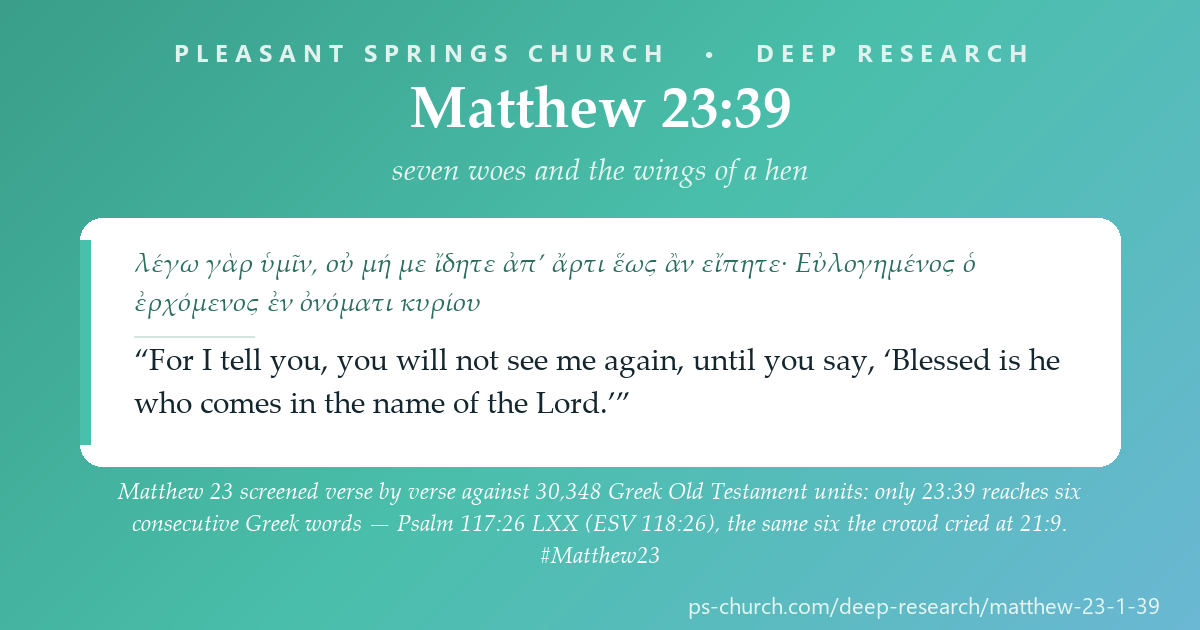
One verse reaches six, and four tie at five. The six is Εὐλογημένος ὁ ἐρχόμενος ἐν ὀνόματι κυρίου at 23:39, the first six of the eleven words of Psalm 117:26 LXX (εὐλογημένος ὁ ἐρχόμενος ἐν ὀνόματι κυρίου εὐλογήκαμεν ὑμᾶς ἐξ οἴκου κυρίου), which goes on ἐξ οἴκου κυρίου, from the house of the Lord; in Matthew the verse before it is “your house is left to you desolate”. The same six words stand in five verses of the Greek New Testament (Matthew 21:9, Matthew 23:39, Mark 11:9, Luke 13:35, John 12:13) and, of the held Greek Old Testament, only in the psalm. In Matthew they stand at 21:9 and 23:39: against the rest of the Gospel, 23:39’s deepest row is 6 with 21:9, tie band 1, and no other verse of chapter 23 goes beyond 4. The crowd’s welcome on the road in and the last sentence Jesus speaks in the temple are the same six words; at 24:1 he leaves the temple.
| Matthew | deepest run | tie band | partner | what it is |
|---|---|---|---|---|
| 23:39 | 6 | 1 | Psalm 117:26 LXX (ESV 118:26) | The blessing, as at 21:9 (6, band 1) |
| 23:35 | 5 | 1 | Genesis 41:31 | Counter-example: Joseph’s famine |
| 23:22 | 5 | 1 | Psalm 77:10 LXX | Counter-example: an accident |
| 23:30 | 5 | 1 | Joel 1:2 | In the days of the fathers: a phrase |
| 23:15 | 5 | 3 | Jonah 1:9; Haggai 2:6, 2:21 | The sea and the dry land |
| 23:2 | 4 | 1 | 2 Chronicles 19:11 | The scribes and the: Jehoshaphat’s officials |
| 23:7 | 4 | 1 | Song of Songs 3:2 | Counter-example: the bride in the markets |
| 23:34 | 4 | 13 | Amos, Ezekiel … | Therefore behold I: a formula |
| 23:37 | 3 | 28 | — | The lament: shallow against the Old Testament |
| 23:38 | 2 | 130 | — | The house: two words, a band of 130 |
The four fives are the page’s first counter-examples. 23:35 — the verse with Abel and Zechariah in it — reaches five with Genesis 41:31, ἐπὶ τῆς γῆς ἀπὸ τοῦ, a sentence about Joseph’s famine, tie band one. 23:22 reaches five with Psalm 77:10 LXX, τοῦ θεοῦ καὶ ἐν τῷ, tie band one. A tie band of one is not a citation. The texts that the verse is about measure far lower, and that is the next table.
The texts set beside the chapter, measured
| Matthew 23 | the text | run | what is shared |
|---|---|---|---|
| 23:35 | Zechariah 1:1 | 1 | one form |
| 23:35 | Isaiah 8:2 | 1 | Βαραχιου |
| 23:35 | 2 Chronicles 24:20–22 | 1 / 1 / 1 | one form each |
| 23:35 | Genesis 4:8 / 4:10 | 1 / 2 | of the earth |
| 23:35 | Lamentations 4:13 | 2 | αἷμα δίκαιον |
| 23:37 | Deuteronomy 32:11 | 2 | τὰς πτέρυγας |
| 23:37 | Ruth 2:12 / Psalm 90:4 LXX | 3 / 3 | ὑπὸ τὰς πτέρυγας |
| 23:37 | Psalms 16:8, 35:8, 56:2, 60:5 LXX | 1 / 1 / 1 / 1 | no wing-form: the psalms have the genitive, Matthew the accusative |
| 23:38 | Jeremiah 22:5 | 2 | ὁ οἶκος |
| 23:38 | Jeremiah 12:7 | 0 | no word form |
| 23:38 | Psalm 68:26 LXX (ESV 69:25) | 1 | the article |
| 23:23 | Leviticus 27:30 / Deuteronomy 14:22 | 1 / 1 | one form |
| 23:23 | Micah 6:8 / Hosea 12:7 LXX | 1 / 1 | and |
| 23:27 | Ezekiel 13:10 / Deuteronomy 27:2 / Proverbs 21:9 | 1 / 1 / 1 | and (Proverbs 21:9 also the participle, not adjacent); see below |
| 23:5 | Exodus 13:9 / Deuteronomy 6:8 / Numbers 15:38 | 1 / 1 / 2 | a pronoun and and |
The screen finds verbatim contact, not allusion, and the table says so plainly: every text in it is a real background to the chapter in the sense the commentaries mean, and none shares more than three consecutive word forms with it. What the screen can see is the single word and the phrase, and that is where the rest of this stage looks.
23:35 — Abel to Zechariah son of Barachiah
so that on you may come all the righteous blood shed on earth, from the blood of righteous Abel to the blood of Zechariah the son of Barachiah, whom you murdered between the sanctuary and the altar.
Abel and the two Zechariahs · Genesis 4:10; 2 Chronicles 24:20–22; Zechariah 1:1; Isaiah 8:2
Hebrew · Greek OT · ESVThe name. In the Hebrew Bible Zechariah and Berechiah (at Isaiah 8:2 the longer Jeberechiah) stand together in three verses (Isaiah 8:2; Zechariah 1:1, 1:7), and Zechariah and Jehoiada in one (2 Chronicles 24:20). The Greek held here has Zachari- with Barachi- in the same three verses, and in 2 Chronicles 24 it has no Zachari- form at all: the priest is τὸν Αζαριαν τὸν τοῦ Ιωδαε τὸν ἱερέα. On the stems, the order Zachari-, son, Barachi- as Matthew has it — Ζαχαρίου υἱοῦ Βαραχίου — stands in one Greek Old Testament verse, Isaiah 8:2, τὸν Ζαχαριαν υἱὸν Βαραχιου, where the Hebrew has Jeberechiah; Zechariah 1:1 has Ζαχαριαν τὸν τοῦ Βαραχιου υἱὸν Αδδω. These are observations about strings. None of the three Greek verses with the patronym describes a murder.
The place. μεταξὺ τοῦ ναοῦ καὶ τοῦ θυσιαστηρίου: the phrase stands in no other verse of the Greek New Testament, and Luke has ἕως αἵματος Ζαχαρίου τοῦ ἀπολομένου μεταξὺ τοῦ θυσιαστηρίου καὶ τοῦ οἴκου. Chronicles has ἐν αὐλῇ οἴκου κυρίου / בַּחֲצַר בֵּית יְהֹוָה, in the court of the house of the Lord. The Hebrew Bible has the two-point phrase between the porch and the altar in two verses: Joel 2:17, בֵּין הָאוּלָם וְלַמִּזְבֵּחַ, “Between the vestibule and the altar let the priests” weep (the Greek has ἀνὰ μέσον τῆς κρηπῖδος τοῦ θυσιαστηρίου, between the base of the altar), and Ezekiel 8:16, where men stand there with their backs to the temple. Matthew’s run with Joel 2:17 is 2.
The blood. πᾶν αἷμα δίκαιον ἐκχυννόμενον: the adjacent pair blood + righteous stands in no other verse of the Greek New Testament, and in four screened Greek Old Testament units (Joel 4:19, Jonah 1:14, Lam 4:13, Prov 6:17). One of them is Lamentations 4:13, τῶν ἐκχεόντων αἷμα δίκαιον ἐν μέσῳ αὐτῆς, “the sins of her prophets and the iniquities of her priests, who shed in the midst of her the blood of the righteous”. Abel’s name stands beside Cain’s in five screened units: four in Genesis 4 and τὸν ἀναιρεθέντα Αβελ ὑπὸ Καιν ἀνεγίνωσκέν τε ὑμῖν (4 Maccabees 18:11), he used to read to you of Abel, slain by Cain (our rendering), a mother recalling her husband’s teaching. And the patronym that Matthew alone has is not in the apparatus held here: the SBLGNT apparatus has no entry at 23:35. Stage 5 sets out the readings.
23:37–39 — the hen, the house, and the psalm
O Jerusalem, Jerusalem, the city that kills the prophets and stones those who are sent to it! How often would I have gathered your children together as a hen gathers her brood under her wings, and you were not willing!
Against Luke the lament is nearly verbatim; against the Old Testament it is not. Ἰερουσαλὴμ Ἰερουσαλήμ, ἡ ἀποκτείνουσα τοὺς προφήτας καὶ λιθοβολοῦσα τοὺς ἀπεσταλμένους πρὸς αὐτήν— ποσάκις ἠθέλησα is fourteen consecutive words of Luke 13:34, tie band 1; then the two diverge at the infinitive, and Luke’s hen gathers ὄρνις τὴν ἑαυτῆς νοσσιὰν. Against the Greek Old Testament 23:37’s deepest run is 3 with a band of 28.
The wings. The image of refuge under God’s wings is the Psalter’s and Ruth’s, and the measurement shows how little of its wording is Matthew’s. ὑπὸ τὰς πτέρυγας stands in three screened Greek Old Testament units: Ruth 2:12, ὑπὸ τὰς πτέρυγας αὐτοῦ (“under whose wings you have come to take refuge”; Hebrew תַּחַת־כְּנָפָיו), Psalm 90:4 LXX, ὑπὸ τὰς πτέρυγας αὐτοῦ ἐλπιεῖς (“under his wings you will find refuge”; the Greek has you will hope), and 3 Kingdoms 8:6, the cherubim over the ark. Only one screened unit has a wing-form beside a noss- or neoss- form (nest, nestling), Deuteronomy 32:11, the eagle: “Like an eagle that stirs up its nest, that flutters over its young, spreading out its wings”. The Greek there differs from the Hebrew: ὡς ἀετὸς σκεπάσαι νοσσιὰν αὐτοῦ καὶ ἐπὶ τοῖς νεοσσοῖς αὐτοῦ ἐπεπόθησεν, as an eagle to shelter its nest, and over its young it yearned (our rendering), where the Hebrew כְּנֶשֶׁר יָעִיר קִנּוֹ עַל־גּוֹזָלָיו יְרַחֵף has stirs up and hovers. And only one screened unit has a wing-form beside a form of synagō or episynagō, gather (searched unanchored, augments included): Isaiah 11:12, συνάξει ἐκ τῶν τεσσάρων πτερύγων τῆς γῆς, he will gather from the four wings of the earth (our rendering) — the dispersed of Israel and Judah. No form of ὄρνις stands beside a wing in the Greek Old Testament.
See, your house is left to you desolate.
The house. Jeremiah 22:5 LXX, εἰς ἐρήμωσιν ἔσται ὁ οἶκος οὗτος (Hebrew כִּי־לְחׇרְבָּה יִהְיֶה הַבַּיִת הַזֶּה; “this house shall become a desolation”), measures 2 against ὁ οἶκος ὑμῶν ἔρημος, and Jeremiah 12:7, ἐγκαταλέλοιπα τὸν οἶκόν μου ἀφῆκα τὴν κληρονομίαν μου (“I have forsaken my house; I have abandoned my heritage”), measures 0 — though its ἀφῆκα is the verb of Matthew’s ἀφίεται in another form. Psalm 68:26 LXX, γενηθήτω ἡ ἔπαυλις αὐτῶν ἠρημωμένη (“May their camp be a desolation”), measures 1. The pair ὁ οἶκος ὑμῶν in the nominative stands in no screened Greek Old Testament unit, and in the Greek New Testament in Matthew 23:38, Luke 13:35. And the one word that ties 23:38 to Jeremiah’s desolation is the word an edition lacks: ἔρημος Treg NA28 RP ] – WH.
For I tell you, you will not see me again, until you say, ‘Blessed is he who comes in the name of the Lord.’
23:23 and 23:27 — the weightier matters, and the plaster
Woe to you, scribes and Pharisees, hypocrites! For you tithe mint and dill and cumin, and have neglected the weightier matters of the law: justice and mercy and faithfulness. These you ought to have done, without neglecting the others.
The triad. τὴν κρίσιν καὶ τὸ ἔλεος καὶ τὴν πίστιν — justice, mercy and faith. Micah 6:8 and Hosea 12:7 LXX (ESV 12:6) are the texts usually set beside it, and in Greek each has two of the three: Micah τοῦ ποιεῖν κρίμα καὶ ἀγαπᾶν ἔλεον καὶ ἕτοιμον εἶναι τοῦ πορεύεσθαι, to do judgement, love mercy, and be ready to walk (our rendering) — where the Hebrew וְהַצְנֵעַ לֶכֶת is to walk humbly (“to do justice, and to love kindness, and to walk humbly with your God”) — and Hosea ἔλεον καὶ κρίμα φυλάσσου καὶ ἔγγιζε πρὸς τὸν θεόν σου, keep mercy and judgement and draw near to your God (our rendering), where the Hebrew has וְקַוֵּה, and wait (“hold fast to love and justice, and wait continually for your God”). Both have krima where Matthew has krisis. Searched unanchored, seventeen screened Greek Old Testament units have a kris- or krima form beside a form of eleos (twenty-six if every ele- form is counted, eleēmosynē and eleeō included; none of those has a faith-word either). Two of them also hold the letters pist-, and neither is a faith-word: ἐπιστρέψεις (Hosea 12:7, you will return) and ἐπιστήμῃ (Psalms of Solomon 2:33, knowledge). None of the seventeen has a form of πίστις, pistos or pisteuō; in the Greek New Testament the three nouns together stand only at 23:23. In these files, faith is the member of the triad that never stands with the other two.
Woe to you, scribes and Pharisees, hypocrites! For you are like whitewashed tombs, which outwardly appear beautiful, but within are full of dead people’s bones and all uncleanness.
The plaster. The English whitewash points to Ezekiel 13:10, “these prophets smear it with whitewash” — but the Greek of Ezekiel 13 has αὐτοὶ ἀλείφουσιν αὐτόν, they smear it, a form of aleiphō in five verses of the chapter, and no form of Matthew’s verb anywhere in it; the Hebrew is טָחִים אֹתוֹ תָּפֵל. The link is in the English, not in the Greek. Matthew’s verb stands in three screened Greek Old Testament units. Two are Deuteronomy 27:2 and 27:4, the stones of the law at Ebal, κονιάσεις αὐτοὺς κονίᾳ (“plaster them with plaster”; Hebrew וְשַׂדְתָּ אֹתָם בַּשִּׂיד). The third holds the form κεκονιαμένοις exactly, and it is the only screened unit that does: Proverbs 21:9, κρεῖσσον οἰκεῖν ἐπὶ γωνίας ὑπαίθρου ἢ ἐν κεκονιαμένοις μετὰ ἀδικίας καὶ ἐν οἴκῳ κοινῷ, better to live in a corner under the open sky than in plastered rooms with injustice, and in a house held in common (our rendering). The Hebrew has no plaster: וּבֵית חָבֶר, “a house shared with a quarrelsome wife”. So the one Greek Old Testament sentence with Matthew’s exact word sets ἐν κεκονιαμένοις μετὰ ἀδικίας beside each other, and Matthew 23:28 names ὑποκρίσεως καὶ ἀνομίας inside. The pair measures 1: no two consecutive words, and two single words in common, and and κεκονιαμένοις itself. The page reports the coincidence of the word and makes nothing more of it.
The woes against Isaiah 5 and Habakkuk 2 — and against Luke 11
A woe series is a prophetic form. Isaiah 5 has six units with οὐαὶ in Greek (5:8, 5:11, 5:18, 5:20, 5:21, 5:22) and the same six with הוֹי in Hebrew; the first is οὐαὶ οἱ συνάπτοντες οἰκίαν πρὸς οἰκίαν (“Woe to those who join house to house”). Habakkuk 2 is a case where the Greek and the Hebrew differ. The Hebrew has הוֹי five times (2:6, 2:9, 2:12, 2:15, 2:19); the Greek has οὐαὶ ὁ πληθύνων… at three of them and the interjection ὦ ὁ πλεονεκτῶν… at the other two (2:9, 2:15). Matthew’s seven woes share one or two consecutive words with either series — 23:13 measures 1 against Isaiah 5:8, and 23:16 measures 2 against Isaiah 5:20 (οἱ λέγοντες) — and the pair Οὐαὶ ὑμῖν, woe to you, stands in two screened units, Sirach 2:14 and 41:8. The form is the prophets’; the wording measured here is Matthew’s own.
Against Luke 11. No verse of Matthew 23 shares more than six consecutive word forms with any verse of Luke 11; the two that reach it are 23:23 and 23:7. Against the whole New Testament outside Matthew:
| deepest run, at least | 14 | 7 | 6 | 5 | 4 | 3 | 2 |
|---|---|---|---|---|---|---|---|
| verses of Matthew 23 | 1 | 2 | 5 | 7 | 12 | 32 | 38 |
| Matthew 23 | Luke | longest shared run | what differs |
|---|---|---|---|
| 23:37 | 13:34 | 14 | the hen gathers τὰ νοσσία αὐτῆς / ὄρνις τὴν ἑαυτῆς νοσσιὰν |
| 23:39 | 13:35 | 7 | the six words of the psalm, with you say before them |
| 23:38 | 13:35 | 6 | Luke has no desolate in the SBLGNT |
| 23:23 | 11:42 | 6 | dill and cumin / rue and every herb |
| 23:7 | 11:43 | 6 | the greetings in the marketplaces |
| 23:25 | 11:39 | 5 | a woe in Matthew; not a woe in Luke |
| 23:29 | 11:47 | 3 | tombs and monuments / monuments |
| 23:34 | 11:49 | 3 | I send / the wisdom of God said |
| 23:35 | 11:51 | 2 | son of Barachiah / no father named; the sanctuary and the altar / the altar and the house |
| 23:27 | 11:44 | 2 | plastered tombs / unmarked graves |
| 23:13 | 11:52 | 2 | you shut the kingdom / the key of knowledge |
The order differs too. Luke’s six woes run tithes, seats and greetings, graves, burdens, tombs, key; Matthew’s seven run kingdom, convert, oaths, tithes, cup, tombs, tombs. Luke’s cup and dish (11:39) is not a woe, and Matthew’s seats and greetings (23:6–7) are not either. The lament of 23:37 stands in Luke two chapters later, at 13:34. These are facts about the texts we hold. Which way the material travelled, or whether both drew on something older, the measurement cannot decide, and the page does not.
One more counter-example, against the page’s own instinct. The verse the Robinson–Pierpont text and the TR print at 23:13 or 23:14 — the woe on widows’ houses — measures 8 consecutive words with Mark 12:40 and 7 with Luke 20:47, deeper than any of Matthew’s seven woes reaches with Luke 11. A deep run is evidence of shared wording, and nothing else; it does not say which text is earlier.
Where the chapter is read in more than one way, the readings are set out with their reported holders and what the texts show; then the limits.
Who is the Zechariah of 23:35?
| who is the Zechariah of 23:35? | reported holders | what the texts held here show |
|---|---|---|
| 1. Zechariah son of Jehoiada, stoned in the temple court (2 Chronicles 24:20–22); with Abel, the first and last named martyrs of the Hebrew Bible in its traditional order, Genesis to Chronicles (the order narrates later killings, 2 Chronicles 24:25 among them). The patronym son of Barachiah is then explained by one of the next two rows. | most commentators (reported) | The Masoretic corpus held here ends with 2 Chronicles 36:23. The Greek of 24:20 names the priest τὸν Αζαριαν τὸν τοῦ Ιωδαε τὸν ἱερέα. The traditional order is reported (it is not the Greek Old Testament’s). |
| 2. A conflation of two Zechariahs — the murdered priest and the prophet son of Berechiah — in the tradition before Matthew, in Matthew, or in early copying. | many (reported) | The apparatus held has no entry at 23:35. Codex Sinaiticus is reported to lack son of Barachiah (the NPNF editor, in a note to Theodoret, Ecclesiastical History 4.7: the probably interpolated words son of Barachias which are a difficulty in Matt. xxiii. 35, and do not appear in the Codex Sinaiticus.); the page did not check a manuscript. |
| 3. Identification by grandfather or ancestor: son of naming a forebear, as the prophet is son of Berechiah son of Iddo at Zechariah 1:1 and son of Iddo at Ezra 5:1 and 6:14. | some (reported) | In the Hebrew Bible Zechariah stands with Iddo in five verses; the Greek of Ezra 5:1 has Ζαχαριας ὁ τοῦ Αδδω. No text held here gives Jehoiada a father named Berechiah. |
| 4. The prophet Zechariah son of Berechiah, himself held to have been murdered. | some (reported); later legend reported | No text held here records the prophet’s death. |
| 5. A different Zechariah: Zacharias son of Baris, killed in the temple by the Zealots in AD 67–68 (Josephus, Jewish War 4.334–344, reported); or Zacharias the father of John the Baptist, as in the Protevangelium of James 23–24. | some modern scholars (reported); the Protevangelium (held) | Josephus is not held; the report is not checked. The Protevangelium is held (Stage 2). |
The shelf’s Luke 11 study (Luke 11) reports the same texts for Luke’s fatherless Zechariah. This page does not choose among the readings.
23:39 — a promise, a judgement, or a condition?
| 23:39: until you say, Blessed is he who comes | reported holders | what the text shows |
|---|---|---|
| 1. A promise: Jerusalem will one day welcome him, read with Romans 11:26 and Zechariah 12:10 as a future turning of Israel to its Messiah. | many, including historic premillennial readers (reported) | The sentence names a condition with ἕως ἂν εἴπητε. |
| 2. A judgement: the acclamation will be made at his coming, too late, when every knee bows. | some (reported) | The next chapter is the discourse on the end (24:3). |
| 3. A conditional prophecy: he will not be seen until the city says it; whether it will is left open. | Dale C. Allison and others (reported) | — |
| 4. Fulfilled at the entry. Some read Luke 13:35 this way, since in Luke the multitude of the disciples cries the words, with the king among them, later, at 19:38. | some, on Luke (reported) | In Matthew this is not available: the crowd has already cried the six words at 21:9, two chapters before. |
The church’s eschatology is historic premillennial and does not follow the Darby–Scofield scheme; it has ratified no reading of this verse, and the page chooses none.
23:8–10 — titles
| 23:8–10: call no one Rabbi, father, instructor | reported holders | what the text shows |
|---|---|---|
| 1. Against claiming what belongs to God, not against the words: the title may be given, the authority of the one Father may not be taken. | Catholic and Orthodox readers, and many Protestants (reported) | Paul speaks of ἀλλ’ οὐ πολλοὺς πατέρας and of having begotten the Corinthians (1 Corinthians 4:15); Stephen opens Ἄνδρες ἀδελφοὶ καὶ πατέρες (Acts 7:2). |
| 2. Against religious honorifics as such: no titles for teachers or clergy. | some Protestant, Anabaptist and Quaker traditions (reported) | The three nouns are titles of address in 23:7–10. |
| 3. A word to a community of brothers, aimed at rank among disciples (“you are all brothers”), with 23:11–12 as its point. | many commentators (reported) | 23:11–12 follow at once with the greatest as the attendant. |
The church has ratified no position on titles, and the page takes none.
How the woes have been read, and misread
The woes are addressed to scribes and Pharisees, and they have been read against Jews. In Christian history the chapter, with 27:25, is reported to have been used to blame Jews as a people for the death of Jesus and the prophets, and the word Pharisee to have become a byword for any hypocrite (reported). Since the mid-twentieth century many interpreters, Jewish and Christian, have read the chapter as an intra-Jewish dispute in the idiom of Israel’s prophets, and have revised older portraits of the Pharisees (reported). The texts on this page support only what they say: the address is to a class of teachers (23:2, 23:13), the hearers are told to do what those teachers say (23:3), the lament is over a city (23:37), and the Greek of Psalms of Solomon 4 shows a Jewish writer making the same kind of charge (Stage 2).
The church’s Statement of Beliefs, Article 7, The Church, says: The Church fails whenever it replaces mercy with legalism or grace with performance. That sentence is the right place for a reader of this chapter to begin.
What this page could not check — and where it is weakest
- No manuscript apparatus was consulted. The SBLGNT apparatus held here compares printed editions (Westcott–Hort, Tregelles, NA28, the NIV’s Greek, Robinson–Pierpont, the TR), not manuscripts, and it has no entry at 23:35. The report that Codex Sinaiticus lacks son of Barachiah comes from an editor’s note in the Nicene and Post-Nicene Fathers and was not checked against the manuscript. 23:14 is printed by the RP and the TR and not by WH, Tregelles or NA28, on this apparatus; the manuscript evidence for it was not examined.
- Rahlfs only. The Greek Old Testament is one printed text. Whether some Greek manuscripts of 2 Chronicles 24:20 read Zacharias where Rahlfs reads Azarias was not checked; nor whether other Greek texts of Proverbs 21:9 or Ezekiel 13 read otherwise.
- Not held: Josephus, the Mishnah, the Talmud, the Targums, the midrashim, Jerome’s commentary on Matthew, and the lexicons. Every statement drawn from them — Moses’ seat as furniture, the tithing of dill and cumin, the marking of tombs, Zacharias son of Baris, the legend of the seething blood, the Nazarene reading son of Jehoiada, the ordinary sense of phylaktērion — is marked reported and is unchecked. The Protevangelium, Origen, Chrysostom and the NPNF note are quoted from the Ante-Nicene and Nicene Fathers held here.
- No Hebrew screen of Matthew. The measurements are Greek against Greek. The Hebrew is printed where the Greek and the Hebrew differ and a claim leans on the difference.
- The woe-structure counts depend on a stop-list. Nouns, verbs and adjectives by the MorphGNT part-of-speech column, less six words of the address formula. A different list would move the pair counts by a word or two; it would not, on these figures, make the mirror pairs outscore the neighbours.
- Our renderings were checked by machine against the KJV and every ESV verse cached for this page, and by eye against the ESV, NRSV and NIV wording, which this shelf does not hold in full.
- Tie bands are properties of the corpus searched. A band of one over 30,348 units is not a claim about every Greek text that existed. With the Odes put back (30,637 units) every run on this page stands, no band printed on this page moves, and six bands the page does not print move by one to eight (23:6, 23:16, 23:21, 23:23, 23:26, 23:36).
- Nothing here establishes direction of influence. The page reports where words stand in Matthew, Luke and the Greek Old Testament, and does not say which text depends on which.
Do what they say; watch what you do; and listen to the lament.
Name what you learned, why it matters, and one concrete response.
What should we carry away — and do?
- The woes are for teachers, and for any of us who teach. “For they preach, but do not practice”. The chapter is aimed at people who handle Scripture for others; a church that reads it as being about someone else has missed it.
- The weightier matters are named. “justice and mercy and faithfulness” — and “without neglecting the others”. The small obedience is not mocked; the large one is not to be traded for it.
- Outside and inside. The fifth and sixth woes share the pair outside / inside (23:25–28). A plastered tomb is clean to look at and full of what defiles.
- The lament is the last word. “How often would I have gathered your children together as a hen gathers her brood under her wings”. The chapter of woes ends in grief, not in contempt.
- The last sentence is a psalm of welcome. “Blessed is he who comes in the name of the Lord” — the words of 21:9, and the chapter’s only run of six against the Greek Old Testament.
Step in response: read 23:2–12 and write down one thing you say that you do not do. Then read 23:37 aloud, and notice who is speaking, and how.
Matthew 23:39 · to share
Greek NT + ESVEvery Deep Research page traces its passage across the whole sweep — the Old Testament, the Second-Temple world between the testaments (historical witnesses, not Scripture), and the New Testament. Follow the thread:
Related on the shelf. Matthew 21, where the crowd first cries the six words of Psalm 117:26; Matthew 22, the questions that end in silence before this chapter; Matthew 24–25, the discourse that follows; Matthew 12, the first offspring of vipers on Jesus’ lips; Luke 11, the woes at a Pharisee’s table and Luke’s Zechariah; Luke 12–13, the lament in Luke; Mark 12, the scribes’ long robes and the widows’ houses; Psalm 118, the psalm; 2 Chronicles 23–27, Jehoiada and his son; Zechariah 1–8, the prophet son of Berechiah, and the fringe of 8:23; Isaiah 8–11, the witness Zechariah and the four wings of the earth; Genesis 4, Abel; Lamentations, the righteous blood in the city; Joel, between the porch and the altar; Deuteronomy 32, the eagle; Ruth 2, under his wings; Psalms 90–92, the refuge; Psalms 15–17, the shadow of your wings; Jeremiah 21–24 and Jeremiah 11–15, the house forsaken; Psalm 69, the desolate camp; Micah and Hosea 9–14, justice and mercy; Leviticus 27 and Deuteronomy 14–15, the tithe; Exodus 13, Deuteronomy 6 and Numbers 15, the sign and the tassel; Numbers 18–19, the impurity of the dead; Deuteronomy 27, the plastered stones; Proverbs 16–22, the plastered rooms; Ezekiel 12–16, the smeared wall; Isaiah 1–6 and Habakkuk, the woe series; Acts 22–23, the plastered wall; Psalms 1–2, the seat; 4 Maccabees 8–18, Abel read to the children; Psalms of Solomon 1–9, the profane one in the council. Our church’s Statement of Beliefs.
Pleasant Springs Church — Deep Research
Research method after Michael S. Heiser’s Bible Research Method (examine dictionaries → ancient literature → important words → textual connections → academic publications → share), with the Pleasant Springs “Author & Audience” foundation. Scripture set in the Hebrew, the Greek editions named on each page and the ESV (Old Testament), and the Greek New Testament and the ESV (New Testament), per the practice of Pleasant Springs Church. Matthew works named on this page (none re-read for it): Davies and Allison, Luz, France, Keener, Nolland, Garland, Newport, Sanders, Saldarini and Allison’s JSNT article — none of which were consulted for any number on this page. Text: Greek New Testament from the SBL edition as digitized by MorphGNT (text, parsing and lemma columns); SBLGNT apparatus, Michael W. Holmes (ed.), Society of Biblical Literature and Logos Bible Software, CC BY 4.0; Greek Old Testament from Rahlfs’ Septuaginta as digitized by CATSS; Hebrew and Aramaic from the Masoretic text as printed in Sefaria’s Miqra according to the Masorah; the Protevangelium of James and Origen from the Ante-Nicene Fathers, John Chrysostom and the editor’s note to Theodoret, Ecclesiastical History 4.7, from the Nicene and Post-Nicene Fathers. ⚠️ VERSE NUMBERING. The SBLGNT numbers Matthew 23 1–39 with no verse 14 (38 verses); the KJV has 39. Psalm 118:26 = LXX 117:26; Psalm 91:4 = LXX 90:4; ESV Psalm 69:25 = MT 69:26 = LXX 68:26; ESV Hosea 12:6 = MT and LXX 12:7; ESV 1 Kings 4:23 = MT 5:3 = 3 Kingdoms 5:3. ⚠️ The measurement, in full. Greek against Greek; MorphGNT normalised word; CATSS form column; accents and breathings dropped, final sigma folded, with the shelf’s edition-equivalence table on cross-corpus screens. Contiguous runs of whole word forms, never lemmas. 38 rows against 30,348 verse units — the 64 CATSS files less the Odes — and against the 6,859 verses of the Greek New Testament outside Matthew. Form and co-occurrence searches are unanchored regular expressions over the same normalised forms. Hebrew phrase counts consonantal, over 23,204 Masoretic verse units. Exhaustive and deterministic. It finds verbatim contact, not allusion.
Scripture quotations marked ESV are from the ESV® Bible (The Holy Bible, English Standard Version®), © 2001 by Crossway, a publishing ministry of Good News Publishers. ESV Text Edition: 2016. Used by permission. All rights reserved. The ESV text may not be quoted in any publication made available to the public by a Creative Commons license, and the ESV may not be translated in whole or in part into any other language. www.esv.org
|
Did this study bless you today? 💚 Give to Support PS Church100% of gifts go to the General Fund — thank you. |