Deep Research • John · 3:1–4:54

One Word Between

John 3:1–4:54 — Nicodemus by night, the wind and the serpent, the bridegroom’s friend, the woman at the well at noon, this mountain, and the one speaking

Every one of the 90 verses of John 3–4 was screened against all 30,348 screened verse units of the Greek Old Testament held here. No row goes past five consecutive words, and the three that reach five are an accident in Joshua and two formulas. Moses’ serpent, Ezekiel’s water and Spirit, Jeremiah’s fountain and Jacob’s field measure two words or fewer each; Genesis 48:22 shares no word form with John 4:5 at all. Then the woman says the Messiah will tell us all things, and Jesus answers Ἐγώ εἰμι, ὁ λαλῶν σοι — “I who speak to you am he”. One verse of the Greek Old Testament held here has Ἐγώ εἰμι followed, one word later, by ὁ λαλῶν: Isaiah 52:6, ἐγώ εἰμι αὐτὸς ὁ λαλῶν, “it is I who speak”. One word stands between, αὐτὸς, and because of it a run screen scores the pair two and leaves Isaiah out of the eighteen units it ties John 4:26 with. The page prints that verse beside its counter-examples, and beside three other things the corpora show: the only Greek Old Testament verse with John 4’s own three words for the source and its water, spring, well and living (Song of Songs 4:15); a serpent set on a sign in Greek Numbers, where John has lifted up; and the Samaritan Pentateuch, held here, reading Gerizim at Deuteronomy 27:4 where the Hebrew and the Greek read Ebal. It never says which text came first. See the method →

The Passage

John 3:1–4:54

Greek NT · ESV or our rendering
Ἦν δὲ ἄνθρωπος ἐκ τῶν Φαρισαίων, Νικόδημος ὄνομα αὐτῷ, ἄρχων τῶν Ἰουδαίων·3:1Among the Pharisees was a man, Nicodemus by name, one of the Jewish rulers. (our rendering; the ESV of this verse is not printed here)Translation noteΝικόδημος stands five times in the Greek New Testament, all in John (3:1, 3:4, 3:9, 7:50, 19:39).
οὗτος ἦλθεν πρὸς αὐτὸν νυκτὸς καὶ εἶπεν αὐτῷ· Ῥαββί, οἴδαμεν ὅτι ἀπὸ θεοῦ ἐλήλυθας διδάσκαλος· οὐδεὶς γὰρ δύναται ταῦτα τὰ σημεῖα ποιεῖν ἃ σὺ ποιεῖς, ἐὰν μὴ ᾖ ὁ θεὸς μετ’ αὐτοῦ.3:2This man came to Jesus by night and said to him, “Rabbi, we know that you are a teacher come from God, for no one can do these signs that you do unless God is with him.”Translation noteνυκτὸς: the only token of νύξ in John 3–4; at 19:39 John recalls him as ὁ ἐλθὼν πρὸς αὐτὸν νυκτὸς τὸ πρῶτον. And ταῦτα τὰ σημεῖα: the noun σημεῖον stands in John 3–4 three times, here, 4:48 and 4:54 (Stage 4).
ἀπεκρίθη Ἰησοῦς καὶ εἶπεν αὐτῷ· Ἀμὴν ἀμὴν λέγω σοι, ἐὰν μή τις γεννηθῇ ἄνωθεν, οὐ δύναται ἰδεῖν τὴν βασιλείαν τοῦ θεοῦ.3:3Jesus answered him: Amen, amen, I say to you, without being born from above (or: anew), no one is able to see God’s kingdom. (our rendering; the ESV of this verse is not printed here)Translation noteγεννηθῇ ἄνωθεν: the adverb ἄνωθεν can mean from above or again, anew, and the Greek does not choose (Stage 3). Against the rest of John 3–4 this verse and 3:5 share eight words in a row, the deepest pair inside the passage.
λέγει πρὸς αὐτὸν ὁ Νικόδημος· Πῶς δύναται ἄνθρωπος γεννηθῆναι γέρων ὤν; μὴ δύναται εἰς τὴν κοιλίαν τῆς μητρὸς αὐτοῦ δεύτερον εἰσελθεῖν καὶ γεννηθῆναι;3:4Nicodemus said to him, “How can a man be born when he is old? Can he enter a second time into his mother’s womb and be born?”Translation noteNicodemus hears it as δεύτερον, a second time.
ἀπεκρίθη Ἰησοῦς· Ἀμὴν ἀμὴν λέγω σοι, ἐὰν μή τις γεννηθῇ ἐξ ὕδατος καὶ πνεύματος, οὐ δύναται εἰσελθεῖν εἰς τὴν βασιλείαν τοῦ θεοῦ.3:5Jesus answered, “Truly, truly, I say to you, unless one is born of water and the Spirit, he cannot enter the kingdom of God.Translation noterun 6, tie band 2: εἰσελθεῖν εἰς τὴν βασιλείαν τοῦ θεοῦ with Mark 9:47 and Acts 14:22. ἐξ ὕδατος καὶ πνεύματος has one preposition for both nouns, and the phrase stands nowhere else in the Greek New Testament or in a screened Greek Old Testament unit. Against Ezekiel 36:25, 26 and 27 the row measures one each (Stage 4).
τὸ γεγεννημένον ἐκ τῆς σαρκὸς σάρξ ἐστιν, καὶ τὸ γεγεννημένον ἐκ τοῦ πνεύματος πνεῦμά ἐστιν.3:6What has its birth from flesh is flesh; what has its birth from the Spirit is spirit. (our rendering; the ESV of this verse is not printed here)Translation noteἐκ τῆς σαρκὸς shares three words with Ezekiel 36:26, ἐκ τῆς σαρκὸς — more than 3:5 shares with any of Ezekiel’s three verses. An accident: Ezekiel’s words are the heart of stone taken out of your flesh (Stage 4 prints it as a counter-example).
μὴ θαυμάσῃς ὅτι εἶπόν σοι Δεῖ ὑμᾶς γεννηθῆναι ἄνωθεν.3:7Do not wonder at my telling you, You (plural) must be born from above. (our rendering; the ESV of this verse is not printed here)Translation noteγεννηθῆναι ἄνωθεν, and the pronoun is plural: ὑμᾶς.
τὸ πνεῦμα ὅπου θέλει πνεῖ, καὶ τὴν φωνὴν αὐτοῦ ἀκούεις, ἀλλ’ οὐκ οἶδας πόθεν ἔρχεται καὶ ποῦ ὑπάγει· οὕτως ἐστὶν πᾶς ὁ γεγεννημένος ἐκ τοῦ πνεύματος.3:8The wind blows where it wishes, and you hear its sound, but you do not know where it comes from or where it goes. So it is with everyone who is born of the Spirit.Translation noteπνεῦμα twice in one verse: τὸ πνεῦμα ὅπου θέλει πνεῖ, and ἐκ τοῦ πνεύματος. The ESV renders the first The wind blows and the second born of the Spirit; the Greek uses one word. Stage 4 sets it beside Ecclesiastes 11:5.
ἀπεκρίθη Νικόδημος καὶ εἶπεν αὐτῷ· Πῶς δύναται ταῦτα γενέσθαι;3:9Nicodemus answered him: How is it possible for these things to happen? (our rendering; the ESV of this verse is not printed here)
ἀπεκρίθη Ἰησοῦς καὶ εἶπεν αὐτῷ· Σὺ εἶ ὁ διδάσκαλος τοῦ Ἰσραὴλ καὶ ταῦτα οὐ γινώσκεις;3:10Jesus answered him: You are the teacher of Israel, and these things you do not know? (our rendering; the ESV of this verse is not printed here)Translation noterun 5, tie band 1 with Matthew 11:3, εἶπεν αὐτῷ· Σὺ εἶ ὁ; inside John, Pilate’s question at 18:33 shares six, καὶ εἶπεν αὐτῷ· Σὺ εἶ ὁ. A question formula.
ἀμὴν ἀμὴν λέγω σοι ὅτι ὃ οἴδαμεν λαλοῦμεν καὶ ὃ ἑωράκαμεν μαρτυροῦμεν, καὶ τὴν μαρτυρίαν ἡμῶν οὐ λαμβάνετε.3:11Amen, amen, I tell you: what we know, we speak; and what we have seen, we testify to; and our testimony you do not receive. (our rendering; the ESV of this verse is not printed here)
εἰ τὰ ἐπίγεια εἶπον ὑμῖν καὶ οὐ πιστεύετε, πῶς ἐὰν εἴπω ὑμῖν τὰ ἐπουράνια πιστεύσετε;3:12If I have spoken to you about things of earth and you have no faith, how will you have faith when I speak about things of heaven? (our rendering; the ESV of this verse is not printed here)
καὶ οὐδεὶς ἀναβέβηκεν εἰς τὸν οὐρανὸν εἰ μὴ ὁ ἐκ τοῦ οὐρανοῦ καταβάς, ὁ υἱὸς τοῦ ἀνθρώπου.3:13No one has ascended into heaven except he who descended from heaven, the Son of Man.Translation noteNo SBLGNT apparatus for John is held on this disk. The King James Version ends this verse which is in heaven, a clause the SBLGNT does not print (Stage 5).
καὶ καθὼς Μωϋσῆς ὕψωσεν τὸν ὄφιν ἐν τῇ ἐρήμῳ, οὕτως ὑψωθῆναι δεῖ τὸν υἱὸν τοῦ ἀνθρώπου,3:14And as Moses lifted up the serpent in the wilderness, so must the Son of Man be lifted up,Translation note★ run 5, tie band 2: ὑψωθῆναι δεῖ τὸν υἱὸν τοῦ ἀνθρώπου shares five words with the passion sayings of Mark 8:31 and Luke 9:22. Against Numbers 21:8 and 21:9, the serpent it names, the row measures 1 and 2: the Greek Numbers has no form of ὑψόω in chapter 21, and sets the serpent ἐπὶ σημείου (Stage 4).
ἵνα πᾶς ὁ πιστεύων ἐν αὐτῷ ἔχῃ ζωὴν αἰώνιον.3:15that whoever believes in him may have eternal life.Translation noteπᾶς ὁ πιστεύων: two words of it stand in Numbers 21:8, πᾶς ὁ — the run is 2.
Οὕτως γὰρ ἠγάπησεν ὁ θεὸς τὸν κόσμον ὥστε τὸν υἱὸν τὸν μονογενῆ ἔδωκεν, ἵνα πᾶς ὁ πιστεύων εἰς αὐτὸν μὴ ἀπόληται ἀλλὰ ἔχῃ ζωὴν αἰώνιον.3:16For God so loved the world, that he gave his only Son, that whoever believes in him should not perish but have eternal life.Translation noterun 4, tie band 1 (Romans 3:6). Οὕτως γὰρ ἠγάπησεν ὁ θεὸς τὸν κόσμον stands in no other verse of the Greek New Testament. μονογενής: nine New Testament tokens, four in John; against Genesis 22:2, where the Greek has τὸν ἀγαπητόν, the row measures 2 (Stage 3).
οὐ γὰρ ἀπέστειλεν ὁ θεὸς τὸν υἱὸν εἰς τὸν κόσμον ἵνα κρίνῃ τὸν κόσμον, ἀλλ’ ἵνα σωθῇ ὁ κόσμος δι’ αὐτοῦ.3:17For God did not send his Son into the world to condemn the world, but in order that the world might be saved through him.Translation noteκόσμος three times in one verse; with 3:16 and 3:19, five tokens in three verses. Against 1 John 4:9 the row measures 4.
ὁ πιστεύων εἰς αὐτὸν οὐ κρίνεται· ὁ δὲ μὴ πιστεύων ἤδη κέκριται, ὅτι μὴ πεπίστευκεν εἰς τὸ ὄνομα τοῦ μονογενοῦς υἱοῦ τοῦ θεοῦ.3:18Whoever believes in him is not condemned, but whoever does not believe is condemned already, because he has not believed in the name of the only Son of God.Translation noteἤδη κέκριται: the perfect tense, already.
αὕτη δέ ἐστιν ἡ κρίσις ὅτι τὸ φῶς ἐλήλυθεν εἰς τὸν κόσμον καὶ ἠγάπησαν οἱ ἄνθρωποι μᾶλλον τὸ σκότος ἢ τὸ φῶς, ἦν γὰρ αὐτῶν πονηρὰ τὰ ἔργα.3:19And this is the judgment: the light has come into the world, and people loved the darkness rather than the light because their works were evil.Translation noteἠγάπησαν οἱ ἄνθρωποι μᾶλλον τὸ σκότος: the verb of 3:16 again, ἀγαπάω, with people as its subject and darkness as its object.
πᾶς γὰρ ὁ φαῦλα πράσσων μισεῖ τὸ φῶς καὶ οὐκ ἔρχεται πρὸς τὸ φῶς, ἵνα μὴ ἐλεγχθῇ τὰ ἔργα αὐτοῦ·3:20Everyone who practises what is worthless hates the light and will not come near it, so that his works may not be brought into the open. (our rendering; the ESV of this verse is not printed here)
ὁ δὲ ποιῶν τὴν ἀλήθειαν ἔρχεται πρὸς τὸ φῶς, ἵνα φανερωθῇ αὐτοῦ τὰ ἔργα ὅτι ἐν θεῷ ἐστιν εἰργασμένα.3:21But whoever does what is true comes to the light, so that it may be clearly seen that his works have been carried out in God.Translation noteAgainst 3:20, five words: ἔρχεται πρὸς τὸ φῶς, ἵνα.
Μετὰ ταῦτα ἦλθεν ὁ Ἰησοῦς καὶ οἱ μαθηταὶ αὐτοῦ εἰς τὴν Ἰουδαίαν γῆν, καὶ ἐκεῖ διέτριβεν μετ’ αὐτῶν καὶ ἐβάπτιζεν.3:22Later Jesus and his disciples came to Judea, to the countryside, and there he spent time with them, baptising. (our rendering; the ESV of this verse is not printed here)Translation noterun 7, tie band 1 (Mark 8:27): ὁ Ἰησοῦς καὶ οἱ μαθηταὶ αὐτοῦ εἰς — the deepest row of the passage against the New Testament outside John, and a narrative formula: John 2:2 has the same seven.
ἦν δὲ καὶ ὁ Ἰωάννης βαπτίζων ἐν Αἰνὼν ἐγγὺς τοῦ Σαλείμ, ὅτι ὕδατα πολλὰ ἦν ἐκεῖ, καὶ παρεγίνοντο καὶ ἐβαπτίζοντο·3:23John too was baptising, at Aenon close to Salim, since the water there was abundant, and people were arriving and being baptised. (our rendering; the ESV of this verse is not printed here)
οὔπω γὰρ ἦν βεβλημένος εἰς τὴν φυλακὴν ὁ Ἰωάννης.3:24This was before John had been thrown into prison. (our rendering; the ESV of this verse is not printed here)
Ἐγένετο οὖν ζήτησις ἐκ τῶν μαθητῶν Ἰωάννου μετὰ Ἰουδαίου περὶ καθαρισμοῦ.3:25So John’s disciples fell into a dispute with a Jew over purification. (our rendering; the ESV of this verse is not printed here)Translation noteμετὰ Ἰουδαίου: singular in the SBLGNT. Some editions are reported to read the plural; not checked here (Stage 5).
καὶ ἦλθον πρὸς τὸν Ἰωάννην καὶ εἶπαν αὐτῷ· Ῥαββί, ὃς ἦν μετὰ σοῦ πέραν τοῦ Ἰορδάνου, ᾧ σὺ μεμαρτύρηκας, ἴδε οὗτος βαπτίζει καὶ πάντες ἔρχονται πρὸς αὐτόν.3:26They went to John and told him: Rabbi, he who was with you on the far side of the Jordan, to whom you bore witness, see, he is baptising, and all are flocking to him. (our rendering; the ESV of this verse is not printed here)
ἀπεκρίθη Ἰωάννης καὶ εἶπεν· Οὐ δύναται ἄνθρωπος λαμβάνειν οὐδὲ ἓν ἐὰν μὴ ᾖ δεδομένον αὐτῷ ἐκ τοῦ οὐρανοῦ.3:27John answered: A person cannot receive even one thing unless it has been given him from heaven. (our rendering; the ESV of this verse is not printed here)Translation noteAgainst John 6:65, seven words: ἐὰν μὴ ᾖ δεδομένον αὐτῷ ἐκ τοῦ.
αὐτοὶ ὑμεῖς μοι μαρτυρεῖτε ὅτι εἶπον· Οὐκ εἰμὶ ἐγὼ ὁ χριστός, ἀλλ’ ὅτι Ἀπεσταλμένος εἰμὶ ἔμπροσθεν ἐκείνου.3:28You yourselves bear me witness, that I said, ‘I am not the Christ, but I have been sent before him.’Translation noteΟὐκ εἰμὶ ἐγὼ ὁ χριστός: in the Greek order, not am I. The first εἰμί with ἐγώ in John 3–4 is a denial; the second is 4:26 (structure).
ὁ ἔχων τὴν νύμφην νυμφίος ἐστίν· ὁ δὲ φίλος τοῦ νυμφίου ὁ ἑστηκὼς καὶ ἀκούων αὐτοῦ, χαρᾷ χαίρει διὰ τὴν φωνὴν τοῦ νυμφίου. αὕτη οὖν ἡ χαρὰ ἡ ἐμὴ πεπλήρωται.3:29The one who has the bride is the bridegroom. The friend of the bridegroom, who stands and hears him, rejoices greatly at the bridegroom’s voice. Therefore this joy of mine is now complete.Translation noteὁ δὲ φίλος τοῦ νυμφίου stands in no other verse of the Greek New Testament and in no screened Greek Old Testament unit. διὰ τὴν φωνὴν τοῦ νυμφίου: the bridegroom’s voice stands in four verses of the Greek Jeremiah (Stage 4).
ἐκεῖνον δεῖ αὐξάνειν, ἐμὲ δὲ ἐλαττοῦσθαι.3:30He has to grow greater; I have to become less. (our rendering; the ESV of this verse is not printed here)Translation noteαὐξάνω and ἐλαττόω stand together in no other verse of the Greek New Testament, and in no unit of the Greek Old Testament held here, Odes included, in any form of either (Stage 4).
Ὁ ἄνωθεν ἐρχόμενος ἐπάνω πάντων ἐστίν. ὁ ὢν ἐκ τῆς γῆς ἐκ τῆς γῆς ἐστιν καὶ ἐκ τῆς γῆς λαλεῖ· ὁ ἐκ τοῦ οὐρανοῦ ἐρχόμενος ἐπάνω πάντων ἐστίν·3:31He who comes from above is above all. He who is of the earth belongs to the earth and speaks in an earthly way. He who comes from heaven is above all.Translation noteὉ ἄνωθεν ἐρχόμενος: the adverb of 3:3 and 3:7, here plainly from above, set against ὁ ἐκ τοῦ οὐρανοῦ ἐρχόμενος. ἐπάνω πάντων ἐστίν is printed twice by the SBLGNT; that the second is absent from some witnesses is reported, not checked (Stage 5).
ὃ ἑώρακεν καὶ ἤκουσεν τοῦτο μαρτυρεῖ, καὶ τὴν μαρτυρίαν αὐτοῦ οὐδεὶς λαμβάνει.3:32To the things he saw and heard he testifies, and his testimony nobody receives. (our rendering; the ESV of this verse is not printed here)
ὁ λαβὼν αὐτοῦ τὴν μαρτυρίαν ἐσφράγισεν ὅτι ὁ θεὸς ἀληθής ἐστιν.3:33Whoever has received his testimony has set his seal to this: God is true. (our rendering; the ESV of this verse is not printed here)
ὃν γὰρ ἀπέστειλεν ὁ θεὸς τὰ ῥήματα τοῦ θεοῦ λαλεῖ, οὐ γὰρ ἐκ μέτρου δίδωσιν τὸ πνεῦμα.3:34The one God sent utters God’s own words, for the Spirit he gives is not measured out. (our rendering; the ESV of this verse is not printed here)
ὁ πατὴρ ἀγαπᾷ τὸν υἱόν, καὶ πάντα δέδωκεν ἐν τῇ χειρὶ αὐτοῦ.3:35The Father’s love is on the Son, and into his hand he has given everything. (our rendering; the ESV of this verse is not printed here)
ὁ πιστεύων εἰς τὸν υἱὸν ἔχει ζωὴν αἰώνιον· ὁ δὲ ἀπειθῶν τῷ υἱῷ οὐκ ὄψεται ζωήν, ἀλλ’ ἡ ὀργὴ τοῦ θεοῦ μένει ἐπ’ αὐτόν.3:36Whoever believes in the Son has eternal life; whoever does not obey the Son shall not see life, but the wrath of God remains on him.Translation noterun 5, tie band 1: ὁ πιστεύων εἰς τὸν υἱὸν ἔχει ζωὴν αἰώνιον with 1 John 5:10. The verb is present: ἔχει.
Ὡς οὖν ἔγνω ὁ Ἰησοῦς ὅτι ἤκουσαν οἱ Φαρισαῖοι ὅτι Ἰησοῦς πλείονας μαθητὰς ποιεῖ καὶ βαπτίζει ἢ Ἰωάννης—4:1When Jesus came to know of a report among the Pharisees, that Jesus was making and baptising disciples in greater numbers than John (our rendering; the ESV of this verse is not printed here)
καίτοιγε Ἰησοῦς αὐτὸς οὐκ ἐβάπτιζεν ἀλλ’ οἱ μαθηταὶ αὐτοῦ—4:2(though Jesus himself did no baptising; his disciples did), (our rendering; the ESV of this verse is not printed here)
ἀφῆκεν τὴν Ἰουδαίαν καὶ ἀπῆλθεν πάλιν εἰς τὴν Γαλιλαίαν.4:3he left Judea and went back again to Galilee. (our rendering; the ESV of this verse is not printed here)Translation note★ run 5, tie band 1: καὶ ἀπῆλθεν πάλιν εἰς τὴν with Joshua 6:14 (B text), where the army goes back into the camp after circling Jericho. One of the passage’s three deepest rows against the Greek Old Testament — and an accident.
ἔδει δὲ αὐτὸν διέρχεσθαι διὰ τῆς Σαμαρείας.4:4His way had to take him through Samaria. (our rendering; the ESV of this verse is not printed here)
ἔρχεται οὖν εἰς πόλιν τῆς Σαμαρείας λεγομένην Συχὰρ πλησίον τοῦ χωρίου ὃ ἔδωκεν Ἰακὼβ τῷ Ἰωσὴφ τῷ υἱῷ αὐτοῦ·4:5So he came to a town of Samaria called Sychar, near the field that Jacob had given to his son Joseph.Translation noteΣυχὰρ stands once in the Greek New Testament and in no unit of the Greek Old Testament held here. Against Genesis 48:22, where Jacob gives Joseph Σικιμα, the row shares no word form at all (Stage 4).
ἦν δὲ ἐκεῖ πηγὴ τοῦ Ἰακώβ. ὁ οὖν Ἰησοῦς κεκοπιακὼς ἐκ τῆς ὁδοιπορίας ἐκαθέζετο οὕτως ἐπὶ τῇ πηγῇ· ὥρα ἦν ὡς ἕκτη.4:6Jacob’s well was there; so Jesus, wearied as he was from his journey, was sitting beside the well. It was about the sixth hour.Translation noteπηγὴ τοῦ Ἰακώβ: the first word for the water source is πηγή, spring. ὥρα ἦν ὡς ἕκτη stands in one other verse of the Greek New Testament, John 19:14, at Pilate’s judgment seat.
Ἔρχεται γυνὴ ἐκ τῆς Σαμαρείας ἀντλῆσαι ὕδωρ. λέγει αὐτῇ ὁ Ἰησοῦς· Δός μοι πεῖν·4:7A woman of Samaria comes to draw water. Jesus says to her: Let me drink. (our rendering; the ESV of this verse is not printed here)Translation noteἀντλῆσαι ὕδωρ: two words shared with Genesis 24:13, the servant at the spring. Every unit of the Greek Old Testament with a form of ἀντλέω is listed in Stage 4.
οἱ γὰρ μαθηταὶ αὐτοῦ ἀπεληλύθεισαν εἰς τὴν πόλιν, ἵνα τροφὰς ἀγοράσωσιν.4:8His disciples, you see, had gone away to the town to get food. (our rendering; the ESV of this verse is not printed here)
λέγει οὖν αὐτῷ ἡ γυνὴ ἡ Σαμαρῖτις· Πῶς σὺ Ἰουδαῖος ὢν παρ’ ἐμοῦ πεῖν αἰτεῖς γυναικὸς Σαμαρίτιδος οὔσης; οὐ γὰρ συγχρῶνται Ἰουδαῖοι Σαμαρίταις.4:9The Samaritan woman said to him, “How is it that you, a Jew, ask for a drink from me, a woman of Samaria?” (For Jews have no dealings with Samaritans.)Translation noteΣαμαρῖτις stands in the Greek New Testament twice, both in this verse.
ἀπεκρίθη Ἰησοῦς καὶ εἶπεν αὐτῇ· Εἰ ᾔδεις τὴν δωρεὰν τοῦ θεοῦ καὶ τίς ἐστιν ὁ λέγων σοι· Δός μοι πεῖν, σὺ ἂν ᾔτησας αὐτὸν καὶ ἔδωκεν ἄν σοι ὕδωρ ζῶν.4:10Jesus answered her: If you knew God’s gift, and knew who is saying to you, Let me drink, you would have been asking him, and he would hand you water that is alive. (our rendering; the ESV of this verse is not printed here)Translation noteὕδωρ ζῶν. Against Zechariah 14:8, ἐξελεύσεται ὕδωρ ζῶν, two words; against Jeremiah 2:13 one, and against Jeremiah 17:13 none; the Greek of both has ζωῆς, of life, where John has a participle (Stage 4).
λέγει αὐτῷ ἡ γυνή· Κύριε, οὔτε ἄντλημα ἔχεις καὶ τὸ φρέαρ ἐστὶν βαθύ· πόθεν οὖν ἔχεις τὸ ὕδωρ τὸ ζῶν;4:11The woman says to him: Sir, there is no bucket in your hands, and this well goes down deep. So from where do you have the water, the one that lives? (our rendering; the ESV of this verse is not printed here)Translation noteοὔτε ἄντλημα ἔχεις: ἄντλημα stands once in the Greek New Testament. The word for the source changes: τὸ φρέαρ ἐστὶν βαθύ, φρέαρ, a dug well.
μὴ σὺ μείζων εἶ τοῦ πατρὸς ἡμῶν Ἰακώβ, ὃς ἔδωκεν ἡμῖν τὸ φρέαρ καὶ αὐτὸς ἐξ αὐτοῦ ἔπιεν καὶ οἱ υἱοὶ αὐτοῦ καὶ τὰ θρέμματα αὐτοῦ;4:12Are you greater than our father Jacob? He gave us the well and drank from it himself, as did his sons and his livestock.Translation noterun 5, tie band 9: καὶ οἱ υἱοὶ αὐτοῦ καὶ ties with nine units — a formula. No unit of the Greek Old Testament held here that names Jacob with a well or a spring says he dug or gave one (Stage 4).
ἀπεκρίθη Ἰησοῦς καὶ εἶπεν αὐτῇ· Πᾶς ὁ πίνων ἐκ τοῦ ὕδατος τούτου διψήσει πάλιν·4:13Jesus said to her, “Everyone who drinks of this water will be thirsty again,
ὃς δ’ ἂν πίῃ ἐκ τοῦ ὕδατος οὗ ἐγὼ δώσω αὐτῷ, οὐ μὴ διψήσει εἰς τὸν αἰῶνα, ἀλλὰ τὸ ὕδωρ ὃ δώσω αὐτῷ γενήσεται ἐν αὐτῷ πηγὴ ὕδατος ἁλλομένου εἰς ζωὴν αἰώνιον.4:14but whoever drinks of the water that I will give him will never be thirsty again. The water that I will give him will become in him a spring of water welling up to eternal life.Translation noteπηγὴ ὕδατος ἁλλομένου: ἅλλομαι has three New Testament tokens (John 4:14, Acts 3:8, Acts 14:10); the other two are lame men leaping up.
λέγει πρὸς αὐτὸν ἡ γυνή· Κύριε, δός μοι τοῦτο τὸ ὕδωρ, ἵνα μὴ διψῶ μηδὲ διέρχωμαι ἐνθάδε ἀντλεῖν.4:15The woman says to him: Sir, let me have this water, so that thirst does not come on me again and I need not walk out here to draw. (our rendering; the ESV of this verse is not printed here)
Λέγει αὐτῇ· Ὕπαγε φώνησον τὸν ἄνδρα σου καὶ ἐλθὲ ἐνθάδε.4:16He says to her: Go and summon your husband, then come here. (our rendering; the ESV of this verse is not printed here)
ἀπεκρίθη ἡ γυνὴ καὶ εἶπεν αὐτῷ· Οὐκ ἔχω ἄνδρα. λέγει αὐτῇ ὁ Ἰησοῦς· Καλῶς εἶπας ὅτι Ἄνδρα οὐκ ἔχω·4:17The woman answered him: A husband I do not have. Jesus says to her: Well spoken: no husband is what you have; (our rendering; the ESV of this verse is not printed here)Translation noteΚαλῶς εἶπας (4:17) and τοῦτο ἀληθὲς εἴρηκας (4:18): twice he calls her answer right.
πέντε γὰρ ἄνδρας ἔσχες, καὶ νῦν ὃν ἔχεις οὐκ ἔστιν σου ἀνήρ· τοῦτο ἀληθὲς εἴρηκας.4:18for five husbands you have had, and the one you have now is not your husband. What you have said is true. (our rendering; the ESV of this verse is not printed here)Translation noteπέντε γὰρ ἄνδρας ἔσχες. The text gives no reason for the five, and the page supplies none. Stage 5 sets out the readings.
λέγει αὐτῷ ἡ γυνή· Κύριε, θεωρῶ ὅτι προφήτης εἶ σύ.4:19The woman says to him: Sir, I am beginning to see it: you are a prophet. (our rendering; the ESV of this verse is not printed here)
οἱ πατέρες ἡμῶν ἐν τῷ ὄρει τούτῳ προσεκύνησαν· καὶ ὑμεῖς λέγετε ὅτι ἐν Ἱεροσολύμοις ἐστὶν ὁ τόπος ὅπου προσκυνεῖν δεῖ.4:20Our fathers worshiped on this mountain, but you say that in Jerusalem is the place where people ought to worship.Translation noteἐν τῷ ὄρει τούτῳ προσεκύνησαν: the mountain is not named; προσκυνέω stands nine times in 4:20–24. ὁ τόπος ὅπου προσκυνεῖν δεῖ: Deuteronomy 12:5 has τὸν τόπον ὃν ἂν ἐκλέξηται (Stage 4).
λέγει αὐτῇ ὁ Ἰησοῦς· Πίστευέ μοι, γύναι, ὅτι ἔρχεται ὥρα ὅτε οὔτε ἐν τῷ ὄρει τούτῳ οὔτε ἐν Ἱεροσολύμοις προσκυνήσετε τῷ πατρί.4:21Jesus said to her, “Woman, believe me, the hour is coming when neither on this mountain nor in Jerusalem will you worship the Father.Translation noterun 4, tie band 3: ἐν τῷ ὄρει τούτῳ with Deuteronomy 1:6, Isaiah 25:7 and Exodus 3:12, where God tells Moses you shall serve God on this mountain.
ὑμεῖς προσκυνεῖτε ὃ οὐκ οἴδατε, ἡμεῖς προσκυνοῦμεν ὃ οἴδαμεν, ὅτι ἡ σωτηρία ἐκ τῶν Ἰουδαίων ἐστίν·4:22You worship what you do not know; we worship what we know, for salvation is from the Jews.Translation noteἡ σωτηρία ἐκ τῶν Ἰουδαίων ἐστίν stands once in the Greek New Testament. The speaker is a Jew, speaking of his own people’s worship, in the first person plural (Stage 5).
ἀλλὰ ἔρχεται ὥρα καὶ νῦν ἐστιν, ὅτε οἱ ἀληθινοὶ προσκυνηταὶ προσκυνήσουσιν τῷ πατρὶ ἐν πνεύματι καὶ ἀληθείᾳ, καὶ γὰρ ὁ πατὴρ τοιούτους ζητεῖ τοὺς προσκυνοῦντας αὐτόν·4:23But the hour is coming, and is now here, when the true worshipers will worship the Father in spirit and truth, for the Father is seeking such people to worship him.Translation noteἐν πνεύματι καὶ ἀληθείᾳ stands in the Greek New Testament here and in 4:24 only.
πνεῦμα ὁ θεός, καὶ τοὺς προσκυνοῦντας αὐτὸν ἐν πνεύματι καὶ ἀληθείᾳ δεῖ προσκυνεῖν.4:24God is spirit, and those who worship him must worship in spirit and truth.Translation noteπνεῦμα ὁ θεός: the noun of 3:5, 3:6 and 3:8 again; πνεῦμα stands in John 3–4 nine times.
λέγει αὐτῷ ἡ γυνή· Οἶδα ὅτι Μεσσίας ἔρχεται, ὁ λεγόμενος χριστός· ὅταν ἔλθῃ ἐκεῖνος, ἀναγγελεῖ ἡμῖν ἅπαντα.4:25The woman said to him, “I know that Messiah is coming (he who is called Christ). When he comes, he will tell us all things.”Translation noteΜεσσίας stands in the Greek New Testament twice, John 1:41 and here, each time glossed as χριστός.
λέγει αὐτῇ ὁ Ἰησοῦς· Ἐγώ εἰμι, ὁ λαλῶν σοι.4:26Jesus said to her, “I who speak to you am he.”Translation note★ Ἐγώ εἰμι, ὁ λαλῶν σοι. Against the screened Greek Old Testament: run 3, tie band 18, all on Ἐγώ εἰμι, ὁ, Exodus 3:14 among them. Isaiah 52:6 is not in the band: its ἐγώ εἰμι αὐτὸς ὁ λαλῶν shares only two words in a row, because one word, αὐτὸς, stands between. An unanchored search finds that pattern in Isaiah 52:6 and nowhere else (Stage 4). The ESV’s am he renders Ἐγώ εἰμι; there is no Greek word for he in this verse.
Καὶ ἐπὶ τούτῳ ἦλθαν οἱ μαθηταὶ αὐτοῦ, καὶ ἐθαύμαζον ὅτι μετὰ γυναικὸς ἐλάλει· οὐδεὶς μέντοι εἶπεν· Τί ζητεῖς; ἢ τί λαλεῖς μετ’ αὐτῆς;4:27At this his disciples came, and they wondered that the person he spoke with was a woman; but none of them asked, What are you after? or, What are you saying to her? (our rendering; the ESV of this verse is not printed here)
ἀφῆκεν οὖν τὴν ὑδρίαν αὐτῆς ἡ γυνὴ καὶ ἀπῆλθεν εἰς τὴν πόλιν καὶ λέγει τοῖς ἀνθρώποις·4:28Leaving her water jar, then, the woman went away into the town and says to the people: (our rendering; the ESV of this verse is not printed here)
Δεῦτε ἴδετε ἄνθρωπον ὃς εἶπέ μοι πάντα ὅσα ἐποίησα· μήτι οὗτός ἐστιν ὁ χριστός;4:29“Come, see a man who told me all that I ever did. Can this be the Christ?”Translation noteμήτι οὗτός ἐστιν ὁ χριστός: the third Χριστός of John 3–4 (3:28, 4:25, 4:29).
ἐξῆλθον ἐκ τῆς πόλεως καὶ ἤρχοντο πρὸς αὐτόν.4:30Out of the town they came, and were making their way to him. (our rendering; the ESV of this verse is not printed here)Translation noterun 5, tie band 2: ἐξῆλθον ἐκ τῆς πόλεως καὶ with 1 Maccabees 9:67 and 4 Kingdoms (ESV 2 Kings) 2:23 — a formula.
Ἐν τῷ μεταξὺ ἠρώτων αὐτὸν οἱ μαθηταὶ λέγοντες· Ῥαββί, φάγε.4:31Meanwhile the disciples were urging him: Rabbi, eat. (our rendering; the ESV of this verse is not printed here)
ὁ δὲ εἶπεν αὐτοῖς· Ἐγὼ βρῶσιν ἔχω φαγεῖν ἣν ὑμεῖς οὐκ οἴδατε.4:32He told them: There is food I have for eating that is unknown to you. (our rendering; the ESV of this verse is not printed here)
ἔλεγον οὖν οἱ μαθηταὶ πρὸς ἀλλήλους· Μή τις ἤνεγκεν αὐτῷ φαγεῖν;4:33So the disciples were saying to one another: Has someone brought him something to eat? (our rendering; the ESV of this verse is not printed here)
λέγει αὐτοῖς ὁ Ἰησοῦς· Ἐμὸν βρῶμά ἐστιν ἵνα ποιήσω τὸ θέλημα τοῦ πέμψαντός με καὶ τελειώσω αὐτοῦ τὸ ἔργον.4:34Jesus says to them: My food is this, that I carry out the will of the one who sent me and complete his work. (our rendering; the ESV of this verse is not printed here)
οὐχ ὑμεῖς λέγετε ὅτι Ἔτι τετράμηνός ἐστιν καὶ ὁ θερισμὸς ἔρχεται; ἰδοὺ λέγω ὑμῖν, ἐπάρατε τοὺς ὀφθαλμοὺς ὑμῶν καὶ θεάσασθε τὰς χώρας ὅτι λευκαί εἰσιν πρὸς θερισμόν· ἤδη4:35Do you not have a saying, Four months yet, and then the harvest? See here, I am telling you: raise your eyes and take in the fields: they are pale for harvesting. Already (our rendering; the ESV of this verse is not printed here)Translation noteλευκαί εἰσιν πρὸς θερισμόν stands once in the Greek New Testament, and no screened Greek Old Testament unit has a form of λευκός with θερισμός. The SBLGNT closes the verse with ἤδη; editions differ on whether it ends 4:35 or begins 4:36.
ὁ θερίζων μισθὸν λαμβάνει καὶ συνάγει καρπὸν εἰς ζωὴν αἰώνιον, ἵνα ὁ σπείρων ὁμοῦ χαίρῃ καὶ ὁ θερίζων.4:36the reaper is drawing his wages and gathering fruit into eternal life, that sower and reaper may share the joy together. (our rendering; the ESV of this verse is not printed here)
ἐν γὰρ τούτῳ ὁ λόγος ἐστὶν ἀληθινὸς ὅτι Ἄλλος ἐστὶν ὁ σπείρων καὶ ἄλλος ὁ θερίζων·4:37For here the saying holds true, ‘One sows and another reaps.’Translation noteἌλλος ἐστὶν ὁ σπείρων καὶ ἄλλος ὁ θερίζων stands once in the Greek New Testament. Against Micah 6:15 and Job 31:8 the row measures one each (Stage 4).
ἐγὼ ἀπέστειλα ὑμᾶς θερίζειν ὃ οὐχ ὑμεῖς κεκοπιάκατε· ἄλλοι κεκοπιάκασιν, καὶ ὑμεῖς εἰς τὸν κόπον αὐτῶν εἰσεληλύθατε.4:38I sent you to reap that for which you did not labor. Others have labored, and you have entered into their labor.
Ἐκ δὲ τῆς πόλεως ἐκείνης πολλοὶ ἐπίστευσαν εἰς αὐτὸν τῶν Σαμαριτῶν διὰ τὸν λόγον τῆς γυναικὸς μαρτυρούσης ὅτι Εἶπέν μοι πάντα ἃ ἐποίησα.4:39From that town many Samaritans came to faith in him through what the woman said in her testimony: He told me all I have done. (our rendering; the ESV of this verse is not printed here)
ὡς οὖν ἦλθον πρὸς αὐτὸν οἱ Σαμαρῖται, ἠρώτων αὐτὸν μεῖναι παρ’ αὐτοῖς· καὶ ἔμεινεν ἐκεῖ δύο ἡμέρας.4:40When the Samaritans reached him, then, they begged him to remain with them, and he remained there for two days. (our rendering; the ESV of this verse is not printed here)
καὶ πολλῷ πλείους ἐπίστευσαν διὰ τὸν λόγον αὐτοῦ,4:41and on account of his word far more believed, (our rendering; the ESV of this verse is not printed here)
τῇ τε γυναικὶ ἔλεγον ὅτι Οὐκέτι διὰ τὴν σὴν λαλιὰν πιστεύομεν· αὐτοὶ γὰρ ἀκηκόαμεν, καὶ οἴδαμεν ὅτι οὗτός ἐστιν ἀληθῶς ὁ σωτὴρ τοῦ κόσμου.4:42They said to the woman, “It is no longer because of what you said that we believe, for we have heard for ourselves, and we know that this is indeed the Savior of the world.”Translation noteὁ σωτὴρ τοῦ κόσμου: with 1 John 4:14 (accusative), the only two New Testament verses with the phrase in any case; no screened Greek Old Testament unit has it.
Μετὰ δὲ τὰς δύο ἡμέρας ἐξῆλθεν ἐκεῖθεν εἰς τὴν Γαλιλαίαν·4:43When the two days were over, he went out from there into Galilee. (our rendering; the ESV of this verse is not printed here)
αὐτὸς γὰρ Ἰησοῦς ἐμαρτύρησεν ὅτι προφήτης ἐν τῇ ἰδίᾳ πατρίδι τιμὴν οὐκ ἔχει.4:44(For Jesus himself had testified that a prophet has no honor in his own hometown.)Translation noteπροφήτης ἐν τῇ ἰδίᾳ πατρίδι τιμὴν οὐκ ἔχει: the saying is in Matthew 13:57, Mark 6:4 and Luke 4:24, and against each John 4:44 measures two words, ἐν τῇ. Its deepest run with any verse outside John (run 3, tie band 2) is with Acts 1:7 and 1 Corinthians 7:37 — an accident.
ὅτε οὖν ἦλθεν εἰς τὴν Γαλιλαίαν, ἐδέξαντο αὐτὸν οἱ Γαλιλαῖοι, πάντα ἑωρακότες ὅσα ἐποίησεν ἐν Ἱεροσολύμοις ἐν τῇ ἑορτῇ, καὶ αὐτοὶ γὰρ ἦλθον εἰς τὴν ἑορτήν.4:45On his arrival in Galilee the Galileans received him gladly, for they had seen everything he did in Jerusalem during the festival; they had been at the festival themselves. (our rendering; the ESV of this verse is not printed here)
Ἦλθεν οὖν πάλιν εἰς τὴν Κανὰ τῆς Γαλιλαίας, ὅπου ἐποίησεν τὸ ὕδωρ οἶνον. καὶ ἦν τις βασιλικὸς οὗ ὁ υἱὸς ἠσθένει ἐν Καφαρναούμ.4:46So he came again to Cana in Galilee, where he had made the water wine. And at Capernaum there was an official whose son was ill.Translation noteὅπου ἐποίησεν τὸ ὕδωρ οἶνον: the text points back to 2:1–11. βασιλικός, a royal official.
οὗτος ἀκούσας ὅτι Ἰησοῦς ἥκει ἐκ τῆς Ἰουδαίας εἰς τὴν Γαλιλαίαν ἀπῆλθεν πρὸς αὐτὸν καὶ ἠρώτα ἵνα καταβῇ καὶ ἰάσηται αὐτοῦ τὸν υἱόν, ἤμελλεν γὰρ ἀποθνῄσκειν.4:47Hearing that Jesus was back from Judea in Galilee, he went off to him and pleaded with him: would he come down and cure his son, since the boy was on the point of death. (our rendering; the ESV of this verse is not printed here)Translation noteAgainst 4:54, six words: ἐκ τῆς Ἰουδαίας εἰς τὴν Γαλιλαίαν — the second-deepest pair inside the passage.
εἶπεν οὖν ὁ Ἰησοῦς πρὸς αὐτόν· Ἐὰν μὴ σημεῖα καὶ τέρατα ἴδητε, οὐ μὴ πιστεύσητε.4:48So Jesus said to him, “Unless you see signs and wonders you will not believe.”Translation noteσημεῖα καὶ τέρατα: the second σημεῖον of the passage.
λέγει πρὸς αὐτὸν ὁ βασιλικός· Κύριε, κατάβηθι πρὶν ἀποθανεῖν τὸ παιδίον μου.4:49The royal official says to him: Sir, come down, before my little boy dies. (our rendering; the ESV of this verse is not printed here)
λέγει αὐτῷ ὁ Ἰησοῦς· Πορεύου· ὁ υἱός σου ζῇ. ἐπίστευσεν ὁ ἄνθρωπος τῷ λόγῳ ὃν εἶπεν αὐτῷ ὁ Ἰησοῦς καὶ ἐπορεύετο.4:50Jesus said to him, “Go; your son will live.” The man believed the word that Jesus spoke to him and went on his way.Translation noteAgainst 4:53, four words: ὁ υἱός σου ζῇ.
ἤδη δὲ αὐτοῦ καταβαίνοντος οἱ δοῦλοι αὐτοῦ ὑπήντησαν αὐτῷ λέγοντες ὅτι ὁ παῖς αὐτοῦ ζῇ.4:51While he was still going down, his slaves came to meet him, saying that his boy lived. (our rendering; the ESV of this verse is not printed here)
ἐπύθετο οὖν τὴν ὥραν παρ’ αὐτῶν ἐν ᾗ κομψότερον ἔσχεν· εἶπαν οὖν αὐτῷ ὅτι Ἐχθὲς ὥραν ἑβδόμην ἀφῆκεν αὐτὸν ὁ πυρετός.4:52He asked them, then, at what hour he had taken a turn for the better; they said to him: Yesterday, in the seventh hour, his fever let go of him. (our rendering; the ESV of this verse is not printed here)
ἔγνω οὖν ὁ πατὴρ ὅτι ἐκείνῃ τῇ ὥρᾳ ἐν ᾗ εἶπεν αὐτῷ ὁ Ἰησοῦς· Ὁ υἱός σου ζῇ, καὶ ἐπίστευσεν αὐτὸς καὶ ἡ οἰκία αὐτοῦ ὅλη.4:53The father knew that was the hour when Jesus had said to him, “Your son will live.” And he himself believed, and all his household.
τοῦτο δὲ πάλιν δεύτερον σημεῖον ἐποίησεν ὁ Ἰησοῦς ἐλθὼν ἐκ τῆς Ἰουδαίας εἰς τὴν Γαλιλαίαν.4:54This was now the second sign that Jesus did when he had come from Judea to Galilee.Translation noteδεύτερον σημεῖον: the text counts. 2:11 has ταύτην ἐποίησεν ἀρχὴν τῶν σημείων.
All 90 verses, one row each. Where the ESV is printed it is quoted from Crossway’s text; where it is not, the Greek stands with our own rendering, labelled as ours: this page prints the ESV of no more than 40 verses of John. Bold marks a measured run (the partner is named in the note); underlining marks the words a note is about. The Greek is the SBLGNT as MorphGNT carries it, apparatus sigla stripped. No SBLGNT apparatus for John is held on this disk.
The Method

Versification. John 3–4 has no offset: the SBLGNT, the ESV and the King James Version all count 36 verses in chapter 3 and 54 in chapter 4, verse for verse. There is no Septuagint column, because John is a New Testament book. The offsets are in the Old Testament texts measured. Greek Psalm 21:21 = Hebrew 22:21 = ESV 22:20; Greek 24:16 and 34:17 = Hebrew and ESV 25:16 and 35:17; Greek 67:7 = Hebrew 68:7 = ESV 68:6. Greek Jeremiah 40:11 = Hebrew and ESV Jeremiah 33:11, because the Greek Jeremiah orders its chapters differently; Jeremiah 2:13, 7:34, 16:9, 17:13 and 25:10 carry the same numbers in all three. 2 Kings = Greek 4 Kingdoms (17:24, 17:29 alike). The ESV’s Song of Solomon is the Greek Song of Songs, and the Greek Ecclesiastes is Qoheleth; 4:15 and 11:5 alike. Joshua and Judges survive in two Greek texts (A and B); Joshua 24:32 and 6:14 are cited from the B text, Judges 11:34 from both. Tobit is cited from both Greek texts; 6:11 in the BA text answers 6:15 in the S text. Genesis 21, 22, 24, 26, 29, 33 and 48, Exodus 2 and 3, Numbers 21, Deuteronomy 11, 12 and 27, Isaiah 12, 44, 52 and 62, Ezekiel 36, Amos 9, Micah 6, Zechariah 14 and Job 31 have no offset in the verses printed. The Samaritan Pentateuch is cited by its own verse numbers, which agree with the Masoretic text at every verse printed here but two: its Exodus 20:17 and Deuteronomy 5:21 (the ESV’s numbers too) are the Masoretic 20:14 and 5:18 as Sefaria numbers them, where the last commandment stands. Josephus is cited by Niese’s sections. Wisdom, Tobit, 1–2 Maccabees and the Psalms of Solomon are Greek only and are witnesses, not Scripture.

The Shape of the Passage

A sequence of four panels, threaded by repeated words — NOT a chiasm
Night3:1–21A Pharisee comes νυκτὸς; γεννηθῇ ἄνωθεν; ἐξ ὕδατος καὶ πνεύματος; the wind; the serpent lifted up; Οὕτως γὰρ ἠγάπησεν ὁ θεὸς τὸν κόσμον; light and darkness
Witness3:22–36John baptising at Aenon; Οὐκ εἰμὶ ἐγὼ ὁ χριστός; the bridegroom’s friend; ἐκεῖνον δεῖ αὐξάνειν, ἐμὲ δὲ ἐλαττοῦσθαι; Ὁ ἄνωθεν ἐρχόμενος
Noon4:1–42A Samaritan woman comes at ὥρα ἦν ὡς ἕκτη; ὕδωρ ζῶν; this mountain; ἐν πνεύματι καὶ ἀληθείᾳ; Ἐγώ εἰμι, ὁ λαλῶν σοι; the fields; ὁ σωτὴρ τοῦ κόσμου
Cana4:43–54Back in Galilee; a royal official’s son; δεύτερον σημεῖον
This is a sequence, and the page will not call it a chiasm. The first and third panels share a colour because they share measured words, not because they mirror each other. Each opens with someone coming to Jesus at a stated time (νυκτὸς; ὥρα ἦν ὡς ἕκτη), and between them they share πνεῦμα (3:5, 3:6, 3:8 | 4:23, 4:24; also 3:34, in the second panel), ὕδωρ (3:5 | 4:7–15; also 3:23 and 4:46, in the second and fourth), the first-person plural οἴδαμεν (3:2, 3:11 | 4:22, 4:42), the question Πῶς (3:4, 3:9, 3:12 | 4:9), κόσμος (3:16, 3:17, 3:19 | 4:42) and eternal life (3:15, 3:16 | 4:14, 4:36; also 3:36, in the second); of these six, only the first-person plural, the question and the world-word stand in the first and third panels alone. But they share words, not sentences: the deepest run between any verse of the first panel and any verse of the third is 4, a speech formula, ἀπεκρίθη Ἰησοῦς καὶ εἶπεν. The passage also counts its own frame: ὅπου ἐποίησεν τὸ ὕδωρ οἶνον (4:46) and δεύτερον σημεῖον (4:54) point back to the first sign at Cana (2:11), and σημεῖον stands in John 3–4 only at 3:2, 4:48 and 4:54. And the first ἐγώ with εἰμί in these chapters is the Baptist’s Οὐκ εἰμὶ ἐγὼ ὁ χριστός (3:28); the second is 4:26. Inside the passage the deepest pair is 3:3 / 3:5 (8 words), then 4:47 / 4:54 (6). The panels are labelled by content, and the page does not claim the writer drew them.
Author & Audience
The Method

Two chapters, 90 verses: two conversations, a testimony and a healing. The Greek is measured against the rest of the New Testament, the Greek Old Testament and, for one mountain, the Samaritan Pentateuch; the authorship is reported, not tested.

Author

Tradition from Irenaeus onward names John, the disciple of the Lord.

Afterwards, John, the disciple of the Lord, who also had leaned upon His breast, did himself publish a Gospel during his residence at Ephesus in Asia.Irenaeus, Against Heresies 3.1.1 (ANF 1)

The page cannot test that from the text and does not try; the shelf’s John 1:1–5 study states the same position.

What the text shows is a writer who explains Semitic words and Samaritan matters to his readers. He glosses Μεσσίας as ὁ λεγόμενος χριστός (4:25), tells them that οὐ γὰρ συγχρῶνται Ἰουδαῖοι Σαμαρίταις (4:9), and counts his own signs (2:11, 4:54). Against the other Gospels the passage reaches seven words in a row at most, and that is a narrative formula. The page reports where the words stand, and says nothing about who wrote first.

Audience

Readers who need Aramaic glossed and Samaritan custom explained, and who are told why the book was written: that they may believe and have life in his name (20:31).

Readers who knew the Greek Scriptures. The chapters name Moses’ serpent, Jacob, Joseph and his field, and the mountain of the fathers’ worship, without explaining any of them. Two of the passage’s speakers are a ruler of the Jews and a Samaritan woman; the page reads both as persons Jesus addressed, not as types of a people.

The Research, Stage by Stage
1Examine Bible Dictionaries

Orient on Nicodemus and the Pharisees, new birth, baptism, the Spirit, the bronze serpent, the love of God, John the Baptist, the Samaritans and Mount Gerizim, Jacob’s well and Sychar, worship, the Messiah, the harvest, and the signs in John.

The Method

Search by reference and by topic: Nicodemus, born from above (anothen), water and Spirit, wind / pneuma, bronze serpent (Nehushtan), Son of Man lifted up, only Son (monogenes), world (kosmos), Aenon, bridegroom, friend of the bridegroom, Samaritans, Samaritan Pentateuch, Gerizim, Sychar, Jacob’s well, living water, worship in spirit and truth, Messiah / Taheb, harvest, royal official, signs in John.

Which articles are relevant?

  • Dictionary of Jesus and the Gospels (IVP, 2nd ed. 2013) — “John, Gospel of,” “New Birth,” “Samaritans,” “Holy Spirit,” “Signs and Wonders,” “Worship,” “John the Baptist.”
  • Anchor Bible Dictionary — “Nicodemus,” “Gerizim, Mount,” “Samaritan Pentateuch,” “Sychar,” “Jacob’s Well,” “Nehushtan,” “Aenon.”
  • Dictionary of New Testament Background (IVP) — “Samaritans,” “Purity,” “Marriage and Divorce,” “Water.”
  • NIDNTTE — ἄνωθεν, πνεῦμα, ὑψόω, μονογενής, κόσμος, νυμφίος, προσκυνέω, σημεῖον.

Bibliography surfaced:

  • Commentaries on John: Raymond E. Brown, The Gospel According to John I–XII (AB 29); D. A. Carson, The Gospel According to John (PNTC); Craig S. Keener, The Gospel of John (2 vols.); J. Ramsey Michaels (NICNT); Andrew T. Lincoln (BNTC).
  • On the well scene as a narrative pattern: Robert Alter, The Art of Biblical Narrative (1981), on the betrothal type-scene.
  • On the use of the Old Testament: Andreas J. Köstenberger, “John,” in Beale and Carson, Commentary on the New Testament Use of the Old Testament (2007).
  • On the Samaritans: Reinhard Pummer, The Samaritans: A Profile (2016); Stefan Schorch (ed.), The Samaritan Pentateuch: A Critical Editio Maior (2018–).

The works above are named as places to look. None was re-read for this page, and no number on it comes from them. Stage 5 says so again.

2Ancient Literature & Culture

What the world of the text supplies: a ruler who comes by night, two second-century readers of the serpent, a temple on Gerizim, a people Josephus names twice, and a well in Samaria.

The serpent on a pole, read in the second century

Moses then makes a brazen serpent, and places it upon a beam,Epistle of Barnabas 12 (ANF 1)
he himself made a brazen serpent and set it on a standard, and bade those who were bitten look at it: and they were saved when they looked at it.Justin Martyr, Dialogue with Trypho 112 (ANF 1)

Both read Numbers 21 as pointing to the cross, and Justin’s on a standard (the ANF translator’s English; Justin’s Greek is not held here) answers to the Greek Numbers’ ἐπὶ σημείου. They are readers, and early ones; Stage 4 measures what the Greek words themselves share.

New birth and baptism, in the second century

For Christ also said, “Except ye be born again, ye shall not enter into the kingdom of heaven.”Justin Martyr, First Apology 61 (ANF 1)

Justin cites the saying inside his account of baptism, and in a form that differs from the SBLGNT of 3:5: kingdom of heaven, where the SBLGNT has τὴν βασιλείαν τοῦ θεοῦ. Whether Justin is quoting John, paraphrasing it, or citing a saying known to him another way is debated (reported). The quotation is the ANF translator’s English.

A temple on Gerizim (4:20)

Josephus, held here in Niese’s Greek, describes the Samaritans in Alexandria as those οἳ τὸ ἐν Γαριζεὶν προσεκύνουν ἱερόν (Antiquities 13.74) — who worshipped at the temple on Gerizim (our rendering) — with the verb of John 4:20, and of the temple itself, after John Hyrcanus captured Shechem and Gerizim, συνέβη δὲ τὸν ναὸν τοῦτον ἔρημον γενέσθαι μετὰ ἔτη διακόσια (13.256), and it came about that this temple was made desolate two hundred years [after it was built] (our rendering). 2 Maccabees 6:2 (a witness) has the king renaming τὸν ἐν Γαριζιν for Zeus Xenios. In John 4:20 the woman speaks of a mountain where οἱ πατέρες ἡμῶν worshipped, in the past tense; no temple is named.

Five peoples, and two names (4:9, 4:18)

2 Kings 17:24 lists the places the king of Assyria brought settlers from: καὶ ἤγαγεν βασιλεὺς Ἀσσυρίων ἐκ Βαβυλῶνος τὸν ἐκ Χουνθα καὶ ἀπὸ Αια καὶ ἀπὸ Αιμαθ καὶ Σεπφαρουαιν καὶ κατῳκίσθησαν ἐν πόλεσιν Σαμαρείας ἀντὶ τῶν υἱῶν Ισραηλ καὶ ἐκληρονόμησαν τὴν Σαμάρειαν καὶ κατῴκησαν ἐν ταῖς πόλεσιν αὐτῆς. Josephus, retelling it, writes ἕκαστοι κατὰ ἔθνος ἴδιον θεὸν εἰς τὴν Σαμάρειαν κομίσαντες, πέντε δʼ ἦσαν (Antiquities 9.288), each people bringing its own god into Samaria; and there were five (our rendering), and says too that they are called οἱ κατὰ μὲν τὴν Ἑβραίων γλῶτταν Χουθαῖοι, κατὰ δὲ τὴν Ἑλλήνων Σαμαρεῖται (9.290), Cuthaeans in the Hebrew tongue, Samaritans in the Greek (our rendering). In the screened Greek Old Testament the people-name stands in one unit, οἱ Σαμαρῖται (2 Kings 17:29, the Samaritans). Stage 5 reports the reading that links these five to the woman’s five husbands, and does not adopt it.

By night, and at noon (3:2, 4:6)

The text gives the hours and not their reasons. That a teacher might be visited at night for study, and that midday was an unusual hour to draw water, are both reported in the literature; neither is tested here, and the page draws nothing from either. What is measured is that ὥρα ἦν ὡς ἕκτη stands in John twice, here and 19:14 (see the shelf’s John 19 study).

Jews and Samaritans (4:9)

οὐ γὰρ συγχρῶνται Ἰουδαῖοι Σαμαρίταις is the narrator’s note. The verb συγχράομαι stands once in the Greek New Testament; whether it means have no dealings with (the ESV, have no dealings with) or do not share vessels with is debated (reported). The page does not choose.

3Important Words

Nine words. Where a count is given it is a lemma count from the MorphGNT columns, re-checked by unanchored search; Greek Old Testament counts are of units with a matching form.

ἄνωθενanōthenfrom above; anew

Thirteen tokens in the Greek New Testament (Matthew 27:51, Mark 15:38, Luke 1:3, John 3:3, John 3:7, John 3:31, John 19:11, John 19:23, Acts 26:5, Galatians 4:9, James 1:17, James 3:15, James 3:17), five in John. Outside 3:3 and 3:7, by our reading, three are temporal (Luke 1:3, Acts 26:5, Galatians 4:9: from the start, again) and the rest are spatial or from above, John 3:31 and 19:11 among them. In the screened Greek Old Testament the bare form stands in 23 units; by our reading all are spatial or from above except Wisdom 19:6, πάλιν ἄνωθεν διετυποῦτο; it is the only Greek Old Testament unit with πάλιν ἄνωθεν, as Galatians 4:9 is the only New Testament verse. The word carries both senses, and Nicodemus answers with δεύτερον.

πνεῦμαpneumawind; breath; spirit

Nine tokens in John 3–4: six in chapter 3 (3:5, 3:6 twice, 3:8 twice, 3:34) and three in 4:23–24. The verb πνέω stands seven times in the New Testament (Matthew 7:25, Matthew 7:27, Luke 12:55, John 3:8, John 6:18, Acts 27:40, Revelation 7:1), always of wind. In 3:8 the noun and the verb stand side by side; the ESV gives the noun two English words.

ὑψόωhypsoōlift up, exalt

Five tokens in John (John 3:14, John 3:14, John 8:28, John 12:32, John 12:34): the first of Moses lifting up the serpent (3:14), the other four of the Son of Man being lifted up, 12:32 in the first person; twenty in the New Testament. In the Greek Numbers held here an hyps- form stands in 5 units, none of them in chapter 21.

μονογενήςmonogenēsonly, one of a kind

Nine New Testament tokens (Luke 7:12, Luke 8:42, Luke 9:38, John 1:14, John 1:18, John 3:16, John 3:18, Hebrews 11:17, 1 John 4:9). In the screened Greek Old Testament a monogen- form stands in 13 units (both Greek texts of Judges 11:34 and of Tobit counted separately), and in one Ode; of the twelve Hebrew verses with אֶת־יְחִידְךָ and its forms, the Greek has an agapet- form in 7 and a monogen- form in 4 (Judges 11:34, A text, has both). Hebrews 11:17 uses the word of Isaac, τὸν μονογενῆ; Greek Genesis 22:2 does not (Stage 4).

νυμφίοςnymphiosbridegroom

Four tokens in John, three of them in this verse. In the screened Greek Old Testament 14 units have a form of it — and none of them is in the Song of Songs, whose Greek has the bride, νύμφη, in 6 units and the bridegroom-word in none.

ἐλαττόωelattoōbecome less

Three New Testament tokens (John 3:30, Hebrews 2:7, Hebrews 2:9). Set against αὐξάνω in no other unit of the Greek Bible held here (Stage 4).

φρέαρphrearwell (dug), pit

Seven New Testament tokens (Luke 14:5, John 4:11, John 4:12, Revelation 9:1, Revelation 9:2, Revelation 9:2, Revelation 9:2). John 4 calls the same source πηγή (4:6, twice; the word comes again at 4:14, of the water Jesus gives) and φρέαρ (4:11, 4:12); no New Testament verse has both words, and in the Greek Old Testament held here two units do (Stage 4).

ἀντλέωantleōdraw (water)

Four New Testament tokens, all in John (John 2:8, John 2:9, John 4:7, John 4:15), at Cana and at the well; the noun ἄντλημα once. In the screened Greek Old Testament an antl- form (compounds, such as the verb of Proverbs 20:5 and Haggai 2:16, not counted) stands in 6 units: Genesis 24 (twice), Exodus 2 (three times) and Isaiah 12:3.

προσκυνέωproskyneōworship, bow down

Nine of John’s eleven tokens stand in 4:20–24 — five verses.

4Textual Connections

Every verse of John 3–4 screened against the New Testament outside John and against the whole Greek Old Testament held here; then the named passages, one by one; then the pattern the screen cannot see.

What the screens find, and how little

Against the New Testament outside John (7,061 verses), the passage’s deepest row is 3:22, seven words, a narrative formula (Mark 8:27). Next is 3:5, six words, εἰσελθεῖν εἰς τὴν βασιλείαν τοῦ θεοῦ, tied with Mark 9:47 and Acts 14:22. Four rows reach five: 3:8 and 3:36 with 1 John, 3:10 with Matthew 11:3, and 3:14 with the passion sayings of Mark 8:31 and Luke 9:22.

deepest run against the NT outside John765432
rows of John 3–4114254514

Against the 30,348 screened units of the Greek Old Testament (the Odes excluded; letting them back in deepens no row), no row reaches six. The three at five are the counter-examples this page prints first: 4:3 and Joshua 6:14, καὶ ἀπῆλθεν πάλιν εἰς τὴν (band 1), an army going back to camp; 4:12, καὶ οἱ υἱοὶ αὐτοῦ καὶ, tied with nine units; and 4:30, ἐξῆλθον ἐκ τῆς πόλεως καὶ, tied with two. Every row shares at least two consecutive word forms with some unit.

deepest run against the screened Greek OT5432
rows of John 3–43214719

So the measurement cannot see the Old Testament passages John 3–4 names or is most often read beside. That is a fact about verbatim contact, not about allusion, and the sections below take them one at a time.

The serpent lifted up (3:14; Numbers 21:8–9)

The serpent · Numbers 21:8–9

Hebrew · Greek OT · ESV
וַיֹּאמֶר יְהֹוָה אֶל־מֹשֶׁה עֲשֵׂה לְךָ שָׂרָף וְשִׂים אֹתוֹ עַל־נֵס וְהָיָה כׇּל־הַנָּשׁוּךְ וְרָאָה אֹתוֹ וָחָיκαὶ εἶπεν κύριος πρὸς Μωυσῆν ποίησον σεαυτῷ ὄφιν καὶ θὲς αὐτὸν ἐπὶ σημείου καὶ ἔσται ἐὰν δάκῃ ὄφις ἄνθρωπον πᾶς ὁ δεδηγμένος ἰδὼν αὐτὸν ζήσεταιNu 21:8And the Lord said to Moses, “Make a fiery serpent and set it on a pole, and everyone who is bitten, when he sees it, shall live.” ⚠️ The ESV’s pole renders the Hebrew עַל־נֵס; the Greek has θὲς αὐτὸν ἐπὶ σημείου, on a sign. Where the Hebrew has שָׂרָף (a fiery one), the Greek has ὄφιν, a serpent.
וַיַּעַשׂ מֹשֶׁה נְחַשׁ נְחֹשֶׁת וַיְשִׂמֵהוּ עַל־הַנֵּס וְהָיָה אִם־נָשַׁךְ הַנָּחָשׁ אֶת־אִישׁ וְהִבִּיט אֶל־נְחַשׁ הַנְּחֹשֶׁת וָחָיκαὶ ἐποίησεν Μωυσῆς ὄφιν χαλκοῦν καὶ ἔστησεν αὐτὸν ἐπὶ σημείου καὶ ἐγένετο ὅταν ἔδακνεν ὄφις ἄνθρωπον καὶ ἐπέβλεψεν ἐπὶ τὸν ὄφιν τὸν χαλκοῦν καὶ ἔζηNu 21:9So Moses made a bronze serpent and set it on a pole. And if a serpent bit anyone, he would look at the bronze serpent and live. ⚠️ Hebrew עַל־הַנֵּס; Greek ἔστησεν αὐτὸν ἐπὶ σημείου. The verb is ἔστησεν, set up.
Greek: Rahlfs as CATSS holds it. Hebrew: the Masoretic text as Sefaria prints it.

John 3:14 measures 1 against Numbers 21:8 and 2 against 21:9 (τὸν ὄφιν). Its verb, ὕψωσεν τὸν ὄφιν, is not in the Greek Numbers 21 at all; the Greek sets the serpent ἐπὶ σημείου, and those two words stand together in no other screened unit. The noun is the word John has for the signs: ταῦτα τὰ σημεῖα (3:2), δεύτερον σημεῖον (4:54). In the Hebrew both verses have עַל־נֵס, the word the ESV renders pole.

What 3:14 does share verbatim is ὑψωθῆναι δεῖ τὸν υἱὸν τοῦ ἀνθρώπου with δεῖ τὸν υἱὸν τοῦ ἀνθρώπου πολλὰ παθεῖν (Mark 8:31; Luke 9:22 ties at five), and four words with John’s own 8:28 and 12:34; it shares 1 with Matthew 16:21. ὄφις stands once in John, and fourteen times in the New Testament.

Water and Spirit (3:5; Ezekiel 36:25–27; Isaiah 44:3)

Water and Spirit · Ezekiel 36:25–27; Isaiah 44:3

Greek OT · ESV
καὶ ῥανῶ ἐφ' ὑμᾶς ὕδωρ καθαρόν καὶ καθαρισθήσεσθε ἀπὸ πασῶν τῶν ἀκαθαρσιῶν ὑμῶν καὶ ἀπὸ πάντων τῶν εἰδώλων ὑμῶν καὶ καθαριῶ ὑμᾶςEz 36:25I will sprinkle clean water on you, and you shall be clean from all your uncleannesses, and from all your idols I will cleanse you.
καὶ δώσω ὑμῖν καρδίαν καινὴν καὶ πνεῦμα καινὸν δώσω ἐν ὑμῖν καὶ ἀφελῶ τὴν καρδίαν τὴν λιθίνην ἐκ τῆς σαρκὸς ὑμῶν καὶ δώσω ὑμῖν καρδίαν σαρκίνηνEz 36:26And I will give you a new heart, and a new spirit I will put within you. And I will remove the heart of stone from your flesh and give you a heart of flesh.
καὶ τὸ πνεῦμά μου δώσω ἐν ὑμῖν καὶ ποιήσω ἵνα ἐν τοῖς δικαιώμασίν μου πορεύησθε καὶ τὰ κρίματά μου φυλάξησθε καὶ ποιήσητεEz 36:27And I will put my Spirit within you, and cause you to walk in my statutes and be careful to obey my rules.
ὅτι ἐγὼ δώσω ὕδωρ ἐν δίψει τοῖς πορευομένοις ἐν ἀνύδρῳ ἐπιθήσω τὸ πνεῦμά μου ἐπὶ τὸ σπέρμα σου καὶ τὰς εὐλογίας μου ἐπὶ τὰ τέκνα σουIs 44:3For I will pour water on the thirsty land, and streams on the dry ground; I will pour my Spirit upon your offspring, and my blessing on your descendants.
Greek: Rahlfs as CATSS holds it.

John 3:5 measures 1, 1 and 1 against Ezekiel 36:25, 26 and 27, and 1 against Isaiah 44:3. In Ezekiel the water (ὕδωρ καθαρόν, 36:25) and the spirit (πνεῦμα καινὸν, 36:26; τὸ πνεῦμά μου, 36:27) stand in neighbouring verses, never in one: of the 17 screened units with both a form of water and a form of spirit, none is in Ezekiel 36, and Isaiah 44:3 (δώσω ὕδωρ … τὸ πνεῦμά μου) is one. The phrase ἐξ ὕδατος καὶ πνεύματος stands in no screened unit.

A counter-example: the next verse, 3:6, shares three words with Ezekiel 36:26, ἐκ τῆς σαρκὸς — more than 3:5 does. Ezekiel’s three words are the heart of stone taken ἐκ τῆς σαρκὸς; John’s are what is born of the flesh. An accident, printed so that a three-word run is not read as more than it is.

The wind (3:8; Ecclesiastes 11:5)

The way of the wind · Ecclesiastes 11:5

Hebrew · Greek OT · ESV
מַה־דֶּרֶךְ הָרוּחַἐν οἷς οὐκ ἔστιν γινώσκων τίς ἡ ὁδὸς τοῦ πνεύματος ὡς ὀστᾶ ἐν γαστρὶ τῆς κυοφορούσης οὕτως οὐ γνώσῃ τὰ ποιήματα τοῦ θεοῦ ὅσα ποιήσει σὺν τὰ πάνταEc 11:5As you do not know the way the spirit comes to the bones in the womb of a woman with child, so you do not know the work of God who makes everything. ⚠️ The ESV’s the way the spirit comes renders מַה־דֶּרֶךְ הָרוּחַ; the Greek has τίς ἡ ὁδὸς τοῦ πνεύματος. Hebrew הָרוּחַ and Greek πνεύματος can each mean wind, breath or spirit.
The Hebrew column prints only the words the note is about.

3:8 measures 2 against Ecclesiastes 11:5, τοῦ πνεύματος. The two verses set the same thing side by side — not knowing the way of the πνεῦμα, and a birth (Ecclesiastes: the bones in the womb; John: everyone born of the Spirit) — in different words: John has οὐκ οἶδας, Ecclesiastes οὐκ ἔστιν γινώσκων. That is a likeness of content, not a measured run, and the page claims no link. 3:8’s deepest Greek Old Testament partner is Deuteronomy 5:24, καὶ τὴν φωνὴν αὐτοῦ (run 4, tie band 1).

The only Son (3:16; Genesis 22:2)

The only one · Genesis 22:2; Judges 11:34

Hebrew · Greek OT · ESV
אֶת־יְחִידְךָκαὶ εἶπεν λαβὲ τὸν υἱόν σου τὸν ἀγαπητόν ὃν ἠγάπησας τὸν Ισαακ καὶ πορεύθητι εἰς τὴν γῆν τὴν ὑψηλὴν καὶ ἀνένεγκον αὐτὸν ἐκεῖ εἰς ὁλοκάρπωσιν ἐφ' ἓν τῶν ὀρέων ὧν ἄν σοι εἴπωGn 22:2He said, “Take your son, your only son Isaac, whom you love, and go to the land of Moriah, and offer him there as a burnt offering on one of the mountains of which I shall tell you.” ⚠️ The ESV’s your only son renders אֶת־יְחִידְךָ; the Greek has τὸν υἱόν σου τὸν ἀγαπητόν, your beloved son.
יְחִידָהκαὶ ἦλθεν Ιεφθαε εἰς Μασσηφα εἰς τὸν οἶκον αὐτοῦ καὶ ἰδοὺ ἡ θυγάτηρ αὐτοῦ ἐξεπορεύετο εἰς ἀπάντησιν αὐτοῦ ἐν τυμπάνοις καὶ χοροῖς καὶ αὕτη μονογενὴς αὐτῷ ἀγαπητή καὶ οὐκ ἔστιν αὐτῷ πλὴν αὐτῆς υἱὸς ἢ θυγάτηρJg 11:34 AThen Jephthah came to his home at Mizpah. And behold, his daughter came out to meet him with tambourines and with dances. She was his only child; besides her he had neither son nor daughter. ⚠️ The A text has both words: μονογενὴς αὐτῷ ἀγαπητή.
καὶ ἦλθεν Ιεφθαε εἰς Μασσηφα εἰς τὸν οἶκον αὐτοῦ καὶ ἰδοὺ ἡ θυγάτηρ αὐτοῦ ἐξεπορεύετο εἰς ὑπάντησιν ἐν τυμπάνοις καὶ χοροῖς καὶ ἦν αὕτη μονογενής οὐκ ἦν αὐτῷ ἕτερος υἱὸς ἢ θυγάτηρJg 11:34 BThe B text of the same verse; μονογενής only.
Greek: Rahlfs as CATSS holds it; the two Greek texts of Judges printed separately.

3:16 measures 2 against Genesis 22:2, τὸν υἱόν. The Hebrew of Genesis 22:2, 12 and 16 has the word that Greek Judges 11:34 and Greek Psalms 21:21, 24:16 and 34:17 render with μονογενής (τὴν μονογενῆ μου, Psalm 21:21 = ESV 22:20); Greek Genesis has an agapet- form in all three verses (ἀγαπητόν in 22:2). Of the twelve Hebrew verses with that word, 7 have an agapet- form in the Greek and 4 a monogen- form. In the Greek witnesses outside the Hebrew canon the word is used of an only daughter (Tobit 3:15, both texts), an only son (Psalms of Solomon 18:4) and Wisdom’s spirit, πνεῦμα νοερόν ἅγιον μονογενές (Wisdom 7:22).

The bridegroom’s friend (3:29–30)

The bridegroom’s voice · Jeremiah 33:11 (Greek 40:11); Isaiah 62:5

Hebrew · Greek OT · ESV
קוֹל חָתָןφωνὴ εὐφροσύνης καὶ φωνὴ χαρμοσύνης φωνὴ νυμφίου καὶ φωνὴ νύμφης φωνὴ λεγόντων ἐξομολογεῖσθε κυρίῳ παντοκράτορι ὅτι χρηστὸς κύριος ὅτι εἰς τὸν αἰῶνα τὸ ἔλεος αὐτοῦ καὶ εἰσοίσουσιν δῶρα εἰς οἶκον κυρίου ὅτι ἀποστρέψω πᾶσαν τὴν ἀποικίαν τῆς γῆς ἐκείνης κατὰ τὸ πρότερον εἶπεν κύριοςJe 33:11the voice of mirth and the voice of gladness, the voice of the bridegroom and the voice of the bride, the voices of those who sing, as they bring thank offerings to the house of the Lord: “‘Give thanks to the Lord of hosts, for the Lord is good, for his steadfast love endures forever!’ For I will restore the fortunes of the land as at first, says the Lord. (Greek Jeremiah 40:11)
καὶ ὡς συνοικῶν νεανίσκος παρθένῳ οὕτως κατοικήσουσιν οἱ υἱοί σου μετὰ σοῦ καὶ ἔσται ὃν τρόπον εὐφρανθήσεται νυμφίος ἐπὶ νύμφῃ οὕτως εὐφρανθήσεται κύριος ἐπὶ σοίIs 62:5For as a young man marries a young woman, so shall your sons marry you, and as the bridegroom rejoices over the bride, so shall your God rejoice over you.
Hebrew: only the two words voice of the bridegroom. In Exodus 18:24 the same consonants, לְקוֹל חֹתְנוֹ, mean the voice of Moses’ father-in-law; a consonant search that does not separate them is wrong by one verse.

διὰ τὴν φωνὴν τοῦ νυμφίου: the bridegroom’s voice, with an article or without, stands in 5 screened units — Jeremiah 7:34, 16:9, 25:10 and 40:11 (ESV 33:11), and Baruch 2:23 — and in the New Testament here and Revelation 18:23. Against Jeremiah 40:11 the row measures 1, against Isaiah 62:5, εὐφρανθήσεται νυμφίος ἐπὶ νύμφῃ, 1. ὁ δὲ φίλος τοῦ νυμφίου is in no screened unit. A bridegroom with his friends stands in a witness, 1 Maccabees 9:39, ὁ νυμφίος ἐξῆλθεν καὶ οἱ φίλοι αὐτοῦ; and in the B text of Judges 15:6 the bridegroom, Σαμψων ὁ νυμφίος, is the man whose wife was given τῷ ἐκ τῶν φίλων αὐτοῦ, to one of his friends. The Greek Song has no bridegroom-word at all (Stage 3).

ἐκεῖνον δεῖ αὐξάνειν, ἐμὲ δὲ ἐλαττοῦσθαι: no unit of the Greek Old Testament held here, Odes included, has a form of αὐξάνω and a form of ἐλαττόω together (the elass- spellings searched too), and no other New Testament verse does.

A spring, a well, and water that lives (4:6–15)

A spring, a well, and water that lives · Song of Songs 4:15; Genesis 26:19, 21:19; Jeremiah 2:13, 17:13; Zechariah 14:8

Hebrew · Greek OT · ESV
מַעְיַן גַּנִּים בְּאֵר מַיִם חַיִּיםπηγὴ κήπων φρέαρ ὕδατος ζῶντος καὶ ῥοιζοῦντος ἀπὸ τοῦ ΛιβάνουSg 4:15a garden fountain, a well of living water, and flowing streams from Lebanon.
בְּאֵר מַיִם חַיִּיםκαὶ ὤρυξαν οἱ παῖδες Ισαακ ἐν τῇ φάραγγι Γεραρων καὶ εὗρον ἐκεῖ φρέαρ ὕδατος ζῶντοςGn 26:19But when Isaac’s servants dug in the valley and found there a well of spring water, ⚠️ The ESV’s spring water renders בְּאֵר מַיִם חַיִּים; the Greek has φρέαρ ὕδατος ζῶντος, the same words as the Song.
בְּאֵר מָיִםκαὶ ἀνέῳξεν ὁ θεὸς τοὺς ὀφθαλμοὺς αὐτῆς καὶ εἶδεν φρέαρ ὕδατος ζῶντος καὶ ἐπορεύθη καὶ ἔπλησεν τὸν ἀσκὸν ὕδατος καὶ ἐπότισεν τὸ παιδίονGn 21:19Then God opened her eyes, and she saw a well of water. And she went and filled the skin with water and gave the boy a drink. ⚠️ The Hebrew has בְּאֵר מָיִם, a well of water, with no word for living; the Greek has φρέαρ ὕδατος ζῶντος.
מְקוֹר מַיִם חַיִּיםὅτι δύο πονηρὰ ἐποίησεν ὁ λαός μου ἐμὲ ἐγκατέλιπον πηγὴν ὕδατος ζωῆς καὶ ὤρυξαν ἑαυτοῖς λάκκους συντετριμμένους οἳ οὐ δυνήσονται ὕδωρ συνέχεινJe 2:13for my people have committed two evils: they have forsaken me, the fountain of living waters, and hewed out cisterns for themselves, broken cisterns that can hold no water. ⚠️ The ESV’s the fountain of living waters renders the Hebrew מְקוֹר מַיִם חַיִּים; the Greek has πηγὴν ὕδατος ζωῆς, a spring of water of life.
מְקוֹר מַיִם־חַיִּיםὑπομονὴ Ισραηλ κύριε πάντες οἱ καταλιπόντες σε καταισχυνθήτωσαν ἀφεστηκότες ἐπὶ τῆς γῆς γραφήτωσαν ὅτι ἐγκατέλιπον πηγὴν ζωῆς τὸν κύριονJe 17:13O Lord, the hope of Israel, all who forsake you shall be put to shame; those who turn away from you shall be written in the earth, for they have forsaken the Lord, the fountain of living water. ⚠️ Hebrew מְקוֹר מַיִם־חַיִּים; the Greek has πηγὴν ζωῆς, a spring of life, and no word for water.
מַיִם־חַיִּיםκαὶ ἐν τῇ ἡμέρᾳ ἐκείνῃ ἐξελεύσεται ὕδωρ ζῶν ἐξ Ιερουσαλημ τὸ ἥμισυ αὐτοῦ εἰς τὴν θάλασσαν τὴν πρώτην καὶ τὸ ἥμισυ αὐτοῦ εἰς τὴν θάλασσαν τὴν ἐσχάτην καὶ ἐν θέρει καὶ ἐν ἔαρι ἔσται οὕτωςZc 14:8On that day living waters shall flow out from Jerusalem, half of them to the eastern sea and half of them to the western sea. It shall continue in summer as in winter.
The Hebrew column prints only the words the notes are about. Greek: Rahlfs as CATSS holds it.

Water that lives. An hydor form followed, with or without the article, by a zon- participle stands in 3 New Testament verses (John 4:10, John 4:11, John 7:38) and in 10 screened Greek Old Testament units: Song of Songs 4:15, Genesis 21:19 and 26:19, Leviticus 14:5, 6, 50, 51 and 52, Numbers 19:17 and Zechariah 14:8 (Numbers 5:17 joins when a word may stand between). The Hebrew מַיִם־חַיִּים stands in 12 verses. The two lists disagree four times, and two of the four are Jeremiah 2:13 and 17:13, verses often set beside John 4 (reported), which have the Hebrew phrase but not the Greek one — the Greek has πηγὴν ὕδατος ζωῆς and πηγὴν ζωῆς — and so does Leviticus 15:13; Genesis 21:19 has the Greek phrase and not the Hebrew. Against Zechariah 14:8, ἐξελεύσεται ὕδωρ ζῶν, John 4:10 shares two words; against Jeremiah 2:13 one; against 17:13, none.

A spring and a well. John 4 calls the source πηγή (4:6; at 4:14, of the water Jesus gives) and φρέαρ (4:11, 4:12), and says τὸ ὕδωρ τὸ ζῶν in the verse with the well. A form of spring and a form of well stand together in two units of the Greek Old Testament held here, Odes included: Proverbs 5:15 and Song of Songs 4:15. A form of well stands with water that lives in three: Genesis 21:19, Genesis 26:19 and the Song. All three — spring, well and water that lives — stand in one: Song of Songs 4:15, πηγὴ κήπων, φρέαρ ὕδατος ζῶντος. A counter-example: let the cistern-word λάκκους count as a well and ζωῆς as living, and Jeremiah 2:13 joins the Song — the only other unit that does. The Hebrew of the two verses is the same pair: מַעְיַן גַּנִּים בְּאֵר מַיִם חַיִּים in the Song, and in Jeremiah 2:13 מְקוֹר מַיִם חַיִּים with בֹּארוֹת, cisterns, spelled with the letters of the word for a well (a consonant search also catches Jeremiah 17:13, whose בָּאָרֶץ is in the earth). The Song measures 1 against John 4:11 and 1 against 4:14: this is a co-occurrence of three words in different forms, not a run, and it is weaker evidence than a run. Genesis 26:19, Isaac’s servants finding φρέαρ ὕδατος ζῶντος in a valley, has the same phrase as the Song and no spring.

Drawing water · Genesis 24:13; Isaiah 12:3

Hebrew · Greek OT · ESV
ἰδοὺ ἐγὼ ἕστηκα ἐπὶ τῆς πηγῆς τοῦ ὕδατος αἱ δὲ θυγατέρες τῶν οἰκούντων τὴν πόλιν ἐκπορεύονται ἀντλῆσαι ὕδωρGn 24:13Behold, I am standing by the spring of water, and the daughters of the men of the city are coming out to draw water.
מִמַּעַיְנֵי הַיְשׁוּעָהκαὶ ἀντλήσετε ὕδωρ μετ' εὐφροσύνης ἐκ τῶν πηγῶν τοῦ σωτηρίουIs 12:3With joy you will draw water from the wells of salvation. ⚠️ The ESV’s wells renders the Hebrew מִמַּעַיְנֵי הַיְשׁוּעָה, springs; the Greek has ἐκ τῶν πηγῶν τοῦ σωτηρίου. Neither has the word for a dug well.
Greek: Rahlfs as CATSS holds it.

Drawing water. ἀντλῆσαι ὕδωρ shares two words with Genesis 24:13, ἀντλῆσαι ὕδωρ. The complete list of screened units with a form of the verb is short: Genesis 24:13 and 24:20, the servant’s prayer and Rebekah at the well; Exodus 2:16, 17 and 19, the priest’s daughters at the well in Midian (ἤντλουν); and Isaiah 12:3, ἀντλήσετε ὕδωρ ἐκ τῶν πηγῶν τοῦ σωτηρίου. Against Isaiah 12:3 John 4:22 shares two words, ἐκ τῶν, and its noun for salvation is a different form from the Greek of Isaiah’s. Stage 5 reports the reading of the well scene as a betrothal scene.

Jacob, Joseph and the field · Genesis 33:19, 48:22; Joshua 24:32

Hebrew · Greek OT · ESV
καὶ ἐκτήσατο τὴν μερίδα τοῦ ἀγροῦ οὗ ἔστησεν ἐκεῖ τὴν σκηνὴν αὐτοῦ παρὰ Εμμωρ πατρὸς Συχεμ ἑκατὸν ἀμνῶνGn 33:19And from the sons of Hamor, Shechem’s father, he bought for a hundred pieces of money the piece of land on which he had pitched his tent. ⚠️ Where the ESV has for a hundred pieces of money, the Greek has ἑκατὸν ἀμνῶν, a hundred lambs.
שְׁכֶם אַחַדἐγὼ δὲ δίδωμί σοι Σικιμα ἐξαίρετον ὑπὲρ τοὺς ἀδελφούς σου ἣν ἔλαβον ἐκ χειρὸς Αμορραίων ἐν μαχαίρᾳ μου καὶ τόξῳGn 48:22Moreover, I have given to you rather than to your brothers one mountain slope that I took from the hand of the Amorites with my sword and with my bow. ⚠️ The ESV’s one mountain slope renders שְׁכֶם אַחַד; the Greek reads the first word as the place-name, δίδωμί σοι Σικιμα, I give you Shechem.
καὶ τὰ ὀστᾶ Ιωσηφ ἀνήγαγον οἱ υἱοὶ Ισραηλ ἐξ Αἰγύπτου καὶ κατώρυξαν ἐν Σικιμοις ἐν τῇ μερίδι τοῦ ἀγροῦ οὗ ἐκτήσατο Ιακωβ παρὰ τῶν Αμορραίων τῶν κατοικούντων ἐν Σικιμοις ἀμνάδων ἑκατὸν καὶ ἔδωκεν αὐτὴν Ιωσηφ ἐν μερίδιJos 24:32 BAs for the bones of Joseph, which the people of Israel brought up from Egypt, they buried them at Shechem, in the piece of land that Jacob bought from the sons of Hamor the father of Shechem for a hundred pieces of money. It became an inheritance of the descendants of Joseph. ⚠️ The ESV’s It became an inheritance of the descendants of Joseph renders the Hebrew וַיִּהְיוּ לִבְנֵי־יוֹסֵף לְנַחֲלָה; the Greek has ἔδωκεν αὐτὴν Ιωσηφ, and he gave it to Joseph, with Jacob as the giver. Where the ESV has a hundred pieces of money, the Greek has ἀμνάδων ἑκατὸν, a hundred ewe-lambs.
Greek: Rahlfs as CATSS holds it; Joshua from the B text.

Jacob’s field and Jacob’s well. John 4:5, ὃ ἔδωκεν Ἰακὼβ τῷ Ἰωσὴφ τῷ υἱῷ αὐτοῦ, shares no word form at all with Genesis 48:22. Against 33:19 and Joshua 24:32 its longest run is 1 and 1 word, but the Greek of Joshua 24:32 has John’s giver, gift and receiver, ἔδωκεν αὐτὴν Ιωσηφ, and he gave it to Joseph, with Jacob the subject; the Hebrew does not (codex note). Συχὰρ stands in no unit of the Greek Old Testament held here. Three screened units have Jacob with a spring or a well — Genesis 28:10, 29:10 and 46:5 — and none says that Jacob dug or gave one. The woman’s ὃς ἔδωκεν ἡμῖν τὸ φρέαρ (4:12) stands in no unit of the Greek Old Testament held here. The deepest pair John 4:12 makes with Genesis 29, where Jacob rolls the stone from the well, is 3 words, αὐτοῦ καὶ τὰ.

This mountain (4:19–24)

This mountain · Deuteronomy 11:29, 27:4, 27:12, 12:5

Hebrew (MT, and the Samaritan Pentateuch) · Greek OT · ESV
עַל־הַר גְּרִזִיםκαὶ ἔσται ὅταν εἰσαγάγῃ σε κύριος ὁ θεός σου εἰς τὴν γῆν εἰς ἣν διαβαίνεις ἐκεῖ κληρονομῆσαι αὐτήν καὶ δώσεις τὴν εὐλογίαν ἐπ' ὄρος Γαριζιν καὶ τὴν κατάραν ἐπ' ὄρος ΓαιβαλDt 11:29And when the Lord your God brings you into the land that you are entering to take possession of it, you shall set the blessing on Mount Gerizim and the curse on Mount Ebal.
בְּהַר עֵיבָל · SP בהרגריזיםκαὶ ἔσται ὡς ἂν διαβῆτε τὸν Ιορδάνην στήσετε τοὺς λίθους τούτους οὓς ἐγὼ ἐντέλλομαί σοι σήμερον ἐν ὄρει Γαιβαλ καὶ κονιάσεις αὐτοὺς κονίᾳDt 27:4And when you have crossed over the Jordan, you shall set up these stones, concerning which I command you today, on Mount Ebal, and you shall plaster them with plaster. ⚠️ The Masoretic text has בְּהַר עֵיבָל and the Greek ἐν ὄρει Γαιβαλ: Ebal. The Samaritan Pentateuch held here has בהרגריזים: Gerizim.
עַל־הַר גְּרִזִים · SP הרגריזיםοὗτοι στήσονται εὐλογεῖν τὸν λαὸν ἐν ὄρει Γαριζιν διαβάντες τὸν Ιορδάνην Συμεων Λευι Ιουδας Ισσαχαρ Ιωσηφ καὶ ΒενιαμινDt 27:12When you have crossed over the Jordan, these shall stand on Mount Gerizim to bless the people: Simeon, Levi, Judah, Issachar, Joseph, and Benjamin.
הַמָּקוֹם אֲשֶׁר־יִבְחַר · SP המקום אשר בחרἀλλ' ἢ εἰς τὸν τόπον ὃν ἂν ἐκλέξηται κύριος ὁ θεὸς ὑμῶν ἐν μιᾷ τῶν φυλῶν ὑμῶν ἐπονομάσαι τὸ ὄνομα αὐτοῦ ἐκεῖ ἐπικληθῆναι καὶ ἐκζητήσετε καὶ εἰσελεύσεσθε ἐκεῖDt 12:5rather, to the place that your God, the Lord, will choose from among all your tribes, for setting his name there (the Hebrew) (our rendering) ⚠️ The Masoretic text has הַמָּקוֹם אֲשֶׁר־יִבְחַר, will choose; the Samaritan Pentateuch held here has המקום אשר בחר, has chosen; the Greek has τὸν τόπον ὃν ἂν ἐκλέξηται. Where the Masoretic text and the Samaritan Pentateuch both have מִכׇּל־שִׁבְטֵיכֶם, from all your tribes, the Greek has ἐν μιᾷ τῶν φυλῶν ὑμῶν, in one of your tribes.
Hebrew: only the words the notes are about. The Samaritan Pentateuch is the DT-UCPH Text-Fabric transcription of MS Dublin, Chester Beatty Library 751 (CC BY-NC 4.0), consonantal; one manuscript, not an edited text.

John 4:20 never names the mountain, and no New Testament verse has a form of Gerizim. In the screened Greek Old Testament Γαριζιν stands in 7 units, two of them in 2 Maccabees; in the Masoretic text in 4 verses, 2 of them in the Pentateuch. The Samaritan Pentateuch held here names Gerizim in 5 verses of the Pentateuch: Deuteronomy 11:29 and 27:12 with the Masoretic text, Deuteronomy 27:4 where the Masoretic text and the Greek have Ebal, and Exodus 20:17 and Deuteronomy 5:21, where its commandments run on into a charge to build an altar בהרגריזים. In Deuteronomy 12:5 the place is one the Lord הַמָּקוֹם אֲשֶׁר־יִבְחַר in the Masoretic text and המקום אשר בחר in the Samaritan. The page reports these as readings of two texts and does not judge between them.

4:21’s ἐν τῷ ὄρει τούτῳ ties, at four words, with three units: Deuteronomy 1:6, Isaiah 25:7 and Exodus 3:12, λατρεύσετε τῷ θεῷ ἐν τῷ ὄρει τούτῳ — worship on this mountain, said at Horeb. A tie band of three on a four-word phrase is a phrase, not a citation.

I am, the one speaking (4:25–26; Isaiah 52:6)

I am, the one speaking · Isaiah 52:6

Hebrew · Greek OT · ESV
לָכֵן יֵדַע עַמִּי שְׁמִי לָכֵן בַּיּוֹם הַהוּא כִּי־אֲנִי־הוּא הַמְדַבֵּר הִנֵּנִיδιὰ τοῦτο γνώσεται ὁ λαός μου τὸ ὄνομά μου ἐν τῇ ἡμέρᾳ ἐκείνῃ ὅτι ἐγώ εἰμι αὐτὸς ὁ λαλῶν πάρειμιIs 52:6Therefore my people shall know my name. Therefore in that day they shall know that it is I who speak; here I am. ⚠️ Hebrew אֲנִי־הוּא הַמְדַבֵּר; Greek ἐγώ εἰμι αὐτὸς ὁ λαλῶν. Where the Hebrew has הוּא, the Greek has αὐτὸς. The verse ends in the Hebrew הִנֵּנִי and in the Greek πάρειμι; the ESV’s here I am renders the Hebrew.
λέγει αὐτῇ ὁ Ἰησοῦς· Ἐγώ εἰμι, ὁ λαλῶν σοι.Jn 4:26Jesus said to her, “I who speak to you am he.”
Greek: Rahlfs as CATSS holds it; John 4:26 from the SBLGNT.

This is the finding the screen cannot make. Run against all 30,348 screened units, 4:26’s best is three words, Ἐγώ εἰμι, ὁ, tied with 18 units — Exodus 3:14, ἐγώ εἰμι ὁ ὤν, among them — and that is a formula. Isaiah 52:6 is not in the band. Its words are ἐγώ εἰμι αὐτὸς ὁ λαλῶν: Ἐγώ εἰμι, then αὐτὸς, then ὁ λαλῶν. Because one word stands between, the run against John 4:26 is 2.

An unanchored search — Ἐγώ εἰμι followed within two words by ὁ λαλῶν, any unit — finds Isaiah 52:6 and nothing else in the Greek Old Testament held here (all 30,637 units, Odes included), and John 4:26 and nothing else in the Greek New Testament. Without the article one more unit answers: Isaiah 45:19, ἐγώ εἰμι κύριος λαλῶν, where the Hebrew has אֲנִי יְהֹוָה דֹּבֵר and no word for he; the finding depends on the article. The Hebrew אֲנִי־הוּא הַמְדַבֵּר stands in Isaiah 52:6 only; אֲנִי־הוּא alone stands in 8 verses (Deuteronomy 32:39, 1 Chronicles 21:17 and six in Isaiah 41–52); with the longer pronoun, אָנֹכִי הוּא stands in two more, Isaiah 43:25 and 51:12, whose Greek, ἐγώ εἰμι ἐγώ εἰμι ὁ, is in 4:26’s tie band. ὁ λαλῶν by itself stands in 11 screened units, eight of them in Zechariah, of the angel who talked with me; Ἐγώ εἰμι by itself in 182.

What that does and does not show. It shows that one verse of the Greek Old Testament held here and one verse of John put the same four words in the same order, with one word more between them in Isaiah. It does not show that John meant Isaiah, or that the woman or John’s readers would have heard it. In John’s own order this is the first verse with Ἐγώ εἰμι (24 verses in all, counting every verse with the two words side by side in that order, the healed man’s at 9:9 among them); the Baptist’s Οὐκ εἰμὶ ἐγὼ ὁ χριστός (3:28) stands just before it in the passage. Stage 5 reports how the saying is read.

The harvest (4:35–38)

Sowing and reaping · Amos 9:13; Micah 6:15; Job 31:8

Hebrew · Greek OT · ESV
וְנִגַּשׁ חוֹרֵשׁ בַּקֹּצֵרἰδοὺ ἡμέραι ἔρχονται λέγει κύριος καὶ καταλήμψεται ὁ ἀλοητὸς τὸν τρύγητον καὶ περκάσει ἡ σταφυλὴ ἐν τῷ σπόρῳ καὶ ἀποσταλάξει τὰ ὄρη γλυκασμόν καὶ πάντες οἱ βουνοὶ σύμφυτοι ἔσονταιAm 9:13Behold, the days are coming,” declares the Lord, “when the plowman shall overtake the reaper and the treader of grapes him who sows the seed; the mountains shall drip sweet wine, and all the hills shall flow with it. ⚠️ The ESV’s the plowman shall overtake the reaper renders וְנִגַּשׁ חוֹרֵשׁ בַּקֹּצֵר; the Greek has καταλήμψεται ὁ ἀλοητὸς τὸν τρύγητον, the threshing shall overtake the vintage.
σὺ σπερεῖς καὶ οὐ μὴ ἀμήσῃς σὺ πιέσεις ἐλαίαν καὶ οὐ μὴ ἀλείψῃ ἔλαιον καὶ οἶνον καὶ οὐ μὴ πίητε καὶ ἀφανισθήσεται νόμιμα λαοῦ μουMi 6:15You shall sow, but not reap; you shall tread olives, but not anoint yourselves with oil; you shall tread grapes, but not drink wine.
σπείραιμι ἄρα καὶ ἄλλοι φάγοισαν ἄρριζος δὲ γενοίμην ἐπὶ γῆςJb 31:8then let me sow, and another eat, and let what grows for me be rooted out.
Greek: Rahlfs as CATSS holds it.

Ἄλλος ἐστὶν ὁ σπείρων καὶ ἄλλος ὁ θερίζων (4:37) measures 1 against Micah 6:15 and 1 against Job 31:8, σπείραιμι ἄρα καὶ ἄλλοι φάγοισαν. Micah’s reaping verb is ἀμήσῃς, not John’s θερίζω; a form of John’s sowing verb followed by his reaping verb stands in 7 screened units, Micah 6:15 not among them. 4:36 measures 1 against Amos 9:13, where the Hebrew and the Greek differ (codex note). 4:35’s deepest Greek Old Testament run is a phrase about eyes, τοὺς ὀφθαλμοὺς ὑμῶν καὶ (run 4, tie band 3).

The second sign (4:43–54)

προφήτης ἐν τῇ ἰδίᾳ πατρίδι τιμὴν οὐκ ἔχει (4:44): the saying stands in all three other Gospels, and against Matthew 13:57, Mark 6:4 (Οὐκ ἔστιν προφήτης ἄτιμος εἰ μὴ ἐν τῇ πατρίδι αὐτοῦ) and Luke 4:24 John 4:44 measures 2 words each. Its deepest partners outside John are Acts 1:7 and 1 Corinthians 7:37, ἐν τῇ ἰδίᾳ.

The official’s son is often set beside the centurion’s servant (Matthew 8:5–13; Luke 7:1–10). Against those two blocks, the deepest run any verse of John 4:46–54 reaches is 2 with Matthew and 3 with Luke (ἤδη δὲ αὐτοῦ). Whether they are one event is debated (reported); the page measures the words and does not decide.

5Academic Publications — and what we could not check

Where the passage is read in more than one way, the readings are set out with their reported holders and what the texts held here show. Then the limits.

Born from above, or born again? (3:3, 3:7)

ἄνωθεν carries both senses (Stage 3). Many readers hold that John means both at once, and that Nicodemus hears only the second (reported); others hold for from above on the strength of 3:31 and 19:11, or for again on the strength of 3:4 (reported). The page renders from above (or: anew) where the ESV is not printed, and does not choose.

Water and Spirit

3:5: water and Spiritreported holderswhat the text gives
1. Baptism. The water is the water of baptism, and the birth is given in it.Catholic, Orthodox, Lutheran and Anglican traditions (reported); Justin reads the saying in his account of baptism (Stage 2)John has the disciples baptising in the next scene (3:22–23, 4:1–2). 3:5 has one preposition for both nouns, ἐξ ὕδατος καὶ πνεύματος.
2. Cleansing and Spirit together. One birth described by two images, read against Ezekiel 36:25–27.many evangelical commentators (reported)The Ezekiel verses measure one word each against 3:5 (Stage 4); the image, not the wording, is shared.
3. Natural birth, then spiritual birth. Water is the first birth Nicodemus asked about (3:4).some Baptist and other interpreters (reported)3:6 sets ἐκ τῆς σαρκὸς against the Spirit.
4. John’s baptism of repentance, and the Spirit.some commentators (reported)John baptises ὅτι ὕδατα πολλὰ ἦν ἐκεῖ (3:23).

The church’s /beliefs page has no article on baptism, and this page attributes no doctrine of the church to this verse. It sets out the readings and the words, and leaves the verse to be taught.

God’s love for the world, and whoever believes

3:16–21: the world, and whoever believesreported holderswhat the text gives
Reformed. God’s love for the world is real; saving faith is the gift of God to the elect, and the world is humanity in general or people of every nation.Calvin; the Synod of Dort; many Reformed commentators (reported)κόσμος stands five times in 3:16–19, and in 3:19 people ἠγάπησαν darkness.
Arminian. God loves every person and enables every person to respond; whoever believes is saved, and unbelief is refusal.Arminius; Wesley; Remonstrant and Wesleyan traditions (reported)πᾶς ὁ πιστεύων (3:15, 3:16); ἤδη κέκριται of the one who does not believe (3:18).
Molinist. God loves every person, provides for every person, and by his knowledge of what free creatures would do orders a world in which grace is truly offered and may be refused.Luis de Molina; modern defenders such as William Lane Craig (reported)3:17 gives the purpose of the sending as ἵνα σωθῇ ὁ κόσμος δι’ αὐτοῦ; 4:42 calls him ὁ σωτὴρ τοῦ κόσμου.

The church’s frame. Pleasant Springs teaches the Molinist (ROSES) account, not the Canons of Dort (see TULIP, DAISY, ROSES), and its teaching is that the atonement is unlimited in provision: Christ died for all. /beliefs itself has no article on the extent of the atonement, and the page does not attribute that wording to it. What /beliefs does say, in Article 5, Humanity, is: “We believe every human being is deeply loved by God and yet profoundly broken.” The other two readings are given in their holders’ terms.

Life now, and kept

ὁ πιστεύων εἰς τὸν υἱὸν ἔχει ζωὴν αἰώνιον (3:36): the verb is present, and 3:18 has the perfect ἤδη κέκριται. These verses are read in the debate over assurance from every side (reported). The church’s position is in its own words in /beliefs, Article 10, Hope: “all who genuinely receive Christ are held secure”, and “Scripture’s warnings are themselves a real means by which He holds us fast.”

Flesh is flesh

3:6, ἐκ τῆς σαρκὸς … σάρξ ἐστιν, has been read as a statement of inherited guilt (the Augustinian reading, reported) and as a statement about origin and need, not guilt. The church holds that what passed from Adam is mortality, not inherited legal guilt (see Original Sin). The verse names a birth and its nature; it does not use the words guilt or condemnation, and the page does not supply them.

The well scene

That a man meeting a woman at a well echoes the scenes with Rebekah (Genesis 24), Rachel (Genesis 29) and Zipporah (Exodus 2) is reported from Robert Alter’s account of the betrothal type-scene, and is widely held of John 4 (reported). What the corpora add: the Greek verb for drawing water stands only in two of those three scenes and in Isaiah 12:3 (Stage 4); the only Greek Old Testament verse with John 4’s three words for the source and its water is a line of the Song, in the passage that calls the beloved νύμφη (4:8–12); and in John 3:29, just before, the Baptist calls himself the bridegroom’s friend. Those are word facts. John 4 has no betrothal and no bride, and the page does not supply them.

The five husbands

4:16–18: five husbandsreported holderswhat the text gives
A life of losses or divorces, told plainly. Widowhood, divorce or both; the text does not say which.many commentators (reported)πέντε γὰρ ἄνδρας ἔσχες; Jesus twice calls her answer right, Καλῶς εἶπας and τοῦτο ἀληθὲς εἴρηκας.
A figure of Samaria’s five peoples and their gods.some commentators (reported)2 Kings 17:24 names five places; Josephus says ἕκαστοι κατὰ ἔθνος ἴδιον θεὸν εἰς τὴν Σαμάρειαν κομίσαντες, πέντε δʼ ἦσαν (Stage 2). John 4 does not mention them.
A moral indictment.a common popular reading (reported)No verse of John 3–4 has a form of the word for sin; the scene moves at once to worship (4:19–20) and she becomes a witness (4:39).

The page does not adopt any of the three. It reports the text: five husbands, a man who is not her husband, and two sentences in which Jesus says she has spoken truly.

Salvation is from the Jews

ἡ σωτηρία ἐκ τῶν Ἰουδαίων ἐστίν (4:22) is spoken by a Jew, to a Samaritan, in the first person plural — ἡμεῖς προσκυνοῦμεν ὃ οἴδαμεν — in the same breath that says the hour is coming when neither this mountain nor Jerusalem will be the place (4:21, 4:23). It is read as a statement about where the promise came from, not as a ranking of peoples (reported, widely). The page reads it so, and notes that the scene ends with Samaritans calling Jesus ὁ σωτὴρ τοῦ κόσμου (4:42). It uses neither speaker’s people as a foil for the other.

I am, the one speaking

Ἐγώ εἰμι, ὁ λαλῶν σοι is read as an ordinary self-identification (I am he, the Messiah you spoke of), as the first of John’s absolute I am sayings, or as both (all reported). The measured gap with Isaiah 52:6 is consistent with the second and does not prove it; the page reports the words and their order, and does not say what John meant by them.

What this page did NOT check, and where it is weakest:

  • No SBLGNT apparatus for John is held on this disk (held: Jude, Luke, Rev, Rom). So the known variant points are reported, not verified: the clause at the end of 3:13, which the King James Version prints as which is in heaven and the SBLGNT does not; the second ἐπάνω πάντων ἐστίν in 3:31, which the SBLGNT prints and some witnesses are reported to lack; the singular Ἰουδαίου in 3:25; and where 4:35’s ἤδη belongs. No papyrus, uncial, version or Father was collated for any of them.
  • The headline is a gapped search, and its convention matters. “Ἐγώ εἰμι followed within two words by ὁ λαλῶν” finds one Greek Old Testament verse. A wider gap or a different form of the participle would be a different search; the selfcheck prints the variants it tried. It is still a fact about words, not about intention.
  • The Greek Old Testament is Rahlfs as CATSS digitised it, with no apparatus. No Göttingen volume and no manuscript of Isaiah, Jeremiah, Numbers or the Song was searched. If some Greek manuscripts of Jeremiah 2:13 read living water, the page’s description of the Greek would change.
  • The Samaritan Pentateuch is one manuscript. It is the DT-UCPH transcription of Chester Beatty Library 751 (Schorch’s base text); von Gall’s apparatus, which is on this disk in OCR, was not consulted for Deuteronomy 27:4 or 12:5. The page reports what that manuscript reads, not what every Samaritan copy reads.
  • Josephus is quoted from Niese’s Greek; the English beside it is ours. No English translation of Antiquities 9 or 13 is held. The Targums and Philo are on this disk and were not consulted; the Mishnah, the Talmud and the Samaritan chronicles are not held, and nothing on the page depends on them.
  • The co-occurrences are weaker evidence than runs. Song of Songs 4:15 measures one word against John 4:11 and 4:14; its distinction is that its three nouns occur together, in other forms. The betrothal reading is reported from Alter, whose book is not held.
  • Our readings of ἄνωθεν are ours. Classing each token as spatial or temporal is judgement, not measurement; the lists are printed so it can be checked.
  • The commentaries named in Stage 1 were not consulted, and every holder named in this stage is reported. The Fathers are quoted from the Ante-Nicene Fathers translation.
  • The ESV of the 51 John verses whose English is not printed was deliberately not fetched, so our own renderings of those verses were checked by machine against the King James Version, the Berean Standard Bible and every ESV verse the page does print, not against the ESV of the same verse. The NRSV and NIV are not on this disk.
  • The structure diagram is ours. It is built from measured word links, not from a commentary’s outline, and it is labelled a sequence, expressly not a chiasm.
  • Wisdom, Tobit, Baruch, Sirach, 1–2 Maccabees and the Psalms of Solomon are witnesses, not Scripture. They are screened because CATSS holds them, and labelled where named. There is no Isaiah 44 study on the shelf yet; the John 3:5 / Isaiah 44:3 comparison is made here only.
  • Direction of influence is never asserted. Where John’s wording stands near Mark (3:5, 3:14), Isaiah (4:26) or the Song (4:6–15), the page reports where the words stand and nothing more.
6Share Your Insights

Night and noon; a spring and a well; and the one speaking.

The Method

Name what you learned, why it matters, and one concrete response.

What should we carry away — and do?

  • The verse everyone knows is in the middle of a conversation. “For God so loved the world, that he gave his only Son, that whoever believes in him should not perish but have eternal life” is said to a ruler who came by night and asked how these things could be (3:9).
  • Two people come; both are answered. A teacher of Israel and a Samaritan woman, at night and at noon. The word for the Spirit runs through both conversations (3:5–8; 4:23–24).
  • The woman becomes a witness. “Come, see a man who told me all that I ever did”, and by the end the town says “this is indeed the Savior of the world”.
  • One word between. “it is I who speak” (Isaiah 52:6) and “I who speak to you am he” (John 4:26): in the Greek the two verses put four words in the same order, with one more between them in Isaiah; the page measures that and leaves the reader to weigh it.

Step in response: read John 3:1–21 and 4:1–42 aloud, one after the other. Then name one person you would not expect to meet at a well, and find one way this week to speak with them.

John 4:26 · to share

Greek NT + ESV
λέγει αὐτῇ ὁ Ἰησοῦς· Ἐγώ εἰμι, ὁ λαλῶν σοι.4:26Jesus said to her, “I who speak to you am he.”
Caption to share: On the SBLGNT, John 4:26 reads ‘ego eimi, ho lalon soi’. Of the 30,637 Greek Old Testament units held here (Rahlfs/CATSS), only Isaiah 52:6 has ‘ego eimi ... ho lalon’ - with one word, autos, between, so a run screen scores it 2. ESV: ‘it is I who speak’. #John4
The Thread — OT · Between the Testaments · NT

Every Deep Research page traces its passage across the whole sweep — the Old Testament, the Second-Temple world between the testaments (historical witnesses, not Scripture), and the New Testament. Follow the thread:

Related on the shelf. John 2, the first sign at Cana, and John 5, the chapter after; John 1:14–18, the only Son; John 7–9, rivers of water that lives (7:38) and Nicodemus again (7:50); John 19, the sixth hour and Nicodemus a third time; Numbers 21:4–9, the bronze serpent; Ezekiel 36:24–28, clean water and a new spirit; Ecclesiastes 7–12, the way of the wind; Genesis 22, the beloved son; Judges 10–12, Jephthah’s only daughter; Jeremiah 33–38, the bridegroom’s voice; Song of Songs 3:1–5:1, the well in the Song; Genesis 24 and Genesis 29, women at wells; Genesis 26, Isaac’s wells; Jeremiah 1–5 and Jeremiah 16–20, the spring of life; Zechariah 9–14, water from Jerusalem; Isaiah 12–16, the springs of salvation; Genesis 33, Genesis 48 and Joshua 23–24, Jacob’s field at Shechem; 2 Kings 14–17, the settlers in Samaria; Deuteronomy 11, Deuteronomy 12 and Deuteronomy 27, Gerizim and Ebal; Exodus 3, worship on this mountain; Isaiah 52–54, the one speaking; Amos 6–9 and Micah, sowing and reaping.
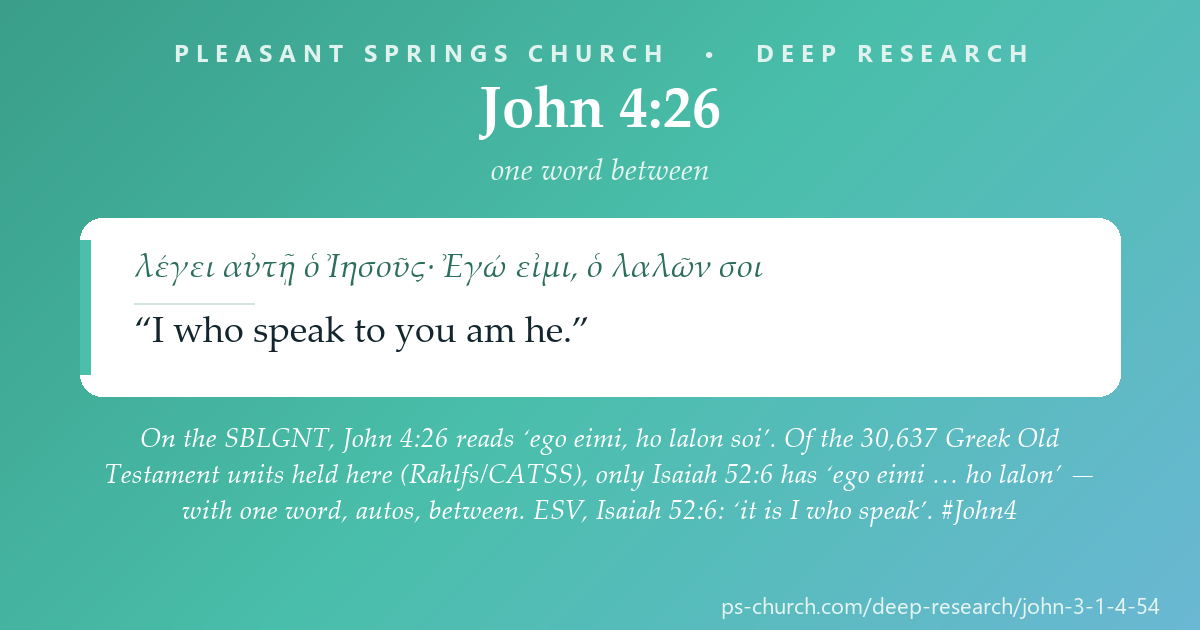
Share this card Share card — On the SBLGNT, John 4:26 reads 'ego eimi, ho lalon soi'. Of the 30,637 Greek Old Testament units held here (Rahlfs/CATSS), only Isaiah 52:6 has 'ego eimi ... ho lalon' - with one word, autos, between, so a run screen scores it 2. ESV: 'it is I who speak'. #John4
Facebook X / Twitter Download

Pleasant Springs Church — Deep Research

Research method after Michael S. Heiser’s Bible Research Method (examine dictionaries → ancient literature → important words → textual connections → academic publications → share), with the Pleasant Springs “Author & Audience” foundation. Scripture set in the Hebrew, the Greek editions named on each page and the ESV (Old Testament), and the Greek New Testament and the ESV (New Testament), per the practice of Pleasant Springs Church. John works named on this page (none re-read for it): Brown, Carson, Keener, Michaels, Lincoln, Alter, Köstenberger, Pummer — none of which were consulted for any number on this page. Text: Greek New Testament from the SBL edition as digitized by MorphGNT (text, parsing and lemma columns); no SBLGNT apparatus for John is held; Greek Old Testament from Rahlfs’ Septuaginta as digitized by CATSS; Hebrew from the Masoretic text as printed in Sefaria’s Miqra according to the Masorah; the Samaritan Pentateuch from the Text-Fabric Dataset of the Samaritan Pentateuch (Christian Canu Højgaard, Martijn Naaijer and Stefan Schorch, 2023, Zenodo, doi:10.5281/zenodo.7734632; MS Dublin, Chester Beatty Library 751; CC BY-NC 4.0; described in Naaijer, Højgaard, Schorch and Ehrensvärd, Research Data Journal for the Humanities and Social Sciences 9 (2024)); Josephus from B. Niese (1885–1890) as digitized by the Perseus Digital Library (CC BY-SA 4.0); Irenaeus, Barnabas and Justin from the Ante-Nicene Fathers; the King James Version (1769) for its wording of 3:13. ⚠️ VERSE NUMBERING. John 3–4 is numbered alike in the SBLGNT, the ESV and the KJV (36 and 54 verses). LXX Psalm 21:21 = MT 22:21 = ESV 22:20; LXX 24:16 and 34:17 = ESV 25:16 and 35:17. LXX Jeremiah 40:11 = MT and ESV 33:11. 2 Kings = 4 Kingdoms. Joshua 24:32 and 6:14 from the B text. The other Old Testament verses printed are numbered alike in all three. ⚠️ The measurement, in full. Greek against Greek; MorphGNT normalised word; CATSS form column, beta-code transliterated first; both sides lowercased, accents and breathings dropped, final sigma folded, with the shelf’s edition-equivalence table on cross-corpus screens. Contiguous runs of whole word forms, never lemmas. 90 rows against 30,348 verse units — the 64 CATSS files less the Odes — and against the 7,061 verses of the Greek New Testament outside John; and each row against the other 89. Unanchored searches are regular expressions over the same normalised forms, augments, articles and movable nu allowed for; a search said to cover the whole Greek Old Testament held here covers all 30,637 units, Odes included. Hebrew word searches over 23,204 Masoretic verse units, consonants only, prefixes allowed. Exhaustive and deterministic. It finds verbatim contact, not allusion.

Scripture quotations marked ESV are from the ESV® Bible (The Holy Bible, English Standard Version®), © 2001 by Crossway, a publishing ministry of Good News Publishers. ESV Text Edition: 2016. Used by permission. All rights reserved. The ESV text may not be quoted in any publication made available to the public by a Creative Commons license, and the ESV may not be translated in whole or in part into any other language. www.esv.org

Did this study bless you today?

💚  Give to Support PS Church

100% of gifts go to the General Fund — thank you.