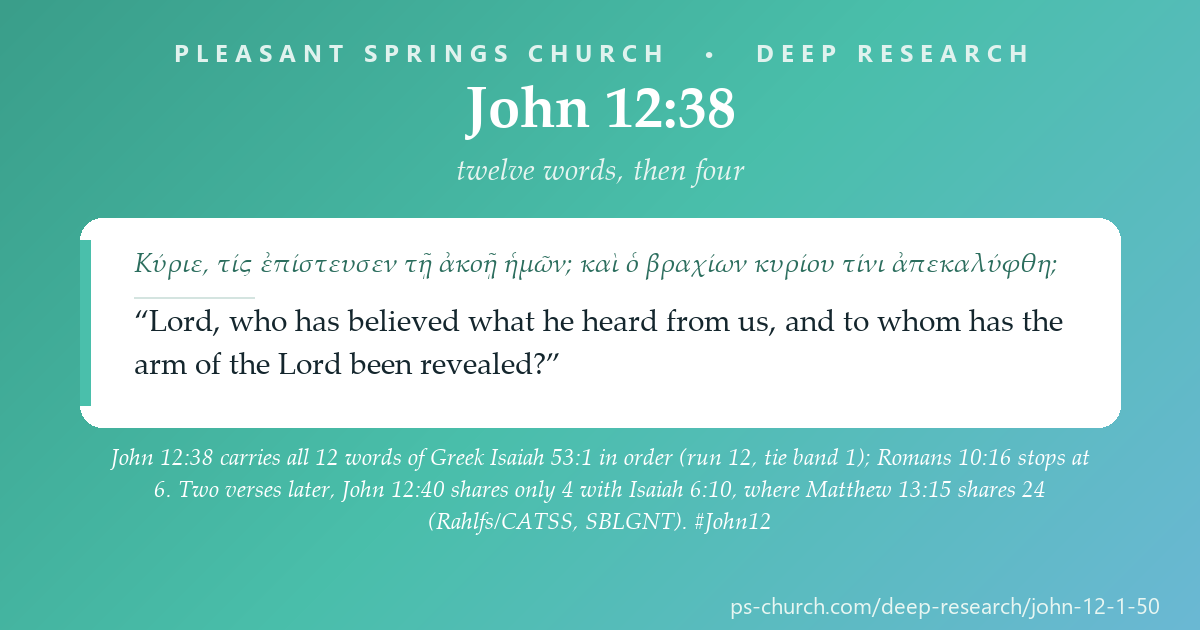
Two verses apart, John 12 gives two sayings of Isaiah. The first time, 12:38, the words that follow are Κύριε, τίς ἐπίστευσεν τῇ ἀκοῇ ἡμῶν; καὶ ὁ βραχίων κυρίου τίνι ἀπεκαλύφθη: the whole of the Greek Isaiah 53:1, all twelve words in order, “Lord, who has believed what he heard from us”. Every one of the chapter’s 50 verses was screened against the 30,348 screened verse units of the Greek Old Testament held here, and no other row comes near: the next is six. Against the whole Gospel only John 19:24, with Psalm 21:19, ties it. The second time, 12:40, the run is four, ἴδωσιν τοῖς ὀφθαλμοῖς καὶ, against Isaiah 6:10 — the verse Matthew 13:15 and Acts 28:27 share twenty-four words with. John’s Isaiah has a different agent, Τετύφλωκεν αὐτῶν τοὺς ὀφθαλμοὺς, and no ears. And four, with a tie band of one, is also what 12:25 scores against 1 Samuel 19:5, which is an accident. The page prints both, beside two things the corpora show: the glory of 12:41 stands in the Greek of Isaiah 6:1 and not in the Hebrew of that verse (both have it at 6:3); and the two Hebrew roots of high and lifted up in Isaiah 6:1 stand together again at Isaiah 52:13, three verses before 53:1, where the Greek has ὑψωθήσεται καὶ δοξασθήσεται σφόδρα — the two verbs this chapter uses for the hour. It never says which text came first. See the method →
John 12:1–50
Greek NT · ESV or our renderingVersification. John 12 has no offset: the SBLGNT, the ESV and the King James Version all count 50 verses, verse for verse. There is no Septuagint column, because John is a New Testament book. The offsets are in the Old Testament texts measured. Psalms: Greek 117:25–26 = Hebrew and ESV 118:25–26; Greek 6:4–5 = Hebrew 6:4–5 = ESV 6:3–4 (the Hebrew counts the title as verse 1); Greek 41:6–7 = Hebrew 42:6–7 = ESV 42:5–6; Greek 88:37 = Hebrew 89:37 = ESV 89:36; Greek 91:1 = Hebrew 92:1 = the ESV’s title of Psalm 92; Greek 92:1 = Hebrew and ESV 93:1, and its opening title is in the Greek only; Greek 21:19 = Hebrew 22:19 = ESV 22:18; Greek 108:22 = ESV 109:22. 2 Esdras 14:8 is in the Greek Nehemiah (ESV Nehemiah 4). Isaiah 9:6 in the Greek and the Hebrew = ESV 9:7. Daniel 4:31 in both Greek texts and the ESV = Aramaic 4:28. 1 Samuel = Greek 1 Kingdoms (19:5 alike). Genesis 32:16 in the Greek and the Hebrew = ESV 32:15; Deuteronomy 5:24 in the Greek and the ESV = Hebrew 5:21. Daniel survives in two Greek texts (Old Greek and Theodotion), each cited by name. Isaiah 2, 6, 10, 33, 40, 42, 44, 52, 53 and 57, Zechariah 9, Zephaniah 3, Genesis 49, Deuteronomy 15 and 18, Leviticus 23, the Song of Songs (the ESV’s Song of Solomon) 1 and 4, Ezekiel 37, Job 17 and Lamentations 4 have no offset in the verses printed. 1–2 Maccabees and Sirach are Greek only and are witnesses, not Scripture.
The Shape of the Passage
A sequence of five panels, threaded by repeated words — NOT a chiasmOne chapter, 50 verses: a supper, an entry, a discourse, a verdict and a last cry. The Greek is measured against the rest of the New Testament and the Greek Old Testament, and the Hebrew where the Greek and the Hebrew part; the authorship is reported, not tested.
Author
Tradition from Irenaeus onward names John, the disciple of the Lord.
Afterwards, John, the disciple of the Lord, who also had leaned upon His breast, did himself publish a Gospel during his residence at Ephesus in Asia.Irenaeus, Against Heresies 3.1.1 (ANF 1)
The page cannot test that from the text and does not try; the shelf’s John 3–4 study states the same position.
What the text shows is a narrator who stops the story to judge it. 12:37–43 is his voice, not Jesus’, and it names Isaiah three times in four verses (12:38, 39, 41). He also tells the reader what the disciples did not yet understand (ὅτε ἐδοξάσθη Ἰησοῦς, 12:16) and what Judas was (12:6). The page reports where the words stand, and says nothing about who wrote first.
Audience
Readers who are told the purpose of the book: that they may believe and have life in his name (20:31). This chapter is where the narrator explains why many did not.
Readers who knew the Greek Scriptures. The chapter introduces two passages of Isaiah by name and a psalm and a prophet without names, and expects the reader to know who the King of Israel and the daughter of Zion are. Its speakers include a woman who anoints, a disciple who objects, a crowd, Greeks, chief priests, Pharisees and rulers who believe in secret; the page reads each as persons in a narrative, not as types of a people.
Orient on Bethany, Lazarus, Mary and Martha, anointing and burial, nard, Judas, the poor, Passover, palm branches and Hosanna, the King of Israel, the daughter of Zion, the Greeks, the hour, glory, the Son of Man lifted up, the ruler of this world, light and darkness, hardening, and the synagogue ban.
Search by reference and by topic: Bethany, Lazarus, anointing at Bethany, spikenard, Judas Iscariot, Passover, palm, Hosanna, Triumphal Entry, Zion, Greeks / Hellenists, hour (hora) in John, glorify (doxazo), lift up (hypsoo), voice from heaven (bath qol), ruler of this world, light, hardening / blinding, aposynagogos, Isaiah in John.
Which articles are relevant?
- Dictionary of Jesus and the Gospels (IVP, 2nd ed. 2013) — “John, Gospel of,” “Triumphal Entry,” “Anointing,” “Glory,” “Light,” “Son of Man,” “Synagogue.”
- Anchor Bible Dictionary — “Bethany,” “Lazarus,” “Nard,” “Hosanna,” “Palm,” “Hardening of the Heart.”
- Dictionary of New Testament Background (IVP) — “Festivals and Holy Days,” “Synagogues,” “Hellenism.”
- NIDNTTE — νάρδος, ὡσαννά, ὥρα, δοξάζω, ὑψόω, ἕλκω, τυφλόω, πωρόω, ἀποσυνάγωγος.
Bibliography surfaced:
- Commentaries on John: Raymond E. Brown, The Gospel According to John I–XII (AB 29); D. A. Carson, The Gospel According to John (PNTC); Craig S. Keener, The Gospel of John (2 vols.); J. Ramsey Michaels (NICNT); Andrew T. Lincoln (BNTC).
- On Isaiah in John: Andreas J. Köstenberger, “John,” in Beale and Carson, Commentary on the New Testament Use of the Old Testament (2007); Craig A. Evans, To See and Not Perceive: Isaiah 6.9–10 in Early Jewish and Christian Interpretation (1989); Richard Bauckham, Jesus and the God of Israel (2008), on Isaiah 6, 52:13 and 57:15.
- On divine hardening: G. K. Beale, “An Exegetical and Theological Consideration of the Hardening of Pharaoh’s Heart,” Trinity Journal 5 (1984); William Lane Craig, The Only Wise God (1987), on foreknowledge and freedom.
The works above are named as places to look. None was re-read for this page, and no number on it comes from them. Stage 5 says so again.
What the world of the text supplies: palms carried into a liberated citadel, palms at a rededication, a labourer’s wage, and a bishop of the fifth century reading the hardest sentence in the chapter.
Palms, before John (12:13)
The noun of John 12:13 for the branches, βάϊον, stands once in the New Testament, and in the Greek Old Testament held here only in 1 Maccabees 13:51 (a witness, not Scripture), when Simon’s party enters the citadel of Jerusalem μετὰ αἰνέσεως καὶ βαί̈ων — with praise and palm branches (our rendering) — with lyres, cymbals, harps, hymns and songs. At the rededication of the temple, 2 Maccabees 10:7 has the people φοίνικας ἔχοντες ὕμνους ἀνέφερον, holding palms, they offered up hymns (our rendering). The Law’s own palms are at the feast of booths, Leviticus 23:40, κάλλυνθρα φοινίκων (fronds of palms (our rendering)). John 12 is set at Passover (12:1), not at booths, and names no Maccabee. Against 1 Maccabees 13:51 the row measures 1; against Leviticus 23:40, 2.
Three hundred denarii (12:5)
Matthew 20:2 agrees a vineyard labourer’s pay at ἐκ δηναρίου τὴν ἡμέραν, a denarius for the day (our rendering). By that measure the ointment’s price is the pay of about three hundred working days. That nard was imported from India, and was costly for that reason, is reported from the ancient naturalists; no such text is held here, and the page draws nothing from it.
Hosanna (12:13)
Ὡσαννά is a Greek spelling of a Hebrew cry. The two Hebrew words it is usually derived from, הוֹשִׁיעָה נָּא, stand together in one verse of the Masoretic text held here, Psalm 118:25; the Greek psalm has, for the whole line, ὦ κύριε σῶσον δή, and no unit of the Greek Old Testament held here has a form beginning hosann-. That the psalm was sung at the pilgrim feasts as part of the Hallel is reported from later Jewish sources; the Mishnah is not held here.
“They could not believe” (12:39), read in the fifth century
because that Isaiah the prophet foretold it; and the prophet foretold it because God foreknew that such would be the case. But if I am asked why they could not, I reply at once, because they would not; for certainly their depraved will was foreseen by God, and foretold through the prophet by Him from whom nothing that is future can be hid.Augustine, Tractates on the Gospel of John 53.6 (NPNF1 7)
For God thus blinds and hardens, simply by letting alone and withdrawing His aid: and God can do this by a judgment that is hidden, although not by one that is unrighteous.Augustine, Tractates on the Gospel of John 53.6 (NPNF1 7)
Augustine answers the verse first by foreknowledge (the prophet foretold because God foreknew) and then by the will (they could not because they would not), and describes the blinding as God’s withdrawing his aid. Stage 5 sets his reading beside the others. The English is the NPNF translator’s; Augustine’s Latin is not held here.
“All”, or “all things” (12:32), read in the fifth century
But He did not say, All men, but all things; for all men have not faith.Augustine, Tractates on the Gospel of John 52.11 (NPNF1 7)
And of a certainty all classes of men, both of every language and every age, and all grades of rank, and all diversities of talents, and all the professions of lawful and useful artsAugustine, Tractates on the Gospel of John 52.11 (NPNF1 7)
There are here two readings in the Greek mss., pantas (all men), and panta (all things), of which the former seems now the better approved; but the latter is that adopted by Augustin and the Vulgate.the NPNF translator’s note 1068 to Tractate 52.11
Augustine’s Latin had all things; the SBLGNT prints πάντας. He reads the word two ways in one paragraph: the whole person, and every class of people. Stage 5 takes up what the masculine reading has been taken to mean.
Eight words. Where a count is given it is a lemma count from the MorphGNT columns; Greek Old Testament counts are of units, by the CATSS lemma column where verb and noun share letters.
Five tokens in John (John 3:14, John 3:14, John 8:28, John 12:32, John 12:34): the first of Moses lifting up the serpent (3:14, ὕψωσεν τὸν ὄφιν), the other four of the Son of Man being lifted up, 12:32 in the first person; twenty in the New Testament. The crowd’s words at 12:34 are δεῖ ὑψωθῆναι τὸν υἱὸν τοῦ ἀνθρώπου; with ὑψωθῆναι the form stands in two verses of the New Testament, John 3:14 and 12:34. In the screened Greek Old Testament a form of the verb (CATSS lemma) stands in 190 units.
Twenty-three tokens in John, five of them in this chapter (12:16, 12:23, 12:28 three times); the noun δόξα stands three times (12:41, 12:43 twice). In the screened Greek Old Testament 9 units have a form of this verb and a form of ὑψόω together (CATSS lemmas; by form Isaiah 4:2 makes ten, its second verb filed by CATSS under another lemma); Isaiah 52:13 and Isaiah 33:10 are two of them (Stage 4). No verse of the Greek New Testament has both verbs.
Eight New Testament tokens (John 6:44, John 12:32, John 18:10, John 21:6, John 21:11, Acts 16:19, Acts 21:30, James 2:6), five in John. At 6:44 the subject is the Father; here it is the Son. Elsewhere in John it is a sword drawn and a net hauled; in Acts and James, people dragged.
Three New Testament tokens (John 12:40, 2 Corinthians 4:4, 1 John 2:11). At 2 Corinthians 4:4 the subject is named, ἐτύφλωσεν τὰ νοήματα, by the god of this age; at 12:40 it is not. In the screened Greek Old Testament the verb (CATSS lemma) stands in two units, Isaiah 42:19, ἐτυφλώθησαν οἱ δοῦλοι τοῦ θεοῦ, and Tobit 7:6 (S text). The adjective blind is a separate word, and a search on the letters typhl- finds both: the page counts the verb by its lemma.
Five New Testament tokens of the verb (Mark 6:52, Mark 8:17, John 12:40, Romans 11:7, 2 Corinthians 3:14). The letters pōrō- also find the noun, hardening, at Mark 3:5, Romans 11:25 and Ephesians 4:18; the noun is not the verb, and is not counted. In the screened Greek Old Testament the verb stands in one unit, Job 17:7, πεπώρωνται γὰρ ἀπὸ ὀργῆς οἱ ὀφθαλμοί μου — of the eyes.
Seven New Testament tokens (Matthew 13:31, Matthew 17:20, Mark 4:31, Luke 13:19, Luke 17:6, John 12:24, 1 Corinthians 15:37): five of the mustard seed, one here, one in 1 Corinthians 15:37. In the screened Greek Old Testament the noun (CATSS lemma) stands in two units, ἐπὶ κόκκων (Lamentations 4:5) and κεκλωσμένῃ κόκκῳ (Sirach 45:10); by our reading both are of scarlet dye, not seed.
Six tokens in John (John 5:7, John 11:33, John 12:27, John 13:21, John 14:1, John 14:27): the pool, Jesus at the tomb of Lazarus (11:33), here, at the betrayal (13:21), and the disciples told not to let their hearts be troubled (14:1, 14:27). The form of 12:27, τετάρακται, stands in one unit of the Greek Old Testament held here, Psalm 108:22 (ESV 109:22), ἡ καρδία μου τετάρακται, of the heart.
Three tokens in the Greek New Testament (John 9:22, John 12:42, John 16:2), all in John, and none in the Greek Old Testament held here. 9:22 and 12:42 give it as a fear; 16:2 as a prediction.
Every verse of John 12 screened against the New Testament outside John and against the whole Greek Old Testament held here; then the named passages, one by one; then the counter-examples.
What the screens find
Against the New Testament outside John (7,061 verses), the chapter’s deepest row is 12:8, eight words with Matthew 26:11, band 1. Then 12:13 with Mark 11:9 (seven, band 1), and two rows at six, both band 1: 12:15 with Matthew 21:5 and 12:38 with Romans 10:16.
| deepest run against the NT outside John | 8 | 7 | 6 | 5 | 4 | 3 | 2 |
|---|---|---|---|---|---|---|---|
| rows of John 12 | 1 | 1 | 2 | 2 | 12 | 24 | 8 |
Against the 30,348 screened units of the Greek Old Testament (the Odes excluded; letting them back in deepens no row), one row stands apart: 12:38, twelve words, band 1, Isaiah 53:1. The next are 12:13 (six, Psalm 117:26) and 12:15 (five, Zechariah 9:9), each band 1. Then six rows at four, and they are the page’s counter-examples (below). Every row shares at least two consecutive word forms with some unit.
| deepest run against the screened Greek OT | 12 | 6 | 5 | 4 | 3 | 2 |
|---|---|---|---|---|---|---|
| rows of John 12 | 1 | 1 | 1 | 6 | 31 | 10 |
Screened the same way, the whole Gospel (866 SBLGNT verses) reaches twelve twice: 12:38 and 19:24 (Psalm 21:19, the garments divided). No row of John goes deeper.
Twelve words: Isaiah 53:1 (12:38)
Lord, who has believed · Isaiah 53:1
Hebrew · Greek OT · ESVJohn 12:38 introduces the words with ἵνα ὁ λόγος Ἠσαΐου τοῦ προφήτου πληρωθῇ, and the words after it are the Greek verse entire. Romans 10:16 names Isaiah too and stops after six, Κύριε, τίς ἐπίστευσεν τῇ ἀκοῇ ἡμῶν; John 12:38 and Romans 10:16 share those six with each other (band 1 against the New Testament outside John). Both begin with Κύριε, which the Greek Isaiah has and the Hebrew does not. The page reports the agreement in wording and asserts nothing about how it arose. See the shelf’s Isaiah 52:13–53:12 study and Romans 9–11 study.
Four words: Isaiah 6:10 (12:40)
Eyes, ears, heart · Isaiah 6:10
Hebrew · Greek OT · ESV| Isaiah 6:10 Hebrew | Isaiah 6:10 Greek | Matthew 13:15 / Acts 28:27 | John 12:40 | |
|---|---|---|---|---|
| who acts | the prophet, told to act (imperatives) | the people’s heart grew thick; they shut their eyes | as the Greek | he has blinded, he hardened (third person singular, unnamed) |
| order | heart, ears, eyes; then eyes, ears, heart | heart, ears, eyes; then eyes, ears, heart | as the Greek | eyes, heart; then eyes, heart |
| ears | twice | twice | twice | none |
| turn | וָשָׁב (and turn) | ἐπιστρέψωσιν | ἐπιστρέψωσιν | στραφῶσιν |
| run with the Greek Isaiah 6:10 | — | — | 24 (both) | 4 |
The same verse, measured three ways. Matthew 13:15 and Acts 28:27 share 24 consecutive words with the Greek Isaiah 6:10 (the shelf’s Matthew 13 and Acts 25–28 studies; re-measured here). John 12:40 shares four, ἴδωσιν τοῖς ὀφθαλμοῖς καὶ, with Isaiah 6:10 alone in its band; Mark 4:12 shares two with John 12:40, μὴ ἴδωσιν. John’s verse is 23 words; the Greek Isaiah 6:10 is 35. John’s has no ears, puts eyes before heart, and has for its verbs Τετύφλωκεν αὐτῶν τοὺς ὀφθαλμοὺς and ἐπώρωσεν αὐτῶν τὴν καρδίαν: a third-person singular agent whom the verse does not name. The Hebrew has the prophet commanded to do it; the Greek has the people’s heart grown thick and the people shutting their own eyes. John 12:40 has νοήσωσιν τῇ καρδίᾳ where the Greek Isaiah has τῇ καρδίᾳ συνῶσιν, and στραφῶσιν where it has ἐπιστρέψωσιν; it agrees with the Greek at the end, ἰάσομαι αὐτούς. The page reports what the three texts have, and assigns no motive to any of them; Stage 5 sets out how the unnamed he is read.
⚠️ The counter-examples at four
Six rows of John 12 reach four against the Greek Old Testament. Read them together before reading anything into 12:40’s four:
| row | run, band | partner | what it is |
|---|---|---|---|
| 12:40 | run 4, tie band 1 | Isaiah 6:10 | a passage the verse itself introduces with πάλιν εἶπεν Ἠσαΐας |
| 12:25 | run 4, tie band 1 | 1 Samuel 19:5 | an accident: David ἔθετο τὴν ψυχὴν αὐτοῦ ἐν τῇ χειρὶ αὐτοῦ; the shared words are τὴν ψυχὴν αὐτοῦ ἐν |
| 12:7 | run 4, tie band 2 | Psalm 91:1 and 92:1 (titles) | an accident: εἰς τὴν ἡμέραν τοῦ σαββάτου |
| 12:41 | run 4, tie band 2 | Deuteronomy 5:24; Isaiah 8:7 | a phrase, τὴν δόξαν αὐτοῦ, καὶ; against Isaiah 6:1, the verse of the vision, the row measures 1 |
| 12:28 | run 4, tie band 22 | 22 units | a formula, ἐκ τοῦ οὐρανοῦ· Καὶ |
| 12:34 | run 4, tie band 52 | 52 units | formulas: εἰς τὸν αἰῶνα, καὶ (43), μένει εἰς τὸν αἰῶνα (7), τίς ἐστιν οὗτος ὁ (2) |
12:40 and 12:25 have the same numbers — four words, a band of one — and only one of them is a citation. The run measures verbatim contact; it does not measure whether a passage is meant. John 12:40 is known to be Isaiah because John says so, not because of its four.
He saw his glory (12:41; Isaiah 6:1, 6:3)
The glory, and the robe · Isaiah 6:1, 6:3
Hebrew · Greek OT · ESVεἶδεν τὴν δόξαν αὐτοῦ comes after the second naming of Isaiah. In the Greek of Isaiah 6 the prophet εἶδον τὸν κύριον, and the house is full τῆς δόξης αὐτοῦ; in the Hebrew of 6:1 it is his skirts that fill the temple, and the word glory waits for the seraphim at 6:3. At 6:5 both texts have the prophet seeing the King, the Greek τὸν βασιλέα κύριον σαβαωθ εἶδον. With εἶδεν or another verb of seeing immediately before it, τὴν δόξαν stands in five New Testament verses (Luke 9:32, John 1:14, John 11:40, John 12:41, John 17:24). Whose glory his means is a reading, set out in Stage 5. See the shelf’s Isaiah 1–6 study.
High and lifted up (12:32–34; Isaiah 52:13, 6:1, 33:10)
High and lifted up · Isaiah 6:1; 52:13; 57:15; 2:13; 33:10
Hebrew · Greek OT · ESVIn the Hebrew, רָם וְנִשָּׂא and its forms stand side by side in four verses of the Masoretic text held here, all in Isaiah: 2:13 (the cedars), 6:1 (the throne), 52:13 (the servant) and 57:15 (God). Isaiah 52:13 is three verses before 53:1, the verse John 12:38 gives whole. In the Greek the pair is not kept: 6:1 has ὑψηλοῦ καὶ ἐπηρμένου, 52:13 ὑψωθήσεται καὶ δοξασθήσεται σφόδρα, 57:15 ὁ ὕψιστος ὁ ἐν ὑψηλοῖς. Of the 9 screened Greek units with a form of ὑψόω and a form of δοξάζω together (CATSS lemmas; a tenth by form, Isaiah 4:2, τοῦ ὑψῶσαι καὶ δοξάσαι, has its second verb filed by CATSS under another lemma), Isaiah 52:13 is one, and Isaiah 33:10 is the only one that also has νῦν: νῦν δοξασθήσομαι νῦν ὑψωθήσομαι. John 12 has Νῦν at 12:27 and twice at 12:31, the verb for glory at 12:23 and 12:28, and the verb for lifting up at 12:32 and 12:34.
And the words do not meet. Against Isaiah 52:13, 12:32 shares no word form at all, and 12:23, 12:28 and 12:34 measure 1 each (12:34 has two such single words); against Isaiah 33:10, 12:27 shares one and 12:28 and 12:32 none. The two verbs stand in different verses of John, in different forms; no verse of the Greek New Testament has both. This is a co-occurrence of vocabulary across a chapter, which is weaker evidence than a run, and the page prints it as that. That John 12 is read beside Isaiah 52:13 and 6:1 is reported (Stage 5).
Hosanna and the King of Israel (12:13; Psalm 118:25–26)
Hosanna, and the one who comes · Psalm 118:25–26 (Greek 117:25–26)
Hebrew · Greek OT · ESV12:13 measures 6 against Psalm 117:26 and 0 against 117:25 (no word form shared). Re-measured here, Matthew 21:9 scores 6 against the screened Greek Old Testament, band 1, with the same verse (the shelf’s Matthew 21 study). Psalm 117:26 is the only unit of the Greek Old Testament held here with εὐλογημένος ὁ ἐρχόμενος; in the New Testament the words stand in six verses (Matthew 21:9, Matthew 23:39, Mark 11:9, Luke 13:35, Luke 19:38, John 12:13).
ὁ βασιλεὺς τοῦ Ἰσραήλ has no partner in the psalm. With the article and τοῦ optional, and any case of the noun for king, the title stands in 3 New Testament verses side by side (Matthew 27:42, Mark 15:32, John 12:13; and at John 1:49, βασιλεὺς εἶ τοῦ Ἰσραήλ, with one word between). In the Greek Old Testament it is mostly the title of human kings; at Isaiah 44:6 and Zephaniah 3:15 it is God: Isaiah 44:6, ὁ βασιλεὺς τοῦ Ισραηλ, and Zephaniah 3:15, βασιλεὺς Ισραηλ κύριος (Hebrew מֶלֶךְ יִשְׂרָאֵל), one verse after χαῖρε σφόδρα θύγατερ Σιων and one before the Hebrew’s fear not to Zion (next). ⚠️ The Greek of Zephaniah 3:14 opens with the same four words as the Greek Zechariah 9:9, χαῖρε σφόδρα θύγατερ Σιων; the Hebrew openings differ, רׇנִּי בַּת־צִיּוֹן and גִּילִי מְאֹד.
Fear not, daughter of Zion (12:15; Zechariah 9:9; Zephaniah 3:16; Isaiah 40:9)
Daughter of Zion, and the colt · Zechariah 9:9; Zephaniah 3:16; Isaiah 40:9; Genesis 49:11
Hebrew · Greek OT · ESV12:15 measures 5 against Zechariah 9:9, ἰδοὺ ὁ βασιλεύς σου ἔρχεται (Matthew 21:5 measures 6, ἰδοὺ ὁ βασιλεύς σου ἔρχεταί σοι). The opening is not Zechariah’s: John has Μὴ φοβοῦ, θυγάτηρ Σιών, Zechariah χαῖρε σφόδρα θύγατερ Σιων. Where does fear not stand with Zion? In the Hebrew, a form of אַל־תִּירָאִי and Zion share a verse three times: Isaiah 10:24, Isaiah 40:9 and Zephaniah 3:16. In the Greek, two: Isaiah 10:24 (μὴ φοβοῦ) and Isaiah 40:9 (μὴ φοβεῖσθε). Zephaniah 3:16 drops out, because its Greek has θάρσει Σιων. In the Hebrew of Zephaniah 3:14–16 the daughter of Zion (3:14), the King of Israel (3:15) and a form of the verb fear (3:15, 3:16) stand within three verses; in the Greek of 3:15 the fear clause is οὐκ ὄψῃ κακὰ οὐκέτι, you will see no more evil (Hebrew לֹא־תִירְאִי רָע). With a form of daughter in the same unit, fear not stands in two units of the Greek Old Testament held here, and neither names Zion: Ruth 3:11, Boaz to Ruth, θύγατερ μὴ φοβοῦ, and 2 Esdras 14:8 (in Nehemiah 4). Against Zephaniah 3:16 and Isaiah 40:9, 12:15 measures 1 and 2. The page sets the verses side by side and draws no line between them. See the shelf’s Zephaniah 3:14–17, Zechariah 9:9–10 and Isaiah 40–42 studies.
The colt of a donkey. καθήμενος ἐπὶ πῶλον ὄνου: in the Greek New Testament πῶλον ὄνου (the colt-word followed within one word by ὄνου) is this verse only. In the Greek Old Testament held here a form of the colt and a form of the donkey stand in one unit twice (CATSS lemmas): Genesis 32:16, a list of Jacob’s gift, and Genesis 49:11, τὸν πῶλον τῆς ὄνου αὐτοῦ, in Jacob’s blessing of Judah. The Greek Zechariah 9:9 has no form of that word for the donkey; its animals are ἐπιβεβηκὼς ἐπὶ ὑποζύγιον καὶ πῶλον νέον, a beast of burden and a colt. Against Genesis 49:11, 12:15 measures 1. See the shelf’s Genesis 49 study.
My soul troubled (12:27; Psalms 6 and 42)
My soul troubled · Psalm 6:3–4 (Greek and Hebrew 6:4–5); Psalm 42:6 (Greek 41:7)
Hebrew · Greek OT · ESVIn the screened Greek Old Testament, ἡ ψυχή μου followed at once by a form of the verb of 12:27 is two verses, Psalm 6:4 and Psalm 41:7 — both aorist; John has the perfect, τετάρακται. The noun and the verb in one unit, any order, are 9 units (CATSS lemmas). Psalm 6 has, in its next verse, σῶσόν με, and so does John 12:27, σῶσόν με ἐκ τῆς ὥρας ταύτης; against Psalm 6:5 the row measures 2. Psalm 6:4–5 is the only place among the 16 screened units with σῶσόν με where the verse before has the soul troubled. Mark 14:34 has another word, Περίλυπός ἐστιν ἡ ψυχή μου, the word of Psalm 41:6, ἵνα τί περίλυπος εἶ ψυχή; John 12:27 has no form of it. Against Mark 14:34 and Matthew 26:38, 12:27 measures 3 each. The run of three is ἡ ψυχή μου, and its band is 98.
The Christ remains forever (12:34)
Remains forever · Psalm 89:36 (Greek 88:37)
Hebrew · Greek OT · ESVThe crowd says it heard ὁ χριστὸς μένει εἰς τὸν αἰῶνα ἠκούσαμεν ἐκ τοῦ νόμου. In the screened Greek Old Testament μένει εἰς τὸν αἰῶνα stands in 7 units (Isa 40:8, Ps 110:3, Ps 110:10, Ps 111:3, Ps 111:9, Ps 116:2, Sir 42:23), and none of them names an anointed one. No screened unit has a form of Χριστός with a form of μένω (CATSS lemmas). Psalm 88:37 has τὸ σπέρμα αὐτοῦ εἰς τὸν αἰῶνα μενεῖ: the seed remains, and the words stand in another order; the run is 3, εἰς τὸν αἰῶνα. Note that the Greek psalm’s μενεῖ is future and John’s μένει is present: the normaliser drops the accent, so the screen sees one form where the texts have two tenses. Other verses read as the crowd’s source measure three as well, all on the same three words: Isaiah 9:6 (ESV 9:7), ἀπὸ τοῦ νῦν καὶ εἰς τὸν αἰῶνα χρόνον; Ezekiel 37:25, Δαυιδ ὁ δοῦλός μου ἄρχων αὐτῶν ἔσται εἰς τὸν αἰῶνα. Daniel 7:14 measures 1 in each Greek text (Old Greek ἡ ἐξουσία αὐτοῦ ἐξουσία αἰώνιος ἥτις οὐ μὴ ἀρθῇ; Theodotion ἡ ἐξουσία αὐτοῦ ἐξουσία αἰώνιος ἥτις οὐ παρελεύσεται). See the shelf’s Psalm 89, Isaiah 9:6–7 and Daniel 7:9–14 studies.
Nard, and the house full of its scent (12:3)
My nard · Song of Songs 1:12
Hebrew · Greek OT · ESVIn the Greek Old Testament held here a form of νάρδος stands in three units, all in the Song: 1:12, 4:13 (κύπροι μετὰ νάρδων) and 4:14 (νάρδος καὶ κρόκος). Only 1:12 has nard and its scent in one verse, νάρδος μου ἔδωκεν ὀσμὴν αὐτοῦ (Hebrew נִרְדִּי נָתַן רֵיחוֹ). John 12:3 has ἡ δὲ οἰκία ἐπληρώθη ἐκ τῆς ὀσμῆς τοῦ μύρου. Against Song 1:12 the row measures 1; against 4:13, 0 (no word form shared). The word πιστικός stands in no unit of the Greek Old Testament held here.
Three anointings. Mark 14:3 has μύρου νάρδου πιστικῆς πολυτελοῦς poured on the head, κατέχεεν αὐτοῦ τῆς κεφαλῆς; John 12:3 has the feet, wiped ταῖς θριξὶν αὐτῆς, the words of John 11:2, ἐκμάξασα τοὺς πόδας αὐτοῦ ταῖς θριξὶν αὐτῆς; Luke 7:38, a different woman in a Pharisee’s house, has ταῖς θριξὶν τῆς κεφαλῆς αὐτῆς ἐξέμασσεν. Against Mark 14:3, Matthew 26:7 and Luke 7:38, John 12:3 measures 3, 1 and 3. The page reports the words; it does not decide how many events lie behind them. See the shelf’s Mark 14, Luke 7–8 and Song of Songs 1–2 studies.
The poor you always have (12:8; Deuteronomy 15:11)
The poor in the land · Deuteronomy 15:11
Hebrew · Greek OT · ESV12:8 is the chapter’s deepest row against the New Testament outside John, run 8, tie band 1 with Matthew 26:11, πάντοτε γὰρ τοὺς πτωχοὺς ἔχετε μεθ’ ἑαυτῶν; against Mark 14:7 it measures 5. Against Deuteronomy 15:11, the verse it is most often set beside, it measures 1: the Greek Deuteronomy’s words for the poor are ἐνδεὴς, πένητι and ἐπιδεομένῳ, and the Hebrew’s אֶבְיוֹן and לַעֲנִיֶּךָ וּלְאֶבְיֹנְךָ. The thought stands in both; the Greek words do not. See the shelf’s Deuteronomy 14–15 study.
A grain of wheat (12:24)
ὁ κόκκος τοῦ σίτου: in the Greek New Testament, a form of κόκκος with a form of σῖτος in one verse is this verse and 1 Corinthians 15:37, γυμνὸν κόκκον εἰ τύχοι σίτου; and ἐὰν μὴ with a form of die within eight words, this verse and 1 Corinthians 15:36, ἐὰν μὴ ἀποθάνῃ. Against 1 Corinthians 15:36 the row measures 2. In the Greek Old Testament held here no unit has both nouns, and the two units with κόκκος are of scarlet (Stage 3). The image has no Greek Old Testament partner in these corpora. See the shelf’s 1 Corinthians 15:1–11 study.
A voice from heaven (12:28)
ἦλθεν οὖν φωνὴ ἐκ τοῦ οὐρανοῦ. With the noun followed at once by from (the) heaven, the Greek Old Testament held here has it in Daniel 4:31 only, in both Greek texts: Old Greek φωνὴν ἐκ τοῦ οὐρανοῦ ἤκουσε, Theodotion φωνὴ ἀπ' οὐρανοῦ ἐγένετο (a voice from heaven (our rendering)), to Nebuchadnezzar, announcing that his kingdom has passed from him; with the words reversed and apart, Deuteronomy 4:36. In the New Testament the same shape is in seven verses (Matthew 3:17, Luke 3:22, John 12:28, Revelation 10:4, Revelation 14:2, Revelation 14:13, Revelation 18:4). Against the Old Greek Daniel 4:31, 12:28 measures 3, ἐκ τοῦ οὐρανοῦ. The crowd at 12:29 hears thunder or an angel.
What the Father commanded (12:49–50; Deuteronomy 18:18)
12:49 says the Father ἐντολὴν δέδωκεν τί εἴπω καὶ τί λαλήσω. Deuteronomy 18:18 promises a prophet who λαλήσει αὐτοῖς καθότι ἂν ἐντείλωμαι αὐτῷ, will speak to them as I command him (our rendering). The two are often read together (reported). Against Deuteronomy 18:18, 12:49 measures 1; against 18:19, 12:48 measures 1. The thought is shared; no two consecutive words are. See the shelf’s Deuteronomy 18:15–19 study.
Where the chapter is read in more than one way, the readings are set out with their reported holders and what the texts held here show. Then the limits.
They could not believe (12:37–41)
| 12:37–43: they could not believe | reported holders | what the text gives |
|---|---|---|
| Reformed. The unnamed he of 12:40 is God; the hardening is his sovereign and just act, and those hardened remain responsible for their unbelief. | Calvin; many Reformed commentators (reported) | διὰ τοῦτο οὐκ ἠδύναντο πιστεύειν (12:39); Τετύφλωκεν αὐτῶν τοὺς ὀφθαλμοὺς and ἐπώρωσεν αὐτῶν τὴν καρδίαν (12:40). |
| Arminian. The hardening is judicial: it answers a refusal already made, and confirms it. Could not describes a consequence of would not. | Arminius; Wesley; Remonstrant and Wesleyan commentators (reported) | 12:37 comes first: τοσαῦτα δὲ αὐτοῦ σημεῖα πεποιηκότος … οὐκ ἐπίστευον εἰς αὐτόν. The unbelief is stated before Isaiah is named. |
| Molinist. God knows what each person would freely do in every circumstance; the prophecy is fulfilled because it foresaw a refusal that was free, and God orders a world in which that refusal serves his purpose. | Luis de Molina; modern defenders such as William Lane Craig (reported) | 12:38 introduces Isaiah with ἵνα ὁ λόγος Ἠσαΐου τοῦ προφήτου πληρωθῇ. Augustine’s first answer is by foreknowledge (Stage 2). |
| Corporate and historical. The hardening is of a people, for a time, in the history of salvation; the chapter that has Greeks asking for Jesus (12:20–21) is the chapter that explains Israel’s unbelief. | many commentators on John and on Romans 9–11 (reported) | Ἕλληνές τινες (12:20); and at once after the verdict, ὅμως μέντοι καὶ ἐκ τῶν ἀρχόντων πολλοὶ ἐπίστευσαν εἰς αὐτόν (12:42). |
The church’s frame. Pleasant Springs teaches the Molinist (ROSES) account, not the Canons of Dort (see TULIP, DAISY, ROSES). That is the church’s frame for reading these verses, not a claim that the verses settle the debate. The text holds two things the page will not separate: the narrator says διὰ τοῦτο οὐκ ἠδύναντο πιστεύειν, and two verses later he says many even of the rulers ἐπίστευσαν εἰς αὐτόν.
All people (12:32)
| 12:32: all | reported holders | what the text gives |
|---|---|---|
| All without distinction. People of every kind and nation — Greeks as well as Jews — not every individual. | Augustine (Stage 2: all classes of men); many Reformed commentators (reported) | The Greeks of 12:20–21 ask for him two paragraphs earlier. The SBLGNT reads πάντας. |
| All without exception. Every person is drawn, and may resist; the drawing is universal, the response is not. | Arminian and Wesleyan commentators; many Molinists (reported) | πάντας ἑλκύσω πρὸς ἐμαυτόν; and at 12:47, οὐ γὰρ ἦλθον ἵνα κρίνω τὸν κόσμον ἀλλ’ ἵνα σώσω τὸν κόσμον. |
The church’s teaching is that the atonement is unlimited in provision: Christ died for all. /beliefs itself has no article on the extent of the atonement, and the page does not attribute that wording to it. What /beliefs does say, in Article 5, Humanity, is: “We believe every human being is deeply loved by God and yet profoundly broken.” The neuter reading all things, reported in some witnesses and expounded by Augustine, would change the question, and the page cannot check it (below).
Believers in secret (12:42–43)
| 12:42–43: believers who did not confess | reported holders | what the text gives |
|---|---|---|
| Real but fearful faith. They believed, and failed to confess; the verse is a warning, not a verdict on their standing. | many commentators (reported) | ὅμως μέντοι καὶ ἐκ τῶν ἀρχόντων πολλοὶ ἐπίστευσαν εἰς αὐτόν; then οὐχ ὡμολόγουν. At 19:38 Joseph of Arimathea is a disciple κεκρυμμένος δὲ διὰ τὸν φόβον τῶν Ἰουδαίων, and he comes forward at the burial. |
| Inadequate faith. Like the believing of 2:23–25 and 8:31, a faith that does not yet abide. | other commentators (reported) | ἠγάπησαν γὰρ τὴν δόξαν τῶν ἀνθρώπων μᾶλλον ἤπερ τὴν δόξαν τοῦ θεοῦ (12:43) — the comparison of 3:19. |
The church’s position on security is in its own words in /beliefs, Article 10, Hope: “all who genuinely receive Christ are held secure”, and “Scripture’s warnings are themselves a real means by which He holds us fast.” The page does not decide which of the two readings these rulers fit; the text does not say what became of them.
He saw his glory (12:41)
εἶδεν τὴν δόξαν αὐτοῦ: the nearest his is Jesus, of whom Isaiah ἐλάλησεν περὶ αὐτοῦ. Many read the verse as saying Isaiah saw the glory of the pre-existent Son in the vision of Isaiah 6 (reported, widely; Richard Bauckham is reported to read it with Isaiah 52:13 and 57:15). Others read it as Isaiah seeing God’s glory and foreseeing the Christ’s (reported). What the corpora add is narrow: glory stands in the Greek of Isaiah 6:1 and not in the Hebrew, and at 6:3 in both (Stage 4). The variant when for ὅτι (the King James Version’s reading) would make the verse a statement of time; it is reported, not checked.
“The Jews”, the authorities, and Judas
The chapter’s two tokens of Ἰουδαῖος (of 71 in John) are both of ordinary people: a crowd who come to see Lazarus (12:9), and many who ἐπίστευον εἰς τὸν Ἰησοῦν (12:11). The plot is the chief priests’ (12:10); the Pharisees speak at 12:19 and are feared at 12:42. That the Jews in John can mean the people, the Judeans, or the Jerusalem authorities, and that the Gospel’s usage has been read against Jews to great harm, is widely discussed (reported). The page reads each group as the persons the verse names, and uses no people as a foil for another. Judas (12:4–6) is one of the Twelve, named and described by the narrator; his conduct is his own.
Now, and the last day
12:48 speaks of judgment ἐν τῇ ἐσχάτῃ ἡμέρᾳ, and 12:31 of a judgment that is νῦν. The church holds historic premillennialism, not the dispensational scheme of Darby and Scofield; /beliefs has no eschatology article, and the page attributes none to it. These verses name a present judgment and a last day, and the page builds no timetable from them.
What this page did NOT check, and where it is weakest:
- No SBLGNT apparatus for John is held on this disk (held: Jude, Luke, Rev, Rom). The MorphGNT text carries the SBLGNT’s variant marks in 27 verses of this chapter (12:1, 12:2, 12:3, 12:4, 12:6, 12:7, 12:9, 12:12, 12:13, 12:16, 12:18, 12:19, 12:20, 12:22, 12:23, 12:25, 12:26, 12:30, 12:32, 12:34, 12:35, 12:36, 12:40, 12:41, 12:47, 12:49, 12:50), but the apparatus that explains them is not here. So every variant point is reported, not verified: the clause at 12:1 the King James Version prints as which had been dead; τηρήσῃ at 12:7, where the King James has hath she kept this; the reported absence of 12:8 from some witnesses (12:8 itself carries no variant mark here); πάντας or all things at 12:32; ἐπώρωσεν and a reported variant spelling at 12:40; ὅτι or when at 12:41; καὶ μὴ φυλάξῃ at 12:47, where the King James has and believe not. No papyrus, uncial, version or Father was collated for any of them, except that Augustine’s all things is quoted from the NPNF translation.
- The headline is two runs and one contrast. Twelve against Isaiah 53:1 and four against Isaiah 6:10 are facts about consecutive word forms in Rahlfs as CATSS digitised it. They say nothing about which Greek text of Isaiah anyone read, or why John 12:40 differs. No Göttingen Isaiah, no Hexaplaric reading and no manuscript of Isaiah was searched; if another Greek text of Isaiah 6:10 stood nearer John 12:40, the description would change, and this page could not see it.
- The high and lifted up finding is a co-occurrence, not a run. In Greek, John 12:32 shares no word form with Isaiah 52:13; the link the page prints is a pair of Hebrew roots in four verses of Isaiah and a pair of Greek verbs in nine screened units by CATSS lemma (ten by form, with Isaiah 4:2). It is the weakest evidence on the page, and labelled so. The Hebrew search is on consonants, and a different spelling of either root would be a different search.
- The Targum of Isaiah is not held. That its Isaiah 6:5 speaks of the prophet seeing the glory is reported, and bears on 12:41; the page could not check it. The Mishnah, which is reported to set Psalm 118 in the Hallel, is not held either. The ancient naturalists on the price of nard are not held.
- The Greek Old Testament is Rahlfs as CATSS digitised it, with no apparatus. Lemma counts in the Greek Old Testament use the CATSS lemma column; one CATSS row, Psalm 118:41, carries an extra lemma token, and the selfcheck allows for it. Daniel is cited from both Greek texts by name.
- The commentaries named in Stage 1 were not consulted, and every holder named in this stage is reported. Augustine is quoted from the NPNF translation; his Latin is not held.
- The ESV of the 16 John verses whose English is not printed was deliberately not fetched, so our own renderings of those verses were checked by machine against the King James Version, the Berean Standard Bible and every ESV verse the page does print, not against the ESV of the same verse. The NRSV and NIV are not on this disk.
- The structure diagram is ours. It is built from measured word links, not from a commentary’s outline, and it is labelled a sequence, expressly not a chiasm. The frame of light around the verdict is two words, φῶς and σκοτία.
- 1–2 Maccabees and Sirach are witnesses, not Scripture. They are screened because CATSS holds them, and labelled where named.
- Direction of influence is never asserted. Where John’s wording stands near Mark (12:3, 12:8, 12:13), Matthew (12:15), Romans (12:38), Isaiah, Zechariah, Zephaniah or Genesis, the page reports where the words stand and nothing more.
A supper, a road, a seed, a voice, and a verdict.
Name what you learned, why it matters, and one concrete response.
What should we carry away — and do?
- The chapter is honest about unbelief. “Though he had done so many signs before them, they still did not believe in him” — and the narrator does not hide it, but sets two passages of Isaiah beside it.
- And it does not end there. “Nevertheless, many even of the authorities believed in him”; the next verse has Jesus crying out, and within the cry, “I have come into the world as light” (12:46).
- The hour is a death that bears fruit. “if it dies, it bears much fruit”; and the servant is told “where I am, there will my servant be also”.
- Twelve words, then four. The same narrator gives Isaiah 53:1 word for word and Isaiah 6:10 in a form of its own. The page measures both, prints the accident that scores the same as the second, and leaves the reader to weigh them.
Step in response: read John 12:37–50 aloud, then Isaiah 52:13–53:1 and Isaiah 6:1–10. Then name one thing that holds you back from saying openly what you believe (12:42), and say it to one person this week.
John 12:38 · to share
Greek NT + ESVEvery Deep Research page traces its passage across the whole sweep — the Old Testament, the Second-Temple world between the testaments (historical witnesses, not Scripture), and the New Testament. Follow the thread:
Related on the shelf. John 11:25–26, Lazarus raised, the chapter before; John 13, the chapter after; John 3–4, the serpent lifted up; John 7–9, lifted up again (8:28) and put out of the synagogue (9:22); John 6:35, the Father draws (6:44); John 19, the garments divided and the hundred pounds of myrrh; Matthew 21 and Mark 10–11, the entry; Luke 19–21, the king who comes; Mark 14, the anointing at Bethany; Luke 7–8, the woman in the Pharisee’s house; Matthew 13 and Acts 25–28, Isaiah 6:9–10 at twenty-four words; Romans 9–11, Isaiah 53:1 and the hardening; Isaiah 1–6, the vision; Isaiah 52:13–53:12 and Isaiah 52–54, the servant; Isaiah 31–35, now I will be lifted up (33:10); Isaiah 40–42, fear not; Isaiah 9:6–7, forever; Psalm 118, Hosanna; Psalms 6–8 and Psalms 42–43, the troubled soul; Psalm 89, the seed that remains; Zechariah 9:9–10 and Zechariah 9–14, the king on the colt; Zephaniah 3:14–17 and Zephaniah, the King of Israel in your midst; Genesis 49, the colt of his donkey; Song of Songs 1–2, my nard; Deuteronomy 14–15, the poor in the land; Deuteronomy 18:15–19, the prophet; Daniel 7:9–14, an everlasting dominion; Daniel 1–6, the voice from heaven; Leviticus 23, palms at booths; 1 Corinthians 15, the bare grain.
Pleasant Springs Church — Deep Research
Research method after Michael S. Heiser’s Bible Research Method (examine dictionaries → ancient literature → important words → textual connections → academic publications → share), with the Pleasant Springs “Author & Audience” foundation. Scripture set in the Hebrew, the Greek editions named on each page and the ESV (Old Testament), and the Greek New Testament and the ESV (New Testament), per the practice of Pleasant Springs Church. John works named on this page (none re-read for it): Brown, Carson, Keener, Michaels, Lincoln, Köstenberger, Evans, Bauckham, Beale, Craig — none of which were consulted for any number on this page. Text: Greek New Testament from the SBL edition as digitized by MorphGNT (text, parsing and lemma columns); no SBLGNT apparatus for John is held; Greek Old Testament from Rahlfs’ Septuaginta as digitized by CATSS (form and lemma columns); Hebrew from the Masoretic text as printed in Sefaria’s Miqra according to the Masorah; Irenaeus from the Ante-Nicene Fathers; Augustine from the Nicene and Post-Nicene Fathers, First Series, vol. 7; the King James Version (1769) for its wording at 12:1, 12:7, 12:41 and 12:47. ⚠️ VERSE NUMBERING. John 12 is numbered alike in the SBLGNT, the ESV and the KJV (50 verses). LXX Psalm 117:25–26 = MT and ESV 118:25–26; LXX and MT Psalm 6:4–5 = ESV 6:3–4; LXX 41:6–7 = MT 42:6–7 = ESV 42:5–6; LXX 88:37 = MT 89:37 = ESV 89:36; LXX 21:19 = ESV 22:18. Isaiah 9:6 (LXX, MT) = ESV 9:7. Daniel 4:31 (LXX, ESV) = MT 4:28. Genesis 32:16 (LXX, MT) = ESV 32:15. Deuteronomy 5:24 (LXX, ESV) = MT 5:21. 1 Samuel = 1 Kingdoms. The other Old Testament verses printed are numbered alike in all three. ⚠️ The measurement, in full. Greek against Greek; MorphGNT normalised word; CATSS form column, beta-code transliterated first; both sides lowercased, accents and breathings dropped, final sigma folded, elided forms expanded, with the shelf’s edition-equivalence table on cross-corpus screens. Contiguous runs of whole word forms, never lemmas. 50 rows against 30,348 verse units — the 64 CATSS files less the Odes — and against the 7,061 verses of the Greek New Testament outside John; and each row against the other 49. Unanchored searches are regular expressions over the same normalised forms, articles allowed for; where verb and noun share letters the count is by lemma (MorphGNT; CATSS). A search said to cover the whole Greek Old Testament held here covers all 30,637 units, Odes included. Hebrew word searches over 23,204 Masoretic verse units, consonants only, prefixes allowed. Exhaustive and deterministic. It finds verbatim contact, not allusion.
Scripture quotations marked ESV are from the ESV® Bible (The Holy Bible, English Standard Version®), © 2001 by Crossway, a publishing ministry of Good News Publishers. ESV Text Edition: 2016. Used by permission. All rights reserved. The ESV text may not be quoted in any publication made available to the public by a Creative Commons license, and the ESV may not be translated in whole or in part into any other language. www.esv.org
|
Did this study bless you today? 💚 Give to Support PS Church100% of gifts go to the General Fund — thank you. |