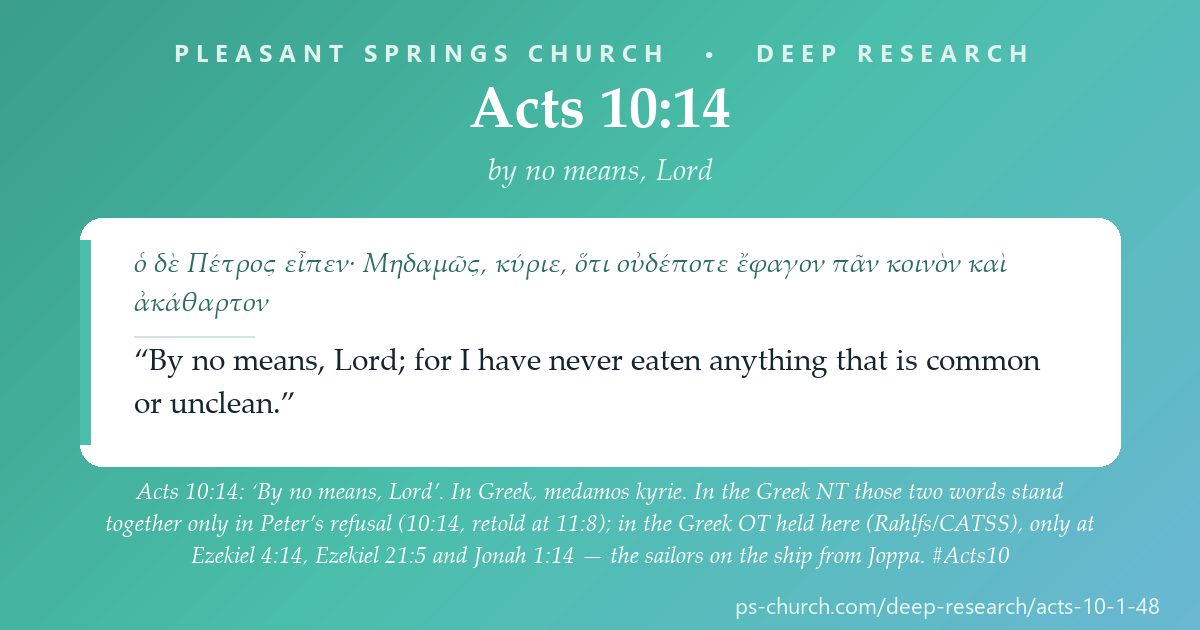
On a roof at Joppa, told to kill and eat, Peter answers “By no means, Lord”. The Greek is two words, Μηδαμῶς, κύριε. In the Greek New Testament they stand side by side only here and where Peter retells the scene (11:8). In all 30,637 Greek Old Testament units held here they stand together three times: Ezekiel 4:14, where the prophet refuses defiled food; Ezekiel 21:5 (ESV 20:49); and Jonah 1:14, where the sailors on the ship that sailed from Joppa cry out. The link readers usually draw is to Ezekiel’s “I have never eaten” — and that link is English. Greek Ezekiel 4:14 has no word for never, and not Peter’s adjective for unclean (it has the noun ἀκαθαρσίᾳ, uncleanness, of the prophet’s soul); and the pair in Peter’s answer, κοινὸν καὶ ἀκάθαρτον, stands in no unit of the Greek Old Testament held. In the Hebrew, Ezekiel says אֲהָהּ אֲדֹנָי and the sailors say אָנָּה יְהֹוָה: neither is a refusal word. So the contact exists in the Greek column only, and it is two words in a tie band of 359. This page prints that measurement beside its counter-examples: the chapter’s two deepest Greek Old Testament runs, tied at five, are formulas, in my house and and into his house and; the verse that says hanging him on a tree lands deepest not on Deuteronomy 21 but on Manasseh; and the Isaiah 61 anointing that Luke 4:18 shares in twelve words in a row, Acts 10:38 meets in one. See the method →
Acts 10:1–48
Greek NT · ESV or our renderingThe Shape of the Passage
A sequence with measured repetitions — NOT a chiasmForty-eight verses: two visions, two journeys, two reports, a sermon, and the Spirit falling before the water. The Greek is measured against the rest of the New Testament and the Greek Old Testament; the authorship is reported, not tested.
Author
Tradition names Luke, the writer of the Gospel, and both books address Theophilus (Luke 1:3; Acts 1:1). This page cannot test authorship from the text and does not try.
What the text shows is a writer who tells this story more than once. The vision of the sheet is told here and retold by Peter in 11:5–17, and the two tellings share runs of eight, seven and six words (the Acts 11–12 study measures them). Inside this chapter the angel’s words are given twice and the messengers repeat the narrator. And one sentence of Peter’s sermon shares eight of nine words with an accusation in Luke’s Gospel (Luke 23:5; Stage 4). The page reports where the words stand, and says nothing about who wrote first.
Audience
Readers who know what Jewish purity meant and why it mattered. Peter tells a Gentile household that it is ἀθέμιτόν for a Jew to associate with a foreigner (10:28), and the chapter does not mock that. The same adjective stands in 2 Maccabees 7:1 of the swine’s flesh that seven brothers were tortured for refusing. The people of this chapter — Cornelius, Peter, the brothers from Joppa, the believers from the circumcision — are read here as particular persons, not as types of a people.
Readers who will meet the question again. The church in Jerusalem asks it at 11:3, a council answers it in Acts 15, and Peter’s own table at Antioch shows it was not finished (Galatians 2:11–14).
Orient on Caesarea, the cohort, the God-fearers, Joppa and purity, and settle the numbering.
Search by topic: Caesarea Maritima; Roman auxiliary cohorts; centurion; Cornelius; God-fearers and proselytes; alms and prayer; Joppa; tanning; clean and unclean animals; table fellowship between Jews and Gentiles; partiality; anointing; crucifixion and Deuteronomy 21; tongues; baptism.
Which articles are relevant?
- Anchor Bible Dictionary — “Cornelius,” “Caesarea,” “Joppa,” “God-fearers,” “Clean and Unclean,” “Italian Cohort” (reported titles).
- Dictionary of New Testament Background — “Purity,” “Proselytism and Godfearers,” “Roman Military” (reported titles).
- NIDNTT / TDNT — the articles on κοινός, ἀκάθαρτος, προσωπολήμπτης and μνημόσυνον.
Bibliography surfaced (none of it consulted for any number on this page):
- Craig S. Keener, Acts: An Exegetical Commentary, vol. 2; C. K. Barrett (ICC); Joseph A. Fitzmyer (Anchor Yale); Darrell L. Bock (BECNT); F. F. Bruce (NICNT); David G. Peterson (Pillar).
- Jonathan Klawans, Impurity and Sin in Ancient Judaism, on ritual and moral impurity as two different things (reported).
- Jacob Milgrom, Leviticus (Anchor), on the animal lists of Leviticus 11 (reported).
- A. T. Kraabel, “The Disappearance of the God-Fearers” (1981), and the replies to it after the Aphrodisias inscription was published (reported).
Versification. Acts 10 has no offset: the SBLGNT, the ESV and the King James Version all count 48 verses, verse for verse. There is no Septuagint column, because Acts is a New Testament book. The offsets are in the Old Testament texts measured. Greek and Hebrew Ezekiel 21:5 = ESV 20:49. Greek Psalm 14:2 = Hebrew and ESV 15:2; Greek 106:20 = Hebrew and ESV 107:20; Greek 47:15 = Hebrew 48:15 = ESV 48:14; Greek 65:16 = Hebrew and ESV 66:16; Greek 147:7 = Hebrew and ESV 147:18. Greek Nahum 2:1 = ESV 1:15. Greek 2 Esdras 17:2 = Nehemiah 7:2. 1 and 2 Samuel = Greek 1 and 2 Kingdoms; 1 and 2 Kings = Greek 3 and 4 Kingdoms, and Greek 3 Kingdoms 5:13 = ESV 1 Kings 4:33. Greek and Hebrew 2 Chronicles 2:15 = ESV 2:16; Ezra 3:7 = Greek 2 Esdras 3:7. Greek Daniel 4:4, in both the Old Greek and Theodotion, = Aramaic 4:1 = ESV 4:4. Ezekiel 4:14, Jonah 1:3 and 1:14, Genesis 1:24, Leviticus 2:2, 19:15 and 20:25, Deuteronomy 10:17 and 21:22–23, 2 Chronicles 19:7, Isaiah 52:7, 56:5 and 61:1, Jeremiah 15:4 and Exodus 28:29 carry the same numbers in all three. Sirach is numbered as Rahlfs numbers it in CATSS, and the King James Apocrypha prints the same clauses one line earlier (its 35:12 begins with what Rahlfs numbers 35:11). Tobit is given in both Greek forms Rahlfs prints. Sirach, Tobit and the books of Maccabees are Greek only here and are witnesses, not Scripture.
A Roman officer, a Jewish line he would not ask a Jew to cross, and a port with a past.
Which parallels shed light on religion and worldview?
The officer. Caesarea was the Roman seat of government in Judea, built by Herod as a harbour city. Cornelius commands a century in a cohort called Ἰταλικός; an inscription naming an Italian cohort in Syria later in the century is reported in the background literature and was not checked here. ἑκατοντάρχης stands in thirteen verses of Acts, and centurions in Luke’s two books are drawn without contempt (Luke 7:2–10; 23:47; Acts 27:43).
The words for him. Luke calls Cornelius εὐσεβὴς and φοβούμενος τὸν θεὸν. The participle with God as its object stands in four verses of the Greek New Testament, all in Acts (Acts 10:2, Acts 10:22, Acts 13:16, Acts 13:26); a different participle, σέβομαι, stands in six more (Acts 13:43, Acts 13:50, Acts 16:14, Acts 17:4, Acts 17:17, Acts 18:7). Whether these were a recognised class of Gentile sympathisers at the synagogues is argued; the case for and against is reported in Stage 1 and not settled here. What can be checked is that the same participle and object stand in four units of the Greek Old Testament held, and one of them is a man of rank in Jerusalem: Nehemiah’s Hananiah, καὶ φοβούμενος τὸν θεὸν (Greek 2 Esdras 17:2; “God-fearing man”). Acts 10:2 shares four words in a row with it, alone in its band.
The line. ἀθέμιτόν (10:28) is a strong word, and Peter says it himself. The same adjective stands in four units of the Greek Old Testament held, all in 2 and 3 Maccabees, and one of them is the torture of seven brothers to make them touch ἀπὸ τῶν ἀθεμίτων ὑείων κρεῶν (2 Maccabees 7:1). In 1 Maccabees the adjective of Acts 10:14 is the word for what the faithful would not eat: τοῦ μὴ φαγεῖν κοινὰ (1:62), yet many in Israel stood strong and fortified themselves never to eat what was common (our rendering). The purity line Peter names was one that, in these books, Jews had died rather than cross. The page reads Peter’s hesitation in that light and not as narrowness.
Impurity is not sin. In Leviticus, uncleanness is a state that one contracts, waits out and washes off: whoever touches the carcass of an unclean animal is unclean until evening, and whoever carries it washes his clothes (Leviticus 11:24–25), and for that alone no offering is prescribed; Leviticus 5:2–6 requires a guilt offering only where such uncleanness was hidden from a person and then came to light. The distinction between ritual impurity and moral wrong is drawn at length in the scholarship named in Stage 1 (reported). Peter’s κοινὸν καὶ ἀκάθαρτον is a statement about his diet and his table, not a confession, and the voice’s answer is about status, not forgiveness: ἐκαθάρισεν.
The port. Joppa was the old harbour of Judea. Ἰόππη stands in ten verses of the Greek New Testament, all between Acts 9:36 and 11:13, and in 17 units of the Greek Old Testament held, among them the timber from Lebanon floated to Joppa (2 Chronicles 2:15 in the Greek and Hebrew, ESV 2:16; Ezra 3:7, Greek 2 Esdras 3:7) and κατέβη εἰς Ιοππην (Jonah 1:3; “He went down to Joppa”). That is where the prophet sent to Gentiles boarded a ship going the other way. The page reports the place-name as a co-occurrence; Luke does not name Jonah here.
The memorial. An angel tells Cornelius his prayers and alms ἀνέβησαν εἰς μνημόσυνον ἔμπροσθεν τοῦ θεοῦ (10:4). In Tobit an angel tells Tobit something close to that, in other words: προσήγαγον τὸ μνημόσυνον τῆς προσευχῆς ὑμῶν ἐνώπιον τοῦ ἁγίου — it was I who brought the memorial of your prayer before the Holy One (our rendering) (Tobit 12:12, the longer Greek form; the other form reads ἐνώπιον τῆς δόξης κυρίου). Four verses earlier the same angel says ἀγαθὸν προσευχὴ μετὰ νηστείας καὶ ἐλεημοσύνης καὶ δικαιοσύνης (12:8). In the Greek Old Testament held, the prayer word of 10:4 (noun or verb) and the alms word stand in one unit in three places (Sirach 7:10, and Tobit 12:8 in both forms); the memorial word with the prayer word, only in Tobit 12:12 (both forms). Measured, Acts 10:4 shares one word in a row with either form of Tobit 12:12. A witness, not Scripture on this shelf.
A Father on 10:35
John Chrysostom, preaching on this chapter (Homilies on Acts 23, NPNF1 11), asks the question 10:35 raises — whether a God-fearing man far away is already acceptable — and answers it this way: “If he be worthy, in this regard he is acceptable, that it should be granted him to be brought unto faith.” And a few lines later: “But what he says is to this effect, that God rejects no man.”
That is one reading among several, and Stage 3 sets it beside the others.
Common, unclean, partial, acceptable — and the questions the chapter leaves open.
Counts are searches over the 7,927 verses of the SBL Greek New Testament (MorphGNT lemma and normalised-form columns) and the Greek Old Testament units held, not lexicon figures.
By no means. Two verses of the Greek New Testament, both Peter on the roof. In the Greek Old Testament held it stands in 19 units, and with the vocative Μηδαμῶς, κύριε in three (Stage 4).
Common; in Acts 2:44 and 4:32 it is what the believers held in common, and in 10:14, 10:28 and 11:8 it is the profane, the not-set-apart. Twelve verses of the New Testament. Kept apart from the verb κοινόω (10:15; 11:9; 21:28), to make or call common.
Unclean; 30 verses of the New Testament, most of them unclean spirits. With κοινός in one verse: 10:14, 10:28 and 11:8, and no unit of the Greek Old Testament.
One who receives a face: a partial judge. Once in the New Testament; with its family (Acts 10:34, Romans 2:11, Ephesians 6:9, Colossians 3:25, James 2:1, James 2:9, 1 Peter 1:17), seven verses. No word containing the stem stands in the Greek Old Testament held, which says receive a face and marvel at a face as phrases.
Memorial: the portion of the grain offering burned on the altar (τὸ μνημόσυνον αὐτῆς, Leviticus 2:2), the names on the high priest’s breastpiece (Exodus 28:29). Three verses of the New Testament; 74 units of the Greek Old Testament.
Of another tribe, a foreigner. Once in the New Testament, here; 278 units of the Greek Old Testament, 197 of them in 1–2 Kingdoms and the two Greek texts of Judges.
To hinder, withhold. With a word for baptism in one verse of the New Testament three times: John trying to stop Jesus (διεκώλυεν, Matthew 3:14, a compound), the eunuch (Acts 8:36), and here. Peter’s retelling turns the verb on himself: ἐγὼ τίς ἤμην δυνατὸς κωλῦσαι τὸν θεόν (11:17).
What the vision is about: food, people, or both?
The church has ratified no position on whether the food laws bind anyone today, and this page does not supply one. The readings, fairly:
- Food and people both. The vision is about food on its surface (Ἀναστάς, Πέτρε, θῦσον καὶ φάγε) and Peter applies it to people (κἀμοὶ ὁ θεὸς ἔδειξεν μηδένα κοινὸν ἢ ἀκάθαρτον λέγειν ἄνθρωπον). Readers of this kind set it beside Mark’s note “Thus he declared all foods clean” and Paul’s οὐδὲν κοινὸν δι’ ἑαυτοῦ (Romans 14:14), and hold that the distinction of foods is ended for believers (reported; widely held in Protestant commentary).
- People only. Peter himself interprets the vision, and he interprets it of persons (10:28; 15:9). Readers of this kind, among them Messianic Jewish interpreters (reported), hold that Acts 10 says nothing about what a Jewish believer eats, and point to the table requirements kept for Gentiles in Acts 15:20, 29.
- A sign, in the prophets’ manner. The animals stand for the nations, as clean and unclean stood for Israel and the nations in some ancient Jewish readings of the food laws (reported); the vision reorders the picture, and what Peter learns is who may be called common.
On any of these readings, the uncleanness of Leviticus is not sin, and the chapter does not treat Peter’s refusal as sin. Mark 5–7 measures Mark 7:19; Leviticus 11 and Deuteronomy 14 print the lists.
“In every nation” (10:35): who is acceptable, and to what?
but in every nation anyone who fears him and does what is right is acceptable to him. The verse is read in several ways, and the page gives them without ruling:
- Acceptable to be brought to faith. Cornelius is not yet saved; in Peter’s retelling the angel told him that Peter would speak words by which he would be saved (11:14). His fear of God is what God answers by sending Peter. This is Chrysostom’s reading (Stage 2) and that of many commentators (reported).
- Prevenient or preparatory grace. God was already at work in Cornelius before Peter came; the prayers and alms are the fruit of that work, not the price of the visit (reported: Wesleyan and Arminian readings).
- Middle knowledge. God, knowing how this man would respond in the circumstances he would meet, arranged the angel, the timing and the messenger (reported: Molinist readings, e.g. William Lane Craig).
- Inclusivism. A person who responds to the light he has may be saved by Christ without hearing of him (reported: Clark Pinnock, John Sanders). Others answer that 11:14 makes Cornelius a poor example, since he is told he must still hear (reported).
- Election. Cornelius’s fear of God was itself the sign that God had chosen him, and the sending of Peter is its outworking (reported: Reformed readings).
What the text says plainly is the scope of the offer: “everyone who believes in him”. The church’s confession says “no one is beyond the offer of grace” (Article 10, Hope); /beliefs itself has no article on the extent of the atonement, and the page does not attribute one to it.
The Spirit before the water (10:44–48)
Here the Spirit falls “While Peter was still saying these things”, and then the water. In 2:38 the order of the sentence is baptism, then the gift; in 8:16–17 baptism, then the laying on of hands. Readings of the order, fairly: that the Spirit is not given by the water, and baptism comes after as the church’s recognition (reported, many evangelical readings); that this is a deliberate exception, God acting first so that no one could refuse the Gentiles the water (reported); that baptism remains commanded at once and is not optional for that reason (10:48; reported, sacramental readings); and that the tongues mark a reception of the Spirit after conversion (reported, Pentecostal readings). /beliefs has no ordinance article, and the page claims no church position on the order.
The church’s confession does speak to what comes after receiving Christ: “all who genuinely receive Christ are held secure”, and “Scripture’s warnings are themselves a real means by which He holds us fast” (Article 10, Hope).
By no means, Lord — and the echoes that measure less than they promise.
Every figure below was produced for this page by the run engine described in the footer: longest contiguous sequence of identical word forms, tie band reported beside every run. It finds verbatim contact, not allusion. Searches are unanchored and run over normalised forms.
1. Two words, five places: Μηδαμῶς, κύριε
Peter’s refusal opens with two words that are rare together. Screened against the Greek Old Testament, Acts 10:14’s deepest run is only two, and 359 units tie at two — 326 of them on the article and particle ὁ δὲ, 28 on κύριε, ὅτι, two on καὶ ἀκάθαρτον (Leviticus 11:32 and 15:17) and three on Μηδαμῶς, κύριε. By the size of the run, nothing stands out. What stands out is which three.
| where | the two words | what is happening | the Hebrew behind the Greek |
|---|---|---|---|
| Acts 10:14 | Μηδαμῶς, κύριε | Peter, told to kill and eat | — (Greek original) |
| Acts 11:8 | Μηδαμῶς, κύριε | Peter retelling it in Jerusalem | — |
| Ezekiel 4:14 (Greek) | μηδαμῶς κύριε | the prophet, told to bake his bread over dung | אֲהָהּ אֲדֹנָי — ah |
| Ezekiel 21:5 (Greek; ESV 20:49) | μηδαμῶς κύριε | the prophet, protesting that they say of him “Is he not a maker of parables?” | אֲהָהּ אֲדֹנָי — ah |
| Jonah 1:14 (Greek) | μηδαμῶς κύριε | the sailors, before they throw Jonah overboard | אָנָּה יְהֹוָה — please, LORD |
The search was run three ways over all 30,637 units held (the Odes included): the two forms side by side; Μηδαμῶς anywhere in a unit with the vocative κύριε anywhere in it; and the adverb alone. The first two give the same three units; the adverb alone stands in 19. In the New Testament the adverb stands in two verses, and both give Peter’s answer on the roof.
The Hebrew is not saying by no means in any of the three. Ezekiel says אֲהָהּ אֲדֹנָי, an exclamation, in both places, and the sailors say אָנָּה יְהֹוָה, a plea. The ESV renders the Hebrew: “Ah, Lord God!” and “O Lord, let us not perish”. ⚠️ Hebrew and Greek differ in all three Old Testament verses here: the two shared words exist in the Greek column only. In Ezekiel 4:14 the Greek also has God of Israel where the Hebrew has the divine name.
Peter’s other refusal has a twin of the same kind. When Jesus first speaks of his death, Peter says Ἵλεώς σοι, κύριε (Matthew 16:22; “Far be it from you, Lord!”). Those three words, with either pronoun, stand in one unit of the Greek Old Testament held: David refusing the water of Bethlehem, ἵλεώς μοι κύριε (Greek 2 Kingdoms 23:17; “Far be it from me, O Lord”, where the Hebrew is חָלִילָה לִּי יְהֹוָה). Two refusals by Peter to his Lord, and each has only a few verbal neighbours in the Greek Old Testament: three for the one, one for the other. The page reports the pattern and draws nothing from it about what Luke or Matthew intended.
And Jonah 1:14 is not the only place in this chapter where Jonah’s first chapter turns up: Acts 10:5 and 10:32 share three words, εἰς Ἰόππην καὶ, with Jonah 1:3 — and with 1 Maccabees 12:33 and 13:11, so those three words are in a tie band of three. A sailor’s cry and a harbour are a co-occurrence, measured; the text names neither prophet.
2. “I have never eaten”: the link that is English
In the ESV, Acts 10:14 and Ezekiel 4:14 share a sentence-shape: “I have never eaten anything that is common or unclean” and “I have never eaten what died of itself”. The Greek does not. Acts says οὐδέποτε ἔφαγον πᾶν κοινὸν καὶ ἀκάθαρτον; Greek Ezekiel says ἡ ψυχή μου οὐ μεμίανται ἐν ἀκαθαρσίᾳ and οὐ βέβρωκα — I have not eaten, as the Hebrew לֹא־אָכַלְתִּי does. The two verses share four word forms, Μηδαμῶς, κύριε, πᾶν and a conjunction, and two of them in a row.
| search, over all 30,637 Greek Old Testament units held | units |
|---|---|
| οὐδέποτε, never | 4 — Exodus 10:6, 3 Kingdoms 1:6, 2 Maccabees 6:16, Wisdom 15:17 |
| the same, in a unit with any word for eating, food, uncleanness or the common | 0 |
| any form of κοινός or κοινόω in a unit with any form of the ἀκάθαρτον stem, noun or adjective | 0 |
| the same in the Greek New Testament | Acts 10:14, Acts 10:28, Acts 11:8 |
So the pair κοινὸν καὶ ἀκάθαρτον is a New Testament pairing: three verses, all in Peter’s vision. The Greek Old Testament does use the adjective for forbidden food — θύειν ὕεια καὶ κτήνη κοινὰ and τοῦ μὴ φαγεῖν κοινὰ (1 Maccabees 1:47, 62) — and a synonym search (the adjective or verb with a word for defiling) finds one unit, ἐκοίνωσας μιαροφαγίᾳ (4 Maccabees 7:6), of Eleazar, who would not let his belly be made common by defiled eating. Never with the word for unclean in the same unit, though 1 Maccabees 1:48, the next verse of the same sentence as 1:47, has ἐν παντὶ ἀκαθάρτῳ. Where Ezekiel and Acts 11:8 do share wording, it is the mouth: οὐδὲ εἰσελήλυθεν εἰς τὸ στόμα μου in Ezekiel, εἰσῆλθεν εἰς τὸ στόμα μου in Acts 11:8 — the verbs differ, so the run is four, εἰς τὸ στόμα μου. The Acts 11–12 study reports that Acts 11:8 reaches five on these words with Daniel 10:3.
One small fact about the retelling. Acts 10:14 joins the two words with καὶ; Peter’s own explanation at 10:28 joins them with ἢ; and when he retells the vision at 11:8 the conjunction is the one of 10:28, not of 10:14 (κοινὸν ἢ ἀκάθαρτον). Acts 11:8 measures three against 10:14 and three against 10:28.
3. The sheet’s three kinds: Genesis, not Leviticus
In it were all kinds of animals and reptiles and birds of the air. The Greek of the first noun is τετράποδα, four-footed creatures. The three nouns stand together in the Greek New Testament in Acts 10:12, Acts 11:6, Romans 1:23, and in no unit of the Greek Old Testament held. With another word for land animals in the first place (cattle or wild beasts), 19 units have all three kinds, among them creation and the flood (Genesis 1, 6–8), Solomon’s learning (3 Kingdoms 5:13, ESV 1 Kings 4:33), the purity law of Leviticus 20:25 (“separate the clean beast from the unclean”), Hosea 2 and 4, Psalm 148 and Ezekiel 38:20.
| Acts 10:12 against | run | the words |
|---|---|---|
| Genesis 1:24 (Greek) | 3 | τετράποδα καὶ ἑρπετὰ καὶ θηρία τῆς γῆς — the only unit held with both τετράποδα and ἑρπετὰ |
| Genesis 1:25 | 3 | creeping things of the earth |
| Genesis 6:20 (into the ark) | 2 | of the earth |
| Leviticus 20:25 (separate the clean from the unclean) | 2 | of the earth |
| Leviticus 11:46 | 2 | of the earth |
| Leviticus 11:47 | 1 | isolated words only |
| Deuteronomy 14:4 | 1 | isolated words only |
| Deuteronomy 14:20 | 0 | no word form at all |
Acts 10:12’s deepest run against the Greek Old Testament is three, in a tie band of 198; 177 of them share only of the earth and, and Genesis 1:24 is the one unit sharing τετράποδα καὶ ἑρπετὰ. The Greek of Genesis 1:24 has τετράποδα where the Hebrew has livestock; the ESV says “livestock and creeping things”. ⚠️ Genesis 1:24: the Greek’s four-footed creatures render the Hebrew word for livestock. Romans 1:23, the third verse with all three nouns (πετεινῶν καὶ τετραπόδων καὶ ἑρπετῶν; “birds and animals and creeping things”), measures one against Acts 10:12: the same three nouns, in another order and another case. Genesis 1:20–25 and Leviticus 20 are on the shelf.
4. No partiality: a New Testament word for an Old Testament phrase
So Peter opened his mouth and said: “Truly I understand that God shows no partiality, The noun is προσωπολήμπτης. Its stem stands in seven verses of the Greek New Testament (Acts 10:34, Romans 2:11, Ephesians 6:9, Colossians 3:25, James 2:1, James 2:9, 1 Peter 1:17) and in no word of any unit of the Greek Old Testament held — tested as a substring of every word, spellings with and without the nasal both. Whether the compound is older than the New Testament cannot be settled from these corpora; the lexicons report its first appearances in Christian writings. The Greek Old Testament says the same thing as a phrase, two ways:
| phrase, side by side, all 30,637 units | units | among them |
|---|---|---|
| a verb of marvelling at + face | 10 | Deuteronomy 10:17 οὐ θαυμάζει πρόσωπον; 2 Chronicles 19:7 θαυμάσαι πρόσωπον (“or partiality or taking bribes”) |
| a verb of receiving + face | 8 | Leviticus 19:15 οὐ λήμψῃ πρόσωπον πτωχοῦ; Sirach 35:13 οὐ λήμψεται πρόσωπον |
Leviticus 19:15 has both: οὐ λήμψῃ πρόσωπον πτωχοῦ and θαυμάσεις πρόσωπον δυνάστου (“You shall not be partial to the poor or defer to the great”), where the Hebrew has לֹא־תִשָּׂא פְנֵי and then a different verb. Deuteronomy 10:17’s Hebrew is לֹא־יִשָּׂא פָנִים, does not lift faces, which the Greek renders does not marvel at a face; the ESV has “who is not partial”. ⚠️ Deuteronomy 10:17 and 2 Chronicles 19:7: the Greek verb (marvel) is not the Hebrew verb (lift).
| Acts 10:34 against | run | what is shared |
|---|---|---|
| Deuteronomy 10:17 | 2 | ὁ θεός |
| 2 Chronicles 19:7 | 3 | ὅτι οὐκ ἔστιν — in a tie band of 59, 57 of them on these three words |
| Sirach 35:12 | 2 | οὐκ ἔστιν |
| Romans 2:11 (προσωπολημψία) | 1 | one word form |
The thought is the Old Testament’s; the word is the New Testament’s; and the verbatim contact between Acts 10:34 and the verses usually named is two and three words of ordinary Greek. Sirach 35:12 – 13 (Rahlfs numbering): since the Lord is the judge, and with him rank carries no glory (our rendering); he will not show favour to anyone at a poor man’s expense; the wronged man’s plea he will hear (our rendering). Deuteronomy 9–10, 2 Chronicles 17–20 and Sirach 29–36 are on the shelf.
5. “Does what is right”: Psalm 15 in Greek
The next verse holds the passage’s cleanest small contact. καὶ ἐργαζόμενος δικαιοσύνην (10:35) and καὶ ἐργαζόμενος δικαιοσύνην (Greek Psalm 14:2, ESV 15:2): three words, run 3, tie band 5, and the other four units in the band share only ἐν παντὶ ἔθνει. The ESV renders both “does what is right”. A form of the verb for working with δικαιοσύνην directly after it stands in one unit of the Greek Old Testament held, this one, and in two verses of the New Testament (Acts 10:35, Hebrews 11:33); with one word between, Zephaniah 2:3 joins, where the noun belongs to the next verb. The Hebrew of the psalm, וּפֹעֵל צֶדֶק, agrees with the Greek.
Psalm 15 asks who may dwell on God’s holy hill, and answers with a character, not a lineage. Acts 10:35 says such a person is δεκτὸς ἐν παντὶ ἔθνει. The page reports the three shared words and that the text signals no citation; Psalms 15–17 is on the shelf.
6. The sermon against its Old Testament: little verbatim, and one Gospel twin
Peter says that all the prophets bear witness (10:43), and names none. Measured, the sermon’s Old Testament contacts are small:
| Acts row | against | run | what is shared, and what is not |
|---|---|---|---|
| 10:36 τὸν λόγον ὃν ἀπέστειλεν | Greek Psalm 106:20 (ESV 107:20) | 2 | the word; ἀπέστειλεν τὸν λόγον αὐτοῦ shares the verb too, in another order. A form of that verb directly before τὸν λόγον stands in two units held, this one and Greek Psalm 147:7 (ESV 147:18). The ESV: “He sent out his word”. |
| 10:36 εὐαγγελιζόμενος εἰρήνην | Greek Isaiah 52:7 | 1 | εὐαγγελιζόμενος ἀγαθά has the same participle (the ESV, from the Hebrew: “who brings good news of happiness”); peace there is εὐαγγελιζομένου ἀκοὴν εἰρήνης, another case, where the Hebrew has a second participle (the ESV: “who publishes peace”). Verb and noun of peace in one unit: Isaiah 52:7 and Nahum 2:1 (ESV 1:15). Side by side, in the New Testament only: here and εὐηγγελίσατο εἰρήνην (Ephesians 2:17). |
| 10:38 ὡς ἔχρισεν αὐτὸν ὁ θεὸς πνεύματι ἁγίῳ | Greek Isaiah 61:1 | 1 | πνεῦμα κυρίου ἐπ' ἐμέ οὗ εἵνεκεν ἔχρισέν με: one word form in common. The verb of anointing and the Spirit stand in one unit in two places in the Greek Old Testament held, 1 Kingdoms 16:13 (David, ἔχρισεν αὐτὸν) and Isaiah 61:1; in the New Testament in two, Luke 4:18 and here. |
| Luke 4:18 | Greek Isaiah 61:1 | 12 | Πνεῦμα κυρίου ἐπ’ ἐμέ, οὗ εἵνεκεν ἔχρισέν με … — the reading in the synagogue at Nazareth, twelve words in a row: “The Spirit of the Lord is upon me, because he has anointed me”. |
| 10:39 ἀνεῖλαν κρεμάσαντες ἐπὶ ξύλου | Greek Deuteronomy 21:22 | 2 | κρεμάσητε αὐτὸν ἐπὶ ξύλου (“you hang him on a tree”): the phrase on a tree. Against 21:23 also 2. |
| 10:39 | Acts 5:30 | 3 | κρεμάσαντες ἐπὶ ξύλου — Peter at the council |
| 10:39 | Galatians 3:13 | 2 | πᾶς ὁ κρεμάμενος ἐπὶ ξύλου (“Cursed is everyone who is hanged on a tree”); Galatians 3:13 against Deuteronomy 21:23 measures 3, and it is the one of these marked it is written |
| 10:42 κριτὴς ζώντων καὶ νεκρῶν | 2 Timothy 4:1 · 1 Peter 4:5 | 2 · 1 | κρίνειν ζῶντας καὶ νεκρούς and κρῖναι ζῶντας καὶ νεκρούς (“who is to judge the living and the dead”; “him who is ready to judge the living and the dead”): the same confession, a verb and the accusative where Acts has a noun and the genitive, so the runs are two and one. |
The verb, the root and the theme can all be shared while the word forms are not. Acts 10:36–38 and Greek Isaiah 61:1–2 share the verbs for bringing good news (εὐαγγελίσασθαι πτωχοῖς), anointing and healing (ἰάσασθαι / ἰώμενος) and the adjective for acceptable (ἐνιαυτὸν κυρίου δεκτὸν / δεκτὸς), and of all those, one word form is identical; beyond them the verses share only small words, such as πάντας τοὺς. A run counts forms, never roots, and the page reports the run rather than the theme. ⚠️ Isaiah 61:1: the Hebrew names the LORD as the one who anoints (מָשַׁח יְהֹוָה אֹתִי); the Greek has no subject, and the ESV renders the Hebrew: “the Lord has anointed me”. Deuteronomy 21:23: in the curse clause the Greek has every one and on a tree where the Hebrew has neither (קִלְלַת אֱלֹהִים תָּלוּי); the ESV renders the Hebrew: “a hanged man is cursed by God”.
The one twin the sermon does have is in Luke. καθ’ ὅλης τῆς Ἰουδαίας, ἀρξάμενος ἀπὸ τῆς Γαλιλαίας (10:37) and καθ’ ὅλης τῆς Ἰουδαίας, καὶ ἀρξάμενος ἀπὸ τῆς Γαλιλαίας (Luke 23:5): four words, then καὶ in Luke alone, then four more — eight of Luke’s nine words in order. Against the New Testament outside Acts, the four-word run is alone in its band (run 4, tie band 1); ἀρξάμενος ἀπὸ τῆς Γαλιλαίας stands in those two verses only. The ESV prints “throughout all Judea” in both. In Luke the words are an accusation before Pilate: “He stirs up the people, teaching throughout all Judea, from Galilee even to this place”. In Acts Peter tells a Gentile household what happened over the same ground. The page reports the shared words and says nothing about which was written first, beyond the tradition that one writer wrote both books. Luke 23 is on the shelf.
7. A memorial before God
ἀνέβησαν εἰς μνημόσυνον ἔμπροσθεν τοῦ θεοῦ (10:4) is the language of offering. In the Greek Old Testament 74 units carry the noun; followed directly by a word for before and then God or the Lord, three (Exodus 28:29 with God; Exodus 30:16 and Isaiah 23:18 with the Lord). Exodus 28:29 has μνημόσυνον ἔναντι τοῦ θεοῦ, of the names on Aaron’s breastpiece; against Acts 10:4 it measures 2, because the two use different words for before. The grain offering’s τὸ μνημόσυνον αὐτῆς (Leviticus 2:2) measures 1.
Exodus 28:29 in the Hebrew is לְזִכָּרֹן לִפְנֵי־יְהֹוָה, before the LORD, continually; the ESV has “to bring them to regular remembrance before the Lord”. ⚠️ Exodus 28:29: the Greek says before God where the Hebrew says before the LORD, and has no word for continually. No form of the verb for going up stands directly before εἰς μνημόσυνον in either corpus except here. The angel speaks as if prayer and alms had been an offering; the text signals no citation.
8. Who can withhold the water? (10:47)
“Can anyone withhold water for baptizing these people, who have received the Holy Spirit just as we have?” The verb κωλύω and a word for baptism stand in one verse of the Greek New Testament three times: διεκώλυεν in Matthew 3:14, τί κωλύει με βαπτισθῆναι in Acts 8:36, and here. Against Acts 8:36 the row measures 1 (ὕδωρ), sharing the infinitive for being baptized out of order; against Peter’s retelling at 11:17, 2. Acts 8:37 is not printed as text in the SBL edition or the ESV (the ESV gives it in a footnote), so no figure here touches it. Against Acts 15:8, where Peter says God gave them the Spirit καθὼς καὶ ἡμῖν, the row measures 4, on the name of the Spirit.
The Spirit’s falling measures six against Peter’s retelling (ἐπέπεσε τὸ πνεῦμα τὸ ἅγιον ἐπὶ / ἐπέπεσεν τὸ πνεῦμα τὸ ἅγιον ἐπ, 11:15) and five against Acts 19:6, as the Acts 19–21 study reports; δωρεά with τοῦ ἁγίου πνεύματος after it stands in the New Testament at 2:38 and here.
9. The counter-examples this page prints against itself
Six of the chapter’s Old Testament runs are printed here as accidents or formulas, and two of them are the deepest of all.
| Acts row | deepest Greek Old Testament partner | run, band | what it is |
|---|---|---|---|
| 10:30 ἐν τῷ οἴκῳ μου, καὶ | Isaiah 56:5 · Daniel 4:4 (Old Greek and Theodotion) | run 5, tie band 3 | Tied for the chapter’s deepest run. Isaiah 56:5 is God promising foreigners and eunuchs a name “in my house and within my walls”; Daniel 4:4 is Nebuchadnezzar at ease in his. Cornelius is saying where he prayed. |
| 10:22 | 22 units, all εἰς τὸν οἶκον αὐτοῦ and a conjunction | run 5, tie band 22 | A formula: the other half of the tie at five. |
| 10:39 πάντων ὧν ἐποίησεν ἔν | Jeremiah 15:4, περὶ πάντων ὧν ἐποίησεν ἐν Ιερουσαλημ | run 4, tie band 1 | The verse that says hanging him on a tree lands deepest on Manasseh: “because of what Manasseh the son of Hezekiah, king of Judah, did in Jerusalem”. Deuteronomy 21 measures two. |
| 10:42 ὅτι οὗτός ἐστιν ὁ | Greek Psalm 47:15 (ESV 48:14) | run 4, tie band 1 | God as the guide of Zion, four ordinary words. |
| 10:21 εἶπεν· Ἰδοὺ ἐγώ εἰμι | Greek 2 Kingdoms 24:17 | run 4, tie band 1 | David owning his sin before the angel: Peter is saying he is the man at the gate. |
| 10:43 πάντες οἱ προφῆται | seven units | run 3, tie band 10 | The phrase, nominative, stands in seven Greek Old Testament units, and they are Ahab’s four hundred (πάντες οἱ προφῆται ἐπροφήτευον, 3 Kingdoms 22; 2 Chronicles 18) and Jehu’s summons of πάντες οἱ προφῆται τοῦ Βααλ (4 Kingdoms 10:19, 21). In another case the phrase can mean the LORD’s prophets (4 Kingdoms 17:13, genitive). In the New Testament, with one word between allowed, three verses: Matthew 11:13, Acts 3:24 and here. |
⚠️ Jeremiah 15:4: the Greek has all where the Hebrew has עַל אֲשֶׁר־עָשָׂה, for what he did, so the four-word run exists in the Greek only. 2 Samuel 24:17: the Greek I am renders the Hebrew הִנֵּה אָנֹכִי חָטָאתִי without a separate verb. Printing these is what holds section 1 to its right size. The two words Peter shares with Ezekiel and Jonah are a smaller run than any of these; they are worth reporting because of where else they stand, and that is all.
10. Where the whole chapter lands, in one table
| screen | deepest run | distribution |
|---|---|---|
| Acts 10 against the Greek New Testament outside Acts 10 (7,879 verses) | 8 — 10:11 against 11:5, tie band 1 | all 48 reach two; 42 reach three; 12 reach four; 7 reach five; 4 reach six; 2 reach seven; 1 reaches eight |
| Acts 10 against the Greek New Testament outside Acts (6,925 verses) | 4 — six rows, one of them 10:37 against Luke 23:5 alone in its band | all 48 reach two; 37 reach three; 6 reach four |
| Acts 10 against 30,348 Greek Old Testament units (the Odes excluded; letting them back in deepens no row) | 5 — two rows, 10:22 (tie band 22) and 10:30 (tie band 3) | all 48 reach two; 39 reach three; 11 reach four; 2 reach five |
Against the New Testament, the four rows at six and above are all Peter’s retelling in Acts 11 (10:11, 10:15, 10:16, 10:44), the figures the Acts 11–12 study prints from the other side. Outside Acts, nothing reaches five. Against the Greek Old Testament, nothing reaches six, and the two rows at five are the formulas of section 9.
The scholarship, and an honest account of where this page is thin.
This is the section that makes the shelf trustworthy. It names what was not consulted, what could not be checked, and which claims above would fall first.
Commentaries & studies (none of which produced any number above):
- Keener, Barrett, Fitzmyer, Bock, Bruce and Peterson on Acts (named in Stage 1; not re-read for this page).
- Klawans and Milgrom on impurity (reported); Kraabel and his respondents on the God-fearers (reported).
- Pinnock and Sanders (inclusivism), William Lane Craig (middle knowledge), and the Wesleyan and Reformed readings of 10:35 are reported from general knowledge of the positions, not from texts held here.
- Bruce M. Metzger, A Textual Commentary on the Greek New Testament, for the variants named below (reported; not re-read).
⚠️ What was NOT consulted, and what could NOT be checked
- No SBLGNT apparatus for Acts is held. The Greek is the SBL edition as MorphGNT carries it, sigla stripped. Variants are reported only: at 10:19 readings with three men and two men are reported beside the SBL text, which has no number; the longer Western text of Acts, reported for several verses of this chapter (10:25 among them), is not held in any form. None of these was checked.
- The headline depends on spelling and on one edition. The run engine matches word forms. Μηδαμῶς, κύριε is a common enough pair of words that another edition of the Greek Old Testament, or a manuscript of it, could add or remove a unit. The count of three is Rahlfs as CATSS digitizes it, and nothing else.
- The Hebrew difference is the point, and it is also a limit. The page says the contact with Ezekiel and Jonah exists in the Greek column only. Whether the Greek translators of those books chose Μηδαμῶς, κύριε for a reason, and whether any reader in the first century heard Ezekiel in Peter’s words, cannot be measured, and the page does not say.
- Every “in no unit” and “only” is scoped to the SBLGNT (7,927 verses) and to Rahlfs’ Septuaginta as CATSS digitizes it (30,637 units held, 30,348 screened; the Odes included in every search said to cover the whole Greek Old Testament). Philo, Josephus and the papyri were not searched; the claim about προσωπολήμπτης is a claim about these corpora only.
- The inscription for the Italian cohort, the God-fearer inscriptions, Caesarea’s history and the tanner’s trade are reported from general knowledge, not from sources on this disk.
- Chrysostom is given in the nineteenth-century English of NPNF1 11, a translation from his Greek; the Greek of the homilies was not consulted.
- Hebrew and Greek Old Testament differ in several verses printed (Ezekiel 4:14, 21:5; Jonah 1:14; Deuteronomy 10:17, 21:23; 2 Chronicles 19:7; Genesis 1:24; Isaiah 52:7, 61:1; Jeremiah 15:4; Exodus 28:29; 2 Samuel 24:17). Each difference that bears on a measurement is marked beside it. The measurements are Greek against Greek.
- Direction of influence is never asserted. Where Acts stands near Ezekiel, Jonah, a psalm, Isaiah, Deuteronomy or Luke, the page reports where the words stand and nothing more.
Where this page is weakest — ranked
- 1. The headline is two words. Μηδαμῶς, κύριε is a run of two, in a tie band of 359. What is rare is the pair, not the run, and a reader is entitled to think that by no means, Lord is simply what Greek speakers said when they refused a superior.
- 2. The Jonah thread is a co-occurrence of a place and of two words. It is easy to build a sermon on; the text names Jonah nowhere in Acts.
- 3. The Luke 23:5 twin depends on one edition’s spelling of καθ, which the normaliser folds to its full form in both verses. It holds on the SBLGNT and was not tested elsewhere.
- 4. The readings sections report positions and name a few holders; they are not a survey.
- 5. The structure is labelled, not discovered. The repetitions are measured; the scene boundaries and names are the page’s.
Interpretation notes worth keeping:
- God moves both men. And he stared at him in terror and said, “What is it, Lord?” And he said to him, “Your prayers and your alms have ascended as a memorial before God. Then the roof at Joppa. Neither vision makes sense without the other.
- Peter will not be worshipped. But Peter lifted him up, saying, “Stand up; I too am a man.” The same refusal is given to John in Revelation 19:10 and 22:8.
- The offer is to everyone. To him all the prophets bear witness that everyone who believes in him receives forgiveness of sins through his name.
- The Gentiles receive what the apostles received. And the believers from among the circumcised who had come with Peter were amazed, because the gift of the Holy Spirit was poured out even on the Gentiles. Acts 2:1–21 studies the first outpouring.
A man who prayed, a man who refused, and a God who would not let either stay where he was.
Name what you learned, why it matters, and one concrete response.
What should we carry away — and do?
- God answers a Gentile’s prayer by sending a Jew to his house. “your prayer has been heard” — and the answer is a person and a message, not a feeling.
- Peter’s refusal was not wickedness. He had kept what he had been taught, and Μηδαμῶς, κύριε is a faithful man’s answer. What he learned was who God now calls clean: “God has shown me that I should not call any person common or unclean”.
- No one is out of reach. “in every nation anyone who fears him”; “everyone who believes in him receives forgiveness of sins”. The church’s confession says it in its own words: no one is beyond the offer of grace (Article 10, Hope).
- God went first. The Spirit fell while Peter was still talking, and the only question left was who would refuse the water.
Step in response: read Acts 10:1–48 and 11:1–18 aloud, one after the other. Then name one person you would hesitate to sit at table with, and invite them this month.
Acts 10:14 · to share
Greek NT + ESVEvery Deep Research page traces its passage across the whole sweep — the Old Testament, the Second-Temple world between the testaments (historical witnesses, not Scripture), and the New Testament. Follow the thread:
Related on the shelf. Acts 9, Peter at Lydda and Joppa and Simon the tanner; Acts 11–12, the vision retold in Jerusalem; Acts 3–4, the ninth hour of prayer (3:1) and the anointing of 4:27; Acts 5–6, the tree of 5:30; Acts 19–21, the Spirit at Ephesus; Acts 14–16, the council of Acts 15; Ezekiel 1–5, the prophet’s refusal of 4:14; Ezekiel 17–22, the second Μηδαμῶς, κύριε (21:5); Jonah, Joppa and the sailors; Leviticus 11 and Deuteronomy 14, the clean and unclean; Leviticus 2, the memorial portion; Leviticus 19, receiving a face; Exodus 28, the breastpiece; Deuteronomy 19–21, hanged on a tree; Isaiah 52–54 and Isaiah 61:1–3, good news of peace and the anointing; Isaiah 56–60, the foreigners’ name in God’s house; Psalm 107, he sent out his word; Luke 4:16–30, the Nazareth sermon; Luke 7–8, the centurion of Capernaum; Mark 5–7, all foods clean; Galatians, the curse of the tree and the table at Antioch; Romans 14–16, nothing common in itself; 2 Timothy and 1 Peter, the judge of the living and the dead; Nehemiah 7–9, Hananiah; Tobit, the angel and the memorial of prayer; 1 Maccabees 1–4 and 2 Maccabees 6–10, the food that was refused.
Pleasant Springs Church — Deep Research
Research method after Michael S. Heiser’s Bible Research Method (examine dictionaries → ancient literature → important words → textual connections → academic publications → share), with the Pleasant Springs “Author & Audience” foundation. Scripture set in the Hebrew, the Greek editions named on each page and the ESV (Old Testament), and the Greek New Testament and the ESV (New Testament), per the practice of Pleasant Springs Church. Acts works named on this page (none re-read for it): Keener, Barrett, Fitzmyer, Bock, Bruce, Peterson, Klawans, Milgrom, Kraabel, Metzger — none of which were consulted for any number on this page. Text: Greek New Testament from the SBL edition as digitized by MorphGNT (text, parsing and lemma columns); no SBLGNT apparatus for Acts is held; Greek Old Testament from Rahlfs’ Septuaginta as digitized by CATSS; Hebrew from the Masoretic text as printed in Sefaria’s Miqra according to the Masorah; John Chrysostom from the Nicene and Post-Nicene Fathers, first series, volume 11. ⚠️ VERSE NUMBERING. Acts 10 is numbered alike in the SBLGNT, the ESV and the KJV (48 verses). Greek and Hebrew Ezekiel 21:5 = ESV 20:49. LXX Psalm 14:2, 106:20, 47:15 and 65:16 = ESV 15:2, 107:20, 48:14 and 66:16; LXX Psalm 147:7 = ESV 147:18. Greek Nahum 2:1 = ESV 1:15. Greek Daniel 4:4 = Aramaic 4:1 = ESV 4:4. Greek and Hebrew 2 Chronicles 2:15 = ESV 2:16; 3 Kingdoms 5:13 = ESV 1 Kings 4:33. Greek 2 Esdras 17:2 = Nehemiah 7:2. 1–2 Samuel = 1–2 Kingdoms; 1–2 Kings = 3–4 Kingdoms. Sirach by Rahlfs’ numbering. The other Old Testament verses printed are numbered alike in all three. ⚠️ The measurement, in full. Greek against Greek; MorphGNT normalised word; CATSS form column, beta-code transliterated first; both sides lowercased, accents and breathings dropped, final sigma folded, with the shelf’s edition-equivalence table on cross-corpus screens. Contiguous runs of whole word forms, never lemmas. 48 rows against 30,348 verse units — the 64 CATSS files less the Odes — against the 7,879 verses of the Greek New Testament outside Acts 10, and against the 6,925 outside Acts. Screens run with the unigram fallback on, so a reported 1 means a row shares isolated words but no two in a row, and 0 means it shares no word form at all. Unanchored searches are regular expressions over the same normalised forms, augments, articles and movable nu allowed for; a search said to cover the whole Greek Old Testament held covers all 30,637 units, Odes included. Exhaustive and deterministic. It finds verbatim contact, not allusion.
Scripture quotations marked ESV are from the ESV® Bible (The Holy Bible, English Standard Version®), © 2001 by Crossway, a publishing ministry of Good News Publishers. ESV Text Edition: 2016. Used by permission. All rights reserved. The ESV text may not be quoted in any publication made available to the public by a Creative Commons license, and the ESV may not be translated in whole or in part into any other language. www.esv.org
|
Did this study bless you today? 💚 Give to Support PS Church100% of gifts go to the General Fund — thank you. |